


Mobilizing for Techno-Economic War, Part 6: From Free Trade Agreements to Strategic Techno-Economic Agreements
The era of free trade globalization is over. To replace it, the United States should lead a new class of binding deals with allies, with a dual objective of strengthening allied national economic power industries and weakening China’s.
KEY TAKEAWAYS
Key Takeaways
Contents
Why the Free Trade Vision Failed. 4
Why a New Approach Is Needed. 8
Defining Strategic Techno-Economic Agreements 11
Pillars and Components of A Strategic Techno-Economic Agreement 12
What Should Be Required to Join an STEA. 13
Components to Advance Allies’ National Economic Power Industry Development 14
Components to Constrain the PRC’s National Power Industry Development 23
Precedents: The United States Has Implemented Variations of an STEA’s Components 33
Likely Sources of Opposition. 40
Introduction
The era of free trade globalization should be over, but autarky should not replace it. The free trade vision, in which nations agreed to remove tariffs and nontariff barriers—grew during the 1990s and 2000s within a very specific geopolitical context. These decades were characterized by the idea that it was a “unipolar moment” for the United States in the post-Cold War Era—that no other hegemon would challenge U.S. global influence and dominance.[1] In that context, Fukuyama’s “End of History” notion in the early 1990s—that all societies would eventually converge on liberal Western democratic models—shaped the belief that the victory of trade liberalization was inevitable.[2]
But the rise of China as a global techno-economic challenger to the United States—already surpassing America in certain areas—sustained by nonmarket, mercantilist policies, has proved that this vision, while well intentioned, was fundamentally flawed. The global trading system was not prepared for the scale of China’s economic aggression. The World Trade Organization’s (WTO’s) members opened the door for the People’s Republic of China (PRC) to join the organization, but they failed to realize that the WTO, as it was structured, could not address the blatant and intentional mercantilism of the world’s most populous and fastest-growing economy.[3] In fact, WTO accession gave the PRC de facto carte blanche permission to massively distort global trade. For the Chinese Communist Party (CCP), the WTO rules and procedures effectively gave it sovereign immunity from trade prosecution.
This is not a call for total decoupling, as doing so is not possible. Rather, it is a call for a much more joint approach that significantly limits China’s advanced industry access to allied markets, coupled with genuine cooperation.
Since then, U.S. administrations have failed to address the ongoing weakening of America’s national economic power industries caused by the PRC’s economic aggression. One reason has been the utter dominance of the free trade doctrine. As one economist wrote, “At the end of the twentieth century, if you do not believe in free trade, you had better be a pretty good applied game theorist. Otherwise, you run the risk of being branded ‘not a real economist’ and exiled to a vaguely unfashionable academic address.”[4]
Arguably, the age of unfettered global free trade began to end when both Donald Trump and Hillary Clinton rejected the idea of the United States joining the Trans-Pacific Partnership (TPP).[5] But it was the election of President Trump in 2016 and his willingness to contravene long-held bipartisan standards against unilateral action toward China that changed the consensus among U.S. policymakers. But Trump’s unilateralism, his failure to distinguish between strategic and nonstrategic sectors and between allies and adversaries, and his now withdrawing from pushing back on China are a dead end.
It’s time to recognize that we need to return to the way policymakers conceived of trade across most of the 20th Century: two global trading blocs (at the time, the “first world” and the “second world”); today, an allied bloc working to limit the PRC bloc. To be sure, reality is very different from in the Cold War, when there was very little allied production in the Soviet bloc and relatively little trade between the Soviets and the West. This is not a call for total decoupling, as it is not possible. Rather, it is a call for a much more joint approach that significantly limits China’s advanced industry access to allied markets, coupled with genuine cooperation to limit China’s techno-economic gains.[6]
No country alone has the capabilities to counter Chinese techno-economic aggression. Instead of yearning for a revival of a bygone era of liberalization that has proven infeasible, leading democracies, including the EU, should form a new type of trade partnership with the dual objectives of strengthening allied national power and weakening China’s. At its core, it should take the original vision of globalization much further than it previously went and establish radical free trade among partners. At the same time, membership in such a win-win alliance would bring responsibilities—in this case, close cooperation to limit China’s aggressive gains. That means, among other things, joint limits on Chinese imports; cooperation to limit Chinese foreign direct investment (FDI); a joint, robust export-control and outbound investment-review regime; agreements to share commercial counterintelligence; and engagement in close techno-industrial collaboration.
Instead of yearning for a revival of an era of liberalization that is gone and has proven infeasible, leading democracies should form a new type of trade partnership with the dual objective of strengthening their national power and weakening China’s.
This is an idealistic, but hopefully not naïve, vision. Such a new system will not be easy. The national protectionists who have taken over the Republican Party will object. On the other hand, a number of globalists and many in the expert foreign policy community focused on China will balk because this vision violates free trade for the former and is too aggressive for the latter.[7] But there are still both pragmatists and individuals who are open to changing their minds.[8] Indeed, the Office of the U.S. Trade Representative’s (USTR’s) March 2026 Report to Congress on China’s WTO Compliance states that “more and more U.S. trading partners are coming to understand the need for new strategic approaches for dealing with China and its state-led, non-market approach to the economy and trade.”[9] Most recently, U.S. Secretary of the Treasury Scott Bessent argued that “America’s openness will be matched by reciprocity, which is the basis of durable cooperation.”[10]
This report deepens the argument that no country alone can counter Chinese mercantilism. It then presents the core ideas of STEAs, describing two key pillars—improving joint competitiveness in advanced, strategic industries and countering Chinese mercantilism. It offers specific details on their components and how to implement them, with these serving as the basis for the proposed agreements’ chapters and provisions.
Why the Free Trade Vision Failed
Trade policy is not neutral—it has always been based on a view of the world without strategic competition. During the Cold War, the Western trading system was designed to boost the allocation efficiency of non-Soviet nations. The Ricardian notion of competitive advantage predominated in the Western world, where efficiency was manifested in trade as countries exporting goods in which they were relatively more competitive at producing and importing goods that other countries were relatively better at producing.
This system for maximizing resource allocation among trade partners assumes that all partners routinely engage in cross-border commerce by adhering to shared rules. There is an inherent prisoner’s dilemma: if a country “free rides” on the system, it can capture other countries’ benefits of trade by, for example, artificially boosting its comparative advantages by subsidizing its industries, narrowing the gap in low-productivity industries by closing its markets, or gaining capabilities through unauthorized access to trade secrets and intellectual property (IP) theft. Multilateralism—first through the 1947 General Agreement on Tariffs and Trade (GATT) and later with the creation of the WTO in 1995—was intended to serve as a stabilizer, preventing countries from free riding on the global trade system.
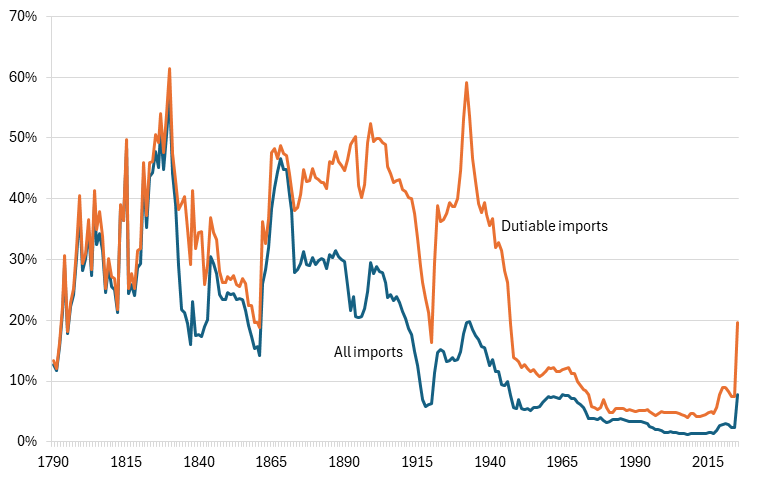
Free trade has been an exception in the history of both capitalism and the United States itself. For virtually all of America’s development up until World War II, American production was protected by tariff walls. (See figure 1.) The first year of the second Trump administration saw America experience the highest tariffs since the end of World War II. Yet, 2025 tariffs were still lower than the historical average. The average tariff rate on all imports from the first full year of the U.S. Constitution in 1790 through 2025 is 18 percent, and the average tariff rate on dutiable imports is 27 percent.[11]
Figure 1: U.S. import tariff rates since ratification of the U.S. Constitution (1790–2025)[12]
Reduced tariffs and the expansion of globalization since the end of World War II were a model tailored to expand U.S. hegemony during the Cold War. During that period, there were two almost completely separate economic and trade blocs: the Soviet bloc and the West. During the Cold War, the United States advocated for free markets, but did so from a position of strength in manufacturing and innovation. Moreover, Cold War competition meant that by the early 1960s, the federal government spent more on research and development (R&D) than did the rest of the world combined.[13]
The end of the Cold War marked the beginning of the United States’ “unipolar moment,” during which it was the indisputable, sole global hegemon in both hard and soft power.[14] But not when it came to industrial competitiveness. Indeed, U.S. manufacturing peaked in the late 1970s as a share of the economy.[15]
Nonetheless, the unipolar moment led to the U.S. trade policy of globalization through market liberalism, spurred by an ascendant neoliberal, orthodox economics profession that held that free trade was an ultimate objective. At the time, the idea that Western liberal-democratic capitalism had triumphed over all other models had led to the belief that free trade would permeate and liberalize all countries, including autocracies, which would eventually open as middle classes emerged.[16] President Clinton reflected this when he stated at the signing of the North American Free Trade Agreement (NAFTA)—a free trade agreement (FTA) between Canada, Mexico, and the United States—side agreements in 1993, “That’s how we won the Cold War. That’s how we have promoted peace and reconciliation in the Middle East. And that’s how the United States of America has promoted freer trade and bigger markets for our products and those of other nations throughout the world. NAFTA is such an issue.”[17]
U.S. efforts to promote extreme globalization ended the tradition of an American economic policy guided by “national developmentalism.” Once the Soviet Union collapsed, the belief was that this system should be expanded across the globe. Indeed, one of the WTO’s stated goals was to eliminate all barriers to free trade, gradually and through multilateral negotiations.[18]
Understanding National Developmentalism[19]
National developmentalism rejects the moral vision of libertarianism—a global market of individuals with no significant local or national attachments—as alien to human nature. It also rejects the moral vision of progressive localism, with its self-reliant yeoman farmers and artisans and shopkeepers, as anachronistic in the industrial era.
The developmentalist view does see benefits in deeper global economic integration. However—in the case of the United States—in order to maximize high-value-added exports, the federal government must play a proactive role by partnering with knowledge-intensive companies, creating incentives to boost manufacturing productivity, and promoting trade.
There are five basic principles of national developmentalism:
§ Growth is at the center, particularly productivity, innovation, and competitiveness. Productivity is the only source of higher living standards, and it largely stems from the development and widespread adoption of new technologies in enterprises.
§ Strong, dynamic capabilities in companies of all sizes, especially large corporations, are key to achieving growth. It is the capabilities of firms—including large and small, foreign and domestic—that determine a nation’s economic well-being. Firms’ capabilities are instrumental in achieving what society requires and needs: fast and broad increases in productivity, innovation, and competitiveness. Dynamic capabilities recognize that companies, processes, products, and technological paradigms must evolve over time to remain competitive.
§ Well-designed, effective government interventions are essential. This does not mean that the development state has the expertise to decide “the next big thing,” especially as narrowly defined (e.g., lithium-ion batteries), but it does mean that government should seek to maximize enterprise capabilities and guide private enterprise toward state goals through public-private partnerships.
§ National development is focused more on goals than processes. National developmentalism is clearly focused on three goals—innovation, productivity, and competitiveness—and is generally agnostic about the means of achieving them.
§ National developmentalism rejects the neoliberal and neo-New Deal Marxian capital-labor dialectic. Both doctrines assume that capital and labor are fighting in a zero-sum game, and therefore what’s good for one is bad for the other. That is not true. History shows that wages grow as capital expands.
That post-Cold War vision made some sense amid the euphoria of the Soviet Union’s decline. It didn’t make sense before that—when the Soviet Union closed itself off from the “Second World” and the United States promoted free trade—but was subject to developmentalists’ priorities. But it blithely ignored the structural weaknesses in the U.S. production system and assumed that trade agreements would automatically end all protectionism, even among key allies such as Europe and Japan. They were wrong. And then came China, a trade juggernaut the world had never seen before. The PRC’s techno-economic aggression was the final nail in the coffin of the free-trade vision.
Free-trade-based neoclassical economics failed for many reasons. First, U.S. trade policy was largely blind to the harm that foreign countries might inflict on U.S. national power industries.[20] Both companies and U.S. policymakers supported offshoring to relocate production to lower-cost jurisdictions under the assumption that doing so would ultimately benefit U.S. interests. In some cases, it did; in others, it did not. Thus, while the United States began to detach its priorities from its large multinational companies—and vice versa—other countries, such as Germany and Japan, continued to prioritize consumption and policy support for their national champions.[21]
The PRC’s techno-economic aggression was the final nail in the coffin of the free-trade vision.
Second, there was the assumption that the United States would specialize in high-value goods and services to offset potential losses of multinationals’ offshoring production outside the country. This failed both from the supply and demand sides of the job market. The former is reflected in a 2021 Information Technology and Innovation Foundation (ITIF) report, which outlines that, according to the Organization for Economic Cooperation and Development (OECD), fully one-third of working-age Americans possessed only limited digital skills, and one in six were unable to use email, web search, or other basic online tools.[22] From the demand side, this assumption failed because the recipient countries of offshore investments advanced up the value chain faster than anticipated, ultimately competing with the United States.
Third, while the post-Cold War period was marked by significant reductions in tariffs, other economies were enacting “behind-the-border” barriers. Free trade stopped at customs, as countries surreptitiously complemented their tariff reductions by erecting new types of trade-distorting nontariff measures, such as localization requirements.[23] Worse, nontariff measures are almost twice as trade restrictive as tariffs.[24] World Bank analysts argue that “[non-tariff measures] have become a defining instrument of contemporary trade policy” and “increasingly define the geography of market access in the global economy.”[25] The WTO’s Doha Round in 2001—the last significant round of trade negotiations among the WTO members—envisioned a global system with reduced barriers to trade, but it has failed to keep that promise. Many observers point to the Doha Round as the pivotal moment when the WTO proved that it had failed in its trade liberalization function.[26]
Finally, and arguably most importantly, China’s accession to the WTO in 2001 and subsequent intentional failure to fulfill its accession commitments upended the entire global trade system. The WTO system was not structured to address a large economy directly antithetical to its fundamental principles of market-oriented policies. The WTO’s former director-general from 2002 to 2005, Supachai Panitchpakdi, misguidedly stated in 2002 that China’s accession to the WTO signals “China’s willingness to play by international trade rules and to bring its often opaque and cumbersome governmental apparatus into harmony with a world order that demands clarity and fairness.”[27] The reality is that Chinese accession to the WTO, on balance, has not moved the country significantly toward the WTO trading order because, by and large, China has willfully not lived up to its commitments.[28] Indeed, China has failed to meet numerous WTO commitments on issues such as industrial subsidies, the protection of foreign IP, the requirement to enter into joint ventures and transfer technology, and the provision of market access to service industries.[29]
Chinese authorities never intended to obey the rules needed to make free trade work, and have instead set their goal of becoming the global techno-economic powerhouse. China is a “power trader” rather than a mere beneficiary of globalization, reviving the notion that trade can be weaponized to advance a nation’s own economic and national power interests.[30]
It is in this context that the United States began to reject free trade with bipartisan support, but without a long-term, positive strategy, especially to keep the PRC from taking over advanced production globally. In 2016, Congress and both presidential candidates—Donald Trump and Hillary Clinton—rejected the idea of the United States joining the TPP, an Asia-Pacific economic bloc initially designed to exclude China.[31] Since then, the United States has pivoted to more protectionist policies, first gradually through targeted tariffs during the first Trump administration and the retention and selective expansion of those policies during the Biden administration and later more radically, with the U.S. government imposing blanket tariffs on nearly all countries during the second Trump administration.
The new era, rather than a collective global optimization of the allocation of efficiency through trade, is a zero-sum game for global techno-economic dominance. There is no “win-win” in this context—it is either the West or China that will surpass the other.
Why a New Approach Is Needed
No country alone will be able to counter the PRC’s agenda for global techno-economic dominance. As ITIF has stated previously, “It will take a concerted and coordinated effort for the United States, Europe, Japan, Australia, Canada, South Korea, and other allies to have any chance of enacting collective defenses against predatory Chinese economic practices. A united front can impose costs on China that together would have the potential to limit its gains in advanced industry market share.”[32] It is time to acknowledge that the vision of global free trade must be put on hold—at least until China transitions to a democracy, if and when that happens.[33]
Over a century ago, the U.S. economy surpassed the combined size of France, Germany, and the United Kingdom. The key difference is that when America overtook Europe, the two were not adversaries. This is not the case with China. The United States and like-minded countries need to face the reality that negotiating market-based rules with the PRC—hoping it will not deplete their manufacturing base or use economic coercion at will—is fiction. ITIF has stated previously, “The horse is already out of the barn when it comes to China overtaking Europe and America economically and technologically.”[34]
China’s techno-economic rise changes everything regarding existing trade rules and agreements—not necessarily because of its growth, size, and scale per se. Rather, China is a “power trader”—its policies and programs are designed not only to advance its own power, but also to degrade that of its adversaries, even at a financial cost to its own economy.[35] As China’s model stands at odds with WTO principles, naturally, its inclusion in this forum in 2001 did not stop the PRC’s nonmarket approach to development. As noted, China has failed to meet numerous WTO commitments on issues such as industrial subsidies, the protection of foreign IP, the requirement to enter into joint ventures and transfer technology, and the provision of market access to service industries.[36]
China’s techno-economic rise changes everything regarding existing trade rules and agreements. China is a “power trader”—its policies and programs are designed not only to advance its own power, but also to degrade that of its adversaries, even at a financial cost to its own economy
China’s model contains an essential goal of creating dependencies on the part of third countries. The Chinese economic model operates on a “dual circulation” strategy, involving two cycles: an internal cycle emphasizing consumption, innovation, and reducing reliance on foreign imports, and an external cycle aimed at increasing other countries’ dependence on Chinese trade, technologies, manufacturing, and supply chains.[37] This is reflected in the PRC’s narrative, which suggests a sense of historical inevitability about China’s dominance. Xi Jinping himself said in 2023, “The Chinese people have become the masters of their future, the Chinese nation has achieved the great transformation from standing up and growing prosperous to becoming strong, and China’s national rejuvenation has become a historical inevitability.”[38]
It is in this context that hoping for fair, rules-based trade rules with China becomes naivety. Many Western officials and leaders have fallen into the fallacy of assuming that trade with China is like trade with a normal market-based economy. For example, in 2023, Canada and the European Union issued a joint statement: “China is an important trade and economic partner, and we will seek to ensure a level playing field and a balanced, reciprocal and mutually beneficial trade and economic relationship.”[39] In January 2025, the United Kingdom’s chancellor Rachel Reeves and the Chinese vice premier, He Lifeng, released a joint statement ensuring, “Both sides are committed to a fair and open investment environment that avoids arbitrary discrimination, and to ensuring that where legitimate restrictions exist, these are applied and communicated transparently.”[40]
To be clear, many U.S. allies have come to realize the scope of the challenge posed by China’s mercantilism. In the early 2020s, when Australia pushed to phase out Huawei from its 5G telecommunications systems and began questioning the PRC’s official narrative regarding the origin of the COVID-19 pandemic, China used its trade leverage to coerce Australia.[41] The Chinese strategy was to impose substantial costs across the economy and change Australia’s national security policy by implementing import bans and high tariffs on many relevant Australian export sectors.[42] Likewise, Chinese tourists to Japan dropped by over 45 percent year on year in February 2026, largely in retaliation for Japan’s stance on Taiwan.[43] Although the view in Europe on China is mainly driven by the PRC’s support for Russia’s illegal invasion of Ukraine, many EU and U.K. officials have expressed their concerns about China’s subsidized industries flooding their markets and displacing their manufacturing capabilities.[44]
Even if the United States and its allies develop a broad-based consensus on the real nature of the China challenge, domestic action alone will not be enough.
Box 1: Defining National Economic Power Industries
The conventional view is that the only industries that matter to national power are defense industries. But that is now vastly too limiting. As Corelli Barnett wrote, “For munitions production for modern war is not primarily a question of specialized armament industries, as some suppose, but of all those varied industrial and scientific resources that in peacetime make for a successful and expanding export trade.”[45] As such, ITIF has developed a classification of U.S. industries for their relevance to national power. This can be viewed as a continuum between defense industries on one side, nonstrategic industries on the other, and strategic industries and strategic enabling industries in the middle. (See figure 2.)
Figure 2: Industrial power scale
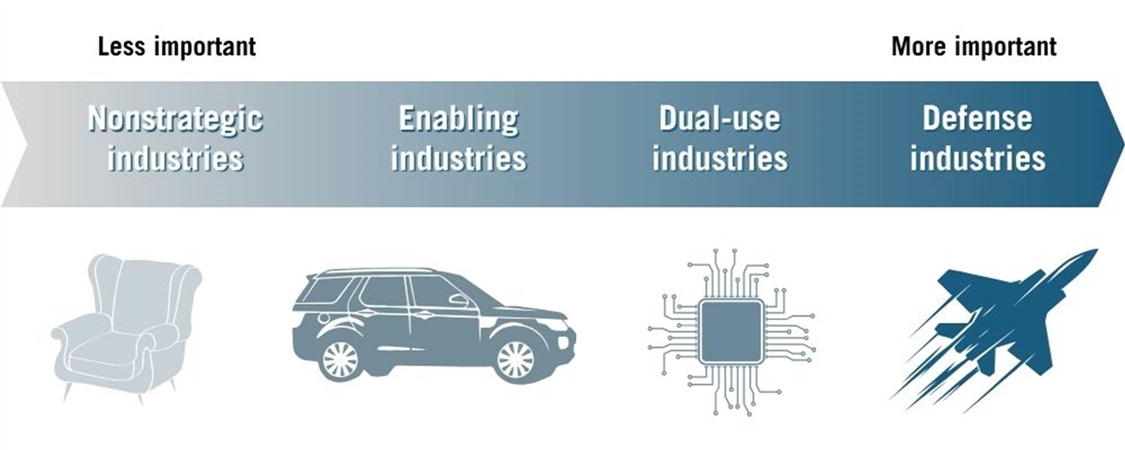
At one end of the continuum are defense industries. Clearly industries such as ammunition, guided missiles, military aircraft and ships, tanks, drones, defense satellites, and others are strategic. Not having world-class innovation and production capabilities in these industries means a weakened military capability. Policymakers across the aisle generally (with the exception of the isolationist Right and the pacifist Left) agree that these industries are strategic and that market forces alone will not produce the needed results.
At the other end of the spectrum are industries in which the United States has no real strategic interests. These include furniture, coffee and tea manufacturing, bicycles, carpet and rug mills, window and door production, plastic bottle manufacturing, wind turbine production, lawn and garden equipment, sporting goods, jewelry, caskets, toys, toiletries, running shoes, etc. If worst came to worst and our adversaries (e.g., China) gained dominance in any of these industries and decided to cut America off, we’d survive—in part, because none of these are critical to the running of the U.S. economy, as many are final goods that might inconvenience consumers but wouldn’t cripple any industries, and also because, in most cases, domestic production could be started or expanded relatively easily because none of these products are all that technologically complex from either a product or process concern and the barriers to entry are relatively low.
Next to defense industries, dual-use industries are critical to American strength. Losing aerospace, pharmaceuticals, chemicals, semiconductors, displays, advanced software, fiber optic cable, telecom equipment, machine tools, motors, measuring devices, and other dual-use sectors would give our adversaries incredible leverage over America. Just the threat to cut these off (assuming that they have also deindustrialized our allies in these sectors) would immediately bring U.S. policymakers to the bargaining table. National power industries also tend to need a global scale in order to compete. Moreover, many are intermediate goods such as semiconductors and chemicals, where a cutoff would cripple many other industries. Finally, these industries are hard to rebuild once they’re lost because of the complexity of their production processes, product knowledge, and the importance of the industrial commons that support them. In other words, barriers to entry are high and, if these industries are lost, they would be very difficult and expensive to reconstitute.
Finally, there are enabling industries. These are industries wherein, if the United States were cut off, the immediate effects on military readiness would be small. And the U.S. economy could survive for at least a while without production. America could survive for many years without an auto sector, since we would all just keep driving cars longer. But because of the nature of these industries—including technology development, process innovation, skills, and supporting institutions—their loss would harm both dual-use and defense industries. That is because enabling industries contribute to the industrial commons that support dual-use defense industries. A severely weakened motor vehicle sector would weaken the tank and military vehicle ecosystem.[46] Similarly, a weakened commercial shipbuilding sector has weakened military shipbuilding. A weakened consumer electronics sector weakens military electronics.
Defining Strategic Techno-Economic Agreements
Strategic Techno-Economic Agreements (STEAs) should represent a unified, binding set of provisions that secure America’s and its partners’ global leadership in advanced industries. The idea of an STEA goes beyond trade facilitation—which is one of its components—and should encompass specific chapters covering the development of national power industries and the protection of proprietary technologies from access by China. STEAs would be the following:
▪ Strategic, because of their dual objective of strengthening U.S. and allies’ national power while focusing on weakening those of its adversaries, particularly China.
▪ Techno-Economic, due to their focus on national power industries—advanced, traded-sector industries that form the foundation of military strength, economic resilience, and strategic independence.
▪ Agreements, since they include well-defined, binding long-term commitments. While diplomatic language is often flexible, there is a broad consensus that agreements represent binding commitments with specific obligations, whereas other mechanisms, such as partnerships, are more broadly defined and nonbinding forms of cooperation. The U.S. State Department Mission to the United Nations notes that “most states reserve the term ‘agreement’ for legally binding instruments and refrain from referring to non-binding instruments as ‘agreements.’ They do so specifically so that the term ‘agreement’ may be used to distinguish legally binding instruments from non-binding instruments.”[47]
The concept of “agreement” is also pragmatic. In diplomacy, “agreements” and “treaties” have the same practical binding effect. However, the U.S. Constitution governs treaties, requiring two-thirds of the Senate to approve them.[48] On the other hand, agreements are not defined in the U.S. Constitution, and they require a simple majority in both houses to be approved.
The United States should establish minimum conditions to participate in such partnerships. If the trade partners have notable trade irritants against U.S. companies or national power industry sectors, they should commit to specific timelines and metrics to address them.[49] And they should agree to the various chapters described in the following section.
Pillars and Components of A Strategic Techno-Economic Agreement
An STEA is built on two pillars, each supporting the others. The pillars focus on national power industries’ competitiveness and countering Chinese mercantilism, reflecting an STEA’s dual goal: to create conditions that enable national industries to lead globally while also slowing rivals. Each pillar has different components, as detailed in table 1. These components should be understood as the minimum chapters that an STEA should contain—15 in total.
Table 1: Pillars and components of an STEA
|
|
|
|
▪ Preferred Market Access: Parties should agree to implement zero-for-zero tariffs if they comply with all the other components and provisions of an STEA. ▪ Digital Economy: An STEA should be the world’s template for digital trade rules—with modern, binding provisions that enable digital market integration, foster a competitive environment, and improve the user experience ▪ National Power Industries: Parties should seek preferential treatment for investments and production capabilities in national power industries ▪ Defense Production: Parties should commit to cooperate in dual-use and defense technology research and manufacturing. ▪ High-Skilled Talent Movement: Parties should commit to eliminate migration constraints for highly skilled professionals, particularly in STEM fields. ▪ Joint Antitrust Interpretation: Parties should agree to incorporate international competitiveness considerations within their antitrust frameworks. ▪ Nonmarket Economies Clause: No party should sign binding commitments with non-market economies, such as China, without prior agreement of the other parties. |
▪ Immediate Reciprocity: Parties should have a reciprocal approach to addressing the extensive nontariff barriers and other technical barriers to trade that China has erected to impede U.S. (and allied) companies’ ability to compete in China. ▪ Fully Integrated Investment Screening: Parties should implement shared mechanisms among parties themselves to prevent the inflow of Chinese investment connected to the People’s Liberation Army or investments that make national power industries’ supply chains vulnerable. ▪ Full Export Control Alignment: Parties should be fully aligned on banning the export of or restricting the use of certain critical technologies outside the economic bloc. ▪ Joint Section 301-like Investigations: Parties should jointly conduct investigations to identify and combat Chinese unfair foreign trade practices. ▪ Joint Sovereign Fund to Reverse Chinese Technology Adoption: Parties should seek to establish a joint sovereign fund to offset the switching costs of phasing out Chinese technologies. ▪ Joint Import Bans: Parties should take measures to avoid companies with a sustained record of IP infringements from entering their markets. ▪ Limiting Chinese R&D Funding: Parties should commit to establishing boundaries on Chinese research organizations’ access to the local ecosystem and on companies’ ability to gain market share, enabling them to reinvest in R&D. ▪ Shared Commercial Counterintelligence: Parties should make a commitment to help companies gain more complete information about the environment in which they operate with allies. |


What Should Be Required to Join an STEA
A trade partnership under an STEA would require strong, long-term commitments—a key aspect of which is rebuilding trust among allies. As the United States is engaged in trade negotiations with many countries, the first steps toward building a durable economic bloc among like-minded democracies are to demonstrate commitment and implement reforms that enable the implementation of more significant policies across the components. For the United States, this would entail recalibrating its trade policy to center on its techno-economic competition with China. This means reversing or changing certain policies and approaches that treat allies and trade partners the same way as they do the PRC. An illustrative example of this is the February 2026 announcement of a Section 301 investigation into structural excess capacity and production in the manufacturing sectors of 16 economies, including China, the European Union, Japan, Mexico, South Korea, and Taiwan.[50]
For other trade partners, the first steps should be to acknowledge trade irritants with the United States and to take measures to address them. Some of these policy changes and diplomatic gestures should be the following:
1. Eliminate or significantly reduce nontariff barriers, particularly nontariff attacks. Nontariff attacks represent a particular subset of nontariff barriers—resource-extractive, discriminatory, and often extraterritorial policies that largely target U.S. technology firms.[51] Digital service taxes are an example of a nontariff attack. To join an STEA, trade partners should, at a minimum, eliminate these so-called nontariff attacks and provide credible evidence of significant reductions in the nontariff barriers that USTR outlines annually in its National Trade Estimates report.
2. Openly promote and share a commitment to reach an agreement with the United States based on fair, reciprocal trade. As an STEA membership process involves trade partners obtaining approval from their respective parliaments, it should not be left to uncertainty or used as a negotiating tool to extract unrelated concessions from the United States, for example, on agricultural goods.
3. The United States and trade partners should embark on symbolic, believable commitments to lay the groundwork for STEA membership. For example, develop a joint expedited visa program to facilitate the exchange of STEM experts that goes beyond the current visa schemes. Governments—at the federal and subnational levels—should expand exchange and capacity-building agreements to share practices and standards that could later facilitate, for example, investment screenings or the implementation of joint export control measures.
Additionally, as an STEA would be an alliance that requires high levels of commitment among its partners, the United States can explore a modular membership approach. For example, it is likely that few, if any, Global South countries would be willing to endorse all the commitments required to counter Chinese mercantilism, or that some commodity-intensive economies are not necessarily contemplating investment in national power industries. In those cases, the United States and STEA partners should be receptive to another tier of membership to an STEA, without providing preferred market access.
Trade partners should acknowledge that they have trade irritants with the United States and take measures to address them.
In this regard, an STEA could have tiered membership based on the partners’ commitments to the chapters and provisions:
▪ STEA Member status should be for those countries that fully adopt all components and provisions. These countries should enjoy reciprocal market access through zero-for-zero tariffs and the absence of behind-the-border trade barriers.
▪ STEA Cooperating Partner status should be for those countries that adopt most of the components and provisions but do not adhere to all of them. Cooperating Partners could still be subject to tariffs and other trade barriers that impede full market access with STEA members.
▪ STEA Observing Partner status should be for those countries that desire to signal a balance of U.S.-China relations or their reluctance to align with the Chinese economy but are not capable of or willing to commit to implementing measures to constrain Chinese mercantilism fully. The Observing Partner status should primarily serve as an avenue for Global South countries to share practices and regulatory standards aligned with an STEA.
Components to Advance Allies’ National Economic Power Industry Development
The development of national economic power industries is understood in a broader context of advancing allied capabilities and constraining China’s. A key driver for countries to join would be barrier-free access to the U.S. economy (and vice versa).
Preferred Market Access Among Partners
Specific Measures
▪ Zero-for-zero tariffs ideally on all products, but at a minimum on defense, dual use, and enabling products, conditional on the parties agreeing to the remaining components of an STEA.
▪ Zero tariffs should only apply under rules of origin (ROOs) thresholds. ROOs determine where a product is made based on where its components come from and where it is produced. The United States-Mexico-Canada Agreement (USMCA), for example, defines ROOs to determine “USMCA-qualifying products” to apply a zero-tariff regime.[52] The current USMCA ROOs define thresholds based on what is produced within North America (i.e., regional value content, or RVC). Similar to the USMCA framework, parties should commit to a zero-for-zero regime only for products primarily produced within an STEA’s economic bloc.
▪ Parties should have a “clean sheet” regarding nontariff barriers in national power industry sectors. The partners to an STEA should reserve the right not to provide a zero-for-zero tariff if they identify repeated trade irritants in national power industries. In the case of the United States, this means it should lower tariffs to zero if the trade partner, for example, does not have serious nontariff barriers in the USTR National Trade Estimate Report, is not listed in the USTR Special 301 Report on Intellectual Property Protection and Enforcement, and does not have physical or online markets in USTR’s Notorious Market List.
Rationale
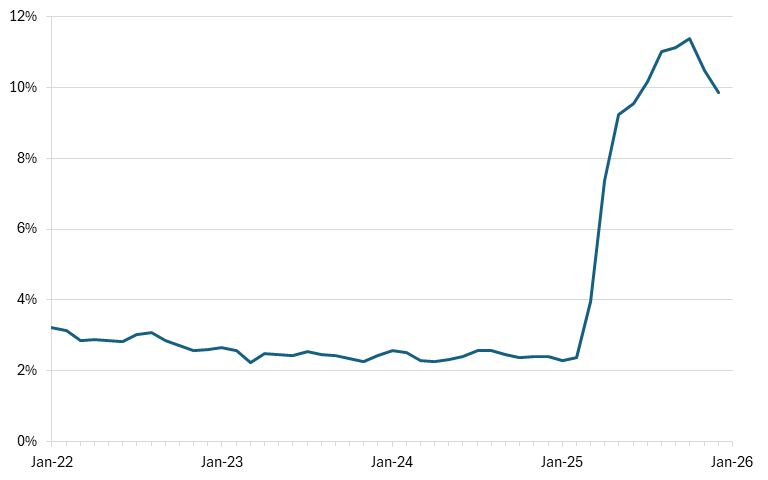
Access to the U.S. consumer market is arguably one of the most significant levers the United States can use in trade policy. Up until the Trump administration’s so-called “liberation tariffs,” the U.S. market was accessible to most countries either through the most-favored-nation rule—a WTO nondiscrimination principle that states that if any tariff advantage is granted to one member, it is extended to all WTO members—or through FTAs. The United States has FTAs with 20 countries, including regional agreements such as the USMCA and the U.S.-Dominican Republic-Central America FTA (CAFTA-DR).[53] Thus, the effective tariff rate before April 2, 2025—the date those tariffs went into effect, also known as “liberation day”—fluctuated between 2 percent and 3 percent.
Figure 3 illustrates the change in U.S. effective tariffs from January 2022 to December 2025, using data from Penn Wharton’s Budget Model. The average effective tariff rate reflects the typical rate in customs data, calculated as the value of customs duties divided by the value of imports, and it increased fivefold after six months of Trump’s tariffs. It’s important to note that figure 3 does not account for the February 2026 Supreme Court decision declaring most liberation-day tariffs unlawful.[54]
Figure 3: Average effective U.S. tariff rates (January 2022–December 2025)[55]
Despite the erratic rollout of the tariffs and—as ITIF has stated—the failure to identify China as the real target for correcting trade imbalances, the current restructuring of the trade system gives the United States unique leverage.[56] If there is genuine intent and interest in providing market access to allies by lowering tariffs to zero under certain conditions, those conditions can create an environment for U.S. national power industries to thrive. This is the core of an STEA’s proposal—a set of minimum conditions that allies and like-minded countries should follow to ensure that the strategic dual goal is achieved. In exchange, U.S. trade partners will both strengthen their capabilities to address Chinese mercantilism and gain access to the U.S. market in a zero-for-zero tariff scheme.
Digital Economy Integration
Specific Measures
▪ Rely on the key USMCA provisions. The USMCA should be used as a template for provisions regarding the moratorium on customs duties on electronic transmissions and digital products; nondiscriminatory treatment for digital products; a ban on data localization; free cross-border transfer of personal information; and a prohibition by parties on requiring the transfer of source code as a condition for market access.
▪ Explicitly ban digital service taxes (DSTs). Digital service taxes are surcharges on digital activities, such as online marketplaces, streaming, social media platforms, and data brokerage. DSTs typically impose taxes on the domestic revenue of multinational companies in a narrow range of business models, and include thresholds to exclude all but the largest firms.[57] These types of taxes have proven to be distortive, to discriminatory against a narrow set of companies and sectors, and to unfairly punish the same transactions depending on the platform on which they are made (e.g., an online purchase might be subject to a DST based on whether the company meets the tax’s thresholds).[58]
▪ Avoid broad carve-outs. One shortcoming of the USMCA’s digital trade chapter is that it does not apply to government procurement.[59] Whereas it was intended to include additional mechanisms and carve-outs to protect sensitive government data, in practice, it has proven ineffective and has been used to advance digital protectionism. It has proven misguided because the cybersecurity safeguards required to protect sensitive government information are not subject to the provisions of the USMCA—for example, data security depends more on encryption protocols than on where the data is stored. As long as the company involved has a legal nexus with a nation, it is subject to that nation’s privacy and cybersecurity laws and regulations. For example, foreign companies operating in the United States must comply with the privacy provisions of the Health Insurance Portability and Accountability Act (HIPAA), which govern U.S. citizens’ privacy rights regarding health data—even when moving data outside the United States.[60] And, if a foreign company’s affiliates overseas violate HIPAA, then U.S. regulators can bring legal action against the foreign company’s operations in the United States.
Rationale
Digital trade rules help lower barriers to cross-border trade in digitized information and services. Digital trade represents 22 percent of global trade.[61] In 2024, the value of global digital trade reached $7.23 trillion, a nearly 60 percent increase from $4.59 trillion in 2020, representing an average annual growth rate of about 12 percent and outpacing the growth of physical trade.[62]
The U.S. digital sector is particularly competitive compared with other industries. ITIF’s Hamilton Index (a measure of techno-economic strength across 10 high-tech industries) indicates that information technology (IT) services explain why the United States has not lost even more ground in advanced industries—in other words, “U.S. strength in IT services masks a real, structural weakness in advanced manufacturing.”[63] America’s global share of advanced industries in 2020 was 21.5 percent, a 2- percentage-point increase from 2010. However, this increase has been primarily driven by IT services. Without this sector, the United States would not have increased its global share in advanced industries and its share would be 2.5 percentage points lower.
Furthermore, as digitalization has permeated all sectors, a growing number of “traditional” industries rely on data from their operations, suppliers, and customers worldwide to make routine decisions. Digitalization of processes drives productivity growth. For example, a 2025 WTO report outlines that firms are increasingly “integrating data about sourcing, production, logistics, and sales to create unified data systems that provide real-time insights into the movements and characteristics of goods.”[64] Even among small and medium-sized enterprises (SMEs)—which are traditionally at the “long-tail of low productivity”—digitalization helps increase and diversify revenues, making them more resilient to external shocks.[65] Digitalization can also help informal SMEs formalize their businesses, expanding their access to capital.[66]
National Power Industries Collaboration
China’s panoply of support measures for its advanced industries are so massive that it will be hard for any particular country’s industries to respond effectively. What is required is much more cooperation between allies.
Specific Measures
▪ Nondiscriminatory principles applied to all national power industries. This means that no party should give different treatment to advanced technology companies headquartered in the other party of the agreement compared with the potential benefits that local companies can receive. For example, advanced technology companies should receive the same tax incentives, credit guarantees, and other policy interventions as local firms do. This also means national treatment when it comes to regulations and taxes (e.g., no more unfair EU Digital Markets Act (DMA) rules discriminating against American firms, no more digital taxes, etc.).
▪ Articulate and streamline technology partnerships among signatories. The parties should compromise to jointly develop technologies and national power industries in which China’s manufacturing scale creates systemic dependence. To do this, the signatories of an STEA should commit to promoting industrial policy tools—for example, investment incentives, preferential tax credits, etc.—to boost these selected sectors and technologies, thereby facilitating a small number of trusted production hubs.
▪ Launch a joint manufacturing hub competition in third markets. To incentivize the search for alternatives to China, the parties should establish a joint global manufacturing-hub competition in countries outside an STEA.[67] In this scheme, countries and subnational governments would compete for a special designation by reforming restrictive regulations, boosting skills development, ensuring adequate financial incentives, reducing corruption, and developing adequate infrastructure. The designated countries or regions would then benefit from increased aid from the United States and allies, and from agreements that governments would craft with their leading manufacturers to concentrate foreign manufacturing investment in the winning nations.
▪ Establish a “Western Belt and Road”: Align aid, development assistance, and export promotion oriented toward strengthening allied national power industries. Signatories of an STEA need to commit to codeveloping a long-term strategy to jointly build development assistance and loan programs that expand Western national power and counter China’s efforts to create dependencies in third markets, including programs such as the Belt and Road Initiative. This effort would involve, for example, measurable and accountable commitments to enhance coordination among aid agencies, such as Australia’s Department of Foreign Affairs and Trade, the United Kingdom’s Foreign, Commonwealth and Development Office, and development finance organizations such as the Japan Bank for International Cooperation, the Korea Development Bank, the European Investment Bank, and the European Bank for Reconstruction and Development. These organizations should expand incipient initiatives to create capabilities and co-invest in development initiatives in third markets that support supply-chain diversification efforts of mutual interest, for example, in critical minerals or semiconductor assembly, testing, and packaging (ATP).
▪ Amplifying representation in standards bodies. Technical standards are key enablers of trade and commerce, and an STEA should serve as a platform for companies to set global standards. In this context, the parties should commit to establishing mechanisms that incentivize the private sector in STEA countries to engage with standards-setting organizations and with government support, and to ensure that export control restrictions do not apply to STEA companies interacting with entity-listed Chinese participants in international standards-setting. In addition, the parties should create a working group to identify common ground and coherence among STEA members when they engage with standards bodies.
Rationale
National power industries lie at the core of Western countries’ rivalry with China—whoever is at the technological frontier in these sectors will be able to set standards, expand their global influence, and ultimately achieve dominance over the other Great Power. The idea of prioritizing strategic sectors is neither new nor necessarily Western. The concept of “commanding heights” is attributed to Lenin, who was referring to “the critical sectors that dominated economic activity—primarily electricity generation, heavy manufacturing, mining, and transportation.”[68] The American historian Daniel Yergin and the economist Joseph Stanislaw in their book The Commanding Heights: The Battle for the World Economy, defined the 20th-century Cold War as an economic and ideological battle for market-driven or state-centralized global control for these critical sectors.[69] Despite some similarities with the rivalry with China during the 21st century—e.g., the United States contesting global hegemony against a unitary-party communist regime—the Soviet Union was a military and geopolitical rival, but unlike China, it was neither an essential market for the U.S. economy nor a business competitor for American companies.[70]
As a counterpoint, an STEA should exclude nonstrategic industries, such as professional services and retail, as well as traded industries, such as furniture, food, soda, paper, clothing, or office equipment, to name a few. These industries may have other values, such as enabling innovation or driving domestic productivity, but they are not consequential for geo-technology interests.
Despite some similarities with the rivalry with China during the 21st century, the Soviet Union was a military and geopolitical rival, but unlike China, it was neither an essential market for the U.S. economy nor a business competitor for American companies.
Furthermore, many traditional FTAs and other types of agreements are often shaped or blocked by interests in these nonstrategic industries. For example, the United States’ attempt to create an economic bloc in the Asia-Pacific region without China in the mid-2010s—the TPP (now called the Comprehensive and Progressive Agreement for Trans-Pacific Partnership, or CPTPP)—partly failed due to disagreements among U.S. constituents in agriculture and business services.[71] TPP was viewed as strategic because “the agreement’s scale gives it considerable strategic heft, by creating an economically significant bloc of nations that has agreed to its broad disciplines.”[72] Thus, the size of the economic bloc was prioritized over the integrated market’s actual output. As a consequence, the agreement contained a wide range of—from a techno-economic power perspective—nonstrategic issues, such as agricultural standards, environmental protection provisions, labor requirements, a chapter on SMEs, and a chapter on sanitary and phytosanitary standards.[73]
The U.S. government can build on what is already being implemented through the State Department’s initiatives, such as Pax Silica and the Forum on Resource Geostrategic Engagement (FORGE), but should focus on expanding its depth (i.e., binding mechanisms) and breadth (i.e., explicit, measurable goals). The administration should balance the political objective of delivering quick results by signing nonbinding memorandums of understanding (MOUs) with the goal of building long-term relationships with allies and like-minded countries by negotiating stricter, binding agreements.
Defense Production and Security Elements
Specific Measures
▪ Parties should set specific, measurable objectives to codevelop dual-use and defense applications. For example, parties could set a minimum percentage of their military spending relative to gross domestic product (GDP), earmarked for joint military production. This could include partnering with such allies on areas such as robotics and aerospace, artificial intelligence (AI) use in the military, developing a shared network of advanced-industry centers in which firms from both countries could participate in each other’s programs, and joint participation in national science programs.
▪ Approve strategic transactions between the defense industrial bases of North Atlantic Treaty Organization (NATO) countries.[74] In international markets, very few mergers or joint development agreements, even between leading firms in separate NATO countries, are likely to substantially lessen competition. Instead, transactions that consolidate the defense industrial bases among NATO countries can serve a critical purpose toward developing the scale necessary to drive innovation, solidify relationships among key NATO partners, and counter China’s quest for techno-economic dominance.
▪ The parties agree to collaborate on R&D and applications of defense technologies, similar to AUKUS (a trilateral security partnership between Australia, the United Kingdom, and the United States) Pillar II.
▪ Parties should be prohibited from procuring goods, services, or technology produced by listed entities and from contracting with companies that employ lobbyists who lobby for those same Chinese military companies. Furthermore, the ban should apply to all military components, not only final goods. To do so, parties should develop systems to monitor the origin and ownership of component-level suppliers, particularly for raw materials and parts.
▪ Joint cyberdefense and malware counterattacks. Parties should commit to creating joint procedures and reinforcing capabilities to coordinate cyberdefense, strengthen early‑warning mechanisms, and coordinate cybercounterattacks when needed. Cybersecurity is fundamentally collective, and the leadership in this field depends on shaping the partnerships and standards that govern cyberspace.[75]
Rationale
STEA members need a strong dual-use defense industrial base. The network of U.S. alliances provides a strong base for military-to-military cooperation. However, defense spending and production requirements have, so far, been kept out of trade negotiations. This approach is new and tailored for an era of techno-economic power struggle with China.
Parties should commit to collaborating on economic security activities. For instance, the Five Eyes alliance—which includes Australia, Canada, New Zealand, the United Kingdom, and the United States—provides members with mutual access to intelligence activities, including cybersecurity, and promotes greater military interoperability.[76] Another benefit of Five Eyes participation is that any nation can submit firms for accreditation in America’s trusted foundry program, which ensures the availability of trusted suppliers for the integrated circuits (and other foundational components) that go into national security-critical satellites, missiles, and weapons platforms.[77] ITIF has called for the United States to lead like-minded nations in developing a broader Five Eyes-like alliance specifically focused on combatting state-sponsored economic espionage in advanced-technology industries, and all members of an STEA should be part of this initiative.[78]
High-Skilled Talent Movement
Specific Measures
▪ Parties should agree to facilitate STEM visas for highly qualified students and professionals to enable national power industries’ workforce migration. Partner nations should seek to develop STEM visas that can be applied for by both master’s and Ph.D. students and by professionals in STEM fields. Increasing the circulation of academic and professional STEM talent would abet STEA nations’ ability to develop technologies to counter Chinese threats.
Rationale
While the foundation of any long-term talent strategy should be a well-developed secondary and tertiary education system, that alone is insufficient. The United States and its partners also need policies that facilitate the movement of highly skilled researchers and STEM professionals, thereby enabling “brain circulation,” deeper research collaboration, and international networks that accelerate knowledge creation and innovation.
A nation’s STEM talent is key to its economic growth and competitiveness, especially in advanced industries where science and technology lay the foundation. Yet, the United States is falling behind China in producing STEM talent at both the undergraduate and graduate levels.[79] China has been surpassing the United States in STEM Ph.D. graduates since 2007.[80] In 2000, the United States produced 17,830 STEM Ph.D.s compared with China’s 7,520. But by 2007, China had edged ahead with 24,430 Ph.D.s versus the United States’ 23,940, and the gap has only widened since. By 2022, China awarded more than 50,970 STEM doctorates—over 50 percent more than the 33,820 awarded in the United States.
A nation’s STEM talent is key to its economic growth and competitiveness. Yet, the United States is falling behind China in producing STEM talent at both the undergraduate and graduate levels.
While China’s larger population partly explains these disparities, the implications for U.S. competitiveness are significant. Advanced industries such as semiconductors, biotechnology, AI, and weapons systems depend on a robust pipeline of world-class STEM talent. If the United States and allies fail to keep pace with China in cultivating the next generation of researchers, they risk ceding ground in the very sectors that will define economic and geopolitical leadership in the 21st century.
Joint Antitrust Interpretation Focused on Competitiveness
Specific Measures
▪ Parties should agree to consider competitiveness in antitrust regulations. After liability is established in cases involving strategic sectors, authorities should incorporate international competitiveness into their prosecutorial discretion and remedies. ITIF also recommends that, during merger reviews, agencies utilize prosecutorial discretion by not allocating limited resources to challenging deals with strong competitiveness justifications and instead focus on blocking anticompetitive deals that lack such justifications.[81]
▪ Competitiveness considerations should apply only in national power industries. Antitrust agencies should focus resources on cases without competitiveness concerns. This approach would maintain the consumer welfare standard’s analytical rigor while ensuring that enforcement decisions account for national strategic interests, including effects on U.S. innovation capabilities and strategic industry leadership.
▪ Joint antitrust consultation. Parties should agree that their antitrust agencies will establish a formal consultation process in which relevant agencies related to trade, national security, and foreign affairs provide input on international competitive effects before finalizing enforcement actions in strategic industries.
▪ Improve coordination and cooperation among antitrust agencies. The USMCA includes nonbinding language suggesting that antitrust agencies should cooperate in law enforcement—including through investigative assistance, notification, consultation, and exchange of information; mutually agreed technical cooperation activities; and enhanced information sharing and mutual legal assistance.[82] Parties to an STEA should have binding commitments to guarantee that this cooperation continues.
Rationale
Antitrust enforcement functions under a consumer welfare standard that has proven flexible enough to address different competitive harms but lacks formal mechanisms to consider international competitiveness implications. ITIF has previously noted that it is problematic when the Department of Justice’s Antitrust Division and the Federal Trade Commission (FTC) make enforcement decisions without structured input—from entities such as the Department of Commerce’s Bureau of Industry and Security (BIS), USTR, and the Department of State—regarding trade or national security impacts.[83] As noted, “antitrust agencies have no systematic process to weigh whether enforcement actions against U.S. firms might strengthen foreign competitors or harm U.S. strategic interests.”[84]
Furthermore, there are reports that other governments use U.S. antitrust policies to validate their own actions against American companies. For example, the European Union cites U.S. cases to justify provisions of the DMA—a discriminatory regulation that overtly targets U.S. firms—and is imposing fines on American firms.[85]
Nonmarket Economies Clause
This provision advocates that no party should sign binding commitments with nonmarket economies, such as China’s, without prior agreement of the other parties.
Specific Measures
▪ Cover all types of binding agreements. The clause should cover all types of agreements, including FTAs, digital trade agreements, and new forms of economic cooperation, such as digital economy and green economy agreements.[86]
▪ Narrow the list of nonmarket countries. The list of nonmarket countries should be narrower than the U.S. Department of Commerce’s International Trade Administration’s (ITA’s) list of nonmarket economies. Vietnam, for example, provides a key destination for offshoring investments from China, and is a free-trade partner of U.S. allies such as Australia and Japan through the CPTPP. The list could be narrowed to the Department of Commerce’s list of foreign adversaries: China, Cuba, Iran, North Korea, and Russia.[87]
▪ Revise existing agreements with China retroactively. Some U.S. allies have binding FTAs with China. Australia and South Korea, for example, signed bilateral FTAs with the PRC in 2015, while the New Zealand–China FTA has been in force since 2008.[88] In addition, many U.S. allies—Australia, Japan, New Zealand, the Philippines, South Korea, and Thailand—are part of the Regional Comprehensive Economic Partnership (RCEP), a regional trade agreement led by China. These agreements should be reviewed and, if necessary, renegotiated if the U.S. government finds that they contain binding commitments that harm an STEA’s economic bloc interests.
Rationale
The goal of this clause should be to restrict how China gains influence among U.S. trade partners and indirectly affects U.S. supply chains by being a relevant trade partner with third countries. This does not exclude STEA partners from having trade and economic relations with China, but it provides a means to deter the PRC from indirectly entering the economic bloc’s supply chains.
Components to Constrain the PRC’s National Power Industry Development
The parties to an STEA should jointly agree on minimum actions and frameworks to address the impact of Chinese mercantilism on the economic bloc’s competitiveness, particularly in national power industries.
Immediate Reciprocity
Specific Measures
▪ Parties should agree to form and join a mutually assisted alliance to counter Chinese attacks on each other’s economy. This model follows ITIF’s previous recommendations for creating a new “NATO for trade” wherein economic aggressions can be countered collectively.[89]
▪ Full reciprocity commitment. The parties should commit to mirroring the restrictions that China imposes on foreign companies in its market. Such restrictions or limitations should retain legal authority only so long as the Chinese policy remains in effect. Any imposed restrictions should be imposed immediately, with a presumption of harm to the parties’ interests. Any right of appeal that Chinese companies would have before the pertinent agency—such as the Federal Communications Commission (FCC) or U.S. International Trade Commission (USITC) in the United States—would be conditioned on the appeal or redress rights available to the parties’ companies in China.
▪ Monitoring and data sharing. Parties should establish (and resource) a unit at their trade agencies to monitor—and publish in real time via an interactive digital dashboard—a comprehensive list of Chinese market access restrictions on U.S. companies.
Rationale
The strategic trade alliance envisioned in this report would be akin to another proposal ITIF has made: that allied nations should form a new “NATO for trade” to combat Chinese trade aggression. Allied nations could form a pact in which they agree to come to each other’s aid when economically threatened by the CCP.[90] The new organization, a Democratically Aligned Trade Organization (or “DATO”), would be governed by a council of participating countries, and if any individual nation were threatened or attacked, DATO would quickly convene and potentially agree to take joint action to defend the nation attacked. For example, if China threatened to expel a given nation’s students, DATO nations could agree to ban Chinese students in return. If China threatened to put a country’s firms on its “Unreliable Entity List,” DATO nations could agree to limit imports from Chinese firms. Any democratic nation would be welcome to join DATO, but should any nation fail to take the steps necessary to respect a DATO decision, it would lose the right to remain a member. This approach should be a core STEA feature.
In addition, the parties should agree to adopt a policy of strict reciprocity regarding products and services that Chinese companies may sell in overseas markets but that foreign companies are precluded from selling, or are heavily limited in selling, in China. An illustrative example of this is social media bans and censorship. The United States should encourage STEA partners to develop similar reciprocity provisions, and STEA partners could go further by collectively denying Chinese entities access to partner markets if China is precluding partner companies from competing in China. Further, wherever China imposes onerous restrictions or conditions on firms from partner countries competing in China, the United States and partner countries should impose similar restrictions or conditions.
The new organization, a Democratically Aligned Trade Organization (or “DATO”), would be governed by a council of participating countries, and if any individual nation were threatened or attacked, DATO would quickly convene and potentially agree to take joint action to defend the nation attacked.
There are many markers and products in which U.S. companies are precluded or impeded from competing in China. For instance, in April 2025, China severely restricted U.S. drone makers’ ability to sell drones in China by placing 11 leading U.S. drone manufacturers—including Skydio, BRINC Drones, and Insitu—on its Ministry of Commerce “Unreliable Entity List.”[91] (In a good example of how this policy recommendation could work, the Trump administration in December 2025 subsequently banned Chinese drone makers from selling new drone models in the United States.)[92] Similarly, in 2023, the Chinese government banned U.S. memory chipmaker Micron from selling its products in critical Chinese infrastructure.[93] The ban ultimately forced Micron to abandon its data-center chip business in China.[94] The United States should ensure that Chinese memory chipmakers—such as Yangtze Memory Technologies Corporation (YMTC)—cannot sell their products for similar uses in the United States. Another example is that “China prohibits the importation of remanufactured products, which it typically classifies as used goods.”[95] Similarly, the United States and allies should prohibit Chinese companies from selling any remanufactured products in their markets.
The United States (and allies) should ensure that the exact same restrictions or conditions that are imposed on U.S. companies trying to compete in China are imposed on Chinese companies trying to compete in the United States (and allied countries). Another good example is cloud services. China prohibits foreign companies from directly providing cloud computing services, including computer data processing and storage services and software application services provided over the Internet.[96] To access China’s market, foreign cloud services providers must “establish a contractual partnership with a Chinese company, which is the holder of the necessary Internet data center license, and turn over its valuable technology, IP, know-how, and branding as part of this agreement.”[97] Chinese cloud services companies should be made to operate under similarly restrictive conditions if they wish to compete in the United States.
China flatly prohibits foreign companies from providing film production and distribution services in China.[98] China further prohibits the retransmission of foreign television channels, foreign investment in TV production, and foreign investment in TV stations and channels.[99] Further, when China joined the WTO, it committed to allowing “20 films to be imported on a revenue-sharing basis in each of the three years after accession.”[100] It also committed to permit U.S. firms to “form joint ventures to distribute videos, software entertainment, and sound recordings and to own and operate cinemas.”[101] China failed to meet these commitments. Accordingly, an MOU initially negotiated in February 2012, and updated in 2017 between China and the United States, was to provide “for substantial increases in the number of foreign films imported and distributed in China each year, along with substantial additional revenue for U.S. film producers.”[102] Still, “China has not yet fully implemented its MOU commitments, including with regard to critical commitments to open up film distribution opportunities for imported films.”[103] While China needs to come into compliance with these commitments, until that happens, the United States should impose mirror limitations on Chinese entities’ ability to distribute films in the United States.
The United States and partner countries need to ensure that they’re treating Chinese entities the same way China treats its companies and organizations in standards-setting activities.
China further imposes severe restrictions on basic telecommunications services, including an informal ban on new entry, a 49 percent foreign equity cap, a requirement that foreign suppliers enter only into joint ventures with state-owned enterprises, and exceedingly high capital requirements.[104] So onerous are these requirements, “Since China acceded to the WTO more than two decades ago, not a single firm has succeeded in establishing a new joint venture to enter the sector.”[105] Chinese authorities have also restricted the ability to offer voice-over Internet protocol (VoIP) services interconnected with the public switched telephone network (i.e., to call a traditional phone number).[106] Allied countries should ensure that reciprocal restrictions are in place for Chinese companies seeking to compete in their telecommunications service markets.
The United States and partner countries need to ensure that they’re treating Chinese entities the same way China treats its companies and organizations in standards-setting activities. While China claims that it provides equal treatment to foreign companies in China’s standardization activities, “in practice, the Chinese government continues to limit foreign participation in standards setting and, at times, still pursues unique national standards to protect its domestic industry.”[107]
As an example, foreign companies have reported that they were excluded from the technical committee for cybersecurity standards (TC-260) “on the basis that their companies are headquartered outside of China.”[108] The Chinese government further directs and often coordinates the positions of Chinese stakeholders at standards meetings.[109] STEA countries should work collaboratively to ensure their firms are treated fairly in Chinese standard-setting activities.
Fully Integrated Investment Screening
Specific Measures
▪ Commitment to shared investment screening procedures. The parties should agree on mechanisms to “white list” inward investments from other parties and to prevent the inflow of Chinese investment linked to the Chinese military or investments that make strategic industries’ supply chains vulnerable. Having shared minimum procedures—such as in due diligence, sector priorities, and exposure to key industries—does not require every country to have the same FDI screening regime; instead, the different approaches should be compatible while respecting each country’s institutional framework.
▪ Information sharing and shared review commitments. Parties should commit to creating information-sharing mechanisms to minimize information asymmetries about which companies are under scrutiny and the authorization decisions made. Parties should also commit to creating a common registry of all Chinese-origin companies operating in the economic bloc, including subsidiaries, joint ventures, firms with Chinese financing, and entities with partial Chinese government ownership.[110] In addition, parties should commit to fully collaborating with each other in cases where investment screening requires analyzing companies’ information in the other party’s jurisdiction—for example, reviewing existing Chinese interests in multiple companies across the economic bloc.
▪ All parties should commit to similar rules for approval for Chinese joint ventures. China can gain access to U.S. firm technology by requiring a joint venture for any sales or production in China.[111] The scale of the Chinese market allows the PRC to play Western trade partners against each other. If American companies cannot sell in China and other U.S. trading partners can, the only result will be lost U.S. sales. One way to address this is for all parties to adopt similar screening rules for joint ventures.
▪ Better reporting of outbound investments in China. Parties should commit to improving reporting on STEA countries’ firms’ activities in China, requiring them to disclose the financial information of those activities and creating facilitation mechanisms for reporting cases of coercion or forced technology transfer to diplomatic authorities
Rationale
The Committee on Foreign Investment in the United States (CFIUS) is the body authorized to review certain transactions involving foreign investment in the United States to determine whether they are aligned with U.S. national security. ITIF has advocated for CFIUS reform to better address serious issues with Chinese FDI.[112] The mercantilist nature of China’s economic model means that its outbound investments are not necessarily market based—there are reports of the PRC government subsidizing companies to outbid competitors for strategic acquisitions, thereby creating technological dependencies or enabling the transfer of American IP and know-how to China.[113]
CFIUS has been implementing the Foreign Investment Risk Review Modernization Act of 2018 (FIRRMA) in its review screens since 2020.[114] Under this framework, CFIUS should consider “whether a covered transaction involves a country of special concern that has a demonstrated or declared a strategic goal of acquiring a type of critical technology or critical infrastructure that would affect United States leadership in areas related to national security.”[115] FIRRMA, however, is too narrow in its definition of what would affect U.S. leadership, as it excludes industries critical to economic and strategic competitiveness.[116]
If the United States has challenges in addressing Chinese mercantilism in inbound FDI, allies and trade partners with less leverage—and often less political will—face greater difficulties.
Full Export Control Alignment
Specific Measures
▪ Parties should agree either to jointly implement export controls against rivals or not to implement export controls at all. Unilateral export controls ultimately harm the country imposing them. With this principle, an STEA should seek full alignment on export controls—avoiding loopholes or free riding.
▪ Export controls should be targeted and focused on technological chokepoints. Export controls on semiconductor manufacturing equipment serve as a good example of a “small yard, high fence” approach; an STEA should leverage that experience. It is important to note that not all participating countries will control relevant chokepoints. Still, an STEA should make clear from the outset that this tool is designed to restrict access to critical technologies—not to justify broad protectionist measures or create strategic advantages for individual members.
▪ Information sharing for improving alignment. An STEA should contain a provision committing the parties to disclose information, including information gathered by intelligence agencies, that may help improve the design and enforcement of export controls.
▪ Parties should commit to expanding the remit and funding their export control agencies or bodies. In the case of the United States, this would require Congress to expand the scope and budget of the Export Control and Related Border Security (EXBS) program within the U.S. Department of State. The EXBS program works with partner governments to identify regulatory and institutional gaps and provide technical and capacity-building assistance.[117] While the EXBS program has traditionally focused on export controls on weapons of mass destruction and national security-related technologies, its remit could be expanded to assist allied nations in further developing their capacity to evaluate export controls for advanced technologies.
Rationale
Export controls represent a vital tool for limiting rivals’ access to cutting-edge technologies. The current “policy toolbox” for export controls enables the U.S. government to prohibit direct exports of U.S. technologies to competitors or to ban goods produced with U.S. technologies. This has facilitated restrictions on China’s access to U.S. advanced chips and sophisticated semiconductor equipment. The enforcement mechanism for export controls in other jurisdictions is the Foreign-Direct Product (FDP) rule, which applies to a foreign-produced item under the Export Administration Regulations (EAR) if it is a direct product of U.S. technologies, including U.S. software.[118] The FDP rule is a powerful tool, as it has allowed the U.S. government to impose unilateral export restrictions without consulting allies that hold significant supply chain chokepoints. Other tools for enforcing export controls are Entity Lists, end-use and end-user controls, controls on U.S. persons, and licensing, among others.[119]
The case of the Entity List-based export controls on Huawei since 2019 evidence that unilateral restrictions—without allied coordination—are suboptimal.[120] The restrictions on exporting U.S. technologies or direct products to Huawei created a loophole, as competitors of U.S. companies who disregarded U.S. export controls could gain market share. While these cases were exceptions, they harmed American companies. A notable example was Teradyne, a U.S. robotics and semiconductor testing company, which lost revenue to its Japanese competitor because the export restrictions on U.S. technologies to Huawei applied only to them.[121]
Joint Section 301-Like Investigations
Specific Measure
▪ The parties should agree to establish the necessary legal procedures and develop adequate technical capabilities to jointly conduct investigations to identify and combat Chinese unfair foreign trade practices. In addition, the parties should agree to jointly implement remediation and retaliatory mechanisms derived from these investigations.
Rationale
China’s massive industrial subsidies and excess capacity pose a global challenge to the economics of innovation-based industries that compete on market principles. The International Monetary Fund (IMF) estimates that the equivalent fiscal cost of Chinese industrial policy through cash subsidies, tax benefits, subsidized credit, and subsidized land for favored sectors (including both private and state-owned firms) is equal to about 4 percent of Chinese GDP per year.[122] Similarly, a study from the Kiel Institute for the World Economy finds that over 99 percent of a sample of 5,260 listed Chinese firms received government subsidies totaling €35.3 billion in 2022, double the amount from 2015.[123] China has plowed over $230 billion of subsidies into its electric vehicle (EV)/battery industry.[124] China has funneled at least $150 billion into its semiconductor industry.[125] China subsidized its national aerospace champion, COMAC (the Commercial Aviation Corporation of China), with between $49 billion and $72 billion in state-related support through 2020.[126] In steel, China’s share of world output grew from just 15 percent in 2000 to 55 percent today.[127] China’s steel sector is currently dealing with an overcapacity of more than 50 million tonnes (Mt), a figure that is projected to rise to 250 Mt by 2035.[128]
Rather than launching Section 301 investigations against core allies, the United States should enroll them in its Section 301 investigations against China when they address shared challenges, such as massive industrial subsidies and overcapacity.
China’s predatory “massive industrial subsidization inducing overcapacity to eliminate foreign competitors” strategy reached its apotheosis with solar panels.[129] China’s share of global solar panel exports grew from just 5 percent in the mid-2000s to 67 percent by 2018, with Chinese solar output turbocharged by at least $42 billion in subsidies from 2010 to 2012 alone. This instigated a global glut that saw world prices for solar panels crash by 80 percent from 2008 to 2013, bankrupting over 500 of the most innovative foreign competitors and setting up Chinese producers for a final coup de grace: using their government-enabled profits to try to buy bankrupt U.S. solar firms to strip out their remaining technology and send it back to China. As Ben Santarris of SolarWorld, a German solar panel manufacturer, once explained, “Pervasive and all-encompassing Chinese subsidies are decimating our industry.”[130]
In March 2026, USTR rightly initiated a Section 301 investigation relating to structural excess capacity and production in manufacturing sectors.[131] But China wasn’t the only target of this investigation; 15 other nations, including allies such as Japan and South Korea, were also under scrutiny. To be sure, the United States should push back if and where core allies have industrial policies driving overcapacity that harms U.S. enterprises. But in cases such as these, allied countries—just as with the United States—are more likely to be harmed by Chinese overcapacity, rather than our allies being the perpetrators of that overcapacity. Rather than launching Section 301 investigations against core allies, the United States should enroll them in its Section 301 investigations against China when they address shared challenges, such as massive industrial subsidies and overcapacity (e.g., in areas such as aerospace, steel, or semiconductors).
Joint Sovereign Fund to Reverse Chinese Technology Adoption
Specific Measures
▪ Lump-sum commitment when joining the agreement. Signatory parties should allocate initial capital to the joint sovereign fund, proportional to the size of their economy and fiscal capabilities. For example, assuming that the U.S. government will allocate two times its expenditure in the 2020 rip-and-replace program, a similar initial capital investment would be around 0.1 percent of each country’s GDP.[132] This would mean that, for example, allies such as Japan and the United Kingdom should contribute with $4 billion and $3.7 billion, respectively.[133] For countries that might be fiscally constrained, the fund’s initial capital investment could be provided by borrowing from the U.S. Treasury, for example, through the U.S. International Development Finance Corporation (DFC).
▪ Ex ante definition of reimbursement conditions. There should be minimum conditions to use the fund to replace Chinese technologies. The rip-and-replace program, for example, only reimburses the replacement of Huawei/ZTE technologies acquired before June 30, 2020. In addition to a similar threshold, the joint sovereign fund should naturally cover costs only if the new technologies originate among the parties. Likewise, the threshold should be narrowed to specific technology “chokepoints,” such as telecommunications, key aspects of EV charging, or semiconductor manufacturing equipment.
▪ Good sovereign fund governance. The main guide for good sovereign fund governance is the International Forum of Sovereign Wealth Funds’ (IFSWF’s) Santiago Principles, which are voluntary, generally accepted principles and practices the objective of the which is to ensure that sovereign wealth funds are managed with transparency and accountability and invested prudently. Parties in an STEA should abide by the Santiago Principles in a binding manner.
Rationale
Subsidized manufactured goods allow China to “flood markets,” making non-Chinese manufacturing relatively more costly due to the unfair competition. For example, a 2025 OECD report on the global steel industry finds that China’s rise in this sector is “driven by market-distorting subsidies and other non-market policies and practices,” leaving other countries’ steel producers in a “precarious state” due to this unfair advantage.[134] In terms of EVs, Chinese low-cost production, enabled by a state-supported environment that includes reduced utility rates and suppressed labor costs, leads to artificial overcapacity, causing non-Chinese automakers to lag behind in EV technologies development and adoption.[135] These cases recur—with some nuance—across multiple national power industry sectors.[136]
China is also embedded in America’s and allies’ supply chains—even in national power industries. Huawei’s technologies are present in the telecommunications network of nine U.S. allies—Hungary, Iceland, Italy, South Korea, Spain, the Netherlands, the Philippines, Thailand, and Turkey—and are being phased out from six others: Belgium, France, Germany, Poland, Romania, and the United Kingdom.[137] Furthermore, despite efforts to reshore production out of China to reduce U.S. dependency on its economy through frameworks such as the China Plus One—a supply chain management strategy in which a firm retains substantial production capacity in China while shifting production to at least one other country to reduce risk—many internal value chains remain anchored in China, giving the PRC significant leverage over U.S. interests.[138]
For the United States and its potential partners in an STEA, this creates two practical problems. First, as described, cheaper Chinese products are displacing other countries’ products, thereby eroding their manufacturing capability and reinforcing dependency. Second, as Chinese inputs and intermediate goods are embedded in allies’ supply chains due to their artificially constructed cost effectiveness, replacing them would increase production costs. In other words, if the desired outcome is to build an advanced technology supply chain free of Chinese dependency, policymakers should create mechanisms to offset switching costs.
Joint Import Bans
Specific Measures
▪ Parties should agree to ban and implement strong retaliatory measures against Chinese imports that are made unfairly or pose cyber risks. These measures should apply at the firm level, expanding the scope of traditional import bans that apply solely at the product level. In particular, firm-level bans on Chinese companies should apply where foreign companies in the same industry have limited market access in China, where Chinese firms receive subsidies above global norms, and where Chinese firms have benefited from infringing IP. For example, Huawei’s and ZTE’s telecom equipment notably fit both categories.[139] As such, no country should be allowed to join if it has not implemented a full ban on Huawei and ZTE telecom equipment within its borders.
▪ Build an “inspection wall” against counterfeit and pirated Chinese goods: parties should commit to properly funding their IP protection agencies and IP enforcement bodies. For example, the United States’ Customs and Border Patrol (CBP) agency needs more resources. ITIF has called on Congress to increase the CBP budget and ensure that the CBP director collaborates with private sector stakeholders, including brand sellers, online marketplaces, and shippers, to establish real-time information sharing and analytics on potential counterfeit shipments, enabling them to better detect and seize imported counterfeits.[140] Greater information sharing would enable an allied effort to work more closely together in combating fraudulent Chinese products entering allied markets.
▪ The United States and parties should agree to resurrect core elements of the Anti-Counterfeiting Trade Agreement (ACTA)—a U.S.-led multilateral initiative to strengthen enforcement against counterfeit goods and copyright piracy—in an STEA, particularly those pertaining to combatting piracy, counterfeiting, and IP theft.[141] ACTA was signed in 2011 by countries including Australia, Canada, Japan, the United States, and several EU member states, but it ultimately failed to gain broad acceptance and was rejected by the European Parliament, among others.[142]
▪ The parties should agree to enforce mutual arrest warrants against IP infringers. The commitment should be to prosecute IP infringers in the country where the IP was stolen, enabling other parties to arrest the individual if the individual is within their jurisdiction.
Rationale
China remains the world’s most significant practitioner of IP theft, content piracy, and the export of counterfeit goods. In total, the annual cost to the U.S. economy of counterfeit goods, pirated software, and trade secret theft perpetrated by China ranges from $225 billion to $600 billion, according to the U.S. Federal Bureau of Investigation.[143] Similarly, a 2023 Library of Congress report finds that “counterfeiting and piracy costs U.S. businesses more than $200 billion a year and leads to the loss of more than 750,000 jobs.”[144]
In certain industries, China has acquired significant market share—even leading globally—aided by IP theft. For example, Chinese enterprises’ global share of liquid crystal display (LCD) production has reached 72 percent, while their share of organic light-emitting diode (OLED) production has surpassed 50 percent, both up from under 1 percent a decade ago.[145] Two separate USITC investigations have demonstrated that Chinese display producers have also benefited from extensive foreign IP theft.[146] An STEA should outline provisions that ban the import of all products, among all STEA partners, from companies that have benefited from IP theft.
According to CBP data, in FY 2024, the agency seized 27,927,068 counterfeit or pirated products from China and Hong Kong, with a retail value of $5.02 billion (using manufacturers’ suggested retail price), accounting for approximately 90 percent of the total quantity of seized counterfeit goods entering the United States that year.[147] But China’s extensive counterfeiting affects not just the United States but also allies across the world. Indeed, OECD affirms that “China remains the dominant source of counterfeit goods.”[148] Another assessment finds that China accounts for 63 percent of all counterfeit goods produced worldwide.[149] The EU has likewise found that China and Hong Kong account for some three-quarters of exports of dangerous counterfeits entering its continent.[150] In 2019, the European Union Intellectual Property Office issued a report that estimates that foreign IP infringement costs the EU €60 billion ($69 billion) in annual sales through IP theft in goods and services. The report identifies China/Hong Kong as the “main offender.”[151] Japan estimates that it loses $30 billion annually from counterfeit goods—again, the majority of them coming from China.[152]
Parties need to bolster their own policies to combat the import of Chinese goods that benefit from pilfered IP or are counterfeit, and work alongside strategic trade partners in doing so.
Limiting Chinese R&D Funding
Specific Measures
▪ Parties should agree to ban public funding for Chinese researchers at their countries’ universities and R&D facilities. Parties should develop procedures to address the challenge of China funding students, researchers, or both at their universities, with the goal of the knowledge and technology produced will likely flow back to China. At a minimum, universities and research organizations within STEA nations should be required to disclose in real time all research partnerships with researchers or companies in China. Where those partnerships are with entities of concern in China, People’s Liberation Army (PLA) military institutions, or affiliated institutions (e.g., the “seven sons of national defense”), the researchers should be required to first get permission from the country’s pertinent science agency (such as the U.S. National Science Foundation [NSF]).
▪ Parties should require that the faculty members from their countries disclose research with Chinese academics related to national power industries. Academic research and exchange between Western and Chinese researchers should not be banned per se. Instead, there should be narrowed and targeted limitations. There should be a presumption that the research is problematic, and institutions should be required to obtain waivers to proceed for researchers affiliated with PLA-linked entities or for frontier research on strategic technologies. In other words, endangered species research sharing with China, yes; EV research sharing, no.
▪ No public procurement to Chinese advanced-technology companies, including at the subnational and local levels. Revenues and market share are directly correlated with companies’ capabilities to invest in R&D, particularly in advanced-technology sectors.[153] As such, STEA members should commit to banning public procurement in China’s advanced-technology sectors unless it is proven that no alternative is available.
Rationale
The PRC’s espionage ecosystem is aided by the U.S. research environment, which privileges the free flow of ideas and researchers, allowing China to recruit (or coerce) talent trained in America to engage in IP theft and technology transfer. The challenge is to maintain a U.S. research environment within this framework while closing gaps and loopholes that enable IP and trade secret theft.
Shared Commercial Counterintelligence
Specific Measure
▪ Parties should agree to share intelligence on China’s IP theft actions in their countries. Parties should also establish a formal “innovation mercantilism intelligence sharing process” whereby allied nations share information on various and sundry unfair practices that benefit a specific list of major Chinese firms.
Rationale
Counterintelligence, within an STEA economic bloc, should, among other tasks, help companies gain more complete information about the environment in which they operate so they can more effectively reduce information loss to competitors. These companies are currently competing against rivals that benefit from their home country’s counterintelligence efforts. Western advanced-technology companies are often targeted by foreign intelligence services seeking to obtain valuable knowledge and other IP surreptitiously. To accomplish all this, the signatories of an STEA should agree to establish a mechanism for interagency coordination on counterintelligence outreach programs.
Precedents: The United States Has Implemented Variations of an STEA’s Components
This section outlines precedents for U.S. policies and successful cases in which the proposed components of an STEA have been implemented—or at least a similar approach has been taken. The objective of this section is to demonstrate that, although the vision of a developmentalist approach to trade agreements focused on techno-economic power is challenging, its implementation is possible and there are precedents for its components.
Precedents for the Components for Advancing Allies’ National Economic Power Industry Development
Preferred Market Access Among Partners
The Reciprocal Trade Agreements Act of 1934 (RTAA) is a historical precedent in which the United States demonstrated a political willingness to reduce its tariff rates suddenly and radically. The RTAA granted the president a temporary three-year authority to increase or reduce U.S. tariffs by up to 50 percent of their current levels. The RTAA served as one of the pillars of the New Deal and provided the model for the GATT, which would later become the WTO. In that context, the RTAA should be viewed as a precedent for tariff reduction, not necessarily as a model for lowering tariffs based on techno-economic or geopolitical alignment, as an STEA proposes.
National Power Industries Collaboration
The United States has pursued several scattered, generally nonbinding bilateral and multilateral engagements with allies in national power industries. For example, the Biden administration’s Indo-Pacific Economic Framework for Prosperity (IPEF) was a regional initiative aimed at strengthening economic ties among 14 countries in the Asia-Pacific region.[154] IPEF was short of being either a trade agreement—due to that administration’s unwillingness to sign trade deals—or a decisive turning point for IPEF partners in terms of their relationships with China. Despite its shortcomings, IPEF achieved some progress in specific areas of national power industry cooperation. For example, the IPEF’s Supply Chain pillar represents a multicountry agreement for supply chain resilience, creating governance mechanisms through coordination bodies and, among other things, focusing on semiconductors, critical minerals (including those for batteries), and chemicals.[155] Despite the fact that the Trump administration has not been engaged in IPEF, in October 2025, some IPEF partners—whose identities were not disclosed—met in South Korea to discuss an “IPEF Supply Chain Agreement’s Crisis Response Network” meeting for a simulation exercise of a shutdown of critical minerals, and to coordinate potential responses.[156]
In addition, the Biden administration’s Mineral Security Partnership (MSP) focused on mining investment and strategic stockpiling. MSP partners included Australia, Canada, Estonia, the European Commission, Finland, France, Germany, India, Italy, Japan, Norway, South Korea, Sweden, and the United Kingdom.[157] In February 2026, the State Department announced FORGE, a platform that “serves as the successor to the MSP” and will allow countries to collaborate at the policy and project levels.[158] During the launch of FORGE, the U.S. government announced bilateral critical minerals frameworks with Argentina, the Cook Islands, Ecuador, Guinea, Morocco, Paraguay, Peru, the Philippines, the UAE, the United Kingdom , and Uzbekistan.[159]
The U.S.-U.K. MOU on critical minerals—signed during FORGE’s launch—outlines the participants’ intent to strategically prioritize and coordinate investments, permitting, asset sales, and other mechanisms across key segments of the critical minerals supply chain.[160] It also outlines commitments to “secure their respective critical minerals and rare earths industries from non-market policies and unfair trade practices.”[161] Likewise, the United States and the Philippines signed an MOU on the critical minerals supply chain in February 2026.[162] Although the details of this MOU are not publicly available, some statements indicate that it concentrates on “mapping and survey, and research and innovation in mining, processing, refining, and recycling” of critical minerals.[163]
The current Trump administration is leading the Pax Silica initiative, a plurilateral engagement for AI and supply chain security, initiated—as of June 2026—by over 20 countries and the European Union.[164] Taiwan has endorsed the Pax Silica as a nonsignatory participant. Pax Silica serves as a tech-diplomacy platform to align partner countries’ efforts to reduce their supply-chain dependence on China.
Digital Economy Integration
The digital trade chapter of the USMCA was considered pioneering and a template for digital trade rules when it entered into force in 2020. The chapter outlined key, binding provisions that enable companies and individuals to conduct digital activities seamlessly. Some of these binding provisions include the following:[165]
▪ A moratorium on customs duties on electronic transmissions and digital products. This provision prohibits signatories from imposing tariffs on digital transmissions, many of which are basic activities that could require cross-border exchange of digitized information, such as downloading files, streaming, or sending emails.
▪ Nondiscriminatory treatment for digital products. This provision states that no party should offer less-favorable treatment “to a digital product created, produced, published, contracted for, commissioned, or first made available on commercial terms” in the other party’s jurisdiction.[166] This ensures that digital products and services receive the same access and legal treatment as their domestic counterparts do.
▪ Ban on data localization measures. Data localization targets an increasing variety of specific data types and broad categories of data considered “important,” “sensitive,” or related to national security.[167] Thus, data localization reduces the accessibility and security of the Internet, makes it more expensive and complex, and hampers innovation. Businesses rely on data to generate value, and many can only maximize that value when data flows freely across borders.
▪ Cross-border transfer of personal data. Facilitating regulated, secure cross-border data transfers supports global value chains and digital services while building trust by adhering to key privacy principles. In that context, the USMCA states that “no Party shall prohibit or restrict the cross-border transfer of information, including personal information, by electronic means if this activity is for the conduct of the business of a covered person.”[168]
▪ Prohibition of forced transfer of source code as a condition for market access. This provision protects companies’ IP and deters adversaries from identifying and exploiting security and privacy vulnerabilities. In addition, protecting companies’ IP ensures that they can capture returns from future innovations, incentivizing continuous improvement of digital products.
Defense Production and Security Elements
As noted, AUKUS represents a trilateral security partnership between Australia, the United Kingdom, and the United States.[169] AUKUS Pillar II focuses on the development and sharing of advanced technologies to enhance warfighting capabilities and increase interoperability among forces. Pillar II features collaborative efforts to develop defense technologies in areas including AI and autonomy, robotics, drones, quantum, hypersonics, and advanced cyberspace technologies. Overall, AUKUS Pillar II seeks to enable faster development and deployment of defense technologies to enhance strategic advantage in the Indo-Pacific region. STEA members should be eligible for participation in AUKUS Pillar II.
High-Skilled Talent Movement
The United States faces a growing shortage of U.S. citizens and permanent residents pursuing careers in STEM—a gap that threatens the nation’s economic strength, technological leadership, and innovation capacity.[170] Indeed, NSF data shows that a substantial share of graduate STEM degrees in the United States are awarded to these temporary visa holders.[171] Between 2012 and 2021, temporary visa holders earned between 25 and 40 percent of all science (including social sciences) and engineering master’s degrees, as well as between 33 and 35 percent of all science and engineering doctorates.[172]
The presence of STEM graduates is even more pronounced in strategically important fields.[173] In computer and information sciences, temporary visa holders earned 58 percent of all doctorates in 2024, compared with 37 percent awarded to U.S. citizens or permanent residents. The pattern is similar in engineering, where 51 percent of doctorates went to temporary visa holders, compared with 44 percent awarded to domestic students.
Joint Antitrust Interpretation Focused on Competitiveness
There are precedents of systematic antitrust scrutiny weakening U.S. strategic industries. The U.S. antitrust authorities weakened Western Electric (the predecessor of Lucent) and Bell Labs (a world-class R&D laboratory, now owned by Nokia) for over 60 years.[174] This persistent regulatory scrutiny led to a decline in U.S. global leadership in telecom equipment. Today, European companies such as Nokia and Ericsson dominate the U.S. 5G equipment providers’ market.[175]
Traditional trade agreements consider antitrust elements; however, they are meant to align with general principles, such as maintaining competition laws that proscribe anticompetitive behavior or applying their national competition laws to all commercial activities. For example, the USMCA’s competition chapter sets minimum standards to ensure that antitrust enforcement against companies from other countries receives fair treatment, similar to the scrutiny a national company would receive.[176] However, the Trump administration has not included antitrust or competition provisions in the recent trade deals and frameworks it negotiated during 2025 and the first quarter of 2026.[177]
Nonmarket Economies Clause
The United States has signed agreements with other countries to prevent them from entering commitments with nonmarket economies. The Department of Commerce defines a list of nonmarket economy countries for purposes of the U.S. antidumping and countervailing duty laws. As of March 2026, there were 14 nonmarket economy countries: Angola, Armenia, Azerbaijan, Belarus, China, Georgia, Kyrgyzstan, Laos, Moldova, Russia, Tajikistan, Turkmenistan, Uzbekistan, and Vietnam.[178]
The USMCA includes a “non-market FTA” clause in which parties should notify the other partners if they are intending to sign an FTA with a nonmarket economy and provide them with an “opportunity to review the full text of the agreement, including any annexes and side instruments.”[179] If a USMCA partner enters into an FTA with a nonmarket economy, the other partners can terminate the USMCA within the first six months.
The Trump administration often added similar clauses to the trade deals it negotiated in 2025 and early 2026, but narrowed them to digital trade agreements. For example, the U.S.-Indonesia agreement signed in February 2026 states that “Indonesia shall communicate with the United States before entering into a new digital trade agreement with another country that jeopardizes essential U.S. interests.”[180] As of March 2026, the administration had signed similar clauses with Cambodia, Guatemala, Malaysia, and Taiwan.[181]
Precedents for the Components for Constraining the PRC’s National Power Industry Development
Immediate Reciprocity
Reciprocity—alongside national treatment and nondiscrimination—represents a basic foundational principle of the WTO, and of international trade. Technically, in the WTO context, “reciprocity” means that concessions granted between nations should be equally and fairly distributed.[182] With regard to China, it obviously means treating Chinese companies the same way U.S. (or allied) companies are treated in China. Reciprocity has also long been a foundational principle of U.S. trade policymaking. Munak has noted (citing scholar Dough Irwin’s work) that “the modern era of US trade policy, which begins around 1932, was driven by the objective of reciprocity, where the US government prioritized reductions in tariff and non-tariff barriers through negotiated agreements with other countries.”[183]
Or, as another scholar noted, “It was the United States that brought reciprocity into trade policy.”[184]
Lastly, the recent U.S. proposal on WTO reform emphasizes the imperative of developing “reciprocal and mutually advantageous arrangements” in the context of “a new economic order premised on reciprocity and balance and oriented toward serving concrete national interests.”[185]
Fully Integrated Investment Screening
Japan’s foreign investment screening regime de facto considers competitiveness. In April 2023, citing concerns over national security and technology leakage, Japanese authorities added 10 advanced-technology sectors to its FDI screening regime: semiconductors, storage batteries, natural gas, metal 3D printers, machine tools and industrial robots, fertilizers (potassium chloride, etc.), permanent magnets, marine equipment, metals, and mineral products.[186] In March 2026, Japanese authorities announced the creation of a CFIUS-like screening panel and a plan to expand reviews of third parties that acquire a foreign company that already holds shares in a Japanese firm.[187]
Full Export Control Alignment
The coordination of semiconductor export controls in 2022 and 2023 among Japan, the Netherlands, and the United States serves as an example of alignment. The United States unilaterally imposed export controls on advanced chips and semiconductor manufacturing equipment to China in October 2022 with the explicit goal of preventing the PRC from catching up in chipmaking capabilities.[188] Just a few months later, in January 2023, the Netherlands and Japan agreed to ban shipments of the most-advanced extreme ultraviolet (EUV) lithography semiconductor manufacturing equipment, effectively blocking access to key chokepoints in the chipmaking supply chain.[189] The Center for Strategic and International Studies (CSIS) stated that those EUV export controls “could have backfired disastrously if other countries, particularly Japan and the Netherlands, moved to fill the gaps in the Chinese market that the partial U.S. exit left.”[190] (Note: This was indeed a laudable effort, but it was incomplete. While the most advanced semiconductor manufacturing equipment technology—EUV lithography equipment—was restricted by all partners, the one-generation-older version of the technology—deep ultraviolet (DUV) lithography equipment—was restricted by the United States but not by the Netherlands or Japan. The result has been significant sales losses for U.S. DUV firms as competitors continue to sell into China, but U.S. players have been restricted. This is the subject of the MATCH (Multilateral Alignment of Technology Controls on Hardware) Act currently being considered in the U.S. Congress.[191]
The “small yard, high fence” approach of limiting China’s access to advanced semiconductor technologies can only be achieved through coordination with allies, particularly Germany, Japan, the Netherlands, South Korea, and Taiwan. However, this doesn’t mean export controls should necessarily be the only go-to tool. As ITIF has stated, “Many who advocate for export controls do so because they can’t think of other steps to impede China technologically.”[192]
The “small yard, high fence” approach of limiting China’s access to a narrow set of the most advanced semiconductor technologies can only be achieved with coordination with allies.
Even when export controls are well coordinated, if they are too broad (i.e., not chokepoints), blanket restrictions will eventually backfire. They will create opportunities for retaliation and accelerate China’s path to self-sufficiency—all while losing revenue and market opportunities.
Joint Section 301-Like Investigations
The United States has previously worked with like-minded nations (including through the erstwhile trilateral framework with the EU and Japan) and at the WTO to update its rules to impose much stiffer conditions on, and penalties for, aggressive industrial subsidization.[193] The effort clarified the definition of a “public body,” extending it to include state-influenced activities by entities such as state-owned enterprises and private firms.[194] In that effort, ITIF called on like-minded nations to work to achieve a significant increase in global subsidy transparency, including insisting on timely and complete notification of subsidies and establishing a presumption of prejudice against subsidies not timely notified.[195] In other words, there is already a strong precedent for STEA partners to work on industrial subsidization/overcapacity issues.
Joint Sovereign Fund to Reverse Chinese Technology Adoption
The U.S. federal government does not currently maintain sovereign wealth funds, primarily because it has not had budget surpluses for decades. The U.S. federal deficit reached $1.78 trillion in 2025 alone, contributing to a total national debt of roughly $40 trillion.[196] However, the federal government can learn best practices in sovereign fund management from local states and allies. The Sovereign Wealth Fund Institute has identified 14 sovereign funds owned by states—Alabama, Alaska, Colorado, Hawaii, Idaho, Louisiana, New Mexico, North Dakota, Oklahoma, Texas, Utah, West Virginia, Wisconsin, and Wyoming—which collectively total over $370 billion.[197] Many U.S. allies have sovereign wealth funds that they use for what they consider strategic purposes and to boost their capital markets—for example, Ireland’s Strategic Investment Fund, the Israeli Citizens Fund, and South Korea’s Investment Corporation.[198]
There are also precedents for providing public financial incentives to offset switching costs induced by escaping Chinese mercantilism. The FCC launched the Secure and Trusted Communications Networks Reimbursement Program—commonly known as the “rip-and-replace program”—during the first Trump administration, under the 2019 Secure Networks Act.[199] The rip-and-replace program is a nearly $5 billion program created with the explicit objective of reimbursing telecommunications providers “for reasonable expenses incurred in the removal, replacement, and disposal of communications equipment and services produced or provided by Huawei Technologies Company (Huawei) or ZTE Corporation (ZTE).”[200]
The State Department’s Pax Silica initiative is reportedly creating a voluntary investment consortium for a $4 trillion fund for energy, infrastructure, critical minerals, and supply chain resilience.[201] The consortium is described as “a coalition of sovereign wealth funds and institutional investors joining forces around a single strategic imperative” by the State Department’s authorities.[202] It is reported that it will include sovereign wealth funds from Qatar, Singapore, Sweden, and the UAE.
Joint Import Bans
The United States and allies such as Mexico have long collaborated to combat the entry of counterfeit Chinese goods into the U.S. market. For instance, in 2018, the United States and Mexico concluded deals to improve cooperation on trade and customs compliance and to combat illicit activities such as the export of counterfeit merchandise and substandard pharmaceuticals into the United States.[203] Mexico is working with the United States to target Chinese online retailers such as Shein and Temu that peddle counterfeit goods.[204] The USMCA strengthened North American efforts to combat the entry of counterfeit Chinese goods. For instance, previously, Canadian customs officials could detain only commercial shipments of suspected counterfeit goods destined for Canada. With the passage of the USMCA, the Canada Border Services Agency (CBSA) is now empowered to detain in-transit commercial shipments of suspected counterfeit goods traveling through Canada en route to their final destinations.[205]
In 2006, Japan and the United States conceived the Anti-Counterfeiting Trade Agreement (ACTA), which was signed in 2011. The agreement aimed to establish an international legal framework for issues such as targeting counterfeit goods and generic medicines and addressing copyright infringement on the Internet. USTR portrayed ACTA as “a groundbreaking initiative by key trading partners to strengthen the international legal framework for effectively combating global proliferation of commercial-scale counterfeiting and piracy.”[206] ACTA did not come to fruition, but could provide a template for developing high-standard commitments among STEA participants to collaboratively address issues such as combatting counterfeit goods imports and copyright infringement.
Limiting Chinese National Power R&D
China seeks to acquire knowledge and technology through all available means, both fair and unfair: while it produces hundreds of thousands of scientists and engineers legitimately, it also engages in cyberespionage and IP theft, imposes forced tech or IP transfers as a condition for market access, attracts or buys talent, acquires companies, and uses other methods. A particular concern is Chinese funding of R&D being conducted at U.S. universities and Chinese funding of postdocs studying at U.S. universities and federally funded research and development centers ITIF has called for a ban on Chinese funding of research at U.S. universities and for better screening of Chinese students studying at U.S. universities.[207]
In 2022, Chinese students accounted for 35 percent of the international pool of students seeking STEM Ph.D.s at U.S. universities.[208] Chinese doctoral students’ intention to remain in the United States after graduation (i.e., the “stay rate”) has declined from 90 percent in 2016 to 76 percent in 2022.[209] Partner countries should not implement blanket bans on Chinese Ph.D. students studying in their countries, but rather limit access on research in sensitive and strategic technologies. Still, at the very least, it would behoove partner countries to generate better data on the STEM fields in which Chinese Ph.D. students are pursuing degrees in partner countries. In 2025, the United States announced that it would begin revoking the visas of Chinese students studying in critical fields, such as national defense. Partner nations should also do likewise.
ITIF has called for a ban on Chinese funding of research at U.S. universities and for better screening of Chinese students studying at U.S. universities.
A recent ITIF report, part of this National Power Series, outlines several policy challenges for the United States to close gaps that allow the PRC’s espionage complex to steal U.S. industrial and defense technologies.[210] For example, it urges Congress to approve the Securing American Funding and Expertise from Adversarial Research Exploitation Act of 2025 (SAFE Act) to block U.S. federal grants to scientists with a history of collaborating with hostile foreign countries, such as China. The SAFE Act would ban federally funded STEM research by researchers with a history of collaborating with PRC-associated entities, ban Department of Defense funding for universities that partner with adversaries, and, similar to the Defending Education Transparency and Ending Rogue Regimes Engaging in Nefarious Transactions (DETERRENT) Act, impose stricter disclosure requirements on collaboration with entities associated with adversaries.
In addition, the report supports the House Select Committee on the CCP’s recommendation to create “an unclassified database using open-source information to keep track of PRC research entities that engage in defense and military research and civil-military fusion programs” to improve the vetting process.[211]
Shared Commercial Counterintelligence
As ITIF has reported, the U.S. intelligence community has long collected what it calls “economic intelligence.”[212] A 1953 Central Intelligence Agency memo defined economic intelligence as “analysis and evaluation of a foundation of economic information, mostly quantitative, with the object of solving problems related to national security.”[213]
In this context, ITIF has proposed that Congress and the administration establish a narrowly tailored pilot authority allowing the U.S. intelligence community to share classified assessments with vetted U.S. firms competing against Chinese companies for major third-country contracts.[214] The mechanism should not authorize the collection or transfer of foreign trade secrets for purely commercial gain. Instead, it should focus on bid-specific risks such as PRC subsidies, coercive financing, sanctions evasion, corruption, cybersecurity vulnerabilities, forced technology-transfer links, or military-civil fusion ties.
Likely Sources of Opposition
Changing the trade policy paradigm from free trade to a strategic techno-economic approach focused on competing against China will likely face criticism. First, China will of course decry it as protectionist. But China holds the capacity to stop this new arrangement by ending its panoply of unfair trade practices and techno-economic aggression—which will never occur.
Second, non-national power industries will characterize an STEA as hurting American consumers. But in a world wherein Western economies do not have to worry about another country becoming the global hegemon (i.e., the PRC) policy could focus on consumers. But the current reality is that that is not a possibility, similar to how U.S. taxpayers had to support Cold War efforts against the Soviets. Contrary to nonstrategic sectors, national power industries support national defense, either through direct production for the Defense Department or dual-use production.[215]
Third, many economic and foreign policy pundits and experts will likely oppose this. ITIF typified these groups in a 2025 report of the current Chinese National Power Industry War series.[216] They represent three flawed responses:
▪ Some are “engagers,” seeking engagement with China above all else, yet they dismiss and downplay the CCP’s actions against U.S. interests.[217] Much of the argument for engaging in collaboration with China, above all, concerns global challenges, such as climate change. Yet, this omits the underlying political economy of why China is willing to engage in “collaboration” in certain issues. As ITIF has stated, we are long past the time when Western countries could meaningfully influence China’s policy.[218] The engagers would fundamentally oppose having a trade policy focused on countering China’s techno-economic agenda—much in line with what the CCP would like.
▪ On the other end of the spectrum, some pundits are “deniers” who are so convinced of America’s superiority and China’s structural flaws that there is nothing to worry about. Under this view, there is no need to change the trajectory of U.S. trade or foreign policy. Most U.S. adherents of free-market doctrine dismiss the China threat because they believe free-market economies are inherently superior to more planned ones. As such, there is no way we can lose unless we become more like China. The deniers would fundamentally oppose the fact that the United States indeed needs its allies and trade partners to maintain American leadership—yearning for a pre-World Wars period when the United States was more isolated and wasn’t a global hegemon.
▪ Finally, there is a group who largely ignore either attacking Chinese capabilities or defending against its techno-economic aggression and instead focus only on ways the United States can improve. The deniers would object to the pillar of countering China’s aggression, but they might support the pillar of strengthening U.S. and allies’ national power industries.
Yet the most vociferous opposition will likely come from the trade policy community. First, it will come from traditional free traders who might still believe that, with some adjustments to the WTO governance structure and scope, the global trade system can return to the post-Cold War period. The criticism will argue that some components of an STEA constitute nonmarket practices or may be non-WTO compliant. That’s part of the problem that gets the global trade system to its current state: it is not possible to keep the same extreme free-market-oriented toolkit and architecture to address China’s aggression, as it is fundamentally antithetical to WTO principles. A variant of the traditional free traders is “partial globalists”—those who call for plurilateral trade deals among like-minded nations but still cling to the outdated assumption that maximizing global allocation efficiency should remain the primary objective and that trade deals should focus on trade and little else.[219]
The second group of trade policy pundits criticizing an STEA is populist, spanning the Right and the Left. Populists fundamentally reject the idea of global trade. Whether driven by entrenched nationalism on the Right or a rejection of wealth and capital accumulation on the Left, these groups advocate for very limited trade, prioritizing autarky. That would ultimately condemn the U.S. economy to being a low-tech, natural-resource producer.
It may be that only a few nations would be willing to join a U.S-led alliance. But if a few courageous leaders do, it will be more likely that others will then join when they see the safety that numbers bring and the benefits to their own economy that joining an STEA brings.
Conclusion
The global trading system gives China enormous freedom to launch attacks, often successful, on allied advanced industries and firms. It may not be possible to avoid losing to these attacks, given the CCP’s focus, scale, and power. But one thing is for sure: Western countries will be much more likely to lose if nations do not collaborate more systematically, not only to launch a deep free trade zone for the West, but also to deepen techno-economic cooperation while limiting China’s abilities to penetrate the West.
It may be, given China’s power to punish nations that challenge Beijing, that only a few brave nations would be willing to join a U.S-led alliance. But if a few courageous leaders do, it will be more likely that others will then join when they see the safety that numbers bring and the benefits to their own economy that joining an STEA brings.
But this would require more nations to acknowledge that the PRC is a threat to Western countries’ national power industries. For the United States, it would require changing its rhetoric to allies and abandoning the hubristic notion that America alone can deal with China—a rival unlike any other it has faced in its 250 years of constitutional democracy.
Acknowledgments
This report is part of a series that has been made possible in part by generous support from the Smith Richardson Foundation. (For more, see: itif.org/power-industries.) ITIF maintains full editorial independence in all its work.
The authors would like to thank Robert Atkinson for his assistance with this report. Any errors or omissions are the authors’ alone.
About the Authors
Rodrigo Balbontin is an associate director covering trade, IP, and digital technology governance at ITIF. He has extensive experience in policy design and research on science, technology, and innovation governance in the Americas and the Asia-Pacific regions. He earned a master’s degree in science and technology policy from the University of Sussex and a bachelor’s degree in economics from the University of Chile.
Stephen Ezell is vice president for global innovation policy at ITIF and director of ITIF’s Center for Life Sciences Innovation. He also leads the Global Trade and Innovation Policy Alliance. His areas of expertise include science and technology policy, international competitiveness, trade, and manufacturing.
About ITIF
The Information Technology and Innovation Foundation (ITIF) is an independent 501(c)(3) nonprofit, nonpartisan research and educational institute that has been recognized repeatedly as the world’s leading think tank for science and technology policy. Its mission is to formulate, evaluate, and promote policy solutions that accelerate innovation and boost productivity to spur growth, opportunity, and progress. For more information, visit itif.org/about.
Endnotes
[1]. Charles Krauthammer, “The Unipolar Moment,” Foreign Affairs 70, no. 1 (1990/91): 23–33, https://www.foreignaffairs.com/articles/1990-01-01/unipolar-moment.
[2]. Francis Fukuyama, “The End of History?” The National Interest, no. 16 (Summer 1989): 3–18, https://www.jstor.org/stable/24027184.
[3]. Robert D. Atkinson and Stephen J. Ezell, False Promises: The Yawning Gap Between China’s WTO Commitments and Practices (Information Technology and Innovation Foundation, September 17, 2015), https://itif.org/publications/2015/09/17/false-promises-yawning-gap-between-chinas-wto-commitments-and-practices/.
[4]. Eric O’N. Fisher, review of Against the Tide: An Intellectual History of Free Trade, by Douglas A. Irwin, Review of International Economics 6, no. 2 (May 1998): 340–342, https://www.researchgate.net/publication/41752953_Review_of_Against_the_Tide_An_Intellectual_History_of_Free_Trade.
[5]. Kevin Granville, “The Trans-Pacific Partnership Trade Deal Explained,” The New York Times, July 26, 2016, https://www.nytimes.com/interactive/2016/business/tpp-explained-what-is-trans-pacific-partnership.html.
[6]. Robert D. Atkinson et al., “Mobilizing for Techno-Economic War, Part 2: Slowing China’s Advance” (Information Technology and Innovation Foundation, March 30, 2026), https://itif.org/publications/2026/03/30/mobilizing-for-techno-economic-war-part-2-slowing-chinas-advance/.
[7]. Robert D. Atkinson, “Marshaling National Power Industries to Preserve America’s Strength and Thwart China’s Bid for Global Dominance” (Information Technology and Innovation Foundation, November 17, 2025), https://itif.org/publications/2025/11/17/marshaling-national-power-industries-to-preserve-us-strength-and-thwart-china/.
[8]. David Shambaugh, Breaking the Engagement: How China Won and Lost America (New York: Oxford University Press, 2025), https://global.oup.com/academic/product/breaking-the-engagement-9780197792421.
[9]. Office of the United States Trade Representative, 2025 Report to Congress on China’s WTO Compliance (Washington, D.C.: Office of the United States Trade Representative, 2026), https://ustr.gov/sites/default/files/files/Countries%20and%20Regions/China%2C%20Mongolia%20%26%20Taiwan/2025%20USTR%20Report%20to%20Congress%20on%20China’s%20WTO%20Compliance%20(Final%202025).pdf.
[10]. Scott Bessent, “Remarks from Secretary of the Treasury Scott Bessent at The Economic Club of New York’s America 250 Gala Dinner: American Economic Statecraft in the 21st Century,” June 23, 2026, https://home.treasury.gov/news/press-releases/sb0539.
[11] The U.S. Constitution entered force on March 4, 1789.
[12]. Penn Wharton Budget Model, “Effective Tariff Rates and Revenues (Updated February 23, 2026),” University of Pennsylvania, February 23, 2026, https://budgetmodel.wharton.upenn.edu/p/2026-02-23-effective-tariff-rates-and-revenues-updated-february-23-2026/.
[13]. Robert D. Atkinson, “How ‘National Developmentalism’ Built America,” The American Conservative, March 9, 2023, https://www.theamericanconservative.com/how-national-developmentalism-built-america/.
[14]. Charles Krauthammer, “The Unipolar Moment.”
[15]. Katelynn Harris, “Forty Years of Falling Manufacturing Employment,” Beyond the Numbers 9, no. 16 (U.S. Bureau of Labor Statistics, November 2020), https://www.bls.gov/opub/btn/volume-9/forty-years-of-falling-manufacturing-employment.htm.
[16]. William J. Clinton, “Remarks by the President on China,” Johns Hopkins University, Washington, D.C., March 8, 2000, https://clintonwhitehouse6.archives.gov/2000/03/2000-03-08-remarks-of-the-president-on-china.html.
[17]. William J. Clinton, “Remarks by President Clinton, President Ford, President Carter, President Bush, and Vice President Gore on the North American Free Trade Agreement,” Washington, D.C., September 14, 1993, https://clintonwhitehouse6.archives.gov/1993/09/1993-09-14-remarks-by-clinton-and-former-presidents-on-nafta.html.
[18]. World Trade Organization, “Principles of the Trading System,” in Understanding the WTO, https://www.wto.org/english/thewto_e/whatis_e/tif_e/fact2_e.htm.
[19]. Robert D. Atkinson and Michael Lind, “National Developmentalism: From Forgotten Tradition to New Consensus,” American Affairs 3, no. 2 (Summer 2019), https://americanaffairsjournal.org/2019/05/national-developmentalism-from-forgotten-tradition-to-new-consensus/; Robert D. Atkinson, National Developmentalism: The Alternative to Neoliberalism and Neo-New Dealism (Information Technology and Innovation Foundation, January 22, 2024), https://itif.org/publications/2024/01/22/national-developmentalism-the-alternative-to-neoliberalism-and-neo-new-dealism/.
[20]. Robert D. Atkinson, Mobilizing for Techno-Economic War, Part 1: The Case for Policy Transformation (Information Technology and Innovation Foundation, February 2, 2026), https://itif.org/publications/2026/02/02/mobilizing-for-techno-economic-war-part-1-the-case-for-policy-transformation/.
[21]. Robert D. Atkinson and Stephen Ezell, “Toward Globalization 2.0: A New Trade Policy Framework” (Information Technology and Innovation Foundation, March 24, 2025), https://itif.org/publications/2025/03/24/globalization2-a-new-trade-policy-framework/.
[22]. Stephen J. Ezell, Assessing the State of Digital Skills in the U.S. Economy (Information Technology and Innovation Foundation, November 29, 2021), https://itif.org/publications/2021/11/29/assessing-state-digital-skills-us-economy/.
[23]. Stephen J. Ezell, Robert D. Atkinson, and Michelle A. Wein, Localization Barriers to Trade: Threat to the Global Innovation Economy (Information Technology and Innovation Foundation, September 2013), https://itif.org/publications/2013/09/25/localization-barriers-trade-threat-global-innovation-economy/.
[24]. World Trade Organization (WTO), “World Trade Report 2012” (WTO, 2012), 136, http://www.wto.org/english/res_e/booksp_e/anrep_e/world_trade_report12_e.pdf.
[25]. Daria Taglioni and Hiau Looi Kee, It’s Not (Just) the Tariffs: Rethinking Non-Tariff Measures in a Fragmented Global Economy, Policy Research Working Paper 11236 (World Bank, October 2025), https://openknowledge.worldbank.org/entities/publication/cc60a414-a245-418c-bc02-c624806c1415.
[26]. Jürgen Matthes et al., Key Issues for Reforming the World Trade Organization (Global Trade and Innovation Policy Alliance, 2021), https://www2.itif.org/2021-gtipa-wto-reform.pdf.
[27]. Supachai Panitchpakdi and Mark Clifford, China and the WTO: Changing China, Changing World Trade (New York: John Wiley & Sons, 2012), 2–4.
[28]. Stephen J. Ezell and Robert D. Atkinson, False Promises: The Yawning Gap Between China’s WTO Commitments and Practices.
[29]. Stephen Ezell, False Promises II: The Continuing Gap Between China’s WTO Commitments and Its Practices (Information Technology and Innovation Foundation, July 26, 2021), https://itif.org/publications/2021/07/26/false-promises-ii-continuing-gap-between-chinas-wto-commitments-and-its/.
[30]. Robert D. Atkinson, “We Are in an Industrial War. China Is Starting to Win,” The New York Times, January 9, 2025, https://www.nytimes.com/2025/01/09/opinion/china-industrial-war-power-trader.html.
[31]. Alan Yuhas, “Congress Will Abandon Trans-Pacific Partnership Deal, White House Concedes,” The Guardian, November 12, 2016, https://www.theguardian.com/business/2016/nov/12/tpp-trade-deal-congress-obama.
[32]. Robert D. Atkinson, Go to the Mattresses: It’s Time to Reset U.S.-EU Tech and Trade Relations (Information Technology and Innovation Foundation, October 21, 2024), https://itif.org/publications/2024/10/21/its-time-to-reset-us-eu-tech-and-trade-relations/.
[33]. Robert D. Atkinson, “The Era of Global Free Trade Is Over: Time for the Era of Strategic Partnerships” (Information Technology and Innovation Foundation, January 9, 2026), https://itif.org/publications/2026/01/09/the-era-global-free-trade-over-time-for-era-strategic-partnerships/.
[34]. Robert D. Atkinson, “A Transatlantic G2 Against Chinese Technology Dominance,” Limes (reprinted by the Information Technology and Innovation Foundation), April 5, 2024, https://itif.org/publications/2024/04/05/a-transatlantic-g2-against-chinese-technology/.
[35]. Robert D. Atkinson and Stephen Ezell, “Toward Globalization 2.0: A New Trade Policy Framework.”
[36]. Stephen J. Ezell, False Promises II: The Continuing Gap Between China’s WTO Commitments and Its Practices.
[37]. Nis Grünberg, “Party-State Capitalism Under Xi: Integrating Political Control and Economic Efficiency,” MERICS Paper on China: The CCP’s Next Century (Mercator Institute for China Studies, June 15, 2021), https://merics.org/en/party-state-capitalism-under-xi-integrating-political-control-and-economic-efficiency.
[38]. Xi Jinping, “Full Text of Xi Jinping’s Speech at the First Session of the 14th National People’s Congress,” The State Council of the People’s Republic of China, March 14, 2023, https://english.www.gov.cn/news/topnews/202303/14/content_WS641078bac6d0f528699db457.html.
[39]. Prime Minister of Canada, “Canada-European Union Summit 2023: Leaders’ Joint Statement,” November 24, 2023, https://www.pm.gc.ca/en/news/statements/2023/11/24/canada-european-union-summit-2023-leaders-joint-statemen.
[40]. HM Treasury, “2025 UK-China Economic and Financial Dialogue: Policy Outcomes,” Government of the United Kingdom, January 11, 2025, https://www.gov.uk/government/publications/2025-uk-china-economic-and-financial-dialogue-policy-outcomes/2025-uk-china-economic-and-financial-dialogue-policy-outcomes.
[41]. Naoise McDonagh, “Hidden Lessons from China’s Coercion Campaign Against Australia,” Australian Outlook (Australian Institute of International Affairs), February 28, 2024, https://www.internationalaffairs.org.au/australianoutlook/hidden-lessons-from-chinas-coercion-campaign-against-australia/.
[42]. Ibid.
[43]. Kyoko Hasegawa, “Chinese tourists ditch Japan for third month running,” The Japan Times, March 18, 2026, https://www.japantimes.co.jp/news/2026/03/18/japan/chinese-visitors-drop-february/.
[44]. Esther Goreichy et al., “China’s Overcapacity and the EU + German China Policy Under Merz + EU-China Trade,” MERICS Europe China 360°, May 16, 2025, https://merics.org/en/merics-briefs/chinas-overcapacity-and-eu-german-china-policy-under-merz-eu-china-trade.
[45]. Corelli Barnett, The Collapse of British Power (London: Faber, 1972), 85.
[46] Stephen Ezell and Meghan Ostertag, “America Needs an Industrial Strategy for Motor Vehicles” (ITIF, May 2026), https://itif.org/publications/2026/05/11/america-needs-an-industrial-strategy-for-motor-vehicles/.
[47]. United States of America, Information Provided by the United States of America on Its Practice Relating to Non-Legally Binding Exchanges and Instruments (submission to the International Law Commission, 2025), https://legal.un.org/ilc/sessions/76/pdfs/english/nlba_us.pdf.
[48]. Christopher T. Zirpoli, Congressional and Executive Authority Over Foreign Trade Agreements, CRS Report R47679 (Congressional Research Service, updated September 25, 2025), https://www.congress.gov/crs-product/R47679.
[49]. Some of the trade irritants are numbered in USTR’s National Trade Estimate Report, the USTR Special 301 Report on Intellectual Property Protection and Enforcement (also known as the IP Watch List), and USTR’s Notorious Market List.
[50]. Office of the United States Trade Representative, “USTR Initiates Section 301 Investigations Relating to Structural Excess Capacity and Production in Manufacturing Sectors,” news release, March 11, 2026, https://ustr.gov/about/policy-offices/press-office/press-releases/2026/march/ustr-initiates-section-301-investigations-relating-structural-excess-capacity-and-production.
[51]. Information Technology and Innovation Foundation, “Non-Tariff Attack Tracker,” https://itif.org/publications/knowledge-bases/attack-tracker/.
[52]. Office of the United States Trade Representative, “Chapter 4: Rules of Origin,” Agreement Between the United States of America, the United Mexican States, and Canada, https://ustr.gov/sites/default/files/files/agreements/FTA/USMCA/Text/04-Rules-of-Origin.pdf.
[53]. Office of the United States Trade Representative, “Free Trade Agreements,” https://ustr.gov/trade-agreements/free-trade-agreements.
[54]. Christopher T. Zirpoli, “Supreme Court Rules Against Tariffs Imposed Under the International Emergency Economic Powers Act (IEEPA),” Legal Sidebar LSB11398 (Congressional Research Service, February 23, 2026), https://www.congress.gov/crs-product/LSB11398.
[55]. Penn Wharton Budget Model, “Effective Tariff Rates and Revenues (Updated February 23, 2026).”
[56]. Robert D. Atkinson and Rodrigo Balbontin, “Liberation Day Tariffs Miss the Real Target: China” (Information Technology and Innovation Foundation, April 4, 2025), https://itif.org/publications/2025/04/04/liberation-day-tariffs-miss-the-real-target-china/.
[57]. Joe Kennedy, “Digital Services Taxes: A Bad Idea Whose Time Should Never Come” (ITIF, May 13, 2019), https://itif.org/publications/2019/05/13/digital-services-taxes-bad-idea-whose-time-should-never-come/.
[58]. Ibid.
[59]. Office of the United States Trade Representative, “Chapter 19: Digital Trade,” Agreement Between the United States of America, the United Mexican States, and Canada, https://ustr.gov/sites/default/files/files/agreements/FTA/USMCA/Text/19-Digital-Trade.pdf.
[60]. Nigel Cory and Robert D. Atkinson, “The Administration Should Disregard Progressives’ Unfair Attacks on Its Digital Trade Agenda” (Information Technology and Innovation Foundation, May 25, 2023), https://itif.org/publications/2023/05/25/the-administration-should-disregard-progressives-unfair-attacks-on-its-digital-trade-agenda/.
[61]. International Trade Center, “The click that crossed borders: How digital trade is rewriting globalization,” September 25, 2025, https://www.intracen.org/news-and-events/news/the-click-that-crossed-borders-how-digital-trade-is-rewriting-globalization.
[62]. Ibid.
[63]. Robert D. Atkinson and Ian Tufts, The Hamilton Index, 2023: China Is Running Away With Strategic Industries (Information Technology and Innovation Foundation, December 13, 2023), https://itif.org/publications/2023/12/13/2023-hamilton-index/.
[64]. World Trade Organization, World Trade Report 2025: Making Trade and AI Work Together to the Benefit of All (Geneva: World Trade Organization, 2025), https://www.wto.org/english/res_e/booksp_e/wtr25_e.pdf.
[65]. OECD Centre for Entrepreneurship, SMEs, Regions and Cities (CFE), SME Digitalisation to Manage Shocks and Transitions: 2024 OECD D4SME Survey, OECD SME and Entrepreneurship Papers (Paris: OECD Publishing, 2024), https://www.oecd.org/content/dam/oecd/en/publications/reports/2024/09/sme-digitalisation-to-manage-shocks-and-transitions_735fc44d/eb4ec9ac-en.pdf.
[66]. Andre Wirjo, Sylwyn Calizo Jr., and Rodrigo Balbontín, Stepping Outside the Shadows: Informality and Digitalisation, APEC Policy Support Unit Policy Brief no. 44 (Asia-Pacific Economic Cooperation, April 2022), https://www.apec.org/docs/default-source/publications/2022/4/stepping-outside-the-shadows-informality-and-digitalisation/222_psu_informality-and-digitalisation.pdf?sfvrsn=80c289d1_2.
[67]. Information Technology and Innovation Foundation, “To Do: Launch a Joint Manufacturing Hub Competition With U.S. Allies,” Tech Policy To-Do List, last updated February 7, 2025, https://itif.org/publications/2024/09/23/to-do-launch-a-joint-manufacturing-hub-competition-with-us-allies/.
[68]. Arnold Kling and Nick Schulz, “The New Commanding Heights,” National Affairs, no. 8 (Summer 2011): 3–19, https://www.nationalaffairs.com/storage/app/uploads/public/58d/e7c/d1b/58de7cd1b6819330495869.pdf.
[69]. Daniel Yergin and Joseph Stanislaw, The Commanding Heights: The Battle for the World Economy (New York: Simon & Schuster, 1998).
[70]. David Moschella, Limits to Alliances: In China, the United States and Its Allies Are Just Not Aligned (Information Technology and Innovation Foundation, September 2021), https://www2.itif.org/2021-limits-to-alliances.pdf.
[71]. Ian F. Fergusson, Mark A. McMinimy, and Brock R. Williams, The Trans-Pacific Partnership (TPP) Negotiations and Issues for Congress, CRS Report R42694 (Congressional Research Service, March 20, 2015), https://nationalaglawcenter.org/wp-content/uploads/assets/crs/R42694.pdf.
[72]. Brock R. Williams et al., The Trans-Pacific Partnership (TPP): Strategic Implications, CRS Report R44361 (Congressional Research Service, February 3, 2016), https://sgp.fas.org/crs/row/R44361.pdf.
[73]. Ian F. Fergusson, Mark A. McMinimy, and Brock R. Williams, The Trans-Pacific Partnership (TPP) Negotiations and Issues for Congress.
[74]. Robert D. Atkinson et al., A Techno-Economic Agenda for the Next Administration (Information Technology and Innovation Foundation, June 10, 2024), https://itif.org/publications/2024/06/10/a-techno-economic-agenda-for-the-next-administration/.
[75]. David Kertai, “America’s Cyber Withdrawal Needs a Replacement” (Information Technology and Innovation Foundation, February 9, 2026), https://itif.org/publications/2026/02/09/americas-cyber-withdrawal-needs-a-replacement/.
[76]. Office of the Director of National Intelligence, “Five Eyes Intelligence Oversight and Review Council,” https://www.dni.gov/index.php/ncsc-how-we-work/217-about/organization/icig-pages/2660-icig-fiorc.
[77]. Stephen Ezell, “An Allied Approach to Semiconductor Leadership” (ITIF, September 2020), https://itif.org/publications/2020/09/17/allied-approach-semiconductor-leadership/.
[78] Ibid.
[79]. Trelysa Long, “America’s Innovation Future Is at Risk Without STEM Growth” (Information Technology and Innovation Foundation, September 10, 2025), https://itif.org/publications/2025/09/10/americas-innovation-future-at-risk-without-stem-growth/.
[80]. Alex Irwin-Hunt, “China’s Universities Outpace US Peers Amid Tech Competition,” fDi Intelligence, April 30, 2025, https://www.fdiintelligence.com/content/d0a58f39-0ed0-4b58-8c51-477133b6d9e1.
[81]. Robert D. Atkinson and Hilal Aka, Defending American Tech in Global Markets (Information Technology and Innovation Foundation, December 1, 2025), https://itif.org/publications/2025/12/01/defending-american-tech-in-global-markets/.
[82]. Office of the United States Trade Representative, “Chapter 21: Competition Policy,” Agreement Between the United States of America, the United Mexican States, and Canada, https://ustr.gov/sites/default/files/files/agreements/FTA/USMCA/Text/21_Competition_Policy.pdf.
[83]. Robert D. Atkinson and Hilal Aka, Defending American Tech in Global Markets.
[84]. Ibid.
[85]. Christian Bergqvist, ProMarket website, February 19, 2024, https://www.promarket.org/2024/02/19/taking-stock-of-googles-antitrust-troubles-as-the-world-turns-against-it/.
[86]. New Zealand Ministry of Foreign Affairs and Trade, “Green Economy Partnership Agreement Overview,” https://www.mfat.govt.nz/en/trade/free-trade-agreements/free-trade-agreements-under-negotiation/green-economy-partnership-agreement-gepa/green-economy-partnership-agreement-overview.
[87]. U.S. Department of Commerce, “Determination of Foreign Adversaries,” 15 C.F.R. § 791.4, https://www.ecfr.gov/current/title-15/subtitle-B/chapter-VII/subchapter-E/part-791/subpart-A/section-791.4.
[88]. World Trade Organization, “China–Republic of Korea Free Trade Agreement,” Regional Trade Agreements Database, https://rtais.wto.org/UI/PublicShowRTAIDCard.aspx?rtaid=697; Australian Department of Foreign Affairs and Trade, “China–Australia Free Trade Agreement,” https://www.dfat.gov.au/trade/agreements/chafta/Pages/australia-china-fta; New Zealand Ministry of Foreign Affairs and Trade, “New Zealand–China Free Trade Agreement Overview,” https://www.mfat.govt.nz/en/trade/free-trade-agreements/free-trade-agreements-in-force/nz-china-free-trade-agreement/overview.
[89]. Information Technology and Innovation Foundation, “The G7 Should Spearhead a ‘NATO for Trade,’ ITIF Urges,” news release, May 16, 2023, https://itif.org/publications/2023/05/16/the-g7-should-spearhead-a-nato-for-trade-itif-urges/.
[90]. Robert D. Atkinson, “What is Chinese ‘Innovation Mercantilism’ and How Should the UK and Allies Respond?” (ITIF, June 28, 2021), https://itif.org/publications/2021/06/28/what-chinese-innovation-mercantilism-and-how-should-uk-and-allies-respond.
[91]. Association for Uncrewed Vehicle Systems International, “AUVSI Statement on China’s Sanctions Against U.S. Drone Companies,” news release, April 7, 2025, https://www.auvsi.org/news/auvsi-statement-on-chinas-sanctions-against-u-s-drone-companies/.
[92]. John Liu, “US Bans New Foreign Drone Models in a Blow to Chinese Giant DJI,” CNN Business, December 23, 2025, https://www.cnn.com/2025/12/23/business/us-ban-foreign-drones-dji-intl-hnk.
[93]. Hyunjoo Jin and Brenda Goh, “Micron to Exit Server Chips Business in China After Ban, Sources Say,” Reuters, October 17, 2025, https://www.reuters.com/business/autos-transportation/micron-exit-server-chips-business-china-after-ban-sources-say-2025-10-17/.
[94]. Ibid.
[95]. USTR, “2025 Report to Congress on China’s WTO Compliance” (USTR, 2025), 46, https://ustr.gov/sites/default/files/files/Countries%20and%20Regions/China%2C%20Mongolia%20%26%20Taiwan/2025%20USTR%20Report%20to%20Congress%20on%20China’s%20WTO%20Compliance%20(Final%202025).pdf.
[96]. Ibid., 71.
[97]. Ibid.
[98]. Ibid., 72.
[99]. Ibid.
[100]. Panitchpakdi and Clifford, China and the WTO, 227.
[101]. Ibid.
[102] Stephen Ezell, “False Promises II: The Continuing Gap Between China’s WTO Commitments and Its Practices” (ITIF, July 2021), https://itif.org/publications/2021/07/26/false-promises-ii-continuing-gap-between-chinas-wto-commitments-and-its/; USTR, “2025 Report to Congress on China’s WTO Compliance,” 72.
[103]. USTR, “2025 Report to Congress on China’s WTO Compliance,” 72.
[104]. Ibid., 70.
[105]. Ibid.
[106]. Ibid., 71.
[107]. Ibid., 52.
[108]. Ibid., 53.
[109]. Nigel Cory, “America’s National Security Concerns Over China Shouldn’t Imperil Its Leadership in Technical Standards Development,” Innovation Files, January 30, 2023, https://itif.org/publications/2023/01/20/americas-national-security-concerns-over-china-shouldnt-imperil-its-leadership-in-technical-standards-development/.
[110]. Eli Clemens, “How Some Chinese Companies Obscure Ties to China and What Policymakers Should Do About It” (ITIF, November 2025), https://itif.org/publications/2025/11/03/some-chinese-companies-obscure-ties-to-china-what-policymakers-should-do-about-it/.
[111]. Stephen Ezell, Rodrigo Balbontin, and Eli Clemens, “Comments to the U.S. Treasury Department Regarding the CFIUS Known Investor Program and Foreign Investment Review Process” (ITIF, March 18, 2026), https://itif.org/publications/2026/03/18/comments-to-treasury-department-cfius-known-investor-program-and-foreign-investment-review/.
[112]. Robert D. Atkinson, “How to Implement CFIUS to Support U.S. Competitiveness” (ITIF, January 2, 2020), https://itif.org/publications/2020/01/02/how-implement-cfius-support-us-competitiveness/.
[113]. Ibid.
[114]. Office of Investment Security, USDT, 31 C.F.R. Parts 800-802 (published January 17, 2020).
[115]. Foreign Investment Risk Review Modernization Act of 2018, H.R. 4311, 115th Cong. (2018).
[116]. Clemens, “How Some Chinese Companies Obscure Ties to China.”
[117]. U.S. Department of State, “The EXBS Program,” https://2009-2017.state.gov/strategictrade/program//index.htm.
[118]. U.S. Department of Commerce, Bureau of Industry and Security, “Foreign-Direct Product (FDP) Rules,” 15 CFR 734.9, accessed July 10, 2026, https://www.ecfr.gov/current/title-15/subtitle-B/chapter-VII/subchapter-C/part-734/section-734.9.
[119]. U.S. Department of Commerce, Bureau of Industry and Security, “Part 744—Control Policy: End-User and End-Use Based,” Export Administration Regulations, https://www.bis.gov/regulations/ear/744.
[120]. Rodrigo Balbontin, “Backfire: Export Controls Helped Huawei and Hurt U.S. Firms” (ITIF, October 2025), https://itif.org/publications/2025/10/27/backfire-export-controls-helped-huawei-and-hurt-us-firms/.
[121] Ibid.
[122]. Daniel Garcia-Macia, Siddharth Kothari, and Yifan Tao, “Industrial Policy in China: Quantification and Impact on Misallocation,” IMF Working Paper no. 2025/155 (Washington, D.C.: International Monetary Fund, August 2025), https://www.imf.org/-/media/files/publications/wp/2025/english/wpiea2025155-source-pdf.pdf.
[123]. Frank Bickenbach et al., “Foul Play? On the Scale of Scope of Industrial Subsidies in China,”(policy brief, Kiel Institute for the World Economy, no. 173, April 2024), https://www.kielinstitut.de/publications/foul-play-on-the-scale-and-scope-of-industrial-subsidies-in-china-17562.
[124]. Scott Kennedy, “The Chinese EV Dilemma: Subsidized Yet Striking” (CSIS, June 20, 2024),https://www.csis.org/blogs/trustee-china-hand/chinese-ev-dilemma-subsidized-yet-striking.
[125]. Stephen Ezell, “How Innovative Is China in Semiconductors?” (ITIF, August 2024), https://itif.org/publications/2024/08/19/how-innovative-is-china-in-semiconductors/.
[126]. Scott Kennedy, “China’s COMAC: An Aerospace Minor Leaguer” (Center for Strategic and International Studies, December 7, 2020), https://csis-website-prod.s3.amazonaws.com/s3fs-public/201204_Kennedy_COMAC.pdf.
[127]. Stephen Ezell, “China-Induced Global Overcapacity an Increasing Threat to High-Tech Industries” (ITIF, February 27, 2018), https://itif.org/publications/2018/02/27/china-induced-global-overcapacity-increasing-threat-high-tech-industries/.
[128]. Wood Mackenzie, “China’s steel industry at critical crossroads of overcapacity and green transition,” news release, April 3, 2025, https://www.woodmac.com/press-releases/china-steel-overcapacity.
[129]. Stephen Ezell, “China-Induced Global Overcapacity an Increasing Threat to High-Tech Industries.”
[130]. Keith Bradsher, “200 Chinese Subsidies Violate Rules, U.S. Says,” The New York Times, October 7, 2011, https://www.nytimes.com/2011/10/07/business/us-says-some-chinese-subsidies-violate-trade-rules.html.
[131]. Office of the United States Trade Representative, “USTR Initiates Section 301 Investigations Relating to Structural Excess Capacity and Production in Manufacturing Sectors,” news release, March 11, 2026, https://ustr.gov/about/policy-offices/press-office/press-releases/2026/march/ustr-initiates-section-301-investigations-relating-structural-excess-capacity-and-production.
[132]. U.S. Bureau of Economic Analysis, Gross Domestic Product (billions of dollars, seasonally adjusted annual rate), FRED, Federal Reserve Bank of St. Louis, https://fred.stlouisfed.org/series/GDP.
[133]. World Bank, World Development Indicators (GDP, current U.S. dollars, Japan and United Kingdom; https://data.worldbank.org/indicator/NY.GDP.MKTP.CD?locations=JP-GB.
[134]. Organization for Economic Cooperation and Development (OECD), OECD Steel Outlook 2025 (Paris: OECD Publishing, 2025), https://www.oecd.org/content/dam/oecd/en/publications/reports/2025/05/oecd-steel-outlook-2025_bf2b6109/28b61a5e-en.pdf.
[135]. Stephen Ezell and Meghan Ostertag, “Assessing the Evolving Global Competitiveness of the US Auto Industry” (ITIF, March 2026), https://itif.org/publications/2026/03/23/assessing-evolving-global-competitiveness-of-us-auto-industry/.
[136]. Robert D. Atkinson, “Marshaling National Power Industries to Preserve America’s Strength and Thwart China’s Bid for Global Dominance.”
[137]. Rodrigo Balbontin, “Backfire: Export Controls Helped Huawei and Hurt U.S. Firms.”
[138]. Eli Clemens, “Internal Value Chains Remain Dependent on China Even as Multinationals Shift Production to America” (ITIF, February 2026), https://itif.org/publications/2026/02/23/internal-value-chains-dependent-china-multinationals-shift-production-to-america/; https://itif.org/publications/2025/09/17/dont-let-chinese-ev-makers-manufacture-in-the-united-states/.
[139]. Rodrigo Balbontin, “Backfire: Export Controls Helped Huawei and Hurt U.S. Firms.”
[140]. Robert D. Atkinson et al., “Mobilizing for Techno-Economic War, Part 2: Slowing China’s Advance.”
[141]. “Anti-Counterfeiting Trade Agreement (ACTA),” Office of the United States Trade Representative, https://ustr.gov/acta.
[142]. Office of the United States Trade Representative, “Joint Press Statement of the Anti-Counterfeiting Trade Agreement Negotiating Parties,” news release, October 1, 2011, https://ustr.gov/about-us/policy-offices/press-office/press-releases/2011/october/joint-press-statement-anti-counterfeiting-trade-ag; European Parliament, “European Parliament Rejects ACTA,” news release, July 4, 2012, https://www.europarl.europa.eu/news/en/press-room/20120703IPR48247/european-parliament-rejects-acta.
[143]. Federal Bureau of Investigation, “Executive Summary—China: The Risk to Corporate America” (Washington, D.C.: Federal Bureau of Investigation, 2019), https://www.fbi.gov/file-repository/china-exec-summary-risk-to-corporate-america-2019.pdf.
[144]. Vega Bharadwaj et al., “U.S. Intellectual Property and Counterfeit Goods—Landscape Review of Existing/Emerging Research” (Washington, D.C.: Federal Research Division, Library of Congress, February 2020), https://www.uspto.gov/sites/default/files/documents/USPTO-Counterfeit.pdf.
[145]. Stephen Ezell, “How Innovative Is China in the Display Industry?” (ITIF, September 2024), https://itif.org/publications/2024/09/16/how-innovative-is-china-in-the-display-industry/.
[146]. Robert D. Atkinson, “Comments to the U.S. International Trade Commission Regarding Relief for Section 337 Violations in the OLED Display Industry” (ITIF, August 11, 2025), https://itif.org/publications/2025/08/11/comments-to-the-usitc-relief-for-section-337-violations-in-the-oled-display-industry/.
[147]. U.S. Customs and Border Protection (CBP), “Intellectual Property Rights Seizure Statistics” (Washington, D.C.: CBP, January 2025), https://www.cbp.gov/sites/default/files/2025-01/IntellectualPropertyRightsSeizureStatisticsFiscalYear2024%20FINAL.pdf.
[148]. Organization for Economic Cooperation and Development, “Global Trade in Fake Goods Reached USD 467 Billion, Posing Risks to Consumer Safety and Compromising Intellectual Property,” news release, May 7, 2025, https://www.oecd.org/en/about/news/press-releases/2025/05/global-trade-in-fake-goods-reached-USD-467-billion-posing-risks-to-consumer-safety-and-compromising-intellectual-property.html.
[149]. The White House, “United States Strategic Approach to the People’s Republic of China” (Washington, D.C.: The White House, May 2020), https://2017-2021-translations.state.gov/2020/05/20/united-states-strategic-approach-to-the-peoples-republic-of-china/.
[150]. James Nurton, “OECD/EUIPO Report: China and Hong Kong Account for 75% of Dangerous Counterfeits,” IPWatchdog, March 21, 2022, https://ipwatchdog.com/2022/03/21/oecd-euipo-report-china-hong-kong-account-75-dangerous-counterfeits/#.
[151]. Frank Dillon, “EU may be losing €60bn in annual sales through IP theft in goods and services,” The Irish Times, June 6, 2019, https://www.irishtimes.com/business/innovation/eu-may-be-losing-60bn-in-annual-sales-through-ip-theft-in-goods-and-services-1.3914540.
[152]. “Japan Estimates USD 30 Billion Losses from Counterfeit Goods,” TAPA APAC, February 2, 2026, https://tapa-apac.org/japan-estimates-usd-30-billion-losses-from-counterfeit-goods/.
[153]. Trelysa Long, “Tracking R&D Leadership: US Advantage Narrowing as China Gains Ground” (ITIF, February 2026), https://itif.org/publications/2026/02/09/tracking-rd-leadership-us-advantage-narrowing-as-china-gains-ground/.
[154]. “Indo-Pacific Economic Framework for Prosperity,” U.S. Department of Commerce, https://www.commerce.gov/ipef.
[155]. U.S. Department of Commerce, “Secretary Raimondo, IPEF Ministers Welcome Upcoming Entry into Force of the Clean Economy Agreement, Fair Economy Agreement, and Agreement on the Indo-Pacific Economic Framework for Prosperity (IPEF) and Commit to Continued Progress at Virtual Ministerial,” news release, September 23, 2024, https://www.commerce.gov/news/press-releases/2024/09/secretary-raimondo-ipef-ministers-welcome-upcoming-entry-force-clean; https://isomer-user-content.by.gov.sg/166/6952b438-3aa5-4527-b4bf-f7a097b49d27/ipef_supply_chain_agreement.pdf.
[156]. Song Hyun-soo, “IPEF Member Countries Conduct ‘Critical Mineral Supply Emergency’ Simulation Exercise in Seoul; United States Does Not Participate,” Busan Ilbo, October 22, 2025, https://www.busan.com/view/busan/view.php?code=2025102207033494007 [in Korean].
[157]. “Minerals Security Partnership,” U.S. Department of State, https://2021-2025.state.gov/minerals-security-partnership/.
[158]. U.S. Department of State, “2026 Critical Minerals Ministerial,” fact sheet, February 4, 2026, https://www.state.gov/releases/office-of-the-spokesperson/2026/02/2026-critical-minerals-ministerial.
[159]. Ibid.
[160] Embassy of the Republic of the Philippines, “Philippines Signs MOU on Critical Minerals Supply Chains,” news release, February 6, 2026, https://www.gov.uk/government/news/uk-and-us-sign-memorandum-of-understanding-on-critical-minerals.
[161]. Ibid.
[162]. Embassy of the Republic of the Philippines, “Philippines Signs MOU on Critical Minerals Supply Chains,” https://philippineembassy-dc.org/philippines-signs-mou-on-critical-minerals-supply-chains/.
[163]. Ibid.
[164]. “Pax Silica,” U.S. Department of State, https://www.state.gov/pax-silica.
[165]. Rodrigo Balbontin and Stephen Ezell, “Comments to USTR Regarding the Trade Agreement Between the United States, Mexico, and Canada” (ITIF, November 2025), https://itif.org/publications/2025/11/03/comments-to-ustr-regarding-the-usmca-trade-agreement/; Office of the United States Trade Representative, “USMCA: Chapter 19: Digital Trade.”
[166]. USTR, “Chapter 19: Digital Trade.”
[167]. Nigel Cory and Luke Dascoli, How Barriers to Cross-Border Data Flows Are Spreading Globally, What They Cost, and How to Address Them (ITIF, July 2021), https://itif.org/publications/2021/07/19/how-barriers-cross-border-data-flows-are-spreading-globally-what-they-cost/.
[168]. USTR, “Chapter 19: Digital Trade.”
[169]. “AUKUS: The Trilateral Security Partnership Between Australia, U.K. and U.S.,” U.S. Department of War, https://www.war.gov/Spotlights/AUKUS/.
[170]. Trelysa Long, “The United States Should Retain International Graduates to Meet Demand for STEM Talent” (ITIF December 23, 2025), https://itif.org/publications/2025/12/23/the-united-states-should-retain-international-graduates-to-meet-demand-for-stem-talent/.
[171]. National Science Board, “Characteristics of S&E Degree Recipients,” in Higher Education in Science and Engineering: Science and Engineering Indicators 2024 (Alexandria, VA: National Science Foundation, November 2023), https://ncses.nsf.gov/pubs/nsb202332/characteristics-of-s-e-degree-recipients.
[172]. Ibid.
[173]. National Center for Science and Engineering Statistics, Doctorate Recipients from U.S. Universities: 2024 Data Tables (Alexandria, VA: U.S. National Science Foundation, August 2025), https://ncses.nsf.gov/surveys/earned-doctorates/2024#data.
[174]. Robert D. Atkinson, “Who Lost Lucent?: The Decline of America’s Telecom Equipment Industry,” American Affairs 4, no. 3 (Fall 2020), https://americanaffairsjournal.org/2020/08/who-lost-lucent-the-decline-of-americas-telecom-equipment-industry/.
[175]. Iain Morris, “The Americanization of Ericsson and Nokia,” Light Reading, November 27, 2025, https://www.lightreading.com/regulatory-politics/the-americanization-of-ericsson-and-nokia.
[176]. Office of the United States Trade Representative, “USMCA: Chapter 21: Competition Policy,” https://ustr.gov/sites/default/files/files/agreements/FTA/USMCA/Text/21_Competition_Policy.pdf.
[177]. Inu Manak and Allison J. Smith, “Tracking Trump’s Trade Deals,” Council on Foreign Relations, March 17, 2026, https://www.cfr.org/articles/tracking-trumps-trade-deals.
[178]. International Trade Administration, “NME Countries List and Surrogate Country List Memos,” https://www.trade.gov/nme-countries-list.
[179]. Office of the United States Trade Representative, “USMCA: Chapter 32: Exceptions and General Provisions,” https://ustr.gov/sites/default/files/files/agreements/FTA/USMCA/Text/32_Exceptions_and_General_Provisions.pdf.
[180]. Agreement Between the United States of America and the Republic of Indonesia on Reciprocal Trade, February 19, 2026, https://ustr.gov/sites/default/files/files/Press/Releases/2026/02.19.26%20US-IDN%20ART%20Full%20Agreement%20-%20US%20Final%20for%20Website%20sanitized.pdf.
[181]. Simon Lester, “Comparing the Digital Trade Provisions in the New U.S. Trade Deals,” International Economic Law and Policy Blog, March 18, 2026, https://ielp.worldtradelaw.net/2026/03/comparing-the-digital-trade-provisions-in-the-new-u-s-trade-deals/.
[182]. Switzerland Federal Department of Economic Affairs, “Factsheet: Basic principles of the WTO,” https://www.seco.admin.ch/dam/seco/en/dokumente/Aussenwirtschaft/Internationale%20Organisationen/WTO/WTO-Grundprinzipien.pdf.download.pdf/Factsheet_Basic%20principles%20of%20the%20WTO_EN.pdf.
[183]. Inu Munak, “A return to reciprocity in US trade policy” (Hinrich Foundation, January 16, 2024), https://www.hinrichfoundation.com/research/article/trade-governance/a-return-to-reciprocity-in-us-trade-policy; Douglas Irwin, “Clashing Over Commerce: A History of U.S. Trade Policy.”
[184]. Akiko Yanai, “Reciprocity in Trade Liberalization” (IDE APEC Study Center Working Paper Series 00/01, no. 2, Institute of Developing Economies, JETRO, March 2001), https://www.ide.go.jp/library/English/Publish/Reports/Apec/pdf/2000_b.pdf.
[185]. WTO, “FURTHER PERSPECTIVES ON WTO REFORM COMMUNICATION FROM THE UNITED STATES,” March 23, 2026, https://ustr.gov/sites/default/files/files/Issue_Areas/Trade%20Organizations/US%20Further%20Perspectives%20on%20WTO%20Reform%20-%20March%202026.pdf.
[186]. UN Trade and Development, “Japan—Adds Nine Sectors to the FDI Screening Regime,” Investment Policy Monitor, April 24, 2023, https://investmentpolicy.unctad.org/investment-policy-monitor/measures/4294/adds-nine-sectors-to-the-fdi-screening-regime.
[187]. Kyodo News, “Japan to Strengthen Screening of Foreign Investments with U.S.-Style Panel,” Japan Today, March 18, 2026, https://japantoday.com/category/business/japan-to-strengthen-screening-of-foreign-investments-with-u.s.-style-panel.
[188]. U.S. Department of Commerce, Bureau of Industry and Security, “Implementation of Additional Export Controls: Certain Advanced Computing and Semiconductor Manufacturing Items; Supercomputer and Semiconductor End Use; Entity List Modification,” 87 Fed. Reg. 62,186 (October 13, 2022), https://www.federalregister.gov/documents/2022/10/13/2022-21658/implementation-of-additional-export-controls-certain-advanced-computing-and-semiconductor.
[189]. Ana Swanson, “Netherlands and Japan Said to Join U.S. in Curbing Chip Technology Sent to China,” The New York Times, January 28, 2023, https://www.nytimes.com/2023/01/28/business/economy/netherlands-japan-china-chips.html.
[190]. Gregory C. Allen and Emily Benson, “Clues to the U.S.-Dutch-Japanese Semiconductor Export Controls Deal Are Hiding in Plain Sight” (Center for Strategic and International Studies, March 2023), https://www.csis.org/analysis/clues-us-dutch-japanese-semiconductor-export-controls-deal-are-hiding-plain-sight.
[191] Senate Foreign Relations Committee, “Risch, Ricketts, Kim Introduce MATCH Act; Level the Global Playing Field for U.S. Tech,” news release, April 8, 2026, https://www.foreign.senate.gov/press/rep/release/risch-ricketts-kim-introduce-match-act-level-the-global-playing-field-for-us-tech.
[192]. Robert D. Atkinson, “Stronger Semiconductor Export Controls on China Will Likely Harm Allied Semiconductor Competitiveness” (ITIF October 12, 2023), https://itif.org/publications/2023/10/12/stronger-semiconductor-export-controls-on-china-will-likely-harm-allied-semiconductor-competitiveness/.
[193]. Nigel Cory and Robert D. Atkinson, “Why and How to Mount a Strong, Trilateral Response to China’s Innovation Mercantilism” (ITIF, January 2020), https://itif.org/publications/2020/01/13/why-and-how-mount-strong-trilateral-response-chinas-innovation-mercantilism/.
[194]. Office of the United States Trade Representative, “Joint Statement on Trilateral Meeting of the Trade Ministers of the United States, Japan, and the European Union,” news release, May 31, 2018, https://ustr.gov/about-us/policy-offices/press-office/press-releases/2018/may/joint-statement-trilateral-meeting.
[195]. Stephen Ezell, “Strengthening Subsidies Rules to Tackle Trade-Distortions: Perspectives From the High-Tech Sector” (power point presentation at 2019 WTO Public Forum, “Trading Forward: Adapting to a Changing World,” October 11, 2019).
[196]. U.S. Department of the Treasury, “Understanding the National Deficit,” Fiscal Data, https://fiscaldata.treasury.gov/americas-finance-guide/national-deficit/; U.S. Department of the Treasury, “Understanding the National Debt,” Fiscal Data, https://fiscaldata.treasury.gov/americas-finance-guide/national-debt/.
[197]. Sovereign Wealth Fund Institute, “North America Sovereign Wealth Fund Profiles,” https://www.swfinstitute.org/profiles/sovereign-wealth-fund/north-america.
[198]. Sovereign Wealth Fund Institute, “Top 100 Largest Sovereign Wealth Fund Rankings by Total Assets,” https://www.swfinstitute.org/fund-rankings/sovereign-wealth-fund.
[199]. Secure and Trusted Communications Networks Act of 2019, H.R. 4998, 116th Cong. (2019), https://www.congress.gov/bill/116th-congress/house-bill/4998/text.
[200]. Federal Communications Commission, “Secure and Trusted Communications Networks Reimbursement Program,” https://www.fcc.gov/supplychain/reimbursement.
[201]. Ana Swanson and Sheera Frenkel, “Trump Sets Up ‘Pax Silica’ Fund to Reduce Global Dependencies,” The New York Times, March 23, 2026, https://www.nytimes.com/2026/03/23/business/economy/trump-pax-silica-fund.html.
[202]. Ibid.
[203]. U.S. Customs and Border Protection, “CBP, Mexican Counterparts Sign Agreements for Better Cooperation,” March 30, 2018, https://www.cbp.gov/newsroom/spotlights/cbp-mexican-counterparts-sign-agreements-better-cooperation.
[204]. Simon Romero, “Mexico’s Response to Trump’s Tariffs: Troops, Cartels and China,” The New York Times, March 2, 2025, https://www.nytimes.com/2025/03/02/us/mexico-trump-tariffs-troops-cartel-china.html.
[205]. Graham Hood, “How to Record Your Brand’s Rights and Stop Counterfeit Goods at the Canadian Border,” Smart & Biggar, June 28, 2021, https://www.smartbiggar.ca/insights/publication/protecting-your-brands-at-the-canada-u.s.-border-how-the-request-for-assistance-program-can-work-for-you.
[206]. “Anti-Counterfeiting Trade Agreement (ACTA).”
[207]. Robert D. Atkinson et al., “Mobilizing for Techno-Economic War, Part 2: Slowing China’s Advance.”
[208]. Chris Carr and Dave Christy, “US Universities Are Losing Their STEM Doctoral Pipeline,” Harvard Business Impact, March 27, 2025, https://hbsp.harvard.edu/inspiring-minds/strategies-us-academic-leaders-stem-doctorial-pipeline.
[209]. National Center for Science and Engineering Statistics, “Doctorate Recipients from U.S. Universities: 2022,” NSF 24-300 (Alexandria, VA: National Science Foundation, September 2023), https://ncses.nsf.gov/pubs/nsf24300/data-tables.
[210]. Robert D. Atkinson et al., “Mobilizing for Techno-Economic War, Part 2: Slowing China’s Advance.”
[211]. The Select Committee on the CCP, “Reset, Prevent, Build: A Strategy to Win America’s Economic Competition with the Chinese Communist Party” (The Select Committee on the CCP, December 2023), https://chinaselectcommittee.house.gov/sites/evo-subsites/selectcommitteeontheccp.house.gov/files/evo-media-document/reset-prevent-build-scc-report.pdf.
[212]. Robert D. Atkinson et al., “Mobilizing for Techno-Economic War, Part 2: Slowing China’s Advance.”
[213]. “CIA-RDP79-01206A000200030007-1,” Central Intelligence Agency, accessed February 2026, https://www.cia.gov/readingroom/docs/CIA-RDP79-01206A000200030007-1.pdf.
[214]. Robert D. Atkinson et al. “Mobilizing for Techno-Economic War, Part 2: Slowing China’s Advance.”
[215]. Ibid.
[216]. Atkinson, “Marshaling National Power Industries to Preserve America’s Strength and Thwart China’s Bid for Global Dominance.”
[217]. Ibid.
[218]. Ibid.
[219]. Robert D. Atkinson, “The Era of Global Free Trade Is Over: Time for the Era of Strategic Partnerships.”
