

Paying for Outcomes: Tying University Funding to Commercial Results

Canada funds university research but gives universities too little reason to turn that into Canadian firms, patents, and industrial capacity. To better align their incentives with national goals, funding should flow in part on standardized commercialization outcomes, with universities left to decide how to deliver them.
KEY TAKEAWAYS
Key Takeaways
Contents
How Universities are Currently Funded. 7
Setting Outcomes Without Dictating Operating Models 11
Provincial Funding as the Main Lever 14
Introduction
Canada spends roughly $19 billion a year on research and development (R&D) in the higher-education sector, but the system surrounding that investment does too little to turn that research into patents, Canadian firms, and advanced industry output.[1] Too much of the downstream commercialization that does occur happens elsewhere. Worse, governments still cannot say clearly, in public, what their research spending is producing at any given institution.
This is largely an incentive problem. Provincial operating grants flow on enrolment and formula. Federal research funding flows on peer-reviewed project quality. Tuition flows on student numbers. None of these funding streams gives universities much reason to care whether their research leads to a patent, a company in Canada, or advanced industry domestic output. The system pays for research activity and training, then treats commercialization as a bonus outcome rather than something the funding model is designed to produce.
This is not a story about weak science. Canada performs well on many conventional academic measures. But the funding system treats those measures as if they were the endpoint. Research strength and industrial need are not the same thing. In both its 2018 and 2025 “State of” reports on science and technology, the Council of Canadian Academies found that Canada’s strongest academic fields do not consistently align with its areas of industrial R&D strength, and that Canada is comparatively weak in several enabling and strategic technologies with high commercial relevance.[2] Part of that misalignment reflects downstream weakness in firm absorption and industrial capacity. Part of it reflects upstream incentives that do not push universities to align research priorities with where Canada has, or is trying to build, industrial strength. The upstream problem is more contained, and it is where the funding system gives governments a direct lever.
A meaningful share of public funding for research-intensive universities should be tied to standardized commercialization outcomes, measured in ways that capture real economic results. That does not mean dictating intellectual property (IP) rules, tenure structures, or tech-transfer office design. Those are institutional choices governments should not try to settle from above. Universities should remain free to organize themselves as they choose, but the results of those choices should be reflected in how public money flows.
The Commercialization Gap
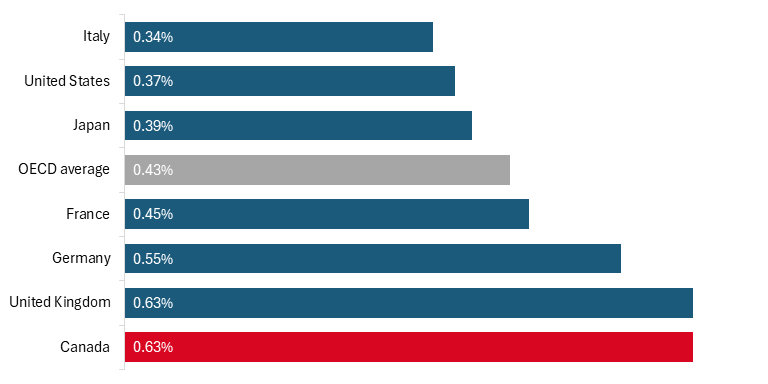
Canada is not failing because it neglects university research. Its higher-education R&D spending is among the highest in the Organization for Economic Cooperation and Development (OECD) as a share of gross domestic product (GDP).[3] And Canada ranks among the highest in the world for postsecondary attainment.[4] As figure 1 shows, Canada devotes a larger share of its economy to higher-education R&D than does any other G7 country, as well as more than the OECD average. The research base is not being starved.
Figure 1: Higher-education R&D spending as share of GDP, G7 countries and OECD average, 2021–2024 average
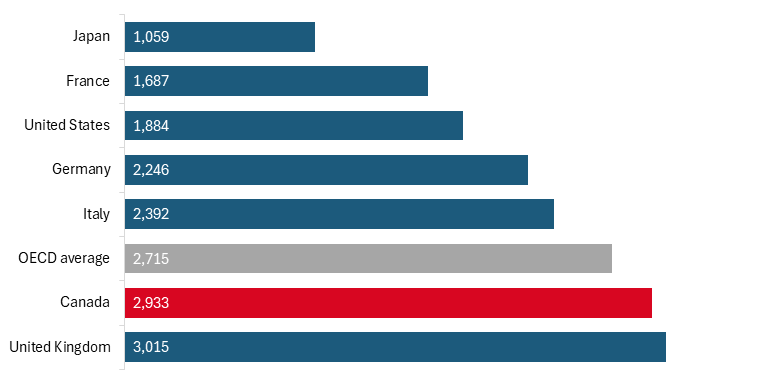
Nor is that spending disappearing into a weak academic system. Canada performs well on conventional academic-output measures. As figure 2 shows, it ranks second among G7 countries, behind only the United Kingdom, on Scopus-indexed citable documents per million population.[5] The measure is not university only, but in Canada, it largely reflects output from universities, colleges, and affiliated public research institutions rather than firms.[6]
Figure 2: Scientific publications per million people, G7 countries and OECD average, 2021–2024 average
The same strength appears in measures beyond raw publication volume. Canada has three universities in the 2025 Academic Ranking of World Universities top 100.[7] Leiden data also placed the University of Toronto among the world’s top 10 universities by publication volume, with University of British Columbia (UBC), University of Alberta, and McGill University all in the global top 80.[8] These institutions also produce substantial volumes of highly cited research and report international co-authorship on roughly 60 percent or more of their publications. Canada’s research system is not isolated or low quality. It is visible, cited, and internationally connected.
Canada is not failing because it neglects university research… Canada’s weakness appears when the measure moves closer to commercial use.
These are real academic strengths. They show a university system that produces visible, internationally connected research at scale. But publications are not the final output of an innovation system, and neither are citations, rankings, or international co-authorship. They show that knowledge has been produced and recognized. They do not show that this knowledge has been protected, financed, licensed, absorbed by Canadian firms, or scaled into industrial capacity.
Canada’s weakness appears when the measure moves closer to commercial use. Canada ranks poorly on high-tech exports as a share of total exports.[9] Given Canada’s resource-heavy export mix, this should not be read mechanically, but it is consistent with the broader pattern: academic strength is not translating into a comparable position in tradeable advanced-industry output. The Information Technology and Innovation Foundation’s (ITIF’s) 2025 Hamilton Index tells a similar story from the industry side: advanced industries fell from 10 percent of Canada’s economy in 1995 to 6.9 percent in 2022, which is precisely why university commercialization should be treated as one lever in a broader effort to rebuild advanced industrial capacity, not as a self-contained campus problem.[10]
Topline publication measures also flatter Canada’s commercialization position because they count research across the whole academic system, including fields where patents, licences, and spinouts are not the expected output. The Social Sciences and Humanities Research Council accounts for roughly $1.4 billion in the 2026–2027 Main Estimates, or about 31 percent of combined tri-council spending.[11] Social sciences and humanities research produces value through policy, institutions, law, culture, and public understanding, not primarily through patents, licences, or spinouts. That is precisely why aggregate publication strength can mislead. A country can publish a great deal and still underperform in the parts of the research system where commercial value capture is realistic.
Canada generated roughly 21 PCT applications per 1,000 Scopus-indexed citable documents, the lowest rate in the G7. Germany generated about 91, the United States 86, and France 72.
A patent-to-publication measure points in the same direction. Normalizing by citable documents compares patenting activity against the scale of a country’s research output, rather than its population or economy. In 2024, Canada generated roughly 21 Patent Cooperation Treaty (PCT) applications per 1,000 Scopus-indexed citable documents, the lowest rate in the G7. Germany generated about 91, the United States 86, and France 72.[12] PCT applications are not a direct measure of university commercialization, since they include firms and other applicants, but they are a useful conversion indicator because they compare academic research output with patenting activity that is commercially serious enough to seek international protection. They do not prove that university research caused each patent, but they do show whether a country that produces a large volume of research is also generating a commensurate volume of internationally oriented IP. Canada is not.
The World Intellectual Property Organization’s (WIPO’s) work on innovation and growth shows the conversion problem at the sectoral level. Canada’s largest patenting gaps are in biopharmaceuticals, information and communications technology (ICT), semiconductors and optics, and chemicals—sectors where downstream value is concentrated and defensible.[13] The issue is not a general shortfall in patent counts. It is that Canada’s research strength is not being matched by an industrial IP base in the sectors wherein commercialization matters most. As figure 3 shows, Canada is producing research in high-value technology fields without building a comparable industrial patent base.
Figure 3: Difference between Canada’s actual and estimated potential patents by technology field, 2001–2020
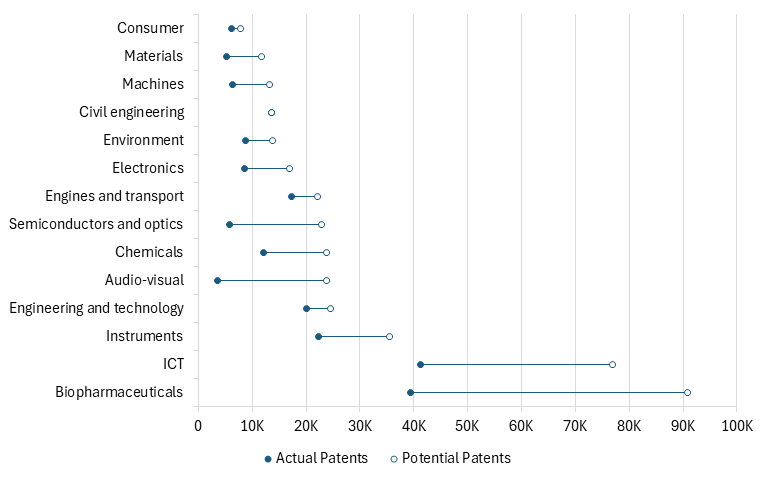
This is the handoff Canada is missing. A country that produces visible research in semiconductors, biopharmaceuticals, and ICT without building a corresponding industrial patent base is not simply leaving academic work underused. It is allowing more of the economic value of that research to be captured by firms and ecosystems elsewhere, especially China.
The same pattern appears at the institutional level, although the data is noisier. AUTM (formerly the Association of University Technology Managers) collects voluntary reporting from university technology-transfer offices across North America. Canadian institutions that report to AUTM consistently lag behind their U.S. counterparts on licences executed, licensing income, start-ups formed, and follow-on capital raised.[14]
University start-up formation gives a useful, if rough, illustration. In 2024, AUTM reported 112 start-ups formed from Canadian institutions, compared with 941 in the United States. Normalized against publication output, that works out to roughly 10 start-ups per 10,000 Scopus-indexed citable documents in Canada, compared with 15 in the United States. Canada generates fewer reported start-ups relative to its publication base, a measure closer to commercialization than publication volume.
The gap is not simply Canada’s top universities being edged out by the Massachusetts Institute of Technology (MIT) and Stanford University. In 2022, the University of Toronto, Canada’s largest and most research-intensive institution, reported licensing income that was less than half of what New York University (NYU) generated in the same reporting year, and NYU is not a top-tier U.S. commercialization performer by any conventional measure.[15] McGill University, whose faculty invented plexiglass and built the world’s first Internet search engine, reported roughly the same volume of invention disclosures as did Iowa State University.[16] These are not cherry-picked comparisons against outliers. They are unflattering comparisons against the middle of the U.S. distribution.
The AUTM data should be read carefully. Participation is voluntary, not every Canadian institution reports every year, and creator-owned IP models can leave commercialization activity outside central technology-transfer offices.[17] A 2017 study by the House of Commons Standing Committee on Industry, Science and Technology identified the lack of consistent technology-transfer data as a major obstacle in Canada, noting specifically that AUTM “appears to systematically underreport the performance of the University of Waterloo.”[18] The issue is not that existing data necessarily makes Canada look worse than it is. They might, or they might not. The problem is that the publicly available data does not let governments compare institutions reliably. The comparisons are useful but directional: they show weak reported performance, with the caveat that the data itself is partial.
Taken together, the evidence points to the same break in the chain. Canada looks strong where governments measure academic production: research spending, publications, citations, rankings, and international collaboration. It looks weaker as the indicators move closer to commercial use: high-tech exports, PCT applications relative to publications, WIPO’s sectoral patenting gaps, and AUTM-reported licences, start-ups, and follow-on capital. AUTM’s limits matter, but they do not explain away the national patent and trade indicators. Canada is performing reasonably well up to the publication stage. The weakness comes after, where knowledge has to be protected, financed, absorbed, and scaled.
That is why the real issue is not whether universities earn more licensing revenue. Even in the best U.S. cases, licensing income is a modest share of institutional budgets, and best practice increasingly suggests that maximizing licence revenue is the wrong objective. Aggressive IP monetization can deter start-ups, slow deals, and reduce the wider economic return on public research.[19] The larger cost sits in the economy. When publicly funded research is not matched by Canadian firms, financing, and industrial ecosystems capable of absorbing and scaling it, more of the downstream value is realized elsewhere. As the Council of Canadian Academies has argued, Canada’s more serious barriers lie less between R&D and innovation than between innovation and wealth creation.[20]
How Universities are Currently Funded
Three streams account for the bulk of institutional revenue at most Canadian research universities, and all three streams mostly ignore commercialization:
1. Provincial operating grants, the largest single source of institutional revenue, flow through total enrollment and historical formulas.
2. Federal research funding through the tri-council agencies flows through peer-reviewed judgments of project quality.
3. Tuition flows through students.
None of these streams tells a university that the results of its research—whether it becomes a Canadian spinout, a patent licensed to a Canadian firm, or downstream value retained in Canada—has any bearing on its financial position. The core funding mechanisms treat commercialization as, at best, a nice to have.
Universities are rational actors, and so are the faculty, administrators, and tech-transfer staff inside them. Provincial operating grants and tuition reward enrolment, so universities recruit students and protect enrolment. Federal tri-council funding rewards peer-reviewed project quality, so faculty win grants and publish papers. Where international students generate higher tuition revenue, institutions also have strong reason to expand the programs and capacity that attract them. Nothing in any of these streams rewards commercialization, so commercialization gets whatever residual attention institutions can spare after the legible metrics are satisfied. An institution that optimized for commercialization outcomes at the expense of those activities would stand to lose money. An institution that optimized for the legible metrics and treated commercialization as a side activity would not.
The consequences show up concretely in institutional capacity. Tech-transfer offices are chronically under-resourced relative to their U.S. counterparts, and commercialization staff are often hired on short-term grants, which makes it difficult to retain the patent agents, licensing specialists, and business development professionals who make these offices effective.
Faculty who want to build firms run into a harder problem than bad incentives. They run into the fact that Canadian universities do not think commercialization is part of the job. Tenure rewards teaching, publishing, and grant capture because those are what the institutions believe a professor exists to do. A faculty member who spends a year building a spinout or working with industry is not underperforming against the tenure criteria. They are doing a different job entirely, and the institution is under no obligation to count it.
That leaves the faculty member carrying the risk alone. They are making a personal bet that the spinout or the licence will pay off big enough to justify the career cost, because the university will not pay them for the attempt and will not credit it toward promotion if it fails. Most academic commercialization does not pay off like that. The rational move, for most faculty most of the time, is to publish the paper and stay on the tenure track.
None of this is the result of a deliberate choice to deprioritize commercialization. It is the result of funding mechanisms that do not require prioritization in the first place. Canadian governments fund research-intensive universities on activity and trust that outcomes will follow.
The problem is not that basic research has no value, but that Canada overemphasizes funding discovery more coherently than funding for institutional, engineering, translational, and firm-level capabilities needed to turn discovery into domestic economic capacity. The result has been strong publication output, weak industrial patenting in high-value sectors, downstream value captured elsewhere, and an institutional funding architecture that does not register the gap because the linear model treats downstream outcomes as someone else’s problem.
The Linear Model of Innovation
Canada’s research funding system still rests on an old theory of how publicly funded research becomes economic value. The theory is the linear model: governments fund basic research, universities produce knowledge, firms pick up the results, and commercial innovation eventually follows. Canada did not create the model, but it built much of its research funding architecture in its shadow.
The model owes much to Vannevar Bush’s 1945 report to U.S. President Truman, Science: The Endless Frontier, which argued that government should fund basic research at universities, select grantees on scientific merit, and protect researchers’ autonomy to pursue questions of their own choosing. Bush’s view prevailed over Senator Harley Kilgore’s competing proposal for a research agency tied more directly to national economic and social purposes. When the National Science Foundation was established in 1950, it was built largely on Bush’s terms, and the model carried particular politics with it. Scientific autonomy became the design principle. Geographic and sectoral targeting were treated with suspicion. Commercialization was treated less as something public policy had to organize than as something industry would pull through later.
The innovation literature has been challenging this account for decades. Stephen Kline made the point plainly in a 1985 article titled “Innovation Is Not a Linear Process”: innovation does not move cleanly from basic research to applied research to development to production. It moves through feedback loops among firms, users, engineers, suppliers, funders, regulators, and researchers.
Yet much of Canada’s research funding architecture is still structured as if the old sequence were true: fund excellent upstream science, preserve academic autonomy, and assume that domestic commercialization will follow.
The model depended on assumptions that fit Canada poorly in the postwar period—and fit it worse now. It assumed domestic industry would have the scale and capacity to absorb research from universities. But Canada has never had enough large technology-intensive firms headquartered here, deep supplier networks in advanced industries, or procurement systems that reliably pull domestic technologies into use. In larger industrial economies, some university research is absorbed by nearby anchor firms almost by default. In Canada, too much of it has nowhere obvious to go.
It also assumed spillovers from publicly funded research would mostly land in the domestic economy. That assumption was more plausible when international scientific exchange was slower, capital was less mobile, and production was more geographically rooted. It is much weaker in a small open economy today. Basic research is general-purpose, nonrival, and usually published openly, which makes it almost instantly available to any firm in any country capable of using it. Applied research, engineering capability, translational financing, procurement, and production capacity are stickier. They stay closer to the firms and jurisdictions that organize and fund them. A small open economy that pays for upstream research without a strategy for downstream capture is not simply investing in knowledge. It is helping supply the industrial bases of countries better equipped to use that knowledge.
The Limits of IP Reform
The obvious retort to this diagnosis is that Canada already knows the answer. Adopt Bayh-Dole-style university-owned IP, professionalize tech-transfer functions, and let the results follow. The United States has done it. Canadian universities should do it too. Problem solved.
That diagnosis already misreads Canada’s starting point: university-generated IP in Canada is governed by institutional policies, collective agreements, and research contracts, producing a patchwork of creator-owned, university-owned, and hybrid regimes rather than a single national rule.
To be sure, there is a real argument behind this reflex. Bayh-Dole transformed U.S. academic technology transfer. Between 1996 and 2020, U.S. academic technology transfer produced 554,000 disclosed inventions, 141,000 patents, 18,000 start-ups, and an estimated US$1.9 trillion in gross industrial output.[21] The act gave universities clear title they could license, contract, and build institutional capacity around to manage.
But the question for Canada is narrower. It is not whether Bayh-Dole worked in the United States. It is whether changing IP ownership rules in Canadian universities, without changing anything else, would reproduce the U.S. result. The answer is no, because Bayh-Dole did not produce the U.S. commercialization system on its own. It worked because it sat inside a system already capable of using it: sustained federal research spending, professionalized and resourced tech-transfer offices, dense venture capital willing to take early-stage technology risk, and absorptive capacity in advanced industry at a scale Canada does not have.[22]
A government that focused its commercialization reform on IP ownership rules would be choosing the one variable other countries’ experience suggests works least well in isolation.
Comparative experience reinforces the point. Countries that adopted Bayh-Dole-style legislation later, including Japan in 1999 and Germany with its abolition of the professor’s privilege in 2002, generally did not see the surge in licensing, spinouts, or industry engagement the rule alone was supposed to produce.[23] Some of those systems improved. Others did not. The ownership rule was the same change in each case. What differed was the surrounding ecosystem: depth of local venture capital, absorptive capacity of domestic industry, resourcing of tech-transfer offices, and translational financing.
The domestic picture is consistent with this. Canada runs a mix of ownership models across its research-intensive universities. The University of Waterloo operates on a creator-owned basis, often cited for its entrepreneurial culture and the density of its start-up ecosystem, though attributing Waterloo’s success to its IP model alone would be reductive. The University of Toronto, McGill, and UBC operate on university-owned or hybrid models. If ownership were the decisive variable, a clean performance gap between the two groups should be visible. None is, and the available data is too partial to produce one even if the gap existed.
None of this means IP rules don’t matter inside a commercialization system. They do. It means dictating an IP ownership model is the wrong lever for Canadian governments to reach for. The U.S. evidence does not show that a single ownership rule produces commercialization outcomes; it shows that ownership rules work when paired with tech-transfer offices, capital, absorptive industry, and faculty incentives that universities and broader policy build over time. Canada’s commercialization gap sits in those other components, and the lever that shapes whether universities invest in them is the funding system, not the IP statute. A government that focused its commercialization reform on IP ownership rules would be choosing the one variable other countries’ experience suggests works least well in isolation, while leaving the levers that actually shape institutional behaviour untouched.
Setting Outcomes Without Dictating Operating Models
Even if the evidence were clearer, dictating an IP ownership model would still be the wrong lever for government. The commercialization choices that matter most sit inside institutional systems governments are poorly equipped to design from the centre: IP rules, tech-transfer staffing, tenure and promotion criteria, incubator models, faculty entrepreneurship leave, and the informal relationships between researchers, firms, investors, and local industry. These choices depend on discipline, faculty culture, institutional history, collective agreements, regional industry depth, and the quality of the people doing the work. A model that works for engineering at Waterloo may not work for life sciences at McGill, artificial intelligence at Toronto, or agriculture at the University of Saskatchewan. Governments are entitled to decide what public money should produce. They should not pretend ministries are better positioned than institutions to design the machinery that produces it.
Universities are, by definition, the institutions society has designated for examining evidence and producing reasoned judgments under uncertainty. Asking them to apply that competence to their own commercialization arrangements, as opposed to having Ottawa or a provincial ministry do it for them, is not exactly asking them to work outside their wheelhouse. On top of that, there is a vast body of literature on best practices for university tech commercialization. The problem is not what to do, it is generating the motivation to do it.
University IP arrangements also sit at the intersection of faculty collective agreements, institutional autonomy, provincial postsecondary law, and constitutional division of powers, which is to say the kind of rough terrain governments would enter only at significant political cost and with little expertise to show for it. A provincial cabinet trying to settle the creator-owned versus university-owned question for every research university in its jurisdiction would be making that call with less information, less context, and more political interference than would the institutions themselves. To be sure, universities do not always get these decisions right. But they are still closer to the evidence than the federal government and provincial governments are.
Much of the Canadian commercialization debate has spent years cycling through operating fixes. Change the IP model. Give money to tech-transfer offices. Build another incubator. Add entrepreneurship training. Create a proof-of-concept fund. Pool patents across institutions. Borrow Waterloo’s model, or Stanford’s, or whatever example is currently doing the rounds. The list is familiar because the instinct is familiar: if commercialization is weak, give universities another tool, office, program, template, or best-practice guide. Some of these ideas are useful. Some are already being tried. But they treat the symptom as the disease. The deeper problem is motivation.
Motivation changes when money changes. Right now, public funding for research-intensive universities flows almost entirely on inputs. Provincial operating grants flow on enrolment and formula. Federal research funding flows on peer-reviewed project quality. Tuition flows on student counts. None of these streams signals to a university that whether its research produces a Canadian spinout, a patent licensed to a Canadian firm, or downstream value retained in Canada has any bearing on its financial position.
Recent federal reviews have identified the same structural problem in different terms. The Bouchard report argues that Canada needs stronger links from research through knowledge mobilization, pre-commercialization, and commercialization, and highlights a missing middle in support for researcher entrepreneurs trying to scale.[24] Canada has spent two decades trying to improve commercialization through programs layered around the edges of the system. But programs on the margins cannot redirect institutions whose central revenue is indifferent to the outcomes they are meant to produce. The lever that matters is the one attached to the money that moves the institution.
Under a funding regime tied to outcomes, universities would remain free to organize themselves however they see fit. They could:
▪ continue to choose creator-owned, university-owned, or hybrid IP models;
▪ centralize technology transfer in a single office, decentralize it across faculties, or pool it regionally, rather than treating the tech-transfer office as a residual administrative unit;
▪ revise tenure and promotion criteria to credit commercialization work, or accept that the current criteria will continue to direct faculty effort elsewhere;[25]
▪ run incubators, accelerators, and entrepreneurship leave programs as core institutional capacity, or not at all;
▪ build translational infrastructure as a deliberate institutional commitment, or continue to rely on grants and individual persistence to keep it running; and
▪ expand research programs that better capture the research needs of industry in Canada.
All of those choices would still belong to the institutions. Universities that chose well would perform better on the measured outcomes and be funded accordingly. Universities that chose poorly would have to answer for the results.
Canadian universities do not lack ideas about how to improve commercialization. They lack a reason to prioritize it institutionally. The conversation has been running inside institutions and across the policy community for years, and most of the operational fixes are already familiar: better tech-transfer office staffing, tenure credit for commercialization work, serious investment in pathways from lab to firm.
What has been missing is a funding system that makes those fixes matter financially. Tech-transfer offices remain residual administrative units because nothing in the funding system rewards them as core capacity. Translational infrastructure survives on grants and individual persistence because no one funds it as institutional commitment. Tenure criteria are silent on commercialization because nothing in the funding model asks them to speak to it.
None of this requires a government to dictate institutional design. A provincial ministry does not need to tell a research-intensive university how to staff its tech-transfer office, what its tenure criteria should look like, or whether it should run its own incubator. It needs to make commercialization outcomes matter financially and let institutions work out the rest.
Canada’s postsecondary system does many things. Commercialization is a plausible institutional function only where the scale, sectoral mix, and research base make it one. Applying commercialization-linked funding across the whole system would either dilute the incentive to the point of irrelevance or penalize institutions whose core mandate is teaching, regional access, or professional training. The target is research-intensive universities wherein commercialization is already a stated objective and the research base could plausibly support commercial outcomes.
Standardized Reporting
A funding regime tied to commercialization outcomes is only as good as the outcomes it can measure, and the outcomes it can measure publicly. Governments cannot fund institutions differently from one another on the basis of data the public cannot see. Canada does not yet have the public, institutional-level commercialization data needed to support that kind of funding model.
Governments cannot fund institutions differently from one another on the basis of data the public cannot see.
In its 2017 study on technology transfer, the House of Commons Standing Committee on Industry, Science and Technology found that Canada lacked reliable information for policymaking, that existing indicators were too narrow, and that AUTM’s voluntary survey was incomplete and poorly suited to some Canadian institutional models.[26] Waterloo was the obvious case: because its inventor-owned IP model routes much commercialization activity outside the central technology-transfer office, AUTM could systematically understate its performance. The committee recommended a new set of indicators and an annual Statistics Canada survey on technology transfer, with disclosure that could be made mandatory or incentivized.
Statistics Canada has now built much of the missing machinery. In 2025, it released the first results from the Survey on Research Activities and Commercialization of Intellectual Property in Higher Education (SRACIPHE), a mandatory annual census of universities, colleges, and research hospitals performing more than $1 million in R&D.[27] The survey collects many of the right indicators: patent filings, patents held, licences, licensing income, R&D contracts, industry partnerships, IP management costs, start-ups, spinoffs, and follow-on capital raised. The instrument is not the problem.
The constraint is publication because SRACIPHE is collected under the Statistics Act, so Statistics Canada must protect respondent confidentiality.[28] With roughly 100 universities and a small number of research hospitals, almost any table showing that a named institution produced a certain number of patents, licences, start-ups, or licensing dollars would identify the respondent. The result is therefore a survey that collects granular performance data but publicly releases mostly participation rates and sector-level aggregates.
A policymaker cannot use the public data to compare commercialization performance between UBC and Simon Fraser University (SFU), Toronto and McGill, or Waterloo and Queen’s University Canada. Provinces see only the sector aggregates the public sees. A ministry deciding how to allocate operating grants between the University of Calgary and the University of Alberta has the same data as a journalist writing about Canadian universities in general, which is to say, nothing actionable. Innovation, Science and Economic Development Canada (ISED) may have more detailed access through its data-sharing arrangements with Statistics Canada, and academic researchers can work with confidentiality-cleared outputs through the Federal Research Data Centre, but neither route produces the public, referenceable numbers a government needs to justify funding one institution differently from another. The data supports sector aggregates and internal briefings, not the visibility that would change institutional behaviour.
In the absence of public Canadian data, policymakers fall back on AUTM. AUTM is a U.S. industry association built around U.S. institutions and legal frameworks, with voluntary and incomplete Canadian participation—categories that fit university-owned IP systems better than creator-owned models, and a subscription paywall on top. Canadian governments should not have to rely on a U.S. association to answer a basic question about what Canadian public research funding produces.
The fix should sit in funding agreements, not in a rewrite of the Statistics Act. ISED, the tri-council funding agencies, or the Canada Foundation for Innovation (CFI) should require research-intensive universities receiving federal research funding to publish institutional-level commercialization data on a common framework, using SRACIPHE definitions wherever possible. The data would stay with the institutions and the reporting obligation would come through public funding, which would put the publication requirement outside Statistics Act confidentiality. Other federal departments routinely collect institutional reporting data this way as a condition of funding or regulatory approval; commercialization reporting would sit in that more familiar category.
Universities already produce this data for SRACIPHE. What is missing is public, institution-level reporting on common definitions. A common reporting framework would force institutions to define what they count and fill the gaps where the data does not currently exist. Without that, commercialization-linked funding would rest on private data, partial data, or no data at all.
Provincial Funding as the Main Lever
The strongest institutional funding lever sits with the provinces. They provide operating support to universities and set much of the accountability environment within which institutions make decisions about priorities, staffing, and internal resource allocation. That makes provincial governments the actors best positioned to tie a portion of institutional funding to commercialization performance. Where the objective is to change how universities behave as institutions, the operating grant is the most direct instrument available.
Meanwhile, the federal government funds research projects and researchers through the tri-council agencies, influences business behaviour through instruments such as Scientific Research and Experimental Development (SR&ED), and can finance or coordinate where national comparability and common measurement matter. Those are material powers. But they do not give the federal government the main lever over university operating finance—and that matters because commercialization remains peripheral when it is supported only through adjacent programs rather than built into an institution’s core funding logic.
That split has contributed to the present equilibrium. Provinces often treat innovation and commercialization as federal terrain because Ottawa funds research, operates national programs, and is more visibly engaged in economic policy. Ottawa, meanwhile, has often approached commercialization through targeted programs, partnerships, and ecosystem supports rather than through the incentives governing universities as institutions.
Provinces can point to federal grants, federal research support, and federal innovation programs. The federal government can point to provincial jurisdiction over universities and the limits that follow from it. Neither claim is wrong. Together they have allowed the core incentive problem to remain in place.
The result is that both orders of government act, but neither has changed the main mechanism shaping university behaviour.
Ontario is a useful example because it shows how governments can identify the problem and still stop short of solving it. The province’s 2022 Commercialization Mandate Policy Framework required institutions to publish commercialization policies and annual plans, identify gaps in capacity and incentives, report progress and outcome metrics, and work toward common measures and standardized reporting.[29] That reflected a sound diagnosis. Commercialization was unlikely to improve if institutions were never asked to plan for it, measure it, or compare performance across the system.
But the province did not turn those expectations into a binding funding mechanism. What followed was a softer mix of planning requirements, reporting, metric development, and ecosystem support, with Intellectual Property Ontario (IPON) playing an implementation and coordination role.[30] That may improve visibility and, in some cases, institutional attention. It does not alter the financial calculus facing a university in the way a funding tie would. Better commercialization policy is not the same thing as better commercialization incentives.
Every province has its own postsecondary governance arrangements, funding models, and innovation policy structures. That variation matters for implementation, but it does not change the underlying principles. Provinces hold the direct operating-grant lever, which means they are the actors that have to attach commercialization outcomes to institutional funding. Ottawa’s job is to make that happen through conditional funding. New or incremental federal research-commercialization money should flow only where provinces tie a meaningful share of funding for research-intensive universities to commercialization outcomes, drawing on the institutional-level data the federal reporting requirement makes public. Provinces can choose the design, but they should not be able to opt out of the incentive problem.
International Comparisons
Some countries have moved to tie universities more closely to outcomes beyond publications, and they have done so through funding systems, assessment exercises, and standardized reporting frameworks.
England shows the point clearly. Across the Higher Education Innovation Fund, the Knowledge Exchange Framework, and the Research Excellence Framework, government has built funding and assessment tools that all push universities in the same direction of knowledge exchange, commercialization, and effects beyond academic publication.[31] Some of that pressure comes through formula funding, some through comparative benchmarking, and some through the broader research assessment system that helps determine block-grant research funding. The instruments differ, but the institutional message is consistent. Universities are funded, assessed, and compared on more than papers.
Ireland pushes in the same direction through a smaller and more legible system. Across the universities’ research top-slice, the Higher Education Authority’s funding architecture, and Knowledge Transfer Ireland’s annual survey infrastructure, government has built a framework that does not treat commercialization and business engagement as invisible side effects.[32] Part of university funding is already carved out and allocated on research performance, while the state also maintains common measurement around knowledge transfer and engagement across publicly funded research organizations. The machinery is lighter than in England, but the logic is familiar: make institutional performance legible, standardize reporting, and use funding and measurement together rather than leaving commercialization to local improvisation.
Estonia’s core research funding formula includes patents, patent applications, and income from licensing and patents alongside publications, doctoral degrees, and other research outputs. There is nothing especially ornate about the model. The state has simply decided that commercialization-related outcomes belong inside the funding formula for publicly supported research. Of course, Estonia is not a template Canada can lift and drop into place; the scale is different and so is the institutional setting. It is proof that commercialization indicators can sit directly inside a core research funding formula when governments decide they matter.[33]
These examples do not point to a single model Canada should copy. England combines formula funding, comparative benchmarking, and national research assessment. Ireland pairs funding metrics with knowledge-transfer metrics and common survey infrastructure. Estonia places patents and licensing-related indicators directly inside the research formula. The models differ, but the principle is the same: downstream use is treated as part of institutional performance. Canada’s problem is not that the policy tools are unavailable. It is that they have not been built into the funding system that governs university behaviour.
Objections
The standard objection is that universities are not economic development agencies. Their core function is to produce and disseminate knowledge, including basic research whose value is often uncertain, long term, and not reducible to immediate use.[34] That function is a public good precisely because it is insulated from short-term economic pressures. Tying public funding, even partially, to commercialization outcomes risks narrowing research agendas, privileging applied work over fundamental inquiry, and turning universities into quasi-contract research organizations. From this perspective, the issue is not calibration but category error.
That argument would carry more force if universities were still funded and defended on the understanding that economic use sat wholly outside their remit. They are not. Governments routinely justify research funding in the language of innovation, productivity, industry partnership, and economic impact, and universities themselves seek support in those terms as well.[35] Whether they adopted that language enthusiastically or defensively is, at this point, secondary. If economic impact is part of the case for public money, it should also be part of how public money is judged. Commercialization cannot remain a rhetorical catchphrase while the funding model continues to reward only inputs.
This does not mean abolishing basic research, eliminating academic freedom, or settling the purpose of the university once and for all. It changes the incentive environment at the margin. And because margins matter, the regime would need to be designed carefully to limit the scale, focus on institutions rather than individual researchers, and measure over time through a broad set of outcomes. The answer to the risk of narrowing research agendas is careful design, not permanent indifference to whether publicly funded research produces downstream use where it plausibly can.
A second objection is that commercialization is unusually difficult to measure, and that once governments start funding against it, institutions will adapt to the metric rather than the underlying objective. Commercialization is lumpy and sector-specific, and often occurs in the distant future. Some commercialization outcomes are easier to count than to value. Others are difficult to capture because they occur through creator-owned IP models or informal channels outside standard institutional reporting. A metric-driven regime could therefore reward patenting theatre, low-value spinouts, or aggressive counting practices while missing the harder and more important question of whether publicly funded research is actually being translated into economic use. From this perspective, the problem is not just imperfect data. It is that the thing being measured may be too partial, too time-lagged, and too vulnerable to gaming to serve as a serious basis for funding.
The current system does not avoid distortion because governments are wisely being cautious. It avoids accountability by barely measuring institutional outcomes at all. Governments cannot tell which approaches produce better commercialization results because they have not built the data infrastructure needed to compare them consistently. The answer is not to pretend commercialization can be captured perfectly, but to measure it in ways that are broad, institutional, and revisable: over multiyear periods, through a basket of indicators, and with room to improve the framework as better information becomes available.
A third objection is that university commercialization cannot be fixed by universities alone. Canada has too few domestic firms with the scale, capital, and technical capacity to pull research out of universities and turn it into products, processes, and exports. On this view, tying funding to commercialization outcomes risks blaming universities for a demand-side failure elsewhere in the economy.
That objection is valid. This is a chicken-and-egg problem: weak university incentives and weak firm demand reinforce each other. Universities have limited reason to build serious commercialization capacity when too few domestic firms have the scale, capital, and technical depth to absorb research. Firms, in turn, have limited reason to build absorptive capacity when universities are not organized to move research into commercial use predictably. Canada cannot fix that with another narrow program bolted onto one side of the system. It needs a comprehensive innovation policy package that changes university supply and company demand together: commercialization-linked university funding, scale-up capital, procurement, industry-facing research programs, sector strategies, stronger support for adoption and deployment, and research vouchers that let firms buy applied research, testing, prototyping, validation, and technical problem-solving from universities and other public research organizations.[36] Commercialization-linked funding is not the whole agenda. It is the university-facing part of a broader policy shift from funding research activity to building industrial capacity.
Recommendations
For provinces, the central task is straightforward:
▪ Tie a nontrivial portion of operating funding for research-intensive universities to standardized commercialization outcomes. The regime should be phased in over several years, with differentiated expectations where institutional roles or capacities differ.
▪ Scale provincial research voucher programs that give firms purchasing power to buy applied research, testing, validation, prototyping, and technical problem-solving from universities, colleges, research hospitals, and other public research organizations. Alberta, Nova Scotia, and Ontario already use versions of this instrument, but they remain too small, uneven, and disconnected from the institutional incentives that shape university behaviour.
The federal government’s role is to make the system measurable and make federal money to institutions reflect commercialization performance. Ottawa should do the following:
▪ Require research-intensive universities receiving federal research funding to publish institutional-level commercialization data on a common framework, using SRACIPHE definitions, as a condition of funding. The reporting requirement should sit with ISED, the tri-councils, or CFI as part of contribution agreements and program terms.
▪ Require reporting frameworks to capture sectoral patterns of commercialization activity, so that governments can see whether university research is contributing to sectors of industrial priority.
▪ Allocate a meaningful share of tri-council funding envelopes across research-intensive universities on the basis of standardized commercialization performance, with project selection within each envelope continuing to be made on peer-reviewed scientific merit. Institutions whose research base is producing measurable downstream outcomes should see larger envelopes; those whose research base is not should see smaller ones.
▪ Apply the same logic to federal institutional research support flowing to research-intensive universities, including the Research Support Fund and CFI infrastructure funding, where the recipient is the institution rather than the individual researcher.
Conclusion
Canada’s commercialization problem is not mainly a problem of research quality. It is a problem of incentives. Governments fund research-intensive universities on inputs and then act surprised when commercialization remains peripheral to institutional behaviour.
Commercialization remains peripheral because the funding system makes it peripheral.
The fix is also narrower than Canadian policy debates often assume. Governments do not need to settle the creator-owned versus university-owned debate, redesign universities from above, or build another layer of programs around the margins. Governments need to make commercialization outcomes count financially, and they need to require institutions to publish those outcomes in a public, comparable form as a condition of federal research funding. Best practices will naturally follow.
What makes this urgent is not that Canada lacks ideas. It is that delay compounds the loss. Research that is not commercialized here often does not sit in limbo waiting patiently for better policy. It is licensed elsewhere, scaled elsewhere, and folded into other countries’ firms, supply chains, and industrial capabilities. Each year the system continues to fund activity while treating downstream capture as optional is another year Canada pays for research and leaves more of its value to accrue somewhere else.
If governments want different results, they need to tie funding to them.
About the Author
Lawrence Zhang is head of policy at ITIF’s Centre for Canadian Innovation and Competitiveness. Previously, he served as an advisor to several Canadian cabinet ministers at both the federal and provincial levels, where he advised on key issues relating to industrial and innovation policy.
About the Centre for Canadian Innovation and Competitiveness
The Centre for Canadian Innovation and Competitiveness is an Ottawa-based affiliate of the Information Technology and Innovation Foundation (ITIF), the world’s leading think tank for science and technology policy. As a separately incorporated and registered charity under the Canada Not-for-profit Corporations Act and Income Tax Act, the Centre’s mission is to help policymakers and the Canadian public better understand the nature of the innovation economy and the types of public policies that are necessary to drive Canadian innovation, productivity, and global competitiveness. For more information, visit innovationpolicy.ca.
Endnotes
[1]. Statistics Canada, “Table 27-10-0025-01 - Higher Education Research and Development Estimates, by funding sector and type of science (x 1,000,000),” accessed March 31, 2026, https://www150.statcan.gc.ca/t1/tbl1/en/tv.action?pid=2710002501.
[2]. Council of Canadian Academies, Competing in a Global Innovation Economy: The Current State of R&D in Canada, 2018, https://cca-reports.ca/wp-content/uploads/2018/09/Competing_in_a_Global_Innovation_Economy_FullReport_EN.pdf; Council of Canadian Academies, The State of Science and Technology in Canada 2025, November 18, 2025, https://cca-reports.ca/wp-content/uploads/2025/11/The-State-of-STI-in-Canada-2025_FINAL.pdf.
[3]. Statistics Canada, “Chart 2 - Higher education research and development intensity comparisons across G7 countries, 2019 to 2021,” https://www150.statcan.gc.ca/n1/daily-quotidien/231201/cg-c002-eng.htm.
[4]. World Intellectual Property Organization (WIPO), Global Innovation Index 2025: Innovation at a Crossroads (2025), https://www.wipo.int/web-publications/global-innovation-index-2025/assets/89507/global-innovation-index-2025-en.pdf.
[5]. SCImago, “SJR: SCImago Journal & Country Rank: Country Rankings,” accessed April 3, 2026, https://www.scimagojr.com/countryrank.php.
[6]. Bamini Jayabalasingham, Guillaume Roberge, and Isabelle Labrosse, Bibliometric Analysis for the Expert Panel on the State of Science & Technology in Canada 2025 (Science-Metrix, October 2025), https://cca-reports.ca/wp-content/uploads/2025/11/science-metrix-bibliometric-analysis-for-the-expert-panel-on-the-state-of-science-technology-and-innovation-in-canada-2025.pdf.
[7]. ShanghaiRanking Consultancy, “2025 Academic Ranking of World Universities,” accessed April 3, 2026, https://www.shanghairanking.com/rankings/arwu/2025.
[8]. Centre for Science and Technology Studies (CWTS), Leiden University, “CWTS Leiden Ranking Traditional Edition 2025,” accessed April 3, 2026, https://traditional.leidenranking.com/ranking/2025/list.
[9]. Cambridge Industrial Innovation Policy, “UK Innovation Report 2026” (IfM Engage, Institute for Manufacturing, University of Cambridge, March 2026), https://www.ciip.group.cam.ac.uk/wp-content/uploads/2026/03/UK-Innovation-Report-2026.pdf.
[10]. Meghan Ostertag, “The Hamilton Index, 2026: China’s Dominance in Advanced Industries Is Growing” (ITIF, May 2026), https://itif.org/publications/2026/05/06/hamilton-index-2026-chinas-dominance-in-advanced-industries-is-growing/.
[11]. Treasury Board of Canada Secretariat, 2026–27 Estimates (Government of Canada, 2026), https://www.canada.ca/en/treasury-board-secretariat/services/planned-government-spending/government-expenditure-plan-main-estimates/2026-27-estimates.html.
[12]. World Intellectual Property Organization (WIPO), WIPO Statistics Database, “IP Statistics Data Center: patent statistics by country of origin, selected economies, 2024,” accessed March 31, 2026, https://www3.wipo.int/ipstats/ips-search/search-result?type=IPS&selectedTab=countryprofiles&indicator=600&reportType=13&fromYear=2024&toYear=2024&ipsOffSelValues=&ipsOriSelValues=CA,FR,DE,IT,JP,GB,US&ipsTechSelValues=711.
[13]. World Intellectual Property Organization (WIPO), Making Innovation Policy Work for Development, (2024), https://www.wipo.int/edocs/pubdocs/en/wipo-pub-944-2024-en-world-intellectual-property-report-2024.pdf.
[14]. Robert D. Atkinson and Lawrence Zhang, “Assessing Canadian Innovation, Productivity, and Competitiveness” (ITIF, April 2024), https://itif.org/publications/2024/04/29/assessing-canadian-innovation-productivity-and-competitiveness/#_Productivity_Performance.
[15]. AUTM, “AUTM 2022 Licensing Activity Survey: A Survey of Technology Licensing Related Activity for US Academic and Nonprofit Research Institutions” (AUTM, 2022), https://autm.net/AUTM/media/SurveyReportsPDF/2022-US-AUTM-Licensing-Survey.pdf.
[16]. McGill University, “Technology Transfer,” Research and Innovation, accessed April 6, 2026, https://www.mcgill.ca/research/research/tech-transfer; AUTM, “AUTM 2022 Licensing Activity Survey: A Survey of Technology Licensing Related Activity for US Academic and Nonprofit Research Institutions” (AUTM, 2022), https://autm.net/AUTM/media/SurveyReportsPDF/2022-US-AUTM-Licensing-Survey.pdf.
[17]. AUTM, “FY2025 Licensing Survey,” accessed June 11, 2026, https://autm.net/surveys-and-tools/surveys/licensing-survey/2025-licensing-survey.
[18]. House of Commons, Standing Committee on Industry, Science and Technology, “Intellectual Property and Technology Transfer: Promoting Best Practices,” 42nd Parl., 1st session (House of Commons, November 2017), https://www.ourcommons.ca/Content/Committee/421/INDU/Reports/RP9261888/indurp08/indurp08-e.pdf.
[19]. Louis G. Tornatzky and Elaine C. Rideout, Innovation U 2.0: Reinventing University Roles in a Knowledge Economy, 2014, https://www.innovation-u.com/InnovU-2.0_rev-12-14-14.pdf.
[20]. Council of Canadian Academies, Competing in a Global Innovation Economy: The Current State of R&D in Canada, 2018.
[21]. Stephen Ezell, Meghan Ostertag, and Leah Kann, “The Bayh-Dole Act’s Role in Stimulating University-Led Regional Economic Growth” (ITIF, June 2025), https://itif.org/publications/2025/06/16/bayh-dole-acts-role-in-stimulating-university-led-regional-economic-growth/.
[22]. David C. Mowery et al., “The growth of patenting and licensing by U.S. universities: An assessment of the effects of the Bayh-Dole act of 1980,” Research Policy 30, no. 1 (January 2001): 99–119, https://doi.org/10.1016/S0048-7333(99)00100-6.
[23]. Toshiko Takenaka, “Technology Licensing and University Research in Japan,” International Journal of Intellectual Property Law, Economy and Management 1 (2005): 27–36, https://www.ipaj.org/english_journal/pdf/Technology_Licensing_and_University_Research.pdf; Sidonia von Ledebur, “University-owned Patents in West and East Germany and the Abolition of the Professors’ Privilege” (Working Papers on Innovation and Space 2009-02, Philipps-University Marburg, Department of Geography, 2009), https://www.econstor.eu/bitstream/10419/111862/1/wp2009-02.pdf.
[24]. Advisory Panel on the Federal Research Support System, Report of the Advisory Panel on the Federal Research Support System (Innovation, Science and Economic Development Canada, March 2023), https://ised-isde.canada.ca/site/panel-federal-research-support/en/report-advisory-panel-federal-research-support-system.
[25]. Richard G. Carter, “PTIE Findings: Expanding Promotion and Tenure Guidelines to Inclusively Recognize Innovation and Entrepreneurial Impact” (Oregon State University, September 18, 2020), https://ir.library.oregonstate.edu/concern/defaults/jw827k251.
[26]. House of Commons, “Intellectual Property and Technology Transfer.”
[27]. Statistics Canada, “Survey on Research Activities and Commercialization of Intellectual Property in Higher Education (SRACIPHE), record number 5393.” accessed April 9, 2026, https://www23.statcan.gc.ca/imdb/p2SV.pl?Function=getSurvey&SDDS=5393.
[28]. Statistics Canada, “Privacy and confidentiality,” accessed April 9, 2026, https://www.statcan.gc.ca/en/trust/privacy-confidentiality.
[29]. Ontario Ministry of Colleges and Universities, “Commercialization Mandate Policy Framework” (Government of Ontario, January 14, 2022), https://cdn-ca.agilitycms.com/conestoga-applied-research/commercialization-mandate-policy-framework.pdf.
[30]. Ibid.
[31]. Research England, “Research England: how we fund higher education providers,” UK Research and Innovation, accessed March 23, 2026, https://www.ukri.org/publications/research-england-how-we-fund-higher-education-providers/; Research England, “Higher Education Innovation Funding,” UK Research and Innovation, accessed March 23, 2026, https://www.ukri.org/what-we-do/browse-our-areas-of-investment-and-support/higher-education-innovation-fund/; Research Excellence Framework 2029, “Section 1 – Overview,” accessed March 23, 2026, https://2029.ref.ac.uk/guidance/section-1-overview/.
[32]. Higher Education Authority, “Review of the Allocation Model for Funding Higher Education Institutions, Working Paper 8: Funding Research, Innovation and Enterprise Activity” (Dublin: Higher Education Authority, June 2017), https://hea.ie/assets/uploads/2017/06/HEA-RFAM-Working-Paper-8-Funding-Research-Innovation-and-Enterprise-Activity-062017.pdf; Knowledge Transfer Ireland, “Annual Knowledge Transfer Survey 2023” (Dublin: Knowledge Transfer Ireland, 2024), https://www.knowledgetransferireland.com/Reports-Publications/Annual-Knowledge-Transfer-Survey-2023.pdf.
[33]. Enora Bennetot Pruvot and Thomas Estermann, “Allocating Core Public Funding to Universities in Europe: State of Play & Principles” (European University Association, March 2022), https://www.eua.eu/images/publications/funding_models_v2.pdf.
[34]. Advisory Panel on Federal Support for Fundamental Science, Investing in Canada’s Future: Strengthening the Foundations of Canadian Research (Innovation, Science and Economic Development Canada, April 10, 2017), https://ised-isde.canada.ca/site/canada-fundamental-science-review/sites/default/files/attachments/2022/ScienceReview_April2017.pdf.
[35]. Innovation, Science and Economic Development Canada, “Government of Canada invests in cutting-edge research and the next generation of scientists,” news release, May 26, 2024, https://www.canada.ca/en/innovation-science-economic-development/news/2024/05/government-of-canada-invests-in-cutting-edge-research-and-the-next-generation-of-scientists.html; Universities Canada, “Impact of research funding: Quick facts,” February 8, 2024, https://univcan.ca/publication/impact-of-research-funding-quick-facts/.
[36]. Ezell, Ostertag, and Kann, “Bayh-Dole Act’s Role.”
Editors’ Recommendations
Related
July 20, 2026
Commercializing Canadian Health Research: The Case for Targeting Grants and Increasing Overall Investment
May 28, 2024
