


Mobilizing for Techno-Economic War, Part 9: Finding the Political Will to Transform America’s Economic System

The most important techno-economic policy issue America faces is how its economic system should operate and be governed. The answer is neither market capitalism nor societal capitalism nor socialism. Only national economic power capitalism can provide the framework necessary to avoid losing the techno-economic war to China.
KEY TAKEAWAYS
Key Takeaways
Contents
The Evolution of the American Economic System. 4
Market Capitalism: 1788 to the Civil War 4
Entrepreneurial Capitalism: The Civil War to 1933. 4
Managerial Capitalism: 1933 to the Late 1970s 6
Financial Capitalism: Late 1970s to the 2010s 6
Societal Capitalism: 2009 to the Present 7
Socialism: Vying for Dominance. 10
National Economic Power Capitalism: 2028–Onward? 11
Introduction
The United States has been the world’s dominant techno-economic power for more than 125 years. That dominance has induced complacency as well as divisiveness. In contrast, the People’s Republic of China (PRC) is hungry and determined not only to displace American techno-economic leadership, but also to make America and the West vassal states as the Chinese Communist Party (CCP) calls the shots.[1]
On its current trajectory, it is likely that the PRC in the next decade or two will amass significantly greater techno-economic capabilities than the United States or even the West will in national economic power industries—advanced traded-sector industries critical to national security and sovereignty. With those greater capabilities will come geostrategic hegemony over the West unless the United States forestalls that outcome by adopting a new, transformative national power industry strategy that goes beyond a simple competitiveness or national innovation strategy. This is not a war that the United States and allies can win by focusing only on slowing the growth of the PRC’s national power industries. The harsh reality is that the only way the PRC’s zero-sum assault on the West’s techno-economic leadership position will end is if the CCP goes away and China becomes a free, democratic country—something that shows no evidence of happening. But by adopting a national economic power industry framework, the United States can keep its national power industries relatively strong, thereby avoiding defeat.
However, it will be extremely difficult to find the policy consensus and political will to put in place a national economic power industry framework unless there is a significant change in the prevailing views of what the optimal U.S. economic system should be. There is no iron law that says that the organization of a nation’s economic system must be permanently set in stone. Economic systems change as technology, businesses, and markets evolve. And they change as political power and views change.
Sometimes the break from one economic system to the next is decisive, as when Lenin, Stalin, and Mao overthrew the capitalist systems in Russia and China, respectively, through civil war and purges—executing capitalists, kulaks, and even “rightist” communists.
But mostly these changes were evolutionary, with specific demarcation points. The rise of the New Deal reflected the rise of managerial capitalism over its prior entrepreneurial capitalism. The “stagflation” of the 1970s coupled with the election of Ronald Reagan signaled the next major transition to financial capitalism. The 2008 recession and financial crisis highlighted the flaws of financial capitalism and ushered in a new era of societal capitalism.
By adopting a national economic power industry framework, the United States can keep its national power industries relatively strong, thereby avoiding defeat.
It’s not that hard-core believers in the prior doctrine now embrace the new doctrine. Few do. The American Liberty League tried in vain to resist the emergence of the managerial capitalism and its associated New Deal governance system. Keynesians and organized labor tried in vain to resist the emergence of financial capitalism and neoliberalism. And in the last decade, free-market advocates and even pro-business Democrats have fought a losing battle against societal capitalism, while it appears that mainstream Democrats are somewhat resistant to the rise of democratic socialism.
It isn’t that the opposition to a new economic system just moves on from the old one. Rather, opponents have less influence and less control as they now represent minority positions. Against that backdrop, change occurs because many individuals who formerly were weakly aligned with a flawed system became open to a new view, and because other opportunity seekers pivot with the wind of opinion to embrace a new emerging doctrine. When this happens, what was once a minority view advanced by a few out-of-the box thinkers can become dominant and widely accepted.
In each case, the prior era’s limitations and failures, coupled with group-think resistance to making needed incremental changes within the current system, led to conditions that spurred a majority to reject the governing doctrine. If entrepreneurial capitalism had allowed macroeconomic management and had taken workers’ and other social concerns seriously, perhaps the New Deal would have been more of an evolution than a “revolution.” Likewise, had managerialism capitalism been more enterprise- and entrepreneurially friendly, the supply-side reaction of the 1980s might have been less extreme. More recently, if neoliberal financial capitalism hadn’t gone to such extremes—such as cutting taxes excessively on the wealthy, deregulating finance, and limiting needed social reforms—then perhaps it wouldn’t have been rejected so vociferously and transformed into societal capitalism for most in the Center and into socialism for most on the Left.
And perhaps if societal capitalism took the China competitiveness challenge seriously, instead of placing all its focus on social equity, climate change, and utopian globalization, perhaps a dramatic shift to national economic power capitalism would not be needed.
But the reality of human nature—including, or even perhaps especially, among experts—is that people become myopically committed to particular ways of seeing the world that preclude fully rational and objective analysis. That will not change, even among people whose job it is to be objective. As such, it may be that only a deeper loss of U.S. industrial capability to China, overt PRC territorial aggression, or both will provide a sufficient catalyst for societal capitalism to become questioned and for policymaking elites to embrace national economic power capitalism.
This report discusses prior systems and why elites must now do exactly that.
The Evolution of the American Economic System
Despite what many free-market advocates claim, capitalism is not the same in all places or at all times. Different countries have different varieties. And those varieties evolve over time, as they have in the United States.[2]
Indeed, U.S. capitalism did not always operate the way it does now. As eminent business historian Alfred Chandler noted, capitalism and its governing system have gone through several major stages—and to avoid losing to China, it must go through another.[3]
Market Capitalism: 1788 to the Civil War
At the risk of oversimplification, from the time of the Revolutionary War to the Civil War, market capitalism dominated. For the most part, enterprises were small and local in nature, and they were owned and managed by individuals. Banking was one of the few sectors with publicly traded companies, with shipping and railroads later joining this list. Most companies were self-financed, or “angel financed,” with expansion coming from retained earnings. Most people were small holding farmers, and “Wall Street” played only a limited role in the economy; the largest agency in the U.S. government was the Postal Service.
Capitalism and its governing system have gone through several major stages—and to avoid losing to China, it must go through another.
Entrepreneurial Capitalism: The Civil War to 1933
After the Civil War, as technology enabled the rise of large corporations that required substantial amounts of capital and national markets, companies became much bigger and relied more on equity markets. Even so, these companies were mostly still managed by their founders/owners and small management groups. Think of companies such as Carnegie Steel, Standard Oil (John D. Rockefeller), McCormick Harvester, American Tobacco Company (J. B. Duke), Singer Sewing Machine, New York Central railroad (Cornelius Vanderbilt), and later Kodak (George Eastman), Firestone Tire, Ford Motor, General Electric (Thomas Edison and Owen D. Young), and IBM (Thomas Watson, Sr.). The role of government was still quite limited; as Coolidge said, “the business of the American people is business.”[4] To be sure, some reforms spurred on by the muckrakers and other progressives put some government guardrails on, but by and large, government’s role remained quite limited. Case in point, during the Hoover administration White House core staff was around five people.
Figure 1: The evolution of U.S. capitalism
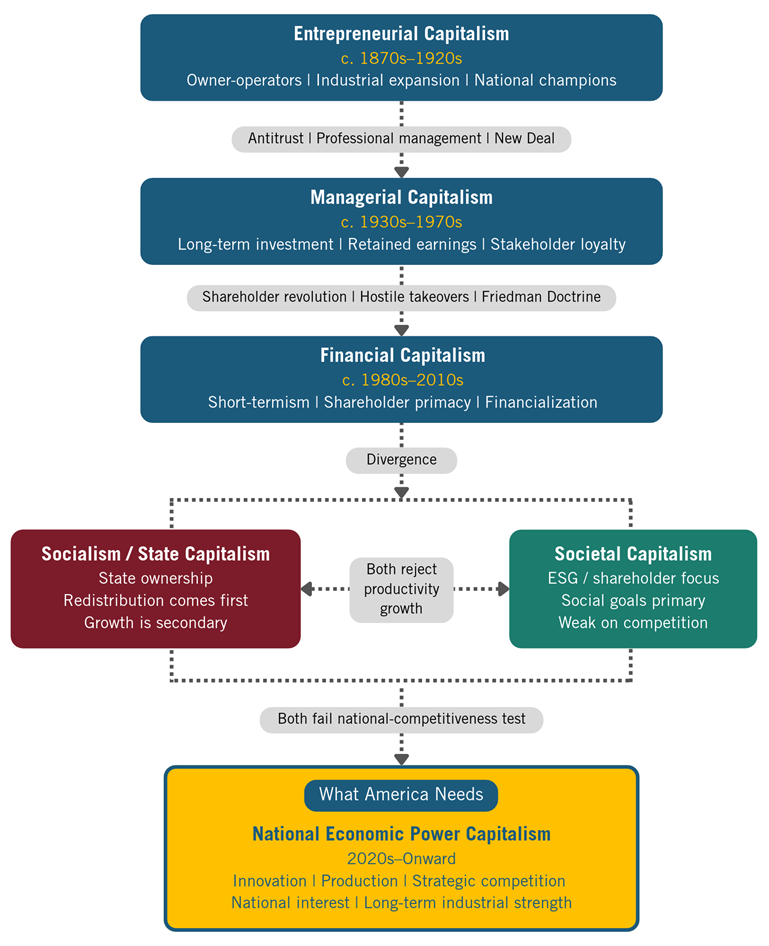
Managerial Capitalism: 1933 to the Late 1970s
As companies got even larger and bigness spread to sectors beyond just core industrials after the 1920s, managerial capitalism, wherein ownership was separate from management, gradually replaced entrepreneurial capitalism. Most founder-managed companies realized that they needed to employ professional managers to run them, especially as founders retired.
Corporations became attuned to more than just expanding and making profits for reinvestment, as managers began to consider social factors in their decision-making. Indeed, in the 1920s, before FDR’s New Deal, many corporate leaders were worried about growing labor radicalism. As a result, they cooperated to establish a movement of “welfare capitalism” wherein they agreed to boost wages and provide retirement benefits, paid vacations, employee stock ownership, and other benefits—something that today’s shareholders would punish. But this was too little, too late. And the emergence of the Great Depression led to the new consensus to want government to play a stronger role in the management of the economy.
As such, government’s role in the economy grew sharply, instigated by FDR’s New Deal. Government took on new, more expansive economic roles, not just actively managing the business cycle, but also regulating a host of industries (including transportation, energy, finance, and utilities), subsidizing agriculture, supporting organized labor, subsidizing housing, and providing state welfare (e.g., Social Security). Taxes on top earners were high while antitrust enforcement was aggressive. And in the later phase, environmental regulations were embraced. Many of these changes were needed. But some were problematic, and the entire system came under stress with the new phase of global competition emerging in the 1970s, coupled with stagflation.
Financial Capitalism: Late 1970s to the 2010s
At least until the mid-1970s, capitalism was able to better balance multiple goals, including profits and also capital investment and worker and community welfare. Until the late 1970s, a general view among corporate managers was that their mission was not just to increase stock prices, but also to serve other constituencies, including the workers, the communities in which their companies were located, and the nation as a whole. And before the 1980s, most U.S. corporations made investment decisions based on expectations of long-term returns.
But by the mid-1970s, that system had come under sharp attack. Intellectually, the attack may have started with free-market economist Milton Friedman and his highly influential essay, “A Friedman doctrine—The Social Responsibility of Business Is to Increase Its Profits,” published by The New York Times in 1970. In it, he wrote, “There is one and only one social responsibility of business—to use its resources and engage in activities designed to increase its profits so long as it stays within the rules of the game, which is to say, engages in open and free competition without deception or fraud.”[5]
This soon became an appealing anthem to corporate leaders besieged by radicals, powerful unions, and liberals pressing for vastly more regulation and limits on corporations. Now they could justify ignoring and pushing back against this anticorporate movement on more than self-interested grounds. Boosting profits was indeed in the public interest.
Adding fuel to the neoliberal fire, economic stagnation and increased foreign competition in the 1970s made the previous, broader view of corporate social responsibility seem impractical to many. Cost cutting, even if it did not raise productivity, was now a duty. Pleasing shareholders, an imperative.
But this was also enabled by a host of regulatory changes. Any regulations standing in the way of firms not efficiently maximizing share price were dismantled one by one.
With the rise of the new free market and global capitalism, industry after industry, including finance, was deregulated. Organized labor was weakened. Globalization was embraced. Taxes, especially on higher earners, were cut and some industry-specific incentives were reduced in favor of across-the-board business tax cuts. Antitrust enforcement was weakened. Societal supports were weakened, at least in some areas. (President Clinton promised to end welfare as we know it.) Again, while some of these changes were needed and salutary, such as deregulating transportation, others were more problematic (e.g., tax cuts on the wealthy) and still others (e.g., aversion to industrial policy) became problematic as the economy faced even stiffer international competition.
Societal Capitalism: 2009 to the Present
Inherent contradictions and challenges in financial capitalism led to increasing attacks and a broad-based loss of faith in it, including from the Center. The 2008 recession—a collapse that would have been easily preventable with managerial capitalism-era regulation—was the key event that turned the tide. On top of that, years of offshoring not backed up by a robust national industrial policy reduced society’s faith that “what’s good for GM is good for the nation” and allowed a growing anticorporate animus to develop. Other factors that made many question financial capitalism—and capitalism itself—included the increase in income inequality (though less than what was portrayed); the purported slower growth of wages compared with productivity (a claim that was vastly overblown, but now widely held as the truth); and the erosion of the social contract for workers made obsolete in part by globalization.[6] Also on the list of failures ascribed to financial capitalism was the increase in carbon dioxide emissions, even though it was caused by industrialization, not by capitalism.
Inherent contradictions and challenges in financial capitalism led to increasing attacks and a broad-based loss of faith in it, including from the Center. The 2008 recession—a collapse that would have been easily preventable with managerial capitalism-era regulation—turned the tide.
The widespread attack on financial capitalism came not just from the progressive Left but also from moderates. Indeed, in 2014, the World Economic Forum (the bastion of societal capitalism) published an article titled “We Need a New Kind of Capitalism.” The article’s frame is now the standard critique:
Capitalism has guided the world economy to unprecedented prosperity. Yet it has also proved dysfunctional in important ways. It often encourages short-sightedness, contributes to wide disparities between the rich and poor, and tolerates the reckless treatment of environmental capital.[7]
In other words, the new societal capitalism warns not to go all the way to socialism. In fact, it holds that financial capitalism is still the best way to spur growth. It’s just that it fails to address externalities, particularly social justice and climate. Underlying this is a palpable worry that unless societal capitalism replaces financial capitalism, socialism or Trumpian nationalism will replace it, and both are abhorrent. So, jump on the reformist societal capitalist bandwagon and hopefully the masses will be assuaged.
Five years later, Klaus Schwab, the pope of societal capitalism, published “The Davos Manifesto” for a better kind of capitalism, in which he stated that “companies should pay their fair share of taxes, show zero tolerance for corruption, uphold human rights throughout their global supply chains, and advocate for a competitive level playing field—particularly in the ‘platform economy.’”[8]
Incredibly, he credited the teenage Swedish activist Greta Thunberg as his inspiration. This kind of vacuous thinking has been latched onto because it appears to be an inoculation against socialism. As one article notes, this is needed to undercut “the Bernie Sanders brigade [that] will foresee the coming of an angry, blood-in-the-streets economic revolution.”[9] Rather than “let them eat cake,” the new view is “let them eat a higher minimum wage and some corporate social responsibility.” The reality is that the relentless attacks on financial capitalism did not inoculate societal capitalists against the Bernie brigade (and the Trump brigade); it only spurred them on by validating their populist critiques.
In this new societal capitalism system, Milton Friedman’s views are (thankfully) overthrown. But now companies must embrace double or triple bottom lines, and usually racially based social justice and climate policy. As the Davos manifesto advocates, we need a new measure of “shared and sustained value creation,” which should include “environmental, social and good governance” (ESG) goals as a complement to standard financial metrics.[10] And companies should pay their executives less. In other words, companies should still make money, but now through some means, usually voluntarily, they should include other stakeholders, such as workers, communities, suppliers, customers, and the environment. Yet, because they are hard-core globalists (who believe in one unified world where we all work together), they refuse to consider the nation state as a key stakeholder. No, the manifesto says, global companies should be responsible in their overseas operations, and the nation state is seen as withering away to be replaced by global institutions and global cooperative capital elites meeting to sort things out at Davos.
A more liberal version was pushed by many foundations that went right up to the edge of embracing socialism. Under the guise of identifying alternatives to neoliberalism, foundations such as Hewlett and Ford funded a massive number of organizations to critique neoliberalism. As Hewlett announced:
Proposals being investigated included the end of unchecked free trade; renewed interest in industrial policy and antitrust; “pre-distribution” rather than redistribution efforts; and solutions to climate change that go beyond what markets can do. But these ideas and their proponents have yet to cohere into a holistic intellectual framework and movement in the way neoliberalism did a half century ago. So, in addition to funding the generation of creative new ideas, the Hewlett Foundation will work to tie these ideas together into a coherent intellectual framework and movement to supersede neoliberalism, one better capable of addressing society’s most pressing problems, from economic and racial inequality, to climate change.[11]
Rather than develop an alternative to neoliberal, financial capitalism to foster stronger growth and competitiveness, the left-leaning societal capitalists wanted to pursue a new goal: achieving economic and racial equity and curbing climate change. Their reference to industrial policy only meant supporting industries that helped advance these two goals, such as the solar panel installer and day care industries.
Many leading societal capitalists on the Left, like Tim Wu, Lina Khan, and Senator Elizabeth Warren (at least while she was in the Biden administration), have denied being socialists but embrace the same goals as socialists, just without the heavy level of government ownership. And like socialists, their rhetoric is binary: the people vs. the powerful; the capitalists vs. the rest.
Rather than develop an alternative to neoliberal, financial capitalism to foster stronger growth and competitiveness, the left-leaning societal capitalists wanted to pursue a new goal: achieving economic and racial equity and curbing climate change.
We see the victory of societal capitalism in a recent series in The International Economy, which asked numerous experts the question “Does American capitalism need to be reimagined?”[12] With the exception of a few hard-core, free-market financial capitalists, they all agree that reimagination is in order, and that should be societal capitalism. Ben Harris, director of economic studies at Brookings, spoke for them when he wrote, “The most valid critique of capitalism is not that it fails to raise living standards or stunts economic growth—that debate has largely been settled—but that it fosters persistent income and wealth inequality.”[13] That in a nutshell is the new received wisdom that one must accept if one wants to be taken seriously in elite Washington circles. Capitalism works, but let’s make sure the masses get a bit more.
Of course, this is vastly oversimplistic. Yes, any serious-minded person who isn’t a socialist understands that capitalism is better than socialism at producing prosperity. But that’s a low bar. The real question is what kind of capitalism is best. Clearly, financial capitalism and societal capitalism both produced less growth than managerial capitalism did—and less than what national economic power capitalism likely would generate in the future.
As such, alternative solutions are mostly vacuous, such as to “leave capitalism alone and help the ’losers.’” Ben Harris wanted to “make more households owners of more capital,” get rid of occupational licensing (a perennial favorite), and subsidize childcare, housing, and medical services.[14] (Socialists don’t want subsidies, they want government ownership.)
Mohamed A. El-Erian, a professor at the Wharton School of business, echoes this view. Capitalism is the best, he has said, but it has “not translated into broad based bottom-up prosperity and stability.”[15] And that is leading to all sorts of awful things, like the questioning of free trade and the emergence of industrial policy.
David Malpass, former president of the World Bank, agrees, arguing that we need to supplement financial capitalism with measures to reduce income inequality and affordability for consumers.[16] He even perversely defends a strong dollar because it increases affordability for consumers, even though it hollows out American industry and global power.
Desmond Lachman, senior fellow at the American Enterprise Institute, which used to be a defender of financial capitalism, joins in.[17] Capitalism is still best, but we need to expand the earned income tax credit, eliminate tax loopholes, institute vigorous antitrust enforcement (the new left-center-right groupthink), increase access to housing and health care, and the perennial more spending on early childhood education. If we just taught math to 3-year-olds, the billionaires would not have so much money.
And of course, under societal capitalism, workers must be protected at all costs. Union demands for wage levels that will price companies out of international competition are a progressive good. As are union demands to limit new technology adoption. Indeed, blue-collarism is the new cool. But job loss from technology? No, that’s another story. If we are to avoid populist rebellion, they now argue, AI and robots should be limited so that few if any workers lose their jobs. They ignore or do not understand that this will mean productivity and wage stagnation. Instead, they argue for just helping workers through redistribution, paid for by increasing the national debt.
In sum, societal capitalism still embraces the core tenets of financial capitalism that investors decide what to invest in and how, but that big companies should now try to act more “responsibly” and government should be more aggressive on antitrust, more generous on social spending, aggressive in favoring ethnic minorities, active in limiting creative destruction, and of course, putting climate change first.
Socialism: Vying for Dominance
The problems with financial capitalism, and the attacks on it by societal capitalists, have provided a new opening for socialism. Long in the minority, progressives took advantage of the various challenges financial capitalism exacerbated, including climate change and racial tensions, to press their attack on capitalism itself, notably with the “Occupy Wall Street” movement.
Indeed, the challenges from financial capitalism have led many Americans to reject it and turn all the way to socialism. An incredible 39 percent of Americans now have a favorable view of socialism, while only 54 percent have a favorable view of capitalism.[18] And one poll finds that 66 percent of Democrats have a favorable view of socialism, compared with just 42 percent having a favorable view of capitalism.[19]
An incredible 39 percent of Americans now have a favorable view of socialism, while only 54 percent have a favorable view of capitalism.
This orientation is seen in politics, not only with the increased popularity of Bernie Sanders and the House Progressive Caucus, but also with the election of socialist mayors of cities such as New York, Washington, DC, and Seattle, socialist executives of counties such as Maryland’s Montgomery County, and other elected officials who are so far left that they are for all intents and purposes socialists (such as Los Angeles Mayor Karen Bass). Meanwhile, hundreds of progressive and even socialist advocacy groups, journals (e.g., Jacobin, Dissent), and of course political parties (e.g., Democratic Socialists of America, Working Families Party, Green Party of the United States, and Socialist Party USA) all have grown.[20] Even former New Deal liberals such as John Judis now proudly proclaim their commitment to democratic socialism.[21] While most socialists don’t fly the banners of Che Guevara and Lenin, at least in public, they are nonetheless supporters of widespread government ownership of the means of production. Or, where that is not possible, they support breaking up or aggressively taxing or regulating big corporations.
Democratic socialism rejects large-business capitalism. It supports small businesses, which they see as in the same league as the oppressed proletariat. Both are oppressed by monopoly capital. It seeks more government ownership of industries such as grocery stores, housing, transportation, utilities, information services, health care and drug distribution, childcare, drug development, and now AI companies.[22] It wants free everything, including free college, a much higher minimum wage, significantly expanded organized labor, mandatory transition to renewable energy, and, of course, a wide variety of racial justice and equity initiatives.[23] And democratic socialists hate technology, which they see as destroying the environment, enriching the elite, and oppressing the masses.[24]
Like left-wing societal capitalists, socialists see the core conflict as being between the capitalists and the rest of America. One recent article in the socialist magazine Current Affairs was titled “You Can’t Love America Without Hating Capitalism.”[25] What it should have said was “You Can’t Love America Without Fundamentally Transforming Away From Its Evil Ways.”
Embracing socialism would mean a steep decline in the rate of growth of productivity, limited innovation, the collapse of the data economy, and a catastrophic loss of U.S. advanced industries.
And with AI, democratic socialism is getting a renewed lease on life. Embracing the nonsensical idea that AI will produce both unlimited prosperity and proletariat immiseration (not to mention environmental destruction and oppression of minorities), some otherwise thoughtful people now argue that socialism—especially free government services and universal basic income—are required.[26] This is similar to when U.S. liberals from the late 1800s to the 1930s thought that prosperity from industrialization would lead to socialism, as Edward Belemy predicted in his 1888 Looking Backward, and the Webbs did in the United Kingdom. Solving the production problem would pave the way for socialism, as Marx claimed 150 years ago.
While social capitalism is anemic, socialism is toxic. Embracing socialism would mean a steep decline in the rate of growth of productivity, limited innovation, the collapse of the data economy, and a catastrophic loss of U.S. advanced industries. It would make the EU look like a model of dynamism and growth. And of course, it would hollow out U.S. military capabilities, just as the PRC accelerates in the opposite direction.
National Economic Power Capitalism: 2028–Onward?
While the societal capitalists assume that the growth and innovation engine from unfettered capitalism is automatic, and socialists don’t care about growth or innovation but see a government-run economy as the rise of a cooperative and just nirvana, national economic power capitalists react to the failures of financial capitalism as a growth and competitiveness engine by prioritizing the latter more than social justice, in part because they rightly believe that a rising tide lifts almost all boats (at least those boats that are willing to row).[27]
In this series of reports, ITIF has laid out tenets of a new national economic power capitalism.[28] They are straightforward:
▪ Companies, especially large companies and high-growth start-ups, are the key to prosperity and national power.
▪ The most important industries are advanced, trade-sector industries, such as biotechnology, telecommunications equipment, aerospace, and semiconductors. Becoming dependent on Chinese production in these industries would give the PRC undue leverage over America.
▪ For most sectors of the economy, market forces, supplemented with the right growth and innovation policies, maximize benefits. However, for a variety of reasons, markets alone will not preserve national techno-economic power. PRC aggression is too great.
▪ Government needs to intervene in the most strategically important industries by providing assistance such as targeted tax incentives (e.g., the R&D tax credit); grants (e.g., through the CHIPS Act); targeted research support, especially to industry-led R&D centers; low-interest loans; and other financing, especially to help new companies get over the “valley of death” to commercialize innovations and scale up.
▪ These incentives should be part of an overall policy push to transition away from the short-termism of financial capitalism, which limits the kind of investment needed to avoid losing to the PRC.[29]
▪ Trade policy should defend advanced industries against the PRC’s predation and maintain deep strategic alliances.[30]
▪ Education and workforce training policy should prioritize STEM (science, technology, engineering, and math) fields and practical technical skills.[31]
▪ Growth and competitiveness should take precedence over redistribution, although the latter should not be ignored.
▪ Without high levels of dynamism and creative destruction, the economy will underperform. Policymakers should resist the forces that oppose progress, including Luddites and NIMBYs.
▪ A wide array of regulations, including antitrust and environmental regulations, need to be restructured to promote national developmentalism.[32]
▪ Ultimately, the capitalist system should serve the national interest, not parochial ones (e.g., consumers, workers, different social groups, shareholders, financiers).
Making a systemic transformation to national economic power capitalism also would entail a wide range of other, complementary policy transformations, as this series of reports has detailed.[33] It is a tall order, but necessary to avoid defeat in the techno-economic war with China.
Conclusion
It is deeply embedded in the American psyche that democratic capitalism eventually should be the system for all countries. It’s just a matter of time before all nations, even China, embrace it. After all, when Francis Fukuyama wrote The End of History, he was the general consensus.[34]
But it’s quite possible, if not likely, that history could have a different ending, with Marxist-Leninism winning under the CCP. That victory would not necessarily have to come through a military invasion or the establishment of a U.S. communist state, but it very well could come voluntarily as most of the developing world chooses to govern itself under CCP oversight and guidance—and the CCP could end up largely calling the shots on global affairs, including issues affecting the advanced nations, particularly the United Sates. That certainly appears to be what Xi Jinping and the CCP leadership are working toward. In the meantime, the United States is focused on pretty much everything else but preserving its national techno-economic power.
Only time will tell whether American elites can respond before it is too late. But doing so will require the courage to reject group think.
As such, it will be extremely difficult, if not impossible, for the United States and the West to avoid sliding toward that fate if they remain committed to social capitalism—or worse, if they embrace socialism—because both doctrines antithetically oppose “picking winners” among industrial sectors and both resist robust dynamism, growth, and competitiveness. Only time will tell whether American elites can respond before it is too late. But doing so will require the courage to reject group think.
Acknowledgments
This report is part of a series that has been made possible in part by generous support from the Smith Richardson Foundation. (For more, see: itif.org/power-industries.) ITIF maintains full editorial independence in all its work. Any errors or omissions are the author’s alone.
About the Author
Dr. Robert D. Atkinson (@RobAtkinsonITIF) is a senior fellow and the founder of ITIF. His books include Technology Fears and Scapegoats: 40 Myths About Privacy, Jobs, AI and Today’s Innovation Economy (Palgrave McMillian, 2024); Big Is Beautiful: Debunking the Myth of Small Business (MIT, 2018); Innovation Economics: The Race for Global Advantage (Yale, 2012); Supply-Side Follies: Why Conservative Economics Fails, Liberal Economics Falters, and Innovation Economics Is the Answer (Rowman Littlefield, 2007); and The Past and Future of America’s Economy: Long Waves of Innovation That Power Cycles of Growth (Edward Elgar, 2005). He holds a Ph.D. in city and regional planning from the University of North Carolina, Chapel Hill.
About ITIF
The Information Technology and Innovation Foundation (ITIF) is an independent 501(c)(3) nonprofit, nonpartisan research and educational institute that has been recognized repeatedly as the world’s leading think tank for science and technology policy. Its mission is to formulate, evaluate, and promote policy solutions that accelerate innovation and boost productivity to spur growth, opportunity, and progress. For more information, visit itif.org/about.
Endnotes
[1]. Robert D. Atkinson, “Marshaling National Power Industries to Preserve America’s Strength and Thwart China’s Bid for Global Dominance” (ITIF, November 2025), https://itif.org/publications/2025/11/17/marshaling-national-power-industries-to-preserve-us-strength-and-thwart-china/.
[2]. Andrew Shonfield, Modern Capitalism: The Changing Balance of Public and Private Power (Oxford, UK: Oxford University Press, 1969).
[3]. Alfred DuPont Chandler, Jr., Scale and Scope: The Dynamics of Industrial Capitalism (Cambridge, MA: The Belknap Press, 1994).
[4]. Calvin Coolidge, Address to the American Society of Newspaper Editors, Washington, D.C., January 17, 1925, https://www.presidency.ucsb.edu/documents/address-the-american-society-newspaper-editors-washington-dc.
[5]. Milton Friedman, “A Friedman Doctrine—The Social Responsibility of Business Is To Increase Its Profits,” The New York Times, September 1970, https://www.nytimes.com/1970/09/13/archives/a-friedman-doctrine-the-social-responsibility-of-business-is-to.html.
[6]. Robert D. Atkinson, “Productivity Growth Still Benefits American Workers; Saying It Doesn’t Reduces Support for Technological Innovation” (ITIF, June 2023), https://itif.org/publications/2023/06/27/productivity-growth-still-benefits-american-workers-saying-it-doesnt-reduces-support-for-technology-led-growth/.
[7]. Paul Polman and Lynn Forester de Rothschild, “Why we need a new kind of capitalism” (World Economic Forum, May 2014), https://www.weforum.org/stories/2014/05/can-capitalism-be-inclusive-sustainable/.
[8]. Klaus Schwab, “Davos Manifesto 2020: The Universal Purpose of a Company in the Fourth Industrial Revolution” (World Economic Forum, December 2019), https://www.weforum.org/stories/2019/12/davos-manifesto-2020-the-universal-purpose-of-a-company-in-the-fourth-industrial-revolution/.
[9]. David M. Smick, “Does American Capitalism Need to Be Reimagined?” The International Economy, Winter 2026, https://www.international-economy.com/TIE_W26_CapitalismSymp.pdf.
[10]. Schwab, “Davos Manifesto.”
[11]. Hewlett Foundation, “Hewlett Foundation announces new, five-year $50 million Economy and Society Initiative to support growing movement to replace neoliberalism,” news release, December 8, 2020, https://hewlett.org/newsroom/hewlett-foundation-announces-new-five-year-50-million-economy-and-society-initiative-to-support-growing-movement-to-replace-neoliberalis.
[12]. David M. Smick, ed., “Does American Capitalism Need to Be Reimagined?” The International Economy, Winter 2026, https://www.international-economy.com/TIE_W26_CapitalismSymp.pdf.
[13]. Ben Harris, “Incentive-Based Government Policies Can Help Address Inequality,” in “Does American Capitalism Need to Be Reimagined?” The International Economy, Winter 2026, 34–35, https://www.international-economy.com/TIE_W26_CapitalismSymp.pdf.
[14]. Ibid.
[15]. Mohamed A. El-Erian, “American capitalism risks becoming too reactive in an increasingly unstable world,” in “Does American Capitalism Need to Be Reimagined?,” The International Economy, Winter 2026, 36, https://www.international-economy.com/TIE_W26_CapitalismSymp.pdf.
[16]. David R. Malpass, “We need a full upheaval in our institutions to allow capitalism to work better,” in “Does American Capitalism Need to Be Reimagined?,” The International Economy, Winter 2026, 38, https://www.international-economy.com/TIE_W26_CapitalismSymp.pdf.
[17]. Desmond Lachman, “There would appear to be a strong case for the introduction of a universal basic income coupled with serious reform to current social welfare programs,” in “Does American Capitalism Need to Be Reimagined?,” The International Economy, Winter 2026, 39, https://www.international-economy.com/TIE_W26_CapitalismSymp.pdf.
[18]. Jeffrey M. Jones, “Image of Capitalism Slips to 54% in U.S.” (Gallup, September 2025), https://news.gallup.com/poll/694835/image-capitalism-slips.aspx.
[19]. Mayra Flores (@mayraflorestx), “Democrats now prefer socialism over capitalism. The Democratic Party is the socialist party, and we all have seen what the leftist socialist ideology has done,” TikTok video, June 24, 2026, https://www.tiktok.com/@mayraflorestx/video/7655030163578703134.
[20]. Branko Marcetic, “American Socialists Aren’t Tired of Winning,” Jacobin, December 13, 2025, https://jacobin.com/2025/12/democratic-socialism-municipal-state-strategy; START, “Economic Justice Organizations,” accessed October 21, 2026, https://startguide.org/orgs/orgs04.html.
[21]. John B. Judis, “Can the Democratic Party become Democratic Socialist?” Foreign & Domestic, June 28, 2026, https://open.substack.com/pub/johnbjudis/p/can-the-democratic-party-become-democratic.
[22]. Richard Eskow, “The Only Ethical Model for AI is Socialism,” Current Affairs, July 12, 2024, https://www.currentaffairs.org/news/the-only-ethical-model-for-ai-is-socialism.
[23]. United States Congress, Congressional Progressive Caucus, “Progressive Caucus Announces ‘New Affordability Agenda”” (April 2026), https://progressives.house.gov/2026/4/progressive-caucus-announces-new-affordability-agenda.
[24]. Brad Reed, “Fearing Mass Job Loss, Working-Class US Voters Believe Government Must Act to Prevent Economic Disaster,” Common Dreams, June 23, 2026, https://www.commondreams.org/news/ai-worker-anxiety-poll.
[25]. Alex Skopic and Nathan J. Robinson, “You Can’t Love America Without Hating Capitalism,” Current Affairs, July 4, 2026, https://www.currentaffairs.org/news/you-cant-love-america-without-hating-capitalism.
[26]. Richard Conrad, “Democratic Socialism,” Dollars & Sense, July 1, 2026, https://open.substack.com/pub/richardc145655/p/democratic-socialism.
[27]. Robert D. Atkinson, “Mobilizing for Techno-Economic War, Part 3: Transforming Financial Capitalism Into National Power Capitalism,” (ITIF, April 2026), https://itif.org/publications/2026/04/13/mobilizing-for-techno-economic-war-part-3-national-power-capitalism/.
[28]. Atkinson, “Marshaling National Power Industries to Preserve America’s Strength and Thwart China’s Bid for Global Dominance.”
[29]. Atkinson, “Mobilizing for Techno-Economic War, Part 3.”
[30]. Rodrigo Balbontin and Stephen Ezell, “Mobilizing for Techno-Economic War, Part 6: From Free Trade Agreements to Strategic Techno-Economic Agreements” (ITIF, July 2026), https://itif.org/publications/2026/07/27/mobilizing-techno-economic-war-6-free-trade-agreements-strategic-techno-economic-agreements/.
[31]. Robert D. Atkinson, “Mobilizing for Techno-Economic War, Part 4: Transforming Education and Workforce Policy” (ITIF, May 2026), https://itif.org/publications/2026/05/13/mobilizing-for-techno-economic-war-part-4-transforming-education-and-workforce-policy/.
[32]. Robert D. Atkinson, “Mobilizing for Techno-Economic War, Part 7: Transforming Regulatory Policy” (ITIF, September 2026), https://itif.org/publications/2026/09/21/mobilizing-for-techno-economic-war-part-7-transforming-regulatory-policy/.
[33]. ITIF, National Power Industry Series, https://itif.org/power-industries.
[34]. Francis Fukuyama, The End of History and the Last Man (New York: Free Press, 1992).
Editors’ Recommendations
November 17, 2025
Marshaling National Power Industries to Preserve America’s Strength and Thwart China’s Bid for Global Dominance
April 13, 2026
