

Comments to NIH on Measuring and Rewarding Scientific Impact
Contents
Industry Funding of University R&D. 3
Expand and Modify SBIR and STTR. 7
International Scientific Collaboration. 8
A Comprehensive Competitiveness Assessment For America’s Biopharmaceutical Industry 9
Introduction and Summary
The Information Technology and Innovation Foundation (ITIF) is pleased to submit the following comments in response to the National Institutes of Health’s (NIH’s) Request for Information on Measuring and Rewarding Scientific Impact. ITIF is an independent, nonprofit, nonpartisan research and educational institute focusing on the intersection of technological innovation and public policy.
The biomedical industry is one of the most critical advanced industries in the world, supporting the development of biologics, pharmaceuticals, and medical devices to improve human health. The United States has been the world leader in the biotechnology industry, with the highest levels of new drug development, medical device production and exports, and the largest share of global output in the industry. But, as ITIF has written extensively, the People’s Republic of China (PRC) is rapidly closing the gap with the United States, with the goal of becoming the world leader in life sciences, specifically in areas such as innovative drug development.[1] China has utilized every policy lever possible to eclipse the United States as the global leader in biomedical innovation and development, including legitimate practices such as research and development (R&D) investments, tax incentives, and talent development programs; as well as a number of illegitimate or illegal tools, according to international trade law, all of which have aided in China’s goal of becoming a genuine competitor in the industry.
As the United States attempts to fight back against China’s growing push for dominance in this industry (and many other high-tech sectors), much needs to change. But to understand which policy levers must be pulled and where the United States needs to advance, the ways the United States stimulates and measures innovation must change as well.[2]
ITIF commends the administration and the NIH for seeking to improve the American scientific enterprise. In the United States, research productivity has continued to decline since the 1980s, with studies showing that scientific research has become increasingly consolidated while papers and patents have become less disruptive since 1980.[3] Moreover, though budgets in areas such as biomedical and pharmaceutical sciences have increased in the past several decades, progress has not been commensurate, with new drug approvals in the United States slowing.[4]
While these issues are concerning and demand change, ITIF first urges the administration not to make any rash decisions that could negatively impact the state of American science. One such adverse action would be the Office of Management and Budget’s (OMB’s) Proposed Rule to Revise the Guidance for Federal Financial Assistance. This rule would greatly expand the authority of OMB and the executive branch, giving them and agencies the authority to terminate grants, or entire classes of awards, mid-award if they are viewed as inconsistent with the goals of the agency or program that is funding them. Moreover, the language used in the proposed rule is incredibly vague, including a provision that allows the termination of a grant if it “is in the interest of the Federal agency,” giving agencies near-unfettered power to revoke grants at will.[5] This proposed rule should be withdrawn from consideration to avoid the unintended consequences that would surely be realized under its implementation.
These comments will present a series of options for how the NIH and other agencies throughout the government can accurately measure scientific advancement and innovation, including measuring new drug development, total industry funding of R&D, translational research, international scientific collaboration, and bolstering the American scientific workforce over the next generation. It will also present several policy proposals for how agencies can increase scientific advancement and innovation in the United States based on these new metrics.
New Drug Development
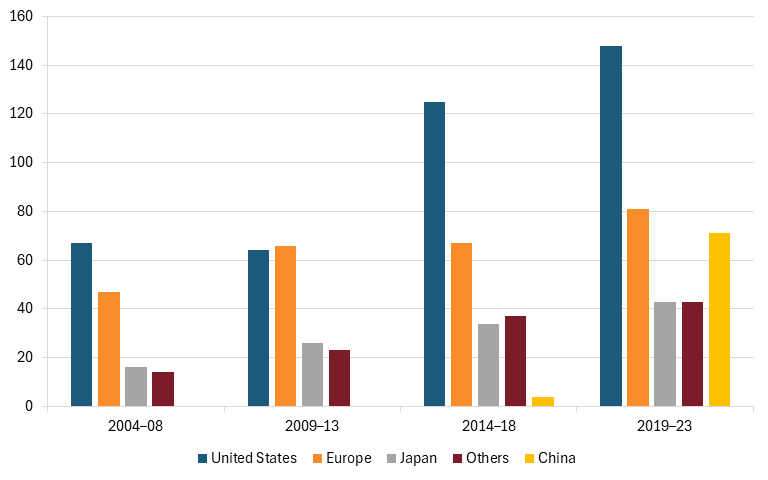
Undoubtedly, the most important and relevant indicator of success in biomedical research impact is the total number of new medicines a country creates. Over the past two decades, the United States has been the leader in new drug development, as measured by the number of new chemical and biological entities produced. (See figure 1.) However, this measure also shows how rapidly China is rising to compete with the United States. Between 2019 and 2023, China produced 71 new chemical or biological entities, a booming increase compared to the four it produced between 2014 and 2018. Over that same period, the number of new entities produced by the United States increased from just 125 to 148.[6] And China has continued to increase its development of new drugs in the years after 2023, casting aside any doubt that China is not a legitimate competitor in this industry.
Figure 1: Number of new chemical and biological entities produced, select countries
Industry Funding of University R&D
A key feature of the American innovation and research engine is the strong interconnection and collaboration between government, private enterprise, and universities. Universities have historically been one of the innovation labs for private enterprise, conducting the basic research that industry builds upon in applied research. Unfortunately, the private sector contributes just a small percentage of research funding to universities. For example, in 2023, the business sector contributed only $3.3 billion, or just 5 percent, of the higher education sector’s total R&D spending on basic research.[7] And this rate differs dramatically from state to state. For example, North Carolina, Georgia, and Kansas led in the share of university research funded by industry, and Nebraska, Rhode Island, and Nevada were last. Among institutions, Duke, MIT, and Ohio State led, while University of Maryland, Michigan State, and Pitt were last.[8]
Robust industry funding for universities pays off economically. There are small, positive correlations between the share of a state’s university research supported by industry and its strength on key innovation variables such as venture capital (a correlation coefficient of 0.28), scientists and engineers (0.19), high-tech startups (0.15), and high-tech jobs (0.14).[9] Industry research funding is also associated with stronger university technology output, with a correlation of 0.26 between industry investment and academic patents.[10] Moreover, interaction with industry as a STEM graduate student is associated with a significantly greater likelihood of producing intellectual property (“IP”, e.g., patents, invention disclosure, etc.).[11]
Congress can and should make the following changes to incentivize and catalyze industry investment into university R&D.
▪ Require programs such as NSF’s Engineering Research Center (ERC) to have at least some matching funds from industry as a condition of being awarded funding. In practice, for instance, this could require the University of Minnesota’s ERC for Advanced Technologies for Preservation of Biological Systems to receive at least 10 percent of its funding from firms in the biotechnology or biomedical industry.[12]
▪ Require a number of actions in the tax code to stimulate industry support of university R&D.
– Expand the R&D credit for companies that fund university research and eliminate language that restricts the definition of basic research to projects “not having a specific commercial objective.”[13]
– Broaden the tax credit for energy research consortia to include all research consortia.
– Make all business funding of university and federal lab research eligible for a 40 percent flat tax credit.
– Restore the Orphan Drug Tax Credit (ODTC) to 50 percent. To incentivize R&D of drugs for rare diseases, which are those that typically affect fewer than 200,000 people in the United States, in 1983 Congress created an orphan drug tax credit equal to 50 percent of qualified clinical trial costs and also offered a seven-year period of orphan drug exclusivity.[14] A 2015 study by the National Organization for Rare Disorders found that at least one-third fewer new orphan drugs would have been developed to treat rare diseases over the preceding 30 years had the act not been implemented.[15] Unfortunately, the 2017 Tax Cuts and Jobs Act halved the ODTC to just 25 percent.[16] This should be restored to 50 percent.
Translational Research
Since the end of WWII, U.S. science policy has followed a path of disciplinary neutrality and openness, allowing principal researchers to conduct curiosity-driven research with generous levels of federal funding and little overt incentive for turning discoveries into marketable IP.[17] This strategy was successful in leading to the development of several critical technologies, including the touchscreen and the Internet, and when coupled with a focus on international competitiveness and complemented by policies such as the Bayh-Dole Act, supported U.S. economic and industrial strength for many decades.[18]
But never in the history of the United States has the country faced a threat to global techno-economic leadership as significant as China poses, requiring a responsive shift in U.S. science policy. Several changes are of the highest importance.
1. U.S. science and research funding should not be cut under any circumstances. Unfortunately, the Trump administration’s proposed FY 2027 budget calls for a 12 percent proposed cut to NIH funding, this coming after an effort to cut NIH funding by 40 percent in FY 2026.[19] If the goal of this RFI is to understand how to maximize scientific impact from federal funding of biomedical research, then policymakers should recognize that the American public enjoys a tremendous return from the federal government’s investments in basic biomedical scientific research. In fact, each NIH dollar invested yields roughly $2.50 in short-term economic returns and stimulates an additional $8.30 in long-term private-sector R&D investment, underscoring the strong multiplier effect of public science funding.[20]
2. U.S. research funding can no longer be technology- or discipline-agnostic. Instead, it must be directed toward the critical and emerging technologies most essential for economic and national power. This means more focus on biology, physics, engineering, and computer science.[21]
This can be measured through the number of discoveries transferred to the commercial marketplace, similar to the statistics reported by the Association of University Technology Managers (AUTM) every year.[22] AUTM publishes data on the economic output, number of patents issued, licenses executed, and start-ups formed from academic technology transfer since 1996, giving a sense of how successful R&D investment has been over the past several decades. It also publishes the number of drugs and vaccines developed through public-private partnerships since the enactment of the Bayh-Dole Act, a critical indicator of success for the biomedical industry.[23]
The Bayh-Dole Act has had a significant impact on technology transfer and commercialization in the United States since its enactment in 1980.[24] The legislation, which allows universities, small businesses, and nonprofit institutions to take ownership of IP rights stemming from discoveries made from federally funded research. The Economist has called the Bayh-Dole Act “Possibly the most inspired piece of legislation to be enacted in America over the past half-century” noting “more than anything, this single policy measure helped to reverse America’s precipitous slide into industrial irrelevance” as it made impact from “all the inventions and discoveries that had been made in laboratories throughout the United States with the help of taxpayers’ money.”[25] In the aftermath of its passage, the Bayh-Dole Act had an almost immediate impact on invention and discovery, with the number of patents awarded to universities ballooning from 390 in 1980 to 3,088 in 2009 and 6,680 in 2015.[26]
Given the profound success of the Bayh-Dole Act in catalyzing technology transfer and economic growth, it’s critical that the legislation be maintained and not misused. Namely, policymakers should refrain from using the Act’s march-in rights to control or ensure “reasonable prices” for drugs. March-in rights were included in the law to ensure that patent owners commercialized their inventions, with the intent to never use the provision to manipulate the pricing of a product.
Despite this, some policymakers have proposed otherwise. For instance, Senator Angus King (I-ME) has proposed legislation that would require the Department of War to issue compulsory licenses under Bayh-Dole “whenever the price of a drug, vaccine, or other medical technology is higher in the U.S. than the median price charged in the seven largest economies that have a per capita income at least half the per capita income of the U.S.”[27] The Trump administration should act to protect Bayh-Dole and its original intent by affirmatively declaring that price is not a legitimate basis for the exercise of Bayh-Dole march-in rights.[28]
U.S. universities should also collect better data on the new business start-ups coming out of U.S. universities to better understand which universities are excelling at commercializing research. This could be done through a directive from Congress directing NSF to develop a metric by which universities report such information annually. In addition, the Department of Commerce could use data available through the ES-202 form (unemployment insurance tax records), which tracks how many employees an establishment has every quarter. If the form noted the university that the founder of the organization attended, it could reveal which colleges and universities have graduates who are founding and running high-growth businesses.[29]
Federal funding agencies, such as the NIH, can take several further steps to aid and incentivize greater technology transfer and commercialization at universities.
▪ Federal agencies should use data on indicators of technology transfer commercialization at universities, including the number of start-ups founded or the extent of technology licensing, to reward universities that exhibit high levels of entrepreneurship. For example, agencies could give these universities bonus points on research grant proposals.
▪ Agencies should begin allocating a small share of university R&D funding—about 5 percent—based on how well universities commercialize research, including the number of start-ups founded from universities or the extent of technology licensing. (Here, agencies could refer to the 11 federal agencies that provide Small Business Innovation Research funding.)[30] This is similar to what other countries have done, including Finland, which allocates 25 percent of the research budgets of Finnish universities based on “quality and efficacy,” including the universities ability to attract research investment from businesses. Similarly, Sweden’s national government allocates 10 percent of regular research funds to universities based on performance indicators.[31]
▪ Similarly, Australia’s engagement and impact assessment system scores universities on industry engagement, income from industry, and impact case studies. The United Kingdom’s Research Excellence Framework includes an “impact” component that assesses commercial and societal impact of research, including patents, spinouts, and industry partnerships. And Chinese university funding and researcher evaluation increasingly weight patents, technology transfer, and enterprise partnerships.
▪ The NIH should establish an entrepreneur-in-residence (EIR) program at universities that receive NIH research funding. Universities and academic medical centers that receive funding from NIH often follow the narrow and traditional path to commercializing research that revolves around patenting and licensing. The technology transfer office at the universities/medical centers then take these patents and licenses to biotechnology and pharmaceutical firms for the development of products. While this model can be an appropriate vehicle for commercialization, it often lacks strong connections between firms and research organizations. Successfully scaling a life-sciences startup requires social and capital networks, mentorship, public-private partnerships, and access to both scientific and managerial talent. The EIR program would help universities identify, support, and grow the research efforts best positioned to become high-growth companies.
▪ Congress should provide financial incentives to universities that develop technology accelerators/incubators to commercialize faculty and student research. For example, Stanford University created StartX and Johns Hopkins created Fast Forward, both of which assist university students and faculty in establishing entrepreneurial ventures seeking to move university-developed discoveries and inventions into the commercial sector. These types of programs are increasingly proliferating throughout the U.S. university system, but additional support from the federal government would support the development through a wider set of universities and colleges, particularly those without large endowments or wealthy alumni to self-fund such programs.
Finally, the federal government needs to prioritize commercialization activities at federal labs and research institutes. America’s federal laboratories are insufficiently incentivized to invest time, energy, and resources in facilitating technology transfer. For instance, Department of Energy (DOE) lab planning guidance includes a dedicated “Technology Transitions, Commercialization, and Partnership Strategy” section asking labs to describe their Cooperative Research and Development Agreement (CRADA), Agreements for Commercializing Technology (ACT), and Strategic Partnerships Projects activities and how these tie into lab strategy. But that’s a planning-narrative requirement, not a scored performance criterion on par with the eight goals. It needs to be an enforced performance requirement tied to funding. Further, the federal government should require that applications for federally funded research at labs, research institutes, and universities include a one-page summary of the potential commercial applications of the research being funded.
Expand and Modify SBIR and STTR
Billed as “America’s Seed Fund,” the Small Business Innovation Research (SBIR) and Small Business Technology Transfer (STTR) programs provide over $2 billion per year to qualified small businesses to fund R&D activities through multiple federal agencies, acting as a key conduit to brining scientific innovations to market. While SBIR accounts for only 3.4 percent of federal extramural research funding, the program punches well above its weight, with as much as 22 percent of America’s top innovations (as reflected by studies of previous winners of R&D Magazine’s R&D 100 innovation awards) coming from companies that received SBIR grants at some point in their history.[32]
Yet SBIR’s impact could be even greater, particularly if certain facets of the program were slightly more strongly geared toward commercialization.
▪ SBIR awardees should be permitted to expend up to 5 percent of their award funds for commercialization-oriented activities. Awardees are currently limited in using grant funds to support critical commercialization activities such as building product or service prototypes, acquiring commercial customers, attracting private capital, or accelerating market entry. These activities span the gamut of important commercial activities, including IP development and prosecution, marketing and market development, and the recruitment of key team members associated with customer acquisition, thereby preventing awardees from taking important steps to commercialize innovations.[33]
▪ All participating agencies in the SBIR and STTR programs consider commercialization potential and plans in their grant funding decisions. However, agencies differ in the weight or emphasis they place on commercialization. In agencies where the intended customers are external, a greater portion of the merit review evaluation criteria and scoring should include commercialization factors, such as the company’s understanding of market opportunity, product development timelines, and needed resources. Further, to evaluate these important criteria, the composition of SBIR/STIR review panels at these agencies should include industry experts, investors with relevant industry or technology expertise, and/or representatives from commercialization intermediary organizations.
International Scientific Collaboration
The China challenge is so large that the United States cannot hope to succeed without partnering with allies. Congress and federal agencies need to expand joint research initiatives with allies in critical technology areas, such as biomedical research, and develop a shared network of advanced-industry centers in which firms from both countries can participate in each other’s programs. International cooperation among national technology agencies, such as the NIH, presents an opportunity for technological innovation and information sharing between the United States and allied countries at potentially lower cost. Such programs have been undertaken by the National Science Foundation’s (NSF) Technology Innovation and Partnership (TIP) Directorate, which conducts both basic and translational, market-ready research.[34]
For example, the Verticals-enabling Intelligent Network Systems (VINES) is a funding opportunity that supports research to enhance wireless communication networks, specifically to advance next-generation network systems. A global network of agencies and industry partners supports VINES, including NSF, Department of Homeland Security, Qualcomm, Ericsson, Intel, and international partners from Finland, India, Japan, and Sweden.[35]Congress should encourage federal agencies to seek out and invest in initiative such as this. NSF TIP has stated that it intends to invest $50 million into VINES when it is allocated its full funding from Congress.[36]
The federal government should not only measure the amount of international collaboration between international partners and federal agencies, such as the NIH, and their outcomes, but also actively encourage these partnerships. One way it can facilitate these is through reducing the bureaucratic barriers to collaboration. Navigating diplomatic and congressional bureaucracy can slow down or even fully prevent these partnerships from materializing. The Department of State should identify countries that are automatically approved for scientific engagement, thus streamlining the path to partnership. The nations identified would be countries with which the United States is closely allied and those that possess the human and infrastructural resources necessary to make the partnership mutually beneficial.
Production of STEM Talent
NIH plays a central role not only in funding research but also in sustaining the nation’s biomedical workforce. It supports graduate education, postdoctoral training, and career pathways for more than 300,000 researchers through nearly 50,000 competitive grants across 2,500 universities and research institutions.[37] In FY2024, 34,000 R01-equivalent investigators applied for NIH funding, with about 9,655 receiving awards.[38]
This talent pipeline represents a strategic national asset. A steady flow of skilled biomedical researchers is essential to respond to pandemics, biothreats, and health security challenges. Without sustained federal investment, this talent will be lost to other countries or diverted to different fields, weakening U.S. capacity for innovation and response. Initiatives such as France’s Choose France for Science campaign and the European Union’s Horizon Europe Strategic Plan 2021–2024, which have been explicitly designed to attract top international talent, especially from the United States, pose a risk to the United States’ ability to attract and retain talent.[39] In this competitive environment, sustained NIH support is critical to maintaining the United States as an attractive global hub for world-class biomedical science and to ensuring that the nation can meet both public health and national security needs.
A Comprehensive Competitiveness Assessment For America’s Biopharmaceutical Industry
These comments contain several policy recommendations for how the NIH and other federal agencies can better record and incentivize innovation and scientific success. But ultimately, any effective policy needs to be backed by ongoing institutional, analytical, and intergovernmental capacity, which appears to be lacking in the United States. The NIH should establish a committee of industry experts and government officials to assess the competitiveness of the U.S. biopharmaceutical industry and issue a biannual report on its state of competitiveness. The report should include all of the metrics we’ve outlined in these comments as well as others, including but not limited to:
▪ Domestic and global industry share of value-added output;
▪ Share of active pharmaceutical ingredients and key starting materials produced in the United States;
▪ Trade balances in the sector;
▪ Foreign direct investment in the sector;
▪ Productivity per worker and total factor productivity;
▪ Annual number of clinical trials for each type of drug;
▪ Global and domestic sales;
▪ Location quotients.
Conclusion
As global competition in biomedical innovation intensifies, particularly from China’s state-directed push for dominance, the United States can no longer rely on outdated measures to gauge scientific progress. NIH and other federal agencies must adopt a more comprehensive framework for measuring scientific impact, one that captures industry outputs such as new drug development, industry investment in university research, the translation of discoveries into commercial and clinical outcomes, the depth of international scientific partnerships, and the strength of the biomedical talent pipeline. These diagnostics will enable policymakers to better understand where U.S. policy is currently insufficient and where targeted actions are warranted.
Pairing smarter metrics with the policy recommendations outlined above, the United States can ensure that its biomedical research enterprise, and greater scientific enterprise as a whole, remains positioned to maintain the economic competitiveness of the United States for years to come.
Thank you for your consideration.
Endnotes
[1]. Stephen Ezell, Meghan Ostertag, and Sandra Barbosu, “China’s Burgeoning Biopharmaceutical Competitiveness Demands a US Response” (ITIF, June 29, 2026), https://itif.org/publications/2026/06/29/chinas-burgeoning-biopharmaceutical-competitiveness-demands-us-response/.
[2]. Robert D. Atkinson, “Testimony to the US Senate Subcommittee on Science, Manufacturing, and Competitiveness on “Measuring What Matters: Science, Standards, and Strategic Competition” (ITIF, July 21, 2026), https://itif.org/publications/2026/07/21/testimony-regarding-science-standards-and-strategic-competition/.
[3]. Michael Park, Erin Leahey, and Russell J. Funk, “Papers and patents are becoming less disruptive over time,” Nature, 613 (January 2023), 138–144, https://www.nature.com/articles/s41586-022-05543-x.
[4]. The White House, “Remarks by Director Kratsios at the National Academy of Science,” May 19, 2025, https://www.whitehouse.gov/briefings-statements/2025/05/remarks-by-director-kratsios-at-the-national-academy-of-sciences/.
[5]. Meghan Ostertag, L. Val Giddings, and Stephen Ezell, “Comments to OMB Regarding Its Proposed Rule to Revise the Guidance for Federal Financial Assistance” (ITIF, July 13, 2026), https://itif.org/publications/2026/07/13/comments-to-omb-regarding-guidance-for-federal-financial-assistance/.
[6]. European Federation of Pharmaceutical Industries and Associations, “Number of New Chemical and Biological Entities (2004-2023),” accessed August 12, 2026, https://www.efpia.eu/publications/data-center/the-pharma-industry-in-figures-rd/new-chemical-or-biological-entities/.
[7]. Trelysa Long, “Why University Research Is Crucia to US Competitiveness” (ITIF, April 22, 2025), https://itif.org/publications/2025/04/22/why-university-research-is-crucial-to-us-competitiveness/.
[8]. Robert Atkinson, “Industry Funding of University Research: Which States Lead?” (ITIF, January 2018), https://itif.org/publications/2018/01/08/industry-funding-university-research-which-states-lead/.
[9]. These variables were taken from: Robert D. Atkinson and John Wu, “The 2017 State New Economy Index” (ITIF, June 2017), https://itif.org/publications/2017/11/06/2017-state-new-economy-index. See also: John Wu and Robert D. Atkinson, “How Technology-Based Start-Ups Support U.S. Economic Growth” (ITIF, November 2017), https://www.itif.org/publications/2017/11/28/how-technology-based-start-ups-support-us-economicgrowth.
[10]. National Science Board “Science & Engineering Indicators 2016” (National Science Foundation, 2016), Table 8-48, “Academic Patents Awarded per 1,000 Science, Engineering, and Health Doctorate Holders in Academia,” https://www.nsf.gov/statistics/2016/nsb20161/uploads/1/13/tt0848.pdf.
[11]. Jennifer Shields Schneider, “A Multivariate Study of Graduate Student Satisfaction and Other Outcomes within Cooperative Research Centers” (Raleigh: North Carolina State University, 2007), http://www.lib.ncsu.edu/resolver/1840.16/52.
[12]. U.S. National Science Foundation, “Engineering Research Centers,” accessed July 29, 2026, https://www.nsf.gov/eng/engineering-research-centers#current-ercs-adhttps://www.nsf.gov/eng/engineering-research-centers#current-ercs-adbb.
[13]. Matthew Stepp and Robert Atkinson, “Creating a Collaborative R&D Tax Credit,” (ITIF, June 2011), https://itif.org/publications/2011/06/09/creating-collaborative-rd-tax-credit/.
[14]. U.S. Food and Drug Administration, “Medical products for rare diseases and conditions,” (FDA, October 2024), https://www.fda.gov/industry/medical-products-rare-diseases-and-conditions.
[15]. National Organization for Rare Disorders, “Impact of the Orphan Drug Tax Credit on Treatments for Rare Diseases” (June 2015), https://rarediseases.org/assets/files/white-papers/2015-06-17.nord-bio-ey-odtc.pdf.
[16]. Zachary Brennan, “Senate, House Agree to Cut Orphan Drug Research Credit in Half in Tax Bill,” Regulatory Affairs Professionals Society, news release, December 18, 2017, https://www.raps.org/news-and-articles/news-articles/2017/12/senate-house-agree-to-cut-orphan-drug-research-cr.
[17]. Robert D. Atkinson, “US Science Policy at a Crossroads” (ITIF, June 23, 2025), https://itif.org/publications/2025/06/23/us-science-policy-at-a-crossroads/.
[18]. Association of American Universities, “Federally Funded Research Drives American Innovation,” accessed August 4, 2025, https://www.aau.edu/sites/default/files/%40%20Files/Research%20and%20Scholarship/Why%20University%20Research%20Matters/Infographics/BASIC_RESEARCH_IPAD.pdf.
[19]. Kritika Agarwal, “White House Once Again Proposes Massive Cuts to Scientific Research and Education,” Association of American Universities, April 3, 2026, https://www.aau.edu/newsroom/leading-research-universities-report/white-house-once-again-proposes-massive-cuts.
[20]. United for Medical Research, “UMR Releases Annual NIH Economic Impact Report: 2025 Update” (UMR, March 2025), https://www.unitedformedicalresearch.org/statements/umr-releases-annual-nih-economic-impact-report-2025-update/.
[21]. Atkinson, “US Science Policy at a Crossroads.”
[22]. AUTM, “AUTM Surveys: Sharing Trends and Insights,” https://autm.net/surveys-and-tools/surveys.
[23]. “Driving the Innovation Economy,” AUTM, https://autm.net/AUTM/media/SurveyReportsPDF/AUTM-2025-US-Infographic.pdf.
[24]. Stephen Ezell, “The Bayh-Dole Act’s Vital Importance to the U.S. Life-Sciences Innovation System” (IITF, March 2019), https://itif.org/publications/2019/03/04/bayh-dole-acts-vital-importance-us-life-sciences-innovation-system/.
[25]. “Innovation’s Golden Goose,” The Economist, December 12, 2002, http://www.economist.com/node/1476653.
[26]. Stephen Ezell, Meghan Ostertag, and Leah Kann, “The Bayh-Dole Act’s Role in Stimulating University-Led Regional Economic Growth” (ITIF, June 16, 2025), https://itif.org/publications/2025/06/16/bayh-dole-acts-role-in-stimulating-university-led-regional-economic-growth/.
[27]. Joseph Allen, “Proposal from Senator King Won’t Reduce Drug Prices, Just Innovation,” IPWatchdog, July 17, 2017, https://www.ipwatchdog.com/2017/07/17/senator-king-reduce-drug-prices-innovation/id=85702/.
[28]. Stephen Ezell, “Comments to the National Institutes of Health on “Maximizing NIH’s Levers to Catalyze Technology Transfer” (ITIF, August 2023), https://itif.org/publications/2023/08/18/maximizing-nih-levers-to-catalyze-technology-transfer/.
[29]. Stephen Ezell and Scott Andes, “Localizing the Economic Impact of Research and Development: Policy Proposals For the Trump Administration and Congress” (ITIF, December 2016), https://www2.itif.org/2016-localizing-economic-impact.pdf.
[30]. U.S. Department of the Interior, “Small Business Innovation Research Programs (SBIR),” https://www.doi.gov/pmb/osdbu/small-business-innovation-research-programs-sbir.
[31]. Ibid.
[32]. Fred Block and Matthew Keller, “Where Do Innovations Come From? Transformations in the U.S. National Innovation System, 1970-2006” (Washington: Information Technology and Innovation Foundation, 2008), http://www.itif.org/files/Where_do_innovations_come_from.pdf.
[33]. Ezell and Andes, ““Localizing the Economic Impact of Research and Development.”
[34]. Robert D. Atkinson and Meghan Ostertag, “Congress Should Fully Fund NSF’s TIP Directorate to Make America More Competitive Versus China” (ITIF, June 30, 2025), https://itif.org/publications/2025/06/30/congress-should-fully-fund-nsf-tip-directorate/.
[35]. “Verticals-enabling Intelligent Network Systems (VINES),” U.S. National Science Foundation, June 2025, https://www.nsf.gov/funding/opportunities/vines-verticals-enabling-intelligent-network-systems.
[36]. Robert D. Atkinson and Meghan Ostertag, “Congress Should Fully Fund NSF’s TIP Directorate to Make America More Competitive Versus China.”
[37]. National Institutes of Health, “Budget, Research for the People,” June 13, 2025, https://www.nih.gov/about-nih/organization/budget.
[38]. National Institutes of Health “RePORT NIH Data Book,”, January 2025, https://report.nih.gov/nihdatabook/category/14.
[39]. “Choose France for Science: launch of the dedicated platform for applications to host international researchers,” Republique Francaise, April 17, 2025, https://anr.fr/en/latest-news/read/news/choose-france-for-science-launch-of-the-dedicated-platform-for-applications-to-host-international-r/; Horizon Europe Strategic Plan 2021 – 2024, Directorate General for Research and Innovation, 2021, https://www.eeas.europa.eu/sites/default/files/horizon_europe_strategic_plan_2021-2024.pdf.
Editors’ Recommendations
Related
August 18, 2023
