

Comments to OMB Regarding Its Proposed Rule to Revise the Guidance for Federal Financial Assistance
Contents
The Risk to U.S. Scientific Leadership. 3
Discretionary Termination of Federal Grants 8
Restrictions on International Collaboration. 10
Elimination of Fixed-Amount Awards for Researchers 11
The E-Verify Mandate Imposes a Compliance Burden for Small Businesses 11
Introduction and Summary
The Information Technology and Innovation Foundation (ITIF) is pleased to submit the following comments in response to the Office of Management and Budget’s (OMB’s) proposed rule, Regulation for Federal Financial Assistance. ITIF is an independent, nonprofit, nonpartisan research and educational institute focusing on the intersection of technological innovation and public policy. The proposed rule amends 91 parts of Title 2 of the Code of Federal Regulations across 456 different sections of the regulations, adding 52 new subsections and fully restating 375 sections.[1] The revisions proposed would impact over $179 billion of funds to small entities.[2] The proposed changes to the Guidance for Federal Financial Assistance (otherwise referred to as the “Uniform Guidance”) represents a significant, and largely unnecessary, revision to what has overall been a highly successful federal grant framework. It is likely to have substantial negative consequences for research and development (R&D), economic growth and competitiveness, and American leadership in science and innovation.
Overall, the proposed rule seeks to reform the American scientific enterprise, a mission that ITIF wholeheartedly supports. In the United States, research productivity has continued to decline since the 1980s, with studies showing that scientific research has become increasingly consolidated while papers and patents have become less disruptive since 1980.[3] Moreover, though budgets in areas such as biomedical and pharmaceutical sciences have increased in the past several decades, progress has not been commensurate, with new drug approvals in the United States slowing.[4] As stated in Director Kratsios’s remarks to the National Academy of Sciences, “more money has not meant more scientific discovery, and total dollars spent has not been a proxy for scientific impact.”[5]
Rather than continuing to increase funding for the U.S. scientific enterprise as it is currently maintained, the United States must realign its priorities in the sciences with national interests, namely committing funding in ways that increase national strategic goals in advanced industries. Developing new grants and research prizes that encourage private-public partnerships or partnerships with international allies and directing larger shares of funding toward national power industry-related research can help to address this productivity conundrum while also ensuring that science doesn’t become a victim of sweeping cuts.
Prizes can be useful tools to incentivize innovation. The Longitude Prize, sponsored by the British government, was famously awarded in 1737 to John Harrison for his novel, clock-based solution for determining a ship’s longitude. Prizes were also offered in Napoleonic France for a functional water turbine, and for a method of preserving food for the army: the precursor of the now ubiquitous tin can. But as ITIF has written, while prizes are important, they should be seen as a complement to, not a replacement for, the traditional channel of cutting-edge R&D that generates novel intellectual property (IP) and technology that leads to new products. That’s particularly true in the life-sciences, where some have called for wholesale “delinkage”—replacing IP rights with government-managed prizes as the main incentive to drive biopharmaceutical innovation.[6] While the use of prizes can make important and meaningful contributions to helping address some global health care challenges, prizes cannot represent the “be all end all” approach to underpinning the global biomedical innovation system or tackling difficult public health challenges. Director Kratsios is correct that, “Prizes, challenges, public-private partnerships, and other novel funding mechanisms, can multiply the impact of targeted federal dollars” but again this needs to complement the core system of federal support for basic (and applied) scientific research.
While the proposed rule changes don’t necessarily directly impact the extent of federal funding for scientific research, this submission begins by emphasizing and reiterating how essential robust federal funding for scientific research is to the U.S. science and innovation system, for it fundamentally underpins U.S. technology and innovation leadership across a wide range of technology sectors. Unfortunately, the Trump administration’s proposed FY 2027 budget calls for a 54 percent cut to the National Science Foundation (NSF), from roughly $7.2 billion to $3.9 billion; a 46 percent cut to National Aeronautics and Space Administration (NASA) Science; an overall 13.5 percent cut to the Department of Energy (DoE) Office of Science (and a 43 percent cut from FY 2026 levels for the Advanced Research Projects Agency-Energy program); and a 12 percent proposed cut to National Institutes of Health (NIH) funding (coming after an effort to cut NIH funding by 40 percent in FY 2026).[7] The administration’s FY 2027 funding request for NIH would also zero out three important NIH institutes: the National Institute on Minority Health and Disparities, the Fogarty International Center, and the National Center for Complementary and Integrative Health.
But as competition with China for leadership in advanced-technology industries continues to intensify, the very last thing the United States should be doing is making broad and sweeping cuts to federal scientific research funding.[8] If anything, it should be increasing it while also implementing alternative funding mechanisms to facilitate the productivity improvements needed.
While its stated mission, to improve the American scientific research establishment, is laudable, and while some of the proposals to do so could constitute a positive change, there are significant sections of the rule—including the near-unfettered ability of government officials to terminate R&D programs at their sole discretion should they deem they no longer concord with “national interests” or “administration priorities”—that constitute a serious threat to America’s world-leading research, science, and innovation system.
The Risk to U.S. Scientific Leadership
The United States represents an irreplaceable actor in the global science and innovation community, with federal grants for scientific R&D going on to produce patents, licensed products, start-ups, and innovations that improve the economic and social well-being of U.S. citizens. The impact of academic technology transfer, powerfully enabled by the Bayh-Dole Act, which gives universities and research intuitions the rights to the IP that stems from federal funded R&D, which they can then license to start-ups, is a core component of this dynamic.[9] In fact, from 1996 to 2020, academic technology transfer activities have led to 115,000 licenses issued, 162,000 patents, 21,000 start-ups formed, and over 200 new drugs or vaccines.[10] This activity has contributed $1 trillion to U.S. gross domestic product (GDP), $1.9 trillion to industrial output, and supported 6.5 million U.S. jobs.[11]
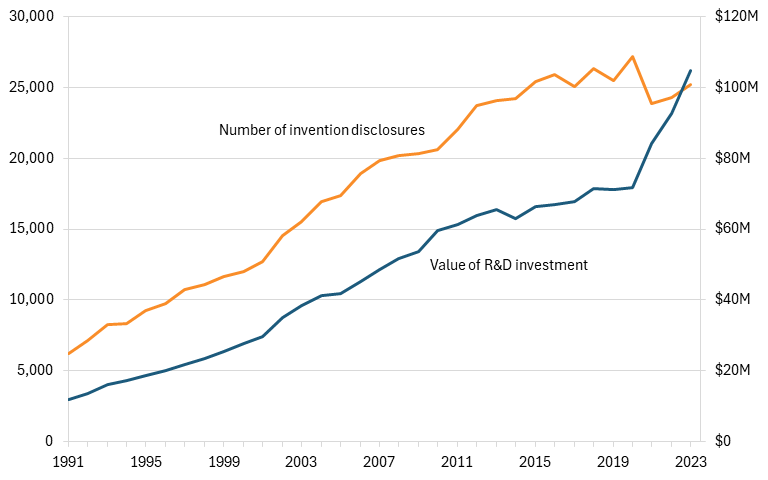
Historically, roughly every $4.2 million in research funding yields one invention disclosure, a trend that has remained fairly constant since the early 1990s (though the relationship was slightly distorted during the COVID era). (See figure 1.) Put simply, research funding leads to inventions in a very linear fashion, and every reduced $1 dollar in federal R&D funding will ultimately lead to fewer invention disclosures produced in the United States.[12]
Basic research is critical to these beneficial outputs, and the United States has historically been the largest financier of basic R&D worldwide. In 2024, the U.S. federal government invested over $145 billion in basic research, more than twice that of the next closest country, China.[13] And the federal government is a critical actor in basic research investment in the United States, funding over half of all basic research conducted by universities, while financing $14 billion in basic research conducted by federal institutions such as NIH.[14]
Figure 1: Relationship between federal R&D funding and invention disclosures[15]
R&D is also critical to advancing economic growth and societal welfare in the United States. In their 2023 research paper for the Federal Reserve Bank of Dallas, Fieldhouse and Mertens found that non-defense R&D funding significantly boosts private-sector innovation, accounting for about 25 percent of business productivity growth since World War II and leading to a social rate of return between 150 and 300 percent.[16] Other studies have found that each dollar of public R&D investment yields between $5 and $20 in social benefit. The social and economic benefits that basic research produces explains why ITIF has found that a 20 percent cut to federal R&D spending would cost the American economy up to $1.5 trillion in GDP over the next decade.[17]
The OMB’s proposed rule risks undermining this leadership, eroding confidence in federal scientific research, and disincentivizing investment in research. Unfortunately, this would come at a time when the U.S. scientific enterprise already faces significant challenges from China, which has rapidly increased its funding for R&D in key technology sectors.
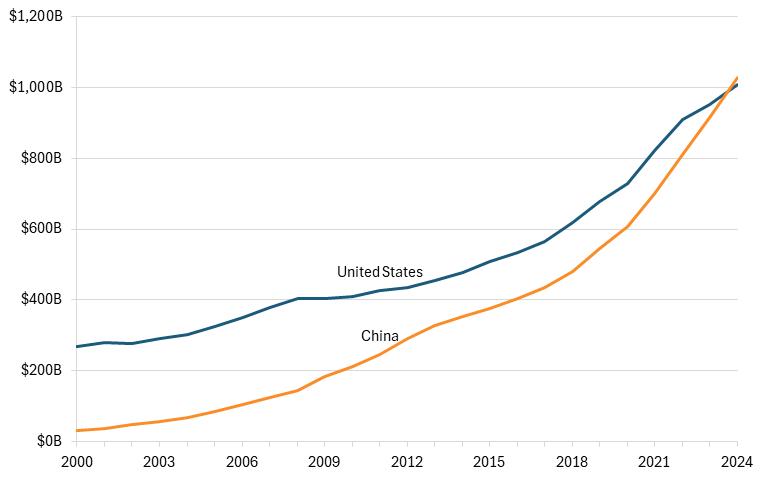
Consider that, in 1960, the United States accounted for 69 percent of global R&D expenditures, meaning it invested more in R&D than the rest of the world combined. But between 1960 and 2023, the United States’ share fell below 30 percent, while China’s R&D investment grew at an unprecedented rate. In 2024, China surpassed the United States as the world's largest R&D funder, investing $1.03 trillion compared to the United States’ $1.01 trillion (at purchasing price parity (PPP) levels).[18] (See figure 2.)
Figure 2: Gross expenditures on R&D, current prices, 2000–2024 (PPP-adjusted USD)[19]
Recent actions by the Trump administration have also accelerated the decline of American scientific leadership. Cuts to federal science funding have already damaged confidence in the U.S. scientific enterprise, with so much as 75 percent of U.S. scientists considering leaving the United States in search of better and more secure opportunities, according to a Nature poll conducted in early 2025.[20] More recently, in 2026, Nature reported that, in a survey of 1,000 U.S. researchers supported by the NIH, 13 percent said their lab had lost researchers to other countries as a result of federal funding disruptions.[21] Still, the Trump administration continues to propose deep cuts to scientific research across the federal government.[22] The loss of institutional talent and knowledge, not only at federal research institutes but also at universities and in the private sector, is detrimental to the success of the American scientific enterprise and economy, leaving the United States in a weakened position as competition with China intensifies.
The proposed rules could also significantly impact the competitiveness of the U.S. biopharmaceutical industry, an industry in which the United States leads in global research investment. For example, in 2023, the NIH received a budget of $47.7 billion for medical research in service of the American people, 82 percent of which was awarded through extramural research via almost 50,000 competitive grants to more than 300,000 researchers at more than 2,500 universities, medical schools, and other research institutions in every state.[23] NIH investments have provided a powerful engine of economic growth.[24] Over the past decade, NIH funding has generated more than $787 billion in new economic output and supported an average of 370,000 jobs annually across all 50 states.[25]
Unfortunately, as noted, the Trump administration’s proposed FY 2026 budget proposal sought to reduce NIH funding by 40 percent, from roughly $48 billion in 2025 to about $27 billion in 2026—a potentially staggering cut.[26] Fortunately, Congress rejected these proposals, providing NIH with a total program funding level of $47.49 billion in FY 2026.144F[27] Nevertheless, the Trump administration has persisted in calling for cuts to NIH funding, with the administration’s proposed FY 2027 budget calling for 12 percent NIH cuts in FY 2027.[28]
These proposed cuts are especially misguided because the American public enjoys a tremendous return from the federal government’s investments in basic biomedical scientific research. In fact, each NIH dollar invested yields roughly $2.50 in short-term economic returns and stimulates an additional $8.30 in long-term private-sector R&D investment, underscoring the strong multiplier effect of public science funding.[29]
Yet some erroneously contend that NIH investment crowds out private-sector life sciences R&D investment. For instance, a recent CATO report asserts, “This government domination [i.e., extensive NIH research funding] has reduced the effectiveness of biomedical research by crowding out new and innovative research.”[30] But the reality is quite the opposite. Indeed, research finds that, in general, an additional dollar of public contact research added to the stock of government R&D has the effect of inducing an additional twenty-something cents of private R&D investment.[31] However, for the life sciences industry, a dollar of NIH support for research leads to an even greater increase in private medical research, roughly thirty-two cents.[32] One survey of over sixty academic articles on whether public-sector R&D crowds out private sector investments concludes, “There are a number of econometric studies that, while imperfect and undoubtedly subject to improvement and revision, between them make a quite convincing case for a high rate of return to public science in this [life science] industry. It is worth noting that there are, so far as we are aware, no systematic quantitative studies that have found a negative impact of public science.”[33] In summary, public R&D investment stimulates private sector R&D investment across all sectors of the U.S. economy and provides an especially indispensable catalyst for U.S. life sciences innovation.
This submission now turns to addressing several specific misgivings regarding OMB’s proposed rule.
Discretionary Termination of Federal Grants
In 1948, at the Lenin All Union Academy of Agricultural Sciences, Trofim Denisovich Lysenko, with the blessing of Joseph Stalin, gave a speech in which he declared that “Mendelism,” (modern genetics), was doctrinally incompatible with Marxism, and announced it would be purged from Soviet biological research.[34] Luminary global scientists such as Nikolai Vavilov saw their research shut down, lost their jobs, and were thrown into the gulag, where he died.[35] Biology in research was plunged into a dark age that lasted for generations, economic residues of which persist to the present day.
In 1966, in China, Mao Tse Tung launched the Great Proletarian Cultural Revolution, an ideological purge that lasted a decade.[36] Through it, Mao sought to re-align China’s economy and culture with “correct” communist principles. Widely seen as delivering cataclysmic results for the country, it caused economic collapse and cultural turmoil, vestiges of which continue to linger decades after the ideology that spawned it was abandoned.
It seems strange that any U.S. administration would seek to correct perceived or alleged intrusions of politics or ideology into scientific research by proposing a wholesale political takeover of research funding that emulates such disastrous historical examples as those cited above, yet that is precisely what the OMB has proposed in its May 29th Federal Register notice.[37]
Indeed, OMB’s proposed rule would greatly expand the authority of OMB and the executive branch, giving them and agencies the authority to terminate grants, or entire classes of awards, mid-award if they are viewed as inconsistent with the goals of the agency or program that is funding them. The rule would transform the Uniform Guidance from guidance into a regulation that applies to all government agencies and carries the force of law. Additionally, the language used in the proposed rule is incredibly vague, including a provision that allows the termination of a grant if it “is in the interest of the Federal agency,” giving agencies near-unfettered power to revoke grants at will.
Moreover, the rule would not give researchers a process to appeal this termination, offering no right of cure to what could very possibly be arbitrary, politically based cancellations of research grants. These standards would undermine confidence in the U.S. federal research system, discouraging investment in scientific research due to fears of grant cancellations and a lack of effective recourse.
The Trump administration has a legitimate case that America’s scientific community has swung too far in excessively focusing on prioritizing diversity, equity, and inclusion (DEI) in scientific research activities. In recent years, leading science and tech policy journals, including Issues in Science and Technology and MIT’s Technology Review, have increasingly shifted toward progressive politics. Indeed, science became increasingly politicized in the mid-2010s, moving toward a culture that prioritized DEI over talent or scientific relevance.[38] For instance, John Sailer reported that, in 2017, a University of California Berkeley search committee rejected 600 of over 800 applicants for a life sciences position based solely on their DEI statements.[39] That’s not right. Researchers and applications for scientific research grants should be evaluated solely on the merits of the science or the academic, technical, research qualifications of the professorial or research application. However, while the administration is right to want to address this challenge, it does not justify the wholesale changes it is proposing through this OMB rule, changes that would drastically undermine what has been, overall, a highly successful framework for federal science funding over the past eight decades.
More broadly, it is time for the United States to reorient R&D funding activities to more actively support “national power industries” in the techno-economic competition with China. National power industries are those that enable a strong military or give the United States leverage over other nations due to their importance for economic and national security. This means prioritizing high-impact fields—such as physics, engineering, life sciences, and computer science—over others with less direct relevance to national competitiveness. It means partnering more closely with industry. It means increasing the share of NSF research funding going to engineering, which currently sits at just 8.2 percent.[40] And it means actively supporting technology transfer and commercialization rather than treating them as secondary to basic research.[41] In particular, it means prioritizing funding for NSF’s Directorate for Technology, Innovation, and Partnership (TIP) which was established in 2022 with a more tightly focused mission of accelerating key technologies to advance U.S. competitiveness.[42]
Restrictions on International Collaboration
The so-called “Wolf Amendment” (passed in the annual Commerce, Justice, and Science (CJS) appropriations in 2011) states that no government funding for NASA, the White House’s Office of Science and Technology Policy (OSTP), or the National Space Council can be used to collaborate with, host, or coordinate bilaterally with China or Chinese-owned companies without certification from the Federal Bureau of Investigations.[43]
The OMB proposed rule calls for expanding the Wolf amendment; it “establishes a government-wide baseline rule prohibiting recipients and subrecipients from using Federal funds to support bilateral or multilateral collaborations, agreements, programs, or activities with covered foreign countries or covered foreign entities, unless expressly authorized by Federal statute or approved by the Federal agency in accordance with the proposed exception authority and applicable law.”[44]
ITIF has been clear that it’s time to significantly cabin in U.S.-China scientific research collaboration in national power industries. However, while there are legitimate reasons to restrict collaboration with Chinese entities, there may still be some areas outside key technology sectors where scientific cooperation is reciprocal and not a threat to national power, and thus does not warrant any restrictions. As such, the Trump administration should not impose wholesale restrictions on U.S. collaboration with China; instead, rather it should amend the U.S.-China S&T agreement to limit it to areas that do not provide China with assistance in technologies related to national economic power industries. For example, collaborative research on endangered species should be encouraged, but research into electric vehicles should not.[45] It should also recognize that even in national power industries there may be areas where collaboration is still useful and necessary, such as AI safety and security, where joint progress benefits both sides and a lack of cooperation penalizes both.
Furthermore, it’s imperative that this section of the rule pertain only to “countries of concern” such as China and Russia. It’s imperative that it not impede (or be biased against) highly productive collaborations with researchers from other nations, especially allied nations. Indeed, as ITIF has previously written, approximately two-thirds of all award-winning innovations in the United States result from some level of interorganizational collaboration, a significant increase from the mid to late 1900s, when most award-winning innovations came from corporations acting on their own.[46]
Elimination of Fixed-Amount Awards for Researchers
Another OMB-proposed rule would largely eliminate fixed-amount awards for researchers, introducing burdens that will increase both the time commitment and costs to all parties. Fixed-amount awards allow researchers to be paid based on pre-arranged milestones in their research. However, under the new OMB proposal, fixed-amount awards would be replaced by cost-reimbursement arrangements, which require researchers to submit detailed expense reports for reimbursement. Cost-reimbursement plans are more time-consuming for researchers, as they must submit expense reports, and they also increase administrative costs for both researchers and the federal government, without commensurate benefit in outcomes.
The E-Verify Mandate Imposes a Compliance Burden for Small Businesses
Under the proposed rule, with no apparent justification, all federal grant recipients would be compelled to participate in an E-Verify employment eligibility verification, a requirement that has never before been imposed on grant recipients by OMB or Congress. For small businesses receiving grants under the Small Business Innovation Research or Small Business Technology Transfer programs, this is an unnecessary compliance burden, increasing research costs and the time commitment to administrative tasks. The burden would also fall disproportionately on small businesses who have fewer resources to devote to these administrative tasks.
Conclusion
While the goals of OMB’s proposed rule—to increase the productivity and success of the American scientific research establishment—are commendable and worth some consideration, the rule in its totality would introduce dangerous and counterproductive revisions to the Uniform Guidance that would drastically reshape the American scientific enterprise for the worse and impose severe and long-lasting economic damage. The present proposal should be withdrawn, and, to the extent that changes to the current guidance are necessary, there should be a collaborative discourse with relevant stakeholders to develop focused remedies and avoid adverse consequences for American science, innovation, and competitiveness.
Thank you for your consideration.
Endnotes
[1]. Multi-association letter to Honorable Russell Vought Director, US Office of Management and Budget, “Re: OMB guidance governing federal grants and cooperative agreements,” https://www.idsociety.org/globalassets/idsa/policy--advocacy/federal-funding/joint-request-from-323-organizations-for-extension-of-time-6_12_2026.pdf.
[2]. Ibid.
[3]. Michael Park, Erin Leahey, and Russell J. Funk, “Papers and patents are becoming less disruptive over time,” Nature, 613 (January 2023), 138–144, https://www.nature.com/articles/s41586-022-05543-x.
[4]. The White House, “Remarks by Director Kratsios at the National Academy of Science,” May 19, 2025, https://www.whitehouse.gov/briefings-statements/2025/05/remarks-by-director-kratsios-at-the-national-academy-of-sciences/.
[5]. Ibid.
[6]. Philip Stevens and Stephen Ezell, “Delinkage Debunked: Why Replacing Patents With Prizes for Drug Development Won’t Work” (ITIF, February 2020), https://itif.org/publications/2020/02/03/delinkage-debunked-why-replacing-patents-prizes-drug-development-wont-work/.
[7]. Kritika Agarwal, “White House Once Again Proposes Massive Cuts to Scientific Research and Education,” Association of American Universities, April 3, 2026, https://www.aau.edu/newsroom/leading-research-universities-report/white-house-once-again-proposes-massive-cuts.
[8]. Information Technology and Innovation Foundation, “National Power Industry Series,” https://itif.org/publication-brands/power-industries/.
[9]. Stephen Ezell, Meghan Ostertag and Leah Kann, “The Bayh-Dole Act’s Role in Stimulating University-Led Regional Economic Growth” (ITIF, June 2025), https://itif.org/publications/2025/06/16/bayh-dole-acts-role-in-stimulating-university-led-regional-economic-growth/.
[10]. Association of University Technology Managers (AUTM), “Driving the Innovation Economy: U.S. Academic Technology Transfer in Numbers,” (AUTM, 2026), https://autm.net/AUTM/media/SurveyReportsPDF/Survey%20Reports%20Images/AUTM-FY25-US-Infographic.pdf.
[11]. Ibid.
[12]. Ezell, Ostertag, and Kann, “The Bayh-Dole Act’s Role in Stimulating University-Led Regional Economic Growth.” Data and chart courtesy of the Association of University Technology Managers (AUTM). AUTM Licensing Activity Survey: FY2023. Chart: “Relationship Between Federal R&D Funding and Invention Disclosures.”
[13]. Organization for Economic Cooperation and Development, (Gross domestic expenditure on R&D by sector of performance and type of R&D; accessed July 2026), https://data-explorer.oecd.org/vis?lc=en&pg=0&bp=true&snb=9&vw=tb&df[ds]=dsDisseminateFinalDMZ&df[id]=DSD_RDS_GERD%40DF_GERD_TORD&df[ag]=OECD.STI.STP&df[vs]=1.0&dq=CHN%2BUSA%2BJPN%2BKOR%2BFRA.A.._T...BR...USD_PPP.V&pd=2020,2024&to[TIME_PERIOD]=false.
[14]. Trelysa Long, “Why University Research is Crucial to US Competitiveness” (ITIF, April 2025), https://itif.org/publications/2025/04/22/why-university-research-is-crucial-to-us-competitiveness/.
[15]. Data and chart courtesy of the Association of University Technology Managers (AUTM). AUTM Licensing Activity Survey: FY2023. Chart: “Relationship Between Federal R&D Funding and Invention Disclosures.”
[16]. Justin Riggi, “Government Funding: The Unsung Hero of Innovation and Progress” (ITIF, October 2025), https://itif.org/publications/2025/10/29/government-funding-the-unsung-hero-of-innovation-and-progress/.
[17]. Meghan Ostertag, “How Reducing Federal R&D Reduces GDP Growth” (ITIF, September 2025), https://www2.itif.org/2025-reducing-federal-rd.pdf.
[18]. Meghan Ostertag, “China Overtakes the United States in R&D Investment” (ITIF, May 2026), https://itif.org/publications/2026/05/06/china-overtakes-the-united-states-in-rd-investment/.
[19]. Ibid.
[20]. Alexandra Witze, “75% of US Scientists Who Answered Nature Poll Consider Leaving,” Nature, March 27, 2025, https://www.nature.com/articles/d41586-025-00938-y.
[21]. Andrew Joseph, “Immigration Changes Are Driving Foreign Researchers to Leave the U.S.—Or Not Come to Begin With,” STAT News, May 4, 2026, https://www.statnews.com/2026/05/04/trump-immigration-policy-stat-survey-measures-science-impact/.
[22]. Alessandra Zimmermann, “FY 2027 R&D Appropriations The Presidential Budget Request,” (AAAS, April 10, 2026), https://www.aaas.org/sites/default/files/2026-04/PBR%20Report%202027.pdf.
[23]. National Institutes of Health, “Budget,” https://www.nih.gov/about-nih/organization/budget.
[24]. Sandra Barbsou, “How NIH-Funded Science Supports US Biopharmaceutical Innovation” (ITIF, December 2025), https://itif.org/publications/2025/12/15/how-nih-funded-science-supports-us-biopharmaceutical-innovation/.
[25]. United for Medical Research, “UMR Releases Annual NIH Economic Impact Report: 2025 Update” (UMR, March 2025), https://www.unitedformedicalresearch.org/statements/umr-releases-annual-nih-economic-impact-report-2025-update/.
[26]. Richard G. Frank, “The 2026 health and health care budget” (Brookings Institution, June 2025), https://www.brookings.edu/articles/the-2026-health-and-health-care-budget/.
[27]. Congressional Research Service (CRS), “National Institutes of Health (NIH) Funding: FY1996-FY2026” (CRS, May 18, 2026), https://www.congress.gov/crs-product/R43341.
[28]. Agarwal, “White House Once Again Proposes Massive Cuts to Scientific Research and Education.”
[29]. United for Medical Research, “UMR Releases Annual NIH Economic Impact Report: 2025 Update.”
[30]. John F. Early and Terence Kealey, “Restoring the NIH Mission: Some Good News, Some Not-So-Good News, and Some Really Bad News” (CATO Institute, February 6, 2026), https://www.cato.org/blog/restoring-nih-mission-some-good-news-some-not-so-good-news-some-really-bad-news.
[31]. David M. Levy and Nestor E. Terleckyj, “Effects of Government R&D on Private R&D Investment and Productivity: A Macroeconomic Analysis,” Bell Journal of Economics Vol 14, Issue 2 (1983): 551–561.
[32]. Everett Ehrlich, “An Economic Engine: NIH Research, Employment, and the Future of the Medical Innovation Sector,” (United for Medical Research, Spring 2011), 5, http://www.eyeresearch.org/pdf/UMR_Economic%20Engine_042711a.pdf.
[33]. Iain M. Cockburn and Rebecca M. Henderson, “Publicly Funded Science and the Productivity of the Pharmaceutical Industry” (working paper, National Bureau of Economic Research, January 2001), http://www.nber.org/chapters/c10775.pdf.
[34]. David Joravsky, The Lysenko Affair (Chicago, Illinois: University of Chicago Press, 1986).
[35]. Peter Pringle, The Murder of Nikolai Vavilov: The Story of Stalin's Persecution of One of the Great Scientists of the Twentieth Century (New York, New York: Simon & Schuster, 2008).
[36]. The National Archives, “The Cultural Revolution,” https://www.nationalarchives.gov.uk/education/resources/the-cultural-revolution/.
[37]. Federal Register, “Regulation for Federal Financial Assistance,” https://www.federalregister.gov/documents/2026/05/29/2026-10817/regulation-for-federal-financial-assistance.
[38]. Robert D. Atkinson, “US Science Policy at a Crossroads” (ITIF, June 23, 2025), https://itif.org/publications/2025/06/23/us-science-policy-at-a-crossroads/.
[39]. John D. Sailer, “A Death Knell for Diversity Statements,” City Journal, March 25, 2025, https://www.city-journal.org/article/a-death-knell-for-diversity-statements.
[40]. Robert D. Atkinson, “Mobilizing for Techno-Economic War, Part 5: Transforming STEM Research Policy” (ITIF, June 2026), https://itif.org/publications/2026/06/17/mobilizing-for-techno-economic-war-part-5-transforming-stem-research-policy/.
[41]. Atkison, “US Science Policy at a Crossroads.”
[42]. Meghan Ostertag and Robert D. Atkinson, “Congress Should Fully Fund NSF’s TIP Directorate to Make America More Competitive Versus China” (ITIF, June 2025), https://itif.org/publications/2025/06/30/congress-should-fully-fund-nsf-tip-directorate/.
[43]. Select Committee on China, “Select Committee Releases Report on NASA’s Research Security and Enforcement of the Wolf Amendment,” May 14, 2026, https://chinaselectcommittee.house.gov/media/press-releases/select-committee-releases-report-on-nasa-s-research-security-and-enforcement-of-the-wolf-amendment.
[44]. Federal Register, “Regulation for Federal Financial Assistance,” 17–18.
[45]. Robert D. Atkinson, et al., “Mobilizing for Techno-Economic War, Part 2: Slowing China’s Advance” (ITIF, March 30, 2026), https://itif.org/publications/2026/03/30/mobilizing-for-techno-economic-war-part-2-slowing-chinas-advance/.
[46]. Fred Block and Matthew R. Keller, “Where Do Innovations Come From? Transformations in the U.S. National Innovation System, 1970-2006” (ITIF, July 2008), https://www2.itif.org/Where_do_innovations_come_from.pdf.
Editors’ Recommendations
April 22, 2025
Why University Research Is Crucial to US Competitiveness
September 15, 2025
