

China’s Burgeoning Biopharmaceutical Competitiveness Demands a US Response
China has become an increasingly capable competitor in the global biopharmaceutical industry. To remain competitive, the United States should double down on policies to ensure that it offers the world’s leading environment to support private sector life sciences innovation.
KEY TAKEAWAYS
Key Takeaways
Contents
China’s Biopharmaceutical Ecosystem. 4
China’s Growing Biopharmaceutical Competitiveness 8
Introduction
China has set its sights on becoming the world’s leader in biopharmaceutical innovation. While such a goal might seem fanciful to some, the reality is China has set similar goals—and achieved them—in industries ranging from electric vehicles (EVs)/batteries and solar panels to nuclear power and telecommunications networking equipment.[1] In recent years, China has developed a comprehensive national strategy to strengthen its biopharmaceutical innovation capacity, which features a wide range of policy instruments, including subsidies, financial incentives, high-tech science parks, startup incubators, talent recruitment schemes, regulatory reforms to expedite drug review, enhanced intellectual property (IP) protections, and increased science funding. Overall, China’s government has explicitly prioritized science and biotechnology as engines of national power, identifying biotechnology as a leading technology of “new-quality productive forces.”[2]
China has set its sights on becoming the world’s leader in biopharmaceutical innovation.
China began to seriously target the biopharmaceutical sector as early as 2007, when the Chinese Communist Party (CCP) announced plans to “set up high-tech industrial bases for biotechnology.”[3] In 2011, as part of its 12th Five-Year Plan (2011–2015), China designated biotechnology as a “strategic emerging industry” and also introduced a coordinated national strategy to accelerate biotech innovation and competitiveness.[4] Under its 14th Five-Year Plan (2021–2025), China committed to increasing research and development (R&D) investment by more than 7 percent annually and set a goal of raising R&D’s share of China’s gross domestic product (GDP) to about 3 percent (a figure that currently stands at 2.8 percent).
In 2021 alone, China’s basic science research investment rose by 10.6 percent—part of a deliberate push to build long-term scientific capacity. That same year, Beijing also launched new national laboratories and innovation centers in strategic fields such as artificial intelligence (AI), biopharmaceuticals, and genomics.[5]
In 2022, China for the first time issued a five-year plan specifically for the bioeconomy, articulating broad goals for 2025 in biopharma, bio-agriculture, bio-manufacturing, and bio-security. This Bioeconomy Development Plan established biomedicine as a strategic pillar alongside agriculture and biomanufacturing, targeting a 10 percent annual growth rate in these industries through 2025.[6] Also in 2022, the National Natural Science Foundation of China (NSFC), the country’s largest public science funder, increased its investment to RMB 32.7 billion (about $4.5 billion), up from RMB 31.2 billion ($4.2 billion) the previous year, supporting over 51,000 research projects, with at least 34 percent of its budget invested in research in life science and healthcare.[7] By 2023, Chinese government R&D investment in science reached $110 billion—far exceeding the $65 billion invested by the U.S. government in intramural research.[8] In short, China is channeling massive public funds into biopharmaceutical innovation as it seeks to position itself as a global science leader by 2035—a trajectory that directly challenges U.S. leadership in the sector.
China is rapidly ascending across virtually all measures of biopharmaceutical competitiveness, and if such trends continue unabated, China could achieve its goal of wresting biopharmaceutical leadership from the United States within the coming decade.
These public sector investments have translated into significant growth. China’s biopharmaceutical industry’s market size has grown from an estimated RMB 1.21 trillion ($178.7 billion) in 2010 to RMB 2.97 trillion ($412.7 billion) in 2024.[9] Chinese institutions have also succeeded in attracting highly qualified biopharma talent, with about 30 percent of the world’s top academic talent in the sector working in Chinese universities and labs between 2019 and 2023. In comparison, the United States had 27 percent and Europe 12 percent of such researchers.[10] China is also producing more top-cited, high-impact biotechnology research publications than ever before, surpassing the United States. Moreover, China’s biopharma patents have surged by more than 300 percent over the past decade.
Chinese firms have also utilized process innovation and regulatory streamlining to excel in drug clinical trial testing. The time it takes to secure approval for human trials in China has shrunk from 501 days to just 87. Human trials themselves, usually the slowest stage in the development of a new drug, also move faster. A vast patient pool makes enrollment easier, and a large network of trial centers further speeds things along.[11] As a result, in 2025, Chinese companies conducted nearly one-third of global clinical trials for the most-innovative drugs, an increase of over sixfold from the 5 percent they had accounted for just a decade earlier.[12]
It’s true that, overall, China still trails the United States in many key measures of biopharmaceutical competitiveness. For instance, in 2024, China accounted for only 4.8 percent of the global biotech market, significantly less than for the United States (35 percent) or Europe (31 percent).[13] Moreover, China accounted for only 7.5 percent of global pharma sales in 2023, again far less than that of the United States and Europe, at 53 percent and 23 percent, respectively.[14] As of 2025, the United States still led China in global share of clinical trials for the most-innovative drugs, albeit only by 3 percentage points, 33 percent versus 30 percent. The same can be said for new drug development, wherein Chinese firms developed more than 1,250 new drugs in 2024, the second most in the world behind the United States, which developed 1,440.[15] Nevertheless, the trendlines are starkly clear: China is rapidly ascending across virtually all measures of biopharmaceutical competitiveness, and if such trends continue unabated, China could achieve its goal of wresting biopharmaceutical leadership from the United States within the coming decade.
In short, China’s rise in the global biopharmaceutical industry has been unprecedented in its speed and scale, threatening America’s global leadership in this critical sector. This report first examines the ecosystem assets that have helped enable China’s swift biopharmaceutical growth and then evaluates the extent of that growth by assessing key indicators including scientific publications and patents, R&D investments, global market shares and value-added output, clinical trial activity, drug development, and China’s innovativeness in key emerging fields of biopharmaceutical medicine. Lastly, the report concludes with a series of policy recommendations the United States could enact to help its biopharmaceutical industry better compete with the growing challenge from China.
China’s Biopharmaceutical Ecosystem
Since China began prioritizing the development of its biopharmaceutical industry in 2007, it has pursued a deliberate strategy to strengthen every major input into the sector: infrastructure, incentives, capital accumulation, R&D investments, and workforce development, among others. Some of the measures used to build this ecosystem—including regional cluster initiatives, tax incentives, and talent recruitment programs—are certainly legitimate and consistent with the global rules-based trading system. Other practices, however, raise significant concerns. Indeed, China has deployed a panoply of “innovation mercantilist” practices such as IP theft, industrial subsidization, and the sale of unregulated products, enabling Chinese firms to operate outside the constraints faced by competitors in market-based economies.
Legitimate Practices
Science Parks and Regional Clusters
The Chinese government has intensively supported biotechnology innovation through the construction of science parks, which provide infrastructure, laboratories, talent pools, and financial support. These science parks help reduce the high upfront costs of R&D facilities for start-ups. Locations include the Zhangjiang Hi-Tech Park in Shanghai, the Zhongguancun Life Science Park in Beijing, and BioBay in Suzhou.[16] Changping’s “Life Valley,” which includes Zhongguancun Life Science Park, hosts more than 900 pharmaceutical enterprises, 40 university research facilities, 100 annual conferences, and 4 unicorns (start-ups valued at over $1 billion).[17]
These biotech parks have received funding from both national and local governments. For example, Shanghai, the most advanced of China’s biotech clusters, has invested $15 billion in R&D and promised free leases on land and support for equipment purchases.[18] Between 2016 and 2020, the number of biotech science parks in China grew from about 400 to over 600, and the total value of their output grew more than 80 percent during that period.[19] In the 15th Five-Year Plan, released in March 2026, China declared its intention to continue deploying and building regional science and technology innovation hubs.[20]
The emergence of a new type of organization in the 1990s, known as the contract research organization (CRO), has also spurred the development of China’s biotech industry.[21] CROs provide a wide variety of research services to biotech companies. In recent years, these services have shifted from technology transfer and customized production to a more cooperative R&D model between companies and CROs.[22]
George Baeder, a biotech executive with 30 years of experience in China, has explained that, while early Chinese CROs were not very sophisticated, recently, high-quality, innovative, local CROs have emerged, with a wide range of capabilities, including running clinical trials.[23] These CROs have become instrumental as China has become an ideal locale for clinical trials thanks to the rapid speed and low costs that can be realized in China.
A study of 66 CROs finds that many of them are located among biotech companies in high-tech parks where they can leverage the parks’ infrastructure, incubators, R&D facilities, and government support. The agglomeration offered by high-tech parks, pooling scientific expertise, state-of-the-art technological facilities, biotech companies, incubators, and financial resources, supports the development of CROs, which in turn spurs biotech innovation.[24] Nowadays, CROs and contract development and manufacturing organizations provide services ranging from discovery biology and preclinical research through to biologics manufacturing at both clinical and commercial volumes.
Between 2016 and 2020, the number of biotech science parks in China grew from about 400 to roughly 600, and the total value of their output grew more than 80 percent during that period.
Additionally, China has seen the recent emergence of biotechnology clusters, which facilitate knowledge and resource sharing, playing a critical role in transforming scientific ideas from the laboratory into commercial products, such as novel therapeutics. According to a McKinsey Biocentury report, four leading biotechnology clusters have arisen in China: 1) the Bohai Rim Cluster, located in Beijing, Tianjin, and Jianin; 2) the Yangtze River Cluster, located in Shanghai, Suzhou, and Hangzhou; 3) the Mid-West Cluster, in Wuhan and Chengdu; and 4) the South China Cluster, located in Shenzhen, Guangzhou, and Xiamen. Over 8,500 biotech and biopharma companies are found in these leading Chinese biohubs.[25]
State-Backed Gene and Cell Banks
The Chinese government has also invested heavily in gene and cell banks, also known as “biobanks,” to bolster its domestic biopharmaceutical industry. Biobanks represent massive repositories of genes, cells, and other biomedical samples and data used in drug development—and they are critical in drug R&D, particularly for more complex diseases and therapeutic modalities, including personalized medicine, gene therapy, and cancer.[26]
The United States has long been a leader in biobanking, creating and maintaining some of the world’s largest repositories, including through the NIH’s All of Us research program. However, China has made rapid strides to close this gap. As it stands, China’s National Biobank, which was launched just a decade ago in 2016, is already one of the world’s largest biobanks, containing 10 million blood and cell samples from humans, animals, and other living organisms. Similarly, the National Genomics Data Center, based in Beijing, has doubled in size and integrated eight major databases over just two years. These banks also benefit from China’s large population of over 1.4 billion people, which helps these banks rapidly obtain large amounts of data.
Through its substantial investments in biobanking and data collection, China is laying the groundwork to accelerate drug discovery in the years to come, putting it in a better position to compete with the United States.[27]
Tax Incentives
Chinese biopharma firms have benefited from extensive tax incentive schemes designed to increase biopharmaceutical innovation and competitiveness. Firms in this industry qualify for “high- and new-technology enterprise” (HNTE) status, allowing them to access specific tax incentives. For example, HNTEs are eligible for a reduced corporate income tax rate of 15 percent, rather than the usual 25 percent.[28] HNTEs also qualify for extended tax-loss carry-forward consideration. Under this policy, biopharma firms can carry forward qualified losses for up to 10 years, double the amount for normal enterprises.[29] This is particularly beneficial to firms in the biopharma industry, as losses incurred during the clinical trial stage of drug development can often be extensive, and a great many biotech firms are pre-revenue.
Biopharma firms also qualify for China’s R&D super deduction, which allows for firms making qualified R&D expenditures to deduct 200 percent of the value from their taxable income.[30] These incentives amount to significant savings for firms. Hengrui, a leading Chinese pharmaceutical company, received approximately $5.8 million in tax incentives in 2023, about 10 percent of the total government benefits it received.[31]
Talent Development Programs
China has focused intently on increasing the number of scientists and engineers working in key technology industries, including the life sciences. In 2020, China awarded 338,000 master’s or Ph.D. degrees in science, technology, engineering, and mathematics (STEM) fields, compared with U.S. universities’ awards of 222,000 such degrees. China doesn’t publish graduate data in specific fields, only broad fields such as engineering, science, and agriculture. In 2022, 33.5 percent of Ph.D.s awarded by Chinese universities were in the sciences, which includes the biomedical and life science fields.[32] In the United States, Ph.D. graduates in the biological and biomedical sciences specifically accounted for 16 percent of the total.[33]
China’s Thousand Talents Program is a state-supported initiative designed to attract and incentivize top-tier individuals in their fields to immigrate and work in China, with a specific emphasis on strategic and emerging sectors. Of the more than 7,000 scientists and entrepreneurs recruited by the program since its inception in 2008, 1,400 have been for the life sciences section, making it one of the largest cohorts in the program. They include founders of leading companies, chief scientific officers, and career academics.[34] Anecdotal evidence suggests that recruits through the program have had an outsized impact on China’s biopharmaceutical industry, helping to reverse the brain drain that plagued the country for decades.[35] According to Dan Zhang, former secretary-general of the Thousand Talents Program, recruits are “behind the majority of drug approvals in China … they fill peer review committees and life-science faculties, and … many are made university deans.”[36]
China’s talent strategy has also benefited from a reverse brain drain. Many founders and executives leading China’s most prominent biopharmaceutical firms received their scientific training or early-career experience in the United States or Europe before returning home, meaning that much of China’s contemporary biopharmaceutical leadership was, in effect, educated and credentialed by Western institutions.
Illegitimate Practices
While the preceding policies certainly represent legitimate practices countries can use to grow their life sciences sectors, China has also turned to a range of innovation mercantilist practices that are not consonant with China’s commitments to trade partners under World Trade Organization rules.
IP Theft
There have been many reports of Chinese biomedical researchers working at U.S. universities, often on National Institutes of Health (NIH) grants, and taking the IP developed in their labs back to China.[37] For example, in 2020, the U.S. Department of Justice charged the chair of Harvard University’s Chemistry and Chemical Biology Department, Charles Lieber, with aiding China with “one count of making a materially false, fictitious and fraudulent statement” regarding his work with organizations tied to the Chinese government, while on NIH funding.[38] Also in 2020, Ohio citizen Yu Zhou was sentenced to prison for conspiring to steal trade secrets concerning the research and treatment of different medical conditions, including cancer, from Nationwide Children’s Hospital’s Research Institute to sell to China.[39]
Moreover, Chinese state-sponsored actors have targeted biopharma firms for IP theft, including through cybertheft and rogue employees.[40] That theft is sometimes through direct means whereby scientists working at U.S. biopharma companies steal IP and then transfer it to China. For instance, in 2018, Yu Xue, a leading biochemist working at a GlaxoSmithKline research facility in Philadelphia, admitted to stealing company secrets and funneling them to Renopharma, a Chinese biotech company funded in part by the Chinese government.[41] In October 2023, intelligence chiefs from the Five Eyes countries—Australia, Canada, Great Britain, New Zealand, and the United States—accused China of IP theft in sectors including biotechnology.[42]
Subsidies
China devotes billions of dollars in state subsidies to prop up companies that would not withstand normal market forces.[43] In an analysis conducted by Stanford University’s Center on China’s Economy and Institutions, researchers found that among the firms that accounted for 82 percent of China’s R&D investment, 99 percent had received subsidies from the government. It’s therefore unsurprising that Chinese subsidies account for about one-fifth of all R&D expenditures in the country.[44]
Many of the subsidies provided to biotechnology firms come from state and local governments. For example, Shanghai’s regional government introduced a series of incentives specifically for biopharmaceutical companies. These include financial support for eligible R&D projects on innovative drugs, with a maximum award value of RMB 30 million ($4.2 million), a 50 percent subsidy on low-interest loans for firms investing in technological transformation or production expansion, and a subsidy of 20 percent of investment value for firms starting major projects in emerging industries in the city.[45]
Junshi Biosciences, a leading biopharmaceutical firm headquartered in Shanghai, is one of many firms in the industry to benefit from extensive subsidies. In 2025, Junshi received over RMB 16 million ($2.2 million) for “government grants related to property, plant, and equipment” and an additional RMB 39 million ($5.4 million) in subsidies from the People’s Republic of China (PRC) for R&D activities. This also doesn’t include the RMB 167 million ($23.2 million) the company reported in deferred subsidies, meaning the subsidies had been received by Junshi but not yet fully recognized as income.[46]
Selling Unregulated Products on Gray Markets
Chinese firms have also engaged in selling unregulated products in U.S. markets, and often at price points (often one-fifth retail prices) that undermine legitimate competitors. This is particularly evident in the peptide industry, which has seen the emergence of a large, ill-regulated Chinese export market.[47]
Driven by global demand for weight-loss drugs, anti-aging treatments, and performance-enhancing compounds, hundreds of Chinese vendors now sell peptide products directly to Western consumers through social media, messaging platforms, and e-commerce channels, often sourcing from a small number of manufacturers while obscuring the underlying supply chain. Many of these compounds have not undergone rigorous clinical testing, are not approved for human use in major Western markets, and are sold outside established pharmaceutical distribution channels. Chinese factories bypass international drug regulations by labeling injectable peptides as “for research use only” or “not for human consumption.” This thin legal fiction allows Chinese manufacturers to export compounds directly to consumers or Western domestic intermediaries without seeking proper regulatory approval, as authorities do not oversee chemicals explicitly labeled as nonmedicinal.
This trend not only exposes consumers to potential safety risks associated with contamination, improper handling, and uncertain product quality, but also underscores the strategic importance of strengthening trusted domestic and allied biopharmaceutical manufacturing capacity and improving cross-border oversight of emerging therapeutic technologies.
China’s Growing Biopharmaceutical Competitiveness
As this report’s introduction laid out, China’s biopharmaceutical competitiveness is rapidly growing across virtually all dimensions. This section examines China’s output in innovation input indicators such as patents and scholarly articles, R&D investments, global market share, location quotients (LQs), trade balances, and value-added output in pharmaceutical products. It then examines China’s growth in clinical trial activity and development of innovative drugs.
Patents and Scholarly Publications
The United States continues to lead the world in a number of biopharmaceutical innovation indicators, but its lead is declining. And in certain indicators, such as scientific publications, America’s lead has disappeared altogether.
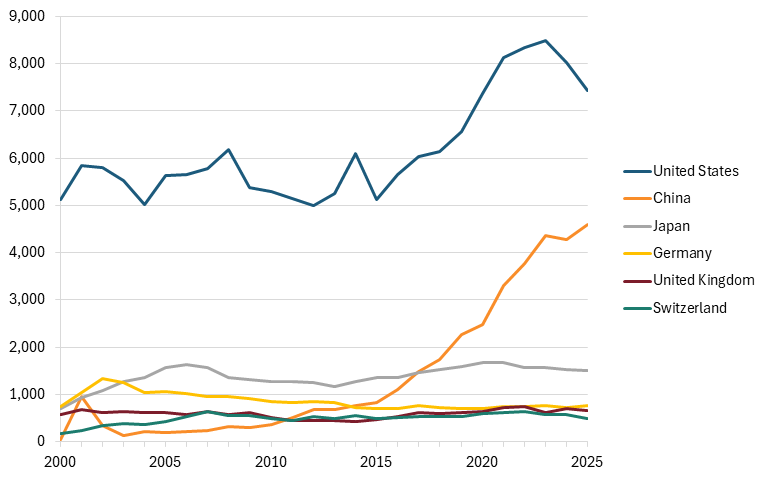
As of 2025, the United States led the world in patenting activity, but China has made great strides. In 2000, China accounted for just 14 patent publications in biopharmaceuticals under the Patent Cooperation Treaty (PCT), including 5 in biotechnology and another 9 in pharmaceuticals. But by 2025, this total had ballooned to 4,595, the second-highest number in the world behind the United States, whose innovators published 7,431 patents that year. Notably, the PCT publishes patents prior to their examination, so published patents are not necessarily granted.[48] (See figure 1.)
Figure 1: PCT patent publications in biotechnology and pharmaceuticals, 2000–2025[49]
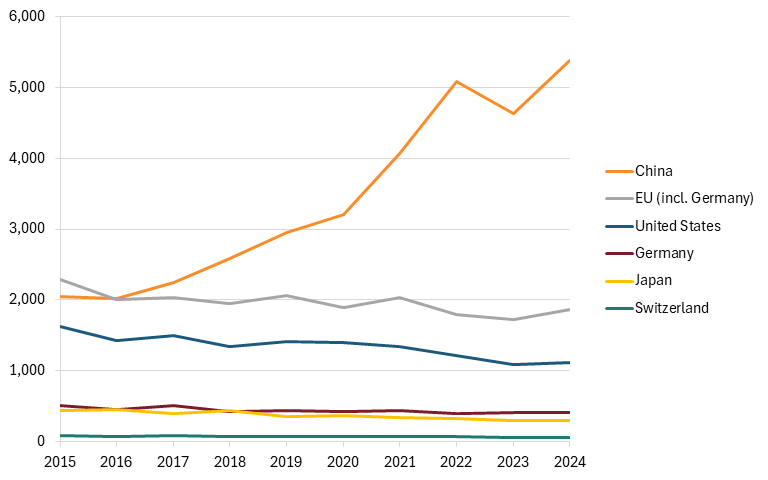
Though the United States leads China in patent activity, China has considerably surpassed the United States (and the rest of the world) in scientific publications in biotechnology. Over the decade from 2015 to 2024, the number of biotechnology publications in China increased by 162 percent, from about 2.1 million to 5.4 million. Over the same period, publications in the European Union and the United States declined by 19 percent and 31 percent, respectively.[50] (See figure 2.)
Figure 2: Scientific publications in biotechnology, 2015–2024[51]
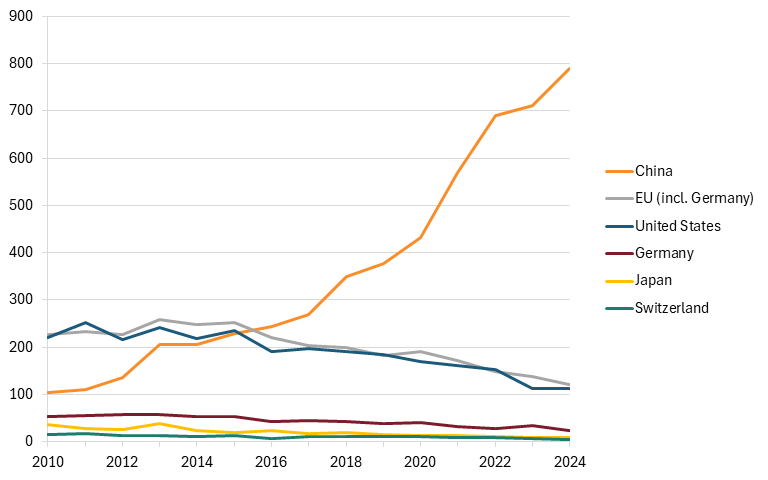
A country’s number of publications in absolute terms in a given field is a less-than-ideal measure of innovation, given that China’s population is roughly four times that of the United States and the prevalence of “paper mills” in China increases the likelihood of fraudulent publications by Chinese institutions.[52] However, the Organization for Economic Cooperation and Development (OECD) provides data on highly cited publications by technology area, which can control for the prevalence of fraudulent papers.
In 2024, China also led the world in highly cited biotech publications, with nearly 800 papers, compared with the next-closest region, the EU, at 122. The United States had 112.[53] (See figure 3.)
Figure 3: Biotech publications among the top 10 percent of the world’s most cited publications, 2015–2024[54]
Research and Development
The biopharmaceutical industry is heavily reliant on R&D investment, with the average Western firm investing about 20 percent of its annual revenue in R&D. Interestingly, Chinese firms invest just half that, or 10 percent of their annual revenue.[55]
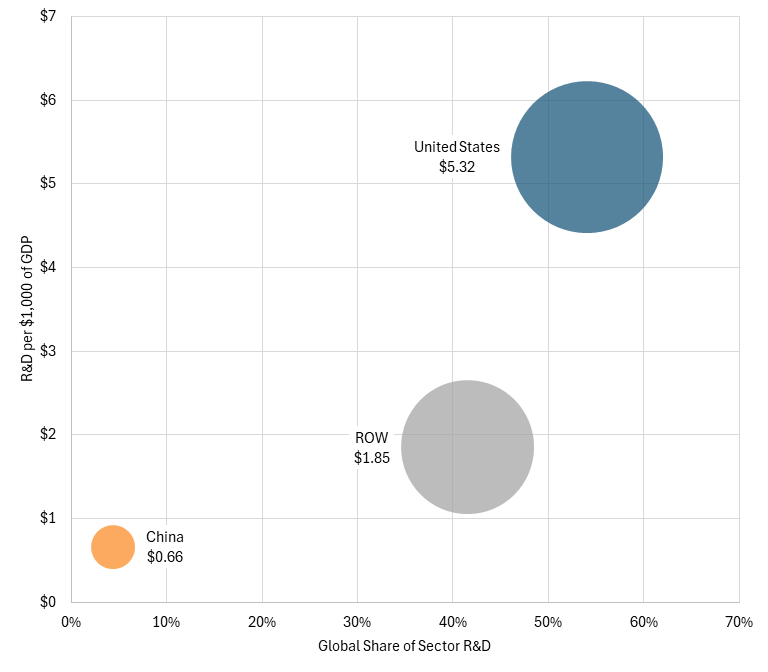
The United States leads the world in private sector R&D investment in the biopharmaceutical sector by a sizeable margin. In 2024, U.S. firms invested $153 billion in R&D, equivalent to 54 percent of global R&D investment in this sector. In comparison, Chinese firms invested about $12 billion, or 4 percent of global investment and just 8 percent of U.S. private-sector investment. When controlling for GDP, U.S. firms invested $5.32 per $1,000 of GDP, compared with just $0.66 per $1,000 of GDP for Chinese firms.[56] (See figure 4.) China also invested less than the rest of the world (ROW) did, which averaged $1.85 per $1,000 of GDP.
However, China is rapidly closing the gap. Between 2014 and 2024, Chinese firms’ share of global biopharmaceutical R&D investment quadrupled, while the United States experienced only a 20 percent increase. Additionally, it’s important to recognize that, on a wage-adjusted basis, every dollar of R&D investment in China goes further than in the United States. For every $100,000 in R&D investment, the United States supports 1 R&D worker while a Chinese firm can deploy 2.3 workers, thereby increasing the amount of research that can be conducted with the same investment.[57]
Figure 4: U.S. and Chinese firms’ R&D investments in pharmaceuticals and biotechnology, 2024[58]
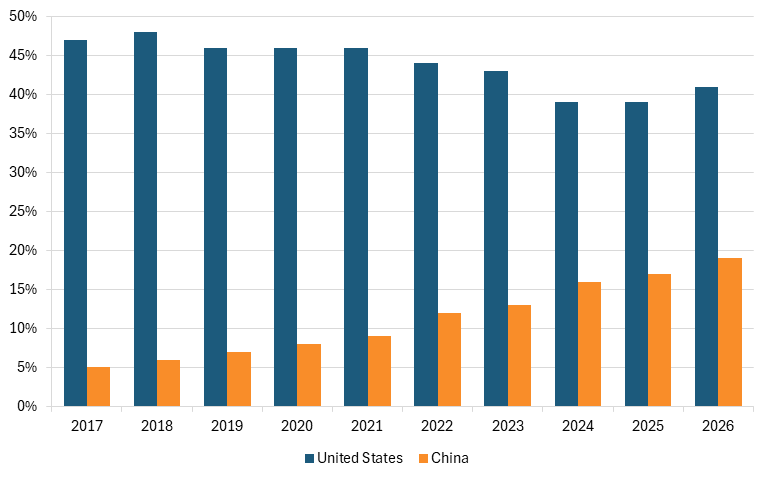
The number of biopharma firms engaged in R&D in China has also grown in recent years, in tandem with R&D investment. From 2017 to 2026, the share of global companies involved in biopharmaceutical R&D in China has grown from just 5 percent to nearly 20 percent, while the share of firms in the United States has declined from a high of 48 percent to 41 percent in 2026.[59] (See figure 5.)
Figure 5: Share of global companies involved in biopharmaceutical R&D, 2017–2026[60]
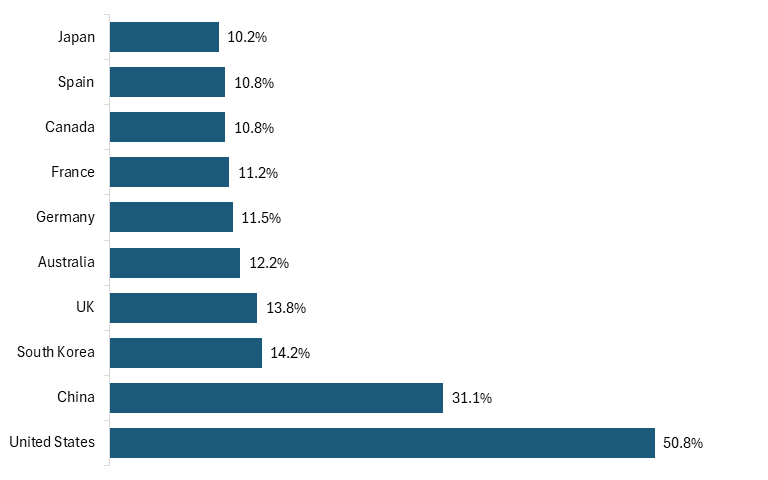
While firms may invest heavily in biopharmaceutical R&D, that research is not necessarily conducted in the country where the company is headquartered. Understanding where drug development actually occurs provides a more complete picture of the scientific workforce, research infrastructure, and innovation resources supporting the industry. Figure 6 shows what percentage of the global drug pipeline is developed by each country. (Notably, as drugs can be developed in more than one country, the percentages do not add to 100 percent.) More than 50 percent of drugs under development globally, or 11,662, were at least partially developed in the United States in 2026, an increase from 2025. Comparatively, China accounts for 7,141 drugs, or 31.1 percent, of the new drug pipeline.[61] (See figure 6.)
Figure 6: Share of global drug development conducted by country, 2026[62]
International Competitiveness Comparisons
This section analyzes international comparisons of national biopharmaceutical competitiveness, assessing global market shares, LQs, trade balances, and value-added output.
Share of Global Pharmaceutical Industry Output
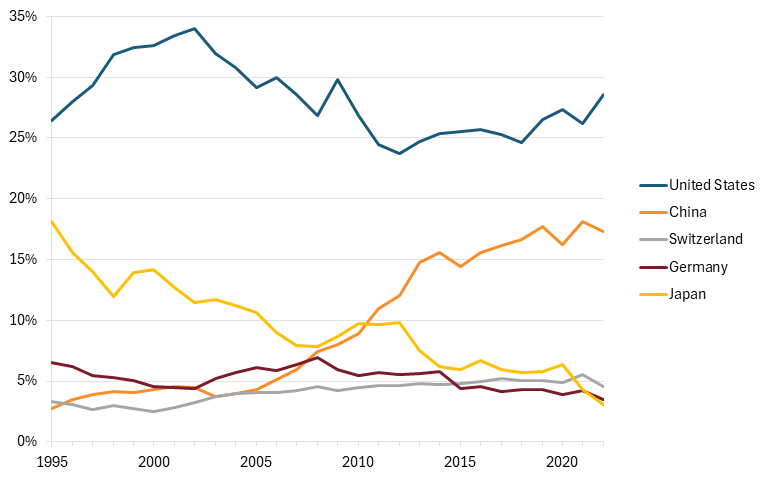
As Chinese firms have ramped up investment in biopharmaceutical R&D, China’s share of global output (i.e., global market share) has grown accordingly. OECD’s Trade in Value Added dataset includes data on value-added output for selected industries from 1995 to 2022. Over this period, China’s global market share increased over sixfold, from an insignificant 2.7 percent to 17.3 percent, second only to the United States. The United States, meanwhile, saw its market share increase only marginally, from 26.5 percent to 28.6 percent, though it is still the dominant leader on this metric.[63] (See figure 7.) Japan’s contraction in share of global pharmaceutical industry output was quite pronounced over this period.
Figure 7: Countries’ share of global pharmaceutical industry output, 1995–2022[64]
Location Quotient
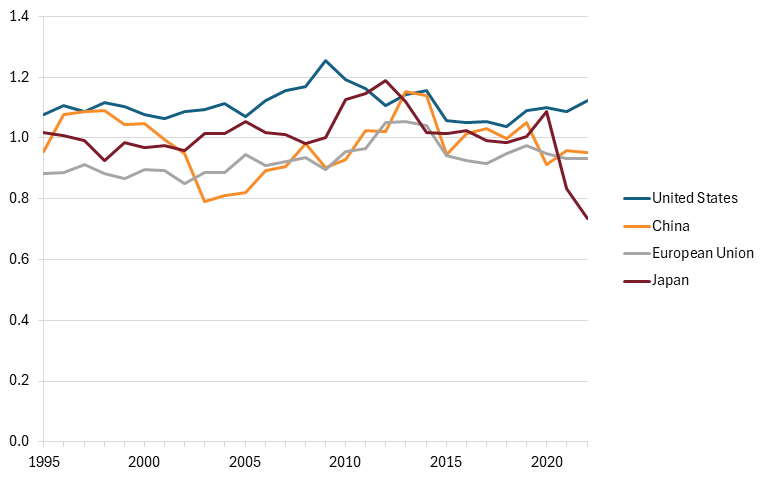
An LQ measures any region’s level of industrial specialization relative to that of a larger geographic unit—in this case, an industry within a country relative to the rest of the world.[65] An LQ of 1 for a given industry indicates that that industry contributes as much to a nation’s economy as that industry contributes to the global economy. The indicator thus demonstrates countries’ relative specializations in certain industries and how their industries are performing relative to the global norm.
As with global market share, the United States leads China in terms of LQ, with a score of 1.12, overperforming the global average, while China posts an LQ of 0.95. China’s LQ fluctuated around average for much of the period from 1995 to 2022, starting at 0.96 in 1995, falling to a low of 0.79 in 2003, and reaching a high of 1.15 in 2013 before settling at its current level, demonstrating that its pharmaceutical industry is growing at or near the same pace as the rest of its economy. (See figure 8.) China’s LQ exceeds that of the EU and Japan, which post LQs of 0.93 and 0.74, respectively.
Figure 8: Selected countries’ LQ in pharmaceuticals, 1995–2022[66]
Trade Balances
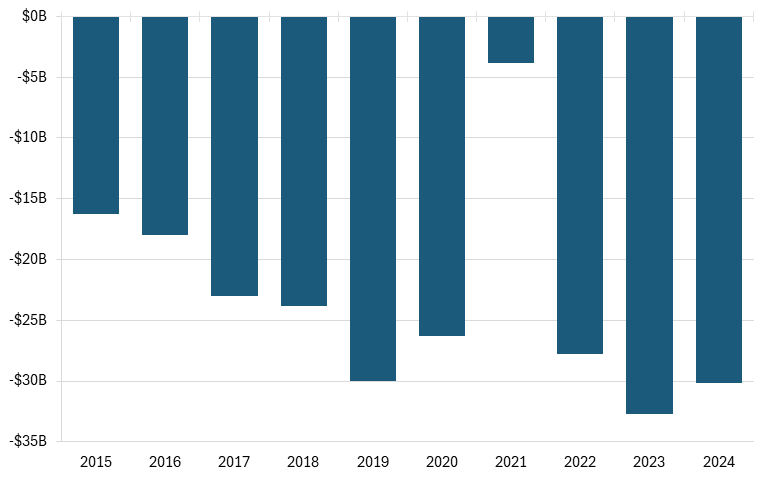
In terms of trade, China ran a persistent trade deficit in pharmaceutical products over the decade from 2015 to 2024. In inflation-adjusted terms, China’s deficit remained above $15 billion annually except in 2019, peaking at nearly $33 billion in 2023. Between 2015 and 2024, China accumulated a $232 billion trade deficit in pharmaceutical products (one-quarter of the United States’ deficit in this sector).[67] (See figure 9.)
However, the United States remains highly dependent on China for key starting materials (KSMs) used to develop active pharmaceutical ingredients (APIs), with 41 percent of KSMs originating in China.[68] (A subsequent section of this report examines China’s API leadership.) Despite this, China runs a trade deficit with the United States due to its dependence on high-value finished medications imported from the United States. As Chinese firms continue to develop innovative, high-value pharmaceuticals, there is potential for China’s deficit to decrease (if not reverse).
Figure 9: China’s trade balance in pharmaceutical products, 2015–2024 (2024 dollars)[69]
Value-Added Output
The cumulative effect of China’s investments in research, talent, clinical development, and advanced therapeutic technologies is increasingly visible in measures of industry output. While the United States remains the world’s leading biopharmaceutical producer, China’s industry has expanded dramatically over the last two decades and is now competing directly with established pharmaceutical powers in Europe, Japan, and North America.
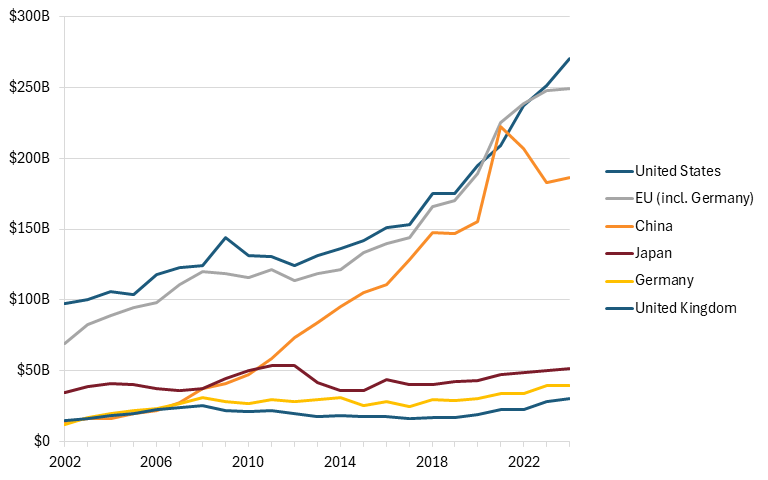
From 2002 to 2024, China’s value-added output in the global pharmaceuticals industry grew nearly 13-fold, from $14.5 billion to $187 billion.
Though the United States continues to generate the highest level of pharmaceutical output globally, China’s output increased from just $14.5 billion in 2002 to nearly $187 billion in 2024, representing a more than 13-fold increase over the period. Overall, China’s value-added output in the pharmaceutical industry increased by 94 percent between 2022 and 2024, about 10 percent annually.[70] (See figure 10.)
Figure 10: Select countries’ value-added output in pharmaceuticals, 2022–2024[71]
China’s growing biopharmaceutical capabilities are increasingly being reflected in the world’s largest drugmakers by pipeline size. Pipeline size measures the number of active drug candidates a company has under development. While U.S. and European firms continue to dominate the rankings, 3 Chinese companies now rank among the world’s 20 largest pharmaceutical pipelines. Jiangsu Hengrui Pharmaceuticals ranks 12th globally with 178 active drug candidates, while Sino Biopharmaceutical and CSPC Pharmaceutical rank 15th and 16th, respectively. Notably, each Chinese firm has either maintained its position or moved up the rankings since 2025, with Jiangsu Hengrui moving from 13th to 12th and CSPC Pharma rising from 19th to 16th.[72] (See table 1.)
Table 1: Top 20 pharma companies by size of pipeline, 2026[73]
|
2026 Position (vs. 2025) |
Company |
Country of HQ |
Active Drugs, 2026 (vs. 2025) |
Originated Drugs, 2026 |
|
1 (2) |
Roche |
Switzerland |
262 (261) |
147 |
|
2 (4) |
AstraZeneca |
United Kingdom |
261 (241) |
166 |
|
3 (1) |
Pfizer |
United States |
257 (271) |
163 |
|
4 (5) |
Sanofi |
France |
251 (233) |
135 |
|
5 (3) |
Novartis |
Switzerland |
244 (254) |
137 |
|
6 (7) |
Eli Lilly |
United States |
233 (224) |
138 |
|
7 (6) |
Bristol Myers Squibb |
United States |
214 (227) |
124 |
|
8 (8) |
Merck & Co. |
United States |
207 (216) |
103 |
|
9 (11) |
AbbVie |
United States |
200 (190) |
76 |
|
10 (9) |
Johnson & Johnson |
United States |
198 (200) |
111 |
|
11 (10) |
GSK |
United Kingdom |
185 (194) |
88 |
|
12 (13) |
Jiangsu Hengrui Pharmaceuticals |
China |
178 (173) |
163 |
|
13 (12) |
Takeda |
Japan |
167 (187) |
61 |
|
14 (14) |
Boehringer Ingelheim |
Germany |
143 (133) |
90 |
|
15 (15) |
Sino Biopharmaceutical |
China |
119 (125) |
93 |
|
16 (19) |
CSPC Pharmaceutical |
China |
117 (102) |
96 |
|
17 (22) |
Novo Nordisk |
Denmark |
109 (97) |
70 |
|
18 (17) |
Gilead Sciences |
United States |
107 (106) |
67 |
|
19 (16) |
Otsuka Holdings |
Japan |
107 (114) |
57 |
|
20 (18) |
Bayer |
Germany |
100 (104) |
65 |
Clinical Trials and Drug Development
Increases in R&D investment and innovation outputs have contributed to China’s growing success in the biopharmaceutical industry, but these are not the only factors. China has developed efficiencies in the clinical trial phase of drug development that have contributed to legitimate time and cost savings for drug developers. For example, the China Food and Drug Administration, the precursor to what is now the National Medical Products Administration (NMPA), adopted and gradually implemented the International Council for Harmonization of Technical Requirements for Pharmaceuticals for Human Use guidelines, enabling China’s drug administration to align with international standards.[74] NMPA also instituted a series of reforms designed to accelerate drug development, including expanding reviewer capacity, modernizing the registration classification system, and allowing researchers to begin testing drugs quickly rather than waiting several months for clearance (as is the case in Western nations).[75] From 2015 to 2018 alone, the time it took to secure approval for human trials in China shrank from 501 days to 87.[76] Additionally, patient enrollment in Chinese tertiary hospitals is 5 to 10 times higher than at American academic medical centers, increasing patient availability and the speed of trial enrollment. Per-patient costs are also lower in China.[77]
Chinese firms can now take a drug from discovery to the start of human trials in about half the global industry’s average time.
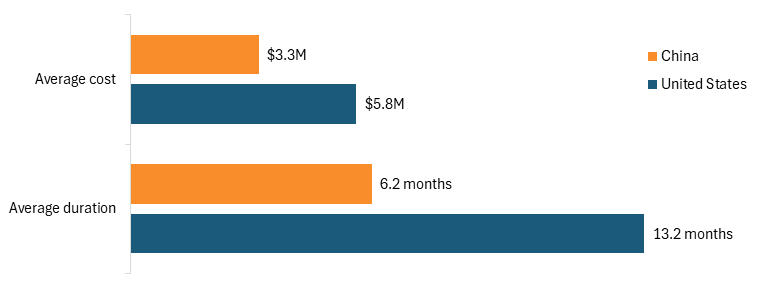
According to a McKinsey report, these process improvements have sped up the timeline from early discovery to new drug application in China by 50 to 70 percent.[78] In total, Chinese firms can now take a drug from discovery to the start of human trials in about half the global industry’s average time.[79] Research from PhRMA finds that the average duration of a phase I clinical trial conducted in China in 2025 was over 50 percent shorter than phase I trials conducted in the United States. Similarly, the average cost of a phase I clinical trial in China was 43 percent less expensive than a phase I trial in the United States.[80] (See figure 11.)
Figure 11: Average cost and duration of U.S. and Chinese phase I clinical trials, all disease areas, 2025[81]
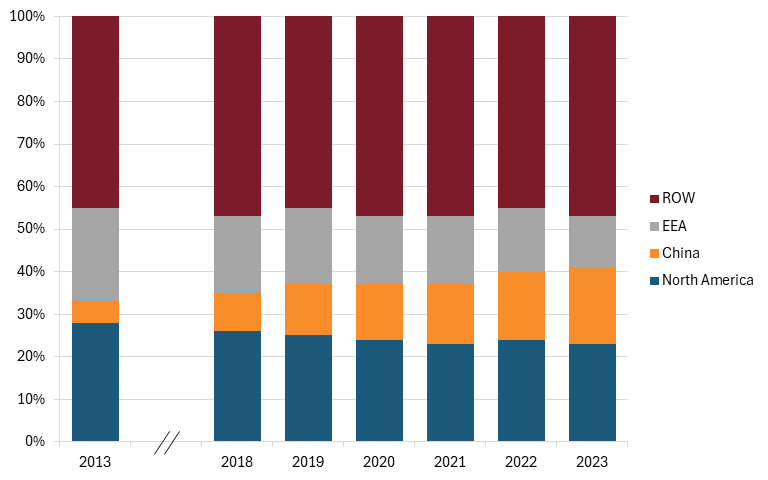
Given the comparative advantage Chinese firms have in completing clinical trials faster and more cheaply than American competitors can, it’s unsurprising that Chinese firms have continued to increase the number of clinical trials they’ve started each year since 2013. In 2013, clinical trial starts in China accounted for 5 percent of all global trials, compared with 28 percent in North America (the majority of which occurred in the United States). By 2023, China accounted for 18 percent of all clinical trials, just 5 percentage points behind North America and more than double the European Economic Area (EEA), which accounted for just 12 percent, a decline from its high of 22 percent in 2013.[82] (See figure 12.)
Figure 12: Percentage of global commercial clinical trial starts by region, 2013–2023[83]
Beyond clinical trials broadly, China is also catching up to the United States in trials of the most-innovative drugs, including those with new mechanisms of action or that use advanced technologies to treat diseases. In 2016, just 5 percent of global clinical trials for innovative drugs were conducted in China, compared with 45 percent in the United States. This gap has now shrunk substantially, with 30 percent of all innovative drug trials taking place in China—a 500 percent increase—compared with 33 percent in the United States.[84] (See figure 13.)
Figure 13: China and U.S. companies’ share of worldwide clinical trials for innovative drugs, 2016–2025[85]
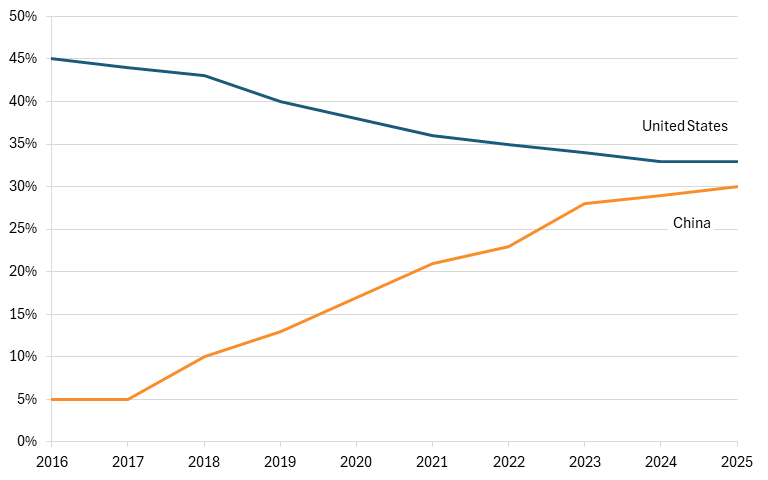
China is catching up to the United States in trials of the most innovative drugs, including those with new mechanisms of action or that use advanced technologies to treat diseases.
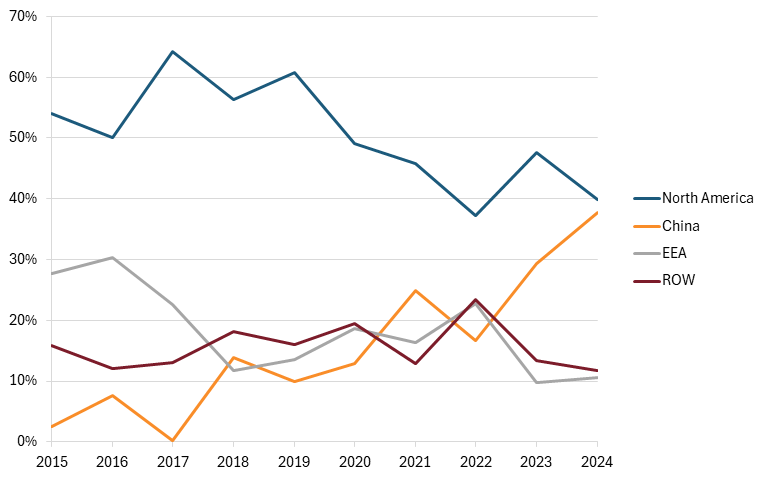
Not only are innovative drugs in China being tested in clinical trials in large numbers, but also those trials are yielding approvals. Approvals of innovative drugs out of China in 2015 accounted for just 3 percent of global drug approvals. North America, by comparison, was responsible for 54 percent, while the EEA was responsible for 28 percent. But in the years since, the quantity of innovative drugs approved in China has ballooned, increasing almost every year. Between 2023 and 2024 alone, the share of global approvals in China skyrocketed, increasing from 29 percent to 38 percent, while North American approvals fell from 48 percent to 40 percent. Just 11 percent of global drug approvals originated from the EEA in 2024.[86] (See figure 14.)
Figure 14: Percentage of first global approvals of innovative drugs, 2015–2024[87]
Out-Licensing Deals
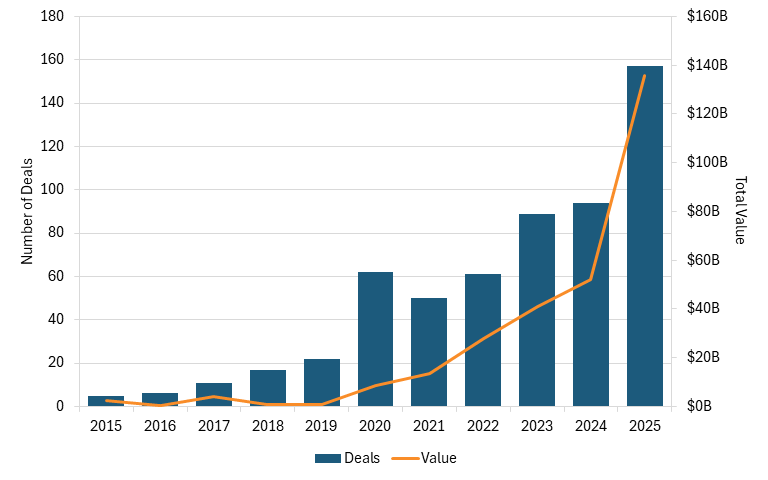
Out-licensing deals occur when a company that developed a treatment grants another organization the rights to develop, manufacture, or market that asset, allowing the developer to monetize their product. From 2015 to 2025, the number of out-licensing deals from China increased by a factor of 31, from 5 deals to 157. The value of these deals increased at an even greater rate. Between 2015 and 2025, the value of out-licensing deals increased by a factor of 54, from $2.5 billion to $135.7 billion, demonstrating the sheer financial growth of the Chinese biopharmaceutical industry over this time period. (See figure 15.) In the first quarter of 2026 alone, out-licensing deals were valued at $60 billion.[88]
Figure 15: China’s out-licensing deals and value, 2015–2025[89]
Between 2022 and 2026, the average upfront value of individual licensing deals between Chinese and Western companies more than tripled, from $52 million to $172 million.[90] In January 2026, AstraZeneca paid CSPC Pharmaceuticals $1.2 billion upfront for its portfolio of weight loss drugs, with the promise of an additional $13.8 billion in milestone payments.[91] In May, Bristol Myers Squibb partnered with Hengrui Pharma to jointly develop 13 programs, paying $600 million upfront and promising up to $15.2 billion should the treatments achieve commercial targets.[92]
From 2015 to 2025, the number of out-licensing deals from China increased by a factor of 31, from 5 deals to 157.
Similarly, in-licensing allows a firm to license the rights of a product from another firm. In 2025, China accounted for 48 percent, nearly half, of global pharmaceutical in-licensing deals, up from a mere 5 percent five years prior.[93]
Emerging Therapies
China is no longer merely a low-cost manufacturer of pharmaceutical products; it is increasingly competing in some of the industry’s most advanced and commercially valuable therapeutic areas. These emerging modalities often command premium prices and generate higher profit margins, making them attractive targets for investment and research. Chinese firms have strategically focused on identifying high-growth therapeutic categories and emerging technologies wherein future demand and commercial potential are greatest.[94] As a result, Chinese biopharmaceutical companies have established leading positions in several cutting-edge fields, demonstrating a growing capacity not only to manufacture medicines, but also to innovate at the technological frontier.
The following section explores China’s advancements in four of these therapeutic areas: oncology, RNA interference (RNAi), antibody drug conjugates (ADCs), and gene therapies.
Oncology
Among therapeutic areas, China has become particularly competitive in oncology drug development, throwing much of its biopharmaceutical weight at the field. Several of China’s largest biopharmaceutical firms, including BeiGene, the largest pharmaceutical R&D investor in the country, specialize in oncology and immune-oncology drug development.[95] BeiGene has developed three approved drugs, including one, Brukinsa, that has been approved in over 70 countries and regions, including the United States.[96]
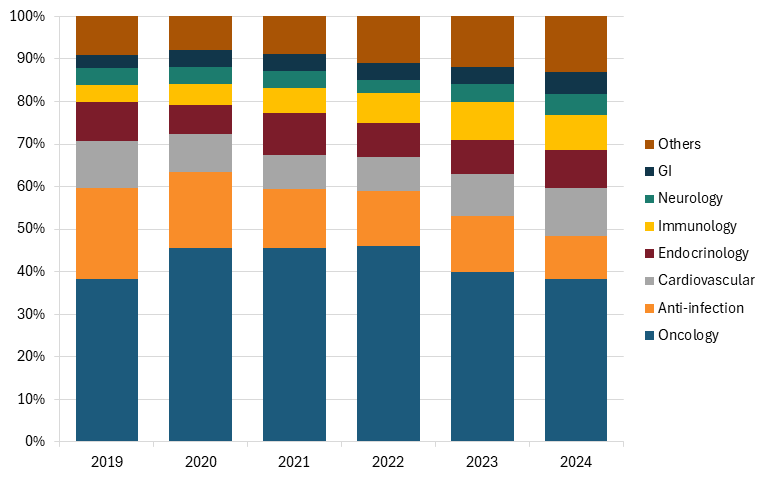
Between 2019 and 2024, oncology clinical trials in China accounted for as much as 46 percent of all clinical trials in the country, although that share fell to 38 percent in 2024. However, compared with other therapies, oncology was over three times higher than the next closest therapeutic area, cardiovascular treatments, in new clinical trial starts.[97] (See figure 16.)
Figure 16: Share of newly started clinical trials in China by therapeutic area, 2019–2024[98]
Chinese cancer therapies have been especially attractive for licensing and approval for U.S. pharma companies. In July 2025, Pfizer licensed a cancer treatment from 3SBio for $1.25 billion, $4.8 billion in milestone payments, and $100 million in equity.[99] In May, Pfizer paid Innovent $650 million upfront, with possible payouts of $9.85 billion, to partner on the development of 12 cancer medications.[100] Overall, oncology drugs accounted for nearly 50 percent of all global licensing deals made by China in 2024, or 23 drug therapies. (See table 2.)
One of the drugs that has gotten particular attention from pharmaceutical companies globally is ivonescimab, an experimental lung cancer drug developed by Chinese firm Akeso Biopharma.[101] The drug, which was licensed by the U.S. firm Summit Therapeutics, reduced the risk of death by 34 percent in patients who received it in a late-stage clinical trial, keeping patients alive for four months longer than the control treatment did.[102]
Table 2: Number of global licensing deals by Chinese firms by therapeutic area[103]
|
Therapeutic Area |
2020 |
2024 |
|
Oncology |
11 |
23 |
|
Immunology and inflammation |
1 |
14 |
|
Cardiometabolic |
1 |
7 |
|
Infectious diseases |
3 |
1 |
|
Ophthalmology |
1 |
0 |
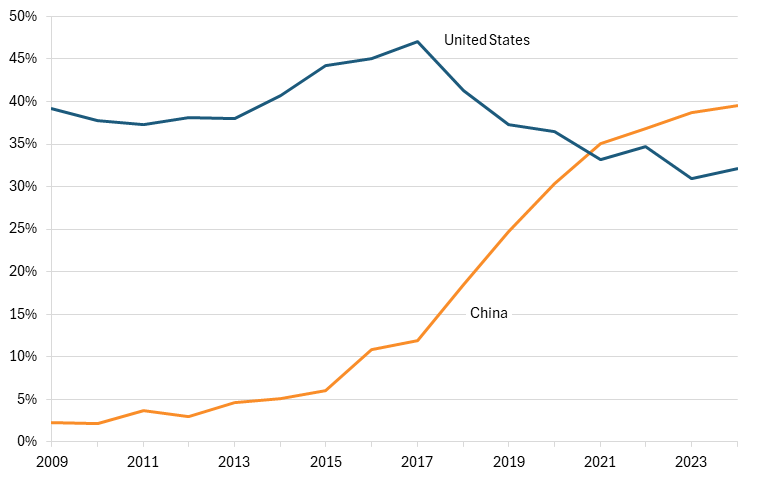
In many respects, China is now beating the United States in oncology R&D. In 2024, China overtook the United States in research output in oncology for the first time, with over 2,600 research publications compared with 2,481 from the United States.[104] Additionally, according to a report from IQVIA, China-based companies accounted for 39 percent of global oncology clinical trial starts in 2024, up from only 5 percent in 2014. (See figure 17.) China surpassed the United States in share of global oncology clinical trial starts in 2021, now accounting for a 7 percentage point higher share than the United States. Between 2020 and 2024, China launched 84 new active substances in oncology, more than double the 37 it had launched from 2015 to 2019.[105]
Figure 17: Share of oncology trial starts by company headquarters location, 2009–2024[106]
Despite China’s great strides in oncological drug development, barriers remain. Though a few drugs, such as the Chinese medications Fruzaqla and Ryzneuta, have been approved for the U.S. market, there are still high barriers to approval, with some U.S. Food and Drug Administration (FDA) regulators simply refusing to approve drugs based on data that was collected in China.[107] There is also a lack of evidence that Chinese cancer drugs, such as ivonescimab, are more effective than existing U.S. therapies. In clinical trials, ivonescimab was tested against a control drug that is not approved in the United States, and it was not compared with the typical immunotherapy drug offered in the United States, Merck’s lung cancer medication Keytruda. Therefore, it’s unclear if ivonescimab is more effective and extends lives longer than Keytruda does.[108]
U.S. companies were the first to create multicancer early detection (MCED) technologies that could drastically improve cancer detection and treatability.[109] MCEDs have the potential to detect dozens of cancers accurately and provide a novel avenue to identify cancers that lack routine screening approaches. Cancers not only remain a significant health challenge to Americans, but also cause significant economic burden, making it imperative that the United States continue to lead in cancer detection tools such as MCEDs.
However, a growing number of highly competitive Chinese companies are becoming key innovators in the MCED space. The recent PROFOUND MCED study sponsored by Shanghai Weihe Medical Laboratories in collaboration with Peking University demonstrates that their emerging liquid biopsy-based MCED test could be relatively effectively tailored to 16 types of cancer that account for approximately 85 percent of total cancer incidences in China, showing an overall sensitivity of 70.6 percent.[110] This study is not just a one-off success story; numerous other Chinese companies are becoming increasingly competitive in the MCED space—including Burning Rock DX, Berry Oncology, and Geneseeq—allowing China to rapidly approach dominance in the MCED sector.
Leadership in MCED technology is still unfolding, but U.S. leadership in this critical field can’t be taken for granted as Chinese competitors become increasingly more entrenched. U.S. leadership in MCED technology not only prevents reliance on foreign adversaries for access to cancer-screening tools, but also safeguards the personal genomic data of U.S. citizens.
RNA Interference
RNAi is a cutting-edge therapeutic technology that uses short RNA strands to selectively silence disease-causing genes before they produce harmful proteins. Unlike traditional small-molecule therapies, RNAi therapies intervene earlier in the disease process, enabling treatment of conditions that were previously difficult or impossible to address. The technology represents one of the most promising areas of modern biopharmaceutical innovation, leading to the development of multiple approved therapies and attracting significant investment.
RNAi is likely to play an increasingly important role in the next generation of medicines, particularly in China. Chinese firms pursuing RNAi programs have become increasingly plentiful, with at least 12 RNAi development companies in China in 2025, most of which were founded in the last decade and 4 of which were founded since 2020. (See table 3.) Since 2024, four licensing deals for RNAi programs developed in China have been announced, each with the potential to generate $1 billion in value. There is also still substantially more activity occurring in the Chinese RNAi pipeline beyond these four programs. Chinese RNAi firms collectively are now operating 22 clinical-stage programs, 75 preclinical programs, and 11 partnered programs as of 2025. Considering this, there is a high potential for more high-value RNAi deals coming from China in the future.[111]
Table 3: China’s RNAi products, 2025[112]
|
Company |
Founded |
Lead Stage |
Clinical Programs |
Preclinical Programs |
Partnered Programs |
Private/Public |
|
Argo |
2021 |
Ph II |
7 |
34 |
4 |
Private |
|
Ribo |
2007 |
Ph II |
7 |
11 |
3 |
Private, in HKEX IPO queue |
|
Rona |
2021 |
Ph II |
3 |
12 |
0 |
Private |
|
Hengrui Pharmaceuticals |
1970 |
Ph II |
1 |
0 |
0 |
Public |
|
Hepa Thera Bio |
2021 |
Ph II |
1 |
0 |
0 |
Private |
|
Anlong Bio |
2019 |
Ph I |
1 |
11 |
3 |
Private |
|
Haichang |
2013 |
Ph I |
1 |
0 |
0 |
Private |
|
Sino Biopharm |
2000 |
Ph I |
1 |
0 |
0 |
Public |
|
SiranBio |
2022 |
Preclin |
0 |
4 |
0 |
Private |
|
Ractigen |
2016 |
Preclin |
1 |
0 |
0 |
Private |
|
Mabwell |
2017 |
Preclin |
0 |
1 |
1 |
Public |
|
Junshi |
2012 |
Preclin |
0 |
1 |
0 |
Public |
|
Total |
|
22 |
75 |
11 |
|
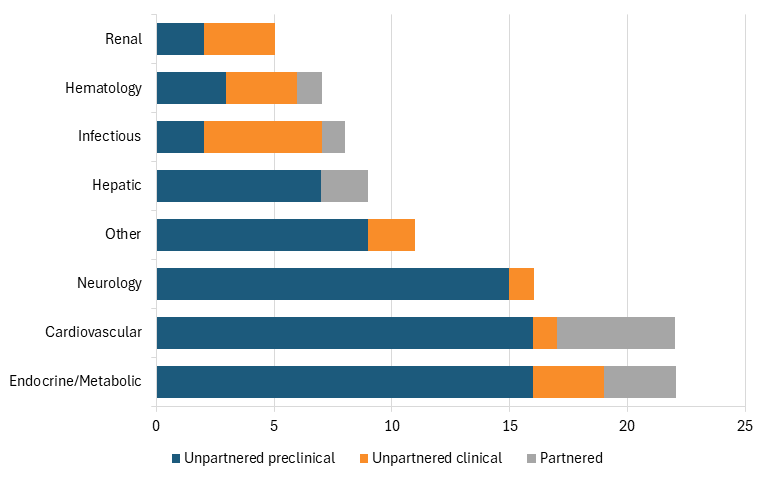
China’s RNAi development pipeline is growing in scale and breadth. The largest concentrations of programs are in endocrine and metabolic diseases and cardiovascular treatments, each accounting for roughly one-quarter of all Chinese RNAi programs. There is also a significant amount of activity in the neurology sector, with about 16 programs. (See figure 18.) Importantly, RNAi research activity in China spans both clinical and preclinical stages, suggesting that Chinese firms are building a long-term pipeline of RNAi assets.[113]
Figure 18: China’s biotech RNAi programs, 2025[114]
Antibody Drug Conjugates
ADCs represent a type of biologic drug used to treat cancer by combining targeted antibodies with cytotoxic small-molecule drugs. These emerging drug treatments have demonstrated higher efficacy rates in treating cancer and also present a safer form of treatment than chemotherapy does. ADC development has grown substantially over the past several years, with first disclosures increasing from 406 in 2021 to a high of 795 in 2024, nearly a 100 percent increase.[115]
China surpassed the United States in the share of global oncology clinical trial starts in 2021, now accounting for 39 percent of global trials, compared with 32 percent in the United States.
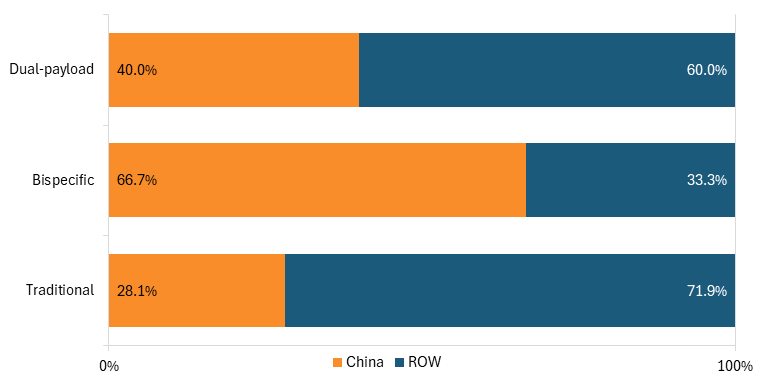
ADCs represent a class of drugs that Chinese companies have intentionally targeted, making China the world leader in the ADC pipeline with more than 42 percent of the global share.[116] Chinese firms have gained particular dominance in next-generation ADC modalities, including bispecific and dual-payload ADCs, accounting for 67 percent and 40 percent of all first drug disclosures, respectively, in 2025. (See figure 19.)
Figure 19: Number of ADC drug disclosures by China and elsewhere, 2025 (through October)[117]
ADC drug trials have also grown rapidly, with the number of global trials increasing by 34 percent annually. Yet the rate of trial growth has been even greater in China, with trials growing at a rapid 54 percent annually. As with clinical trials generally, Chinese ADC developers benefit from the lack of regulatory and logistical hurdles in clinical trial facilitation in China, including low trial costs and access to a large patient pool.[118] As of 2023, ADC clinical trials in China accounted for over half of all global ADC trials. (See figure 20.)
Figure 20: ADC trials initiated in China and elsewhere, 2020–2025[119]
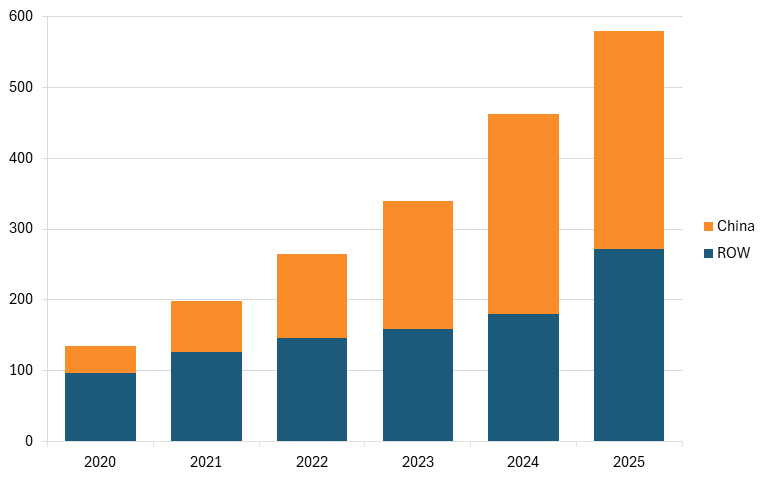
Due to its leadership in ADC innovation and development, China has also become established as a key market for deal-making. Deal-making is a critical component of pharmaceutical innovation and commercialization, with over 70 percent of revenue from new drug development coming from externally sourced, or licensed, products.[120] The number of ADC deals in China grew at an average rate of 18 percent annually between 2015 and 2025, with deal value reaching $24 billion in 2025. Licensing agreements alone were valued at over $60 billion cumulatively from 2020 to 2025.[121]
China’s leadership in ADCs is indicative of a broader shift in the global biopharmaceutical landscape. The country’s dominance in drug disclosures, clinical trials, and licensing activity suggests that Chinese firms are becoming increasingly capable of identifying, developing, and commercializing frontier therapies at scale.
Gene Therapy
Gene therapies constitute a class of treatments that modify a patient’s genetic material to treat diseases. Unlike traditional pharmaceuticals, gene therapies target the underlying genetic cause of a disease by replacing, repairing, inactivating, or introducing genes in a patient’s cells.[122] Gene therapies are also among the most expensive pharmaceutical therapies because they require complex, bespoke manufacturing and often target only small patient populations, resulting in costs of millions of dollars per dose.[123] And due to these high fixed costs, gene therapies were long considered “competition-proof.”[124]
U.S. and other North American firms have historically led in gene therapy manufacturing, with 9 of the top 10 most expensive gene therapy treatments produced by firms headquartered in the United States (the 10th is produced by the U.K. firm Orchard Therapeutics).[125] However, Chinese biopharmaceutical firms have entered the gene therapy market and begun producing therapies at a fraction of the cost of their Western competitors. One such firm, Belief BioMed, developed the first domestically manufactured gene therapy treatment for hemophilia in China. The product sold for just 1/10th the price of the U.S.-produced rival therapy.
In an analysis of the 10 most expensive gene therapies, Endpoints News found that 48 of the 77 competitor drugs in development are from China. In comparison, 21 of the competitor drugs in development are from the United States, and only 7 are from Europe.[126] And the scale of Chinese competition is extensive. Four of the most expensive gene therapy treatments—Zynteglo, Roctavian, Casgevy, and Elevidys—each have at least seven Chinese competitors.[127]
As in other areas of biopharmaceutical development, China’s regulatory and cost advantages have enabled its firms to advance gene therapies more quickly and at a lower cost than Western competitors have. The regulatory path for first-in-human dosing is much faster in China than in Western countries, while the cost per patient is about 50 percent lower, enabling companies to pursue gene therapies for diseases that were previously seen as too high-risk.[128]
Though Chinese firms have succeeded in developing gene therapies, they are not yet at the level of U.S. and European firms in terms of commercialization. Demand for gene therapies within China remains constrained by their high cost, limiting the size of the domestic market for many treatments. Moreover, Chinese therapies have faced challenges entering the U.S. market due to difficulties obtaining FDA approval. Historically, the FDA has been reticent to approve Chinese therapies, creating a roadblock for firms looking to bring their drugs to wealthier markets.[129] Nevertheless, China’s growing capabilities in gene therapy development, combined with its advantages in clinical research and manufacturing, position its firms as increasingly formidable competitors to Western leaders in this strategic field.
Policy Recommendations
As this report explains, U.S. leadership of the global biopharmaceutical industry is at a clear and present risk. If the United States is going to maintain its lead in the field, it’s going to have to develop a serious biopharmaceutical competitiveness strategy, replete with a number of specific policy interventions. The United States needs to develop a comprehensive, whole-of-government strategy, with strong cross-agency collaboration, to advance U.S. biopharmaceutical competitiveness. This report offers policy recommendations grouped into four broad categories: ensuring U.S. biopharmaceutical innovation leadership; achieving biopharmaceutical manufacturing security; coordinating with allies to promote biopharmaceutical leadership in market-oriented, rule of law-based nations; and addressing the China biopharmaceutical threat specifically.
Ensuring U.S. Innovation Leadership
Most don’t realize that the United States was once a global “also ran” in biomedical innovation.[130] Indeed, in the latter half of the 1970s, European-headquartered enterprises introduced more than twice as many new drugs to the world as did those headquartered in the United States.[131] And throughout the 1980s, fewer than 10 percent of new active substances (i.e., new drugs) were first introduced to the world in the United States.[132] And, as recently as 1990, the global research-based pharmaceutical industry invested 50 percent more in Europe than in the United States.[133]
But in recent decades, the United States has flipped the script and come to clearly lead the world in both biopharmaceutical R&D and new drug innovation. For instance, life sciences companies operating in the United States are responsible for 55 percent of global R&D investments and 65 percent of development-stage funding.[134] Since 2020, PhRMA member companies have invested over $1 trillion in biopharmaceutical R&D. In 2021, the R&D intensity of life sciences companies conducting R&D in the United States reached 34 percent.[135] That research drives drug innovation. One study finds that U.S. innovators were solely responsible for 61 percent of medicines approved by the FDA from 2011 to 2020.[136] And those innovative medicines have been made available to Americans first. For instance, considering the availability of new medicines first launched globally from 2011 through 2019, 87 percent were available first in the United States.[137]
That the United States has become the global leader in life sciences innovation has been the result, in no small part, of a series of conscientious and intentional public policies designed to make it so.
That the United States has become the global leader in life sciences innovation has been the result, in no small part, of a series of conscientious and intentional public policies designed to make it so. These policies include significant federal investment in basic life sciences research (complementing and spurring private-sector investment), robust IP protections, effective technology transfer and commercialization policies, investment incentives, and, importantly, drug pricing policies that enable companies to invest in high-risk drug development. Unfortunately, each of these pillars of American biopharmaceutical innovation leadership is under threat.
Public Investment in Biopharmaceutical R&D
The U.S. federal government has long led the world in biopharmaceutical R&D investment. For instance, in 2023, NIH received a budget of $47.7 billion for medical research in service of the American people, 82 percent of which was awarded through extramural research via almost 50,000 competitive grants to more than 300,000 researchers at more than 2,500 universities, medical schools, and other research institutions in every state.[138] NIH investments have provided a powerful engine of economic growth.[139] Over the past decade, NIH funding has generated more than $787 billion in new economic output and supported an average of 370,000 jobs annually across all 50 states.[140] In 2024 alone, NIH awarded approximately $37 billion in research funding, supporting over 408,000 jobs and producing an estimated $94.5 billion in economic activity.[141]
Some contend that NIH investment crowds out private-sector life sciences R&D investment. For instance, a recent CATO report asserts, “This government domination [i.e., extensive NIH research funding] has reduced the effectiveness of biomedical research by crowding out new and innovative research.”[142] But the reality is quite the opposite. In fact, each NIH dollar invested yields roughly $2.50 in short-term economic returns and stimulates an additional $8.30 in long-term private-sector R&D investment, underscoring the strong multiplier effect of public science funding.[143] In short, public R&D investment stimulates private sector R&D investment and provides an indispensable catalyst for U.S. life sciences innovation.
Unfortunately, the Trump administration’s proposed FY 2026 budget proposal sought to reduce NIH funding by 40 percent, from roughly $48 billion in 2025 to about $27 billion in 2026—a staggering cut that called for elimination of entire institutes, including the National Institute on Minority Health and Health Disparities and the National Institute of Nursing Research.[144]
Fortunately, Congress rejected these proposals, providing NIH with a total program funding level of $47.49 billion in FY 2026.[145] Nevertheless, the Trump administration has persisted in calling for cuts to NIH funding, with the administration’s proposed FY 2027 budget, released on April 3, 2026, calling for 12 percent NIH cuts in FY 2027.[146]
But NIH cuts carry serious downstream implications for biopharmaceutical innovation. They prompt universities to pause or cancel hiring, delay clinical trials, and scale back or shut down labs. Because of this, modeling studies indicate that a sustained 10 percent reduction in NIH funding could reduce new drug launches by 4.5 percent a year—equivalent to roughly two fewer lifesaving medicines being developed annually.[147] For this reason, Congress should continue to reject calls for NIH funding cuts. Moreover, Congress should fund NIH in excess of $50 billion in FY 2027 and further assure that NIH funding in future years will increase, at the very least, at the rate of inflation.
Advancing U.S. Biopharmaceutical Innovation
In reports such as “Ensuring U.S. Biopharmaceutical Innovation,” the Information Technology and Innovation Foundation (ITIF) has laid out a comprehensive policy agenda for technology policy to support U.S. biopharmaceutical innovation. The following briefly summarizes some of these proposals.[148]
First, policymakers should pass legislation similar to the CHIPS Act for the biopharmaceutical industry, including allocating at least $5 billion to states to provide incentives for the establishment of new biomedical production facilities and supporting the launch of a joint industry-university-government R&D partnership to reduce the cost of drug development and production. This is akin to the recommendation made by the National Security Commission on Emerging Biotechnology in April 2025 that “the U.S. government should dedicate a minimum of $15 billion over the next five years to unleash more private capital into our national biotechnology sector.”[149]
Further, policymakers should expand U.S. National Science Foundation (NSF) support to university-industry research centers working on biopharma production technology and potentially establish new centers.[150] In particular, policymakers should increase funding for NSF’s Division of Engineering and target much of the increase to the Chemical Process Systems Cluster and Engineering Biology and Health Cluster.[151] The administration should also encourage the creation of the biopharma equivalent of the Semiconductor Research Corporation, a public-private consortium that develops long-term semiconductor technology roadmaps.[152] Lastly, the Trump administration should stand up another Manufacturing USA Institute alongside the National Institute for Innovation in Manufacturing Biopharmaceuticals that would focus on manufacturing innovations for APIs and generic drugs—fields in which China currently leads.
A Market-Based Drug Pricing System
America’s life sciences companies are devoted to developing innovative drugs that tackle some of the most difficult problems in biomedical science, including solutions to heretofore intractable challenges such as Alzheimer’s, Parkinson’s, pancreatic cancer, and rare diseases (which affect small patient populations of less than 10,000). But the work is difficult. That’s why developing a new medicine can take 10 to 15 years and, on average, cost upwards of $2.6 billion.[153] Life sciences companies need to earn revenues from their successful medicines in order to recoup the R&D costs of both their successful and failed efforts, and so they can garner revenues to invest in future generations of biomedical innovation. That’s why research finds a statistically significant positive relationship between a biopharma firm’s profits from the previous year and its R&D expenditures in the current year.[154] Other research makes this linkage direct, finding that every $2.5 billion of additional biopharmaceutical revenue leads to one new drug approval.[155]
If they persist over a 10-year period, MFN drug pricing policies could result in the loss of 210 new drug approvals, together with 290 post-approval indications, resulting in a combined loss of 500 drugs, or 50 per year, leading to approximately 6.6 million lives lost worldwide.
But recent drug price controls introduced by both the Biden and Trump administrations have disrupted market economics and are already having a significant deleterious impact on innovation. Drug price controls in the Biden administration’s Inflation Reduction Act (IRA) had an immediate and swift deleterious impact on drug innovation, especially for small molecule drugs.[156] Research firm Vital Transformations finds that, from September 2021 to 2024, small-molecule investment funding dropped by 70 percent (in the wake of the promulgation of the IRA legislation).[157] That coincided with a 2023 PhRMA study in which 78 percent of PhRMA member respondents reported that they expected to cancel early-stage small-molecule pipeline projects.[158] The IRA has already forced companies to halt more than 55 drug R&D programs since it became law.[159]
Most-Favored Nation (MFN) drug pricing policies proposed by the Trump administration could be even more damaging to U.S. biopharmaceutical innovation than the IRA drug price controls have been because they would apply to all drugs, not just the specific ones selected for price controls in the IRA. Tomas Philipson and his colleagues at the University of Chicago have found that applying MFN pricing policy to existing drugs in Medicare and Medicaid would reduce U.S. pharmaceutical revenues by 49 percent. They further found that if the drug price controls persisted over a 10-year horizon, the revenue shortfall would result in the loss of 210 new drug approvals, together with 290 post-approval indications, resulting in a combined loss of 500 drugs, or 50 per year. The authors associate this large cut in innovation with a loss of 516 million life-years, corresponding to approximately 6.6 million lives lost worldwide.[160] Especially in the face of burgeoning Chinese biopharmaceutical competitiveness, policymakers should repeal the IRA drug price controls and reject the Trump administration’s various MFN drug pricing proposals.[161]
An Effective Drug Regulatory System
One reason the United States lagged behind in drug innovation in the 1970s and 1980s was that it lacked an effective drug regulatory system to support life sciences innovators. At the time, it was not uncommon for pharmaceutical companies to wait several years for their submissions of clinical trial data and efficacy studies for novel drugs to even be examined.[162] The FDA simply lacked the resources it needed to handle the caseload, particularly when a flood of applications arrived in response to the AIDS crisis of the late 1980s. That’s why, in 1987, the median approval time for a new medicines stretched to over two and a half years. Moreover, in the late 1980s, over 60 percent of new medicines were on the market overseas for at least one year before they received approval in the United States.
Especially in the face of burgeoning Chinese biopharmaceutical competitiveness, policymakers should repeal the Inflation Reduction Act drug price controls and reject the Trump administration’s various MFN drug pricing proposals.
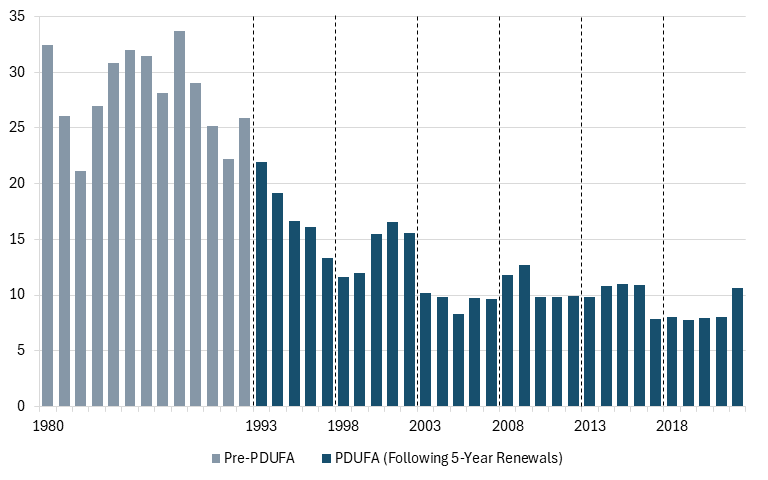
To help address this challenge, in 1992, Congress enacted the Prescription Drug User Fee Act (PDUFA), recognizing that industry user fees could supplement limited general-funds appropriations to ensure that the FDA had the needed resources at its disposal to review new drug applications in a timely manner. PDUFA paid dividends almost immediately. For instance, the U.S. General Accountability Office (GAO) found that the FDA increased its reviewer staff by 77 percent, and drug approval determination times dropped from 27 months to 14 months over the first 8 years of PDUFA.[163] By 2015, even while maintaining the FDA’s high standards for patient safety, the median drug approval time at the FDA had fallen by more than a year and a half (from 1992 levels) to under 10 months (a general timeframe that persists today).[164] (See figure 21.)
Figure 21: FDA new drug approvals median review time (in months), 1980–2022[165]
The United States should continue to explore possible reforms to streamline and accelerate clinical trial procedures, which will be important to consider as PDUFA comes up for reauthorization in 2027. Accelerating clinical trial timelines in the United States will require targeted reforms to regulatory processes that introduce delay without delivering commensurate gains in patient safety or scientific rigor. A central priority should be modernizing the investigational new drug (IND) process overseen by the FDA. Today, IND submissions often function as lengthy dossiers, even for early-stage studies, slowing trial initiation and increasing costs. The FDA should reorient the IND toward a high-level, risk-based document focused on essential safety information and establish a notification-based pathway for lower-risk studies, similar to Australia’s Clinical Trial Notification system, allowing sponsors to begin trials following Institutional Review Board (IRB) approval and notification. The agency has begun moving in this direction through a proposed Expedited IND pathway for certain Phase 1 trials, which would allow sponsors to rely more on existing preclinical data and reduce duplicative and time-consuming steps.[166] This approach would place greater reliance on IRBs to oversee early-stage trials and could be complemented by efforts to modernize IRB processes, including reducing administrative burden, improving review efficiency, and paying reviewers instead of relying solely on volunteers. Requiring a single, centralized IRB for multi-site trials would further help reduce duplicative review and avoidable delays.
Without reforms to clinical trial processes, the United States risks ceding a critical stage of the innovation pipeline; with them, it can accelerate time to proof of concept and retain a larger share of global R&D activity.
The United States could also increase the use of AI to improve clinical trial efficiency. Patient recruitment remains a major bottleneck, frequently delaying studies and increasing costs, with approximately 20 percent of trials failing to recruit the required number of participants. AI tools can identify eligible patients from electronic health records, optimize trial design, and predict high-enrollment locations. For example, Johnson & Johnson has used AI-driven platforms to improve site selection and recruitment efficiency.[167] More broadly, AI-enabled approaches can accelerate enrollment and improve the representativeness of trial populations.
These reforms are increasingly urgent from a competitiveness perspective. Early-stage clinical research is becoming more mobile, with phase I trials increasingly shifting to Australia and proof-of-concept studies increasingly conducted in China. In some cases, access to faster early-stage pathways has been decisive for whether new therapies receive funding. The United States should respond by reducing regulatory and administrative friction across the trial life cycle, including reforming policies that discourage patient participation, such as limits on compensation and gaps in coverage of trial-related costs. Without these changes, the United States risks ceding a critical stage of the innovation pipeline; with them, it can accelerate time to proof of concept and retain a larger share of global R&D activity.
Robust Intellectual Property Rights
Given the time, expense, and uncertainty that accompanies biopharmaceutical innovation, IP rights such as patents, exclusivities, and trade secrets are essential to incentivize innovators to undertake the risky and difficult proposition of life sciences innovation. This section briefly touches on several IP issues U.S. policymakers must get right in order to continue to ensure America leads in biopharmaceutical innovation.
The Bayh-Dole Act of 1980 created a framework for public-private collaboration, allowing universities to patent and license inventions arising from federal grants and becoming one of the most successful technology-transfer laws in history.[168] However, despite Bayh-Dole’s success, in recent years, some policymakers have sought to reinterpret one provision of the act: march-in rights, which allow the government, under limited circumstances, to require patent holders to license their inventions to others.[169] Recently, policymakers have asserted that march-in rights grant the government authority to regulate drug prices, although the law’s authors made clear that the authority was intended instead to ensure that inventions are actually developed and commercialized. The architects of the legislation, Senators Birch Bayh and Bob Dole, explicitly rejected the idea that march-in rights should be used to ensure “reasonable prices,” and the statute contains no such language.[170]
Despite this, proposals have emerged to use march-in rights as a drug-price control mechanism. For instance, the Biden administration floated draft guidance in 2023 that would have permitted governmental use of march-in rights on the basis of the resulting price of a product (though fortunately, it ultimately did not finalize the policy).[171] But weakening the certainty of access to IP rights provided under Bayh-Dole by employing march-in to address drug pricing issues—especially if doing so would give government entities the authority to walk in and retroactively commandeer innovations that private-sector enterprises invested hundreds of millions, if not billions, to create—would significantly diminish private businesses’ incentives to commercialize products supported by federally funded research.[172]
The first Trump administration directed the National Institute of Standards and Technology to review federal policies aimed at bolstering the return on federal R&D investments. That review reaffirmed that march-in rights both are a last resort and had never been used since the act’s passage to control prices.[173] NIH similarly determined that using march-in rights to control drug prices “was not within the scope and intent of the authority.”[174] Fortunately, the second Trump administration has signaled no plans to use march-in rights for this purpose. In January 2025, Department of Health and Human Services (HHS) Secretary Robert F. Kennedy Jr. stated that employing march-in rights to lower drug prices “would not be an appropriate use of march-in rights.”[175] Policymakers should continue to reject calls for the use of Bayh-Dole march-in rights to artificially control drug prices.
Related to this, some have called for misusing Section 1498 of the U.S. code, claiming it gives the government a right of eminent domain in all U.S. patents and, thus, the power of compulsory licensing over those patents. For instance, the civil society organization Public Citizen in February 2026 called on HHS to use Section 1498 to compulsorily license IP related to GLP-1s (glucagon-like-peptide-1 receptor agonists) in order to control the cost of weight-loss drugs.[176] The advocates sought to use Section 1498 to lower drug prices by asking the government to authorize a generic company to manufacture copies of the patented GLP-1 invention, presumably get those copies approved by the FDA, and then sell them at a low price for the government’s use. But this misreads (and indeed turns on its head) the entire intent and purpose of Section 1498.
Section 1498 states the following:
Whenever an invention described in and covered by a patent of the United States is used or manufactured by or for the United States [by a contractor, a subcontractor, or any person, firm, or corporation for the Government and with the authorization or consent of the Government] without license of the owner thereof or lawful right to use or manufacture the same, the owner’s remedy shall be by action against the United States in the United States Court of Federal Claims for the recovery of his reasonable and entire compensation for such use and manufacture.[177]
In other words, Section 1498 creates a private right of action against the U.S. government taking private IP; it does not confer upon the government the unlimited right to take others’ IP. Thus, if the government directs an entity (public or private) to manufacture or use a patented innovation for the government’s use, the patent owner can recover reasonable and entire compensation for infringement by bringing a suit in the U.S. Court of Federal Claims.
However, spurred on by a single article in 2016, price control advocates have sought to expand and redefine Section 1498 as a means for the federal government to assert price controls over pharmaceuticals.[178] Basically, the authors of the article claimed that if an innovator has a patent in the United States, the government essentially owns the patent and does not have to respect the innovator’s rights if it chooses not to, so long as it throws a little money their way.[179] This approach to IP poses a direct threat to a thriving innovation ecosystem.
Moreover, the entire premise behind reducing drug prices via 1498 ignores two facts written into the law: 1) 1498 does not entitle the government to engage in negotiations to lower prices; rather, it says the patent owner can bring a suit before the U.S. Court of Federal Claims to obtain a financial remedy (a costly endeavor for both the rightsholder and the government using taxpayer funding for it) and 2) the law states that patent owners are entitled to reasonable “and entire” compensation, including certain fees related to court proceedings. In other words, even if the government commandeered others’ IP through Section 1498, they’d have to pay full compensation for it, and this would vitiate the entire notion of using Section 1498 to control drug prices.
Most drugs embody multiple innovations, which is why most drugs receive multiple patents, and why a firm receiving multiple patents on a drug is not inherently anticompetitive.
Coming back to the GLP-1 example, those calling for the use of Section 1498 miss the far more important point that market-based competition has already produced tremendous decreases in GLP-1 costs. In fact, since 2022, competition has produced net price discounts of 48 to 79 percent from list prices exceeding $1,000.[180] Today, direct-to-consumer prices for GLP-1s treating obesity have fallen as low as $149 to $299. In summary, policymakers should categorically reject calls for the use of Section 1498 to control drug prices.
Most drugs embody multiple innovations, which is why most drugs receive multiple patents, and why a firm receiving multiple patents on a drug is not inherently anticompetitive. Indeed, medicines frequently incorporate multiple innovations that may independently qualify for patent protection, including the active ingredients, variations on methods of use for different diseases, updated formulations, unique manufacturing processes, and new delivery mechanisms (e.g., pills instead of injections, or pills once a month instead of twice a day).[181] Each innovation is often the result of years of continuing R&D and clinical trials seeking to improve treatment outcomes and patient experience while reducing side effects. Each of those inventions are meritorious of patent protection, provided they each meet the statutory requirements for patentability, including novelty, non-obviousness, and usefulness.
Indeed, biopharmaceutical innovation represents cumulative progress: each innovation builds on earlier ones. Follow-on innovations are key in this process, refining, optimizing, and adding to first-in-class innovations to improve efficacy, safety, and access. That’s why so-called “post-approval R&D” represents a critical part of pharmaceutical development, as it enables the application of existing drugs to treat different conditions.[182]
For example, consider the HIV treatment AZT, wherein a secondary patent enabled the investment needed to bring this lifesaving drug to market. AZT was developed in 1964 as a potential anticancer treatment, so by the time researchers began to explore its potential to combat HIV in the 1980s, a primary patent on the compound itself was no longer possible. Drug developer Burroughs-Wellcome secured a method-of-use patent (categorized as a secondary patent by the guidelines) to use AZT to treat HIV. This patent provided the necessary incentives to translate early promising research into a safe and effective breakthrough drug for HIV patients.[183]
Some assert that multiple patents on a drug constitute “patent thickets” or represent “evergreening” that preclude generic competitors from entering generic drugs once an innovative drug has seen its original patent expire. Yet in a 2024 report requested by Congress, the U.S. Patent and Trademark Office (USPTO) found no correlation between the number of patents associated with a medicine and the timing of generic entry.[184] Another USPTO analysis also concludes that large patent families are “not commonly found” in the pharmaceutical sector and are significantly more common in the electrical and high-technology industries.[185]
Employing march-in rights would significantly diminish private businesses’ incentives to commercialize products supported by federally funded research. Policymakers should continue to reject calls for the use of Bayh-Dole march-in rights to artificially control drug prices.
Yet despite this evidence to the contrary, in recent years, U.S. lawmakers have introduced several bills framed as addressing “evergreening,” “patent thicket,” and “product hopping” concerns that could have harmful impacts on follow-on innovation. Examples include the Reforming Evergreening and Manipulation that Extends Drug Years (REMEDY) Act, introduced in July 2024; the Terminating the Extension of Rights Misappropriated (TERM) Act in 2019; the Affordable Prescriptions for Patients Act of 2023; A Bill to Address Patent Thickets, introduced in 2024; the Medication Affordability and Patent Integrity Act; and most recently, the Eliminating Thickets to Increase Competition (ETHIC) Act, introduced in 2025. Policymakers should reject legislation such as the ETHIC Act, which would essentially seek to prevent a pharmaceutical company from asserting more than one patent in a “patent group.”
Lastly, policymakers needs to ensure that unclear patent subject matter eligibility requirements don’t impede life sciences innovation. For instance, a recent study finds that while 17,743 patent applications for medical devices and diagnostics were rejected in the United States as ineligible for patent protection, 1,694 of those were granted by the European Patent Office, by China’s patent office, or both.[186] Policymakers should make clear that diagnostics and medical devices are eligible for patent protection in the United States.
Drug Manufacturing Security: Reshoring and Friend-Shoring Critical Production
The concentration of active pharmaceutical ingredient production in China represents a structural vulnerability in U.S. drug supply and national security.[187] This has not always been the case. In 1981, Europe produced 63 percent of global APIs and the United States 25 percent. By 2024, China had produced 45 percent and India 43 percent, by which time the European and U.S. shares had fallen to 6 and 3 percent, respectively.[188] This shift reflects decades of cost-driven offshoring: APIs cost 30 to 35 percent less to produce in India and 35 to 40 percent less in China than in the United States, creating structural incentives for offshore production.[189]
Innovation to Advance Drug Manufacturing Security
Reducing this concentration requires a strategy that combines reshoring, nearshoring, and manufacturing innovation. The United States does not need to replicate China’s low-cost model in order to compete. Instead, it can compete through advanced manufacturing. Technologies such as continuous manufacturing and advanced chemistry could help narrow cost differentials while improving resilience and production flexibility.
For example, CONTINUUS Pharmaceuticals’ prototype of an integrated continuous manufacturing platform has been shown to reduce production costs by 30 to 50 percent, solvent use by more than 60 percent, energy costs by 50 to 60 percent, facility footprint by roughly 90 percent, and lead time from months to less than 48 hours.[190] If replicated at commercial scale, these gains could substantially narrow the cost gap between domestic and overseas production. However, achieving those results would require overcoming challenges in process scale-up, workforce training, regulatory approval, and supply-chain integration.
The Strategic Active Pharmaceutical Ingredients Reserve (SAPIR), an initiative supported by an initial $800 million in federal funding through HHS, represents an important effort to strengthen pharmaceutical supply-chain resilience.[191] Led in partnership with companies such as Phlow Corp., SAPIR combines domestic API manufacturing capacity with a distributed storage network, analytical testing infrastructure, and rapid conversion capabilities to produce finished medicines in times of crisis. This approach serves as a “living” reserve that integrates stockpiling, production, and logistics.[192] Policymakers should sustain and expand SAPIR funding to build distributed domestic API manufacturing capacity for essential medicines. Simultaneously, the FDA should streamline approval timelines for APIs manufactured using advanced continuous and bio-fermentation techniques. Moreover, the Trump administration should work with Congress to establish a new Engineering Research Center or Industry-University Cooperative Research Center (IUCRC) focused on scalable API production methods and workforce development, which would accelerate the technological transformation necessary for long-term domestic competitiveness.
Beyond manufacturing innovation and initiatives such as SAPIR, Puerto Rico offers a particularly promising opportunity to rebuild U.S. pharmaceutical and API manufacturing capacity.[193] Congress should leverage the tax code to encourage greater levels of medicines manufacturing in Puerto Rico. For example, Congress should reinstitute Section 936 of the Internal Revenue Code, which, when originally enacted in 1976, released pharmaceutical manufacturers from taxes on profits made in Puerto Rico and other U.S. territories, helping make Puerto Rico a pharmaceutical manufacturing powerhouse. The phase-out of the provision from 2006 to 2016 contributed to a shrinking of the sector and a 40 percent reduction in the territory’s manufacturing job base.[194] Congress should restore these tax incentives for biopharmaceutical production in Puerto Rico and other U.S. territories.[195] Doing so would signal a federal commitment to expanding this domestic production base, generating additional API and finished drugs within the United States at a scale that no other domestic location could match in the near term.[196]
Expand Nearshoring and Friendshoring to Diversify Supply Chains
Nearshoring, friendshoring, and allied coordination could complement efforts to reshore U.S. domestic production by diversifying supply chains without requiring every stage of manufacturing to occur domestically.
A U.S.-Mexico collaboration for API and precursor material manufacturing, for example, could build on Mexico’s growing chemical and manufacturing sector while maintaining proximity to U.S. markets, leveraging existing industrial capabilities and strengthening regional resilience.[197]
Similarly, friendshoring with allies, including India and South Korea, could support diversification in both production and innovation.[198] South Korea represents a compelling friendshoring partner not primarily because of cost, but because of its advanced manufacturing capabilities, strong IP protections, and proven capacity in pharmaceutical production, making it a promising partner for higher-value, technically complex APIs and advanced manufacturing partnerships. Bilateral cooperation should focus on developing APIs wherever technical complexity or quality requirements make South Korean producers competitive, and on mutually supporting R&D to develop next-generation manufacturing platforms.
These partnerships could help reduce reliance on concentrated sources, especially China, while preserving efficiency and scale through coordinated production across trusted allies.
Strengthen Oversight of Foreign API Manufacturing
Another enduring challenge in global pharmaceutical supply chains consists of asymmetries in inspection and enforcement across jurisdictions. While the FDA applies current Good Manufacturing Practice (cGMP) requirements to all facilities supplying the U.S. market, oversight of foreign facilities—particularly in China—has historically been more limited and subject to greater operational constraints than for domestic manufacturers.[199]
Prior to the COVID-19 pandemic, FDA inspections abroad were often pre-announced and conducted less frequently than were domestic inspections. The pandemic further disrupted these processes, reducing foreign inspections and increasing reliance on host-country regulatory oversight, resulting in a backlog that constrained U.S. visibility into foreign manufacturing conditions and practices. Although inspections have since resumed, structural factors, including limited staffing, logistical barriers, and broader geopolitical frictions, continue to affect the FDA’s ability to maintain consistent, on-the-ground oversight of facilities in China.[200]
The inspection regime’s limitations in China are not merely logistical; they reflect a structural information asymmetry that Beijing is difficult to remedy under current conditions. Unlike domestic U.S. facilities, which can be inspected with no warning, FDA inspectors in China must obtain a business visa and schedule inspections in advance, providing facilities with effective forewarning of oversight visits. This advance notice creates opportunities for facilities to stage compliance by concealing deficiencies, updating incomplete records, and coaching workers before inspectors arrive.[201]
As Rosemary Gibson, author of China RX and a witness before the U.S.-China Economic and Security Review Commission, has commented, the FDA faces a regulator’s dilemma: it must choose to either allow potentially defective medicines from noncompliant suppliers to remain on the market or exacerbate drug shortages by banning these suppliers. The dilemma was created because the United States has allowed itself to become dependent on a single adversarial source.[202] This cannot be solved through better inspection protocols alone. Congress should require that all inspections of foreign facilities be unannounced, and that no APIs or finished drugs may be imported from any facility that hasn’t passed an FDA inspection within the preceding three years.
Refrain From Broadly Applying Tariffs on Biopharmaceuticals and Key Inputs
Tariffs represent useful instruments when applied in a limited and surgical manner to specifically protect U.S. industries or to push back against unfair foreign trade practices, which is precisely why ITIF supports the Trump administration’s imposition of 100 percent tariffs on Chinese EVs.[203] But broad-based high tariffs on entire categories of products won’t induce the American manufacturing renaissance the Trump administration envisions.
This is why ITIF has argued that the administration’s April 2026 announcement that it will impose tariffs of up to 100 percent on imports of branded pharmaceutical drugs is misguided and harmful for U.S. patients.[204] Most notably, high tariffs on pharmaceuticals will impact those who rely on innovative medicines from small foreign drugmakers particularly hard. These small foreign drugmakers, which often develop treatments for rare diseases with small patient populations, lack the scale to expand manufacturing operations in the United States. As such, they will be forced to pass on the cost of the high tariffs to patients. For example, the Japanese companies Ono Pharmaceutical and Kyowa Kirin Co. produce innovative treatments for rare gastrointestinal stromal tumors and rare cutaneous T-cell lymphomas, respectively.[205] Meanwhile, the Indian biopharmaceutical company Biocon produces itolizumab, an innovative biologic treatment for acute psoriasis that inhibits the improper immune response that causes psoriatic blemishes.[206] Such small boutique companies can’t afford to open new facilities in America and so any additional tariffs they must pay will necessarily raise prices for consumers (all at a time when the administration professes to be concerned about drug affordability for Americans).
There’s also the reality that for some medicines and APIs, there is currently no manufacturing whatsoever occurring in the United States. For instance, virtually all of the world’s facilities producing the active ingredient of amoxicillin (a common antibiotic) are currently found in China, Europe, and India.[207] Higher tariffs won’t necessarily get those plants to relocate, but prices would rise immediately for patients.
No matter the scale of the Section 232 tariffs, they will raise prices on critical imported drugs, needlessly increasing the cost of medicines Americans rely on. The Trump administration should fully rescind all Section 232 tariffs on biopharmaceuticals and their key inputs.
Allied Coordination: Establishing Burden-Sharing Frameworks
The United States has borne a disproportionate share of the cost of pharmaceutical innovation. American patients and taxpayers fund the majority of R&D in the life sciences, bearing the financial risks of drug discovery and clinical trials that benefit nations globally. At the same time, many OECD countries have implemented price controls on pharmaceuticals, often paying less than is needed to sustain the innovation pipeline they benefit from, creating free riding on American innovation investment. This situation resembles a prisoner’s dilemma: individually, each nation benefits from suppressing drug prices while assuming others, particularly the United States, will continue funding breakthroughs. But when every country around the world other than the United States follows this strategy, the global system becomes unsustainable, innovation slows, and patients worldwide lose access to future therapies.[208]
The innovation costs of this free riding are measurable and substantial. If the 32 OECD countries had lifted pharmaceutical price regulations in 2018, the world would have benefited from approximately 25 additional new drugs per year.[209] These are cures that patients never received, treatments that were never developed because the expected return on investment could not justify the risk and expense. China has recognized this weakness in allied cost-sharing and exploited it strategically. By offering lower-cost generics and biosimilars through state-subsidized manufacturing, China has positioned itself as an attractive alternative to sometimes more expensive Western pharmaceuticals. Allied nations facing budgetary pressures driven by price controls have increasingly turned to Chinese suppliers, weakening both private pharmaceutical innovation in the West and allied governments’ independence from Chinese supply chains.
A 2024 study by Ho and Pakes argues that pharmaceuticals generate global benefits—the moment a drug is developed, patients worldwide can benefit from it—yet no international framework exists to align pharmaceutical pricing or public research contributions across countries. As a result, the study shows that the United States effectively subsidizes global drug development, in large part due to its higher prices. The authors’ analysis of a hypothetical unified pricing model across high-income countries shows that U.S. prices could fall by half, but only if prices in other nations rose substantially—for example, to 148 percent of current levels in Germany, 197 percent in France, 263 percent in Italy, and 287 percent in Spain.[210] U.S. lawmakers have already signaled an interest in investigating the substantial discrepancy in drug pricing, with nearly 50 House Republicans signing a letter urging U.S. Trade Representative Jamieson Greer to open a Section 301 investigation into foreign countries’ unfair drug pricing policies.[211]
The United States should use trade negotiations to correct this misalignment. A prime example—indeed, a template—for this was established in December 2025 when the United States Trade Representative’s Office (USTR) secured a commitment from the United Kingdom that it would pay 25 percent more for new medicines by 2035 as part of a U.S.-U.K. drug pricing deal.[212] Making drug pricing a central issue in bilateral and multilateral trade agreements establishes clear expectations: nations that implement reasonable pharmaceutical pricing that reflects innovation value receive preferential trade treatment, such as reduced tariffs, faster regulatory approval, and priority access to U.S. research partnerships. Conversely, nations that maintain stringent price controls should face trade consequences. This approach requires the United States to credibly signal a willingness to defect from cooperative trade relationships unless allies contribute their fair share to innovation financing. The goal is not punishment but rebalancing, encouraging OECD nations to raise drug prices to more reasonable levels that sustain the innovation ecosystem.[213]
By raising reimbursement for Western-developed drugs through trade-linked pricing mechanisms, allied nations would simultaneously reduce their economic incentive to source Chinese generics and biosimilars. When German health systems can afford recently developed targeted therapies at fair prices negotiated as part of trade agreements, their need for cheaper Chinese alternatives lacking transparency or quality oversight decreases. Trade-linked pricing thus accomplishes multiple strategic objectives at once: it distributes innovation financing more equitably across wealthy nations, preserves incentives for private pharmaceutical R&D, and reduces allied dependence on Chinese supply chains.
Implementation requires establishing a dedicated negotiating team within USTR focused on pharmaceutical pricing in trade negotiations. This team should develop model trade language for bilateral agreements, ensuring consistency and preventing allies from exploiting negotiating differences. U.S. negotiators should explicitly connect burden sharing on innovation financing to supply chain resilience—framing fair pricing as a choice between Western innovation partnership and increasing reliance on Chinese suppliers.
Addressing the China Biopharmaceutical Challenge
The reality is that China is going to become a much more significant player in the global biopharmaceutical supply chain and biopharmaceutical innovation ecosystem, and there is little the United States can do to preclude this. It’s likely that solutions to diseases such as certain forms of cancer will emerge from China in the years ahead. So long as these discoveries result from genuine innovations and market-based practices and aren’t abetted by the use of the aforementioned “innovation mercantilist” practices, this could produce real wins for patients and global health. U.S. biopharmaceutical companies should be permitted to work with Chinese researchers and companies in research activities and clinical trials and for out-licensing deals.
However, at the same time, as the U.S.-China Economic and Security Review Commission has noted, “Chinese leaders regard the United States as China’s primary adversary.”[214] As such, the United States needs to refrain from actively abetting Chinese biopharmaceutical aspirations. Moreover, as ITIF has documented, China has used an extensive panoply of innovation mercantilist practices—including subsidies, forced technology transfer, IP theft, discriminatory IP policies, and other unfair trade practices—to gain advantage in a wide range of advanced technology industries, from EVs and batteries to airplanes and solar panels. The biopharmaceutical sector is no different, and when China elects to use these kinds of economic and trade practices, it harms American competitors. These policies must be aggressively pushed back against.
Science and Technology Policy
The U.S. government needs to stop actively abetting Chinese knowledge acquisition, especially in the life sciences. In 1979, the Carter administration signed the U.S.-China Science and Technology (S&T) Agreement (updated in 2023 by the Biden administration), which seeks “to provide opportunities for cooperation in S&T fields of mutual interest.”[215] But instead of the diplomatic tool the United States envisioned, “China uses S&T engagement as a component of a national strategy to build scientific capabilities,” and China has leveraged the agreement to facilitate “the transfer of sensitive technology through espionage.”[216] As such, the United States should change the S&T agreement to limit it to areas that do not provide China with any assistance in technologies related to national economic power industries. Endangered species research sharing, yes. Biologics manufacturing research sharing, no.[217]
Chinese espionage is a strategy that extends from state intelligence agencies to nominally private firms, and it’s abetted by the U.S. research environment, which privileges the free flow of ideas and researchers, allowing China to recruit (or coerce) talent trained in America and to have some of this talent engage in IP theft and technology transfer. As such, U.S. universities should be required to disclose in real time all research partnerships with researchers or companies in China. Where those partnerships are with entities of concern in China, People’s Liberation Army (PLA) military institutions, or affiliated institutions (e.g., the “seven sons of national defense”), the researchers should be required to first obtain permission from NSF. Congress should also approve the Securing American Funding and Expertise from Adversarial Research Exploitation Act of 2025 (SAFE Act) to block U.S. federal grants to scientists with a history of collaborating with hostile foreign countries, such as China.[218]
The United States should preclude Chinese biopharmaceutical companies from selling products in the United States that have been found complicit in pilfering U.S. IP or technology.
Lastly, a key way China acquires foreign IP and technology is by funding research at universities. There is evidence that the CCP funds American universities to advance its agenda—and currently there is no robust legal tool to compel recipients to disclose their funding sources.[219] Therefore, Congress should make federal funding of university research contingent on universities not receiving Chinese funding for research.[220]
Trade Policy
As noted, Chinese IP theft is rampant in high-tech industries, including the life sciences. The United States should preclude Chinese biopharmaceutical companies that have been found complicit in pilfering U.S. IP or technology from selling products in the United States. There should be a zero-tolerance policy for Chinese companies stealing American IP and selling their products in U.S. markets. Congress should extend this prohibition to Chinese companies that have benefitted from extensive industrial subsidization, as ITIF laid out in a recent report on reforming Section 337 of the 1930 Tariff Act.[221]
Conclusion
Chinese enterprises have become increasingly capable and innovative competitors in the global biopharmaceutical industry—an industry the United States has clearly led for at least the past 30 years. But as with other sectors, from semiconductors and flat panels to EVs/batteries and solar panels, U.S. leadership in advanced technology industries can never be guaranteed or assured.[222] The trend lines in this report, across a range of indicators from scientific publications to clinical trial starts to new drugs in the development pipeline, suggest that the United States is in imminent danger of losing biopharmaceutical leadership to China.
U.S. policymakers can no longer take this crucial sector for granted. It’s time for policymakers, on both sides of the aisle, to stop making own goals—cuts to scientific research, drug price controls, eroding IP protections, etc.—that needlessly harm the U.S. biopharmaceutical industry. Next, policymakers need to “set ambitious goals,” embarking on developing a comprehensive competitiveness strategy for the biopharmaceutical industry, featuring increased R&D investments and support for public-private partnerships that can ensure that the next generation of biopharmaceutical manufacturing processes and innovative medicines emerges from the United States.
The United States simply cannot afford to lose leadership yet again in another critical advanced technology industry—and nor with the right policy interventions does it need to do so.
Acknowledgments
The authors would like to thank Katie Kortbein, Mary Marsh, and Lila Trollip for their assistance with this report.
About the Author
Stephen Ezell is vice president for global innovation policy at ITIF and director of ITIF’s Center for Life Sciences Innovation. He also leads the Global Trade and Innovation Policy Alliance. His areas of expertise include science and technology policy, international competitiveness, trade, and manufacturing.
Meghan Ostertag is a policy analyst for economic policy at ITIF. She holds a bachelor’s degree in economics from American University.
Sandra Barbosu, Ph.D., is associate director of ITIF’s Center for Life Sciences Innovation. Her research focuses on the economics of innovation, particularly the role of emerging technologies in health care. Sandra is also adjunct professor at New York University’s Tandon School of Engineering. She holds a Ph.D. in Strategic Management from the Rotman School of management at the University of Toronto, and an M.Sc. in Precision Cancer Medicine from the University of Oxford
About ITIF
The Information Technology and Innovation Foundation (ITIF) is an independent 501(c)(3) nonprofit, nonpartisan research and educational institute that has been recognized repeatedly as the world’s leading think tank for science and technology policy. Its mission is to formulate, evaluate, and promote policy solutions that accelerate innovation and boost productivity to spur growth, opportunity, and progress. For more information, visit itif.org/about.
Endnotes
[1]. Robert D. Atkinson, “China Is Rapidly Becoming a Leading Innovator in Advanced Industries” (ITIF, September 2024), https://itif.org/publications/2024/09/16/china-is-rapidly-becoming-a-leading-innovator-in-advanced-industries/.
[2]. Alexander Brown and Jeroen Groenewegen-Lau, “Lab Leader, Market Ascender: China’s Rise in Biotechnology” (MERICS, February 9, 2026), 3, https://merics.org/en/report/lab-leader-market-ascender-chinas-rise-biotechnology.
[3]. National Security Commission on Emerging Biotechnology (NSCEB) “Charting the Future of Biotechnology” (NSCEB, April 25), 28, https://www.biotech.senate.gov/final-report/chapters/.
[4]. Ibid.
[5]. “China’s 14th Five-Year Plan (2021–2025) and Its Impact on Your IP Portfolio,” JD Supra, August 4, 2021, https://www.jdsupra.com/legalnews/china-s-14th-five-year-plan-2021-2025-7673093/.
[6]. Xu Zhang et al., “The roadmap of bioeconomy in China,” Engineering Biology Vol. 6, No. 4 (2022): 71–81, https://pmc.ncbi.nlm.nih.gov/articles/PMC9995158/.
[7]. Sandra Barbosu, “How Innovative Is China in Biotechnology?” (ITIF, July 30, 2024), https://itif.org/publications/2024/07/30/how-innovative-is-china-in-biotechnology/; Brown and Groenewegen-Lau, “Lab Leader, Market Ascender: China’s Rise in Biotechnology.”
[8]. Trelysa Long, “China Is Catching Up in R&D—and May Have Already Pulled Ahead” (ITIF, April 2025), https://itif.org/publications/2025/04/09/china-catching-up-rd-may-have-already-pulled-ahead/.
[9]. Ju Wang et al., “Technological and industrial Trends in China’s Pharmaceutical Sector,” Front Pharmacol (2025), https://pmc.ncbi.nlm.nih.gov/articles/PMC12479303/.
[10]. Ibid.
[11]. Ibid.
[12]. “Chinese pharma is on the cusp of going global,” The Economist, November 23, 2025, https://www.economist.com/china/2025/11/23/chinese-pharma-is-on-the-cusp-of-going-global.
[13]. Ibid
[14]. Ibid.
[15]. Lizzi C. Lee and Jing Qian, “China’s Biotech Boom: Why the Nation Must Collaborate To Stay Ahead,” Nature, February 12, 2026, http://nature.com/articles/d41586-026-00387-1.
[16]. Barbosu, “How Innovative Is China in Biotechnology?”
[17]. “The upward trajectory of China’s ‘Silicon Valley’ for the life sciences,” Nature Portfolio, https://www.nature.com/articles/d42473-024-00024-3.
[18]. Gemma Conroy, “How ‘Made in China 2025’ helped supercharge scientific development in China’s cities” (Nature Index, November 20, 2024), https://www.nature.com/articles/d41586-024-03522-y.
[19]. John Wong et al. “Competing in China’s Booming Biopharma Market” (Boston Consulting Group, November 12, 2020), https://www.bcg.com/publications/2020/competing-in-chinas-biopharma-market.
[20]. People’s Republic of China, Outline of the 15th Five-Year Plan (2026–2030) for National Economic and Social Development of the People’s Republic of China, translated by EUCLERA (Austrian Federal Economic Chamber, 2026), https://www.wko.at/noe/aussenwirtschaft/euclera-translation-15th-five-year-plan-2026-2030-.pdf.
[21]. Yun-Zhen Shi, Hao Hu, and Chunming Wang, “Contract Research Organizations (CROs) in China: integrating Chinese research and development capabilities for global drug innovation,” Globalization and Health, Vol. 10: (2014), https://globalizationandhealth.biomedcentral.com/articles/10.1186/s12992-014-0078-4.
[22]. Zhang et al., “Technology Entrepreneurship,” Demystifying China’s Innovation Machine: Chaotic Order.
[23]. Barbosu, “How Innovative Is China in Biotechnology?” 8.
[24]. Christine Xia and Ajay Gautam, “Biopharma CRO industry in China: landscape and opportunities,” Drug Discovery Today Vol. 20, No. 7 (2015): 794–798, https://www.sciencedirect.com/science/article/pii/S1359644615000768.
[25]. “China biopharma – Charting a path to value creation” (McKinsey & Company, November 2023), https://media.biocentury.com/m/68e31b4dc8238342/original/2023-BioCentury-China-Summit-McKinsey-Biopharma-Report.pdf.
[26]. “The Importance of Biobanking in Modern Medical Research,” Biobanking.com, August 9, 2021, https://www.biobanking.com/the-importance-of-biobanking-in-modern-medical-research/.
[27]. Karoline Kan and Amber Tong, “China Races to Build Record Biobank to Rival US Drugs Research,” Bloomberg, April 27, 2026, https://www.businesstimes.com.sg/international/global/china-races-build-record-biobank-rival-us-drugs-research.
[28]. “High and new technology enterprise,” PWC, accessed June 8, 2026, https://www.pwccn.com/en/services/tax/china-rd-incentive-service/high-and-new-technology-enterprise.html.
[29]. “Tax Incentives for Foreign Invested Enterprises, China Briefing, accessed June 8, 2026, https://www.china-briefing.com/doing-business-guide/china/taxation-and-accounting/tax-incentives-in-china.
[30]. Arendse Huld, “Pre-Tax Super Deduction of R&D Expenses in China – An Explainer,” May 10, 2023, https://www.china-briefing.com/news/china-rd-expenses-pre-tax-super-deduction-explainer/.
[31]. Barbosu, “How Innovative is China in Biotechnology?”
[32]. Alex Irwin-Hung, “China’s Universities Outpace US Peers Amid Tech Competition,” fDi Intelligence, April 30, 2025, https://www.fdiintelligence.com/content/d0a58f39-0ed0-4b58-8c51-477133b6d9e1.
[33]. National Center for Science and Engineering Statistics, Survey on Earned Doctorates (Table 1-7. Research doctorate recipients, by trend major field of doctorate and citizenship status: 2013-2023), accessed June 11, 2026, https://ncses.nsf.gov/surveys/earned-doctorates/2023#data.
[34]. Shannon Ellis, “Braced For the Biotech Boom,” Nature Jobs Career Guide, https://scispace.com/pdf/biotech-booms-in-china-utg2jcw9pk.pdf.
[35]. Li Yuan, “China Is Suffering A Brain Drain. The U.S. Isn’t Exploiting It.” New York Times, October 3, 2023, https://www.nytimes.com/2023/10/03/business/china-brain-drain.html.
[36]. Ellis, “Braced For the Biotech Boom.”
[37]. Robert D. Atkinson, “The Impact of China’s Policies on Global Biopharmaceutical Industry Innovation” (ITIF, September 2020), https://itif.org/publications/2020/09/08/impact-chinas-policies-global-biopharmaceutical-industry-innovation/; Lawrence Tabak and Roy Wilson, “Foreign Influences on Research Integrity” (presented at the 117th meeting of the advisory committee to the director, NIH, December 13, 2005), https://acd.od.nih.gov/documents/presentations/12132018ForeignInfluences.pdf.
[38]. Alex Keown, “Harvard Professor Arrested as Government Continues to Crack Down on Researchers’ Financial Ties to China,” BioSpace, January 29, 2020, https://www.biospace.com/article/harvard-professor-two-chinese-national-charged-with-lying-about-ties-to-government-of-china/.
[39]. Kenneth Rapoza, “To Build China’s Biotech, Just Keep Stealing: DoJ Jails Two For Spying,” Prosperous America, April 23, 2021, accessed July 15, 2024, https://prosperousamerica.org/china-ip-theft-in-ohio/.
[40]. Office of the United States Trade Representative Executive Office of the President, Update Concerning China’s Acts, Policies, and Practices Related to Technology Transfer, Intellectual Property, and Innovation (Washington, D.C.: USTR, November 2018), 11, https://ustr.gov/sites/default/files/enforcement/301Investigations/301%20Report%20Update.pdf.
[41]. Jeremy Roebuck, “Chinese American scientist admits plot to steal GlaxoSmithKline’s secrets for firm in China,” The Philadelphia Inquirer, August 31, 2018, http://www.philly.com/philly/news/pennsylvania/philadelphia/chinese-american-scientist-admits-plot-to-steal-glaxosmithklines-trade-secrets-for-firm-in-china-20180831.html.
[42]. Zeba Siddiqui, “Five Eyes intelligence chiefs warn on China’s ‘theft’ of intellectual property,” Reuters, October 18, 2023, accessed July 10, 2024, https://www.reuters.com/world/five-eyes-intelligence-chiefs-warn-chinas-theft-intellectual-property-2023-10-18/.
[43]. NSCEB, “Charting the Future of Biotechnology,” 76.
[44]. Lily Fang et al., “How Anticorruption Enforcement Shapes R&D Subsidies and Firm Innovation in China” (Stanford Center on China’s Economy and Institutions, December 1, 2023), https://sccei.fsi.stanford.edu/china-briefs/how-anticorruption-enforcement-shapes-rd-subsidies-and-firm-innovation-china.
[45]. “Shanghai’s New Incentives for the Biotech and Pharma Industry,” Dentons, May 30, 2023, https://shanghai.dacheng.com/Party_2/82.html.
[46]. Shanghai Junshi Biosciences Co., Ltd., Annual Report 2025 (Shanghai: Shanghai Junshi Biosciences Co., Ltd., 2026), https://junshi-bioscience-v2-umb.azurewebsites.net/media/zoilpfki/hkex-eps_20260427_12124985_0.pdf.
[47]. Jasmine Sun, “Chinese Peptides’ Are the Latest Biohacking Trend in the Tech World,” The New York Times, January 3, 2026, https://www.nytimes.com/2026/01/03/business/chinese-peptides-silicon-valley.html.
[48]. World Intellectual Property Organization (WIPO) (PCT publications by technology).; accessed June 5, 2026, https://www3.wipo.int/ipstats/pmh-search/search-result?type=PMH&selectedTab=pct&indicator=1011&reportType=4001&fromYear=1995&toYear=2026&pmhOffSelValues=&pmhOriSelValues=CN,DE,JP,CH,GB,US&pmhClassSelValues=15.
[49]. Ibid.
[50]. OECD (Bibliometric indicators, by field, biotechnology scientific publications), accessed June 4, 2026, https://data-explorer.oecd.org/vis?fs[0]=Topic%2C1%7CScience%252C%20technology%20and%20innovation%23INT%23%7CBibliometric%20indicators%23INT_BIB%23&pg=0&fc=Topic&bp=true&snb=4&vw=tb&df[ds]=dsDisseminateFinalDMZ&df[id]=DSD_BIBLIO%40DF_BIBLIO&df[ag]=OECD.STI.STP&df[vs]=1.1&dq=CHN%2BUSA%2BEU27_2020%2BCHE%2BDEU%2BJPN.TOP10FPUBS_NBFRAC%2BFPUBS_NBFRAC.PBL_SC.1305.&pd=2010%2C2024&to[TIME_PERIOD]=false.
[51]. Ibid.
[52]. Eleanor Olcott, Clive Cookson, and Alan Smith, “China’s fake science industry: how ‘paper mills’ threaten progress,” Financial Times, March 2023, https://www.ft.com/content/32440f74-7804-4637-a662-6cdc8f3fba86.
[53]. OECD (Bibliometric indicators, by field, biotechnology scientific publications among the word’s top 10% most cited publications), accessed June 4, 2026, https://data-explorer.oecd.org/vis?fs[0]=Topic%2C1%7CScience%252C%20technology%20and%20innovation%23INT%23%7CBibliometric%20indicators%23INT_BIB%23&pg=0&fc=Topic&bp=true&snb=4&vw=tb&df[ds]=dsDisseminateFinalDMZ&df[id]=DSD_BIBLIO%40DF_BIBLIO&df[ag]=OECD.STI.STP&df[vs]=1.1&dq=CHN%2BUSA%2BEU27_2020%2BCHE%2BDEU%2BJPN.TOP10FPUBS_NBFRAC%2BFPUBS_NBFRAC.PBL_SC.1305.&pd=2010%2C2024&to[TIME_PERIOD]=false.
[54]. Ibid.
[55]. Brown and Groenewegen-Lau, “Lab Leader, Market Ascender: China’s Rise in Biotechnology.”
[56]. Trelysa Long, “Tracking R&D Leadership: US Advantage Narrowing as China Gains Ground” (ITIF, February 9, 2026), https://itif.org/publications/2026/02/09/tracking-rd-leadership-us-advantage-narrowing-as-china-gains-ground/.
[57]. Ibid.
[58]. Ibid.
[59]. “Pharma R&D Annual Review 2026,” Citeline Clinical, January 2026, https://www.citeline.com/en/rd26; “Pharma R&D: Annual Review 2024: Insights from our annual review of trends in pharmaceutical R&D,” Citeline Clinical, January 2024, https://www.citeline.com/-/media/citeline/resources/2024/05/pharma-rd-review-2024-infographic/infographic_pharma-rd-annual-review-2024-infographic.pdf; “Pharma R&D Annual Review 2023,” Citeline Clinical, April 2023, https://www.citeline.com/-/media/citeline/resources/pdf/citeline-rd-review-white-paper.pdf; “Pharma R&D Annual Review 2021,” Citeline Informa Pharma Intelligence, February 2021, https://sciex.com/content/dam/SCIEX/pdf/tech-notes/ce1/PharmaRD_Whitepaper.pdf; “Pharma R&D Annual Review 2020,” Pharma Intelligence Informa, March 2020, https://informaconnect.com/uploads/Pharma-R-D-Annual-Review-2020-reduced-sixe--a0aacbcb6332ca5ba2c65b48fd8d95eb.pdf; “Pharma R&D Annual Review 2019” Pharma Intelligence Informa, February 2019, https://www.scribd.com/document/420793408/Pharma; “Pharma R&D Annual Review 2018,” Pharma Intelligence Informa, February 2018, https://www.igroup.com.tw/wp-content/uploads/2018/07/Pharma-RD-Review-2018-Whitepaper-Final含公司資料.pdf.
[60]. Ibid.
[61]. Ian Lloyd, “Pharma R&D Annual Review 2026,” Citeline Clinical, January 2026, https://www.citeline.com/en/rd26.
[62]. Ibid.
[63]. Meghan Ostertag, “The Hamilton Index, 2026: China’s Dominance in Advanced Industries Is Growing” (ITIF, May 6, 2026), https://itif.org/publications/2026/05/06/hamilton-index-2026-chinas-dominance-in-advanced-industries-is-growing/.
[64]. Ibid.
[65]. Robert D. Atkinson and Ian Tufts, “The Hamilton Index, 2023: China Is Running Away With Strategic Industries” (ITIF, December 2023), https://itif.org/publications/2023/12/13/2023-hamilton-index/.
[66]. Ibid.
[67]. UN Comtrade (Imports and exports of HS 30 to the China), accessed June 4, 2026, https://comtradeplus.un.org/TradeFlow.
[68]. Jack Burnham, “The U.S. Will Rely on China To Defend Against The Next Pandemic” (Foundation for Defense of Democracies, October 17, 2025), https://www.fdd.org/analysis/2025/10/17/the-u-s-will-rely-on-china-to-defend-against-the-next-pandemic/.
[69]. UN Comtrade (Imports and exports of HS 30 to the China), accessed June 4, 2026.
[70]. Meghan Ostertag, “The Hamilton Index, 2026: China’s Dominance in Advanced Industries Is Growing.”
[71]. Ibid.
[72]. Ian Lloyd, “Pharma R&D Annual Review 2026,” Citeline Clinical, January 2026, https://www.citeline.com/en/rd26.
[73]. Ibid.
[74]. Brown and Groenewegen-Lau, “Lab Leader, Market Ascender: China’s Rise in Biotechnology.”
[75]. Peter Loftus, “Big Pharma Is Turning to China for the Newest Drug Ideas,” The Wall Street Journal, April 10, 2026, https://www.wsj.com/health/pharma/pfizer-biotech-china-glubio-molecular-glue-dd938650.
[76]. “Chinese pharma is on the cusp of going global,” The Economist.
[77]. Peter Kolchinsky and Tess Cameron, “The Paradox of Biotech Protectionism: Why Walling Off China Biotech Weakens America,” Rapport, May 23, 2026, https://rapport.racap.com/all-stories/the-paradox-of-biotech-protectionism-why-walling-off-china-biotech-weakens-america.
[78]. Anirudh Roy Popli et al., “The Emerging Epicenter: Asia’s Role in Biopharma’s Future” (McKinsey and Company, January 7, 2026), https://www.mckinsey.com/industries/life sciences/our-insights/the-emerging-epicenter-asias-role-in-biopharmas-future.
[79]. “Chinese pharma is on the cusp of going global,” The Economist.
[80]. 2026 analysis performed by GlobalData for PhRMA. Courtesy PhRMA.
[81]. Ibid.
[82]. “Assessing the Clinical Trial Ecosystem in Europe” (IQVIA, EFPIA, and Vaccines Europe, October 2024), https://efpia.eu/media/3edpooqp/assessing-the-clinical-trial-ecosystem-in-europe.pdf.
[83]. Ibid.
[84]. 2026 analysis performed by GlobalData for PhRMA. Courtesy PhRMA.
[85]. Ibid.
[86]. Lee and Qian, “China’s Biotech Boom: Why the Nation Must Collaborate To Stay Ahead.”
[87]. Ibid.
[88]. Yeon Woo Lee, “The next tech war? Why biotech may become a new US-China battleground,” South China Morning Post, June 2, 2026, https://www.scmp.com/economy/global-economy/article/3355700/next-tech-war-why-biotech-may-become-new-us-china-battleground.
[89]. Juan Valencia S. “China’s Out-Licensing Deals Bear Fruit in 2025,” PharmCube, https://globalforum.diaglobal.org/issue/march-2026/chinas-out-licensing-deals-bear-fruit-in-2025/.
[90]. Will Maddox, “After 230% deal size explosion, China is no longer the ‘bargain basement’ for biopharma licensing: analyst,” Fierce Biotech, February 24, 2026, https://www.fiercebiotech.com/biotech/analyst-china-no-longer-bargain-basement-biotech-acquisitions.
[91]. James Waldron, “AstraZeneca returns to China’s CSPC for $18.5B obesity deal,” Fierce Biotech, January 30, 2026, https://www.fiercebiotech.com/biotech/astrazeneca-returns-chinas-cspc-47b-obesity-deal.
[92]. Nick Paul Taylor, “Bristol Myers Squibb inks $15B biobucks deal to bag Hengrui assets, tap China’s R&D speed,” Fierce Biotech, May 12, 2026, https://www.fiercebiotech.com/biotech/bms-inks-15b-biobuck-deal-bag-hengrui-assets-tap-chinas-rd-speed.
[93]. Kolchinsky and Cameron, “The Paradox of Biotech Protectionism: Why Walling Off China Biotech Weakens America.”
[94]. Loftus, “Big Pharma Is Turning to China for the Newest Drug Ideas.”
[95]. Elisabeth Nindl et al., “The 2024 EU Industrial R&D Investment Scoreboard” (Brussels, Belgium: European Commission, December 18, 2024), https://iri.jrc.ec.europa.eu/scoreboard/2024-eu-industrial-rd-investment-scoreboard.
[96]. Barbosu, “How Innovative is China in Biotechnology?”
[97] “Advancing Innovation and Global Reach: The Next Chapter in China’s Clinical Trial Development,” LEK, November 2025, https://www.lek.com/sites/default/files/insights/pdf-attachments/adv-innovation-global-china-ct-dev-report.pdf.
[98]. Ibid.
[99]. Brian Buntz, “Chinese firms landed 6 of 26 major pharma deals in 16 months, worth $53 billion,” Drug Discovery Trends, April 20, 2026, https://www.drugdiscoverytrends.com/chinese-firms-landed-6-of-26-major-pharma-deals-in-16-months-worth-53-billion/.
[100]. Nick Paul Taylor, “Pfizer pens $10B, 12-drug deal with Innovent in broad bet on Chinese cancer med innovation,” Fierce Biotech, May 29, 2026, https://www.fiercebiotech.com/biotech/pfizer-pays-innovent-650m-broad-bet-chinese-innovation-early-development-speed.
[101]. Rebecca Robbins and Gina Kolata, “China’s Rise in Drug Development Looms Over U.S.” The New York Times, May 31, 2026, https://www.nytimes.com/2026/05/30/business/china-lung-cancer-drugs-asco.html.
[102]. Ibid
[103]. Ibid.
[104]. “China Overtakes the United States in Cancer Research Output,” Nature, April 23, 2025, https://www.nature.com/articles/d41586-025-01154-4.
[105]. “Global Oncology Trends 2025,” IQVIA, May 22, 2025, https://www.iqvia.com/insights/the-iqvia-institute/reports-and-publications/reports/global-oncology-trends-2025.
[106]. Ibid.
[107]. Hutchmed, “HUTCHMED Announces European Commission Approval for FRUZAQLA® (Fruquintinib) Received by Takeda,” news release, June 22, 2024, https://www.hutch-med.com/european-commission-approval-for-fruzaqla-fruquintinib/; Evive, “Evive Biotech Announce EC Approval of Ryzneuta® (Efbemalenograstim Alfa Injection) for Chemotherapy-Induced Neutropenia (CIN),” news release, March 24, 2024, https://www.evivebiotech.com/en/newsd/index?id=57.
[108]. Robbins and Kolata, “China’s Rise in Drug Development Looms Over U.S.”
[109]. Stephen Ezell, “Seizing the Transformative Opportunity of Multi-cancer Early Detection” (ITIF, April 2021), https://itif.org/publications/2021/04/19/seizing-transformative-opportunity-multi-cancer-early-detection/.
[110]. Chen Kezhong et al., “The PROUFOUND study: A large-scale prospective multicenter case-control trial of a multi-cancer early detection (MCED) test in China,” Journal of Clinical Oncology Vol. 44, No. 16 (May 2026), https://ascopubs.org/doi/10.1200/JCO.2026.44.16_suppl.10541.
[111]. Lindsay Martin, “China’s RNAi Therapeutics Are in Growing Demand,” Biocentury, November 11, 2025.
[112]. Ibid
[113]. Ibid.
[114]. Ibid.
[115]. “China’s Rise in ADC Development” (Beacon, 2026), https://beacon-intelligence.com/market-reports/chinas-rise-in-adc-development-report/.
[116]. “APAC Focus: China ADC Drugs – A Rising Force in Cancer Treatment,” UBS, accessed June 4, 2026, https://www.ubs.com/global/en/investment-bank/insights-and-data/2023/adc-drugs.html.
[117]. “China’s Rise in ADC Development,” Beacon.
[118]. Ibid.
[119]. Ibid.
[120]. Bart Van de Vyver, “Pulse Check: Key Trends Shaping Biopharma Dealmaking in 2025” (McKinsey, June 20, 2025), https://www.mckinsey.com/industries/life sciences/our-insights/the-synthesis/pulse-check-key-trends-shaping-biopharma-dealmaking-in-2025.
[121]. “China’s Rise in ADC Development,” Beacon.
[122]. “What is Gene Therapy?” Food and Drug Administration, accessed June 5, 2026, https://www.fda.gov/vaccines-blood-biologics/cellular-gene-therapy-products/what-gene-therapy.
[123]. Tom Randall and Jared Whitlock, “China Is Going After the World’s Most Expensive Drugs,” Endpoints Signal, March 10, 2026.
[124]. Ibid.
[125]. Jared Whitlock, “Multimillion-Dollar Gene Therapies Weren’t Supposed To Face Competition. China Has Other Plans,” Endpoints News, March 5, 2026, https://endpoints.news/china-is-taking-on-the-worlds-10-most-expensive-medicines/.
[126]. Ibid.
[127]. Randall and Whitlock, “China Is Going After the World’s Most Expensive Drugs.”
[128]. Ibid.
[129]. Whitlock, “Multimillion-Dollar Gene Therapies Weren’t Supposed To Face Competition. China Has Other Plans.”
[130]. Stephen Ezell, “Ensuring U.S. Biopharmaceutical Competitiveness” (ITIF, July 2020), https://www2.itif.org/2020-biopharma-competitiveness.pdf.
[131]. David Michels and Aimison Jonnard, “Review of Global Competitiveness in the Pharmaceutical Industry” (U.S. International Trade Commission, 1999), 2–3, https://wwwusitcgov/publications/332/pub3172pdf.
[132]. John K. Jenkins, MD, “CDER New Drug Review: 2015 Update” (PowerPoint presentation, US Food and Drug Administration/CMS Summit, Washington, D.C. December 14, 2015), http://wwwfdagov/downloads/AboutFDA/CentersOffices/OfficeofMedicalProductsandTobacco/CDER/UCM477020pdf.
[133]. European Federation of Pharmaceutical Industries and Associations (EFPIA), “The Research Based Pharmaceutical Industry: A Key Actor for a Healthy Europe” (EFPIA, 2006).
[134]. Roman Kasianov, “Global Pharma R&D Investments Surpass $276 Billion Annually, Exceeding Previous Estimates,” BioPharmaTrend, October 24, 2024, https://www.biopharmatrend.com/business-intelligence/global-pharma-rd-investments-surpass-276-billion-annually-exceeding-previous-estimates/.
[135]. Amitabh Chandra et al., “Comprehensive measurement of biopharmaceutical R&D investment,” Nature Reviews Drug Discovery (August 6, 2024), https://www.nature.com/articles/d41573-024-00131-2.
[136]. “55% of FDA-approved drugs were developed by U.S. small biotechs, says study,” BIO, December 6, 2022, https://bio.news/health/55-of-fda-approved-drugs-were-developed-by-u-s-small-biotechs-says-study/; Gwen O’Loughlin, Harry Bowen, and Duane Schulthess, “The US Ecosystem For Medicines: How new drug innovations get to patients Government, Academia, Small firms, and Large firms 2011 – 2020” (Vital Transformations, March 22, 2023), https://vitaltransformation.com/wp-content/uploads/2023/03/Where-do-new-medicines-originate_FINAL-HS-BIO-approved-2023_03_22-v3.pdf.
[137]. PhRMA analysis of IQVIA Analytics Link, U.S. Food and Drug Administration (FDA), European Medicines Agency (EMA), Japan’s Pharmaceuticals and Medical Devices Agency (PMDA), Health Canada and Australia’s Therapeutic Goods Administration (TGA) data, June 2020.
Note: New active substances approved by FDA, EMA, PMDA, Health Canada, and/or TGA and first launched in any country between January 1, 2011 and December 31, 2019.
[138]. National Institutes of Health, “Budget,” https://www.nih.gov/about-nih/organization/budget.
[139]. Sandra Barbsou, “How NIH-Funded Science Supports US Biopharmaceutical Innovation” (ITIF, December 2025), https://itif.org/publications/2025/12/15/how-nih-funded-science-supports-us-biopharmaceutical-innovation/.
[140]. United for Medical Research, “UMR Releases Annual NIH Economic Impact Report: 2025 Update,” March 2025, https://www.unitedformedicalresearch.org/statements/umr-releases-annual-nih-economic-impact-report-2025-update/.
[141]. Sy Boles, “NIH Funding Delivers Exponential Economic Returns,” Harvard Gazette, March 11, 2025, https://news.harvard.edu/gazette/story/2025/03/nih-funding-delivers-exponential-economic-returns/.
[142]. John F. Early and Terence Kealey, “Restoring the NIH Mission: Some Good News, Some Not-So-Good News, and Some Really Bad News” (CATO Institute, February 6, 2026), https://www.cato.org/blog/restoring-nih-mission-some-good-news-some-not-so-good-news-some-really-bad-news.
[143]. United for Medical Research, “UMR Releases Annual NIH Economic Impact Report: 2025 Update.”
[144]. Richard G. Frank, “The 2026 health and health care budget” (Brookings Institution, June 2025), https://www.brookings.edu/articles/the-2026-health-and-health-care-budget/.
[145]. Congressional Research Service (CRS), “National Institutes of Health (NIH) Funding: FY1996-FY2026” (CRS, May 18, 2026), https://www.congress.gov/crs-product/R43341.
[146]. Kritika Agarwal, “White House Once Again Proposes Massive Cuts to Scientific Research and Education,” Association of American Universities, April 3, 2026, https://www.aau.edu/newsroom/leading-research-universities-report/white-house-once-again-proposes-massive-cuts.
[147]. Kritika Agarwal, “NIH Funding Cuts Will Result in Fewer Drugs Coming to Market, CBO Finds,” Association of American Universities, July 25, 2025, https://www.aau.edu/newsroom/leading-research-universities-report/nih-funding-cuts-will-result-fewer-drugs-coming.
[148]. Ezell, “Ensuring U.S. Biopharmaceutical Competitiveness.”
[149]. NSCEB, “Charting the Future of Biotechnology,” 10.
[150]. Ezell, “Ensuring US. Biopharmaceutical Competitiveness.”
[151]. National Science Foundation, “Programs: Directorate for Engineering (ENG),” https://www.nsf.gov/funding/programs.jsp?org=ENG.
[152]. Semiconductor Research Corporation, “Decadal Plan for Semiconductors,” https://www.src.org/about/decadal-plan.
[153]. Tufts Center for the Study of Drug Development, “Cost to Develop and Win Marketing Approval for a New Drug is $2.6 Billion,” news release, November 18, 2014, http://csdd.tufts.edu/news/complete_story/pr_tufts_csdd_2014_cost_study.
[154]. Destrina Grace Simanjuntak and Raymond R. Tjandrawinata, “Impact of Profitability, R&D Intensity, and Cash Flow on R&D Expenditure in Pharmaceutical Companies” (Working paper, Social Science Research Network, April 29, 2011), http://papers.ssrn.com/sol3/papers.cfm?abstract_id=1824267.
[155]. Pierre Dubois, “Market size and pharmaceutical innovation,” The Rand Journal of Economics Vol. 46, No. 4 (October 2015): 844–871, https://onlinelibrary.wiley.com/doi/full/10.1111/1756-2171.12113.
[156]. Stephen Ezell, Leah Kann, and Sandra Barbosu, “The Inflation Reduction Act Is Negotiating the United States Out of Drug Innovation” (ITIF, February 2025), https://itif.org/publications/2025/02/25/the-inflation-reduction-act-is-negotiating-the-united-states-out-of-drug-innovation/.
[157]. Duane G. Schulthess et al., “ The Inflation Reduction Act’s Impact upon Early-stage Venture Capital Investments” (preprint, MedRxiv, January 7, 2025), https://doi.org/10.1101/2025.01.07.25320113.
[158]. PhRMA, “Inflation Reduction Act Already Impacting R&D,” https://cdn.aglty.io/phrma/global/resources/import/pdfs/Infographic%20%20Inflation%20Reduction%20Act%20Already%20Impacting%20RD%20%20010923%20FINAL.pdf.
[159]. Tomas J. Philipson, “Commentary: Price controls on medicines are stymieing innovation. Trump’s plan will make it worse,” The Chicago Tribune, https://www.chicagotribune.com/2026/05/20/opinion-drug-innovation-mfn-most-favored-nation-congress/.
[160]. Tomas J. Philipson, “Policy Brief: The Impact on Patient Health of Most-Favored-Nation Pricing of Already Marketed Drugs” (The University of Chicago, September 27, 2025), https://bpb-us-w2.wpmucdn.com/voices.uchicago.edu/dist/d/3128/files/2025/09/MFN-Impact-on-Patient-Health-Final-Sep-29.pdf.
[161]. See for instance: Stephen Ezell, “Comments to Department of Health and Human Services Regarding the Proposed GUARD Model” (ITIF, February 23, 2026), https://itif.org/publications/2026/02/23/comments-department-health-human-services-regarding-proposed-guard-model/; Stephen Ezell, “Comments to Department of Health and Human Services Regarding the Proposed GLOBE Model” (ITIF, February 23, 2026), https://itif.org/publications/2026/02/23/comments-department-health-human-services-regarding-proposed-globe-model/.
[162]. Stephen Ezell, “How the Prescription Drug User Fee Act Supports Life sciences Innovation and Speeds Cures” (ITIF, February 2017), https://itif.org/publications/2017/02/27/how-prescription-drug-user-fee-act-supports-life-sciences-innovation-and/.
[163]. Sarah Kliff, “Congress Edging Closer to Passing a Very Important Health Policy,” The Washington Post, May 17, 2012, https://www.washingtonpost.com/blogs/ezra-klein/post/congress-edging-closer-to-passing-a-very-important-health-policy/2012/05/17/gIQApqeVWU_blog.html.
[164]. John K. Jenkins, MD, “CDER New Drug Review: 2015 Update” (PowerPoint presentation, U.S. Food and Drug Administration/CMS Summit, Washington, DC, December 14, 2015), http://www.fda.gov/downloads/AboutFDA/CentersOffices/OfficeofMedicalProductsandTobacco/CDER/UCM477020.pdf.
[165]. Enrique Seoane-Vazquez, Rosa Rodriguez-Monguio, and John H. Powers III, “J.H. Analysis of US Food and Drug Administration new drug and biologic approvals, regulatory pathways, and review times, 1980–2022,” Scientific Reports 14, 3325 (2024), https://doi.org/10.1038/s41598-024-53554-7.
[166]. Maaisha Osman, “FDA Floats Alternative IND Pathway; Experts Flag Need for IRB Overhaul,” Inside Health Policy, April 6, 2026, https://insidehealthpolicy.com/daily-news/fda-floats-alternative-ind-pathway-experts-flag-need-irb-overhaul.
[167]. Sandra Barbosu, “Harnessing AI to Accelerate Innovation in the Biopharmaceutical Industry” (ITIF, November 2024), https://itif.org/publications/2024/11/15/harnessing-ai-to-accelerate-innovation-in-the-biopharmaceutical-industry/.
[168]. Ashish Arora et al., “The changing structure of American innovation” (NBER Working Paper 25893, May 2019), https://www.nber.org/system/files/working_papers/w25893/w25893.pdf.
[169]. Ibid.
[170]. Birch Bayh, “Statement of Birch Bayh to the National Institutes of Health,” May 25, 2014, http://www.essentialinventions.org/drug/nih05252004/birchbayh.pdf.
[171]. Stephen Ezell, “Comments to the National Institutes of Health on ‘Maximizing NIH’s Levers to Catalyze Technology Transfer’” (ITIF, August 2023), https://itif.org/publications/2023/08/18/maximizing-nih-levers-to-catalyze-technology-transfer/.
[172]. Stephen Ezell, “The Bayh-Dole Act’s Vital Importance to the U.S. Life sciences Innovation System” (ITIF, March 2019), https://itif.org/publications/2019/03/04/bayh-dole-acts-vital-importance-us-life-sciences-innovation-system/.
[173]. National Institute of Standards and Technology (NIST), “Return on Investment Initiative: Draft Green Paper” (NIST, December 2018), 30, https://nvlpubs.nist.gov/nistpubs/SpecialPublications/NIST.SP.1234.pdf.
[174]. Ibid.
[175]. Rachel Cohrs Zhang, “RFK Jr. says U.S. won’t threaten pharmaceutical patents to push for lower drug prices,” STAT+, January 31, 2025, https://www.statnews.com/2025/01/31/rfk-jr-trump-hhs-pick-kennedy-march-in-rights-drug-prices/.
[176]. Public Citizen, “Letter to the Department of Health and Human Services to Use Section 1498 on Weight Loss Drugs,” February 12, 2026, https://www.citizen.org/wp-content/uploads/1498-Letter_Semaglutide_Tirzepatide_2026.2.12.pdf.
[177]. U.S. Code 28, Part IV, Ch. 91, §1498.
[178]. Amy Kapczynski and Aaron S. Kesselheim, “‘Government Patent Use’: A Legal Approach To Reducing Drug Spending,” Health Affairs 35, No. 5, 791–797, May 2016, https://www.healthaffairs.org/doi/epdf/10.1377/hlthaff.2015.1120.
[179]. Sandra Barbosu, “Not Again: Why the United States Can’t Afford to Lose Its Biopharma Industry” (ITIF, February 2024), https://itif.org/publications/2024/02/29/not-again-why-united-states-cant-afford-to-lose-biopharma-industry/.
[180]. Benedic N. Ippolito and Joseph F. Levy, “Estimating the Cost of New Treatments for Diabetes and Obesity” (AEI, September 2023), https://www.aei.org/wp-content/uploads/2023/09/Estimating-the-Cost-of-New-Treatments-for-Diabetes-and-Obesity.pdf.
[181]. Alliance for Aging Research, “Letter to Committee on the Judiciary, the Subcommittee on Courts, Intellectual Property, Artificial Intelligence, and the Internet,” June 3, 2006.
[182]. Sandr Barbosu, “The Value of Follow-On Biopharma Innovation for Health Outcomes and Economic Growth” (ITIF, March 2025), https://itif.org/publications/2025/03/17/the-value-of-follow-on-biopharma-innovation/.
[183]. Christopher M. Holman, Timo Minssen, and Eric M. Solovy, “Patentability standards for follow-on pharmaceutical innovation,” Biotechnology Law Report Vol. 37, No. 3 (2018): 131–161.
[184]. U.S. Patent and Trademark Office (USPTO), “Drug Patent and Exclusivity Study” (USPTO, 2024), https://www.uspto.gov/sites/default/files/documents/USPTO_Drug_Patent_and_Exclusivity_Study_Report.pdf.
[185]. U.S. Patent and Trademark Office, “Studying Applications with Large Patent Families” (USPTO, 2025), https://www.uspto.gov/sites/default/files/documents/USPTO_Hour_Large_Patent_Family_Study_Final_06042025_CleanCopy_brand508c.pdf.
[186]. Kevin Madigan and Adam Mossoff, “Turning Lead to Gold: How Patent Eligibility Doctrine Is Undermining U.S. Leadership in Innovation,” George Mason Law Review Vol. 24 (April 2017): 939–960, https://papers.ssrn.com/sol3/papers.cfm?abstract_id=2943431.
[187]. “Global manufacturing capacity for active pharmaceutical ingredients remains concentrated,” U.S. Pharmacopeia, https://qualitymatters.usp.org/global-manufacturing-capacity-active-pharmaceutical-ingredients-remains-concentrated.
[188]. Ibid.
[189]. “Overview of the Active Pharmaceutical Ingredient Market,” IQVIA Chemical Intelligence, February 2024, https://www.iqvia.com/-/media/iqvia/pdfs/library/white-papers/iqvia-innsight-api-market-article-02-24-forweb.pdf.
[190]. “Innovations in Pharmaceutical Manufacturing: Proceedings of a Workshop-in Brief” (National Academies Press, 2020), https://www.nationalacademies.org/projects/DELS-BCST-19-04/publication/25814.
[191].”A strategic inventory of critical and essential ingredients that can be converted rapidly to finished drug products in case of emergency,” Phlow SAPIR, https://www.phlow-usa.com/sapir/.
[192]. Ibid.
[193]. “Tax Benefits & Policy,” Invest Puerto Rico, https://www.investpr.org/why-puerto-rico/tax-benefits-policy/.
[194]. Puerto Rico Department of Economic Development and Commerce, “Puerto Rico’s Pharmaceutical and Medicine Manufacturing Profile,” 2025, https://docs.pr.gov/files/DDEC/DEDC%20PUERTO%20RICO%20DATA%20CENTER/Puerto%20Rico%20Industry%20Profiles/Puerto%20Rico%27s%20Pharmaceutical%20Profile%202025.pdf.
[195]. Stephen Ezell, “Faulty Prescription: Why a “Buy American” Approach for Drugs and Medical Products Is the Wrong Solution” (ITIF, June 2020), https://itif.org/publications/2020/06/15/faulty-prescription-why-buy-american-approach-drugs-and-medical-products/.
[196]. Puerto Rico Department of Economic Development and Commerce, “Puerto Rico’s Pharmaceutical and Medicine Manufacturing Profile.”
[197]. “Strengthening US-Mexico Quality Pharmaceutical Supply Chains” (Wilson Center, June 11, 2024), https://www.wilsoncenter.org/article/strengthening-us-mexico-quality-pharmaceutical-supply-chains.
[198]. Indian Pharmaceutical Alliance, “Indo-US pharma alliance: Time to step up,” January 27, 2025, https://www.ipa-india.org/article/indo-us-pharma-alliance-time-step.
[199].“FDA has Improved its Foreign Drug Inspection Program, but Needs to Assess the Effectiveness and Staffing of Its Foreign Offices,” U.S. Government Accountability Office (GAO), December 2016, https://www.gao.gov/assets/gao-17-143.pdf.
[200]. Ibid; “FDA Has Faced Persistent Challenges Overseeing Foreign Drug Manufacturing,” GAO, February 6, 2024, https://www.gao.gov/assets/d24107359.pdf.
[201]. “Oversight and Investigations Subcommittee Hearing: Protecting American Health Security,” Energy & Commerce, February 6, 2024, https://energycommerce.house.gov/events/oversight-and-investigations-subcommittee-hearing-protecting-american-health-security-oversight-of-shortcomings-in-the-fda-s-foreign-drug-inspection-program; “FDA Expands Use of Unannounced Foreign Inspections – A new Compliance era for Global Manufacturers,” PDA Letter, September 2025, Parenteral Drug Association, https://www.pda.org/pda-letter-portal/home/full-article/fda-expands-use-of-unannounced-foreign-inspections; Irena Hwang, “After Pandemic Delays, FDA still Struggling to Inspect Foreign Drug Manufacturers,” ProPublica, April 19, 2023, https://www.propublica.org/article/fda-drugs-medication-inspections-china-india-manufacturers.
[202]. Rosemary Gibson, Testimony before the U.S.-China Economic and Security Review Commission, July 15, 2019.
[203]. Stephen Ezell and Meghan Ostertag, “America Needs an Industrial Strategy for Motor Vehicles” (ITIF, May 2026), https://itif.org/publications/2026/05/11/america-needs-an-industrial-strategy-for-motor-vehicles/.
[204]. Stephen Ezell, “Trump Pharma Tariffs: Wrong Rx for U.S. Patients, Manufacturing, and Innovation” (ITIF, April 3, 2026), https://itif.org/publications/2026/04/03/trump-pharma-tariffs-wrong-rx-for-us-patients-manufacturing-and-innovation/.
[205]. Ibid.
[206]. Roshni Menon and Brinda G. David, “Itolizumab – a humanized anti-CD6 monoclonal antibody with a better side effects profile for the treatment of psoriasis,” Clinical, Cosmetic and Investigational Dermatology (April 2015), https://www.ncbi.nlm.nih.gov/pmc/articles/PMC4407739/pdf/ccid-8-215.pdf.
[207]. Rebecca Robbins, “Trump’s Next Tariffs Target Could Be Foreign-Made Medicines,” The New York Times, April 4, 2025, https://www.nytimes.com/2025/04/04/health/drug-tariffs-trump-manufacturing.html.
[208]. Sandra Barbosu, “America Funds Cures – The World Must Share the Burden,” Innovation Files, April 2025, https://itif.org/publications/2025/04/21/america-funds-cures-the-world-must-share-the-burden/.
[209]. Trelysa Long and Stephen Ezell, “The Hidden Toll of Drug Price Controls: Fewer New Treatments and Higher Medical Costs for the World” (ITIF, July 2023), https://itif.org/publications/2023/07/17/hidden-toll-of-drug-price-controls-fewer-new-treatments-higher-medical-costs-for-world/.
[210]. Kate Ho and Ariel Pakes, “Policy options for the drug pricing conundrum” Proceedings of the National Academy of Sciences Vol. 122, No. 9 (2024), https://www.pnas.org/doi/10.1073/pnas.2418540122.
[211]. David LaRoss, “House Republicans Urge Greer to Open Drug-Pricing Section 301 Probe,” Inside U.S. Trade, June 10, 2026, https://insidetrade.com/authors/David-LaRoss.
[212]. Lisa O’Carroll and Denis Campbell, “NHS to pay 25% more for innovative drugs after UK–US zero-tariff deal,” The Guardian, December 1, 2025, https://www.theguardian.com/business/2025/dec/01/uk-us-agree-zero-tariff-pharmaceuticals-deal.
[213]. Barbosu, “America Funds Cures – The World Must Share the Burden.”
[214]. “2020 Report to Congress of the U.S.-China Economic and Security Review Commission” (USESRC, 2), https://www.uscc.gov/sites/default/files/2020-12/Chapter_1_Section_1--A_Global_Contest_for_Power_and_Influence.pdf.
[215]. “U.S.-China Science and Technology Cooperation Agreement” (Congressional Research Service, December 13, 2024), https://www.congress.gov/crs-product/IF12510.
[216]. U.S.-China Economic and Security Review Commission, “Trends in U.S.-China Science and Technology Cooperation: Collaborative Knowledge Production for the Twenty-First Century?” (USESRC, September 2014), https://www.uscc.gov/sites/default/files/Press%20Release_Trends%20in%20U.S.-China%20Science%20and%20Technology%20Cooperation.pdf.
[217]. Robert D. Atkinson et al., “Mobilizing for Techno-Economic War, Part 2: Slowing China’s Advance” (ITIF, March 2026), https://itif.org/publications/2026/03/30/mobilizing-for-techno-economic-war-part-2-slowing-chinas-advance/.
[218]. Ibid.
[219]. “Research for Sale: How Chinese Money Flows to American Universities” (NAICU, April, 2024), https://www.naicu.edu/news-events/headline-news/2024/04/research-for-sale-how-chinese-money-flows-to-american-universities/; LJ Eads, “China’s Expanding Financial Footprint in U.S. Universities and the Transparency Gap” (Data Abyss: Academic Capture, October 2025), https://www.dataabyss.ai/reports/academic-capture; “China and EU signed Administrative Arrangement on a new round of joint research funding” (Ministry of Science and Technology of the People’s Republic of China, June 2022), https://en.most.gov.cn/pressroom/202206/t20220622_181224.html; Rob Davies, “Oxford places ban on donations and research grants from Huawei,” The Guardian, January 2019, https://www.theguardian.com/technology/2019/jan/17/oxford-places-ban-on-donations-and-research-grants-from-huawei-chinese-national-security; Virginia Allen, “Spies on Campus: Chinese Espionage Exposed at Stanford,” The Daily Signal, May 2025, https://www.dailysignal.com/2025/05/09/spies-campus-chinese-espionage-uncovered-stanford/.
[220]. Robert D. Atkinson et al., “A Techno-Economic Agenda for the Next Administration” (ITIF, June 2024), https://itif.org/publications/2024/06/10/a-techno-economic-agenda-for-the-next-administration/.
[221]. Robert D. Atkinson, “How to Mitigate the Damage From China’s Unfair Trade Practices by Giving USITC Power to Make Them Less Profitable” (ITIF, November 2022), https://itif.org/publications/2022/11/21/how-to-mitigate-the-damage-from-chinas-unfair-trade-practices/.
[222]. Stephen Ezell, “Going, Going, Gone? To Stay Competitive in Biopharmaceuticals, America Must Learn From Its Semiconductor Mistakes” (ITIF, November 2021), https://itif.org/publications/2021/11/22/going-going-gone-stay-competitive-biopharmaceuticals-america-must-learn-its/.
Editors’ Recommendations
September 16, 2024
China Is Rapidly Becoming a Leading Innovator in Advanced Industries
July 30, 2024
