


USMCA Should Be the First Agreement of the New Global Trade Era
The United States-Mexico-Canada Agreement (USMCA), a trilateral free-trade pact that entered into force in 2020, starts its official six-year review on July 1. This review process represents a pivotal moment for U.S. trade policy. “Liberation Day” tariffs have given the U.S. government leverage, which it has sometimes used to urge partners to change longstanding trade irritants, such as targeted policies against U.S. firms. Yet, the tariff escalation drove diversification as a core trade policy objective for many trade partners seeking to reduce their dependence on the United States. The USMCA renewal process therefore should not be treated as another free trade agreement (FTA), but rather as a unique opportunity to build a new type of trade partnership suited to the current geopolitical moment.
Canada and Mexico accounted for more than 42 percent of the U.S. total trade in goods in 2024. The USMCA is the successor to the North American Free Trade Agreement (NAFTA), which dates back to 1994. Conceived as an FTA, it has helped to build a tariff-free economic region among the three trade partners for most goods. In trade, gravity—proximity to the trade partner and the size of the economy—is a strong driver of cross-border commerce, which is precisely what the USMCA facilitates. As trade policy becomes more fragmented and geopolitical, the USMCA preserves a close trade partnership with two large, nearby, and deeply connected markets that can strengthen U.S. production.
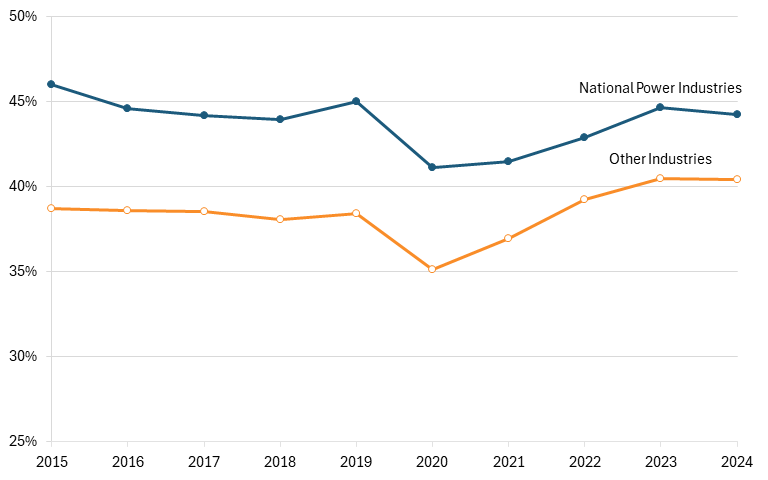
Trade between the United States and its Canadian and Mexican partners is more prevalent in strategic industries. The Information Technology and Innovation Foundation (ITIF) has developed a classification of U.S. industries assessing their relevance to national power. Industries that support national power span a spectrum of sectors, including those for pure defense production, dual-use technologies employed in both military and commercial applications, and enabling industries that support the broader industrial commons. Although these “national power industries” provide a sectoral categorization of the economy, they can be translated to product-level categories for purposes of trade analysis. As such, figure 1 shows that the USMCA (and NAFTA before 2020) contributed to U.S. trade being more intensive in national power industry goods than in non-national power goods.
Figure 1: Aggregate U.S. trade in goods with Canada and Mexico relative to total trade in goods
The strategic relevance of the economic partnership with Canada and Mexico is evident even if the USMCA is not primarily a trade agreement aimed at boosting U.S. techno-economic leadership—especially in the context of competition with China. The USMCA, in contrast to NAFTA, indeed has components that help in this direction. The digital trade section of the agreement (Chapter 19) protects cross-border data flows, limits data localization, prohibits customs duties on digital products, and protects source code from forced disclosure—giving a pro-innovation alternative to China’s state-controlled digital model and Europe’s more precautionary regulatory model. More broadly, the USMCA has served as an institutional foundation for reshoring production in strategically important sectors such as semiconductors, EVs, batteries, medical goods, and advanced manufacturing. In addition, the USMCA “non-market clause”—a veto over any member country entering into an FTA with a non-market country—represents de facto a strategic guardrail against any member country that would deepen its trade integration with China.
Yet the USMCA is, at its core, an FTA, and its main objective is to eliminate trade barriers across nearly all sectors of the North American economy. This is the opposite of strategic, because it limits the significance of the good being traded to its monetary value alone. In other words, a million dollars of potato chips is worth the same as a million dollars of semiconductor chips; they are all the same as far as the agreement is concerned. This framework wasn’t created in a vacuum. The expansion of market access, first through globalization in the Western bloc during the Cold War and later through unfettered global free trade during the “U.S. unipolar moment,” served specific geopolitical purposes. But as the United States gradually loses leadership in strategic sectors to China, its trade policy—and whatever might supersede the USMCA—needs to meet this moment to help reverse this trend.
This means that the renegotiation of the USMCA should focus on making this trade deal the first strategic techno-economic agreement rather than a legacy of the FTA era. This would require two simultaneous reforms: 1) reinforcing the USMCA’s commitments to boost the development of strategic industries among the partners, and 2) limiting the outreach of China’s nonmarket system. The former means updating the USMCA to support deeper supply chain integration in strategic industries, such as by strengthening cooperation on digital trade (for example, banning digital service taxes), by explicitly fomenting innovation in national power industries, and by promoting skilled talent mobility. The latter should make clear that preferential access to the North American market is for trusted partners, not a backdoor for Chinese state-backed firms. That means coordinating investment screening and export controls, and improving customs enforcement against transshipment, counterfeit goods, and other forms of circumvention.
To be clear, much of this can be pursued through the USMCA review process. The United States could sign bilateral side letters with Canada and Mexico or propose annexes to the USMCA text that reinforce provisions such as those described above. A more radical approach, yet still within the USMCA framework, would be to amend the text, which, depending on the depth and specifics, would require passage through each country’s domestic legal procedures, including congressional involvement in the United States.
The main challenge is changing the mindset. The USMCA should not be seen as a free-trade tentpole trying to sustain a global trade system that no longer exists. Likewise, the trade partnership with Canada and Mexico should not be evaluated by the amount of trade surplus or deficit, nor should it be upended for a self-defeating isolationist project. Canadian, Mexican, and U.S. trade negotiators should view the USMCA renewal process as an opportunity to move beyond the old free-trade model and build a strategic North American economic bloc capable of producing, innovating, and competing at the scale required by the China challenge.
