


Mobilizing for Techno-Economic War, Part 2: Slowing China’s Advance
Boosting U.S. competitiveness in national power industries is necessary, but not sufficient to avoid losing to China. America also must take measures to slow the PRC’s progress toward global dominance. This report provides more than 100 actionable recommendations for the administration and Congress. Western allies should take many of the same steps.
KEY TAKEAWAYS
Key Takeaways
Contents
Principles For Limiting the PRC’s National Power Industry Advance. 3
Limit Chinese Knowledge Acquisition. 10
Introduction
National power is the ability of a country to prevent other countries from taking actions against its core interests and the ability of the nation to impose its will on others. Traditionally, national power was largely determined by military power. In the 21st century, globally integrated economy, a key enabler of national power, has become relative strength in industries that enable leverage over adversaries and limit their leverage over us. These are “national economic power industries,” such as semiconductors, machine tools, AI, and aerospace.
As the Information Technology and Innovation Foundation (ITIF) wrote in November 2024, the People’s Republic of China (PRC) is focused on gaining global dominance in an array of national economic power industries.[1] And competition in these industries is mostly win-lose, wherein China’s gains come with U.S. (and allied) losses. This means that unless the United States and allies are stronger than China in these industries and have more techno-economic leverage over the PRC than it has over us, then U.S. power vis-à-vis China will decline even more, with transformative consequences for the global balance of power. This means that the United States, and key allies, need to implement national economic power industry strategies to strengthen and make these industries more resilient. Other reports in this ITIF series will articulate these policy proposals.
While strong domestic policy actions are not necessary, they are not sufficient. This is generally contrary to the dominant Washington narrative that holds that virtually all U.S. efforts should be on “speeding us up,” not slowing China down. Former Obama Treasury official Steven Rattner, in a New York Times op-ed, spoke for most when he wrote, “China is just too formidable as a rival—as well as a critical manufacturing powerhouse—to be reined in by diplomacy or an aggressive shift in policy. The only real solution is to get our house in order and beat China at its own game.”[2]
Ensuring that we don’t lose to China requires limiting the PRC’s progress by limiting Chinese firms’ access to knowledge and related resources while reducing their foreign market share because both provide “jet fuel” for innovation and expansion.
This is wishful thinking. China’s techno-economic-trade mercantilist engine is so powerful, and limitations (political as well as budgetary) of the United States and allied nations so significant, that domestic actions alone will not reverse decline and loss. For multiple reasons, U.S. policy can match Chinese policy.
Ensuring that we don’t lose to China requires limiting the PRC’s progress by limiting Chinese firms’ access to knowledge and related resources while reducing their foreign market share because both provide “jet fuel” for innovation and expansion.
This report lays out a detailed policy agenda to limit Chinese national economic power industry success, providing a suite of policy options for the United States and its core allies to take, organized into five categories:
1. Limiting Chinese knowledge acquisition from U.S. universities, government laboratories, and businesses
2. Limiting Chinese imports to and investment in the United States
3. Reducing the negative impact of Chinese mercantilist policies
4. Reducing allied production in China
5. Contesting Chinese firms in non-Chinese, non-U.S. markets
Principles For Limiting the PRC’s National Power Industry Advance
The United States (and other Western democracies, even if most refuse to acknowledge it) and the PRC are adversaries. The PRC is seeking to gain significant global market share in virtually all advanced industries key to national power. And competition in these industries is win-lose. To the extent China gains global market share, allied nations lose. That process can and often does end in dominance on the Chinese side and market withdrawal on the allied side, as we have seen in industries such as solar panels, shipbuilding, high-speed rail, and telecommunications equipment.
But why not just press the Chinese Communist Party (CCP) to change, to backtrack on some, if not most, of its most egregious “innovation mercantilist” policies and practices? The answer is simple: the only way China will change course is if the CCP loses its dominance. These policies are baked into the CCP’s global goals of becoming the new hegemon in the service of global socialism.[3] Indeed, one of the key lessons from the first Trump administration’s action toward China is that it’s not worth expending political capital to get the CCP to change course. It simply won’t because it is committed to both the goal of dominating national economic power industries and the means of “innovation mercantilism.”
Moreover, as time has gone on, U.S. leverage to get China to change has dramatically shrunk. Perhaps 15 years ago, the West had enough leverage to force China to alter course (e.g., raise the value of its currency, reduce its IP theft, and scale back its industrial subsidies). But it no longer does. If anything, it is China that now holds the leverage, as we have seen with its threats to limit exports of strategic minerals. As such, the goal of efforts directed at China should not be CCP policy change. The CCP has had plenty of opportunities for this in the past and has resolutely and consistently shown that it will not change its overarching goal or playbook.
All proposed actions against the PRC in the techno-economic-trade space should be judged on one factor: do they help or hurt the PRC boost its national economic power industries.
Another approach is to ignore China and decouple, which the Trump administration appears to be doing. The problems with this are numerous. Even if the United States blocked all Chinese imports, thus preserving the U.S. domestic market for firms in the United States, Chinese firms would still conquer “territory” outside the United States—markets that once were the province of U.S. firms.[4] For many, if not most, national economic power industries, the United States cannot hope to have innovative and cost-competitive firms that only sell to U.S. customers. The sales revenue relative to needed levels of fixed cost capital is just too low. Moreover, every yuan U.S. firms earn from selling in China is a yuan that does not go to Chinese firms. So, while production decoupling makes sense (e.g., encouraging U.S. firms producing in China for export to move production to other locations), sales decoupling does not. Cutting off most sales to China just cedes the Chinese market to Chinese firms (and often other allied nation firms) while reducing revenue to U.S. firms.
That leaves helping our firms advance while making it harder for Chinese firms to advance. But doing the latter effectively means first framing the issue properly in terms of defending U.S. national power industries. Unfortunately, the rationales for much action taken against China is based on other factors. For example, the Biden administration justified its 100 percent tariffs on Chinese electric vehicles (EVs) on the grounds of cybersecurity risks. It’s not that this was not an issue, or that the legal means for imposing the tariffs relied on this concern, it’s that framing everything in cybersecurity terms limits taking action on the much broader set of industries and technologies that do not bear a cyberrisk. Similarly, the House Select Committee on China uses “fueling the CCP’s Military, Surveillance State, and Uyghur Genocide” as rational for criticizing some action by a U.S. entity or set of entities.[5] But for the most part, if U.S. firms didn’t do this, firms from other nations or within China would. All proposed actions against the PRC in the techno-economic-trade space should be judged on one factor: do they help or hurt the PRC boost its national economic power industries (including, but not limited to, its military) while not harming U.S. firms.
It is important to note that it is late in the game. If the West had taken the needed steps 20 years ago when the PRC’s technological capabilities were much less than they are now, it likely could have significantly reduced the damage from China’s techno-economic attacks. But after two decades of massive Chinese government investment and all-of-government commitment to be an independent techno-economic-industrial powerhouse, the best the West can hope for is 1) reducing actions that affirmatively help the PRC’s quest and 2) slowing Chinese firms global market expansion.
The Prisoner’s Dilemma
One key reason why there has been so little effective action to counter the PRC’s national power industry policies is it is often not in the interests of individual actors to do so. Universities want more Chinese students and Chinese research money. Local governments want to buy the cheapest Chinese electric buses. Companies want to sell to China. Even federal agencies want to save money by buying Chinese goods. And countries themselves want to cut the best deals so they can sell to China, as we have seen with Canada’s recent actions to get close to China, rather than stand together in a democratic alliance.
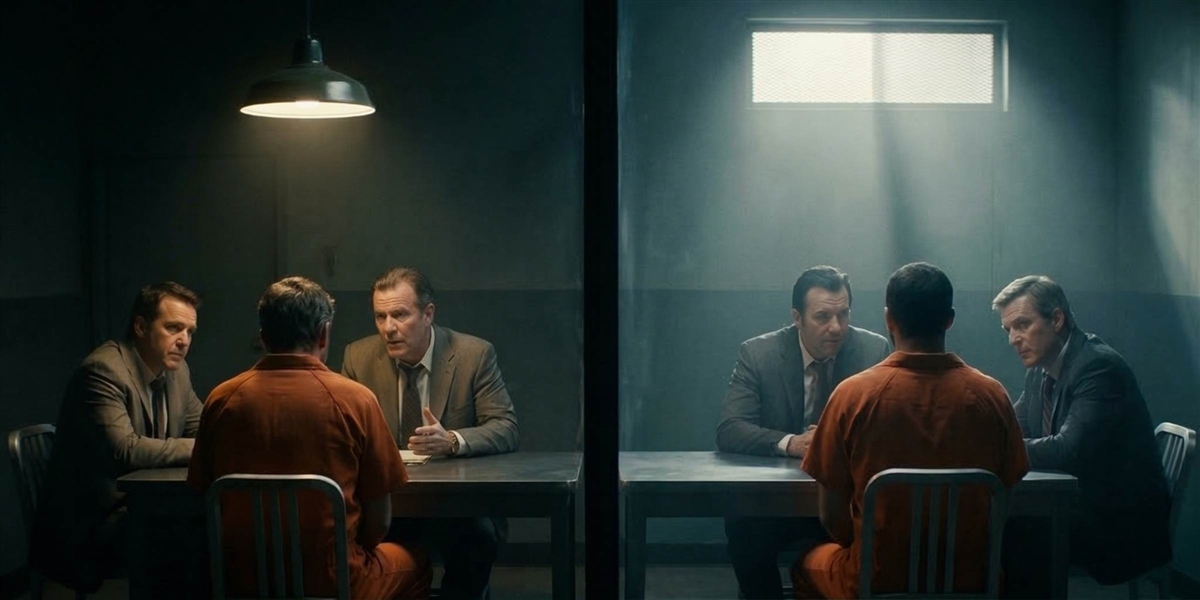
In many ways, game theory, and in particular the prisoner’s dilemma game, describes this dynamic. The prisoner’s dilemma holds that if a prisoner confesses and implicates his partner, then he will get no punishment, and his partner will get the full sentence. If the prisoner does not confess but his partner does, then he will receive the full sentence, and his partner will receive none. If they both confess, then they will receive half the sentence each. And if neither confesses, they will each receive a minimum sentence. So, if they act only based on their own self-interest, the rational move is to confess—they are always better off, no matter what their partner does. But if they stick together and refuse to cooperate, then both will be better off. In the absence of a coordination mechanism, self-interest dictates ratting on one’s partner, especially in a low-trust environment.
Applied to China, it should be clear that if everyone, including our purported allies, cooperated against the PRC, collectively there would be a greatly reduced problem. China could not win the war. It would not gain market access. Its access to technology and knowledge would be limited. It would lose foreign direct investment (FDI). But without strong U.S. leadership and a willingness of allies to show courage and accept some limited short-term pain, it’s rational for each player to defect.
The prisoner’s dilemma holds that if a prisoner confesses and implicates his partner, then he will get no punishment, and his partner will get the full sentence… But if they stick together and refuse to cooperate, then both will be better off.
We see this at virtually every level of competition with China. Most organizations and consumers—cities, federal government departments, companies, countries, international organizations—have every interest to buy the Chinese product since it saves them money, even if it enables a worse global outcome. They all want the best deals. Only laws, regulations, binding agreements, and patriotism devoted to defending Western democracy and freedom will prevent this.
Western allies face a “prisoner’s dilemma” dealing with China; sticking together would be mutually beneficial[6]
It’s not that countries and even firms cannot cooperate for the greater good. There are a few issues where a majority of countries have chosen to not “rat out the other” and to cooperate instead. The major one is climate change, where most nations, leaving aside China and the United States, have committed to sacrificing for the good of the world (e.g., regulating emissions, spending money on more expensive clean energy, and more). Yet, given that climate change is a global challenge, it is rational for individual countries, especially smaller ones, to keep emitting greenhouse gases because the added cost to them is quite small (a bit less reduction in global emissions), but the benefit is large (the savings they make by not spending more on emissions reduction).[7] But largely because elite views in the West identify climate as an issue for “cooperation,” there is at least an expectation of countries cooperating, knowing that if they act selfishly they would suffer reputational harm, as we have seen as most Western nations’ decried President Trump’s withdrawal from climate accords.
But not when it comes to China. We can see this by the widespread use of the term “U.S.-China trade war,” which implies that the United States is equally if not more to blame, and that it is only acting to benefit itself rather than the West overall. This framing lets other nations free ride on America’s sacrifices to limit China’s techno-economic power, and even take advantage of the U.S. by replacing American exports to China with theirs, as Europe has done.[8]
In the past, cooperation has come from two sources. First, the United States used hard and soft power to align foreign interests toward global interests of freedom, rule of law, democracy, and free markets. But as U.S. power has weakened, both politically and economically, it has lost a share of its influence, and under Trump, has pulled back even more from this role, especially as that role has imposed costs on the United States (e.g., asymmetrical market access and larger defense budgets than would be case if allies had shared more of the burden).
Because of the capitulation of international organizations, virtually all the issues relating to how to stop helping and facilitating the rise in the PRC’s industrial power relate to prisoner’s dilemma cooperation issues.
Second, it was the United States that pushed for the establishment of international institutions that should have helped address these challenges. But these institutions have largely failed. The International Monetary Fund, for example, refused to label China a currency manipulator, caving to CCP pressures, so Chinese predatory exports continued to grow. Because of pressure from the PRC, the World Health Organization covered up for China in the COVID crisis. The World Trade Organization (WTO) refused to expel China in spite of the latter’s systematic disregard for trade rules and then proved a paper tiger when it came to getting China to play by the rules.
As such, because of the capitulation of international organizations, virtually all the issues relating to how to stop helping and facilitating the rise in the PRC’s industrial power relate to prisoner’s dilemma cooperation issues. Because it is in the self-interest, particularly the short-term self-interest, of almost all players to cut their own deals with China and to not cooperate in order to limit China’s gain, as we have recently seen with Canada’s, France’s, and the United Kingdom’s behavior toward China.[9]
Given the stakes at play, it is a sad commentary that cooperation is lacking, especially among so-called U.S. allies. Internationally, only the United States can induce cooperation—and only by creating “deals” that force other nations to choose either Western freedom or vassal status to China. But that seems off the table, at least for now. Domestically, the only way to induce cooperation of various actors (government agencies, nonprofits, and businesses) is through law, regulation, or incentives.
Limits of Export Controls
To the casual observer it would seem that the only tool the U.S. government employs to limit China’s advance is export controls. The thinking goes that the United States mostly successfully imposed export controls on the Soviet Union and limited its defense and commercial advancement, so the same success can be had with China. But while there can be no doubt that export controls need to be part of the toolbox to limit China, they should be one tool of many—and they should be applied with restraint and consideration of their effectiveness and also their impact on U.S. industry competitive success.
China is not the Soviet Union. First, it is vastly more capable of producing its own, often world-class, technology substitutes in the face of U.S. export controls. Second, China’s economy is twice as large as the Soviet Union’s was in the early 1970s as a share of global gross domestic product (GDP). As such, it is harder from a competitiveness standpoint for Western companies to abandon that market and still be competitive in the global economy. Third, while COCOM (the Coordinating Committee for Multilateral Export Controls) was never perfect and many members did not comply with the regime fully, it was vastly better than today’s informal and ad hoc regime. At its height, COCOM had 17 national members. Today, while some U.S. allies agree to limit exports to China, many, even if they agree on paper, turn a blind eye and are happy to get the export earnings, especially as they come with reduced competitive position of their U.S. rivals.
Finally, giving up sales to the Soviet Union had virtually no risk that Soviet firms would gain and U.S. firms lose global market share. That is not the case with China. The CCP’s goal is to replace U.S. and Western national economic power industry firms, and cutting off sales to China, while potentially hurting China in the short run, also hurts U.S. firms by reducing their sales and abilities to continue to invest in the future.
Today, while some U.S. allies agree to limit exports to China, many, even if they agree on paper, turn a blind eye and are happy to get the export earnings, especially as they come with reduced competitive position of their U.S. rivals.
We can see the limits of export controls by examining their minimal impact on Chinese telecom equipment producer Huwaei. (See box 1.)This is not to say that export controls should have no place in the arsenal of limiting China’s advance, but they should not be the lion’s share of effort.
That means several things. First, if the Commerce Department is to implement an export control, it should be certain that China cannot get similar technology domestically or from another country. If it can’t be certain, then it is better to not cut off U.S. sales.
Second, if the Trump administration seeks to work with allies, the White House should establish a modern-day version of COCOM focused on China.
Third, the Bureau of Industry and Security (BIS) needs to take more proactive steps to investigate export control diversion. It’s not enough to ban the exports to China of a particular product if grey market middlemen bypass these controls. There are private providers of software that can track such sales. BIS should be more actively using such systems. And when it identifies such a party, it should refer them to the Department of Justice (DOJ) for prosecution. Also, some have reported that some of these enablers of grey market after-sales to China are U.S. entities that have qualified for a Defense Logistics Agency (DLA) Commercial and Government Entity (CAGE) code designation.[10] BIS should also flag these entities for the War Department (DOW) so that it can restrict these companies from securing government contracts.
Box 1: The Effect of Export Controls on Huawei
Due to cybersecurity concerns, since 2018, the U.S. government has gradually banned the sale of Huawei products for U.S. telecommunications networks and encouraged other nations to do the same. But that was not enough for U.S. policymakers; they sought to kill the company. In 2019, the U.S. government sought to sanction Huawei for doing business with adversaries, such as Iran, by taking judicial actions and adding it to the Commerce Department’s BIS Entity List. Entity List-based export controls attempted to cripple the company by disrupting its supply chain, which was heavily reliant on U.S. technologies. The Biden and the second Trump administrations have continued to sanction Huawei, and export controls remain in place.
The export controls backfired. Huawei is the world’s largest telecom equipment manufacturer, and its global market share for telecom equipment increased from 29 percent in early 2018 to 31 percent by 2024.[11] At the same time, U.S. technology companies such as Intel, Teradyne, Qualcomm, and others lost more than $33 billion in sales to Huawei between 2021 and 2024—in a conservative estimate—weakening these American companies globally while strengthening Chinese and other nations’ tech companies. Additionally, due to the restrictions, Huawei launched its operating system, HarmonyOS, in 2019, which now has nearly a billion users and is compatible with mobiles, tablets, and laptops—a direct threat to Google’s Android and Microsoft’s Windows global market share.[12] The company is also catching up on chipmaking, claiming that in 2023 it was able to replace more than 13,000 components and redesign over 4,000 different circuit boards.[13] As of August 2025, Huawei claimed to have built an entire ecosystem independent of U.S. technologies.[14]
Huawei was able to do this because it anticipated these U.S. actions as early as 2012 and invested heavily to offset them.[15] It was able to do so partly because its research and development (R&D) investments grew proportionally more than those of any other major technology company—including Alphabet, Apple, and Microsoft—and it increased its reliance on the Chinese market to sustain revenues. In addition, the PRC provided significant support to the company to decouple from the United States after the restrictions were in place.
Arguably, the U.S. government could have crippled Huawei in the late 2000s or early 2010s when its and China’s technological capabilities were significantly weaker. But by the late 2010s, it was too late for that. As a result, the only outcome was to weaken U.S. technology companies and strengthen Huawei and China’s innovation.
The U.S. government’s attempt to cripple Huawei underestimated the extent of the Chinese government’s support for the company, Huawei’s technological advancements, and its ability to source non-U.S. inputs or develop them domestically. The U.S. government’s approach was outdated, not reflecting the current relative power of the United States.
Moreover, export controls accelerated Huawei’s innovations and harmed American companies. U.S. firms have been directly affected, with lost sales of over $33 billion between 2021 and 2024 and exposure to retaliation by the Chinese government due to these export controls.
Limit Chinese Knowledge Acquisition
University and Government Research Policies
The framework by which U.S. and Western universities generally govern themselves no longer works. During the Cold War, it was widely accepted that universities should work to limit knowledge transfer to the Soviets. University policies were significantly adjusted to align with national security priorities, spurred by federal funding and public anxiety.
But with the fall of the Soviet Union, universities and even government research laboratories embraced a globalist vision of knowledge, just as U.S. corporations embraced a globalist vision of business and economics. In this vision, science is a global good. More collaboration is better. And universities, especially private ones, owe little allegiance to the nation, but rather much to the world as a whole. This is especially true after the declines in federal and state government support to universities, with most universities now, like most companies, looking out first and foremost for their bottom lines, and not national power.
And that creates problems, including pressures to kowtow to Beijing. A report for the Alexander Hamilton Society states, “Protecting language funding, like access to Chinese students, visas, and satellite campuses, depends on placating Beijing.”[16]
The most important change that needs to happen is for widespread acceptance by U.S. universities that China is an adversary, not a customer.
Indeed, the relationship between U.S. universities and China is quite different than it was with the Soviet Union. As the Hamilton Society report notes:
Soviet students never provided crucial revenue for American universities. There was never a “Pushkin Institute” affiliated with the Soviet Communist Party financing most Russian language training at American universities. Conversely, scholar exchanges with the PRC lack the engagement of the U.S. government characteristic of Cold War exchanges with the USSR. Instead, U.S. institutions today build relationships with the PRC to secure access to China.[17]
At the same time, colleges and universities are desperate for revenue, even if that comes from Chinese students, companies, or the CCP. As such, the most important change that needs to happen is for widespread acceptance by U.S. universities that China is an adversary, not a customer. Because of strong incentives for universities to pursue their own self-interest rather than national interest, the federal government will need to play a stronger role. There are many steps it needs to take.
Limit Chinese Nationals Receiving Postdocs at Universities and FFRDCs
Many Chinese nationals obtaining postdoctoral positions in the United States do so after graduating from a U.S. university. And historically, a high share has stayed in America, contributing to the U.S. innovation base and not contributing to China’s. But some Chinese nationals come to study as postdocs after graduating in China. Many of them go back to China, and the United States does not benefit. In fact, key knowledge these students acquire while in the United States is now used in China.
While the National Science Foundation (NSF) does not collect data on the nationality of postdocs (something it should do), many are from other nations. For example, 55 percent of postdocs at federally funded R&D centers are temporary visa holders.[18] Universities and Federally Funded Research and Development Centers (FFRDCs) should be required to report the country of citizenship of postdocs, and the government should track their later decisions to determine whether they stayed in the United States or went back to home countries, especially China. At the same time, where universities and FFRDCs are not able to hire Americans, they should try to hire postdocs from allied nations or nonadversary nations such as India, and not from China.
Ban Chinese Funding of U.S. Research Universities
While China has proven that it can innovate, it still steals U.S. intellectual property (IP) and research to advance its own national technology innovations. One way it does this is by funding U.S. university research. Chinese-funded research conducted here is taken back to China, hurting U.S. competitiveness. There is evidence that the CCP funds American universities to advance its agenda—and currently there is no robust legal tool to compel recipients to disclose their funding sources.[19]
Congress should make federal funding of university research contingent on universities not receiving Chinese funding for research.[20] And this ban should also extend to pass-throughs where China funds a U.S. entity that then funds the U.S. research institution.[21] As such, Congress should pass the Defending Education Transparency and Ending Rogue Regimes Engaging in Nefarious Transactions (DETERRENT) Act to expand the oversight and disclosure requirements regarding Chinese funds channeled to U.S. universities and research institutions.
The DETERRENT Act will close loopholes in inadequate reporting and enforcement of federal laws on university disclosures regarding gifts and contracts from foreign entities.[22] This bill proposes lowering the reporting threshold to $50,000. The DETERRENT Act also prohibits universities from entering into contracts with a foreign country of concern or with a foreign entity of concern without obtaining a waiver and holds private research institutions accountable for their financial partnerships by requiring disclosure of concerning foreign investments in their endowments.[23]
Require Disclosure of U.S. Faculty Research With Chinese Researchers Related to National Power Industries
ITIF has reported that PRC espionage is a strategy that extends from state intelligence agencies to nominally private firms, and that Beijing coordinates cyber, human, and corporate channels to steal U.S. industrial and defense technologies.[24] The PRC’s espionage ecosystem is aided by the U.S. research environment, which privileges the free flow of ideas and researchers, allowing China to recruit (or coerce) talent trained in America and to have some of this talent engage in IP theft and technology transfer.
A 2024 report from the House Select Committee on the CCP reveals that Georgia Tech received $17 million from an entity affiliated with Tianjin University, while UC Berkeley received nearly $22 million from entities affiliated with Tsinghua University.[25] These contracts were discovered years after they were in place, and both involve advanced research on dual-use technologies. The failure to report is due to weak enforcement of Section 117 of the Higher Education Act. This section requires the disclosure of gifts and contracts over $250,000 from foreign entities. However, the auditing is limited to the Department of Education, and it is possible to obscure the true sources of funding by bypassing funds through intermediaries.[26]
At minimum, universities should be required to disclose in real time all research partnerships with researchers or companies in China. Where those partnerships are with entities of concern in China, People’s Liberation Army (PLA) military institutions, or affiliated institutions (e.g., the “seven sons of national defense”), the researchers should be required to first get permission from NSF.
Congress should also approve the Securing American Funding and Expertise from Adversarial Research Exploitation Act of 2025 (SAFE Act) to block U.S. federal grants to scientists with a history of collaborating with hostile foreign countries, such as China. This bill is drafted in response to a Select Committee report that identifies over 50 partnerships between U.S. universities and entities associated with the CCP, including joint degree programs with China’s Seven Sons of National Defense—a group of Chinese universities selected to focus on military and defense research and research on sensitive, dual-use technologies such as submarine engineering, aircraft power engineering, and mechanical design, manufacturing, and automation.[27] The SAFE Act would ban federally funded science, technology, engineering, and mathematics (STEM) research by researchers with a history of collaborating with PRC-associated entities, ban DOD funding for universities that partner with adversaries, and, similar to the DETERRENT Act, impose stricter disclosure requirements on collaboration with entities associated with adversaries.[28]
In addition, a 2023 Select Committee on the CCP report outlines further recommendations to “strengthen U.S. research security and defend against malign talent recruitment.”[29] Among its recommendations, the report suggests improving cross-agency disclosure guidance produced under National Security Presidential Memorandum 33 (NSPM-33) by NSF. This would require all recipients of federal research funding—including personnel and contractors—to disclose their relationships with entities and interests with foreign adversaries for a certain period (e.g., the past five years). In addition, the Select Committee, to help agencies in the vetting process, has proposed the creation of “an unclassified database using open-source information to keep track of PRC research entities that engage in defense and military research and civil-military fusion programs.”[30]
The Select Committee identified 8,800 publications supported by DOD funding published with coauthors affiliated with PRC institutions and more who were directly affiliated with the PRC’s defense research and industrial base.[31] Congress should ban cooperation with CCP/PLA-associated entities, there should be a presumption of research being problematic, and institutions should be required to obtain waivers to proceed.
Institute Better Screening of Chinese STEM Students
There are vastly more Chinese students studying in the United States than U.S. students studying in China. On the one hand, they gain knowledge here that they can use if they go back. On the other hand, if they stay in the United States (and do not transfer knowledge to China), they are a net plus for the U.S. innovation ecosystem, and conversely, their presence weakens China by reducing talent levels in China. Even if they go back to China, they have been exposed to the U.S. system of freedom and democracy and perhaps would want to support that in China at some point in the future.
However, there are two challenges. The first is that some students return to China. But that does not mean we should cut off flows. If they did not come to the United States, they would likely go to other nations with strong higher education systems, and U.S. research university competitiveness would decline. Moreover, the rate of staying for Chinese STEM students remains quite high. One study finds that of a sample of 100 Chinese AI researchers studying in the United States in 2019, 87 percent remained in the United States in 2025.[32] However, this is still a relatively limited time period, and we don’t know how many plan to return in the next decade. One 2024 study of Chinese students enrolled in U.S. higher ed finds that only 43 percent intend to stay in the United States.[33]
At the same time, there is a share of Chinese students who are “bad apples.” They pressure fellow Chinese students to toe the CCP party line. They steal U.S. IP. They are closely tied to the Chinese military or intelligence services.[34] Indeed, the porousness between Chinese academic institutions and the PRC government has proven to be an ongoing problem. The United States in 2025 announced that it would start revoking visas of Chinese students with connections to the CCP or studying in critical fields. This should be expanded. Multiple cases have highlighted specific Chinese schools whose students have been linked to the theft of trade secrets and proprietary information. The United States should blacklist these Chinese institutions and reject their students’ visa applications.
One of the reasons why universities are so opposed to any limits on Chinese students is that many rely on them as a source of tuition revenue and low-wage research assistance.
What is the ratio of “bad apples” to “good”? Is it changing? We do not know. But this should not be a binary choice between limiting or banning Chinese students and opening the doors to all with no assessment. Universities and FFRDCs need to do more due diligence on Chinese STEM students coming here, especially for graduate programs. They need to better monitor for risks of IP theft. The federal government should require universities to be more transparent: how many Chinese are enrolled in what disciplines? And it needs to provide analytical tools to universities and FFRDCs to make better decisions on individual students.
One of the reasons why universities are so opposed to any limits on Chinese students is that many rely on them as a source of tuition revenue and low-wage research assistance. Given the cuts in state and federal funding for universities, this is understandable. But all else equal, universities and related programs should try to recruit students from other nations, such as India. Related to this, the U.S. government should pressure foreign fellowship and other tuition assistance programs to not include Chinese students and instead prioritize students from other nations.
Restrict the U.S.-China Science and Technology Agreement
President Jimmy Carter mistakenly opened up more to China in 1979, and one step was to sign the U.S.-China Science and Technology (S&T) Agreement. The idea was that by sharing S&T, China would move into the U.S. orbit and relations would become friendlier. Like so much of U.S. policy toward China over the last 50 years, it was based on wishful thinking and naïveté. China didn’t want to become like us. It wanted access to our science and technology to advance its national power.
Over the years, the S&T agreement—a process whereby federal agencies engage in partnerships with Chinese agencies and scientists—has led to Chinese advances in national power industries. As a 2014 report from the U.S.-China Economic and Security Review Commission notes:
In contrast to the U.S. approach of utilizing S&T cooperation primarily as a tool of diplomacy, China uses S&T engagement as a component of a national strategy to build scientific capabilities. This has enabled the rapid development of China’s S&T capabilities and threatens the United States’ status as the world’s leading scientific power. The report also identifies some national security challenges, including the transfer of sensitive technology through espionage and other means that have emerged in the context of bilateral S&T cooperation.[35]
Indeed, proponents of the agreement—who are also proponents of engagement with the PRC—point to cooperation on things such as influenza (that clearly did not work out well given China was the source of COVID), birth defects, and air pollution. But they do not mention projects on EVs, agricultural biotechnology, human biotechnology, and nanotechnology and help with technology standards (that China now manipulates).
When the agreement was last up for renewal, the Biden administration negotiated certain changes, but these had nothing to do with preventing transfer of key knowledge to China.[36] To be sure, there may be areas where cooperation is reciprocal and does not lead to advances in key technology areas supporting Chinese national power industries. As such, the Trump administration should not cancel the agreement. But it should change the agreement to limit it to areas that do not provide China with any assistance in technologies related to national economic power industries. Endangered species research sharing, yes. EV research sharing, no.
Business Knowledge Acquisition
China relied heavily on foreign business, scientific, and engineering knowledge and technology to become the technology powerhouse it is today. Most of that was acquired unfairly, through cybertheft, forced tech transfer, and domestic production in exchange for market access, breaking and entering, insider threats, and attracting talent holding stolen information. There is no doubt that China relies less on this than before. But it still benefits from it. As an ITIF report by commercial counterintelligence expert Darren Tremblay, states, “China’s espionage ecosystem is systemic and strategic. From state intelligence agencies to nominally private firms, Beijing coordinates cyber, human, and corporate channels to steal U.S. industrial and defense technologies.”[37]
The report goes on to note:
In 2008, the PRC launched its Thousand Talents Program with the intent of enticing scientists to bring their research to China. Economic espionage was a significant aspect of the Thousand Talents Program. Although in many of the cases that the Department of Justice brought against talent plan participants involved academia, the private sector was not immune. In 2019, The New York Times reported that 600 recruits worked for U.S. companies. These penetrations of the private sector, including Xiaoqing Zheng at General Electric and Xiaorong You at the Coca-Cola and Eastman Chemical, have included attempts to steal trade secrets on behalf of Chinese entities… Therefore, it can be assumed that any expertise applied on behalf of—or technology provided to—a PRC entity will support that country’s ability to counter the United States and its allies militarily.[38]
As such, U.S. and allied policies need to do more to limit this flow of knowledge and technology.
Restore the White House IP Enforcement Coordinator
Although the erstwhile Office of the Intellectual Property Enforcement Coordinator (IPEC) lacked direct enforcement authority, its annual reports served the important function of providing Congress and the public with a consolidated, cross-agency picture of U.S. government efforts to combat IP theft.[39] Piracy and counterfeiting are interdisciplinary crimes and thus require an interagency approach to enforce against. IPEC’s reports were the only documents that systematically compiled enforcement actions, seizures, prosecutions, diplomatic engagements, and capacity-building efforts across all the federal agencies—including U.S. Customs and Border Protection (CBP), U.S. Immigration and Customs Enforcement (ICE), DOJ, the Food and Drug Administration, the U.S. Patent and Trademark Office, the U.S. State Department, and the U.S. Trade Representative (USTR)—with a focus on piracy and counterfeiting.
“China’s espionage ecosystem is systemic and strategic. From state intelligence agencies to nominally private firms, Beijing coordinates cyber, human, and corporate channels to steal U.S. industrial and defense technologies.”
An ITIF investigation of how Chinese online marketplaces list and sell counterfeit products corroborated U.S. government enforcement gaps using empirical evidence of test purchases conducted on Temu, AliExpress, and SHEIN.[40] With IPEC dormant in the Trump administration, the United States lacks a standing mechanism to integrate such evidence into a government-wide enforcement narrative, track implementation of executive and agency recommendations, or ensure coordinated accountability across the interagency. Reinstating a White House-level IP enforcement reporting function would restore the institutional continuity necessary to translate isolated agency actions into a sustained strategic response.
Limit Chinese “False Flagging”
Certain Chinese companies operating in the United States and other economies mask their national origin, presenting themselves as American corporate citizens—sometimes complete with patriotic branding—even while Beijing retains ultimate control over their ownership and strategic direction. This phenomenon of false flagging is favorable to the CCP: these obscured companies benefit from their obfuscation by gaining privileged access to the U.S. market, IP, talent, and even generous government funding to support China’s strategic industrial and military priorities.[41]
In order to strengthen U.S. systems to reduce vulnerabilities to Chinese techno-industrial predation through false flagging, Congress and the Trump administration should take the following steps.
As of 2020, the Committee on Foreign Investment in the United States (CFIUS) is implementing the Foreign Investment Risk Review Modernization Act of 2018 (FIRRMA) in its screens.[42] The FIRRMA states that CFIUS should also factor into its reviews “whether a covered transaction involves a country of special concern that has a demonstrated or declared strategic goal of acquiring a type of critical technology or critical infrastructure that would affect United States leadership in areas related to national security.”[43] ITIF has found evidence of CFIUS permitting Chinese companies with ties to the PLA to acquire U.S.-enabling industry companies, even following this rule change.[44] Congress should strengthen and broaden CFIUS screening and oversight.
Congress should also direct CFIUS to create a comprehensive registry of all Chinese-origin companies operating in the United States, including subsidiaries, joint ventures, firms with Chinese financing, and entities with partial Chinese government ownership. To ensure that the list is accurate and up to date, CFIUS should leverage private sector open-source intelligence providers to both identify Chinese-controlled entities that may otherwise evade detection and ensure that the registry remains accurate and up to date.
Congress should expand the Corporate Transparency Act to require Chinese-origin companies operating in U.S. power industries to report beneficial ownership and operational control, including minority stakes, joint ventures, offshore subsidiaries, and IP transfer rights.[45] Using CFIUS’s registry, the Securities and Exchange Commission should collect detailed information on ownership and decision-making structures, while DOC should verify compliance and monitor access to dual-use technology and strategic assets. Companies that fail to provide full transparency should be barred from doing business in America, and CFIUS and DOC should have authority to enforce restrictions or divestment wherever necessary to protect U.S. national security.
Federal agencies such as the departments of Energy, War, and Transportation; NSF; and federally linked consortia such as the United States Council for Automotive Research, should also implement pre-award due diligence to screen for Chinese ownership, operational control, or dual-use access before awarding grants or cooperative agreements. This would ensure that U.S. taxpayer funds support domestic innovation rather than foreign industrial strategy.
The administration should clarify brand obscuration practices. False-flagging companies maintain U.S. branding to obscure foreign ownership, misleading stakeholders and regulators.[46] The Federal Trade Commission (FTC), with congressional authority as needed, should issue guidance on truth-in-branding and ownership disclosure by requiring companies in defense, dual-use, or enabling industries to clearly disclose foreign state ownership or control in marketing, websites, and communications.
In addition, for Chinese companies operating in defense, dual-use, or enabling industries, Congress should pass legislation or FTC should engage in rulemaking to mandate disclosure of foreign state ownership or control in a standardized and visible manner.[47] This requirement would not apply to benign consumer sectors, where branding obfuscation poses minimal national security or economic risk, but would prevent companies in critical sectors from misleading U.S. consumers, investors, or regulators about their foreign affiliations.
Limit Assets Going to Chinese Firms in U.S. Bankruptcy Proceedings
China gains access to U.S. intellectual capital in bankruptcy proceedings. Case in point, about a decade ago, assets, including patents, from bankrupt U.S. solar firms were acquired by Chinese solar firms, precisely the firms that had put the U.S. companies out of business through unfair means, such as massive subsidies.
Congress should pass legislation that requires bankruptcy courts to consider U.S. national security and competitiveness interests as a factor when approving asset transfers so that the “highest or otherwise best” standard would include more than just the price (right now, it can include other factors such as certainty of closing). The Commerce Department should be able to suggest an alternative that preserves U.S. or allied ownership/control. The threshold for these decisions should be even higher when it involves an acquisition by a Chinese firm.
Pass a New FIRRMA That Is Tougher on China
Even with the changes made in FIRRMA, CFIUS is still designed around the Soviet Cold War challenge and focuses too little on acquisitions in dual-use and enabling industries. Congress should also expand FIRRMA to widen the definition of what would affect U.S. leadership. CFIUS’s mandate should encompass threats to not only U.S. leadership “in areas related to national security” but also industries critical to economic and strategic competitiveness, including dual-use and enabling industries.[48]
In addition, PRC companies, including tech heavyweights Baidu and Huawei, have engaged in R&D in the United States. The presence of such firms amounts to helping Beijing innovate against Washington. Currently, despite FIRRMA, CFIUS is still not able to block certain types of greenfield investments (i.e., nonacquisition) that would empower a foreign adversary such as China. At the same time, both Chinese firms and government venture funds invest in U.S. technology company start-ups and are usually able to avoid CFIUS scrutiny. New CFIUS legislation should expand its coverage to include not just acquisitions but also investments, including venture capital investments, in U.S. firms by entities from China.
In addition, in statute, CFIUS treats all nations the same, regardless of their threat to U.S. security. This results in resources that should be spent on addressing the China threat spent on less-risky transactions. Congress should reform CFIUS by addinga “whitelist” for approved nations—ideally ones that join U.S.-allied strategic trade and technology partnerships (the subject of a forthcoming ITIF report).
CFIUS is designed to limit adversaries’ investments in key U.S. companies because that is a way foreign companies gain access to knowledge and technology. But China can gain access to U.S. firm technology by requiring a joint venture for any sales or production in China. Congress needs to close this loophole. But just like export controls, unilateral action is not only limited in its effect, but also is likely harmful to U.S. national interests. If American companies cannot sell in China, our competitor nations will, and the only result will be lost U.S. sales. As such, any legislation requiring CFIUS approval for Chinese joint ventures needs to ensure that at least Europe and Japan have adopted similar rules.
Finally, the Treasury Department, through CFIUS and working with funding agencies, should require companies that receive U.S. federal funding to obtain explicit approval before relocating operations or substantial portions of their workforce or IP to China, or to accepting any investment from Chinese entities. This requirement should be designed not to prevent legitimate global business activity, but rather to ensure that taxpayer-funded investments are not diverted to China in ways that could undermine U.S. strategic industrial capabilities.
Limit Chinese Companies Doing Business in the United States
As ITIF has reported, “Chinese companies in the United States act as collection platforms. Subsidiaries and ‘consulting’ fronts recruit American talent and channel proprietary know-how back to PRC state-owned enterprises.”[49] Currently, there are no mechanisms to even determine the number of these companies, much less limit their activity.
The U.S. Intelligence Community (IC) is essential to identifying foreign developments that will inform economic espionage. For instance, determining Chinese geopolitical objectives will help the United States to understand what capabilities it needs and what it will likely target. The President’s Intelligence Priorities (PIPs), conveyed through the National Intelligence Priorities Framework (NIPF), inform “resource allocations to ensure collection and analysis of intelligence that provides insights, warning or other illuminating information on the priorities.”[50] The NIPF in turn translates and implements national intelligence priorities “to ensure the IC is focusing its collection, analysis, and operational resources on the most urgent and important national security issues.”[51] Topics that help the United States forecast trends in economic espionage and trade secret theft by the PRC should be incorporated into the PIPs and cascading NIPF if they are not already included. Multiple topics could help the U.S. government disrupt economic espionage and trade secret theft before they manifest themselves in specific crimes that harm the private sector. Collection should include Chinese innovation strategies such as the Made in China 2025 plan; geopolitical objectives including a focus on the South China Sea that new capabilities such as syntactic foam might support; relationships with third countries through which China might already be obtaining technology; China’s intelligence services’ methodologies and tactics; and security vulnerabilities in U.S. industry’s business practice. Analysis should turn this data into an awareness of how these variables might interplay to create risks and, from there, provide recommendations for solutions.
Expand the FBI’s Commercial Counterintelligence Budget and Capabilities
The FBI is the main government organization working against Chinese IP theft, but historically, especially after the fall of the Soviet Union, this function has been underfunded and not a central focus. As that same ITIF report states, “U.S. counterintelligence capacity is eroding. Shifts in FBI and DHS priorities have weakened the government’s ability to detect and disrupt Chinese theft just as Beijing’s efforts intensify.”[52] Senator Mark Warner (D-VA) recently noted that the Bureau had reassigned approximately 25 percent of its total agents to immigration enforcement (with the largest field offices dedicating more than 40 percent of their allotment to this challenge).[53] Some of these agents were drawn from counterintelligence and cybercrime. As such, Congress should significantly increase the FBI’s commercial counterintelligence budget.
Expand the DHS Cybersecurity and Infrastructure Security Agency and Homeland Security Investigations Group
The Cybersecurity and Infrastructure Security Agency (CISA) and Department of Homeland Security (DHS) play key roles in limiting Chinese IP theft. A significant CISA function, often in collaboration with the FBI, is warning the private sector about network vulnerabilities. Such awareness helps the government get in front of PRC cyberactors before they can exploit information technology systems to pilfer private sector secrets.
Unfortunately, CISA lost approximately 1,000 employees to buyouts and layoffs during the first few months of the second Trump administration. Congress needs to ensure that this office has greater, not fewer, capabilities.
Another DHS component, Homeland Security Investigations (HSI), plays a sometimes-overlooked role in combating Chinese theft against the U.S. private sector. The Trump administration, according to the Cato Institute, has opted to reorient HSI agents from their investigatory activities to focus on immigration enforcement.[54] Congress should increase DHS funding for limiting Chinese IP theft.
Limit Chinese Firms From Using the Courts to Gain Access to U.S. IP
Third-party funding in judicial cases is when external parties fund cases to obtain a share of the settlement, the benefit of the judgment, or information. In IP-related litigation, foreign entities can interfere in judicial proceedings to obtain licenses or strategically divert a rival company’s resources. There are cases of Chinese entities acting as third parties in patent litigation in the United States—for example, the Shenzhen-based company Purplevine IP funding cases against Samsung Electronics Co. and a subsidiary.[55] The case of Purplevine IP was discovered only because the judge ordered the company to disclose its true origin, but that’s not the norm.[56] Congress should reintroduce and pass legislation similar to the Protecting Our Courts from Foreign Manipulation Act of 2023 to stop foreign entities from using the U.S. judicial system to obtain sensitive IP. This bill increases transparency and oversight of third-party funding by foreign persons and prohibits such funding by foreign states and sovereign wealth funds.[57]
Increase Criminal Penalties for IP Theft
Technology espionage is not uncommon, including by Chinese nationals working in the United States and then moving to China. While it can be hard to stop this, one step that can be taken is to increase the chances a person will be prosecuted and face stiff penalties. For example, one Chinese national, Hao Zhang, left the U.S. company Skyworks on June 9, 2009. The United States subsequently arrested him when, on May 16, 2015, he re-entered the United States.[58] In 2020, Zhang was convicted on charges including economic espionage and theft of trade secrets and ordered to pay nearly half a million dollars in restitution, but he served no jail time.
One study examining prosecutions of Chinese for not disclosing their involvement in China’s Thousand Talents program finds that sentencing was mostly a slap on the wrist.[59] Instead, wrongdoers need to know that if they facilitate illegal support and transfer of knowledge to the PRC that their risk of getting caught is not minimal and that if caught, their punishment will be more than merely six months of home confinement and a $50,000 fine.
Szuhsiung Ho was the owner and president of Delaware-based Energy Technology International (ETI) and served as a senior advisor to the China Guangdong Nuclear Power Company (CGNPC). It was apparent that Ho was targeting expertise in a specific U.S. company. The FBI brought a case against Ho, and he pled guilty to the special nuclear material charge and was sentenced to just 24 months in prison. Similarly, Shan Shi became president of CBM International (CBMI), which was established in Houston, Texas. In 2019, Shi was convicted on one count of conspiracy to commit theft of trade secrets related to deep sea drilling technology. He received just a 16-month prison sentence and was ordered to forfeit $330,000. Xiaolang Zhang, a former Apple employee who was accused of stealing computer files with trade secrets about Apple’s secretive car division, pleaded guilty in federal court in San Jose in 2022.[60] He was sentenced to just 120 days in jail, 3 years of supervised release, and paying a restitution of $146,984.[61]
As such, Congress should pass legislation increasing criminal penalties for IP theft by adversaries so that the punishment serves as a stronger deterrent. In addition, Congress should reform the Protecting American Intellectual Property Act of 2022 (PAIPA) to include a presumption of refusal to foreign persons who have engaged in significant theft of trade secrets. The PAIPA allows the federal government to impose sanctions on “foreign individuals and entities involved in the theft of trade secrets belonging to a U.S. individual or entity.”[62] These sanctions can take the form of blocking property, inclusion on the Entity List, or denial of credit access from the Export-Import Bank or any international financial institution.[63]
In addition, the PAIPA allows broad presidential authorities to determine and sanction individuals who engage in trade secret theft, even in the “absence of any criminal or civil charges, judicial determination, or even evidence that a theft of trade secrets has occurred.”[64] This allows for a rapid response, but the lack of a judicial determination can lead to discretionary actions, further judicialization of the process, or invite retaliation from third countries against American citizens.[65] Congress should reform the PAIPA so that the executive branch can work with the judiciary to identify individuals engaged in trade secret theft and respond promptly to such theft.
Entities or individuals that have committed sustained theft of U.S. IP rights or have refused to compensate U.S. firms for unlicensed use of their IP do not necessary go on the BIS Entity List. The current legal framework allows BIS to add companies to the list, as such sustained, state-sponsored activities can qualify as a “foreign policy risk.”[66] However, BIS is not mandated to do so—a mandate from Congress would close that gap.
Assist Nations in Modernizing Their Export Control Regimes
The State Department’s Export Control and Related Border Security (EXBS) program works with partner governments to identify regulatory and institutional gaps and provide technical and capacity-building assistance. While the EXBS program has traditionally been more focused on export controls around weapons of mass destruction (WMDs) and national security-related technologies, its remit should be expanded to assist allied nations in further developing their capacity to evaluate export controls on technologies related to national economic power. Congress should expand the remit and funding for the EXBS program at the State Department.
Limit Chinese Imports
The United States needs to do more to limit Chinese firms’ advancement. This means limiting not only their imports to the United States but also U.S. investment and financing of them.
There are a wide range of steps the United States can take to limit imports of Chinese goods in national power industries. For every dollar of sales to the United States, Chinese firms gain resources and, in turn, capabilities. And to the extent these sales replace U.S. firm sales, they reduce U.S. firm resources and capabilities. To be sure, there is no need to limit imports from China of items that are not related to national power industries. More plastic toys and “salad shooters” from China are not a problem.
There are two political challenges to doing this, however. The first is that consumers may complain that they want cheap things—so, why can’t they buy unfairly subsidized Chinese products? The second is that companies will likely complain, too. We may see this soon if companies that consume DRAM computer chips demand that Congress allow imports of Chinese memory chips, given the current shortage. In all cases, the Congress and the administration will need to put the long-term national interest above short-term self-interests.
Stop Imports From Chinese Companies on the Entity List
U.S. trade restrictions can be contradictory: a foreign entity banned from purchasing U.S. products and technologies under Entity List restrictions can still enter and compete in the U.S. market. This is the case, for example, with the Chinese telecommunications company Huawei. Huawei has been on the Entity List since 2019 and subject to de facto export restrictions from U.S. providers and to the use of U.S. technologies.[67] However, consumers and companies in the United States can still purchase Huawei telecommunications equipment.
There is no reason for the federal government to permit imports from companies it designates as part of the Entity List. A company is designated as being on the Entity List because the U.S. government has determined that it poses a “significant risk of being or becoming involved in activities contrary to the national security or foreign policy interests of the United States.”[68] Those risks are pervasive if an Entity List-designated company enters the U.S. market.
Reform Section 337 of the Tariff Act
Section 337 of the 1930 Tariff Act allows the U.S. International Trade Commission (USITC) to bar imports when domestic industries suffer harm due to unfair competition. This legislation was designed to address and enforce laws against specific infringing companies. However, legislators did not consider that an entire economy could be an infringer, making the tool insufficient and outdated. Congress should expand the law to better address the unfair trade practices China uses to capture market share in advanced industries at America’s expense.
The reform of Section 337 should be oriented toward making it a better tool to ban imports from Chinese firms—not from multinational firms operating in China—where there is a reasonable assurance that they have benefited from unfair practices. In addition, ITIF has previously proposed amendments to Section 337.[69] Among those recommendations were the following:
Make explicit that unfair trade practices are eligible for Section 337 investigations. Currently, Section 337 is used mostly to resolve patent or registered trademark infringement cases. Section 337 investigations can also include other forms of unfair competition, such as misappropriation of trade secrets, trade dress infringement, passing off, false advertising, and violations of the antitrust laws. Yet, the existing legislation does not incorporate practices at the core of the PRC’s mercantilism, such as forced technology transfer, closed domestic markets, or subsidies. All of these practices should be explicitly eligible for Section 337 investigations.
Eliminate the requirement for injury for unfair trade practices claims. To succeed in a 337 case, a company has to show harm in the U.S. market. Too often, especially in technologically complex industries, by the time harm is determined, the damaged company has already suffered an irreversible decline in its competitive position. In other cases, the Chinese company takes the growth in the market, not directly reducing U.S. company sales. In other cases, while the company may not have significant production in the United States, it is a core ally that produces for the United States.
Allow any federal entity to file a complaint to initiate a Section 337 unfair trade investigation against innovation mercantilists from nonmarket, non-rule-of-law economies. This should include an increase in funding for the departments of Commerce and Justice to file Section 337 unfair trade practices cases with USITC and increase its funding to handle these cases.
Allow broader exclusionary orders to classes of products, including digital products, as currently there are different standards for unfairness or IP violations to tangible products than for intangible (often digital) products.
Mandate that lower standards of evidence apply to cases involving nonmarket, non-rule of law economies. One way to do this is to apply a “rebuttable presumption,” something the Uyghur Forced Labor Prevention Act (UFLPA) contains. In this case, Section 337 would require the U.S. government to shift the burden of proof to companies whose supply chains include products from Chinese companies engaged in unfair trade practices. This would not necessarily ban imports, but it would shift some of the burden of proof to a Chinese firm facing a 337 exclusion order.
Other ITIF proposals to reform Section 337 include allowing cases to proceed before USITC even if they are eligible under dumping or countervailing duty cases at the Commerce Department, and providing a tax credit to companies for the costs of bringing Section 337 unfair trade practices cases against nonmarket, non-rule-of-law economies.
Rely More on BIS Bans Based on Cyberrisks
Federal authorities need to address Chinese mercantilism pragmatically, using the tools at their disposal. For example, the executive branch has more tools to address national security risks relative to other threats to U.S. national power industries, such as unfair trade practices or Chinese state-directed mercantilism. In practical terms, if something is deemed a cyberrisk, it can open more legal channels and tools for remedy at the federal government's disposal—including the option of banning domestic transactions.[70] The Information and Communications Technology and Services (ICTS) regulations (15 CFR Part 791; EO 13873) allow Commerce to prohibit or condition information and communications technology (ICT) transactions involving foreign adversary suppliers on national security grounds. Under this authority, Commerce can impose sector-wide prohibitions on ICT products containing PRC-origin hardware, firmware, or software, unless the foreign technology is transferred under verification-based licensing terms.
In December 2024, BIS ratified its authority to “investigate, mitigate, and prohibit ICTS transactions involving foreign adversaries.”[71] This is particularly relevant in an environment where Congress does not modernize the mechanisms by which the U.S. government can protect the American national power industries—for example, through the aforementioned reform of Section 337 of the 1930 Tariff Act.
A cybersecurity risk creates the possibility that the executive branch can invoke the International Emergency Economic Powers Act (IEEPA). For example, the 2019 executive order Securing the Information and Communications Technology and Services Supply Chain, “prohibits certain transactions that involve information and communications technology or services designed, developed, manufactured, or supplied by persons owned by, controlled by, or subject to the jurisdiction or direction of a foreign adversary.”[72] This rationale has also been used to protect U.S. EV manufacturers. In January 2025, BIS announced it had the authority to ban “certain transactions involving the sale or import of connected vehicles integrating specific pieces of hardware and software, or those components sold separately, with a sufficient nexus to the People’s Republic of China (PRC) or Russia,” proving that the cyber security risk serves as flexible mechanism to address the protection of industries beyond information technologies.[73] The Trump administration should liberally use BIS cybersecurity authorities to ban certain Chinese imports.
In addition, BIS should limit the ability of PRC companies to license their technology to U.S. companies for sale in the United States if a Chinese company maintains control over a U.S. company. If a PRC company licenses its technology to a U.S. company and maintains no connection to that PRC company this should be seen as generally acceptable. However, if the U.S. is under control of the Chinese company it should not be generally unacceptable. BIS should be examining these licensing deals to discern which is which and, in the case of the latter, prohibiting them.
Strengthen Government Procurement Restrictions
The federal government has a robust stated policy to prioritize purchasing supplies sourced locally; however, there are still carve-outs and loopholes that allow Chinese companies to serve as vendors to the U.S. government. The main policy for federal procurement, the Buy American Act, prioritizes the domestic source over ownership of a product. The current policy requires a 65 percent threshold for costs and production made in the United States, which is set to increase to 75 percent in 2029.[74] That still allows Chinese companies to serve as federal contractors, albeit at the expense of U.S.-headquartered companies whose supply chains include overseas components.
In addition, the Trade Agreement Act of 1979 (TAA) requires that products sold to the U.S. government under specific contracts, such as those under the General Services Administration Schedule, be manufactured or “substantially transformed” in the United States.[75] China is not a designated country under the TAA, so Chinese-origin end products are generally not eligible for this type of government procurement.[76] This rule applies to contractors and subcontractors.
There are other tools that limit public procurement of goods from Chinese vendors, for example:
▪ The 2023 National Defense Authorization Act (NDAA) frequently updates a list of specific Chinese manufacturers deemed security risks, restricting federal agencies and contractors from procuring telecommunications, video surveillance, or semiconductor equipment from them.[77] (The NDAA does not necessarily prohibit an entire company from public procurements.) This is also known as DOD’s 1260H List, which is a repository of Chinese military companies “operating, directly or indirectly, in the United States,” updated annually.[78]
▪ The Federal Communications Commission publishes a list, the Covered List, for “communications equipment and services that are deemed to pose an unacceptable risk to the national security of the United States.”[79] The Covered List includes companies such as Huawei, ZTE, and China Telecom; however, the purchasing prohibitions apply only to a specific category of products or services—not necessarily to an entire company.[80]
▪ DHS released the “Uyghur Forced Labor Prevention Act Entity List” (UFLPA Entity List), a list of companies associated with human rights violations in the PRC that are fully prohibited from entering the U.S. market or exporting goods to the United States.
▪ BIS’s Office of Information and Communications Technology and Services (OICTS) frequently assesses cybersecurity risks and outlines foreign companies and technologies of concern, banning transactions. This tool was previously addressed in this report as a more flexible approach than declaring unfair trade practices.[81]
▪ Treasury’s Office of Foreign Assets Control (OFAC) administers and enforces economic and trade sanctions against targeted foreign jurisdictions and regimes. These authorities go beyond public procurement.[82] OFAC sanctions take various forms, from blocking the property of specific individuals and entities to broadly prohibiting transactions with an entire country or geographic region, such as through a trade embargo or prohibitions on particular sectors of a country’s economy. OFAC controls the Specially Designated Nationals and Blocked Persons List, a repository of individuals and entities acting on behalf of targeted countries, terrorists, or narco-traffickers.[83] All U.S. citizens and entities are prohibited from engaging in transactions with anyone on this list.
While federal procurement restrictions on Chinese entities are broad—and have increased in recent years—there are some adjustments that can improve the system. First, if a specific product is deemed inadequate by federal contractors, the entire company that manufactures it should be banned. There is no practical reason to determine that certain products pose a cybersecurity risk or that some supply chains have ties to the PLA yet not to ban the entire company from federal contracts.
Second, federal procurement rules should be enforced in states with stronger pressure; the federal authority should incentive state governments to adopt procurement rules aligned with U.S. national power, regardless of whether the funding comes from the federal government.
Third, there should be full alignment across different lists of Chinese entities—for example, a Chinese company deemed involved in IP theft through Section 337 investigations should not be eligible for federal contracts.
Lastly, public procurement prohibitions should include carve-outs—rarely used and time-limited—for specific products and inputs that are available only from Chinese vendors.
Require Products Made by Chinese Companies to Be Labeled As Such
In a 2020 survey, 40 percent of Americans said they would not purchase goods made in China.[84] But while the law requires labeling to show where products are made, shoppers cannot easily discern if a product is made by a Chinese company.[85] For example, many American consumers are likely unaware that their Blue Bottle coffee, their GE Appliances microwave, their Smithfield Foods deli meats, or their Wilson Sporting Goods tennis racket are all products sold by Chinese-owned companies.[86] The same is true of longstanding, distinctly American brands, such as Milwaukee Tool, that are owned by companies located in China or Hong Kong.[87]
To determine if Milwaukee Tool is Chinese-owned, a consumer would have no luck on the company’s webpage, which explains its history and mentions that a company called Techtronic Industries Co. (TTi) acquired it in 2005.[88] A consumer would then need to go to TTi’s website, which only states that TTi is publicly traded on the Hong Kong Stock Exchange.[89] With Hong Kong’s legal autonomy from China evaporated, the U.S. government generally views Hong Kong as jurisdictionally part of China, and so a Hong Kong-incorporated company like Milwaukee Tool could be viewed as Chinese-controlled depending on a consumer’s perspective.[90] But regardless, that information is not easily identifiable.
A patriotic-minded American consumer may not wish to purchase from Milwaukee Tool for either privacy or national power reasons. First, with the development of the Internet-of-Things (IoT), even a table saw can collect data, which Milwaukee Tool’s products do—and China’s government can compel companies to share data under its National Intelligence Law.[91] Second, the United States is in industrial competition with China, and the power-driven hand tool manufacturing industry is an enabling industry that supports U.S. national competitiveness and power.[92] Moreover, Milwaukee Tool’s parent company TTi has manufactured components for technology used by Russia in the Russo-Ukrainian war, according to Ukraine’s government.[93] So, a manufacturer ownership label would likely be of more use to a consumer than current country-of-origin manufacturer labels; some of Milwaukee Tool’s products are labelled “Made in USA with Global Materials.”[94]
Congress needs to take steps to allow consumers to easily identify if they are buying a product owned by a Chinese company. Three difficulties would exist for a manufacturer ownership policy: defining ownership, thinking through liability, and choosing scope.
For ownership, defining what “Chinese-owned” or “Chinese-controlled” means in an era of complex global corporate structures is difficult. ByteDance is incorporated in the Cayman Islands.[95] Shein is headquartered in Singapore.[96] A binary yes-or-no label cannot capture these distinctions without misleading consumers in the process. A better approach would be to differentiate between shades of gray, such as a subsidiary of a Chinese parent versus a company where Chinese mutual funds hold a minority stake in publicly traded shares. In the subsidiary case, the Chinese parent company could fire the board and direct the company’s decisions. In the investment case, shareholders benefit from returns but do not govern operations. For the most complicated cases, where elaborate financial arrangements obscure effective control, the Department of Treasury could investigate. Milwaukee Tool is an example of a company that might not qualify as Chinese-controlled.
A threshold of 25 percent beneficial ownership is a reasonable starting point, consistent with standards used in anti-financial crime law.[97] But rather than embedding a rigid threshold in statute, Congress should direct the Department of Commerce, working with industry, to develop a tiered classification framework that distinguishes between majority Chinese-owned, Chinese-controlled-with-minority-stake, Chinese-invested-but-not-controlled, and no material Chinese ownership. Milwaukee Tool is precisely the kind of complicated case a tiered framework should be designed to consider.
With the conceptual piece of control in place, the U.S. government would then need to implement a China control regime. Importers of record—the entities that interact with customs at the border—should bear the disclosure obligation, consistent with how existing country-of-manufacture labeling works.[98] A safe harbor should accompany that obligation. Importers should not need to independently verify ownership structures across layers of holding companies but should have to verify where they got that information, such as from a commercial database, government database, or the manufacturer. Importers who conduct due diligence, use approved data sources, disclose in good faith, and update filings when material information changes should not face liability for inadvertent errors. Importers that do not meet that bar should face civil fines, as they already do for inaccurate or misleading country-of-origin markings.[99]
Sellers who make false ownership claims should bear a higher legal risk than importers. They should face a ban on importing goods into the United States, a power that Customs and Border Protection already holds.[100] Finally, regulators should identify country-of-control at the time of import, accounting for the possibility of post-import changes to corporate structure, which would likely only apply to a minimal amount of goods.
Finally, the scope should be limited to China. Undoubtedly, other countries present similar ownership transparency questions, but none combine China’s scale as an exporter to the United States, its government’s aforementioned legal authority to compel data sharing from private companies, its stated industrial policy goals targeting American competitiveness, and its poor track record on product safety and counterfeiting.[101]
Additionally, not every imported product needs this treatment from day one. The right approach should begin with pilots and eventually move to a volume threshold regime. Regulators could limit the obligation to the top 100 to 200 importers from China, use a price threshold such as consumer goods retailing above $50, or only focus on sectors with clear national interest implications of dual-use and enabling industries. That scope could cover a substantial share of the relevant import value while keeping compliance costs manageable. A machine-readable database of Chinese-controlled manufacturers built on Commerce’s classification tiers would allow consumers to build this into their preferences when shopping online through agentic commerce in the future.
This proposal covers consumer goods in the U.S. retail market only, not business-to-business transactions. It would not ban Chinese products, nor would it restrict foreign investment; it would simply give consumers a piece of information they currently have to dig for, place the obligation on the party best positioned to provide it, and let consumers decide what to do with that information.
Build an “Inspection Wall” Against Counterfeit and Pirated Chinese Goods
Chinaaccountsfor 87 percent of counterfeit goods seized each year, with the combined value estimated to be between $30 billion and $40 billion. Chinese counterfeit goods jeopardize U.S. consumer safety, erode public confidence, reduce U.S. jobs, and unfairly support Chinese economic growth. The U.S. government unfortunately struggles to stop many counterfeit shipments.
To address this problem, Congress should increase the CBP budget and ensure that the director collaborates with private-sector stakeholders, including brand sellers, online marketplaces, and shippers, to establish real-time information sharing and analytics about potential counterfeit shipments that would allow them to better detect and seize more imported counterfeits.
Furthermore, the CBP director should improve CBP’s ability to enforce counterfeit and pirated Chinese goods by leveraging AI. CBP already deploys AI solutions to boost numerous e-commerce enforcement issues, such as procuring the supply chain start-up Altana’s software to assist CBP analysts in “determin[ing] high risk areas for trade targeting in the forced labor mission set.”[102] According to CBP’s AI Use Case Inventory, the agency has an institutional appetite to utilize AI and—through procurement power—shape the development of AI tools for assisting its mission. However, there is no mention of the counterfeit issue in the AI Use Case Inventory.
CBP should procure an AI-driven software solution that systematically “crawls” e-commerce platforms and essentially replicates what ITIF conducted in a test purchase by identifying suspicious listings. The procurement should instruct the software solution to detect a manufacturer’s suggested retail price and list price discrepancies, compare product images and descriptions for inconsistencies (e.g., “cold relief” as a product description but the listing’s photo clearly displaying a well-known pharmaceutical brand), and analyze user reviews for red flags.
Initially, this tool could serve as a lead generation system to prioritize and guide CBP analysts toward high-risk shipments and sellers, such as how CBP currently uses Altana’s product, in which “no decisions or actions come directly from the information presented by Altana.”[103] And, over time, there should be potential for more autonomous, agentic AI systems to take a primary role in identifying counterfeit operations at scale while more manual capabilities focus more on disrupting said operations.
Expand Section 5949 Purchases From Entity List to More Products
Section 5949 of the NDAA prohibits federal agencies from purchasing any electronic equipment that uses semiconductors from certain Chinese companies.[104] The list of companies includes Semiconductor Manufacturing International Corporation (SMIC), ChangXin Memory Technologies (CXMT), and Yangtze Memory Technologies Corp (YMTC).[105] This rule is considered to have the “most comprehensive supply chain restrictions applied to U.S. government contracts.”[106] Section 5949 prohibitions take effect in the 2028 fiscal year.
Congress should expand this rule to include all technology products related to national power industries and manufactured in China. The operationalization of this ban should be product-specific—not only company-specific. To do so, BIS and the International Trade Administration should jointly develop and update the list of specific national power goods using the Harmonized System (HS) codes. That list of national power goods should be included in each year’s NDAA. Similar to Section 5949, the list of products banned from public procurement should be phased in over three or five years to offset the increased costs of not buying from China.
Limit Financing to Chinese Firms
It makes little sense for the United States to provide financing of any kind to Chinese firms. There are a number of steps needed to limit this.
Penalize States and Localities That Provide Incentives to Chinese Companies
While Washington is working to help U.S. companies compete with China, state and local governments are doing the opposite by subsidizing Chinese companies in order to attract investments. As such, Congress should pass legislation prohibiting cities, states, and the federal government from providing any funding to Chinese companies investing in the United States. Lawmakers can start by prohibiting any federal financial aid from being awarded to firms with more than de minimis Chinese interests. This should include federal loans and grants, along with state and local assistance tied to federal programs. At minimum, lawmakers should make federal aid contingent on a state and all its local jurisdictions not providing funding to Chinese companies investing in the United States. The Trump administration should also issue an executive order preventing any federal aid from going to Chinese companies in the United States.[107]
While Washington is working to help U.S. companies compete with China, state and local governments are doing the opposite by subsidizing Chinese companies in order to attract investments.
Stop Public Pension Funds From Investing in China
A 2024 study finds that U.S. public pensions have invested more than $68 billion in Chinese and Hong Kong-based entities.[108] Americans holding pension assets in Chinese markets is problematic—it creates dependencies on the Chinese mercantilist system, potentially funds Chinese national power, and leaves U.S. citizens subject to economic coercion. Congress should codify what states such as Arizona, Florida, Indiana, Iowa, Kansas, Missouri, Tennessee, and Texas are already doing: creating mechanisms to restrict public pension fund investments that require divestment from China.[109]
There are several congressional initiatives aimed at banning pension funds from being channeled to the Chinese ecosystem, but they do not include equity firms. For example, the 2023 Protecting Americans’ Retirement Savings Act prohibits retirement fund investment in foreign adversaries and sanctioned entities, and proposes alternatives to improve the disclosure of existing investments.[110] Congress should also approve a broader initiative banning all types of retirement funds being channeled to the PRC or Chinese-based entities. In addition, it should urge private equity firms and employee retirement plans governed by the Employee Retirement Income Security Act (ERISA) to disclose their ongoing investments in companies based in or controlled by foreign adversaries.
In addition, federal agencies, led by the Office of Management and Budget, should bar U.S.-based companies with PRC financing from receiving U.S. government funding, tax incentives, or other financial support. The same should apply to companies with involvement in China’s military or dual-use programs. These checks should span both national and subnational levels, with CFIUS coordinating with state-level economic development offices. U.S. state policy has proceeded on foreign adversary defensive regulation, but in many cases, these laws are flawed and could be better harmonized to national-level security priorities.[111]
Congress should direct NDAA authorities for FY 2027 to mandate that agencies expand Section 1260H and related authorities to ensure that Chinese-origin companies in defense, dual-use, and enabling industries cannot indirectly advance military capabilities.[112] This should include explicit prohibitions on contracting, technology sharing, and participation in federally funded programs. The NDAA should also direct agencies to require ongoing reporting for Chinese companies, covering IP transfers, supplier relationships, and workforce development activities.
The Trump administration should centralize interagency due diligence. The departments of Treasury, Commerce, War, and other relevant agencies, with oversight from the House and Senate intelligence committees, should establish a single, interagency due-diligence database that integrates CFIUS, DOC, and federal grant-funding data to screen all potential recipients of federal awards, contracts, and research grants. As the Select Committee on the CCP’s Fox in the Henhouse 2025 report and a recent article, “Why Is the U.S. Defense Department Funding China’s Military Research?” underscore, a lack of data interoperability has enabled Chinese defense-linked institutions to receive U.S. funding through loopholes in agency coordination.[113] A unified system bringing together in-house capabilities and outsourced procured capabilities would automatically flag any entity on federal restriction lists (e.g., Entity List, Section 1260H list, or NS-CMIC list) before awards are approved.
Better Identify Chinese Interests in U.S. Research Funding to Business
We need to stop Chinese firms from obtaining U.S. government funding. One place to start is the Small Business Administration’s Small Business Innovative Research (SBIR) and Small Business Technology Transfer (STTR) programs that help small businesses and start-ups cross the so-called “valley of death.”[114] In recent years, it has become clear that SBIR and STTR are vulnerable to PRC influence and thus require more guardrails.
The Department of Defense admitted in an April 2021 report, “Survey of PRC State-Sponsored Technology Transfers Affecting SBIR Programs,” that its own administered SBIR programs “lack capabilities to conduct adequate due diligence to assess national security risks associated with firms applying for SBIR funding” and that “[t]his leaves SBIR programs vulnerable to unauthorized or undesirable technology transfers by adversarial nations, especially China.”[115] The report additionally gives examples of how “China, not the U.S., is the ultimate beneficiary of [DOD] and other US government research investments,” such as successful PRC talent recruitment of key employees at U.S. firms receiving SBIR funding coupled with subsequent IP theft.[116]
In response to the DOD report, Congress passed the SBIR and STTR Extension Act of 2022, which explicitly required small businesses applying for SBIR or STTR awards to disclose any Chinese ownership, talent program participation, technology licensing arrangements, and other information about foreign adversary affiliations.[117] While this law was a step in the right direction, it kept risk mitigation compliance-based, with companies self-reporting risk factors. The success of keeping out PRC statecraft abuse of SBIR and STTR funding, therefore, rested on agencies’ ability to evaluate applicants’ disclosures.
In this regard, federal agencies were unsuccessful. A November 2023 Government Accountability Office (GAO) report investigating federal agencies’ readiness to implement the newly created law’s due diligence program finds concerning inconsistencies between agencies: “Some agencies plan to adapt existing due diligence review processes. Others plan to apply reviews based on different phases of technology development or require disclosures from a wider range of individuals who can significantly influence the research on a particular project.”[118]
Further, in May 2025, Senator Joni Ernst (R-IA), as chair of the Senate Committee on Small Business & Entrepreneurship and cosponsor of the SBIR and STTR Extension Act of 2022, released oversight data on the law’s newly created due diligence program.[119] The findings were stark: of 835 applications flagged for a foreign risk, federal agencies had only denied 303.[120] And in 2023 and 2024, DOD funded nearly $180 million to six recipients of SBIR-STTR funding at DOD with “clear links to countries like China.”[121]
In response to these identified, continued vulnerabilities, Senator Ernst introduced the INNOVATE Act in March 2025, which proposes multiple SBIR-STTR reforms, including measures aimed at addressing the exposed vulnerabilities in the due diligence process:
Defining foreign risk to provide a consistent baseline for agencies’ evaluation of potential awardees, implementing a clear list of ties to foreign countries of concern that deem a small business ineligible for awards, and strengthening federal agencies’ ability to claw back award dollars if a small business exposes SBIR-STTR-funded intellectual property to adversarial influence.[122]
The bill would strengthen federal agencies’ authority to evaluate applicants’ disclosures, which would likely help address the inconsistencies across federal agencies that GAO’s report identifies. It also correctly puts more emphasis on ongoing compliance, placing liability on agencies’ ongoing enforcement in 5 years, 10 years, or indefinite periods following the granting of an award. Congress should pass the national security and foreign risk proposals in the INNOVATE Act.
Yet, the INNOVATE Act likely still does not go far enough to fully protect PRC predation of SBIR-STTR funding. A February 2025 House hearing titled “Fostering American Innovation: Insights into SBIR and STTR Programs” gave Cyrus Miryekta, CEO of Ravelin US, a platform to share PRC tactics, techniques, and procedures (TTPs) on intelligence operations toward SBIR-STTR small companies.[123] Miryekta, a former Air Force Office of Special Investigations agent who was assigned to conduct counterintelligence in Silicon Valley between 2014 and 2021, stated:
By the virtue of being innovators, the way that companies are set up, nothing is classified yet. So, it is very easy if a CCP-affiliated investor puts even a tiny amount of capital in, not just as the investor themselves but even as one of the limited partners, the fact that they have any affiliation or access to the company means that they can start collecting on the people in it.[124]
Miryekta went on to explain that through human intelligence (HUMINT) operations, the PRC is able to subsequently leverage small companies’ IP and talent, either through further HUMINT TTPs or through cyber means. In Miryekta’s opinion, “There is this misconception that cyber exploitation vastly outweighs HUMINT exploitation, which couldn’t be more wrong.”[125] Given his background, Miryekta’s opinions on this matter should carry significant weight.
The SBIR and STTR Extension Act of 2022 and INNOVATE Act enacted and proposed security measures that remain fundamentally compliance based. They will not address the core HUMINT vulnerabilities Miryekta explained in his testimony. Early-stage, unclassified innovation ecosystems cannot realistically compartmentalize information, do not have strong counterintelligence awareness, and cannot meaningfully protect against any single employee.
A solution to build on the INNOVATE Act’s security proposals to protect SBIR-STTR research funding from PRC attacks would borrow from modern cybersecurity frameworks that begin with the premise that compromise is inevitable. In the private sector, this “assume breach” model has driven adoption of zero-trust architectures, continuous monitoring, and post-compromise containment strategies that focus less on perfect prevention and more on limiting damage after a threat actor has gained access.[126]
Applied to SBIR-STTR firms, these frameworks could take the form of lightweight, standardized security baselines tied to award funding; zero-trust architecture controls for sensitive research data and identity-based permissions that limit any single employee’s visibility into core IP. Complementing these technical measures, agencies could fund shared secure research enclaves, managed security services, and basic counterintelligence awareness training rather than expecting small firms to independently develop defenses.
To further harden SBIR-STTR research security against PRC predation, Congress should introduce a targeted SBIR–STTR research security bill that builds on Senator Ernst’s INNOVATE Act. The bill should require SBIR-issuing agencies to condition awards on lightweight, standardized security baselines, including zero-trust architecture controls for sensitive research data and identity-based permissions that limit any single employee’s visibility into core IP. To avoid burdening small firms, the legislation should require relevant agencies to provide shared secure research enclaves and managed security services rather than forcing each company to build defenses independently. Congress should also direct DHS and the FBI to deliver basic counterintelligence and foreign talent recruitment awareness training as an eligible, fundable SBIR support activity. The House and Senate Small Business Committees should oversee implementation to ensure that these safeguards strengthen research security without slowing innovation or commercialization.
Reduce the Negative Impact of Chinese Mercantilist Policies
There are a number of steps the U.S. government can take to reduce the negative impact of Chinese mercantilist policies.
Bring a WTO Case on Subsidies
The USTR, ideally with the European Union, should bring a WTO case against China for its ongoing failure to publish thousands of trade-related final measures, including subsidies, in a single official journal as it’s required to do under WTO rules. One reason it’s been difficult to bring subsidy cases against China at the WTO is that China fails to properly publish its subsidies. Getting the WTO to enforce China’s publication requirements would make it possible to bring additional WTO cases for subsidy or other violations, such as forced IP or technology transfer.
Limit Chinese Funding of Third-Party Litigation
If national competitiveness were based on the extent of litigiousness, America would dominate. Too often, individuals and lawyers take advantage of the U.S. system to bring relatively minor suits that only extract resources from national economic power firms.
America’s courts should not become a backdoor for foreign adversaries and competitors to undermine U.S. technology leadership. But that is exactly the risk posed by third-party litigation financing (TPLF), a fast-growing financial practice that allows outside investors to bankroll lawsuits in exchange for a share of the proceeds. TPLF has evolved into a sophisticated investment strategy that claims to treat lawsuits as financial assets. Hedge funds and opaque investment vehicles now routinely finance litigation, using America’s judicial system like a casino by betting on large settlements or verdicts. And by asserting that these returns should get capital gains treatment, the foreign investment fund pays less in taxes (often zero) on any award or settlement than the actual plaintiff does.
The amount of capital deployed in the United States for TPLF has been recently estimated to be north of $16.1 billion. That number does not even include mass torts or class action lawsuits. The practice is growing so fast that the leading firm saw a 355 percent increase in its assets over the last several years.
One notorious abuser of TPLF is the Chinese government, which uses it as a tool to damage U.S. tech companies in multiple ways. First, TPLF creates a pathway for China to gain access to sensitive American technology through litigation’s discovery process. When a U.S. tech company is sued, it can be compelled to produce internal documents, source codes, business strategies, technical designs, and proprietary communications. If a lawsuit is being funded by Chinese capital, the litigation process itself becomes a mechanism for extracting valuable information that would otherwise be tightly protected.
Second, litigation funding enables the Chinese government to use courts to weaken competitors. By bankrolling lawsuits, foreign-backed funders can tie up American tech companies for years, drain capital, distract leadership, and damage reputations. Even meritless claims can impose enormous costs. For Chinese companies that benefit from state support and industrial policy, this tactic offers a way to tilt the competitive playing field.
Litigation funding enables the Chinese government to use courts to weaken competitors. By bankrolling lawsuits, foreign-backed funders can tie up American tech companies for years, drain capital, distract leadership, and damage reputations.
There are at least three solutions that Congress should pursue. First, mandate disclosure of third-party financers to the judge and defendants in any civil case. Sunlight is the best disinfectant. Many nefarious actors do not want it to be known as abusing the U.S. legal system. Second, ban sovereign wealth funds’ litigation financing activity. There is no justification for allowing foreign sovereign wealth funds to be able to pay to sue U.S. companies in U.S. courts. Third, ban Chinese-firm and Chinese-government participation in TPLF. If a Chinese firm wants to bring a case against an American company, it has every right to do that now—certainly more rights than American firms have in China.
Use Antitrust Law to Combat China’s Anticompetitive Practices
China engages in a number of anticompetitive behaviors that harm U.S. firms and competitiveness. These include subsidies to favored firms to help achieve global economic dominance. Indeed, a study from the Kiel Institute for the World Economy finds that over 99 percent of a sample of 5,260 listed Chinese firms received government subsidies totaling €35.3 billion in 2022, double the amount from 2015.[127] As a recent report issued by the House Select Committee on China titled “Predatory Pricing: How the Chinese Communist Party Manipulates Global Mineral Prices to Maintain Its Dominance” confirms, in critical areas such as rare earths, “The PRC government subsidizes its state mining champions with tens of billions of dollars including zero‐interest‐rate loans to support its global acquisition of mining assets.”[128]
This subsidization by the Chinese government is compounded by downstream predation by Chinese state-owned or controlled firms, especially in key sectors such as rare earths and other critical minerals. As the report continues, not only has the “[t]he PRC government engaged in a decades‐long strategy to dominate the rare earth supply chain but, “[s]tarting in 2021, the PRC government engaged in a coordinated effort to artificially depress global lithium prices that had the effect of preventing the emergence of an America‐focused supply chain.”[129]
Another common strategy employed by the PRC is not allowing American firms to achieve global scale through mergers and acquisitions while at the same time bolstering the global competitiveness of Chinese firms by encouraging consolidation. As the House Select Committee on China report further concluded with respect rare earths:
To further cement government control over the industry, in December 2021, the PRC announced more industry consolidation in rare earth mining and processing from six to four enterprises. The new China Rare Earth Group would control about 70% of the nation’s rare earth element production. To date, this gigantic company wields significant control over rare earth pricing according to the Rare Earth Exchanges. This dominance is expected to continue, unless there is a meaningful challenge. The International Energy Agency estimates the PRC will control 77% of rare earth refining by 2030.[130]
This state-sponsored or directed anticompetitive behavior by the Chinese government through subsidies, predatory practices, and anticompetitive consolidation to undermine U.S. competitors should no longer be given a pass under U.S. antitrust law. Unfortunately, two sets of legal hurdles exist that serve to protect China and its firms from being found liable.
The first are limitations on suing Chinese state-owned enterprises (SOEs) or affiliated firms. These include foreign sovereign immunity, which is a jurisdictional doctrine that generally prohibits foreign states from being sued in the courts of another country. It is codified by the Foreign Sovereign Immunities Act (FSIA) and encompasses within its protections Chinese SOEs. To be sure, while the FSIA contains an exception for commercial activity that will cover many forms of anticompetitive behavior, it does not invariably apply. Given that the Supreme Court has recently made clear that the FSIA does not provide immunity from criminal prosecution, DOJ should use its authority to bring criminal monopolization cases against Chinese state-backed entities that engage in predatory behavior and seek heavy penalties, as well as, when appropriate, jail time for guilty executives.
Another similar limitation is the act of state doctrine, which provides that courts will not assess the legality of the sovereign act of a foreign state. That is, even where U.S. courts can exercise jurisdiction over Chinese state-owned entities to challenge anticompetitive behavior, the act of state doctrine provides a formidable barrier to obtaining relief where they are seen as acting in the Chinese public interest or where the issue may be particularly sensitive to foreign relations. As a result, the State Department should, in connection with antitrust cases brought against Chinese SOEs, be prepared to issue “Bernstein letters” to courts stating that the act of state doctrine is inappropriate when it comes to challenging anticompetitive practices by Chinese state-owned entities.[131] In response, courts should in turn broadly preclude defendants from making the defense.
Finally, there is the related foreign sovereign compulsion doctrine, which gives firms a defense against anticompetitive behavior if they were compelled to do so to comply with foreign governmental requirements. This is important, as not all firms acting under Chinese influence may be state owned, and indeed, as ITIF has found, the “PRC’s industrial strategy encourages embedded footholds within the U.S. economy through a deliberate, state-directed strategy of obfuscation.”[132] Companies that may not be SOEs but are nonetheless also furthering China’s strategic interests through anticompetitive behavior should not be able to hide behind the foreign sovereign compulsion doctrine. Just as Congress restricted foreign sovereign immunity in enacting the FSIA, Congress should consider legislation that limits the foreign sovereign compulsion defense to ensure Chinese firms can be held liable for their anticompetitive behavior when it is directed by the PRC.
As a second set of barriers, even if U.S. courts are able to adjudicate antitrust claims against Chinese state-owned or affiliated entities, there still needs to be a plausible antitrust theory of anticompetitive harm. In fact, with respect to state aid, there is currently no recognized way to challenge this conduct under the U.S. antitrust laws. This is in contrast with the European Union, whose rules prohibit firms from receiving government support that gives them a distortive advantage over their competitors unless an exemption applies. Indeed, the European Union’s Foreign Subsidies Regulation (EU) 2022/2560 expressly covers subsidies from non-EU firms. As such, FTC should make clear that Chinese companies receiving subsidies might be violating antitrust laws as an unfair practice under Section 5 of the FTC Act and spearhead an intergovernmental task force analyzing in what areas Chinese subsidies are having a direct, substantial, and reasonably foreseeable anticompetitive effect on U.S. commerce. There are other actions that the antitrust agencies can take to push back against China’s behavior. In response to China or other governments discriminating against American mergers and acquisitions (M&A) by blocking strategic transactions that do not pose any legitimate competitive concerns, the International Section of the DOJ Antitrust Division and FTC’s Office of International Affairs should actively advocate for these deals to be approved abroad and, where appropriate, recommend potential 301 actions to the USTR where there is substantial evidence that a merger control regulation is being used to discriminate against American firms.
Another procedural barrier to antitrust action is that acquisitions made by foreign governments are subject to exemptions from the notification requirements under the Hart-Scott-Rodino (HSR) Act, providing DOJ and FTC with a reduced ability to prevent anticompetitive consolidation by Chinese state-owned firms. To address this quasi-loophole that exists under the HSR Act in allowing state-owned entities to avoid having to file when “[t]he acquisition is of assets located within that foreign state or of voting securities or non-corporate interests of an entity organized under the laws of that state,” FTC should issue an HSR rulemaking that provides that such an exemption will not apply to Chinese state-owned entities.[133]
Push Back Against SEP Abuse
Technology standards are essential to enable interoperability and compatibility among products and facilitate downstream innovation and technological diffusion. This is especially true for communications standards such as Wi-Fi and cellular communications, the standards for which are led by the U.S.-based IEEE and EU-based European Telecommunications Standards Institute (ETSI), respectively. These standards are comprised of a variety of key technologies that innovators license under standard essential patents (SEPs) on fair, reasonable, and non-discriminatory (FRAND) terms. Innovators compete to have their patented innovations included in a standard, and engineers and businesses in the relevant fields determine which technologies to include based on their technical and commercial merits. This allows the best technologies—developed by the companies making the most significant and meaningful investments in R&D—to be adopted into the standard.
That is how the process is supposed to work. But as in so many other areas, China manipulates the standard-setting process unfairly to its advantage. China has long weaponized antitrust laws against Western SEP holders, most notably through a $975 million fine in 2015 against Qualcomm for allegedly charging excessively high FRAND rates and other practices. In addition, Chinese courts, which are an institutional arm of the CCP’s techno-industrial strategy, have issued rulings that have disproportionately found Chinese firms acting consistent with FRAND against foreign counterparties—regardless of whether the Chinese firm is the licensee or SEP holder. Indeed, just a few years ago, Chinese courts lowered the FRAND rates that U.S.-based Advanced Codec Technologies was able to charge Chinese companies Oppo and Vivo—despite the fact that it was asserting Chinese patents.[134] By contrast, when Chinese companies are the SEP holders, Chinese courts overwhelmingly side with them. A recent example was a decision in favor of Chinese company IWNCOMM against Apple. It held that IWNCOMM had acted consistent with FRAND terms and Apple had not.[135]
Moreover, besides “flooding the zone” of standards bodies with weak Chinese patents, Chinese courts (and courts in some other nations) have asserted jurisdiction to set global licensing terms for U.S. and other Western firms’ patents while preventing them from exercising their patent rights, even in other countries. This began with Oppo v. Interdigital, where China’s Supreme People’s Court affirmed Chinese courts’ ability to set global FRAND rates.[136] And, in the Oppo v. Nokia case just a few months later, a Chinese court set a global FRAND rate differentiated by region (with a 61 percent discount for China relative to the U.S. and other nations).[137] Chinese courts also influence global FRAND terms by issuing injunctions prohibiting foreign firms from winning FRAND determinations in other jurisdictions without facing penalties. These include notable actions against Interdigital, which has seeking to enforce patents against Xiaomi, and Netgear, which was being sued for infringement by Huawei.[138] If the past is any guide, China will continue to favor its own companies through rulings such as these, which then risk setting de facto FRAND licensing rates for global patent portfolios. China is thereby attempting to rig the rules of the game to dominate technology standards.
As a result, among other steps, the administration should require USTR’s Special 301 report on IP abuses to include these practices.
Reduce Allied Production in China
Even though the CCP’s ultimate goal is to replace foreign production in China with domestic, it is far away from being able to do that. As such, the Chinese economy is strengthened by foreign production for export located in China. U.S. policy should encourage U.S. (and other foreign) firms to move their export production out of China.
Create a North American Integrated Market
The United States can never expect to reshore all U.S. production in China to the United States because business costs are too high. However, it is in U.S. interests to have companies move this kind of production to Mexico.
The United States-Mexico-Canada Agreement (USMCA)—while needing adjustments to improve the agreement, for example, in IP protection, rule of origin, and digital trade—is a powerful tool to integrate the North American economy and improve the U.S. position to compete with China.[139] The United States is much better positioned to compete globally against China if North American economies—Canada, Mexico, and the United States—are treated as a single economic bloc.
A stronger North American production system enhances U.S. techno-economic power by expanding regional manufacturing capacity and reducing dependence on China through reshoring and shifting trade flows away from China. The three neighbors should work together to proactively support a North American production system, as investments, R&D, and trade among these countries are more likely to benefit North America than production networks based in China.
The United States also needs to stop reflexively opposing U.S. firms that move to or expand production in Mexico. That’s because production in Mexico is fundamentally different from that in China. For example, 40 percent of the inputs to finished manufactured goods in Mexico come from the United States.[140] By contrast, for China, that figure is a mere 4 percent. In essence, unlike trade with Mexico (and Canada), when production goes to China, the United States loses out on much more of the production process and interlinkages, not to mention enabling a potent adversary. To be sure, it is often better to keep the production in the United States, but if it must be offshored, Mexico is the best place from a U.S. perspective.
The United States can never expect to reshore all U.S. production in China to the United States because business costs are too high. However, it is in U.S. interests to have companies move this kind of production to Mexico.
The USMCA strengthens North America’s ability to leverage its complementary supply chain advantages. For example, while the United States depends on Mexico for a lower-cost production environment, Mexican firms source many inputs from U.S. firms, as evidenced by robust intra-industry trade surpluses. For example, a 2019 ITIF report finds that, in trade with Mexico, tech-based industries accounted for 42 percent of gross exports, 56 percent of gross imports, 45 percent of value-added exports, and 49 percent of value-added imports.[141] These figures show that exports to Mexico are more tech-based and imports are less tech-based (i.e., complex and R&D-intensive) than gross values suggest. In general, trade with Mexico is less tech-based, but the United States relies on Mexican production facilities in large part to supply consumers with cheap tech-based products.
Canada complements the United States’ lead role in knowledge-intensive and value-added manufacturing. However, looking ahead, Canada can specialize in the mining and processing of the critical minerals needed in many advanced technologies, such as EVs. Canada also brings distinct strengths in the aerospace, quantum, and ICT services sectors, and Mexico is growing in sectors such as ICT manufacturing and services and automotive supply.
During the mandated USMCA renegotiation process, set to begin in July 2026, the Trump administration should strengthening specific chapters.[142] The new USMCA agreement needs concrete rules to shield the regional economy from Chinese predatory practices, including implementing more standardized investment screening practices, strengthening rules of origin, definitions, and enforcement, and reinforcing the USMCA’s non-market clause.
Chapter 14 of the USMCA addresses investments, but it needs to establish coordination mechanisms to prevent Chinese investment in strategic industries, including greenfield investments. The USMCA should establish mechanisms that enable the United States to coordinate screening of FDI in North America, providing it with tools to identify and potentially ban Chinese investments in the region, such as Chinese EVs factories.[143] Chapter 14 should outline mechanisms to share information on foreign investment screening from “countries of concern,” with clear objectives, responsibilities, and a mandate to report to the three partners.
In addition, the USMCA should improve rules of origin (ROO) definitions to help prevent Chinese companies that benefit from mercantilist policies from getting their final products (or even inputs) into the U.S. market. ROO definitions of tariff-free USMCA benefits should incorporate the firms’ nationality and exclude companies headquartered in nonmarket economies. Currently, a Chinese company investing in North America is treated the same as any other and is given potential tariff-free access to the U.S. market. This framework ignores the mercantilist nature of the Chinese economy. Any company competing against Chinese counterparts faces potentially significant disadvantages, since the latter often receive numerous forms of support from China (e.g., massive subsidies, extensive IP theft, barriers to competing in China’s market, etc.).
In addition, the USMCA should reinforce the nonmarket clause. The current USMCA (article 32.10) includes a clause that allows countries to terminate the agreement if another party signs a free trade agreement (FTA) with a nonmarket country, including China. This safeguard should cover all trade deals and arrangements, not just full FTAs, to prevent USMCA partners from entering into any trade arrangement with a nonmarket country—particularly China—without prior consultation and alignment with the other partners. Revising this clause would prevent, for example, Canada from considering lifting its 100 percent tariffs on Chinese EVs, which could undermine North America’s auto industry.[144]
Allies Should Agree on Several Non-Chinese Production Hubs
It is in the U.S. and other democratic nation’s interests to have their companies move out of China production that is used to export to other nations. Doing so would weaken the Chinese economy. But we shouldn’t expect them to reshore all or even most of that to high-cost developed nations. But they can and should move to other low-cost developing nations.
One argument against this idea is that the United States should be doing all it can to create manufacturing jobs at home, not in low-wage nations that compete with U.S. labor. This is misguided. First, federal policy can and should do both. Second, it is naïve to believe that significant low-skilled manufacturing will return to the United States, as U.S. costs are too high. Finally, the main goal should not be boosting U.S. jobs (unemployment is quite low, after all). The goal should be to slow China’s continued rise.[145] If 25 million manufacturing jobs could be moved from China to one or two new hubs, that would break China’s manufacturing monopoly in many sectors. Moreover, if Mexico were a winning hub, the benefits to the United States would be significant, as there would be significantly less incentive for illegal immigrants to enter the United States—and, because U.S. trade linkages with Mexico are significantly higher than with China, it would lead to considerably more U.S. exports.
But that process will be slower than needed without a focus on a few key China-alternative hubs. The core concept of regional economics is agglomeration, the idea that the economic strengths of a region are greater than the sum of its parts. Companies benefit from being in places such as Silicon Valley because of interactions with other companies, good international airports, skilled workers, venture capital firms, strong research universities, and the like.
The same concept is true for manufacturing economies. For almost 75 years, American manufacturing hubs such as Detroit, Clevland, St. Louis, and Chicago thrived and grew because of agglomeration: skilled workers, rich supplier networks, training institutions, specialized infrastructure, etc.
Think about agglomeration as a centripetal force, keeping activities clustered, limiting outward movement, and attracting or growing new activity. But centrifugal forces work as well—either the attraction of another stronger agglomeration economy or other regions with lower costs. Spatially, economies are in constant tension between these two forces. A combination of lower costs outside the U.S. manufacturing belt and strong agglomeration economies in other places have led to significant weakening of U.S. manufacturing agglomerations.
How does a region or country with little activity build a strong agglomeration economy? This was China’s dilemma in the 1970s when Deng Xiaoping decided it had to industrialize. But how could China compete against manufacturing leaders that were vastly more productive with higher-quality output? Low costs helped, but they were not enough. There were lots of countries in the 1970s with costs as low as China’s, and few of them succeeded.
Chinese leaders understood this, so they developed an incremental strategy: First, attract foreign manufacturers by dangling incentives of grants, tax holidays, and the like. But at the same time, work hard to build agglomeration effects by supporting domestic suppliers to large multinational factories, boosting technical training in specific skill areas, and attracting similar kinds of manufacturers to certain places, especially special economic zones, each one specializing in various parts of the supply chain.
Creating a robust manufacturing alternative to China is a chicken-or-egg process. Companies may not invest in a particular country because manufacturing is not strong enough, and therefore a country does not build up its manufacturing resources and attractiveness.
China doubled down on this strategy in the 1990s, and with its accession to the WTO signaling to foreign investors that the Chinese market could be used as an export hub, manufacturing grew even more. As a result, China accounted for 35 percent of global manufacturing by 2023, up from around 5 percent in 1995.[146]
That share grew and consistently improved over time, to the point where China developed the strongest manufacturing agglomeration pull in the world. The range and depth of its manufacturing capabilities cannot be equaled anywhere in the world. This is why, even with the tariffs placed on Chinese exports in the last seven years, plus the increased pressure on Western multinationals to diversity out of China, the process has been quite slow. And even with China’s increased wages and growing political tensions with the West, it will be hard to erode this world-beating manufacturing hub.
Perhaps certain production moving to places such as Africa, India, Mexico, and Vietnam will cause some Chinese deindustrialization, but that is likely to be a long, slow process. The West needs to accelerate that process by focusing on building up one or two alternative global manufacturing hubs outside China. The reason is that creating a robust manufacturing alternative to China is a chicken-or-egg process. Companies may not invest in a particular country because manufacturing is not strong enough, and therefore a country does not build up its manufacturing resources and attractiveness.
To overcome this, the United States and core allies should establish a joint global manufacturing hub competition. The idea would be that countries would compete for designation, in part by reforming restrictive regulations, boosting skill development, ensuring adequate financial incentives, reducing corruption, and ensuring adequate infrastructure. The one or two winning countries would then benefit both from more aid from the United States and allies and agreements that governments would craft with their leading manufacturers to concentrate their foreign manufacturing investment in the winning nations. Perhaps as a test case, the initial hub competition could be focused on electronics manufacturing.
To date, most allied nations have focused principally on boosting their own capabilities vis-à-vis China. It’s time for a new approach to build up some other countries’ capabilities and erode China’s centrifugal advantage.
Likely candidates would need to have several characteristics, including a sufficiently large population so that companies would not run out of available workers, as seems to be the risk in places such as Vietnam. Table 1 lists several nations with populations over 130 million. In addition, winning countries should have reasonable business regulations and adequate overall innovation environments. And of course, they should be friendly to the West, which should entail removing most trade barriers with Western nations. Promising candidates could include Bangladesh, India, Indonesia, and Mexico.
Table 1: Current and potential manufacturing hubs
|
Country |
Population (Millions) |
World Bank Doing Business Rank |
Global Innovation Index Rank |
|
China |
1,400 |
31 |
12 |
|
India |
1,400 |
63 |
40 |
|
Indonesia |
283 |
73 |
61 |
|
Nigeria |
232 |
131 |
109 |
|
Bangladesh |
173 |
45 |
105 |
|
Ethiopia |
132 |
159 |
125 |
|
Mexico |
130 |
60 |
58 |
Some might argue that these hubs would end up being used by Chinese firms to avoid U.S. tariffs. But that issue can be addressed by ensuring that any tariffs on Chinese industries apply to Chinese firms, regardless of their location.
To date, most allied nations have focused principally on boosting their own capabilities vis-à-vis China. It’s time for a new approach to build up some other countries’ capabilities and erode China’s centrifugal advantage.
Establish a Reshoring Incentive Fund
A number of countries—including Japan, South Korea, Taiwan, and the United Kingdom—have established reshoring incentive funds that help offset the cost companies incur when relocating their manufacturing activities to their home-headquarter nation. To be sure, it is likely that, even with incentives, it makes little economic sense to reshore significant export-focused production back to the United States, but some can. To do that the United States could create a $10 billion fund companies can apply for to pay for a portion of their expenses in repatriating manufacturing operations.[147] Such a program could be run by the Commerce Department, and companies could apply quarterly for the incentive as a reverse auction, with the companies bringing the most jobs back to the United States with the lowest received incentives getting awards.
Establish a Tax Incentive for Firms to Move Chinese Production to Labor Surplus Areas
Companies should be able to receive a tax incentive if they move production that is in China to chronically high-unemployment counties in the United States. This would be a win-win-win whereby China is weakened, the U.S. economy strengthened, and lagging regions get a job-creating boost. As such, Congress should pass a time-limited tax incentive for firms that move Chinese production to U.S. Labor Department–designated “labor surplus areas.”[148]
Have Companies List Their Reduction of Production in China as Part of ESG Reporting
Environmental, Social, and Governance (ESG) is a framework used by investors, banks, and producers to evaluate a company’s sustainability and ethical impact, focusing on how it manages climate impact, treats people, and governs itself. Many companies seek good ESG performance not only to have favorable perception by current and potential shareholders, but to be seen by their employees as a good place to work, and generally to maintain a good reputation.
But in large part that’s because those external stakeholders simply did not care about national economic power. In fact, some, if not many ESG programs, explicitly state that investing in defense companies is contrary to ESG goals.[149] To the extent governments impose ESG disclosure requirements, they should require disclosure of production in China.[150] At the same time, we need a broader conversation with financial institutions, corporations, and government about why expanding ESG to ESGP (Environmental, Social, Governance, and Power) is needed. Companies should get ESG credit if they take steps to move production out of China.
Establish Escalating Long-Term Tariffs on Final Goods Imports From China
Congress should establish a predictable, consistent, and gradual set of conditions for determining whether Chinese goods enter the U.S. market. Currently, there is no legislation determining specific tariff rates for products made in China.
The tariff rate for most goods coming from China, as of January 2026, is over 37 percent. This rate comes from a combination of executive tools used by the federal government, including a 10 percent baseline “fentanyl tariff” under the IEEPA, Section 301- and Section 232-related tariffs, and most-favored-nation tariffs, which vary by product.[151]
Congress needs to codify the tariffs imposed on Chinese products by legislating a predictable, incremental pathway. The objective should be escalating long-term tariffs to prevent Chinese national power industry products from entering the U.S. market. A starting point should be establishing the current tariff rate of 10 percent under the IEEPA—which is the baseline the Trump administration is using for tariffs across all jurisdictions—and gradually increasing it until it reaches a point where importing national power goods from China is no longer a cost-effective option for American buyers—for example, an 11.25 percentage-point increase in year 2, with a 100 percent tariff by year 10. This tariff should stack on other sector-specific tariffs, such as those related to Section 301 investigations.
Box 2: The Myth That Chinese Racism Is the Cause of U.S. Toughness Toward the PRC
During the Cold War when U.S. policy and overall U.S. attitudes were suspicious of the Soviets, no one accused people holding this view of Soviet racism, partly because racial sensitivities were less and because most of the Soviets America dealt with were white. But now that America is in a new cold war with China, the CCP and many Americans play the racism card, asserting that any actions targeting China are grounded in racism. This is nonsense for the simple reason that there are many Asian nations U.S. policy is favorable toward, including the Chinese nation of Taiwan.
However, examples of this racism claim are numerous. For example, Congresswoman Chu (D-CA) stated:
Anti-Asian xenophobia and prejudice existed before the past year. The Trump administration’s anti-China rhetoric and FBI and DOJ’s China Initiative [an initiative in the first Trump administration to investigate potential Chinese spies in U.S. industry and academia] have resulted in the racial profiling of Chinese and Chinese American students, researchers, engineers, scientists, and even federal employees. While we should acknowledge our policy differences with the Chinese Communist Party, we should not target all Chinese people and promote China-bashing that puts Asian American lives at risk. Such behavior is not only counter-productive to American scientific advancement and economic progress, but also contradictory to American core values.[152]
Many academics, often Chinese by race, make the same claim. Jessica J. Lee, a senior research fellow in the East Asia program at the pacifist Quincy Institute stated:
U.S. foreign policy is influenced by underlying racial components; U.S. foreign policy can widely vary depending on who has a role in the decision-making process. The stigmatization of Asian Americans in government and concerns of dual loyalty make it difficult for patriotic Asian Americans to feel accepted, and to be able to do the work they want to do and are capable of doing.[153]
Kerry McInerney, a left-wing academic at Cambridge, even argued that fear China may win the technology war is racist:
[T]he rhetoric of an AI arms race builds upon the myth of a ‘Clash of Civilizations’ between the West and the East. This civilisational rhetoric constitutes China and the United States as distinct and mutually opposed cultural entities, thus foreclosing the possibility of more peaceful and cooperative alternatives to the AI arms race. Second, I demonstrate how the US–China AI arms race specifically draws on previous racialised configurations of anti-Asian sentiment, such as techno-Orientalism and the Yellow Peril. I coin the term Yellow Techno-Peril to connote how older European and Americans fears of being overrun or controlled by China are reproduced in the AI arms race.[154]
Many liberal advocacy groups see this claim of racism as fertile ground for agitation. The American Civil Liberties Union (ACLU) wrote:
[I]n the past decade, we have continued to see federal agencies use race, ethnicity, national origin, and/or religious beliefs to profile and target Asian Americans, particularly Chinese American scientists and academics. Racial bias against persons of Asian descent permeated federal agencies and influenced the investigations and prosecutions of Asian Americans and immigrants across the country, including Professor Xiaoxing Xi and Sherry Chen. This discrimination intensified under the Justice Department’s now-defunct “China Initiative,” allegedly intended to combat economic espionage and trade secret theft.[155]
Just to be clear, the FBI initiative to root out Chinese spies—of which anyone with any knowledge of commercial counterintelligence will tell you is a very real threat—was not called the “Asian initiative.” It was not targeted against Koreans as the evidence that Koreans in America are spies is almost non-existent.
Indeed, the simple answer to these claims is if anti-Chinese racism is fueling these policy changes, why do the new policies not apply to Taiwanese people? Or Korean, Japanese, Thai, Cambodians, and all the other Asian nations? It is for the simple reason that these are not run by a Marxist-Leninist authoritarian party bent on global hegemony.
A Johns Hopkins School of Advanced International Studies (SAIS) report states:
There is some evidence that a sizable constituency in U.S. domestic politics might be moved by anti-Chinese Othering to support more illiberal policies. For example, surveys by the Committee of 100 indicate that almost one third of respondents believe Chinese Americans are more loyal to the People’s Republic of China (PRC) than to the United States. The trope of disloyal members threatening ingroup cohesion is common when groups police against threats from an Other.[156]
The view clearly is that these Americans are racists. The report goes on to note:
CCP discourses under Xi Jinping have emphasized the obligation of the “sons and daughters of China” in realizing the rejuvenation of the nation. This rhetoric aims to mobilize Chinese people worldwide, regardless of their citizenship. As such it blurs the distinction between nationality and ethnicity, and thus increases the threat that some hawks perceive from Chinese Americans. More empirical research is needed, therefore, into the relationship between Xi’s statements about the children of China and discourses about Chinese American loyalty.[157]
In other words, any American who thinks that the risk profile of a Chinese person in America is higher than that of a non-Chinese person in America is a racist, but the CCP is doing everything it can to encourage Chinese disloyalty to the United States. To be clear, it appears that the vast majority of Chinese Americans are patriotic Americans. But that does not mean that the United States should not oppose Chinese attempts to gain national power and weaken America. That is not racist. It is rational.
Yet, when policymakers or others state this, the racist card is usually played. When former Democratic member of Congress Tim Ryan was running for Senate in Ohio, one of his campaign ads stated, “It is us versus China.” The entire theme of the ad was the economic threat China was to Ohio’s workers.[158] Yet, that did not stop Congresswoman Grace Meng (D-NY), vice chair of the Congressional Asian Pacific American Caucus, to call on Ryan to stop airing it.[159]
Shekar Narasimhan, chairman of AAPI Victory Fund, a super PAC, tweeted that Ryan’s ad “stirs up a racist pedagogy vis-a-vis China and makes Americans of East Asian descent vulnerable to attacks.”[160]
And the Chinese government amplifies these messages to tell the Chinese diaspora that they are not welcome and that they should be loyal to the motherland.[161]
While policymakers and politicians should not conflate being tough on China with being racist toward Chinese people, alienating Chinese Americans as a group would inflict real strategic costs on the U.S. ability to durably compete with China in the long term. Patriotic Chinese Americans are an important part of the citizenry not only as STEM talent, but also for their knowledge of China.
As U.S.-China people-to-people exchanges, academic cooperation, and professional mobility have declined, the United States has lost many talent pipelines of Americans who have a lived understanding of China linguistically, politically, economically, socially, and culturally. The U.S. policy ecosystem tasked with countering China, including intelligence, law enforcement, civilian agencies, and broader thought leadership, needs more of this expertise, not less.
American-born and naturalized Chinese Americans, particularly those who have lived or worked in China, possess a uniquely deep understanding of China. There is, unavoidably, more counterintelligence risk with Chinese Americans: while the PRC’s intelligence apparatus targets both ethnic Chinese and non-ethnic Chinese alike, it is generally able to exert greater leverage over many Chinese Americans. The United States should aim to manage these risks with stronger counterintelligence rather than exclusion. Overcorrecting to avoid all risk would sideline a critical talent pool and risk larger strategic failure in the long run. And finally, whenever policymakers discuss the PRC challenge, they need to go out of their way to make it clear that they are not talking about all Chinese or Asians as a group.
Contest Chinese Firms in Non-Allied Markets
If the United States is to win the techno-economic war instigated by China, then trade and export policy must prioritize fighting for global market share against China, especially for advanced industries with high fixed costs, such as aerospace, software, biopharmaceuticals, and semiconductors.
Advanced technology industries are characterized by high fixed costs compared with marginal costs. That means they must incur very high upfront costs before they can even produce the first chip for sale. For example, the average cost of a computer chip significantly exceeds its marginal cost. Economists describe such industries as experiencing increasing returns to scale, meaning that each additional unit sold yields a higher rate of profit because costs decline.
Figure 1 illustrates the cost structure of a hypothetical firm for which fixed costs are 40 times marginal costs—$400,000 and $10,000, respectively. In other words, the company must spend $400,000 on R&D, design, machinery, and other fixed costs before it can produce its first unit. It then costs $10,000 to make each unit in terms of energy, materials, and labor, and the company can sell them for $14,450 per unit. Because of its high fixed costs, the company loses money until it sells at least 88 units. At that point, it makes an increasing profit on each additional unit sold. For these industries, scale is everything. Imagine if, because of export controls, the size of the market were limited to 75 units. In this case, the company would suffer a loss of $62,500. But if there are no export controls, then the company could earn a profit of $50,000 after selling 100 units. Meanwhile, whereas the total cost for producing the 75th chip would be $15,333, the total cost for producing the 100th chip would drop to $14,000. Now imagine the company needed to invest 20 percent of its revenues in new R&D to remain competitive. That would move the goalpost; it would require selling more than 250 units to become profitable.
Figure 1: Hypothetical firm with fixed costs 40 times greater than marginal costs
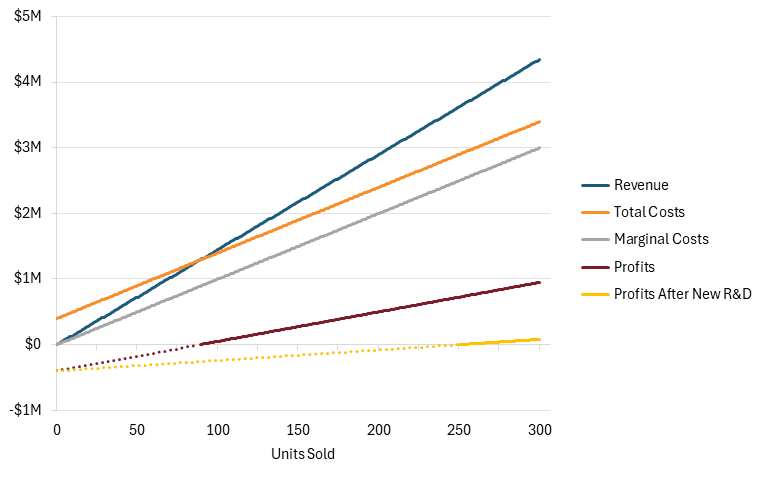
Global market access is existential for industries with high fixed costs. Otherwise, costs won’t fall, R&D won’t increase, and competitors will gain structural advantages that can ultimately lead to the demise of advanced U.S. firms and industries with high fixed costs. Conversely, U.S. sales of advanced goods and services outside the United States take market share from the Chinese, and limit its capacity to reinvest and expand. This is especially true in emerging markets where China is targeting much of its export-based “going out” strategies.
Expand and Reform EX-IM Bank
The Ex-Im (Export–Import) Bank of the United States plays a key role in helping U.S. exporters gain sales.[162] The bank provides financing for export transactions that might not otherwise occur when private commercial lenders are unable or unwilling to provide financing to foreign purchasers of U.S. exports and plays a key role in leveling the playing field for America’s exporters by matching the credit support that other nations provide, ensuring that U.S. exporters are able to compete based on the price and performance features of their products.[163]
In FY 2024, the Ex-Im Bank approved 1,424 transactions worth a total of $8.4 billion, which supported an estimated $12.4 billion in U.S. exports and 38,000 jobs.[164] However, Ex-Im Bank funding has declined dramatically in recent years. For instance, in FY 2011, the Ex-Im Bank authorized $32 billion in transactions; in FY 2012, $35.8 billion. But Ex-Im Bank authorizations haven’t eclipsed $10 billion since FY 2015. Meanwhile, global export credit expenditures grew from $71 billion in 2015 to $115 billion in 2024. China—the leading provisioner of export credit—extended $24 billion in export credit in 2024, almost three times the U.S. amount.[165]
Congress will need to reauthorize the Ex-Im Bank by December 31, 2026 (on February 6, 2026, Senators Kevin Cramer (R-ND) and Mark Warner (D-VA) introduced reauthorizing legislation), and this should be supported fully by the Trump administration.[166] Congress should significantly increase Ex-Im lending levels. It should also permit that Ex-Im’s China and Transformational Exports Program workstream accept greater loan-loss risk across its portfolio and expand its transformational export areas to include cloud services and infrastructure; civil nuclear facilities, material, and technologies; and critical minerals, materials, and rare earth element mining, concentration, separation, refining, alloying, fabrication, and end use.
The Ex-Im Bank has achieved very low default rates for many years—just 0.91 percent in FY 2024.[167] While that’s laudable, it can prevent the Bank from taking on somewhat riskier, yet worthy, investments. As such, in reauthorizing legislation, Congress should increase the permissible Ex-Im Bank default rate from 2 percent to at least 4 percent.[168] Congress could also exempt nuclear energy projects from default risk calculations to encourage more risk-taking. Reauthorization should also permit Ex-Im to finance weapons exports to U.S. allies (with approval from the Pentagon).
Expand the International Development Finance Corporation
The International Development Finance Corporation (DFC) is the international investment arm of the U.S. government, partnering with the private sector to mobilize capital for strategic investments around the world.[169] DFC currently boasts a global development portfolio exceeding $40 billion, with active projects in over 100 countries.
DFC celebrated nearly $12 billion in commitments in FY 2024—a highwater mark for this decade. Unfortunately, DFC issued around $3.5 billion in new commitments in FY 2025.[170] In December 2025, however, Congress reauthorized DFC, increasing its maximum contingent liability to $205 billion from $60 billion previously, a $145 billion increase, hopefully setting the agency up to make much more significant investments in the future.[171] If DFC is able to do so, Congress should increase its contingent liability even more.
The vast majority of DFC activity comes in the form of direct financing or loan guarantees. Direct equity investments were historically a small component of DFC’s commitments due in part to its nonsensical treatment in budget scoring—which assumed that an equity investment yielded a total and immediate loss.[172] To address this, the December 2025 congressional reauthorization created a $5 billion revolving equity fund, but this will have to be capitalized through the appropriations process. These efforts are a step forward to promote U.S. technologies and standards overseas, but DFC’s equity tools are still far from comparable to those of peer institutions around the world and will be insufficient to counter Chinese investments. So, the government should continue the reform of the U.S. development assistance system.
The administration should use the DFC as a centerpiece of a coordinated engagement strategy with allies in Global South countries. If the DFC is going to represent an effective counterweight to China’s global initiatives, it must collaborate with development finance entities from like-minded nations and co-invest in development initiatives that support supply chain diversification efforts of mutual interest. Here, for instance, the United States can invest alongside allies to create alternative suppliers of critical minerals and other strategic resources in developing economies. Announcements of new DFC critical minerals investments in Congo, Brazil, and Kazakhstan, alongside the ministerial meetings Secretary of State Marco Rubio held on critical minerals in February 2026, represent significant steps in this regard.[173]
Congress should increase development finance investments. China has become the world’s leading source of international development finance, with some $1.34 trillion in loans and grants disbursed over 22 years for 20,985 projects in 165 low- and middle-income nations.[174] Over that period, China’s state-run banks and companies have channeled nearly six times as much money into projects as the United States has allocated.[175] Since DFC’s main financial mechanisms are equity and loan guarantees, a large share of increases in the federal budget can be recovered through repayments, fees, and investment returns.
Congress should expand DFC’s institutional capacity and expertise. Congressional reauthorization of DFC has given the entity a large remit and important flexibility. But if it’s going to fulfill its potential to mobilize private capital and scale development impact, it’s going to need a clear strategy and effective leadership to professionally restaff the organization. (DFC lost almost 200 career specialists amid federal workforce reductions last year.)[176]
Congress should require DFC to use its financial tools to explicitly reduce third countries’ reliance on PRC investments, technologies, or standards, and to the extent possible, focus on national economic power industries. DFC should also produce annual reports explaining how much of its maximum contingent liability—its “credit card”—has been committed to countering the PRC, including descriptions of those projects and the sums committed to each.
Congress should make it clear that recipients of DFC funding are not permitted to expend resources on products or services made by Chinese companies (unless there is no feasible alternative). So far, DFC has been subjected to general restrictions on federal procurements—for example, restrictions on telecom and surveillance technologies from companies on the Entity List such as Huawei, Hytera, and ZTE.[177] This is insufficient, particularly because these are federal funds spent overseas. As market share in foreign markets is a zero-sum dynamic, DFC funds should not be allocated to Chinese national power industries, which would help them gain market share in third markets.
Lastly, while DFC plays an important role in competing with Chinese development financing, it needs to do so in ways that do not reward nations with digital policies harmful to U.S. techno-economic interests. Congress and the administration should create explicit criteria for DFC to use in assessing how a country’s trade and technology policies affect U.S. interests. Countries that negatively affect the ability of U.S. firms to enter and compete in foreign markets by supporting trade barriers or substandard IP rules should not be recipients of U.S. development finance aid.[178]
Foster a National Export Promotion System
There is no national export strategy or system, while various federal agencies have their own export programs. GAO wrote about this more than 30 years ago, and little has changed.[179] At the same time, most state governments, some city governments, and other subnational organizations have export promotion agencies. This is a jumble of different programs at different levels of government that is disorganized and uncoordinated, making it difficult for exporters to get the information and assistance they need. There is not comprehensive list of these programs. There is no attempt to create a coordinate network of all these organizational efforts to at least identify synergies. Congress should charge the Commerce Department with establishing a national, inter-agency, and inter-governmentally aligned trade promotion system.
Promote National Power Exports to the Global South
An ITIF report shows that economies in the Global South will account for over 45 percent of the global economy by 2050.[180] The five largest Global South countries—Brazil, India, Indonesia, Mexico, and Turkey—account for a large share of the population and economies of developing countries—42 percent and 47 percent, respectively.[181] Other relevant economies in the Global South include Argentina, Nigeria, Saudi Arabia, South Africa, Thailand, the UAE, and Vietnam. Gaining market share in national power industries in these countries should be a top priority for U.S. foreign and trade policymakers.
Access to developing economies matters so national power industries can reach scale. China’s exports, sales, and investments are growing faster in these markets than those of the United States. Federal support for export promotion in countries in the Global South can help counter this trend.
The Trump administration announced in October 2025 that it is seeking to launch an export program to “full-stack AI export promotion program to advance America’s global leadership”—the American AI Exports Program.[182] While the program is still in its design phase—with the scope, focus, priorities, and instruments to be defined—the stated objective to advance U.S. leadership in a strategic, general-purpose technology such as AI is commendable. It is what is expected of the federal government to lead technologically. However, these efforts would be insufficient if limited to a single set of technologies.
The U.S. government needs to support an export program for all national power industries, particularly in the Global South. This should be a multi-agency effort that overlaps the execution of U.S. grand strategy through diplomacy, and U.S. economic priorities through trade negotiations.
In addition, the State Department should lead a coalition of Western countries to increase allied market share in national power industries in Global South markets. At first, it will be challenging to establish common goals among economies that are competing for market share in third markets—for instance, American and German carmakers would each benefit if the other had more difficulties expanding its footprint in Global South markets. In this context, the first approach should be to address how Chinese mercantilism is expressed in the Global South—with dual-use infrastructure projects and flooding markets to block potential competitors, what is called the “premature deindustrialization” in developing economies. This coalitional work should encompass all areas of foreign affairs—from securing safe supply chains through loans and development assistance to people-to-people exchange programs that raise awareness of the consequences of Chinese mercantilism for the development paths of emerging countries.
Make It Easier to Export Weapons to All Nations in the Foreign Military Sales Program
While competition in national economic power industries, including dual-use industries, is critical to national security, productive capacity in weapons systems is clearly the most important for safeguarding the nation. And like virtually all national economic power industries, greater global sales enable lower marginal production costs and more R&D to invest in next-generation systems. Plus, limiting China from gaining market share is equally valuable to slow its own expansion of weapons systems production.
With countries around the world increasing their defense budgets in a time of geopolitical turmoil, this is an opportune time for the United States to increase its exports of defense equipment. And indeed, U.S. defense sales to foreign nations reached an all-time high of $120 billion in 2025, building on sales of $117.9 billion in 2024, which represented a 46 percent increase from the year prior.[183] But if the United States is to sell more weapons in this moment, then it must improve the speed, predictability, and transparency of its Foreign Military Sales (FMS) processes.[184] Systemic process improvements—not necessarily more staff—will be needed to address this challenge.
However, China has grown its arms exports, selling to 44 nations, including traditional U.S. customers such as Argentina, Malaysia, and Thailand.[185] From 2015 to 2024, China ranked fourth in global arms sales, with about 6 percent global market share.[186] There are several reasons, including lower prices, fewer political strings attached, a noninterference policy that doesn’t impose sanctions or ask questions about how weapons will be used.[187] China’s Ex-Im Bank plays a significant role in financing the country’s defense exports, as do China’s state-owned banks. China regularly offers loans at below-market rates or with extended payment terms that can be make its financing be more attractive than what other nations can provide. As Merics wrote, “Competition between Chinese and Western providers will only intensify in years to come as China tries to boost its exports and expand its global influence.”[188]
China has grown its arms exports, selling to 44 nations, including traditional U.S. customers such as Argentina, Malaysia, and Thailand. From 2015 to 2024, China ranked fourth in global arms sales
On February 6, 2026, the Trump administration introduced a new America First Arms Transfer Strategy, an executive order that seeks to “ensure that future arms sales prioritize American interests by using foreign purchases and capital to build American production and capacity.”[189] The strategy centers on boosting the manufacture of weapons most important to the U.S. military and prioritizes sales that will help revitalize the American defense industrial base.[190] The strategy will further give defense export priority to foreign nations that are taking on more burden sharing and lifting their defense expenditures closer to 5 percent of GDP. The executive order further calls on the departments of War and State to create “a sales catalog of prioritized” weapons the United States will encourage partners to purchase.[191] The order further establishes an End Use Monitoring coordination group, which will ensure that foreign purchasers are complying with U.S. requirements to reduce the risk of weapons diversion.
The executive order represents the biggest modernization of U.S. defense export policy since 2023, when the U.S. State Department’s Bureau of Public-Military Affairs unveiled a 10-point plan to accelerate the approval of FMS by developing a new approach to FMS strategic planning.[192] That plan sought to streamline U.S. arms sales processes to ensure that the vast majority of sales were approved withing 48 hours.[193] The approach called for developing a regional approach to arms transfers, in part by anticipating comparable equipment requests from regional partners, and prioritizing FMS requests based on national security goals. It called for promoting proactive, forward-looking use of the Special Defense Acquisition Fund, which allows for the rapid delivery of selected defense articles and services in advance of normal procurement lead times. Other steps included refining implementation of the Unmanned Aerial System export policy, improving Security Cooperation Officer training, and modernizing congressional notification processes. Through the FMS Strategic Plan, the State Department sought to reduce arms delivery time to select U.S. allies by up to two years.[194]
Yet, Congress still wants to limit sales of weapons to nations that have questionable human rights records. Just like concerns over bribery in other nations to get contracts, the concern is legitimate. But if the alternative is Chinese sales to these countries, then China’s defense industry benefits at the expense of America’s. And for those who say that this shouldn’t be a race to the bottom and we can’t let China dictate U.S. policy, those sentiments were valid when China was not a military and techno-industrial rival. Now it is completely in the interests of the United States, within normal military security concern parameters, to sell as many defense goods as possible in a zero-sum competition with China.
There are several steps to take. Congress should remove the limitation of financing weapons exports that it placed on Ex-Im Bank. Since 1994, Congress authorized Ex-Im to facilitate financing of U.S. exports with both civilian and military applications, provided the bank determines such dual-use items are nonlethal and primarily meant for civilian end use. This was a luxury that the United States can no longer afford. If we don’t sell in international markets, China will.
The Arms Export Control Act, as amended [22 U.S.C. 2751, et. seq.], authorizes the president to finance procurement of defense articles and services for foreign countries and international organizations. Foreign Military Financing (FMF) enables eligible partner nations to purchase U.S. defense articles, services, and training through either FMS or, for a limited number of countries, the foreign military financing of direct commercial contracts program.[195] Three changes are needed.
Congress should significantly increase the lending authorities for the FMF program. The FMF program received $6.16 billion in FY 2026, representing a $25 million (0.4 percent) increase compared with FY 2025. Congress should provide at least $15 billion in FMF loans and $50 billion in loan guarantees each year so that financing does not become the barrier for foreign weapons sales. Expanding FMF loans and loan guarantees would enable allies in the Indo-Pacific, Africa, and the Americas to enhance their military readiness and interoperability by facilitating more rapid procurement of U.S.-manufactured defense weaponry. This is key because, as with so many other technology products, China competes on price and quality that is good enough. And for many lower- and middle-income countries, that is a compelling value proposition. Low-cost financing can help the higher cost, but higher-quality U.S. weapons have a better chance of being chosen.
The Trump administration should reinstate the ability of the program to make grants. In some cases, grants can make the difference between U.S. sales and Chinese sales, and the price is a small one to pay for that market share difference and the ability to interoperate with partner nations during a conflict that may potentially involve China as an adversary.
The FMF program is limited mostly to NATO countries, butFMF should be broadened to all FMS countries. In addition, DOW should review its FMF guidelines to reduce or eliminate barriers to foreign sales.[196]
The Under Secretary of War for Acquisition and Sustainment needs to establish an office whose mission is to focus winning the techno-economic weapons industry war with China by boosting foreign weapons sales. This should be more than simply something DOW does to strengthen our allies; it should be a coherent strategy to boost U.S. defense industry sales and competitiveness, while at the same time limiting PRC weapons sales. Such an office should bolster transparency by providing a “one-stop location” foreign buyers could contact to understand exactly where their orders stand in the review or fulfillment process (e.g., it’s at the State Department for review, or at the Defense Technology Security Administration, or in Congress for pre-notification). This matters, because presently a lack of transparency (and speed) regarding both review processes and order status has played a role in certain foreign nations choosing to procure weapons systems elsewhere.[197]
In 2024, the Defense Acquisition University released a memorandum that detailed eight internal, technical, and procedural improvements DOW could take to accelerate FMS, such as leveraging training and tools for DOW personnel, revising checklists to better define FMS requirements, adopting tools and processes to enhance prioritization of FMS requirements, providing contract order-period information, including FMS case identifiers in contracts, developing priced options in contracts, using undefinitized contract actions for urgent FMS requirements, and expanding the use of data and analytics tools.[198] Most of this is “inside baseball” procedural improvements, but as noted, they could play an important role in accelerating the speed, predictability, and transparency of FMS activity.
Congress should also be more supportive of foreign weapons sales, even to countries that are problematic from a human rights perspective, as long as they are not military adversaries. Taking such higher ground is noble, but at the end of the day, it us unlikely to keep these countries from acquiring weapons systems. They will just get them from China, and the U.S. will be relatively weaker. In addition to doing that, Congress should increase the reporting thresholds for sales the administration must use to report sales to Congress.[199] Currently, any major defense equipment sales valued at $14 million or more must be reported. This threshold should be significantly increased. Congress can also take steps to accelerate internal review and approval of proposed FMS by streamlining deal approval among the so-called congressional “Four Horseman”: Senate and House Foreign Relations minority and majority staff directors.[200]
Finally, some will argue that it makes no sense to boost exports if there are production bottlenecks at home. But these bottlenecks emerged in large part because defense companies did not believe that they could sell more weapons, so they scaled back production capabilities. If they know that the foreign markets represent greater opportunities as rational, for-profit actors, they should be willing to expand domestic production.
Reform the Foreign Corrupt Practices Act to Allow Bribes When Competing With China
The Foreign Corrupt Practices Act (FCPA) was passed in 1977 to make it unlawful for certain classes of persons and entities to make payments to foreign government officials to assist in obtaining or retaining business. In other words, no bribes to obtain contracts in other nations. The Organization for Economic Cooperation and Development (OECD) Anti-Bribery Convention is similar and includes all EU countries, the United Kingdom, Japan, Singapore, Australia, and a few others, but not China.[201] While China has a similar law, it is mostly for show.[202]
Indeed, Chinese companies routinely bribe officials in foreign countries in order to win contracts or gain business advantages. An article by the Forensic Risk Alliance found multiple instances of Chinese firms bribing foreign officials for business advantages.[203] For instance, it found that the China Harbour Engineering Company Ltd. bribed the Bolivian Highway Authorities with $2.7 million in exchange for a road-widening contract worth $95 million.[204] Moreover, in 2022, Chinese state-owned hydropower company Sinohydro Corp allegedly paid bribes to a friend of Ecuadorian government officials to win the Coca Codo Sinclair hydroelectric project contract.[205] In addition to bribing Latin American officials, Chinese firms have also bribed foreign officials in other nations. For instance, China’s ZTE has faced probes by foreign authorities in multiple nations over alleged bribes to obtain telecom contracts.[206] They have similarly offered bribes to EU and African officials.[207]
Chinese companies routinely bribe officials in foreign countries in order to win contracts or gain business advantages.
The Trump administration recently issued guidelines to reduce the unfair competitive advantage this gives to China, in part by stepping up enforcement against Chinese companies.[208] At the same time. the administration issued a temporary pause on enforcement of the FCPA against U.S. companies.[209]
The focus on the FCPA and the OECD Convention were both from an earlier era when the United States and the West generally were working toward a better world governed more by the rule of law. That attempt has failed, and it instead created a two-tier system wherein the United States and allied companies are competing with one arm tied behind their back, including winning contracts in China. Not only bribery, but also a one-sided prohibition of it only hurts American interests and helps Chinese companies gain advantage. It particularly makes no sense to prosecute U.S. companies making bribes in China in order to obtain business. Presumably, in most cases, increased U.S. sales are in the U.S. national interest. If the CCP does not want bribes paid in the PRC, it can bring its own cases.
As such, Congress should pass legislation that exempts U.S. firms’ bribery in China and also allows U.S. firms to get a timely exemption to the FCPA from DOJ if they can show that the bribe is needed to win a contract in a foreign country against a Chinese competitor.
Allow U.S. Intelligence Services to Give Insights Into Chinese Company Bids
The U.S. IC has long collected what it calls “economic intelligence.” A 1953 CIA memo defined economic intelligence as “analysis and evaluation of a foundation of economic information, mostly quantitative, with the object of solving problems related to national security.”[210] In a 1996 testimony, then-Director of Central Intelligence (DCI) John M. Deutch further described the IC’s economic intelligence collection requirements:
We monitor threats to international financial stability and U.S. interests. We alert policymakers when foreign firms use questionable business practices, such as bribery, to disadvantage U.S. firms. Economic intelligence reporting helps us expose activities that may support terrorism, narcotics trafficking, proliferation, and grey arms dealing. Finally, as I mentioned earlier, we also monitor compliance with economic sanctions.[211]
The IC’s economic intelligence regime presents a longtime debate: To what extent, if any, should the IC offer the private sector access to the economic intelligence it collects, effectively thawing the longstanding firewall between economic intelligence collection and U.S. commercial goals?
Those in opposition of breaking the firewall have identified foreign intelligence collection on foreign companies as a red line on moral or normative grounds while maintaining the continued importance of intelligence resources on companies in defensive and counterintelligence capacities.[212] For example, former senator and ambassador to China Max Baucus (D-MT) testified in 1993 that while “we should be prepared to retaliate against those countries who refuse to refrain from using their intelligence services for these unethical purposes,” ultimately, “it is improper for the United States government to be spying on foreign companies.”[213]
Another common refrain from those who oppose breaking the firewall has been that the United States is ahead and thus has little commercial benefits to gain from changing collection requirements and dissemination practices for economic intelligence. As former senior CIA officer Diane C. Snyder wrote in 1997:
A United States industrial espionage plan would be akin to fighting fire with fire. There is a reason why we are targets - we have the most advanced technology. The secrets we would be stealing may have already been stolen from us. The gain would be minimal, while the diplomatic and even life risks would be substantial.[214]
In contrast, supporters of breaking down the longstanding firewall have a variety of rationales.[215] Former senator Dennis DeConcini (D-AZ), a proponent of limited use of U.S. intelligence assets to assist U.S. firms’ competitiveness, rhetorically asked the following question in 1994: “As long as other countries use their intelligence services to support their domestic industries, why should the United States hamstring itself?”[216]
Baucus’s, Snyder’s, and DeConcini’s opinions from the 1990s are all relevant today. However, two major events have changed the calculus since then. The first is that China has become highly innovative in advanced industries and has even surpassed the United States within numerous sectors.[217] This renders the argument that the U.S. economy is so far ahead and stands to comparatively gain little by conducting economic espionage less applicable.[218]
The second event is that since the 1990s, China has pivoted to a strategic campaign to dominate advanced industries that serve as the wellsprings of national power and security for 21st century nations, leaning on its increasingly strong innovation base.[219] This event has in effect launched an industrial war between a China on the attack and the United States, along with its allies and partners, in vulnerable, defensive positions. While China’s continued innovation gains contribute to a long, slow war, China’s government has fueled its strategy to dominate key industries through a bevy of isolated attacks, from mercantilist trade policies to economic espionage.[220]
With this context, it is at the very least worth revisiting the debate on whether the U.S. IC should change either or both of its collection requirements and dissemination of economic intelligence.[221] Indeed, former NSA General Counsel Stewart Baker recently revisited the debate, writing in Lawfare in 2025 in support of breaking the firewall, arguing that “a lot of the reasons given in support of the ban are looking a little threadbare.”[222] Baker’s argument offers strong rebuttals of many of the historical arguments against economic intelligence reform. His analysis, however, concluded that any reform would require serious collaboration between the IC and U.S. private sector: “The question ‘Who gets the intel?’ must be answered in a way that is fair and resistant to favoritism, that ensures an active and demanding customer, and that doesn’t cheapen the sacrifices made by intelligence professionals.”[223]
“As long as other countries use their intelligence services to support their domestic industries, why should the United States hamstring itself?”
Baker considered the debate from a perspective looking squarely at China’s engendered change to the global world order. If nothing else, additional public thought exercises on this question in the context of China’s industrial war is worth further consideration. Following in Baker’s example, two hypothetical examples show some benefits and drawbacks of economic intelligence reform.
First is the DeepSeek example. On January 27, 2025, the Chinese company DeepSeek’s large language model (LLM) app, also called DeepSeek, became the most downloaded free app on Apple’s U.S. app store.[224] This market movement, in addition to the news that DeepSeek’s LLM operated at a much lower cost than leading U.S. LLMs, caused the Nasdaq to fall nearly 600 points.[225] Clearly, investors and Wall Street did not see DeepSeek coming. At least publicly, U.S. tech executives also seemed to be surprised, with former Scale AI CEO Alexandr Wang calling DeepSeek’s LLM “earth-shattering.”[226]
It is unknown whether the U.S. IC knew about the extent of DeepSeek’s prowess in advance. If it had, it is still impossible to know what difference it would have made in the U.S.-China industrial war if the IC had subsequently shared that intelligence with U.S. AI firms. This counterfactual blurs the line between a competitive asset for U.S. firms and counterintelligence; OpenAI later claimed that DeepSeek used its proprietary models for training purposes, thereby breaching OpenAI’s terms of service.[227] While the answers to these questions are unknown, they demonstrate the range of potential benefits to thawing the IC-private sector firewall on economic intelligence.
Assuming DeepSeek has not evaded U.S. sanctions, contributed to developing weapons of mass destruction, or involved itself in corrupt practices in the United States, the IC under current norms would have no mandate to collect DeepSeek’s source code or other proprietary technical artifacts. In a world where the IC had that mandate, managed to collect that intelligence, and disseminated that intelligence to U.S. firms developing LLMs, the question would become, “Would that have improved those companies’ ability to compete against China in advanced AI systems?” Any gains would be offset by raised reciprocity risks and damaged U.S. claims of rule-based competition. At this stage, value from such appropriation of foreign commercial IP would likely not outweigh the risks.
Furthermore, much of what shocked U.S. markets and tech leaders regarding DeepSeek was already visible in open-source discussions well before the company’s commercial release, meaning economic intelligence would have wasted taxpayer money and government resources.[228] James Lewis commented in Lawfare in 2016 that “economic intelligence collected by government agencies will always be of lesser value than what is available to commercial actors.”[229] Perhaps economic intelligence reform might be better spent more on the IC lending its growing open-source intelligence (OSINT) capabilities—the IC strengthened OSINT to “a core intelligence discipline” in 2024—to the U.S. private sector to better track developments emerging from China’s research base.[230]
A second hypothetical example is if the IC were to collect information on a Chinese firm that was bidding on a major foreign government contract in competition against a U.S. firm. If the IC collected intelligence indicating that the Chinese bidder benefitted from opaque state subsidies or other Chinese government benefits or direction, were engaged in dual-use technology diversion, or had corruption risks tied to the bid, a breach of the current firewall would entail the IC sharing that intelligence with the U.S. firm competing for the contract. This could help the U.S. firm level the informational playing field in contests wherein Chinese firms operate as extensions of state strategy, but could alternatively expose IC sources and methods or entangle the United States in accusations of economic coercion.
As in the DeepSeek case, this would go well beyond leveling the informational playing field and into the direct transfer of commercial IP. While such an approach could materially alter outcomes in high-stakes infrastructure, telecom, or energy procurements, it would also significantly heighten diplomatic fallout, expose intelligence sources and methods, and blur the line between defensive economic intelligence and offensive economic warfare.
Taken together, these examples underscore that the core policy challenge is not whether economic intelligence can confer advantage, but where reform should draw and enforce the boundary between strategic awareness and outright espionage. Any change would require change to the Obama administration’s 2014 Presidential Policy Directive PPD-28 that explicitly states:
[T]he collection of foreign private commercial information or trade secrets is authorized only to protect the national security of the United States or its partners and allies. It is not an authorized foreign intelligence or counterintelligence purpose to collect such information to afford a competitive advantage to U.S. companies and U.S. business sectors commercially.[231]
The Biden administration similarly stated in a 2022 executive order that “it is not a legitimate objective to collect foreign private commercial information or trade secrets to afford a competitive advantage to United States companies and United States business sectors commercially.”[232]
Congress and the Trump administration should establish a narrowly tailored pilot authority that allows the IC to share classified assessments with vetted U.S. firms competing with Chinese firms for third-country contracts. Included information in the disseminated intelligence could include a Chinese firm’s ties to PRC subsidies, coercive practices, sanctions evasion, corruption, or dual-use diversion tied to specific bids, but not cross the firewall to collect or disseminate foreign commercial trade secrets for the purpose of conferring a purely commercial advantage. Such a framework should require clear national security objectives, interagency review, strict source-and-methods protections, and congressional oversight, thereby enabling defensive economic intelligence support in power industries without crossing the line into offensive industrial espionage.
Expand Training and Other Outreach to Government Officials in Contested Nations
The U.S. government, mostly through State Department operated or funded programs works to help foreign government officials to better understand key components of the U.S. policy system. For example, the PTO’s Global Intellectual Property Academy (GIPA) brings foreign IP officials—prosecutors, judges, executive branch officials—to Alexandria, Virginia, to learn about IP protection and enforcement best practices.[233] Attendees meet with U.S. officials across the government, as well as private sector experts. GIPA has been a real success story, identifying and cultivating IP champions in foreign markets.
In other cases, the State Department funds organizations to work with other nations, such as meeting with officials to talk about components of innovation policy.
In both kinds of actions, face-to-face relationship building is crucial to helping countries resist falling into the PRC’s orbit. Investment in this kind of soft power education and training is critical if we are to slow China’s encroachment in these other nations. As such, Congress should ensure that agency budgets, especially the State Department’s, include expanded funding for these kinds of relationship building and education efforts.
Conclusion
The United States has faced competitiveness challenges in the past, particularly in the 1980s and early 1990s, and especially against Japan and Germany. But they and other similar competitors at the time differed from China in four key ways:
1. While these nations engaged in some protectionist behavior, compared with China’s behavior, it was relatively limited.
2. Both nations were allies and so had to take U.S. concerns at least somewhat seriously. China is an adversary seeking global hegemony and displacement of America from that role. And it is ruled by a Marxist-Leninist authoritarian regime, not a democratic one. As such, it ignores U.S. concerns with impunity.
3. These nations were bound by the rule of law and administrative law requirements, which limited the capriciousness of law, regulations, and enforcement. China is not bound by any limitations other than what the State Council and Xi dictate.
4. These nations sought comparative advantage in certain sectors the United States competed in, but at the end of the day, their ambitions were limited, and they were willing to import some U.S. goods and services. The PRC’s ambitions for industrial dominance are unlimited, and it seeks autarky, not interdependence.
As such, unlike the competitiveness challenge of the 1980s and 1990s, this is less a competition and more a war; less about fighting over a few industries and more about fighting for all national economic power industries.
If the United States (and allies) do not want their national economic power industries hollowed out, creating crippling dependency on the PRC, it needs to step up its actions. That means putting in place an array of bold new ideas to support national economic power industries, as further ITIF reports in this series will do. But it also means taking an significant array of steps to limit China’s advantage. Not losing depends on both.
The United States and other democratic nations need to stop being the prisoner who rats on their partners and start sticking together to achieve a cooperative win-win outcome.
And perhaps most importantly, it means that the United States and other democratic nations need to stop being the prisoner who rats on their partners and start sticking together to achieve a cooperative win-win outcome. Allies should not break ranks to join up with China, because China is not a reliable partner. It has shown again and again that it is selling out advanced nations, and doing what is good for its own self-interest, not the collective global good. Maybe someday we can convince China to cooperate and we’ll all be better off. But today isn’t that day, and the United States and allies should act accordingly with courage and integrity.
This report is part of a series that has been made possible in part by generous support from the Smith Richardson Foundation. (For more, see: itif.org/power-industries.) ITIF maintains full editorial independence in all its work.
The authors would like to thank Daniel Castro, Jimmy Goodrich, Isaac Stone Fish, and Darren Tromblay for sharing insights and providing editorial feedback and support. Any errors or omissions are the authors’ responsibility alone.
About the Authors
Dr. Robert D. Atkinson (@RobAtkinsonITIF) is the founder and president of ITIF. His books include Technology Fears and Scapegoats: 40 Myths About Privacy, Jobs, AI and Today’s Innovation Economy (Palgrave McMillian, 2024); Big Is Beautiful: Debunking the Myth of Small Business (MIT, 2018); Innovation Economics: The Race for Global Advantage (Yale, 2012); Supply-Side Follies: Why Conservative Economics Fails, Liberal Economics Falters, and Innovation Economics Is the Answer (Rowman Littlefield, 2007); and The Past and Future of America’s Economy: Long Waves of Innovation That Power Cycles of Growth (Edward Elgar, 2005). He holds a Ph.D. in city and regional planning from the University of North Carolina, Chapel Hill.
Rodrigo Balbontin is an associate director covering trade, IP, and digital technology governance at ITIF. He has extensive experience in policy design and research on science, technology, and innovation governance in the Americas and the Asia-Pacific regions. He earned a master’s degree in science and technology policy from the University of Sussex and a bachelor’s degree in economics from the University of Chile.
Eli Clemens is a senior policy analyst focusing on e-commerce and retail technology policy at the Center for Data Innovation as well as U.S.-China competition at ITIF. Previously, he worked as an open source intelligence analyst and served as a Peace Corps volunteer in China. He holds a Master of International Affairs degree from Columbia University’s School of International and Public Affairs and a B.A. from New York University.
Stephen Ezell is vice president for global innovation policy at ITIF and director of ITIF’s Center for Life Sciences Innovation. He also leads the Global Trade and Innovation Policy Alliance. His areas of expertise include science and technology policy, international competitiveness, trade, and manufacturing.
About ITIF
The Information Technology and Innovation Foundation (ITIF) is an independent 501(c)(3) nonprofit, nonpartisan research and educational institute that has been recognized repeatedly as the world’s leading think tank for science and technology policy. Its mission is to formulate, evaluate, and promote policy solutions that accelerate innovation and boost productivity to spur growth, opportunity, and progress. For more information, visit itif.org/about.
Endnotes
[1]. Robert Atkinson, “Marshaling National Power Industries to Preserve America’s Strength and Thwart China’s Bid for Global Dominance” (ITIF, November 2025), https://itif.org/publications/2025/11/17/marshaling-national-power-industries-to-preserve-us-strength-and-thwart-china/.
[2]. “China, AI, E.V.s and Trump,” The New York Times, February 10, 2026, https://www.nytimes.com/2026/02/10/opinion/china-ai-ev-trump.html.
[3]. Hui Jiang (2021), The Great Contribution of the CPC to the World Socialist Movement over the Past Hundred Years, International Critical Thought, 11:4, 497–507, DOI: 10.1080/21598282.2022.1996836.
[4]. Indeed, as an upcoming ITIF report demonstrates, they have already done that in the Global South.
[5]. “COMMITTEE REPORT: American VC Firms Investing Billions into PRC Companies Fueling the CCP's Military, Surveillance State, and Uyghur Genocide” (The Select Committee on the CCP, February 2024), https://chinaselectcommittee.house.gov/media/reports/committee-report-american-vc-firms-investing-billions-prc-companies-fueling-ccps.
[6]. Image generated with Gemini 3.
[7]. For those who argue that clean energy saves money, why then do we need regulations and tax incentives to adopt it? And why has progress been so slow. And why do energy users, both businesses and consumers, largely oppose green mandates and regulations. For more information on this, see Robin Gaster, “Mend It, Don’t End It: It’s Time to Reset Clean Energy Policy by Focusing on Price/Performance Parity (P3)” (ITIF, January 2025), https://itif.org/publications/2025/01/27/time-reset-clean-energy-policy-focusing-price-performance-parity-p3/.
[8]. Robert Atkinson, “How China Divides Europe and the United States” (ITIF, May 2023), https://itif.org/publications/2023/05/12/how-china-divides-europe-and-the-united-states/.
[9]. Robert Atkinson, “2026: The End of the Western Alliance and the Emergence of China” (ITIF, January 2026), https://itif.org/publications/2026/01/22/2026-the-end-of-the-western-alliance-and-the-emergence-of-china/.
[10]. A Commercial and Government Entity (CAGE) code is a unique identifier assigned to suppliers to various government or defense agencies, as well as to government agencies themselves and also various organizations. CAGE codes provide a standardized method of identifying a given facility at a specific location. “CAGE Code - Commercial and Government Entity Code” (Defense Logistics Agency), https://www.dla.mil/Working-With-DLA/Applications/Details/Article/2920893/cage-code-commercial-and-government-entity-code/.
[11]. Shalia Thilakan, “Cable&Wireless: Customer centricity initiatives will become a priority in emerging markets in 2011” (Telecomlead, May 2011), https://telecomlead.com/telecom-equipment/huawei-strengthens-lead-in-global-telecom-equipment-market-120439; “Key Takeaways – Worldwide Telecom Equipment Market 2018,” Dell’Oro Group, https://www.delloro.com/telecom-equipment-market-2018-2/.
[12]. Ryan Daws, “HarmonyOS Next: Huawei’s Challenge to Apple and Android,” Telecoms Tech News, April 25, 2024, https://www.telecomstechnews.com/news/harmonyos-next-huawei-challenge-apple-android/.
[13]. Joe Devanesan, “What Three Years of US Sanctions Did to Huawei,” TechWire Asia, March 28, 2023, https://techwireasia.com/2023/03/what-three-years-of-us-sanctions-did-to-huawei/.
[14]. Coco Feng, “Tech war: Huawei executive claims victory over US sanctions with computing, AI ecosystem,” South China Morning Post, August 2025, https://www.scmp.com/tech/tech-war/article/3323647/tech-war-huawei-executive-claims-victory-over-us-sanctions-computing-ai-ecosystem.
[15]. Since 2012, following a U.S. Congressional report that denounced the company’s unfair practices and cybersecurity risks, Huawei has accelerated its efforts to decouple from U.S. technologies.
[16]. Eamonn Bellin, “Competing in the Episteme: The Cold War, the American University, and Strategic Competition with China Today” (Alecander Hamilton Society, September 2024). https://alexanderhamiltonsociety.org/security-strategy/issue-four/competing-in-the-episteme-the-cold-war-the-american-university-and-strategic-competition-with-china-today/.
[17]. Ibid.
[18]. “Ongoing Changes in the Demographic Composition of Postdoctoral Researchers at Federally Funded Research and Development Centers: 2023” (National Center for Science and Engineering Statistics, October 2024). https://ncses.nsf.gov/pubs/nsf24339.
[19]. “Research for Sale: How Chinese Money Flows to American Universities” (NAICU, April, 2024). https://www.naicu.edu/news-events/headline-news/2024/04/research-for-sale-how-chinese-money-flows-to-american-universities/; LJ Eads, “China’s Expanding Financial Footpring in U.S. Universities and the Transparency Gap” (Data Abyss: Academic Capture, October 2025), https://www.dataabyss.ai/reports/academic-capture; “China and EU signed Administrative Arrangement on a new round of joint research funding” (Ministry of Science and Technology of the People’s Republic of China, June 2022), https://en.most.gov.cn/pressroom/202206/t20220622_181224.html; Rob Davies, “Oxford places ban on donations and research grants from Huawei” The Guardian, January 2019, https://www.theguardian.com/technology/2019/jan/17/oxford-places-ban-on-donations-and-research-grants-from-huawei-chinese-national-security; Virginia Allen, “Spies on Campus: Chinese Espionage Exposed at Stanford,” The Daily Signal, May 2025, https://www.dailysignal.com/2025/05/09/spies-campus-chinese-espionage-uncovered-stanford/.
[20]. Robert D. Atkinson, et al., “A Techno-Economic Agenda for the Next Administration” (ITIF, June 2024), https://itif.org/publications/2024/06/10/a-techno-economic-agenda-for-the-next-administration/.
[21]. “Optica Cuts Ties With Huawei After secret Funding Exposed” (Bloomberg, June 2024), https://www.bloomberg.com/news/articles/2024-06-06/optica-foundation-cuts-ties-with-huawei-after-bloomberg-report.
[22]. “H.R.1048 – Deterrent Act” (119th Congress, February 2025), https://www.congress.gov/bill/119th-congress/house-bill/1048.
[23]. Ibid.
[24]. Darren Tromblay, “From Outside Assaults to Insider Threats: Chinese Economic Espionage” (ITIF, November 2025), https://itif.org/publications/2025/11/03/from-outside-assaults-to-insider-threats-chinese-economic-espionage/.
[25]. The Select Committee on the CCP, “CCP on the Quad: How American Taxpayers and Universities Fund the CCP’s Advanced Military and Technological Resources” (Majority Staff Report, September 2024), https://chinaselectcommittee.house.gov/sites/evosubsites/selectcommitteeontheccp.house.gov/files/evo-media-document/2024-09-23%20Research%20Security%20Report.pdf.
[26]. “ED Ties Foreign Gift Reporting to Title IV Participation” (NASFAA), https://www.nasfaa.org/newsitem/23900/ED_Ties_Foreign_Gift_Reporting_Compliance_to_Title_IV_Participation.
[27]. The Select Committee on the Strategic Competition between the United States and the Chinese Communist Party & the Committee on Education and the Workforce, “Joint Institutes, Divided by Loyalties: How the Chinese Communist party Exploits US University Partnerships to Empower China’s Military and Repression” (Majority Staff Report, September 2025), https://chinaselectcommittee.house.gov/sites/evosubsites/selectcommitteeontheccp.house.gov/files/evo-media-document/jointinstitutesreportfinal.pdf.
[28]. The Select Committee on the CCP, “Joint Institutes, Divided Loyalties” (The Select Committee on the CCP, September 2025), https://chinaselectcommittee.house.gov/media/reports/joint-institutes-divided-loyalties.
[29]. The Select Committee on the CCP, “Reset, Prevent, Build: A Strategy to Win America's Economic Competition with the Chinese Communist Party” (The Select Committee on the CCP, December 2023), https://chinaselectcommittee.house.gov/sites/evo-subsites/selectcommitteeontheccp.house.gov/files/evo-media-document/reset-prevent-build-scc-report.pdf.
[30]. Ibid.
[31]. The Select Committee on the CCP, “CCP on the Quad: How American Taxpayers and Universities Fund the CCP’s Advanced Military and Technological Research” (The Select Committee on the CCP, September 2024), https://chinaselectcommittee.house.gov/media/reports/ccp-on-the-quad-how-american-taxpayers-and-universities-fund-the-ccp-s-advanced-military-and-technological-research.
[32]. Matt Sheehan and Sophie Zhuang, “Have Top Chinese AI Researchers Stayed in the United States?” (Carnegie Endowment for International Peace), https://carnegieendowment.org/emissary/2025/12/china-ai-researchers-us-talent-pool.
[33]. Frank Laczko and Neli Esipova, “Amid Declining U.S. Enrollment, Many Chinese Students Cite Negative Experiences” (Migration Policy Institute, September 2025), https://www.migrationpolicy.org/article/discrimination-chinese-students-us.
[34]. Marc Thiessen, “Trump wants to admit more Chinese students. Here’s why he shouldn’t,” The Washington Post, October 2025, https://www.washingtonpost.com/opinions/2025/10/30/trump-chinese-students-university-economic-espionage/.
[35]. “USCC Report: Trends in U.S.-China Science and Technology Cooperation: Collaborative Knowledge Production for the Twenty-First Century?” (US-China Economic and Security Review Commission,” September 2014), https://www.uscc.gov/sites/default/files/Press%20Release_Trends%20in%20U.S.-China%20Science%20and%20Technology%20Cooperation.pdf.
[36]. Deborah Seligsohn and Scott Kennedy, “The U.S.-China Science and Technology Cooperation Agreement Is Not Yet Obsolete” (CSIS, June 2025), https://www.csis.org/analysis/us-china-science-and-technology-cooperation-agreement-not-yet-obsolete.
[37]. Tromblay, “From Outside Assaults to Insider Threats: Chinese Economic Espionage.”
[38]. Ibid.
[39]. “Annual Intellectual Property Report to Congress” (United States Intellectual Property Enforcement Coordinator, March 2020), https://web.archive.org/web/20210816093904/https://trumpwhitehouse.archives.gov/wp-content/uploads/2020/04/IPEC-2019-Annual-Intellectual-Property-Report.pdf; “Annual Intellectual Property Report to Congress” (United States Intellectual Property Enforcement Coordinator, March 2019), https://trumpwhitehouse.archives.gov/wp-content/uploads/2019/02/IPEC-2018-Annual-Intellectual-Property-Report-to-Congress.pdf.
[40]. Eli Clemens, “How Chinese Online Marketplaces Fuel Counterfeits” (ITIF, August 2025) https://itif.org/publications/2025/08/20/how-chinese-online-marketplaces-fuel-counterfeits/.
[41]. Eli Clemens, “How Some Chinese Companies Obscure Ties to China and What Policymakers Should Do About It” (ITIF, November 2025) https://itif.org/publications/2025/11/03/some-chinese-companies-obscure-ties-to-china-what-policymakers-should-do-about-it/.
[42]. Office of Investment Security, USDT, 31 C.F.R. Parts 800-802 (published January 17, 2020).
[43]. Foreign Investment Risk Review Modernization Act of 2018, H.R. 4311, 115th Cong. (2018).
[44]. Clemens, “How Some Chinese Companies Obscure Ties to China and What Policymakers Should Do About It.”
[45]. Corporate Transparency Act of 2020, Pub. L. No. 116-283, 134 Stat. 3388 (2021); Meghan Ostertag, “US National Power Industries Are at Risk” (ITIF, forthcoming report, November 2025); Atkinson, “Is It Too Much to Ask for a Third Way Beyond Free Trade and Constrained Trade?”
[46]. Clemens, “How Some Chinese Companies Obscure Ties to China and What Policymakers Should Do About It.”
[47]. Atkinson, “Is It Too Much to Ask for a Third Way Beyond Free Trade and Constrained Trade?”
[48]. Robert D. Atkinson, “How to Implement CFIUS to Support U.S. Competitiveness” (ITIF, January 2, 2020), https://itif.org/publications/2020/01/02/how-implement-cfius-support-us-competitiveness/.
[49]. Tromblay, “From Outside Assaults to Insider Threats: Chinese Economic Espionage.”
[50]. National Security Memorandum/NSM-12, “National Security Memorandum on the President’s Intelligence Priorities,” July 12, 2022, https://bidenwhitehouse.archives.gov/briefing-room/statements-releases/2022/07/12/national-security-memorandum-on-the-presidents-intelligence-priorities/; Intelligence Community Directive 204, “National Intelligence Priorities Framework,” https://www.dni.gov/files/documents/ICD/ICD_204_National_Intelligence_Priorities_Framework_U_FINAL-SIGNED.pdf.
[51]. Intelligence Community Directive 204.
[52]. Ibid.
[53]. “FBI agents reassigned to immigration enforcement amid pressure from White House,” The Washington Post, October 8, 2025, https://www.washingtonpost.com/national-security/2025/10/08/fbi-agents-reassigned-immigration/.
[54]. David Bier, “ICE Has Diverted Over 25,000 Officers from Their Jobs” (CATO Institute, September 2025), https://www.cato.org/blog/ice-has-diverted-over-25000-officers-their-jobs.
[55]. Emily Siegel, “China Firm Funds US Suits Amid Push to Disclose Foreign Ties (2)” (Bloomberg, November 2023), https://news.bloomberglaw.com/business-and-practice/china-firm-funds-us-lawsuits-amid-push-to-disclose-foreign-ties.
[56]. Ibid.
[57]. “S.2805 - Protecting Our Courts from Foreign Manipulation Act of 2023,” https://www.congress.gov/bill/118th-congress/senate-bill/2805/text.
[58]. U.S. Department of Justice, “Chinese Professors Among Six Defendants Charged with Economic Espionage and Theft of Trade Secrets for Benefit of People’s Republic of China,” May 19, 2015, https://www.justice.gov/archives/opa/pr/chinese-professors-among-six-defendants-charged-economic-espionage-and-theft-trade-secrets.
[59]. Hal Berghel, “The Thousand Talents Program Prosecutions in Context” (Computer, vol. 56, no. 11, pp. 95-102, Nov, 2023), https://www.computer.org/csdl/magazine/co/2023/11/10286240/1RimYBXmWQw.
[60]. Kif Leswing, “Former Apple engineer accused of stealing automotive trade secrets pleads guilty,” CNBC, August 2022, https://www.cnbc.com/2022/08/22/former-apple-employee-xiaolang-zhang-pleads-guilty-.html.
[61]. Chance Miller, “Former Apple engineer who stole Project Titan trade secrets sentenced to prison” (AAPL Company, February 2024), https://9to5mac.com/2024/02/08/apple-engineer-project-titan-secrets-prison/
[62]. “S.1294 - Protecting American Intellectual Property Act of 2022” (Senate - Banking, Housing, and Urban Affairs), https://www.congress.gov/bill/117th-congress/senate-bill/1294.
[63]. Ibid.
[64]. Burt Braverman and Edlira Kuka, “Congress and the President Act to Protect America’s Intellectual Property” (David Wright Tremaine LLP, May 2023), https://www.dwt.com/blogs/broadband-advisor/2023/05/intellectual-property-national-security-paip.
[65]. Ibid.
[66]. “Part 744 - Control Policy: End-user and End-use Based” (Bureau of Industry and Security US Department of Commerce), https://www.bis.gov/regulations/ear/744#section-744.16.
[67]. Rodrigo Balbontin, “Backfire: Export Controls Helped Huawei and Hurt U.S. Firms” (ITIF, October 2025), https://itif.org/publications/2025/10/27/backfire-export-controls-helped-huawei-and-hurt-us-firms/.
[68]. “Part 744 - Control Policy: End-user and End-use Based” (Bureau of Industry and Security US Department of Commerce), https://www.bis.gov/regulations/ear/744#section-744.16.
[69]. Robert Atkinson, “How to Mitigate the Damage From China’s Unfair Trade Practices by Giving USITC Power to Make Them Less Profitable” (ITIF, November 2022), https://itif.org/publications/2022/11/21/how-to-mitigate-the-damage-from-chinas-unfair-trade-practices/.
[70]. “Commerce Issues Final Rule to Formalize ICTS Program” (Bureau of Industry & Security: Office of Congressional and Public Affairs, December 2024), https://www.bis.gov/press-release/commerce-issues-final-rule-formalize-icts-program.
[71]. Ibid.
[72]. A Presidential Document by the Executive Office of the President, “Securing the Information and Communications Technology and Services Supply Chain” (Federal Register: The Daily journal of the United States Government, May 2019), https://www.federalregister.gov/documents/2019/05/17/2019-10538/securing-the-information-and-communications-technology-and-services-supply-chain; “ICT Supply Chain” (US Department of Commerce), https://www.commerce.gov/issues/ict-supply-chain.
[73]. “Commerce Finalizes Rule to Secure Connected Vehicle Supply Chains from Foreign Adversary Threats” (Bureau of Industry & Security: Office of Congressional and Public Affairs, January 2025), https://www.bis.gov/press-release/commerce-finalizes-rule-secure-connected-vehicle-supply-chains-foreign-adversary-threats.
[74]. “Federal Acquisition Regulation: Amendments to the FAR Buy American Act Requirements” (A Rule by the Defense Department, the General Services Administration, and the National Aeronautics and Space Administration, March 2022), https://www.federalregister.gov/documents/2022/03/07/2022-04173/federal-acquisition-regulation-amendments-to-the-far-buy-american-act-requirements.
[75]. “Trade Agreements Act (TAA)” (Federal Schedules), https://gsa.federalschedules.com/resources/taa-designated-countries/.
[76]. “Look up Trade Agreements Act-designated countries” (US General Services Administration), www.gsa.gov/sell-to-government/step-1-learn-about-government-contracting/how-to-access-contract-opportunities/help-with-mas-contracts-to-sell-to-government/roadmap-to-get-a-mas-contract/readiness-assessment-for-mas-offerors/look-up-trade-agreements-actdesignated-countries.
[77]. Entities Identified as Chinese Military Companies Operating in the United States in Accordance with Section 1260H of the William M. (“Mac”) Thornberry National Defense Authorization Act for Fiscal Year 2021 (Public Law 116-283)1, https://media.defense.gov/2025/Jan/07/2003625471/-1/-1/1/ENTITIES-IDENTIFIED-AS-CHINESE-MILITARY-COMPANIES-OPERATING-IN-THE-UNITED-STATES.PDF.
[78]. “Department of Defense (DoD) 1260H List” (USC Office of Ethics and Compliance), https://oec.usc.edu/compliance-programs/international-activity/restricted-parties/dod-1260-list/.
[79]. “List of Equipment and Services Covered By Section 2 of The Secure Networks Act” (Federal Communications Commission), https://www.fcc.gov/supplychain/coveredlist.
[80]. Ibid.
[81]. “Office of Information and Communications Technology and Services (OICTS),” https://www.bis.gov/OICTS.
[82]. “OFAC Sanctions List Service,” https://sanctionslist.ofac.treas.gov/Home/.
[83]. “Entities Owned by Blocked Persons (50% Rule)” (Office of Foreign Assets Control) https://ofac.treasury.gov/faqs/topic/1521.
[84]. FTI Consulting, “Shifting Expectations Survey: Wave 2,” Question 35, May 15, 2020, https://fticommunications.com/covid-19/wp-content/uploads/2020/05/FTI-Shifting-Expectations-II-Topline-Results.pdf.
[85]. U.S. Customs and Border Protection, “Marking of Country of Origin on U.S. Imports,” last modified July 2005, https://www.cbp.gov/trade/rulings/informed-compliance-publications/marking-country-origin-us-imports; Alliance for American Manufacturing, “Chinese Companies Saturate U.S. Holiday Gift Market; Consumers Hunting for American‑Made Goods,” news release, November 20, 2024, https://www.americanmanufacturing.org/press-release/chinese-companies-saturate-u-s-holiday-gift-market-consumers-hunting-for-american-made-goods/.
[86]. Brendan Ruberry, "China’s Luckin Coffee Acquires Blue Bottle," Semafor, March 4, 2026, https://finance.yahoo.com/news/chinas-luckin-coffee-acquires-blue-223139564.html; Wendy Leigh, "The Beloved American Kitchen Appliance Brand That’s Been Owned By a Chinese Company Since 2016," Tasting Table, August 11, 2025, https://www.tastingtable.com/1930425/american-appliance-brand-china-owned-ge/; Holly Riddle, "These Iconic Food Brands Are Owned By Chinese Companies," The Takeout, July 26, 2025, https://www.yahoo.com/news/articles/iconic-food-brands-owned-chinese-114000768.html; Andrew Cohen, "IPO Could Reportedly Value Wilson Parent at $10 Billion," Front Office Sports, September 7, 2023, https://frontofficesports.com/ipo-could-reportedly-value-wilson-parent-at-10-billion/.
[87]. Pztrick Phillips, “5 Tool Brands You Might Not Realize Are Owned by Chinese Companies,” SlashGear, June 28, 2025, https://www.slashgear.com/1896136/tools-brands-owned-chinese-companies/.
[88]. “The Milwaukee Story,” Milwaukee Tool, accessed March 2026, https://www.milwaukeetool.com/company/milwaukee-story.
[89]. “About Us,” Techtronic Industries, accessed March 2026, https://www.ttigroup.com/company/about-us.
[90]. Hong Kong Special Administrative Region, “The Law of the People’s Republic of China on Safeguarding National Security in the Hong Kong Special Administrative Region,” accessed March 2026, https://www.elegislation.gov.hk/fwddoc/hk/a302/eng_translation_(a302)_en.pdf; The President’s Executive Order on Hong Kong Normalization, Exec. Order No. 13936, 85 Fed. Reg. 43413 (Jul. 17, 2020), https://www.federalregister.gov/documents/2020/07/17/2020‑15646/the‑presidents‑executive‑order‑on‑hong‑kong‑normalization.
[91]. “ONE-KEY,” Milwaukee Tool, accessed March 2026, https://onekey.milwaukeetool.com/; Peter Harrell, “Managing the Risks of China’s Access to U.S. Data and Control of Software and Connected Technology” (Carnegie Endowment for International Peace, January 2025), https://carnegieendowment.org/research/2025/01/managing-the-risks-of-chinas-access-to-us-data-and-control-of-software-and-connected-technology.
[92]. Atkinson, China Is Rapidly Becoming a Leading Innovator in Advanced Industries; Atkinson, Marshaling National Power Industries to Preserve America’s Strength and Thwart China’s Bid for Global Dominance; Ostertag, “US National Power Industries Are at Risk.”
[93]. “Supercam-S150 UAV Reley TRR1C05D00 C21K,” War & Sanctions, accessed March 2026, https://war-sanctions.gur.gov.ua/en/components/5571.
[94]. “Head Protection,” Milwaukee Tool, accessed March 2026, https://www.milwaukeetool.com/products/safety-solutions/personal-protective-equipment/head-protection.
[95]. “BYTEDANCE LTD.,” Bloomberg LEI, accessed March 2026, https://lei.bloomberg.com/leis/view/54930057HU24VGK3CO92.
[96]. Angelica Ang, “The ‘Singapore-washing’ strategy starts to unwind as both China and the U.S. closely scrutinize corporate roots,” Fortune, March 9, 2026, https://fortune.com/2026/03/09/singapore-washing-us-china-shein-manus/.
[97]. Financial Crimes Enforcement Network, “Beneficial Ownership Information Reporting Rule Fact Sheet,” September 29, 2022, https://www.fincen.gov/beneficial-ownership-information-reporting-rule-fact-sheet.
[98]. Jeff Newman Law, “For Products Imported to the U.S. the Importer Has the Responsibility to Make Sure the Marked Country of Origin Is Accurate,” April 17, 2025, https://jeffnewmanlaw.com/for-products-imported-to-the-u-s-the-importer-has-the-responsibility-to-make-sure-the-marked-country-of-origin-is-accurate/.
[99]. Ibid.
[100]. Customs and Border Protection, “Uyghur Forced Labor Prevention Act (UFLPA),” last modified February 4, 2025, https://www.cbp.gov/trade/forced-labor/UFLPA.
[101]. Congressional Research Service, “U.S.-China Trade Relations,” IF11284, updated September 9, 2025, https://www.congress.gov/crs_external_products/IF/PDF/IF11284/IF11284.33.pdf; “Recalls & Product Safety Warnings,” U.S. Consumer Product Safety Commission, accessed March 2026, https://www.cpsc.gov/Recalls; Organisation for Economic Co‑operation and Development, “Global Trade in Fake Goods Reached USD 467 Billion, Posing Risks to Consumer Safety and Compromising Intellectual Property,” news release, May 7, 2025, https://www.oecd.org/en/about/news/press-releases/2025/05/global-trade-in-fake-goods-reached-USD-467-billion-posing-risks-to-consumer-safety-and-compromising-intellectual-property.html.
[102]. “United States Customs and Border Protection – AI Use Cases,” CBP, https://www.dhs.gov/ai/use-case-inventory/cbp; Altana, “United States Customs and Border Protection Chooses Altana to Help Drive Implementation of the Uyghur Forced Labor Prevention Act,” news release, July 20, 2023, https://altana.ai/resources/united-states-customs-and-border-protection-chooses-altana; Eli Clemens, “CBP Should Leverage AI, Not More Staff, to Manage the Surge in Inspections After Partial End to De Minimis Exception” (ITIF, February 6, 2025), https://itif.org/publications/2025/02/06/cbp-ai-to-manage-surge-inspections-after-partial-end-de-minimis/.
[103]. “United States Customs and Border Protection – AI Use Cases,” CBP.
[104]. “H.R.7776 - James M. Inhofe National Defense Authorization Act for Fiscal Year 2023” ( House - Transportation and Infrastructure), https://www.congress.gov/bill/117th-congress/house-bill/7776/text.
[105]. “Federal Acquisition Regulation: Prohibition on Certain Semiconductor Products and Services” (Federal Register: The Daily Journal of the United States Government), https://www.federalregister.gov/documents/2024/05/03/2024-08735/federal-acquisition-regulation-prohibition-on-certain-semiconductor-products-and-services.
[106]. Megan Peterson, “Section 5949’s Semiconductor Ban is a Major Roadblock for U.S. Government Contracts” (ITI, August 2024), https://www.itic.org/news-events/techwonk-blog/section-5949s-semiconductor-ban-is-a-major-roadblock-for-us-government-contracts.
[107]. Robert D. Atkinson, “State and Local Government Need to Stop Subsidizing Chinese Companies,” The Hill, April 21, 2022, https://thehill.com/opinion/finance/3275383-state-and-local-governments-need-to-stop-subsidizing-chinese-companies/.
[108]. “Public Pensions Record of Investing in Adversarial Countries” (Future Union), https://futureunion.co/pensions/.
[109]. Danielle Myles, “Pensions a new front for US clampdown on Chinese investment” (FDI Intelligence, August 2025), https://www.fdiintelligence.com/content/23a70b98-a11a-43b1-a83a-83e622eb21cd.
[110]. “H.R.4008 - Protecting Americans’ Retirement Savings Act” (House - Education and the Workforce), https://www.congress.gov/bill/118th-congress/house-bill/4008/text.
[111]. Eli Clemens, “Make Foreign Adversary Bills Smarter” (ITIF, April 7, 2025), https://itif.org/publications/2025/04/07/make-foreign-adversary-bills-smarter/.
[112]. Atkinson, “Is It Too Much to Ask for a Third Way Beyond Free Trade and Constrained Trade?”
[113]. Select Committee on the CCP, “New Investigative Report Uncovers Billions in Taxpayer Money Used to Fund Chinese Military Apparatus”; Caroline Nowak and Ryan Fedasiuk, “Why Is the US Defense Department Funding China’s Military Research?” The Diplomat, October 15, 2025, https://thediplomat.com/2025/10/why-is-the-us-defense-department-funding-chinas-military-research/.
[114]. Robert Rozansky and Robert Atkinson, “To Grow Innovative Small Businesses, Reform America’s Seed Fund” (ITIF, January 2020), https://itif.org/publications/2020/01/09/grow-innovative-small-businesses-reform-americas-seed-fund/; “About SBIR and STTR,” America’s Seed Fund, https://www.sbir.gov/about.
[115]. “Survey of PRC State-Sponsored Technology Transfers Affecting SBIR Programs: A DoD Case Study” (Report by Protecting the National Security Innovation Base Study Group and OSE/Factor 8 Program, April 2021), https://cdn01.dailycaller.com/wp-content/uploads/2023/10/%E2%80%8Esbtc.orgwp-contentuploads202205PNSIBStudy-DODSBIR-China-Study-FINAL.pdf.
[116]. Ibid.
[117]. “S.4900 - SBIR and STTR Extension Act of 2022” (09/30/2022 Became Public Law No: 117-183.), https://www.congress.gov/bill/117th-congress/senate-bill/4900/all-actions; US Senate Committee on Small Business and Entrepreneurship, “Investigation Alert: Urgent Reforms Needed In SBIR Program To Protect National Security” (Critical American Technology Vulnerable To China, May 2025), https://www.ernst.senate.gov/imo/media/doc/sbir_report.pdf; “Sbir And Sttr Extension Act Of 2022, (Public Law 117–183—Sept. 30, 2022), https://www.congress.gov/117/plaws/publ183/PLAW-117publ183.pdf.
[118]. “Agencies Are Implementing Programs to Manage Foreign Risks and Plan Further Refinement” (Report to Congressional Committees: Small Business Research Programs, November 2023), https://www.gao.gov/assets/870/863924.pdf.
[119]. “Chair Ernst” (US Senate Committee on Small Business and Entrepreneurship), https://www.sbc.senate.gov/public/index.cfm/chairman; “Investigation Alert: Urgent Reforms Needed In SBIR Program To Protect National Security,” https://www.ernst.senate.gov/imo/media/doc/sbir_report.pdf; “S.4900 - SBIR and STTR Extension Act of 2022” (09/30/2022 Became Public Law No: 117-183), https://www.congress.gov/bill/117th-congress/senate-bill/4900/cosponsors.
[120]. “Investigation Alert: Urgent Reforms Needed In SBIR Program To Protect National Security.”
[121]. Ibid.
[122]. “Ernst Unveils INNOVATE Act to Usher in Golden Age of American Innovation” (Joni Ernst, March 2025), https://www.ernst.senate.gov/news/press-releases/ernst-unveils-innovate-act-to-usher-in-golden-age-of-american-innovation.
[123]. “Cyrus Miryekta” (LinkedIn), https://www.linkedin.com/in/cyrus-miryekta-76a221283; “Cyrus Miryekta” (Space Settlement Summit), https://spacesettlementsummit.nss.org/featured_presenters/cyrus-miryekta/.
[124]. “Fostering American Innovation: Insights Into SBIR And STTR Programs” (House Small Business, February 2025), https://www.congress.gov/event/119th-congress/house-event/LC75047/text.
[125]. Ibid.
[126]. Ken Arora, “Zero Trust: Three Key Strategic Components of Assume Breach” (F5, April 2023), https://www.f5.com/company/blog/zerotrust-three-key-strategic-components-of-assume-breach; Arfan Sharif, “What is Continuous Monitoring?” (CrowdStrike, December 2022), https://www.crowdstrike.com/en-us/cybersecurity-101/next-gen-siem/continuous-monitoring/; Mikella Marley, “Data Breach Containment Guide: How to Beat Cyber Threats in Real Time” (Zero Networks, April 2025), https://zeronetworks.com/blog/data-breach-containment-guide.
[127]. Frank Bickenbach, et al., “Foul Play? On the Scale of Scope of Industrial Subsidies in China,” (policy brief, Kiel Institute for the World Economy, no. 173, April 2024), https://www.ifw-kiel.de/publications/foul-play-on-the-scale-and-scope-of-industrial-subsidies-in-china-32738/.
[128]. U.S. House Select Committee on the Strategic Competition Between the United States and the Chinese Communist Party, “Predatory Pricing: How the Chinese Communist Party Manipulates Global Mineral Prices To Maintain Its Dominance” (Washington, DC: U.S. House of Representatives, November 12, 2025), https://www.congress.gov/119/meeting/house/118668/documents/HHRG-119-ZS00-20251119-SD001.pdf.
[129]. Ibid.
[130]. Ibid.
[131]. Bernstein v. N.V. Nederlandsche-Amerikaansche, 210 F.2d 375, 376 (2d Cir. 1954), https://law.justia.com/cases/federal/appellate-courts/F2/210/375/393409/.
[132]. Eli Clemens, “How Some Chinese Companies Obscure Ties to China and What Policymakers Should Do About It” (ITIF, November 2025), https://itif.org/publications/2025/11/03/some-chinese-companies-obscure-ties-to-china-what-policymakers-should-do-about-it/.
[133]. 16 C.F.R. § 802.52, “Acquisitions by or from foreign governmental entities,” Electronic Code of Federal Regulations, accessed March 13, 2026, https://www.ecfr.gov/current/title-16/chapter-I/subchapter-H/part-802/section-802.52.
[134]. Advanced Codec Technologies, LLC v. Guangdong OPPO Mobile Telecommunications Co., Ltd. (2022) ZGFZMZ Nos. 907, 910, 911, 916, 917, and 918, Supreme People’s Court of China, December 12, 2023, WIPO Lex, https://www.wipo.int/wipolex/en/judgments/details/2249; Rohin Pujari, “China’s SEP Case Update – ACT V OPPO, Vivo,” Conventus Law, March 4, 2024, https://conventuslaw.com/report/chinas-sep-case-update-act-v-oppo-vivo/.
[135]. “IWNCOMM v. Apple Inc.,” Beijing Intellectual Property Court, Civil Judgment (2020), summarized in Zhang Xiaodan, “Chinese Court Rules in Favor of IWNCOMM in SEP Dispute with Apple,” China Patents & Trademarks, no. 3 (2021), http://www.cpt.cn/en/2021-03/1710320938.html.
[136]. Apple Computer Trading (Shanghai) Co., Ltd. v. China IWNCOMM Co., Ltd. (2022) ZGFZMZ No. 817, Supreme People’s Court of China, December 30, 2022, WIPO Lex, https://www.wipo.int/wipolex/en/judgments/details/2252.
[137]. Aaron Wininger, “Chongqing No. 1 Intermediate People’s Court Sets Global FRAND Rate for 5G SEPs at $0.707/Unit in Nokia/OPPO Case,” China IP Law Update, December 16, 2023, https://www.chinaiplawupdate.com/2023/12/chongqing-no-1-intermediate-peoples-court-sets-global-frand-rate-for-5g-seps-at-0-707-unit-in-nokia-oppo-case/.
[138]. Ningling Wang and Mike P. Lu, “Recent development on SEP disputes in China — anti-suit injunction,” Kluwer Patent Blog, November 20, 2020, https://legalblogs.wolterskluwer.com/patent-blog/recent-development-on-sep-disputes-in-china-anti-suit-injunction/; Aaron Wininger, “China’s Supreme People’s Court Issues First Anti-Anti-Suit Injunction in Huawei v. Netgear,” China IP Law Update, December 27, 2024, https://www.chinaiplawupdate.com/2024/12/chinas-supreme-peoples-court-issues-first-anti-anti-suit-injunction-in-huawei-v-netgear/.
[139]. Rodrigo Balbontin and Stephen Ezell, “Comments to USTR Regarding the Trade Agreement Between the United States, Mexico, and Canada” (ITIF, November 2025), https://itif.org/publications/2025/11/03/comments-to-ustr-regarding-the-usmca-trade-agreement/.
[140]. Christopher E. Wilson, “Working Together: Economic Ties Between the United States and Mexico” (Mexico Institute, Woodrow Wilson International Center for Scholars, November 2011), https://www.wilsoncenter.org/publication/working-together-economic-ties-between-the-united-states-and-mexico.
[141]. Stephen J. Ezell and Caleb Foote, “Global Trade Interdependence: U.S. Trade Linkages With Korea, Mexico, and Taiwan” (ITIF, June 2019), https://www2.itif.org/2019-global-trade-interdependence.pdf.
[142]. Rodrigo Balbontin and Stephen Ezell, “Comments to USTR Regarding the Trade Agreement Between the United States, Mexico, and Canada” (ITIF, November 3, 2025), https://itif.org/publications/2025/11/03/comments-to-ustr-regarding-the-usmca-trade-agreement/.
[143]. Stephen Ezell, “Don’t Let Chinese EV Makers Manufacture in the United States” (ITIF, September 17, 2025), https://itif.org/publications/2025/09/17/dont-let-chinese-ev-makers-manufacture-in-the-united-states/.
[144]. Eliot Chen, “Canada Set to Side With China on EVs,” The Wire China, October 26, 2025, https://www.thewirechina.com/2025/10/26/canada-set-to-side-with-china-on-evs/.
[145]. Robert Atkinson, “China Is Rapidly Becoming a Leading Innovator in Advanced Industries” (ITIF, September 2024), https://itif.org/publications/2024/09/16/china-is-rapidly-becoming-a-leading-innovator-in-advanced-industries/.
[146]. Richard Baldwin, “China is the world’s sole manufacturing superpower: A line sketch of the rise,” VoxEU, Centre for Economic Policy Research, May 7, 2024, https://cepr.org/voxeu/columns/china-worlds-sole-manufacturing-superpower-line-sketch-rise.
[147]. Stephen J. Ezell, “Policy Recommendations to Stimulate U.S. Manufacturing Innovation” (ITIF, May 2020), https://itif.org/publications/2020/05/18/policy-recommendations-stimulate-us-manufacturing-innovation/
[148]. Robert D. Atkinson, “Killing Two Birds With One Stone: Why Congress Should Establish a Tax Incentive For Companies Reshoring Production from China to U.S. Labor Surplus Areas” (ITIF, March 7, 2021), https://itif.org/publications/2021/03/07/killing-two-birds-one-stone-why-congress-should-establish-tax-incentive/.
[149]. “Is ESG failing defence? Rethinking ethics, investment and national security” (Policy Liaison Group: Environmental, Social, and Governance, July 2025), https://plgesg.org/blogs/is-esg-failing-defence-rethinking-ethics-investment-and-national-security/.
[150]. “Implementing the FCA’s Sustainability Disclosure Requirements” (KPMG, May 2023), https://kpmg.com/xx/en/our-insights/regulatory-insights/implementing-the-fca-sustainability-disclosure-requirements.html.
[151]. Michael Lowell et al., “Trump 2.0 tariff tracker” (Reed Smith: Trade Compliance Resource Hub, February 2026), https://www.tradecomplianceresourcehub.com/2026/01/27/trump-2-0-tariff-tracker/; “Effective Tariff Rates and Revenues” (Penn Wharton Budget Model, January 2026), https://budgetmodel.wharton.upenn.edu/issues/2026/1/15/effective-tariff-rates-and-revenues-updated-january-15-2026.
[152]. Judy Chu, Jessica Lee, and Ian Shin, “Confronting Anti-Asian Racism: Anti-China Foreign Policy and Legislative Change” (NCUSCR, April 2021), https://www.ncuscr.org/event/confronting-anti-asian-racism/.
[153]. Ibid.
[154]. Kerry McInerney, “Yellow Techno-Peril: The ‘Clash of Civilizations’ and anti-Chinese racial rhetoric in the US–China AI arms race” (Big Data & Society, Vol 11, Issue 2, June 2024), https://journals.sagepub.com/doi/10.1177/20539517241227873.
[155]. Gisela Perez Kusakawa, “From Japanese American Incarceration to the China Initiative, Discrimination Against AAPI Communities Must End” (ACLU, May 2022), https://www.aclu.org/news/racial-justice/from-japanese-american-incarceration-to-the-china-initiative-discrimination-against-aapi-communities-must-end.
[156]. “The Racialization of Rivalry Between the United States and China,” American China Forum, Johns Hopkins SAIS, accessed March 13, 2026, https://web.archive.org/web/20220320192802/https://acf.sais.jhu.edu/racialization-rivalry-between-united-states-china.html; Committee of 100, U.S.–China Public Perceptions Survey (New York: Committee of 100, 2022), https://www.committee100.org/research/u-s-china-public-perceptions-survey/.
[157]. Ibid.
[158]. Robert Kuttner, “Is It Racist to Criticize China?” (The American Prospect, April 2022), https://prospect.org/2022/04/19/is-tim-ryan-a-racist/.
[159]. Grace Meng, @Grace4NY, “This may not have been @TimRyan’s intentions, but this is essentially shifting blame away from American corporations’ anti-worker policies and putting a target on the backs of #AAPIs. Take down the ad. #StopAsianHate in both actions and words” (X, March 2022), https://x.com/Grace4NY/status/1509604269133078532.
[160]. Ibid.
[161]. Liu Yinmeng, “United front put forward to fight racism” (China Daily, April 2021), https://www.chinadailyhk.com/hk/article/163623.
[162]. Vivek Chilukuri, “How the United States Can Win the Global Tech Race,” Foreign Policy, June 2025, https://foreignpolicy.com/2025/06/09/china-tech-deepseek-chips-tech/?tpcc=recirc_latest062921.
[163]. Stephen Ezell, Adams Nager, and Robert D. Atkinson, “The Export-Import Bank’s Vital Role in Supporting U.S. Traded Sector Competitiveness” (ITIF, July 2014), https://itif.org/publications/2014/07/28/export-import-banks-vital-role-supporting-us-traded-sector-competitiveness/.
[164]. Shayerah I. Akhtar, “Export-Import Bank: Overview and Issues for Congress” (Congressional Research Service, September 25, 2025), file:///C:/Users/StephenEzell/Downloads/IF10017.39.pdf.
[165]. Ibid.
[166]. National Association of Manufacturers, “Senators Introduce Reauthorization Bill for Ex-Im Bank,” February 6, 2026, https://nam.org/senators-introduce-reauthorization-bill-for-ex-im-bank-35691/.
[167]. Akhtar, “Export-Import Bank: Overview and Issues for Congress.”
[168]. Daniel F. Runde, “The U.S. EXIM Bank in an Age of Great Power Competition” (Center for Strategic and International Studies, June 18, 2024), https://www.csis.org/analysis/us-exim-bank-age-great-power-competition.
[169]. U.S. International Development Finance Corporation, “About Us,” https://www.dfc.gov/who-we-are/about-us.
[170]. Erin Collinson and Julia Brownell, “Looking Back and Moving Forward: What DFC’s 2025 Portfolio Reveals About What Comes Next” (Center for Global Development, January 23, 2026), https://www.cgdev.org/blog/looking-back-and-moving-forward-what-dfcs-2025-portfolio-reveals-about-what-comes-next.
[171]. Erin Collinson, “DFC Reauthorization: What’s New and What It Mean,” Center for Global Development, December 18, 2025, https://www.cgdev.org/blog/dfc-reauthorization-whats-new-and-what-it-means.
[172]. Ibid.
[173]. U.S. International Development Finance Corporation, “DFC Highlights Landmark Critical Minerals Investments to Strengthen U.S. National Security During State Department Ministerial,” news release, February 4, 2026, https://www.dfc.gov/media/press-releases/dfc-highlights-landmark-critical-minerals-investments-strengthen-us-national.
[174]. James T. Areddy, “How China Became the World’s Top Development Financier,” The Wall Street Journal, November 6, 2023, https://www.wsj.com/world/china/how-china-became-the-worlds-top-development-financier-08509fc9.
[175]. Ibid.
[176]. George Ingram, “Reauthorization of the Development Finance Corporation” (Brookings, November 5, 2025), https://www.brookings.edu/articles/reauthorization-of-the-development-finance-corporation/.
[177]. U.S. International Development Finance Corporation, “Security and Privacy Requirements for Information Technology Procurements” (DFC Office of Information Technology, Policy SA-04), https://www.dfc.gov/sites/default/files/media/documents/DFC_OIT_CISO_Policy_SA-04_Security-and-Privacy-Requirements-for-Information-Technology-Procurements.pdf.
[178]. Robert Atkinson, “US Development Financing Needs to Stop Rewarding Nations Whose Policies Harm US Companies and Workers” (ITIF, August 2024), https://itif.org/publications/2024/08/12/us-development-financing-stop-rewarding-nations-policies-harm-us-companies/.
[179]. NSIAD-92-49, “Export Promotion: Federal Programs Lack Organizational and Funding Cohesiveness” (US GAO, January 1992).
[180]. Forthcoming; ITIF, “The Global Trade Battleground: U.S.-China Competition in Third Markets.”
[181]. Ibid.
[182]. Office of Public Affairs, “The Department of Commerce Announces American AI Exports Program Implementation” (International Trade Administration, Press Release, October 2025), https://www.trade.gov/press-release/department-commerce-announces-american-ai-exports-program-implementation.
[183]. “Overview of U.S. defense spending and arms sales in 2025,” New York Center for Foreign Policy Affairs, November 29, 2025, https://nycfpa.org/11/29/overview-of-u-s-defense-spending-and-arms-sales-in-2025/; U.S. State Department Bureau of Political-Military Affairs, “Fiscal Year 2024 U.S. Arms Transfers and Defense Trade,” January 24, 2025, https://www.state.gov/fiscal-year-2024-u-s-arms-transfers-and-defense-trade/.
[184]. Daniel Fata and Jerry McGinn, “How to ensure the US and its allies have the weapons they need,” Defense News, September 17, 2022, https://www.defensenews.com/opinion/commentary/2022/09/27/how-to-ensure-the-us-and-its-allies-have-the-weapons-they-need/.
[185]. Alternativechinar, “China is now the Global Superstore of Cutting-Edge and Futuristic Weapons” (TikTok, October 2025), https://www.tiktok.com/@alternativechinar/video/7556388126579641617.
[186]. Brian Hart, “Where Does China Rank in Global Arms?” Baiguan, May 8, 2024, https://www.baiguan.news/p/where-does-china-rank-in-global-arms.
[187]. Helena Legarda and Meia Nouwens, “China’s Arms Industry Is Increasingly Global—But Don’t Expect It to Supplant NATO’s Counterparts Any Time Soon,” MERICS China Industries Tracker, March 14, 2024, https://merics.org/en/tracker/chinas-arms-industry-increasingly-global-dont-expect-it-supplant-natos-counterparts-any.
[188]. Ibid.
[189]. The White House, “Establishing an America First Arms Transfer Strategy,” February 6, 2026, https://www.whitehouse.gov/presidential-actions/2026/02/establishing-an-america-first-arms-transfer-strategy/.
[190]. Marcus Weisgerber, “New U.S. Arms Export Policy Boosts Production of Weapons Important to Pentagon,” The Wall Street Journal, February 6, 2026, https://www.wsj.com/politics/national-security/new-u-s-arms-export-policy-boosts-production-of-weapons-important-to-pentagon-84871a7b.
[191]. The White House, “Establishing an America First Arms Transfer Strategy.”
[192]. U.S. Department of State, “FMS 2023: Retooling Foreign Military Sales for An Age of Strategic Competition,” May 18, 2023, https://2021-2025.state.gov/fms-2023-retooling-foreign-military-sales-for-an-age-of-strategic-competition/.
[193]. Maiya Clark, “Identifying—and Fixing—the Real Reason Military Equipment Sales to Our Allies Are Lagging So Badly,” The Heritage Foundation, June 23, 2026, https://www.heritage.org/defense/commentary/identifying-and-fixing-the-real-reason-military-equipment-sales-our-allies-are.
[194]. Tony Bertuca, “State Department ‘retooling’ foreign military sales process to accelerate weapons deliveries,” Inside Defense, May 18, 2023, https://insidedefense.com/daily-news/state-department-retooling-foreign-military-sales-process-accelerate-weapons-deliveries.
[195]. “Foreign Military Financing Of Direct Commercial Contracts,” Defense Security Cooperation Agency, https://www.dsca.mil/Programs/Defense-Trade-and-Arms-Transfers/Foreign-Military-Financing/Direct-Commercial-Contracts.
[196]. Ibid.
[197]. Phone interview with Daniel Fata, Fata Advisory, LLC, February 12, 2026.
[198]. Defense Acquisition University, “Steps to Improve Acquisition and Contracting Support to Foreign Military Sales,” June 24, 2024, https://www.dau.edu/artifact/steps-improve-acquisition-and-contracting-support-foreign-military-sales.
[199]. “Third Party Transfers and Foreign Military Sales Teams and Functions,” U.S. Department of State, https://2009-2017.state.gov/t/pm/rsat/c14021.htm.
[200]. Phone interview with Daniel Fata, Fata Advisory, LLC, February 12, 2026.
[201]. Organization of Economic Cooperation and Development, “Convention on Combatting Bribery of Foreign Public Officials in International Business Transaction” (OECD Report, 2025), https://legalinstruments.oecd.org/public/doc/205/205.en.pdf.
[202]. Hogan Lovells, “China’s 2025 Anti-Unfair Competition Law Revision: A new era of enforcement and accountability,” July 25, 2025, https://www.hoganlovells.com/en/publications/chinas-2025-antiunfair-competition-law-revision-a-new-era-of-enforcement-and-accountability.
[203]. Drew Costello, Brian Ross, and Jordan Basich, “Chinese Investment in Latin America Raises Corruption Risks,” Forensic Risk Alliance, December 20, 2023, https://www.forensicrisk.com/news-and-insights/chinese-investment-in-latin-america-raises-corruption-risks.
[204]. Ibid.
[205]. Ibid.
[206]. Karen Freifeld and Sarah Lynch, “Exclusive: China’s ZTE may pay over $1 billion to the US over foreign bribery allegations, sources say,” Reuters, December 11, 2025, https://www.reuters.com/sustainability/society-equity/chinas-zte-may-pay-more-than-1-billion-us-over-foreign-bribery-allegations-2025-12-11/.
[207]. Samuel Petrequin and Sylvain Plazy, “Belgian prosecutors arrest suspects in Huawei bribery probe targeting EU Parliament,” AP News, March 13, 2025, https://apnews.com/article/brussels-european-parliament-arrests-corruption-belgium-bribery-b02bc4aa12f312dcbd360070f3853c1b.; “Patrick Ho, Former Head Of Organization Backed By Chinese Energy Conglomerate, Sentenced To 3 Years In Prison For International Bribery And Money Laundering Offenses,” press release, U.S. Attorney’s Office South District of New York, March 25, 2019, https://www.justice.gov/usao-sdny/pr/patrick-ho-former-head-organization-backed-chinese-energy-conglomerate-sentenced-3.
[208]. “QuickHits: DOJ’s FCPA Shift and Impacts on U.S.-China Operations,” Dickinson Wright, 2025, https://www.dickinson-wright.com/news-alerts/quickhits-fcpa-shift-impacts-on-us-china.
[209]. “Pausing Foreign Corrupt Practices Act Enforcement to Further American Economic and National Security,” The White House, February 10, 2025, https://www.whitehouse.gov/presidential-actions/2025/02/pausing-foreign-corrupt-practices-act-enforcement-to-further-american-economic-and-national-security/.
[210]. “CIA-RDP79-01206A000200030007-1,” Central Intelligence Agency, accessed February 2026, https://www.cia.gov/readingroom/docs/CIA-RDP79-01206A000200030007-1.pdf.
[211]. “Current and Projected National Security Threats to the United States and its Interests Abroad,” https://www.intelligence.senate.gov/wp-content/uploads/2024/08/sites-default-files-hearings-currentprojected00unit.pdf.
[212]. Richard L. Snyder, “Economic Intelligence: A Role for the CIA?” (Consortium for the Study of Intelligence, 1996), https://irp.fas.org/eprint/snyder/economic.htm; Christopher L. Eisgruber, “Balancing Constitutional Rights with National Security,” Princeton University, November 22, 2010, https://www.princeton.edu/news/2010/11/22/balancing-constitutional-rights-national-security; U.S. Senate Select Committee on Intelligence, Hearing on Worldwide Threats, 118th Cong., 2nd sess. (2024), https://www.intelligence.senate.gov/wp-content/uploads/2024/08/sites-default-files-hearings-103650.pdf.
[213]. U.S. Senate Select Committee on Intelligence, Hearing, 118th Cong. (2024), https://www.intelligence.senate.gov/wp-content/uploads/2024/08/sites-default-files-hearings-103650.pdf.
[214]. Richard L. Snyder, “Economic Intelligence: A Role for the CIA?” (Consortium for the Study of Intelligence, 1996), https://irp.fas.org/eprint/snyder/economic.htm; Christopher Eisgruber, “Balancing Constitutional Rights with National Security,” Princeton University, November 22, 2010, https://www.princeton.edu/news/2010/11/22/balancing-constitutional-rights-national-security.
[215]. Samuel J. Rascoff, “Presidential Intelligence,” University of Chicago Law Review 85, no. 4 (2018): 1343–1390, https://lawreview.uchicago.edu/sites/default/files/11%20Rascoff_SYMP_Final.pdf.
[216]. Dennis DeConcini, “The Role of U.S. Intelligence in Promoting Economic Interests,” Journal of International Affairs, Vol. 48, No. 1 (1994): 39–57, https://www.jstor.org/stable/24357334; Timothy D. Foley, “The Role of the CIA in Economic and Technological Intelligence,” The Fletcher Forum of World Affairs, Vol. 18, No. 1 (1994): 135–145, https://www.jstor.org/stable/45289609.
[217]. Robert D. Atkinson, “China Is Rapidly Becoming a Leading Innovator in Advanced Industries” (ITIF, September 16, 2024), https://itif.org/publications/2024/09/16/china-is-rapidly-becoming-a-leading-innovator-in-advanced-industries/.
[218]. Ibid.; R. James Woolsey, “Testimony before the House Permanent Select Committee on Intelligence,” Federal News Service, March 9, 2000, https://irp.fas.org/news/2000/03/wool0300.htm.
[219]. Atkinson, “Marshaling National Power Industries to Preserve U.S. Strength and Thwart China’s Bid for Global Dominance.”
[220]. Stephen J. Ezell, “Chinese Innovation Mercantilism: An Essential Reading List” (ITIF, June 10, 2021), https://itif.org/publications/2021/06/10/chinese-innovation-mercantilism-essential-reading-list/; Meghan Ostertag, “From Outside Assaults to Insider Threats: Chinese Economic Espionage” (ITIF, November 3, 2025), https://itif.org/publications/2025/11/03/from-outside-assaults-to-insider-threats-chinese-economic-espionage/; Meghan Ostertag, “Some Chinese Companies Obscure Ties to China: What Policymakers Should Do About It” (ITIF, November 3, 2025), https://itif.org/publications/2025/11/03/some-chinese-companies-obscure-ties-to-china-what-policymakers-should-do-about-it/.
[221]. Central Intelligence Agency, “Mission & Vision,” accessed February 20, 2026, https://www.cia.gov/about/mission-vision/.
[222]. Paul Rosenzweig, “Should American Spies Steal Commercial Secrets?” Lawfare, May 13, 2015, https://www.lawfaremedia.org/article/should-american-spies-steal-commercial-secrets.
[223]. Ibid.
[224]. Maria Aspan, “Wall Street tumbles as China’s DeepSeek jolts AI stocks,” NPR, January 27, 2025, https://www.npr.org/2025/01/27/nx-s1-5276097/wall-street-stock-markets-tumble-deepseek-ai-tech-stock.
[225]. Eduardo Baptista, “China’s DeepSeek sets off AI market rout,” Reuters, January 27, 2025, https://www.reuters.com/technology/chinas-deepseek-sets-off-ai-market-rout-2025-01-27/; Aspan, “Wall Street tumbles as China’s DeepSeek jolts AI stocks.”
[226]. “Scale AI CEO says China has quickly caught the U.S. with DeepSeek,” CNBC, January 23, 2025, https://www.cnbc.com/2025/01/23/scale-ai-ceo-says-china-has-quickly-caught-the-us-with-deepseek.html.
[227]. “U.S. intelligence and commercial espionage debate,” Financial Times, https://www.ft.com/content/a0dfedd1-5255-4fa9-8ccc-1fe01de87ea6.
[228]. Tyna Eloundou et al., “GPTs Are GPTs: An Early Look at the Labor Market Impact Potential of Large Language Models” (arXiv preprint arXiv:2401.06066, 2024), https://arxiv.org/pdf/2401.06066; Peter Henderson et al., “Foundation Models and the Future of Work” (arXiv preprint arXiv:2401.02954, 2024), https://arxiv.org/pdf/2401.02954.
[229]. David Aaron, “The U.S. Really Does Want to Constrain Commercial Espionage. Why Does Nobody Believe It?” Lawfare, March 25, 2015, https://www.lawfaremedia.org/article/us-really-does-want-constrain-commercial-espionage-why-does-nobody-believe-it.
[230]. Office of the Director of National Intelligence, “The IC OSINT Strategy 2024–2026” (Washington DC: ODNI, 2024), https://www.dni.gov/index.php/newsroom/reports-publications/reports-publications-2024/3785-the-ic-osint-strategy-2024-2026.
[231]. Barack Obama, “Presidential Policy Directive—Signals Intelligence Activities,” Presidential Policy Directive/PPD-28, January 17, 2014, https://obamawhitehouse.archives.gov/the-press-office/2014/01/17/presidential-policy-directive-signals-intelligence-activities.
[232]. Joseph R. Biden Jr., “Enhancing Safeguards for United States Signals Intelligence Activities,” Executive Order 14086, Federal Register 87, no. 198 (October 14, 2022): 62283–62291, https://www.federalregister.gov/documents/2022/10/14/2022-22531/enhancing-safeguards-for-united-states-signals-intelligence-activities.
[233]. U.S. Patent and Trademark Office, The Global Intellectual Property Academy, https://www.uspto.gov/ip-policy/global-intellectual-property-academy.
Editors’ Recommendations
Related
February 2, 2026
Without Fundamental Policy Change US Risks Losing Techno-Economic-Trade War With China, New Report Warns
November 17, 2026
