


The United States Trails China in Math and Science
Science and math abilities among a nation’s students are key to its economic competitiveness, especially in advanced industries. Students who perform well in these areas can develop the skills needed to become scientists, engineers, and other STEM workers who drive innovation, productivity, and economic growth. Despite the importance of these skills, U.S. students are not performing particularly well in science and math, especially when compared with the United States’ principal geopolitical competitor, China.
Indeed, Program for International Student Assessment (PISA) scores for 2025 show that the United States falls far behind the participating Chinese jurisdictions in both science and math. More concerningly, U.S. math scores have declined since 2015, while the scores of participating Chinese jurisdictions have increased substantially. Policymakers should therefore view improving U.S. science and math performance not simply as an education issue, but as a key component of maintaining the nation’s long-term economic and technological competitiveness.
Research has found that a nation’s performance in science and math can have significant implications for its economic well-being. Economists Eric Hanushek and Ludger Woessmann, for example, have found that the cognitive skills of a country’s population are strongly associated with individual earnings and economic growth. In a separate report, the authors concluded that “a highly skilled workforce can raise economic growth by about two-thirds of a percentage point every year.”
Similarly, a Center for Strategic and International Studies analysis has warned that persistent gaps in STEM education could weaken U.S. economic and scientific leadership by limiting the number of students prepared to become the researchers, scientists, engineers, and teachers needed to support future innovation. Without enough students developing strong STEM skills, the United States could eventually face greater workforce shortages in advanced industries, making it more difficult for U.S. firms to innovate and compete, particularly against China.
In 2025, the United States ranked 13th in science and 27th in math among the 91 countries and economies participating in PISA. Although these rankings may initially seem relatively strong, U.S. performance lags many other developed economies. In science, the United States trailed economies including Singapore, Taiwan, the United Kingdom, Canada, and Finland. In math, it fell behind countries and economies such as Singapore, Korea, Estonia, Belgium, Lithuania, and Italy.
More importantly from a competitiveness perspective, the United States fell considerably behind China, whose participating jurisdictions—Beijing, Shanghai, Jiangsu, and Zhejiang—ranked first in both science and math in 2025. (See figures 1 and 2.) The gap is particularly troubling as the United States competes with China for global leadership in the advanced industries and emerging technologies that underpin economic strength and national security.
Figure 1: PISA science scores, 2025 (see endnote for asterisk meaning)[1]
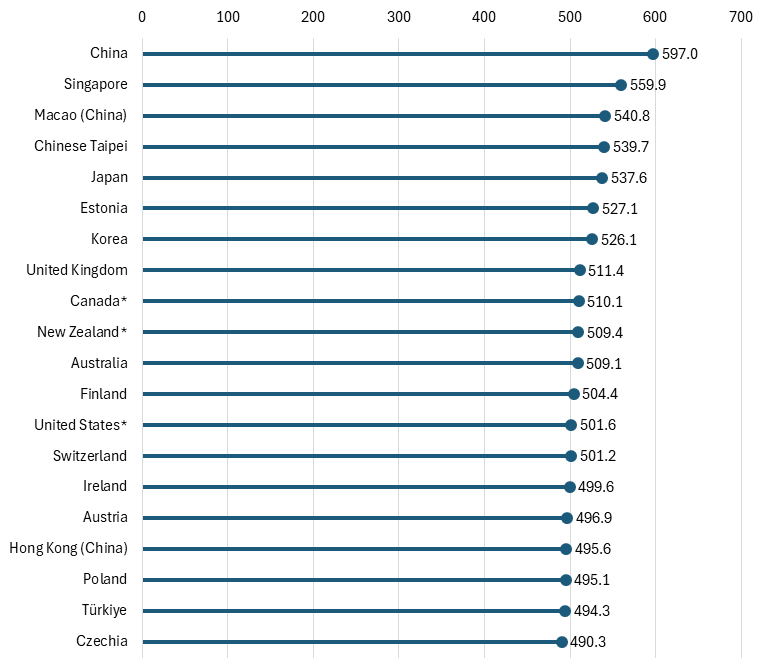
Figure 2: PISA math scores, 2025 (see endnote for asterisk meaning)
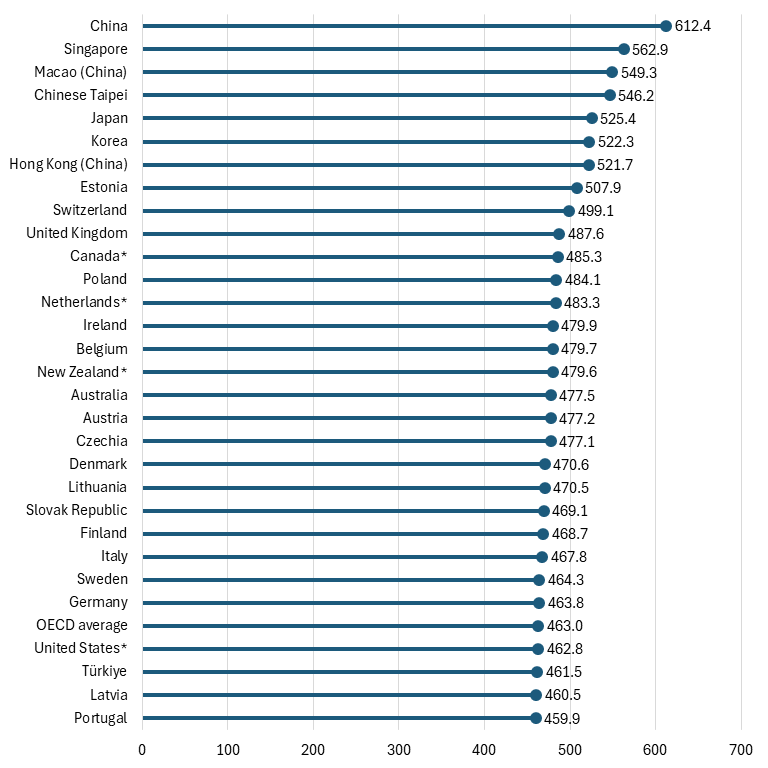
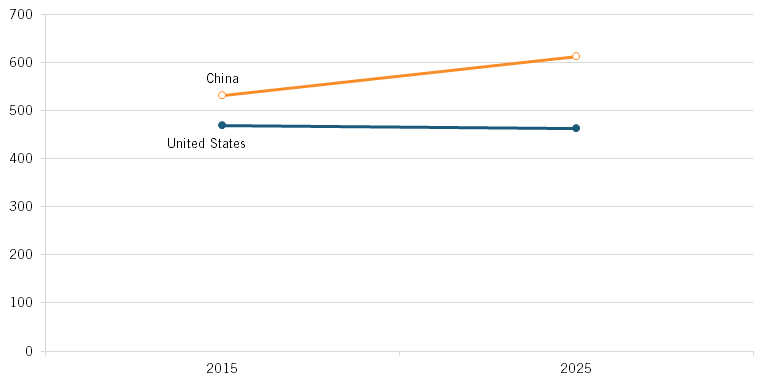
Examining performance over time also reveals concerning trends for the United States. In 2015, U.S. students received an average science score of 496.2, which increased modestly to 501.6 by 2025. However, U.S. math performance moved in the opposite direction, declining from 469.6 in 2015 to 462.8 in 2025.
In comparison, the scores reported for participating Chinese jurisdictions increased substantially from 2015 to 2025. Their science score rose from 517.8 in 2015, when they ranked 10th, to 597 in 2025, when they ranked first. Similarly, their math score increased from 531.3, ranking sixth in 2015, to 612.4, ranking first in 2025. (See figures 3 and 4.) Although changes in the Chinese jurisdictions participating in PISA mean these figures are not a perfectly comparable national time series, the results still demonstrate the exceptionally strong science and math performance of these jurisdictions relative to the United States.
Figure 3: United States and China's science PISA scores for 2015 and 2025
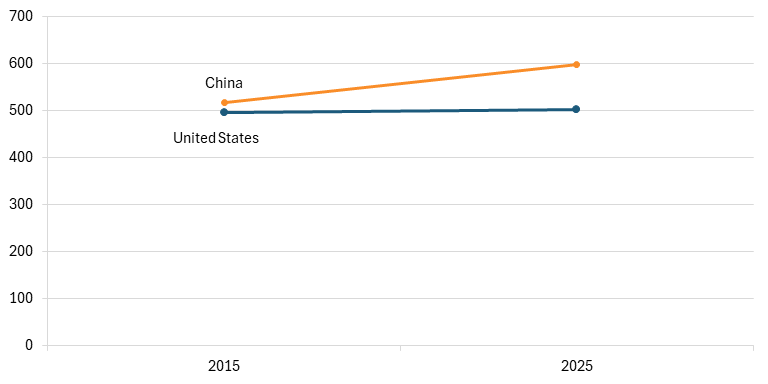
Figure 4: United States and China's math PISA scores for 2015 and 2025
This trend is especially alarming because China has already overtaken the United States in production across several key advanced industries. China now accounts for nearly one-quarter of global production across 10 advanced industries and leads production in 7 of them. Strong science and math skills can help China continue developing the scientists, engineers, and other highly skilled workers needed to innovate and expand these industries.
At the same time, China has dramatically increased its investment in research and development (R&D) and, on a purchasing-power-parity basis, now invests more in R&D than the United States. Strong STEM performance alone does not guarantee technological leadership. But combined with China’s growing advanced-industry production and massive R&D investment, it could bolster the country’s ability to innovate and compete for global market share.
U.S. policymakers should focus on improving student outcomes in science and math. One approach would be to establish competitive STEM performance grants that reward schools for achieving high levels of student proficiency in math and science or demonstrating substantial improvements in those subjects. Such grants could give schools stronger incentives to identify and adopt curricula and teaching practices that actually improve student achievement. Rewarding improvement would also ensure that schools starting from lower levels of performance have an opportunity to qualify.
Additionally, policymakers should expand the pipeline of qualified math and science teachers, as research shows that teachers with strong subject-matter knowledge are better equipped to instruct and inspire students in those disciplines. States could expand scholarships, teacher-training programs, and other incentives that encourage mathematics, science, and engineering graduates to enter teaching, helping ensure that more students learn from educators with strong subject-matter expertise.
Education policy must focus more closely on helping American students develop the STEM skills needed to succeed in advanced industries. To remain competitive with China in the technologies and industries that will drive future economic growth, the United States must make measurable improvements in science and math achievement a national priority.
[1]. PISA scores are calculated using statistical models that estimate students’ proficiency in mathematics, reading, and science based on their responses to a subset of assessment questions. Rather than testing every 15-year-old, PISA assesses a representative sample of students selected to minimize bias and provide precise estimates of performance for each participating country or economy. Caution is required when interpreting estimates for countries or economies marked with an asterisk because one or more PISA sampling standards were not met.
Editors’ Recommendations
August 31, 2020
Competing With China: A Strategic Framework
November 13, 2025
China Welcomes STEM Talent While the United States Pushes It Away
September 10, 2025
