


Data Center Opposition Threatens Millions of Jobs and Billions in Economic Activity
Artificial intelligence (AI) is becoming an increasingly important driver of economic growth, with the potential to boost productivity, accelerate innovation, and strengthen national competitiveness. Data centers are the backbone of this transformation, providing the computing infrastructure needed to develop and deploy AI systems. Yet, despite their growing importance, data centers are facing mounting opposition from local communities concerned about rising electricity costs, water consumption, and environmental impacts. This backlash has already led to the cancellation of billions of dollars in planned investments. In fact, data center projects canceled in 2026 alone could cost the U.S. economy millions of jobs and billions of dollars in foregone wages, economic activity, and state and local tax revenues. Rather than discouraging data center development altogether, policymakers should pursue policies that address legitimate community concerns while ensuring that the United States continues to expand its AI infrastructure.
As countries around the world race to develop and deploy AI, the United States risks undermining its competitive advantage by increasingly resisting the infrastructure needed to support it. According to Heatmap data, at least $260 billion in planned U.S. data center investments have reportedly been canceled following local opposition in 2026 alone, while approximately $1 trillion in additional investments face some form of community resistance. Such opposition reflects broader public skepticism toward data center development. According to an ITIF and Public First survey, nearly half of Americans (46 percent) oppose new data center developments in their communities, and barely a quarter (26 percent) support them. Similarly, a Pew Research Center survey found that 60 percent of Americans say they would be not too comfortable or not at all comfortable with a new data center operating in their community.
This growing resistance is particularly concerning as China continues to invest heavily in AI infrastructure and narrow the technological gap with the United States. By making it increasingly difficult to build the computing capacity necessary for AI development, the United States risks constraining AI adoption, slowing productivity growth, and weakening its long-term economic competitiveness.
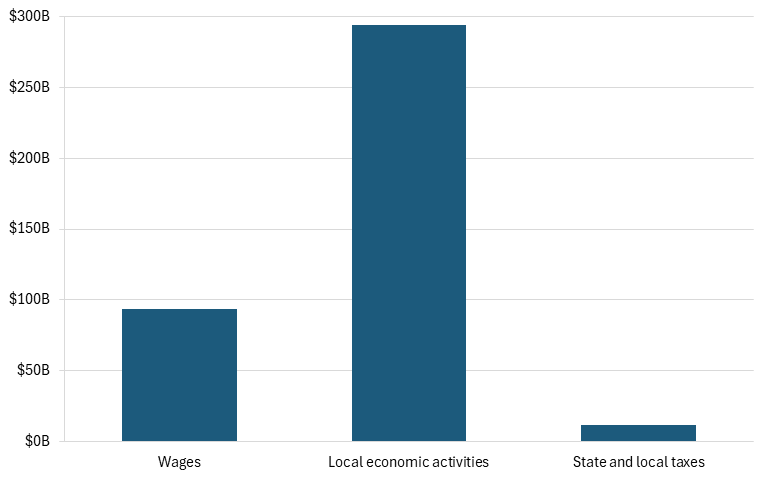
The economic consequences of canceled data center investments extend far beyond the technology sector. To quantify these potential losses, this analysis uses existing estimates of the economic contributions of large data centers to calculate the impacts of canceled investments. Based on these calculations, the $260 billion in canceled investments in 2026 represents the equivalent of approximately 1,207 foregone data center projects. During the construction phase, which typically lasts between 18 and 24 months, these projects could have supported more than 2 million jobs and generated approximately $94 billion in wages, $294 billion in local economic activity, and $12 billion in state and local tax revenues. (See Figure 1.) These benefits would have extended across numerous industries, including construction, electrical equipment manufacturing, engineering, transportation, and other supporting services. Moreover, this economic activity would have directly benefited the communities hosting these facilities, creating employment opportunities and generating additional demand for local businesses, such as restaurants, hotels, grocery stores, and equipment rental companies.
Figure 1: Construction phase foregone local wages, economic activities, and state and local taxes
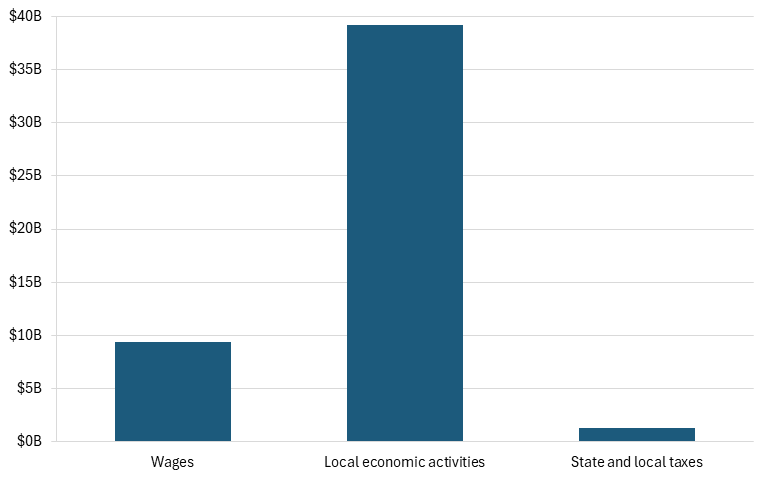
Data centers are built to provide essential digital infrastructure, not to serve as jobs programs, and their permanent on-site workforces are relatively modest compared with the number of workers required to construct them. Nevertheless, their economic contributions persist long after the construction phase. Once operational, data centers require ongoing spending on electricity, maintenance, equipment, security, and other services, supporting employment and economic activity throughout their surrounding communities. ITIF estimates that the canceled projects could have supported more than 189,000 jobs annually, generating approximately $9 billion in wages, $39 billion in local economic activity, and $1.3 billion in state and local tax revenues each year. Unlike the temporary economic benefits associated with construction, these recurring contributions could have provided communities with a sustained source of employment, business activity, and public revenue. Consequently, opposition to data center development risks not only eliminating immediate construction opportunities but also depriving local economies of long-term economic benefits.
Figure 2: Operation phase annual foregone local wages, economic activities, and state and local taxes
Like any form of industrial development, data centers involve trade-offs, and not every project will be the right fit for every community. Concerns about electricity demand, water use, noise, and pollution deserve consideration, but their significance varies by project and location. Some data centers cover the costs of the electricity and water they consume, and in some locations, water availability is not a significant constraint. Policymakers should therefore evaluate proposed projects on their individual merits, ensuring that costs are appropriately addressed and communities benefit from the investment. But blanket opposition to data centers ignores these differences and risks sacrificing substantial economic benefits without regard to a project's actual costs or local impacts. The goal should be to enable responsible development, not to reject it categorically.
Rather than imposing outright bans or restrictive policies that discourage data center investment, state and local policymakers should adopt a targeted approach that addresses specific risks while allowing responsible development. State utility regulators should ensure that large electricity users pay rates reflecting the costs of serving them, while encouraging data centers to manage demand flexibly during periods of grid stress. Policymakers should also improve grid planning and interconnection processes to accommodate new demand without unnecessarily delaying other projects. On water, states should require consistent reporting of consumption and focus safeguards on watersheds where supplies are genuinely constrained, using performance standards that encourage conservation rather than mandating particular technologies. Local governments can address site-specific concerns such as noise and air pollution through enforceable standards. As ITIF has argued, modernizing how policymakers measure, price, and manage data center impacts can protect communities and infrastructure without unnecessarily restricting investment.
State and local officials should ensure that communities share in the fiscal benefits of data center development, using tax revenues to support public services, reduce the tax burden on residents, or invest in local infrastructure and workforce development. Communities such as Loudoun County, Virginia, demonstrate how data center tax revenues can strengthen local finances and help reduce property tax rates. The goal should be to ensure that residents see tangible benefits from hosting these facilities while requiring developers to address the costs their projects impose. As AI becomes increasingly central to economic growth and national competitiveness, the United States cannot afford to turn away data center investments that could generate jobs, strengthen local economies, and provide the infrastructure necessary for continued innovation.
Methodology
To estimate the economic losses associated with canceled data center projects in 2026, this analysis first obtained the total value of canceled data center investments, approximately $260 billion, from Heatmap. Next, using a U.S. Chamber of Commerce study, the analysis obtained the initial capital expenditure required to construct a typical large data center, along with estimates of the local jobs, wages, economic activity, and state and local tax revenues generated during both the construction and annual operational phases.
The total value of canceled data center investments was then divided by the initial capital expenditure required for a typical large data center to estimate the number of equivalent large data center projects represented by cancellations in 2026.
To estimate the economic losses associated with the construction phase, the estimated number of canceled data centers was multiplied by the estimated local jobs, wages, economic activity, and state and local tax revenues associated with constructing a typical large data center.
The same approach was applied to the operational phase, multiplying the estimated number of canceled data centers by the corresponding annual employment, wage, economic activity, and state and local tax revenue estimates for a typical large data center.
These estimates represent the potential economic activity foregone as a result of canceled data center investments, assuming that each canceled project would have generated economic benefits comparable to those of a typical large data center. Construction-phase estimates reflect one-time losses, while operational-phase estimates represent recurring annual economic activity that would have been generated had the projects proceeded.
