

The Data Center Water Problem Is Soluble
Technology exists, and policy instruments are available, to develop a new, state-led model of water governance for data centers and other large industrial users. What’s missing is institutional coordination, regulatory specificity, and a set of standardized mechanisms and metrics.
KEY TAKEAWAYS
Key Takeaways
Contents
Technologies for Data Center Cooling. 5
Water for Energy—Cooling Power Plants 6
Water for Energy—The Regulatory Dimension. 8
Introduction
As hyperscalers race to deploy hundreds of new gigawatts (GW) in data center capacity in the United States to keep up with growing demand for artificial intelligence (AI), their expected use of water will grow too. Some fear that this growth will put too much stress on local watersheds and therefore want to halt data center construction. But a closer look shows a much more nuanced—and overall, significantly less challenging—situation; one that policymakers can manage through better oversight and transparency.
Data centers consume water in two distinct ways: directly for cooling, and indirectly for electricity generation. Past solutions for cooling data centers relied heavily on water, but that won’t work as chips get hotter, racks get denser, and the number of data centers increases substantially. Fortunately, new cooling technologies are emerging that offer superior cooling with limited or zero water consumption.
Indirect water consumption for cooling gas and nuclear plants that will provide much of the energy for data centers—and consumptive evaporation from reservoirs for hydro plants—is the real elephant in the pool. That indirect use consumes about 12 times the amount of water needed directly for data center cooling, according to Lawrence Berkeley National Lab (LBNL).[1]
Water policy is fragmented in the United States. Federal agencies address wastewater quality, but states regulate water consumption, and every state can make its own rules. In addition, regulation of water used for electricity is typically handled differently than water for data center cooling. And water is a convenient hook on which to hang more general opposition to data centers (and AI), as that opens the door to regulatory procedures and, potentially, delays or bans.
In the face of this regulatory patchwork, it’s tempting to reach for the big guns and suggest that the federal government should simply impose national water rules and standards to streamline development. Doing so would be a mistake. Some watersheds experience water stress while others do not. The problems and solutions for water in Arizona are completely different from those in Pennsylvania. This issue is very poorly suited for federal management, even though a new model of water governance for data centers and other large industrial users is both needed and possible.
It’s tempting to reach for the big guns and suggest that the federal government should simply impose national water rules and standards to streamline development. Doing so would be a mistake.
Instead of federal mandates, states should take the lead by requiring transparency via standardized facility-level disclosures, local watershed-level reviews for large projects, technology-neutral water-performance standards, and integrated water-energy review for large loads. Federal agencies should fund and support data standardization, use procurement to encourage low-water-use approaches wherever appropriate, fund more research and development (R&D), especially in water-for-power, and use Federal Energy Regulatory Commission (FERC) interconnection levers to enforce data transparency.
Water Consumption
The data center construction boom has pushed energy demand and electricity pricing to the forefront of policy debates, but new data centers also use water.[2]
There is no accurate national data on water consumption by data centers, partly because data from individual centers is not collected nationally and partly because gathering data on indirect consumption through energy generation is even more challenging. And there is a further distinction to be made between water use and consumptive water use. The former refers to cases in which water is withdrawn from the ground or from surface water, used, and then mostly returned to the local supply. The latter refers to cases in which water is withdrawn, used, and then lost to the local supply through evaporation or other industrial processes. This paper focuses on consumptive water use.
The most widely used estimate of water consumption by data centers is from LBNL, which concludes that data centers directly consumed 17.4 billion gallons annually in 2023, and water consumed for electricity production (indirect water consumption) requires a further 211 billion gallons—12x the amount of direct consumption.[3] All told, that would amount to less than 1 percent of total U.S. water consumption, based on the U.S. Geological Survey’s most recent national consumptive-use assessment, which covers roughly 90 percent of the nation's water withdrawals.[4]
However, the LBNL estimate may well need adjustment:
▪ LBNL’s report excludes all behind-the-meter power, and all power purchase agreements (PPAs). In both cases, the electricity generation mix may feature higher levels of renewable energy (wind and solar/batteries in particular) that require much less water. Amazon, Meta, Google, and Microsoft all report that 100 percent of their electricity comes from renewable sources.[5]
▪ The report does not completely align with other reputable sources. USGS has estimated that in 2015, the amount of water consumed (not merely used) by thermoelectric power plants in the United States was around 1.2 million gallons a day per terawatt-hour (TWh) for once-through cooling, and 1.4 million gallons a day per TWh for recirculating cooling.[6] The equivalent from LBNL is 3.15 million gallons/day. A previous report from the National Laboratory of the Rockies (NLR) supports the USGS.[7]
▪ The difference is largely explained by methodology: The LBNL report includes hydro power, which consumes far more water than other sources do and is limited to a few geographies, (e.g., the Pacific Northwest and the Tennessee Valley Authority region).[8] The USGS and NLR reports both exclude hydro power from their baseline numbers.
▪ Using the estimates from USGS and NLR (and excluding hydro plants), thermoelectric plants consume on average 0.47 gallons of water per kilowatt-hour (KWh), so generating one additional gigawatt-hour (GWh) requires 474,230 gallons, or around just over 4 billion gallons annually in additional indirect water consumption.[9]
▪ USGS and NLR estimates may be outdated. Total water consumption has probably expanded since 2015, so the data center share will be lower given a larger denominator.
▪ The effective impact of power on water consumption for data centers (and all other users) varies widely by region, as different regions have different mixes of power generation technology. For example, coal and nuclear require significant water supplies while solar consumes water only to clean panels. So, water consumption ranges from 2.1 gals/KWh in the Pacific Northwest, which uses a great deal of hydro power, to 0.13 gals/KWh in solar-heavy California.[10]
Water issues are also a lot more salient in the arid West. Some areas near Phoenix, for example, now limit all development because there is no more potable water available.[11] Eastern states may have local water concerns, but overall, there is plenty of water available.
Geographical conditions may make water scarcer, but may also make low-water-use technologies more affordable. Arid regions such as Arizona, for example, are an excellent fit for solar plus batteries, which use almost no water. Calculations about trade-offs are complex—and inherently local.
The basic point is simple: Despite the limits of existing data, it’s clearly true there are real water concerns in certain parts of the country—and also that there is no universal national water problem.
Drought conditions matter too: California has been through periods of intense drought that have forced direct limitations on household water use. Corpus Christi, Texas, is belatedly building a desalination plant.[12] In these circumstances, any additional water use is bound to generate local objections.
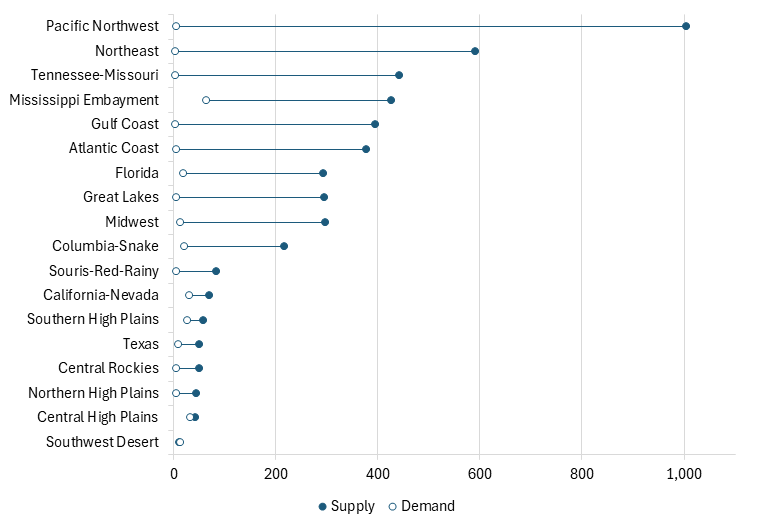
The basic point is simple: Despite the limits of existing data, it’s clearly true that there are real water concerns in certain parts of the country—and also that there is no universal national water problem. As figure 1 shows, across U.S. regions, only the arid Southwest and the Central High Plains are suffering endemic water issues. But given significant local and regional problems (as the ongoing disputes about Colorado River allocations demonstrate) and the reality that many U.S. data centers are planned for drought-challenged regions (and more of the United States has been in drought conditions recently), any intelligent response must analyze and address each watershed separately. That also aligns with how water regulation operates.[13]
Figure 1: Water supply and demand by region (millimeters per year, 2010–2020)[14]
Technologies for Data Center Cooling
There are many technologies for cooling data centers, and each has its strengths and weaknesses.
Older evaporative cooling systems for data centers cool by passing warm air over water-soaked pads; the water evaporates, which cools the air, and the water-filled exhaust is then ejected. These systems consume a lot of water and struggle to handle modern rack densities and hotter chips.
Dry cooling, in contrast, passes ambient air through a radiator system using fans and consumes no water. Although, powering those fans also requires more energy than evaporative cooling. Dry cooling historically was limited in hot climates, because it could not handle high ambient temperatures, but newer technologies will likely address that constraint.[15]
Two current alternatives focus on removing heat directly at the server level: rear-door heat exchangers (RDHx) and liquid direct to chip (LDC), drawing out heat from the rack and the chip for central processing. RDHx is particularly effective for retrofitting existing air-cooled data centers for hotter loads. But both depend on a closed loop of liquid to carry heat away from the chips, pumping it to an external system outside the building where the heat is finally released.
Immersion systems represent another highly efficient solution. Single-phase immersion systems submerge racks in a dielectric oil that remains liquid, while two-phase systems use specialized fluids that boil and condense in a closed loop that exhausts heat through external heat exchangers. Single-phase is more economically viable; two-phase systems can require 2x to 5x the capital expenditure of traditional cooling due to their complex, sealed-tank infrastructure. However, two-phase immersion faces steep supply chain hurdles. 3M, the dominant producer, has exited the market for PFAS (per- and polyfluoroalkyl substances; forever chemicals), where it held an effective monopoly on the PFAS-based dielectric fluids required for two-phase immersion systems. Other suppliers, such as Chemours, are developing alternatives, but these fluids need to be piloted and then validated for commercial use.[16]
Nvidia recently announced that its Rubin generation of AI infrastructure can use liquid cooling to reach zero water consumption.[17] The Rubin technology is more heat tolerant, so data centers can run hotter liquid loops (up to 113 °F) and then use external dry coolers to cool the liquid and then return it, rather than using evaporative cooling towers. That reduces water consumption to near zero, even in warmer climates. Similarly, Microsoft has introduced new AI-optimized data centers that will consume zero water for cooling operations by continuously recirculating fluid through a closed-loop direct-to-chip system.[18]
Technology is evolving rapidly, and optimal solutions will clearly vary by geography and type of load, but the shift toward low or zero water for cooling new data centers is already well under way. Some—including Google, AWS, and Microsoft—are also using municipal wastewater to avoid relying on scarce potable water.
Water for Energy—Cooling Power Plants
Every thermodynamic power plant faces the same fundamental problem: After it drives a turbine, steam must be cooled and condensed back to liquid before it can be reused.
The oldest and simplest solution is once-through cooling: draw water from a nearby river or lake, run it through the condenser, and discharge it back to the source, warmer than it arrived. These systems withdraw enormous volumes but consume relatively little, returning almost all water to its sources. However, discharged water reaches peak temperatures averaging 99°F, roughly 17°F above ambient summer stream temperatures. More than half such systems have reported maximum discharge temperatures exceeding 90°F, a threshold at which aquatic life is typically at risk.[19] Section 316(a) of the Clean Water Act (CWA) limits thermal discharge temperatures, administered through National Pollutant Discharge Elimination System (NPDES) permits, which the Environmental Protection Agency (EPA) has delegated to 46 states.[20] These limits have real operational bite. For example, during the 2007 Southeastern drought, Duke Energy had to scale back generation at two North Carolina coal stations when discharge temperatures exceeded Duke’s permit thresholds.[21]
Seeking reduced exit temperatures, some plants deployed closed-loop systems: water circulating in a closed pipe loop between the condenser and the evaporative tower, so fresh water is not withdrawn and no heated water returns to a river or lake. Closed-loop systems address both consumption (the amount of water consumed for cooling) and withdrawal (the much larger amount of water withdrawn and then returned to the source). However, while the primary loop consumes no water, the secondary loop still needs to be cooled, in some cases through evaporative cooling towers.
Dry cooling replaces the evaporative tower with air-cooled heat exchangers—much like a very large car radiator. Air is driven through the condenser by fans and the hot air is exhausted into the atmosphere. Dry cooling cuts water consumption by more than 90 percent, and California has effectively banned once-through cooling at coastal plants.[22] However, dry cooling requires roughly 1 to 1.5 percent of plant output to power its fans, compared with 0.5 percent for a wet tower. More importantly, performance degrades sharply on hot days—precisely when grid demand peaks and ambient air is least effective as a heat sink. Dry cooled systems that use ambient air don’t work well above 80°F—which is the temperature much of the United States goes beyond in the summer.[23]
Hybrid and zero-liquid-discharge systems represent a practical middle ground. Hybrid designs combine wet and dry cooling, using air cooling on mild days and evaporative towers during heat stress. These systems reduce annual evaporative losses by up to 75 percent without imposing the full cost of all-dry operation.[24] Zero-liquid-discharge systems add a further advance, applying reverse osmosis to the concentrated wastewater periodically purged from recirculating towers, recovering and recycling it. High-recovery reverse osmosis can be implemented at less than 0.1 percent of a facility’s annual electricity output, and substantially reduce overall water consumption.[25] Table 1 compares the advantages and disadvantages of different cooling technologies.
Table 1: Cooling methods for thermoelectric power plants—advantages and disadvantages
|
Cooling Method |
Key Advantages |
Key Disadvantages |
|
Once-through cooling |
▪ Lowest capital cost ▪ Minimal energy penalty ▪ Mechanically simple |
▪ Massive water withdrawals ▪ Thermal discharge harms aquatic life ▪ Increasingly prohibited by CWA §316 permits |
|
Wet recirculating (cooling towers) |
▪Eliminates thermal discharge ▪Low energy penalty (~0.5% of output) ▪Used by > 60% of U.S. thermoelectric capacity |
▪High water consumption (evaporates 3%–5% of circulating flow) ▪Scaling and treatment costs ▪Requires reliable water supply |
|
Dry cooling (air-cooled heat exchangers) |
▪ > 90% reduction in water consumption ▪ No discharge permit required ▪ Viable in arid regions |
▪ Higher energy use ▪ Higher capital cost |
|
Hybrid (wet/dry combined) |
▪Cuts annual evaporative losses up to 75% vs. wet only ▪Preserves efficiency on hot days ▪Flexible operation |
▪Higher capital cost than either standalone approach; operational complexity ▪Gains depend on local climate profile |
|
Zero-liquid-discharge (ZLD) |
▪ Near-zero net water consumption ▪ Eliminates wastewater discharge ▪ Recovers and recycles tower blowdown |
▪ Energy cost of reverse osmosis (~0.1% of output) ▪ Higher capital and operating cost ▪ Requires pre-treatment of feed water |
Genuinely water-minimal cooling is technically achievable today. The barrier is economics and the absence, in most states, of any permitting requirement to develop and require performance standards appropriate for a given region. Simply confirming that water is available to use is not sufficient.
Water for Energy—The Regulatory Dimension
Federal law is largely silent on water consumption; its focus is on wastewater standards as water exits generating facilities, not on the water drawn in and evaporated.[26] CWA Section 316(b) requirements have pushed covered new thermoelectric plants away from once-through cooling and toward recirculating or otherwise lower-intake cooling systems because the rule requires cooling-water intake structures to minimize harm to aquatic life from impingement and entrainment—rules that are difficult to meet using traditional technologies. Newer technologies sharply reduces water withdrawals, but recirculating systems generally consume more water through evaporation than once-through systems do.[27] Beyond water quality, FERC could in theory address water consumption through transmission permitting, as it can set the terms under which any new transmission is connected to the grid, yet it does not do so (there is no evidence that FERC sees water use as part of its remit).
The states therefore regulate water consumption, and the result is a patchwork, as each state operates its own regulatory regime. Western states generally follow the “prior appropriation” doctrine under which water rights are assigned by the order claims were made, regardless of land ownership.[28] Eastern states apply the riparian doctrine: Adjacent landowners may use water so long as the use is “reasonable” and does not harm downstream neighbors, so the timing of claims is irrelevant.[29] Congress has largely left this division intact.[30]
Historically, power plant developers have focused on the existence of available water sources and cooling system costs, not regulatory consumption standards. State regulation of utility water practices has largely been reactive—responding to droughts and heat waves after the fact, rather than being shaped through upfront permit conditions.[31] But that is now changing as states begin to grapple with the rapidly growing use of water both for cooling and for power.
Table 2: State water regulation models
|
State |
Water-Law Model |
Relevance for Data Centers |
|
Texas |
Prior appropriation |
Shortage rules can subordinate junior users, but public-safety exceptions complicate enforcement |
|
Virginia |
Hybrid/riparian permitting |
Major withdrawals require permits; groundwater regulation varies geographically |
|
Ohio |
Riparian with basin-specific rules |
Lake Erie and Ohio River Basin projects face different thresholds |
|
Georgia |
Regulated riparianism |
Permits can be modified or suspended; interstate-basin conflicts constrain supply |
California and Arizona require power plant developers to evaluate water-efficiency options—including recirculating and dry cooling—as part of the siting process, creating a formal incentive to minimize consumption.[32] Under the Great Lakes–St. Lawrence River Basin Water Resources Compact as enacted in Ohio, any facility in the Lake Erie watershed proposing new or increased withdrawals above 1 million gallons per day must obtain a consumptive-use permit and demonstrate no significant adverse impact—one of the few Eastern frameworks that explicitly targets consumption rather than just withdrawal.[33]
The Political Dimension
Data center construction is under attack. In 2025, more than 200 bills addressing data centers were introduced across all 50 states, of which more than 40 were enacted into law. Legislative activity has continued into 2026. Bans and moratoriums for data centers are under discussion in more than 20 states, and more than $130 billion in projects was delayed or abandoned in the first quarter of 2026 alone—more than the total for all of 2025. The volume and geographic breadth of state action suggests that, regardless of federal policy direction, the regulatory environment for data center water consumption will grow substantially more demanding in the coming years. The question for developers, policymakers, and communities alike is not whether water will be regulated, but how—and how quickly.
In part, data centers are a new land use and run up against innate local conservatism, environmental concerns, and NIMBYism. Data centers also stand as a proxy for AI, which many fear will cost them jobs, invade their privacy, and spread misinformation. Data centers are also a proxy for big tech and tech billionaires, who are remarkably unpopular. And environmental organizations have mobilized to block Trump administration efforts to weaken regulation, including the CWA.
There are also concerns about data center impacts on local electricity pricing, possible co-optation of scarce local water resources (or at least price increases), and wastewater treatment and other environmental factors. In dry parts of the country in particular (but not only there), water rights are a huge issue; and data center critics have often pointed to lack of transparency and accountability on water.
Policy Recommendations
AI is a hugely beneficial technology that promises a variety of economic and societal benefits, including environmental benefits. While this paper addresses water consumption by data centers, it is important to understand that water consumption is happening in a broader context in which data centers are a player but not necessarily the largest contributor. If the primary goal is reducing water consumption, then solutions need to be considered holistically in order to have meaningful impact. This includes addressing other, less-efficient uses of water, such as for golf courses, fashion and textile manufacturing, power plants, and steel, chemical, and heavy manufacturing, to name a few.
Policy should broadly aim to meet the following objectives:
▪ Make sure that direct and indirect water consumption matches the capacity and needs of the local watershed and its communities.
▪ Provide transparent water accounting for both regulators and the public.
▪ Encourage the adoption of better technologies that reduce water consumption.
▪ Reduce or eliminate regulatory arbitrage.
▪ Ensure fair treatment of data center developers and other large industrial users while ensuring that they are publicly accountable for the water they use.
▪ Minimize bureaucracy to ensure that water issues are addressed early and quickly in the permitting process.
These objectives are not inherently in conflict. Four sets of recommendations could help to achieve all those objectives.
1. Mandatory Disclosure With Standardized Data Elements
Water regulation is coming, and disclosure requirements are spreading—legislators in Virginia, New Jersey, and California passed legislation that mandated reporting, but these were all vetoed by their governors (one Republican, two Democrats). In several cases, legislation rolled up a number of issues into a single package.[34] Reporting standards also vary considerably, and that limits aggregation and cross-jurisdictional analysis, which could help improve the fit between regulations and local needs.[35]
But water cannot be regulated effectively unless the appropriate data is collected on a comprehensive basis. A well-designed disclosure regime based on national standards (see federal policy recommendations ahead) should require all data center facilities above a minimum threshold (e.g., 1 megawatt (MW)) to report annually (large-scale facilities to report quarterly) on the following elements, for both direct and indirect water use and consumption separately:
▪ Total water withdrawals by source (surface water, groundwater, municipal supply)[36]
▪ Total water consumption, distinguished from withdrawal
▪ Use of potable versus nonpotable or reclaimed water
▪ Peak daily water use
▪ Cooling technology type
▪ Projected water demand at full buildout*
▪ Identified backup water source*
▪ Wastewater discharge metrics, if applicable
*Projected water demand and backup sources are one-time requirements in the permitting stage.
Illinois S.B. 2181 already requires annual reporting of energy and water consumption, offering a workable model. But its impact is limited by high thresholds and low enforcement penalties.[37] Disclosure requirements should also carry penalties commensurate with the scale of the facilities they are regulating. And they should—like Georgia’s—also prohibit blanket nondisclosure agreements as a condition for economic development support.[38]
Disclosure rules should override blanket confidentiality claims for core water-use metrics. Companies may have legitimate security or commercial concerns about certain operational details, but total withdrawals, total consumption, source of water, peak-day demand, and full-build projections are public-resource questions. States should therefore use their economic development levers to prohibit agreements that block disclosure of water use details or infrastructure commitments. To be effective, that reporting will need to be independently audited at the state level, although, again, national-level standards would be helpful.
Transparency itself will drive improvement: it will reward good actors and encourage more thoughtful exploration of water use trade-offs with energy use, CAPEX, and even site planning.
Target actors: state legislatures, state energy offices, Department of Energy (DOE)/LBNL
2. Review by Watershed (Not National Mandates) Using Performance Standards (Not Technology Mandates)
A single national water standard for data centers is neither legally achievable nor good policy. Water law is almost entirely state and local, and the environmental significance of a given quantity of water consumption varies enormously by basin—a million gallons drawn from the Potomac poses different risks than the same volume drawn from the High Plains Aquifer. Policy should reflect these differences.
In 2025, Minnesota became the first state to establish a formal water-permitting requirement for large data centers. Minnesota H.F. 16 requires the Department of Natural Resources to conduct pre-application evaluations of all large data center projects, evaluate water conservation measures, and ensure protection of public health and water resources before issuing permits.[39]
Minnesota also tiers its review based on watershed stress levels: watersheds with high or extremely high water stress require more intensive evaluation and stricter conditions, and a fast-track pre-application process allows developers to assess water viability before committing to a site.[40] States should use EPA’s WaterSense or the USGS Water Resources framework for assessing stress to ensure comparability.
It is not reasonable to exclude data centers and other large industrial users from water planning, especially in arid regions. Under watershed-level regulation, drought declarations should trigger automatic interim restrictions or enhanced monitoring, as they do for most agricultural users in the West. States such as Arizona with formal drought contingency plans have administrative machinery that could cover large industrial water users including data centers, without new regulatory structures.[41] This also implies that watershed level regulation needs to take into account clustering effects: it would be a mistake to treat data center applications on a first-come, first-served basis, as centers with better plans might be further down the queue.
Further, impact assessments need to take a longer-term view: physical data center structures have an expected lifetime of at least 20 years, so water planning needs to match that in an era when droughts appear to be becoming more frequent. This applies in particular to the introduction of more water-saving technology during major refurbishments.
The level of review should also be conditioned on the size and age of a facility. New and larger facilities should attract more detailed review and tighter requirements.
Table 3: Performance requirements by size of facility
|
Facility type |
Regulatory approach |
Rationale |
|
New hyperscale AI campuses |
▪ Require watershed-stress review and water-performance standards at the siting stage. ▪ Include both direct and indirect water use and consumption. |
▪ These projects lock in cooling and water infrastructure early, making later retrofits costly. |
|
Existing large colocation and enterprise facilities |
▪Require reporting and offer utility retrofit incentives and phase-in water-transition plans during major renovations or expansions. |
▪Immediate capital mandates could accelerate consolidation and penalize already-built facilities. |
|
Small enterprise facilities under ~5 MW |
▪ Use simplified reporting, exempt them from direct water-intensity standards, and provide technical assistance. |
▪ They are numerous but account for only a small share of total water consumption. |
Technology-specific mandates will freeze the regulatory target at the current state of knowledge. That can disadvantage legitimate hybrid approaches that achieve equivalent water outcomes and create legal vulnerability, while limiting improvements.[42] In contrast, performance standards set an outcome and let operators choose how to meet it. A well-designed framework covering both direct and indirect water use might include the following performance standards:
▪ A maximum water consumption standard (expressed in gallons per MW-hour of IT load), calibrated by facility size and climate zone
▪ Escalating standards in high-stress basins, refreshed on a three-to-five-year cycle as technology matures
▪ Credit for using reclaimed or nonpotable water
▪ Required water curtailment plans during droughts for facilities above a certain threshold size
Target actors: state legislatures, state environmental and water agencies, public utility commissions
3. Integrated Water-Energy Review
State energy offices, public utility commissions, and water authorities should establish joint review protocols for reviewing the direct and indirect water impacts of large-load data center applications above a defined threshold (e.g., facilities drawing more than 5 MW or consuming more than 50 million gallons annually) via a template that draws on the items listed below. Joint review does not necessarily mean joint decision-making authority, although joint decisions on water would streamline the regulatory process. Joint review does mean that each regulator has a full picture of water issues, and that the resulting record supports a coherent cumulative assessment.
The content of the review should be based on the mandatory disclosure and reporting requirements identified in Recommendation 1, and on the policy framework described in Recommendation 2. The following elements should specifically be included:
▪ Projected annual electricity load
▪ Expected peak load
▪ Daily load distribution
▪ Generation sources, including backup power sources (especially for colocated power plants)
▪ Direct water-consumption intensity
▪ Indirect water intensity
▪ Drought sensitivity
▪ Transmission and interconnection assumptions
▪ Claimed renewable supply as physically deliverable or only contractual
Exactly how joint reviews should be conducted is a matter for each state. The point, though, is to ensure that electricity permitting is functionally integrated with water permitting, using shared data and a shared policy framework, based on national standards but local conditions. This kind of detailed review, based on a national template for data acquisition and transparent local data, would help to avoid the water-related problems highlighted by a New York Times investigation into ground water drawdown in Georgia.[43] Joint reviews should also shorten the regulatory timeline.
At the federal level, an interagency coordination protocol linking FERC’s large-load interconnection review to EPA’s water-availability guidance would improve federal-level analysis without needing new statutory authority. If grid interconnection becomes a significant element in water regulation, interconnection regulators may need to be integrated into the joint review process mentioned earlier.
Target actors: state energy offices, state public utility commissions, state water authorities and Department of Natural Resources agencies, FERC, North American Electric Reliability Corporation (NERC), EPA
4. The Federal Role: Metrics, Procurement, and R&D—Not General Water Preemption
Currently, the federal government is using executive orders to streamline permitting and directing EPA to streamline CWA review. However, states and localities will continue to dominate on water policy because water rights and local land use are largely outside federal jurisdiction. The federal government should instead focus on four core areas:
1. Standardized metrics. LBNL should be funded to publish an annual report on water use by data center at the facility level, using standardized Water Usage Effectiveness (WUE) and indirect water use and consumption accounting methodologies that states can then adopt, replacing the patchwork of state data and self-reported industry figures.[44] This should become the central repository for water data related to data centers, and could more widely become a national repository for water data.
2. Federal procurement. Federal procurement is another lever to encourage lower water consumption. Contracts for cloud computing could require vendors to disclose facility-level water consumption data (including indirect water consumption) using new standardized LBNL metrics, and could also create incentives for lower water consumption where doing so would be appropriate (e.g., in water-scarce regions) through procurement. Federal Acquisition Regulation (FAR) Part 23 provides the statutory foundation.[45]
3. R&D investment. DOE’s Advanced Research Projects Agency–Energy (ARPA-E) COOLERCHIPS and data center efficiency programs can accelerate the next generation of cooling technologies—particularly in the areas of two-phase immersion and advanced heat rejection.[46] But new investments are needed to further reduce water consumption in electricity generation, previously not a significant federal focus.
4. Water transparency and the grid. FERC and NERC should publish data on the water implications of data center load growth as a component of their grid reliability analyses, using LBNL standards. Doing so would not require new substantive authority but would create public accountability for indirect water consumption that currently falls entirely below the regulatory radar. It also seems reasonable that FERC should consider water consumption as one dimension for regulating interconnection; it would not be helpful if FERC simply ignored water consumption, as that would encourage utilities to use cheaper but more water-intensive technologies regardless of local water needs.
The federal government should, however, not preempt state water law or establish a national zero-water mandate for data center cooling. The legal obstacles are substantial, the policy case is weak (given the geographic variability of water stress), and the political cost would exceed any plausible benefit.
Target actors: DOE, LBNL, ARPA-E, Federal Energy Management Program (FEMP), FERC, NERC, U.S. General Services Administration (GSA), Office of Management and Budget (FAR Council)
The federal government should, however, not preempt state water law or establish a national zero-water mandate for data center cooling.
Conclusions
The four recommendations form a coherent package that works:
1. National data collection standards inform disclosure, which creates the informational foundation that watershed-tiered review and performance standards require.
2. Integrated review addresses the institutional fragmentation that allows water impacts to fall through regulatory gaps.
3. Facility segmentation by size and location makes the overall framework workable across the full diversity of the industry.
4. The federal role provides the standardized metrics and R&D investment that make state-level implementation credible and consistent.
None of these recommendations require a federal water mandate or a national zero-water technology standard or even target. All are grounded in existing legal and institutional frameworks. All are designed to be adopted by specific actors—governors and state legislators, utility commissions, water authorities, DOE, and GSA—with a clear chain from recommendation to implementation.
The water problem is soluble. The technology exists. The policy instruments are available. What’s missing is not only the institutional coordination and regulatory specificity to deploy them at the required pace and scale but also the adoption of standardized mechanisms and metrics across the data center industry. The aforementioned recommendations are intended to address that challenge.
About the Author
Dr. Robin Gaster is research director at ITIF’s Center for Clean Energy Innovation and president of Incumetrics Inc. His primary interests lie in clean energy, economic innovation policy, metrics, innovation assessment, and regional economic development.
About ITIF
The Information Technology and Innovation Foundation (ITIF) is an independent 501(c)(3) nonprofit, nonpartisan research and educational institute that has been recognized repeatedly as the world’s leading think tank for science and technology policy. Its mission is to formulate, evaluate, and promote policy solutions that accelerate innovation and boost productivity to spur growth, opportunity, and progress. For more information, visit itif.org/about.
Endnotes
[1]. Arman Shehabi et al., “2024 United States Data Center Energy Usage Report,” LBNL-2001637 (2024), https://doi.org/10.71468/P1WC7Q.
[2]. Robin Gaster, “The United States Needs Data Centers, and Data Centers Need Energy, but That Is Not Necessarily a Problem” (ITIF, November 2024), https://itif.org/publications/2025/11/24/united-states-needs-data-centers-data-centers-need-energy-but-that-is-not-necessarily-a-problem/.
[3]. Shehabi et al., “2024 United States Data Center Energy Usage Report.”
[4]. Edward G. Stets, et al., “The National Integrated Water Availability Assessment, Water Years 2010–20,” chap. A of “U.S. Geological Survey Integrated Water Availability Assessment—2010–20,” USGS Professional Paper 1894–A, p. 24, https://doi.org/10.3133/pp1894A; with category detail in Laura Medalie, et al., “Water use across the conterminous United States, water years 2010–20,” chap. D of the same report, https://pubs.usgs.gov/publication/pp1894D.
[5]. “The AI Water Issue Is Fake - Andy Masley,” Andy Masley blog, accessed June 16, 2026, https://blog.andymasley.com/p/the-ai-water-issue-is-fake; Amazon, “Amazon meets 100% renewable energy goal 7 years early,” blog post, August 14, 2025, https://www.aboutamazon.com/news/sustainability/amazon-renewable-energy-goal; Meta, “Energy,” webpage on Sustainability, https://sustainability.atmeta.com/energy/; Google, “Five years of 100% renewable energy – and a look ahead to a 24/7 carbon-free future,” blog post, June 23, 2022, https://cloud.google.com/blog/topics/sustainability/5-years-of-100-percent-renewable-energy; Anand Gupta, “Microsoft will Achieve 100% Renewable Energy by Next Year – EQ,” EQ Magazine, May 24, 2024, https://www.eqmagpro.com/microsoft-will-achieve-100-renewable-energy-by-next-year-eq/.
[6]. U.S. Geological Survey, “Estimated Use of Water in the United States in 2015,” 2015 https://pubs.usgs.gov/circ/1441/circ1441.pdf.
[7]. P. Torcellini et al., “Consumptive Water Use for U.S. Power Production,” NREL/TP-550-33905 (2003), https://doi.org/10.2172/15005918.
[8]. Shehabi et al., “2024 United States Data Center Energy Usage Report.”
[9]. Ibid.
[10]. Jordan Macknick et al., “Review of Operational Water Consumption and Withdrawal Factors for Electricity Generating Technologies,” NREL/TP-6A20-50900 (2011), https://doi.org/10.2172/1009674.
[11]. “Arizona Limits Construction Around Phoenix as Its Water Supply Dwindles,”- New York Times, accessed May 27, 2026, https://www.nytimes.com/2023/06/01/climate/arizona-phoenix-permits-housing-water.html.
[12]. “City Council Approves Brackish Water Desalination Project,” City of Corpus Christi, accessed May 27, 2026, https://www.corpuschristitx.gov/news/posts/city-council-approves-brackish-water-desalination-project/.
[13]. Oliver Milman et al., “Majority of US’s New AI Datacenters to Be Built on Drought-Hit Land,” The Guardian, June 8, 2026, https://www.theguardian.com/us-news/2026/jun/08/datacenter-ai-drought-water.
[14]. Chart data derived with Automeris.io from the U.S. Geological Survey, “Water availability in the United States,” part 1, “Do we have enough water? Yes, and no,” accessed June 18, 2026, https://water.usgs.gov/vizlab/water-availability/01-water-limitation; Edward G. Stets et al., “The National Integrated Water Availability Assessment, Water Years 2010–20,” USGS Professional Paper 1894–A, 2025, https://pubs.usgs.gov/pp/1894/a/pp1894A.pdf.
[15]. Josh Parker, “Hotter Than a Hot Tub: The 45°C Breakthrough to Cool AI’s Biggest Machines,” NVIDIA blog, June 22, 2026, https://blogs.nvidia.com/blog/liquid-cooling-ai-factories/.
[16]. Webianio, “Liquid that boils at 50 °C may decide the shape of AI data centers,” June 6, 2026, https://webiano.digital/liquid-that-boils-at-50-c-may-decide-the-shape-of-ai-data-centers/.
[17]. Parker, “Hotter Than a Hot Tub: The 45°C Breakthrough to Cool AI’s Biggest Machines.”
[18]. Paul Nyhan, “Inside Microsoft’s Two-Decade Push to Cut Water Intensity While Scaling for Growth,” The Official Microsoft Blog, June 24, 2026, https://blogs.microsoft.com/blog/2026/06/24/inside-microsofts-two-decade-push-to-cut-water-intensity-while-scaling-for-growth/.
[19]. Carey D. Kelsey, Kyle F. Mandli, and Nicole D. Neveu, “Thermal Effluent from the Power Sector: An Analysis of Once-Through Cooling System Impacts on Surface Water Temperature,” Environmental Research Letters 8, no. 3 (2013): 035006, https://doi.org/10.1088/1748-9326/8/3/035006.
[20]. “Understanding the Effects of Thermal Pollution and Possible Solutions,” Interfaith Center for Sustainable Development, accessed May 2026, https://interfaithsustain.com/thermal-pollution/. Section 316(a) of the CWA prohibits plants without variance permits from raising river temperatures above threshold limits; the EPA has delegated NPDES permitting authority to 47 states.
[21]. Kelsey, Mandli, and Neveu, “Thermal Effluent from the Power Sector,” 035006. (“In the summer of 2007, the combined effects of drought and high temperatures caused Duke Energy to scale back power production at the GG Allen Steam Station and the Riverbend Steam Station when the discharge temperatures at these two plants exceeded their permit limits.”)
[22]. Union of Concerned Scientists, “Water for Power Plant Cooling,” October 5, 2010, https://www.ucs.org/resources/water-power-plant-cooling. (“Dry-cooled systems use no water and can decrease total power plant water consumption by more than 90 percent.”)
[23]. European Environment Agency, Climate-ADAPT, “Reducing Water Consumption for Cooling of Thermal Generation Plants,” accessed May 2026, https://climate-adapt.eea.europa.eu/en/metadata/adaptation-options/reducing-water-consumption-for-cooling-of-thermal-generation-plants. (“The operation of a dry cooling system requires in fact 1%–1.5% of the power generated by the plant, compared to 0.5% for a recirculating system.”)
[24]. Richard Breckenridge, “Advanced Cooling and Water Treatment Technology Concepts for Power Plants,” Power, April 1, 2014, https://www.powermag.com/advanced-cooling-and-water-treatment-technology-concepts-for-power-plants/. (“By reducing the heat load on the cooling tower, TSC hybrid systems have the potential to lower annual evaporative losses, makeup water requirements, and blowdown volumes for thermoelectric power plants by up to 75%.”)
[25]. Richard Breckenridge et al., “Zero Liquid Discharge and Water Reuse in Recirculating Cooling Towers at Power Facilities: Review and Research Needs,” ACS ES&T Engineering 2, no. 4 (2022): 508–525, https://doi.org/10.1021/acsestengg.1c00243.
[26]. U.S. Environmental Protection Agency, “National Pollutant Discharge Elimination System—Final Regulations to Establish Requirements for Cooling Water Intake Structures at Existing Facilities and Amend Requirements at Phase I Facilities,” Federal Register 79, no. 157 (August 15, 2014): 48300–48439, https://www.federalregister.gov/documents/2014/08/15/2014-12164.
[27]. “Water Withdrawal and Consumption Trends for Thermoelectric-Power Plants in the Conterminous United States, 2008-2020 | U.S. Geological Survey,” USGS, accessed May 12, 2026, https://www.usgs.gov/publications/water-withdrawal-and-consumption-trends-thermoelectric-power-plants-conterminous.
[28]. “Water Law Overview,” National Agricultural Law Center, University of Arkansas System Division of Agriculture, accessed May 10, 2026, https://nationalaglawcenter.org/overview/water-law/.
[29]. Ibid.
[30]. U.S. Department of the Interior, “Water Rights Act,” statement before Congress, accessed May 10, 2026, https://www.doi.gov/ocl/water-rights-act.
[31]. Uisung Lee et al., “Regional and Seasonal Water Stress Analysis of United States Thermoelectricity,” Journal of Cleaner Production 270 (October 2020): 122234, https://doi.org/10.1016/j.jclepro.2020.122234.
[32]. U. S. Government Accountability Office, “Energy-Water Nexus: Improvements to Federal Water Use Data Would Increase Understanding of Trends in Power Plant Water Use | U.S. GAO,” accessed May 12, 2026, https://www.gao.gov/products/gao-10-23.
[33]. “Division of Water Resources | Ohio Department of Natural Resources,” Ohio DNR, accessed May 12, 2026, https://ohiodnr.gov/discover-and-learn/safety-conservation/about-ODNR/water-resources/about-the-division/division-of-water-resources.
[34]. Miranda Willson, “States Push to End Secrecy over Data Center Water Use,” E&E News by POLITICO, December 8, 2025, https://www.eenews.net/articles/states-push-to-end-secrecy-over-data-center-water-use/.
[35]. Climate XChange, “Water Impacts: State Policy Toolkits for Data Center Regulation,” April 2026, https://climate-xchange.org/resources-for-regulating-data-centers/water-impacts/; MultiState, “State Data Center Water Usage Legislation Gains Momentum in 2025,” March 3, 2026, https://www.multistate.us/insider/2026/3/3/state-data-center-water-usage-legislation-gains-momentum.
[36]. Surface water is water flowing over the surface (rivers, streams); groundwater is water found underground; municipal water is generated and managed by the local municipality.
[37]. Illinois General Assembly, S.B. 2181, 104th General Assembly (introduced February 7, 2025), https://ilga.gov/Legislation/BillStatus?DocNum=2181&GAID=18&DocTypeID=SB&LegId=161884&SessionID=114&GA=104; WTTW Chicago, “Lawmakers Seek Ways to Prevent Data Centers from Straining Illinois’ Power Grids,” April 9, 2025, https://news.wttw.com/2025/04/09/lawmakers-seek-ways-prevent-data-centers-straining-illinois-power-grids.
[38]. MultiState, “State Data Center Water Usage Legislation Gains Momentum in 2025,” March 3, 2026, https://www.multistate.us/insider/2026/3/3/state-data-center-water-usage-legislation-gains-momentum.
[39]. Minnesota Legislature, H.F. 16 (2025 1st Special Session), enacted June 14, 2025, Secretary of State Chapter 12, https://www.revisor.mn.gov/bills/94/2025/1/HF/16/versions/0/; see also Freshwater Society, “Minnesota Water Policy Outcomes from the 2025 Session,” June 18, 2025, https://freshwater.org/2025/06/18/minnesota-water-policy-outcomes-from-the-2025-session/.
[40]. Minnesota Legislature, H.F. 16 (2025 1st Special Session), Secretary of State Chapter 12.
[41]. Arizona Department of Water Resources, “Drought Contingency Planning,” accessed May 2026, https://www.azwater.gov/drought.
[42]. MultiState, “State Data Center Water Usage Legislation Gains Momentum in 2025.”
[43]. Eli Tan et al., “Their Water Taps Ran Dry When Meta Built Next Door,” New York Times, July 14, 2025, https://www.nytimes.com/2025/07/14/technology/meta-data-center-water.html.
[44]. Arman Shehabi et al., 2024 United States Data Center Energy Usage Report, Lawrence Berkeley National Laboratory, December 2024, https://escholarship.org/uc/item/32d6m0d1.
[45]. Federal Register, “Federal Acquisition Regulation: Sustainable Procurement,” Final Rule, April 22, 2024, https://www.federalregister.gov/documents/2024/04/22/2024-07931/federal-acquisition-regulation-sustainable-procurement.
[46]. U.S. Department of Energy, ARPA-E, “COOLERCHIPS Program Overview,” accessed May 2026, https://arpa-e.energy.gov/technologies/programs/coolerchips.
