


US Manufacturing Labor Productivity Growth Has Stagnated
Manufacturing labor productivity growth is a key driver of the United States’ long-term economic performance and global competitiveness. Labor productivity measures how much output workers produce per hour. When it rises, firms can produce more goods with the same amount of labor, lowering unit labor costs and improving efficiency. This makes firms more competitive globally, supports higher wages over time, and strengthens the broader economy. Despite these benefits, data from the Bureau of Labor Statistics show that U.S. manufacturing productivity growth has slowed sharply since 2005. Congress should provide a 25 percent tax credit to firms adopting productivity-enhancing technologies, such as artificial intelligence systems and industrial robots. This would bolster overall manufacturing productivity growth and ensure that the United States remains competitive with its global rivals.
Labor productivity growth across industries drives a nation’s efficiency and competitiveness. When productivity growth is strong in all sectors, workers can produce more output per hour, allowing firms to scale production, reduce per-unit costs, and compete more effectively in global markets. Higher productivity also frees up resources for investment in research, capital equipment, and process innovation, reinforcing long-run technological leadership. Conversely, when productivity growth slows, unit labor costs rise relative to those of foreign competitors, weakening export competitiveness and limiting industrial expansion.
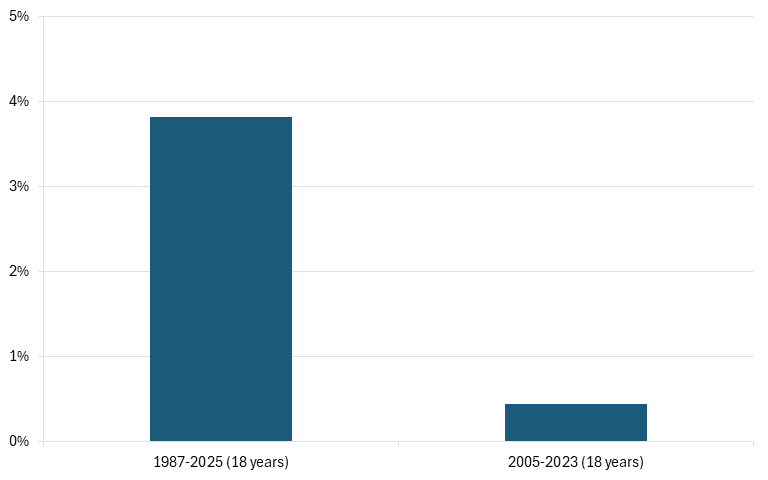
Despite its importance, U.S. manufacturing labor productivity growth has slowed dramatically in recent decades. From 1987 to 2005, manufacturing productivity grew at an average annual rate of 3.8 percent. However, from 2005 to 2023, its average annual growth rate fell to just 0.4 percent. (See figure 1.) This sustained decline points to a structural slowdown rather than merely a cyclical fluctuation, indicating a broad-based weakening in manufacturing productivity performance.
Figure 1:Manufacturing sector's average annual growth rates
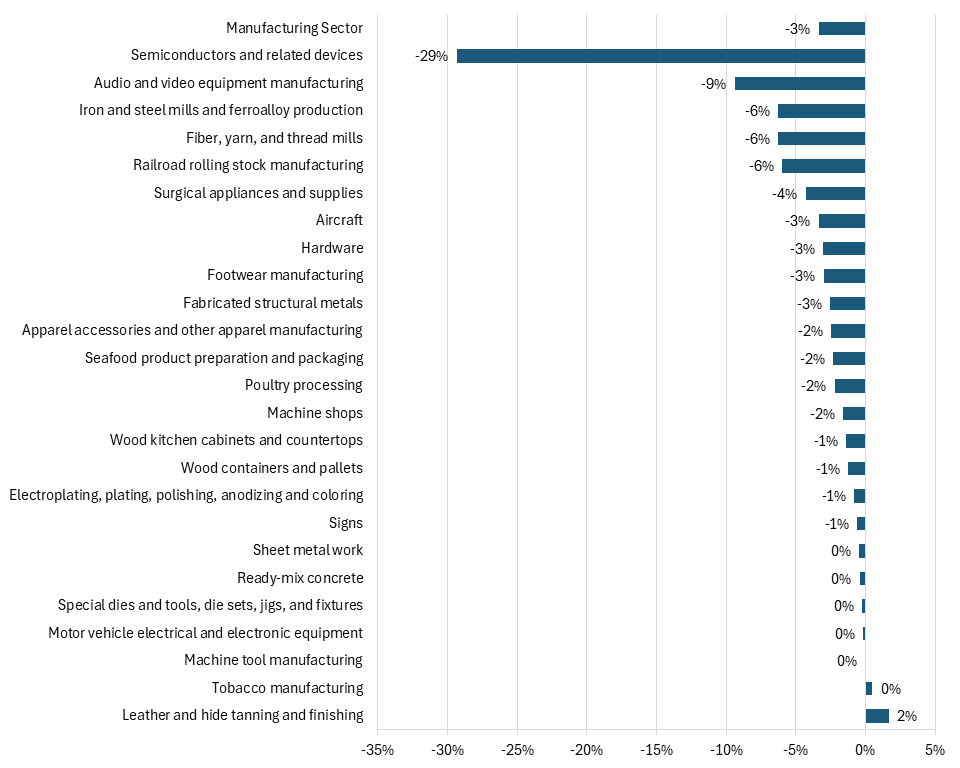
When disaggregated by industry, the data show that the slowdown remains widespread across the manufacturing sector. Of the 27 industries with available data, only 2 experienced higher productivity growth in the post-2005 period than from 1987 to 2005. Notably, both gains occurred in non-advanced industries: leather and hide tanning and finishing, where productivity growth rose by 1.7 percentage points, and tobacco manufacturing, where it increased by 0.5 percentage points.
In contrast, all advanced manufacturing industries for which data are available have experienced declines in productivity growth. For instance, annual productivity growth in computer and electronic product manufacturing fell from 1.9 percent from 1987 to 2005 to −1.2 percent from 2005 to 2023, a decline of roughly 3 percentage points. Aircraft manufacturing experienced a similar decline of about 3 percentage points during the same period. (See figure 2.)
Figure 2: Percentage point change in average annual growth rates from 1987-2005 period to 2005-2023 period, by manufacturing industries
This is particularly worrisome because China has significantly increased its production capacity in advanced industries and has already established leadership in many of them. As the latest edition of ITIF’s Hamilton Index highlights, China now dominates global production in advanced industries, accounting for nearly one-quarter of output across all 10 advanced industries combined and leading production in 7 of them. If U.S. productivity growth continues to stagnate in these sectors, the consequences will include not only slower economic growth but also a sustained loss of global market share in industries where leadership is difficult to regain once lost.
To reverse the slowdown in manufacturing productivity growth, Congress should establish a 25 percent tax credit for firms adopting productivity-enhancing technologies, including industrial robots, artificial intelligence systems, and advanced manufacturing software. By reducing the cost of technology adoption, the credit would encourage firms to modernize their production processes, increase output per worker, and strengthen their global competitiveness.
