

Comments to the Digital Trade and Telecommunications Chapter on a Possible Canada-Mercosur Free Trade Agreement

Mercosur’s Precedent of Digital Protectionism... 2
Mercosur’s Weak Digital Trade-Related Agreements. 4
What Type of Digital Trade Agreement Canada Should Pursue. 7
Introduction and Summary
The Information Technology and Innovation Foundation’s Centre for Canadian Innovation and Competitiveness (CCIC) appreciates the opportunity to contribute to Global Affairs Canada’s consultation on a potential Canada-Mercosur Free Trade Agreement.
Canada has already negotiated high-standard digital trade rules in the Canada-United States-Mexico Agreement (CUSMA) and the Comprehensive and Progressive Agreement for Trans-Pacific Partnership (CPTPP). The question in any Canada–Mercosur negotiation is whether Ottawa intends to defend that standard or dilute it.
Canada should approach exploratory talks regarding a digital trade chapter—or e-commerce, or telecommunications—in the Canada–Mercosur Free Trade Agreement (FTA) with caution. If Mercosur partners are unwilling to accept binding commitments, particularly on data governance, digital services, and telecommunications competition, Canada should avoid including a digital chapter that delivers form without substance. A weak chapter is worse than no chapter. Trade texts create precedent, and once Canada accepts diluted language on data flows, non-discrimination, or dispute settlement in one agreement, future partners will demand the same treatment, ratcheting down Canada’s digital trade standard. Given Mercosur’s track record of protectionism and weak digital chapters, entering talks without a clear defensive baseline risks locking that lower standard in place.
Mercosur’s protectionism in the digital economy is reflected in country-level policies that undermine key principles of digital trade liberalization, including non-discrimination in digital product markets, the free flow of data across borders, and bans on data localization. These are not marginal gaps. They go to the core architecture of digital commerce.
So far, existing trade agreements have proven insufficient to dismantle the protectionist digital policies within Mercosur. This brief document analyzes the digital trade-related issues covered in the Singapore-Mercosur FTA and the EU-Mercosur FTA. Both agreements lack strong, binding digital trade rules. If Canada were to follow a similar path as Singapore and the EU, it would represent a step back from previous precedents of robust digital trade rules that have already been signed, such as the digital trade chapter of the CPTPP and the CUSMA.
Mercosur’s Precedent of Digital Protectionism
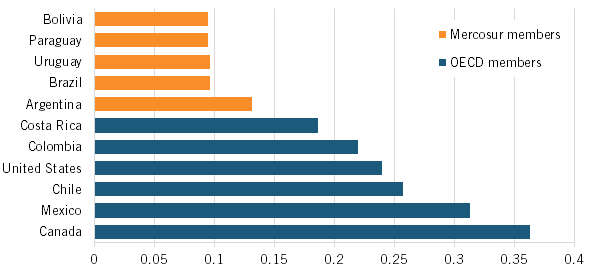
Neither Mercosur nor its individual members have been significant contributor to the development of global digital trade rules. The OECD’s Index of Digital Trade Integration and Openness (INDIGO) provides a framework for quantifying the depth and breadth of a country’s digital trade rules.[1] INDIGO has two key measures: international integration and openness (INDIGO-t), and non-trade-related international instruments (INDIGO-i). These indices are based on 28 specific areas categorised under five broad policy areas—e-commerce environment, cross-border e-commerce, trust in e-commerce, cross-border data flows and data localization, and broader digital economy issues. The indices are measured on a linear scale from 0 to 1, meaning that a country with a 0.2 score is twice as open as one with a 0.1 score.
INDIGO-t, the most important index, captures the influence of trade-related instruments—such as WTO agreements, regional trade agreements (RTAs), and dedicated digital economy agreements (DEAs)—in the country’s digital economy. Considering this measure, Figure 1 shows that Mercosur countries are notably less internationally integrated and open compared to OECD countries in the Americas. OECD countries in the Americas are more than twice as open and integrated in digital trade as Mercosur members, averaging 0.26 and 0.10, respectively.
This means that OECD countries in the Americas are more than twice as integrated into binding digital trade frameworks as Mercosur members. This reflects not only domestic regulatory differences but institutional absence from high-standard trade instruments. Mercosur countries are currently not shaping the rules of digital trade; they are largely outside them.
Figure 1: International integration and digital trade openness, based on OECD's INDIGO-t (GDP-weighted, 2024 values)[2]
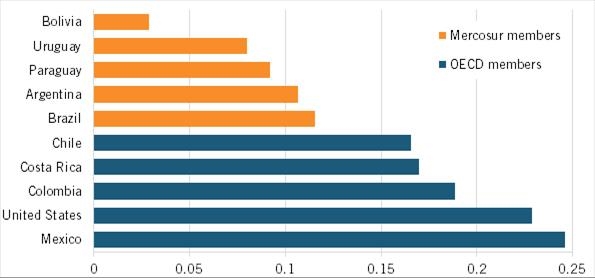
INDIGO-i measures non-trade-related international instruments. For example, how the country participates in, advocates for, and implements digital trade-related issues is informed by discussions at the United Nations or the Asia-Pacific Economic Community (APEC). Again, OECD members are more active in shaping global digital trade rules than Mercosur countries—averaging 0.20 and 0.08, respectively. Lower INDIGO-i scores indicate weaker participation in international norm-setting processes that shape future trade obligations.
Figure 2: Non-trade-related digital trade instruments, based on OECD's INDIGO-t (GDP-weighted, 2024 values)[3]
Mercosur—as an economic bloc—has an e-commerce agreement among its members that doesn’t comprehensively cover good practices for digital trade rules.[4] First, the “Mercosur Electronic Commerce Agreement” exempts procurement policies from the agreement's provisions, creating a loophole for member states to implement protectionist policies, such as de facto data localization requirements, under public procurement requirements. Second, it is incomplete. The agreement lacks a binding commitment to non-discrimination in digital products, does not prohibit the forced transfer of source code, and limits bans on data localization.
Mercosur’s Weak Digital Trade-Related Agreements
Mercosur has recently signed two relevant FTAs with digital trade components, and both are weak in terms of depth and binding commitments. The Singapore-Mercosur FTA, signed in December 2023, has an electronic commerce chapter (Chapter 12), while the EU-Mercosur FTA has digital trade rules embedded in sub-section 6, related to e-commerce, within the trade in services and establishment chapter (Chapter 10).[5] None of these agreements includes meaningful digital trade-related provisions that constitute a substantive digital trade deal.
Moreover, it is unclear whether these two FTAs will be fully implemented. The Singapore-Mercosur FTA has been approved only by Paraguay and Uruguay—and the two largest Mercosur economies, Argentina and Brazil, are not prioritizing it and are not currently submitting it for debate in their respective parliaments.[6] Regarding the EU-Mercosur FTA, only Brazil and Uruguay have shown signs of accelerating their legislative approval.[7]
ITIF has previously created a repository of relevant digital trade provisions. These are 21 types of provisions, categorized as binding or non-binding based on the agreement's language. Figure 3compares the digital trade provisions of the FTAs signed with the EU and Singapore with CUSMA, CPTPP, the Regional Comprehensive Economic Partnership (RCEP), the Digital Economy Partnership Agreement (DEPA), and the WTO’s Joint Statement Initiative on E-commerce (JSI). The two FTAs signed by Mercosur have only two binding provisions, while the agreements signed by Canada—CPTPP, CUSMA, and the JSI—have 8 to 10.
Figure 3: Number of key digital trade-related provisions in existing agreements[8]
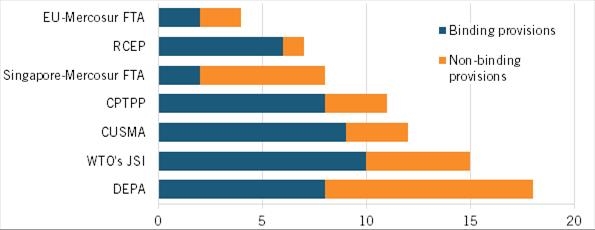
Table 1 presents the details of the digital trade-related provisions, showing that Mercosur’s agreement lacks key provisions. For example, bans on data localization or prohibitions on the forced transfer of source code are omitted, and non-discrimination in digital products is only non-binding in the FTA with the EU. Canada should maintain its precedent by signing future digital trade agreements that include at least the binding provisions present in CUSMA and CPTPP.
Table 1: Digital trade provisions in key agreements[9]
|
Provisions |
Singapore-Mercosur FTA |
EU- Mercosur FTA |
CPTPP |
CUSMA |
DEPA |
RCEP |
WTO's JSI |
|
Moratorium on customs duties on electronic transmissions and digital products |
● |
● |
● |
● |
● |
● |
|
|
Non-discriminatory treatment for digital products |
○ |
● |
● |
● |
|||
|
Ban on data localization |
● |
● |
● |
● |
|||
|
Free cross-border transfer of personal information |
○ |
● |
● |
● |
● |
||
|
Protect consumers’ personal information |
○ |
● |
● |
● |
● |
● |
● |
|
Consumer protection laws that define and prevent fraudulent and deceptive commercial activities |
● |
● |
● |
● |
● |
● |
|
|
Measures against spam or unsolicited messages |
● |
○ |
● |
● |
● |
● |
● |
|
Prohibit parties from forcing the transfer of source code as a condition for market access |
● |
● |
|||||
|
Collaboration on cybersecurity management |
○ |
○ |
○ |
○ |
○ |
○ |
|
|
Safe harbour for Internet intermediaries |
● |
||||||
|
Open government data |
○ |
○ |
○ |
● |
|||
|
Interoperable electronic invoicing |
○ |
● |
● |
||||
|
Interoperable electronic payment system |
○ |
● |
|||||
|
Interoperable digital identities |
○ |
○ |
|||||
|
Cooperation in the fintech sector |
○ |
○ |
|||||
|
Ethical governance of AI |
○ |
||||||
|
Data innovation |
○ |
||||||
|
Digital innovation and emerging technologies |
○ |
||||||
|
Logistics best practices |
○ |
● |
|||||
|
Standards and technical regulations |
○ |
○ |
|||||
|
Open Internet access to consumers |
○ |
○ |
○ |
● |
|||
|
Cooperation on digital inclusion |
○ |
○ |
● |
●: Binding provision ○: Non-binding provision
What Type of Digital Trade Agreement Canada Should Pursue
High-standard digital and telecommunications rules directly affect the ability of Canadian firms to compete in Mercosur markets. Canadian technology exporters, such as Shopify, Lightspeed, and OpenText, along with fintech firms, depend on clear and predictable rules for how data can be stored, processed, and transferred. When data flows are restricted or localization is required, costs rise and operations fragment, favouring established or state-linked players over new entrants. Canadian SaaS, data-analytics, and telecom-tech firms depend on predictable, interoperable cloud markets in Mercosur countries and on rules that allow cross-border data storage and processing through global providers.
These rules matter beyond the technology sector. Exporters of goods increasingly depend on digital customs systems, electronic certification, real-time tracking, and data-enabled supply chains. Weak or unclear digital trade rules slow border processes and raise compliance costs, eroding competitiveness across the economy.
Canada should anchor any digital and telecommunications chapters to the strongest precedents in its existing trade framework. Provisions should be at least as clear and enforceable as those in CUSMA and the CPTPP. A lower-standard chapter risks setting a precedent that weakens Canada's position in future negotiations, including ongoing Canada–EU Digital Trade Agreement talks. Digital trade provisions are often reused. Once Canada accepts weaker language in one agreement, it becomes harder to justify higher standards elsewhere. Future partners point to past texts and ask for similar treatment.
At a minimum, any digital and telecommunications chapter should guarantee:
▪ Cross-border data flows with a clear prohibition on forced data localization
▪ A permanent ban on customs duties on electronic transmissions and digital products
▪ National treatment and non-discriminatory treatment for Canadian digital goods and services
▪ Explicit protections against forced disclosure of source code and algorithms
▪ Legal recognition of electronic contracts and signatures, and binding commitments on telecommunications competition, including fair interconnection, independent regulators, number portability, and transparent licensing
▪ Full coverage under dispute settlement, rather than aspirational cooperation alone
These are not ideological preferences. They are the structural conditions required for a digital chapter to function. Without clear guarantees that data can move across borders, firms cannot operate modern digital services at scale. Non-discriminatory treatment and the prohibition of digital customs duties prevent market access that exists on paper but not in practice. Protections against forced source code disclosure address risks in sectors with strong state involvement. Telecommunications rules, such as independent regulators, transparent licensing, and fair network access, are safeguards against market foreclosure. Dispute settlement coverage gives commitments weight. When obligations are enforceable, firms plan and invest with confidence. A digital chapter that excludes these elements is not incomplete. It is functionally ineffective.
Canada should not accept:
▪ Broad or vague public policy exceptions that allow governments to restrict data transfers without clear limits
▪ Language that renders digital or telecommunications chapters non-binding or purely aspirational
▪ Exclusion of digital trade or telecommunications provisions from dispute settlement
▪ Carve-outs that permit local data storage requirements by default
Canada’s productivity challenge is well documented.[10] Canadian firms already face scale constraints relative to those faced by U.S. and global competitors. In the absence of enforceable digital trade rules, firms face higher regulatory uncertainty, greater compliance burdens, and reduced scale efficiencies, all of which compound Canada’s structural competitiveness challenges. A high-standard digital chapter is a competitiveness tool. If Mercosur partners are not prepared to meet that standard, Canada should defer digital agreements rather than lower it.
Thank you for your consideration.
Rodrigo Balbontin
Associate Director, Trade, IP, and Digital Technology Governance
Lawrence Zhang
Head of Policy, Centre for Canadian Innovation and Competitiveness
Related
August 25, 2025
Comments to Global Affairs Canada Regarding a Possible Canada-EU Digital Trade Agreement
November 19, 2021
