

Internal Value Chains Remain Dependent on China Even as Multinationals Shift Production to America
Advanced manufacturers based in East Asia are expanding investment into the U.S. economy. Yet, many of their internal value chains remain anchored in China, giving the PRC significant leverage over U.S. interests. U.S. policymakers should respond both defensively and offensively.
KEY TAKEAWAYS
Key Takeaways
Contents
Case Study Evaluations of China-Plus-One in the AI Economy 16
Introduction
The primary arena of U.S.-China competition today is industrial.[1] In the techno-economic-trade war, American and Chinese firms compete in global markets amid a backdrop of Schelling-style economic warfare.[2] Longstanding PRC cyber and economic espionage on industry is pulling firms into this conflict, whether they are prepared for it or not.[3] And U.S. and PRC policymakers deploy sanctions, export controls, and control over key commodities as chokepoints.[4] In his recent book Chokepoints, Edward Fishman wrote that “economic warfare, now a baseline feature of our world, will permeate other areas of foreign policy, global economics, domestic politics, and business.”[5]
This report supplies evidence that the next area U.S.-China economic warfare will permeate into is China’s leverage over non-American multinationals’ internal value chains. Over the last decade, U.S. firms have recognized their exposure to China and have taken at least some steps to reshore production, decrease their investments in China, and secure their supply chains.[6] Similarly, U.S. policy has emphasized de-risking first-degree dependence on Chinese supply chains in recent years, but less so second-degree dependence through allied nations’ multinationals.[7] Yet East Asian multinationals with longstanding investments in China have been slower and less able to reduce their PRC regulatory, market, and dependence risks.[8]
This reality is unchanged by U.S. policymakers’ attempts to reshore and increase foreign direct investment (FDI) following decades of offshoring. The Biden and second Trump administrations have sought to bring back advanced manufacturing to the United States through industrial policy and trade pressure. While inward FDI announcements have led to the perception that such investment strengthens U.S. independence from China, the reality is that the internal value chains of many advanced manufacturing multinationals are deeply anchored in China and not easy to relocate. These include accumulated manufacturing process know-how, talent, and IP.
If U.S. reshoring success is defined by the ability to sustain power industry value chains, protect advanced manufacturing know-how, and maintain operational resilience in the event of a future potential U.S.-China decoupling event, then this report argues that most existing approaches fall short.
This dependency is a chokepoint, which Trinh Nguyen in her review of Fishman’s Chokepoints defines as “non-substitutable domains dominated by a single state or small coalition.”[9] The PRC could—and likely will—weaponize this chokepoint against the United States, just as it has weaponized its chokepoint of rare earth mining, processing, and refining.[10] U.S. policymakers have been slow to realize this vulnerability, partly due to the recent flurry of greenfield inbound investment announcements. However, many of these deals will relocate some production without reducing dependence on China for the most valuable parts of firms’ supply chains, thereby falling short of “securing America’s technological and industrial leadership,” as one recent trade deal touted.[11] Conversely, the PRC has explicitly allowed geographic dispersion of production so long as control over key links in value chains remain anchored inside China.
This report examines recent U.S. inbound investment through this lens. Focusing on three case studies—Taiwan’s Inventec, Japan’s Resonac, and South Korea’s LS Cable & System (LS C&S)—it traces how multinational firms critical to U.S. industrial goals have diversified geographically but retained higher-value capabilities and significant risk in China. To be clear, none of these firms have deliberately harmed either American or their home nation’s interests. In most cases, they have made the best decisions available based on global regulations and business incentives.
For U.S. policymakers, the question should not be whether the United States should welcome inbound investment from non-Chinese firms with China dependency. It should. The question should be how the United States defines success when it receives such investment. If success is measured primarily by capital inflows, job counts, or production capacity, then many recent inbound investments are successes. If success is defined by the ability to sustain power industry value chains, protect advanced manufacturing know-how, and maintain operational resilience in the event of a potential U.S.-China decoupling event, then most existing approaches fall short.[12]
Policymakers can and should take more defensive and offensive measures against potential PRC weaponization of multinationals’ dependence on China. Defensively, U.S. policymakers should redefine success regarding China-Plus-One and attempt to build what that success looks like into U.S. strategy on inbound investment, supply chains, and economic security. Offensively, policymakers should proactively work with multinationals and their home countries to wrest back value chain independence from China wherever possible. How U.S. policymakers address multinationals’ dependence on China will shape the next phase of industrial competition with China and determine whether these same firms’ new greenfield investments in the United States contribute meaningfully to long-term competitiveness against China.
The China-Plus-One Strategy
The PRC’s ability to wield leverage over multinationals’ China-dependent internal value chains is best understood under the framework of “China-Plus-One,” a supply chain management (SCM) strategy in which a firm retains substantial production capacity in China while shifting production to at least one other country to reduce risk.[13] The term originated in early-2000s Japan as a public-private risk-management response to rising costs and political uncertainty for Japanese businesses operating in China.[14] Operating under a China-Plus-One strategy, a firm can theoretically hedge against regulatory and institutional risks in China while avoiding full offshoring in order to preserve access to China’s market, talent, and industrial ecosystems.[15]
The most recent wave of China-Plus-One has featured more global diversification, as evidenced by permutations of the original strategy such as China-Plus-Two, China-Plus-Many, China-And-Many, and China-Plus-N.[16] As the China-Plus-One concept spread from Japan to the United States in the 2010s, multinationals tended to shift production from China to Southeast Asia or India in search of lowered risk and labor costs.[17] Yet, in the 2020s, the United States has emerged as a Plus-One recipient economy due less to China risk and more to U.S. tariffs, industrial policy incentives, threats of punitive action, and corporate hedging in U.S.-China competition.[18]
In addition to these geographic shifts, China is no longer simply a low-cost labor-intensive manufacturing hub and has emerged as an innovative techno-economic power with aspirations to globally dominate power industries, which are advanced industries that underpin 21st century national power.[19] China has arrived at this point in part through PRC strategy and its natural economic strengths. Yet, another factor has been technology transfer—both through legal auspices and through PRC economic espionage—from multinationals, especially those with significant operations in China.[20] As China has steadily climbed up the value chain ladder, it has cultivated multinational dependence on its market and industrial ecosystem along the way.[21]
Now as a Plus-One recipient economy, the United States has not fully adapted to this reality. Industrial policy programs such as the CHIPS and Science Act (CHIPS Act), the Inflation Reduction Act (IRA), and the Stargate Project have focused primarily on where and what new capacity is built, rather than the degree to which the new capacity meaningfully decreases China dependence. As The Asia Group has noted, tariff uncertainty has altered firms’ investment calculus, in some cases incentivizing U.S.-based production to preserve market access, even where high-value China-based dependencies remain intact.[22]
In practice, China-Plus-One has increased geographic diversification of production without meaningfully decreasing supply chain dependency on China.
The result is investment that has somewhat expanded U.S. domestic capacity while leaving the most strategic parts of multinationals’ internal value chains and underlying dependency anchored in China. In general, China-Plus-One investment benefits the United States, as every dollar moved out of China—whether it ends up in India or the United States—can weaken the PRC’s industrial leverage at the margin. Yet, in practice, China-Plus-One has increased geographic diversification of production without meaningfully decreasing supply chain dependency on China.
This gap is especially consequential because the United States relies heavily on foreign multinationals—particularly from Taiwan, Japan, and South Korea—for advanced manufacturing that underpins U.S. national power.[23] These firms are indispensable partners for the United States. They are also among the most sophisticated practitioners of China-Plus-One strategies, with longstanding operational ties to China’s manufacturing and talent ecosystems.
Origins of China-Plus-One
“China-Plus-One” originated in Japan as an academic, industry, and government term for diversifying supply chains beyond China. As early as 2002, the Japan Machinery Center for Trade and Investment (JMC)—the foremost industry association representing Japan’s machinery sector—warned Japan’s government that its member companies were increasingly facing risks with their dependence on China’s economy.[24] JMC described Japanese investments in China as having “already gone beyond the mere relocation of production functions, extending to R&D [research and development], procurement, and sales functions.”[25]
JMC wrote that “in China, as industrial clusters develop and activities such as procurement, production, and sales become increasingly self-contained within China, all profits of Japanese companies shift to their Chinese subsidiaries.”[26] According to JMC, this and other dependencies highlighted institutional risk, as China’s “system remains opaque, and in many cases investigations and adjustments are conducted in ways that are inconsistent with international rules or are arbitrary.”[27] Presciently, JMC warned that if Japan’s government did not to pay attention to the risks of over-extending Japanese supply chains to China, the consequence would be no less than “the deterioration or hollowing-out of Japanese headquarters’ functions.”[28]
Although JMC did not explicitly mention China-Plus-One, its warning laid the groundwork for the China-Plus-One strategy that emerged shortly thereafter in reaction to the newly realized risks of making China a production base. By 2003, Japanese policymakers and academics had begun using the term China-Plus-One.[29] That year, Kayoko Kitamura, the then-director of the Japan Society for International Development, published a commentary titled “China-Plus-One: Which country will be chosen?” in the government-affiliated Japan External Trade Organization’s business journal.[30] The concept took root and throughout the 2000s, many Japanese companies began to diversify away from China toward Southeast Asia, as well as to explore India as a potential investment hub, in many cases directly citing China-Plus-One as their strategy.[31]
The 2008 RAND report “Pacific Currents: The Responses of U.S. Allies and Security Partners in East Asia to China’s Rise,” summarized Japan’s governmental view of China-Plus-One as a message of complementarity: “China has great promise as both a market and a production base, but business should hedge its bets against overexposure.”[32] The historical record shows that Japan’s conception of the China-Plus-One strategy was aimed to reduce exposure to China-related shocks, but it was never designed to fully prevent against China dependence.
Recent U.S. Reshoring and Tariff Policies Fail to Address China Dependency Risk
Following China-Plus-One’s origins as a public-private hedge against overexposure to China in Japan, the term became a global industry SCM trend in the 2010s.[33] The concept has also influenced policy globally. While governments around the world rarely use China-Plus-One officially, they apply the SCM framework to trade and industrial policy. For example, South Korea’s 2026 Framework Act on Supply Chain Stabilization for Economic Security set a quantitative target to reduce import dependence on any single country for key items to below 50 percent by 2030.[34]
In the U.S. context, policymakers have evaluated China-related supply-chain risk through language such as reshoring, nearshoring, friendshoring, economic security, de-risking, and supply chain stabilization.[35] While these concepts overlap, they are not synonymous, and their conflation has obscured whether current policies meaningfully address upstream China-supply-chain dependence in national power industries.[36] For example, the Biden administration promoted the CHIPS Act as a measure to “strengthen supply chains and counter China,” and included guardrails preventing subsidy recipients from expanding certain semiconductor facilities in China.[37] However, the program had comparatively little to say about the degree of subsidy recipients’ reliance on upstream China-based inputs, materials, tooling, and components.[38]
Stargate Project has reflected this same pattern. With the backing of the Trump administration, OpenAI has framed Stargate Project as an effort that “will not only support the re-industrialization of the United States but also provide a strategic capability to protect the national security of America and its allies.”[39] Yet, the initiative’s request for proposals did not require any disclosures or information regarding applicants’ upstream China dependency, despite requesting full transparency for corporate and compute ownership.[40]
As academics Laura Alfaro and Davin Chor argued in a 2023 analysis of recent U.S. efforts to reconfigure global value chains through friendshoring, nearshoring, and FDI, “it is unclear if these measures will reduce U.S. dependence on supply chains linked to China.”[41] Answering the question of what share of recent U.S. inbound investment is China-dependent from a macroeconomic standpoint is difficult, especially since FDI announcements do not always translate into actual capital flows, or do so very slowly.[42] Given these limitations, this report approaches the question primarily from a microeconomic and firm-level perspective, using case studies to assess how China-Plus-One operates in practice.
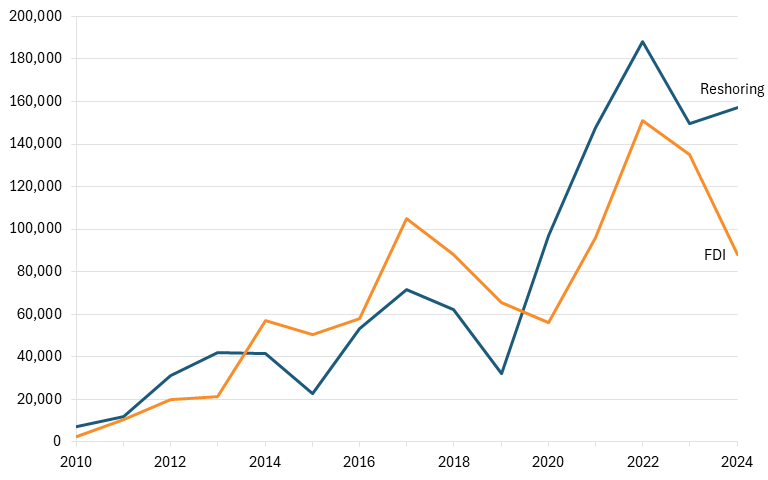
Still, what is clear is that U.S. inbound investment job announcements have significantly risen in recent years.[43] As seen in figure 1, the Reshoring Initiative, which measures corporate job announcements to look at the quantity and makeup of reshoring and FDI in the U.S. economy, has found that both reshoring and FDI job announcements have increased over the last decade, with FDI job announcements reaching a high of 154,409 jobs in 2022. Since 2022, FDI job announcements have continued to make up a large share of total reshored and FDI job announcements, but both types of job announcements have fallen off in recent years following 2022’s IRA and CHIPS Act.[44]
Figure 1: Reshoring and FDI job announcements in the United States, 2010–2024[45]
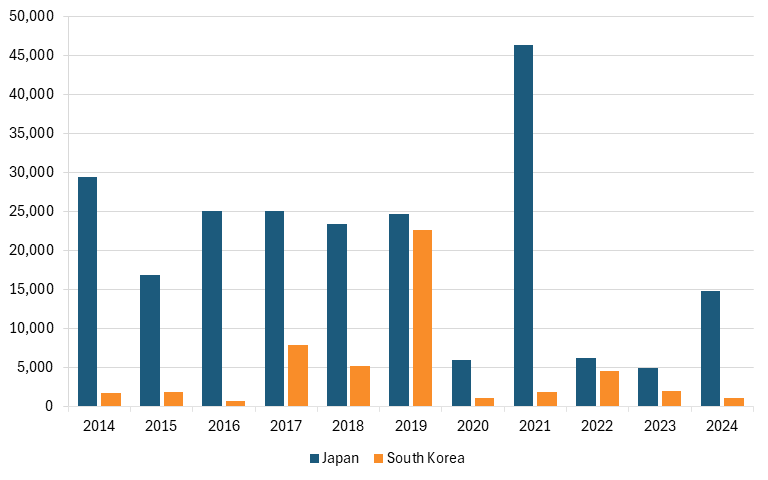
However, as seen in figure 2, most FDI over the last decade has come in the form of acquisitions rather than establishments or expansions. Japan is the largest FDI contributor to the United States, with one academic estimate stating that Japan accounts for close to 15 percent of the stock of all U.S. inward FDI.[46] Beyond Japan, in terms of other East Asian allies (data on Taiwan’s FDI is limited), South Korea has also been a steady FDI contributor, both in terms of first-year expenditures as well as current employment associated with new FDI in the U.S. economy over the last decade, as seen in figure 3 and figure 4.
Figure 2: Total FDI investment by type, 2014–2024[47]
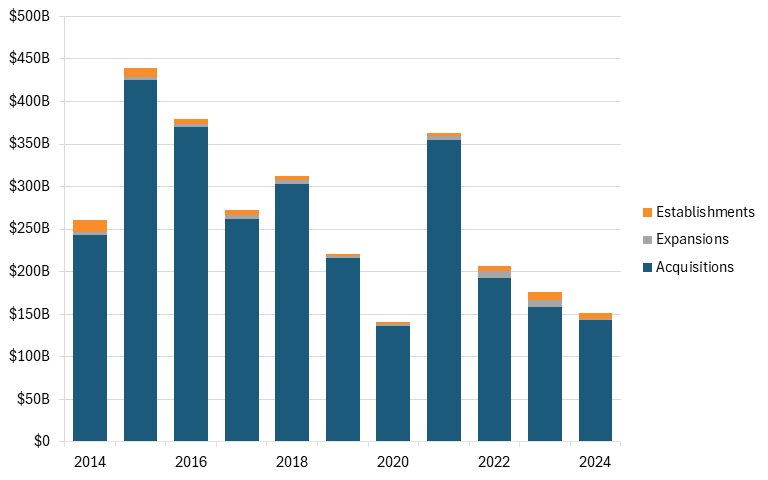
Figure 3: First-year U.S. expenditures from Japan and South Korea, 2014–2024[48]
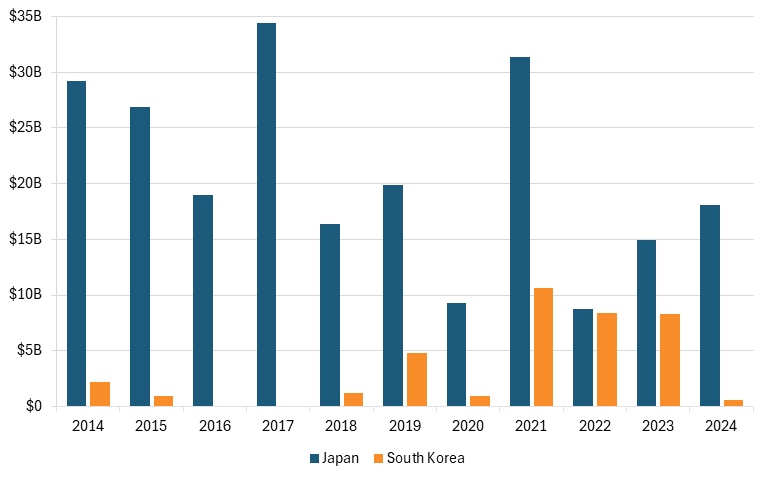
Figure 4: Japan and South Korea, current employment associated with new U.S. FDI , 2014–2024[49]
The second Trump administration’s tariffs are similarly unlikely to mitigate China-dependency risks. As World Bank researchers found in a study of U.S. trade flows from 2017 to 2022, specifically looking at U.S. tariffs’ effect on diversification away from Chinese supply chains, “the reorientation of trade is consistent with a ‘China + 1’ strategy, as opposed to diversified sourcing across multiple countries.”[50] The authors concluded that “to displace China on the export side, countries must embrace China’s supply chains.”[51] In other words, U.S. tariffs have often shifted production to alternative countries that remain deeply integrated in China’s supply networks. While this has somewhat reduced U.S.-China bilateral trade exposure, it has not meaningfully reduced systemic dependence on China.
How to Evaluate Success in China-Plus-One
In a 2011 article, business scholar Peter Enderwick characterized China-Plus-One as a balanced win-win-win paradigm for three stakeholders. As he wrote:
A China-Plus-One strategy appears to be beneficial to both firms that seek to pursue it for reasons of risk diversification, cost reduction or avoidance of overreliance on China, for China in that it frees up resources which can be applied to other higher value activities, and for Plus-One host economies which gain the benefits of inward investment.[52]
Enderwick’s framework is useful, but reflects the optimism of Globalization 1.0, in which most policymakers and academics still believed China was converging toward market norms and discounted the risk of nations being protectionist toward their markets and firms.[53] While Enderwick acknowledged risk from China’s “variability in government policy and in particular, attitudes towards foreign business,” he did not account for China’s explicit use of industrial policy to capture market share.[54] Enderwick also omitted firms’ host countries as a stakeholder.[55]
Updating Enderwick’s framework for 2026 requires three additional components:
1. China’s possession of chokepoints in the form of multinationals’ internal value chain dependencies
2. The backdrop of U.S.-China techno-economic-trade war in which gains for one stakeholder may directly undermine another
3. The addition of diversifying multinationals’ host nations as additional actors in the paradigm, with occasionally differing strategic priorities than the firm’s choices
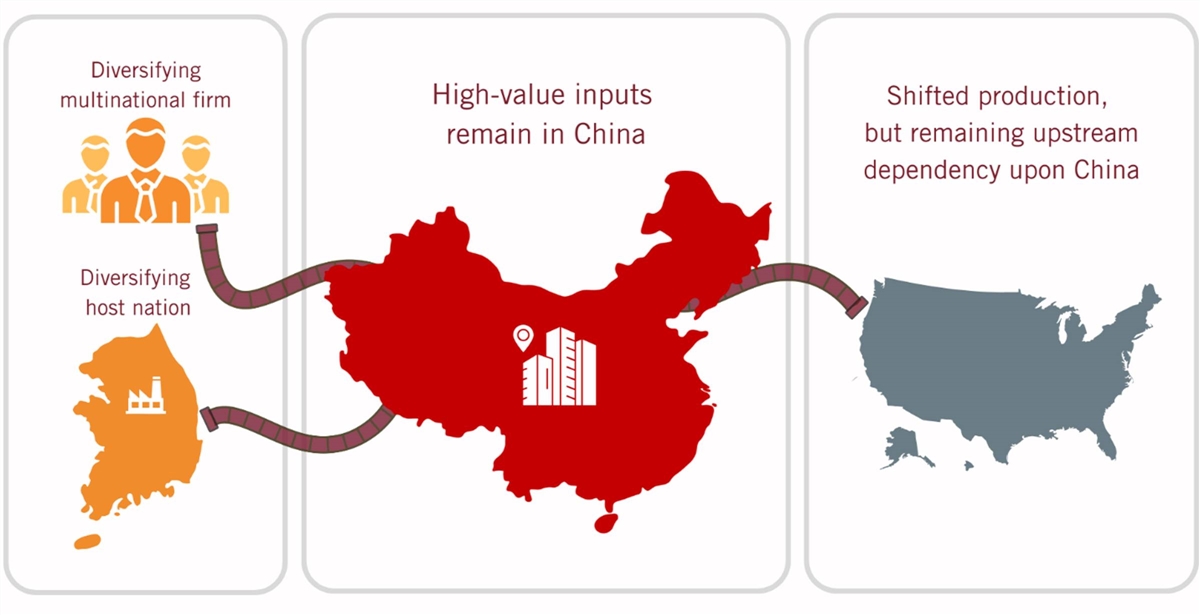
Figure 5 updates Enderwick’s framework for situations in which the United States is the Plus-One recipient economy and the diversifying firm is an advanced manufacturer. The conception rightfully places China at the center of the China-Plus-One framework. China, not the United States—nor the diversifying firm or its host nation—holds the most leverage in the paradigm. In most cases, this framework is not a mutual win. Instead, it tends to result in a win for China, a mixed picture for the diversifying firm and its host nation, and a loss for the United States.
Figure 5: An updated conception of Enderwick’s China-Plus-One framework for 2026
How the United States Wins in China-Plus-One
The United States wins as the recipient economy of China-Plus-One firm-level diversification when inbound investment contributes to a Globalization 2.0 strategy.[56] This means that inbound investment prioritizes advanced industries and leads to technology transfer of critical IP and manufacturing processes, creating both supply chains resilient to geopolitical shock and alignment with allied production ecosystems.[57] Most foreign investment in the United States within the last two administrations fits most of these criteria.
However, there is one more criterion. In high-fixed-cost sectors such as semiconductors, AI infrastructure, and aerospace, competition with China is structurally winner-take-most.[58] As the Information Technology and Innovation Foundation (ITIF) has observed, China’s use of subsidies, closed markets, and nonmarket practices allows it to capture market share that would likely otherwise be won by more genuinely innovative foreign competitors.[59] Every sale of a single-aisle passenger jet China’s state-owned COMAC makes is one less sale for Airbus or Boeing.[60] In this context, U.S. success should be evaluated relative to China’s success, not in isolation. Therefore, a China-Plus-One outcome in which China retains control over key inputs, standards, or ecosystems, while final assembly or lower-value processes shift to the United States, cannot be considered a U.S. “win.”
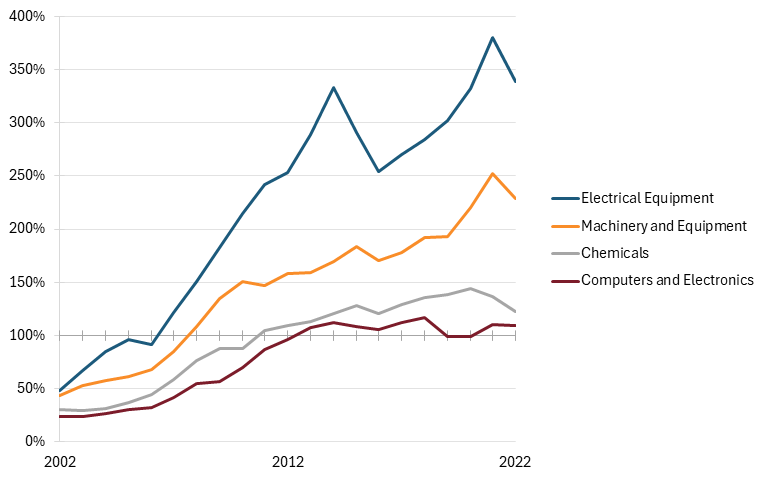
In industries to which the United States is welcoming significant East Asian inward FDI, such as electrical equipment, machinery, computers and electronics, and chemicals, China is already well ahead of the United States globally.[61] The PRC has prioritized industries such as semiconductors, data-center infrastructure, specialty chemicals, critical minerals, and undersea cables in industrial policy plans such as Made in China 2025, and wants to occupy critical positions in global supply chains of these sectors.[62] Sectoral output figures show that China captured global shares of value-added output between approximately 25 and 39 percent of these industries by 2022, and largely increased its lead in global shares over the United States between 2002 and 2022, as seen in figure 6 and figure 7.[63]
A China-Plus-One outcome in which China retains control over key inputs, standards, or ecosystems, while final assembly or lower-value processes shift to the United States, cannot be considered a U.S. “win.”
Figure 6: U.S. global shares of selected advanced industries versus Chinese shares, 2022[64]
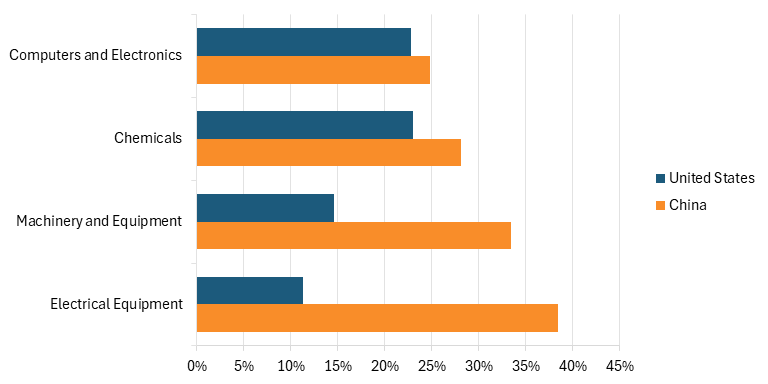
Figure 7: China’s increasing global market share in select advanced industries relative to the U.S. global share[65]
Yet, there is hope for the United States. These figures show output and quantity, not value or quality within these sectors. For the United States, winning in China-Plus-One means ensuring that critical IP, manufacturing processes, and infrastructure can be sustained on U.S. or allied soil in case of any exogenous geopolitical event that would leave the United States and China decoupled. Within the China-Plus-One paradigm, the United States does not need to dominate every node of the value chain, nor far outpace China in global share of output. But at a minimum, it should strive to match China’s capabilities in the segments that determine control, standards, and scalability rather than competing primarily for final assembly or downstream capacity.
How China Wins in China-Plus-One
The PRC does not view China-Plus-One dispersion as a neutral business decision decided by market forces and instead views it as a supply chain security risk requiring active management. The PRC’s approach in this regard rests on two core principles. First, China’s government recognizes that some degree of supply-chain migration out of China is inevitable, whether due to Chinese firms expanding overseas or multinational companies attempting to implement China-Plus-One strategies. In 2023, Chinese president Xi Jinping remarked in a speech that “currently, the global industrial system and supply chains are characterized by diversification.”[66] Xi added that economic and historical trends are shaping this trend in a way that “proceeds independently of individual will.”[67]
Second, China’s government recognizes that not all parts of a value chain are equally important. Speaking at the fifth plenary session of the 19th Communist Party Central Committee, held in 2020, Xi Jinping stated, “Even when relocating operations abroad, every effort must be made to retain key segments of the supply chain domestically.”[68]
While this statement was aimed at Chinese firms, reflecting concern over industrial hollowing out, it shows PRC recognition of quality’s importance relative to quantity in value chains. Xi additionally articulated the recognition that supply chains create chokepoints in a 2016 speech, warning that “[when] core technologies are detached from their industrial chains, value chains, and ecosystems, and when upstream and downstream links are broken, even [major research and development] efforts may go to waste.”[69] Together, these statements show a consistent view that strategic value comes from maintaining control over the highest-value inputs and processes in global value chains that connect R&D to production and commercialization.
As a result, China is highly defensive of its own highest-value supply chain inputs. In March 2025, Wang Lizong, a member of the National Committee of the Chinese People’s Political Consultative Conference (CPPCC) and president of the Guangdong High-Tech Industry Chamber of Commerce, said that “it is necessary to clarify which industrial chains and specific links can be established overseas, and which should be strictly controlled for relocation.”[70]
For foreign multinational enterprises, China’s approach is less defensive and more opportunistic. The PRC sees foreign firms’ investment in China as reinforcing China’s position at the center of global supply chains. In a February 2025 commentary, CPPCC member Zheng Yali wrote that international cooperation on industrial and supply chains can “promote the dissemination of China’s technical standards and rules,” and that success in this area would “form an orderly international division of labor chain with China as the mainstay,” or in other words, make China the central node in global value chains.[71]
Even as some multinationals pursue China-Plus-One strategies, the PRC attempts to leverage its advantages as a manufacturing and export base to retain their integration. Reporter Yan Lanfei of the International Business Daily—a newspaper sponsored and published by the PRC’s Ministry of Commerce—observed in 2024 that “even companies adopting a ‘China-Plus-N’ supply chain strategy prioritize stabilizing and strengthening their presence in China.”[72] Chinese policymakers and academics often use “stickiness” as a term of art to refer to the strategy of retaining multinationals’ integration in China’s supply chains. For example, Zhou Xiaoyong, a professor at Xi’an Jiaotong University who has had over 20 policy recommendations adopted by the PRC, recommended in 2024 that China “enhance the stickiness of supply chains” and “continuously strengthen the connection between [China’s] industrial chains and international ones.”[73]
China wins in China-Plus-One not by preventing supply chain diversification, but by shaping its terms. Beijing accepts that production will disperse geographically, yet works to retain control over high-value technological chokepoints. At the same time, the PRC actively encourages certain foreign multinationals to deepen their integration into China’s industrial ecosystem, creating supply chain stickiness so that China preserves its position as the central node in global supply chains.
How a Diversifying Firm Wins in China-Plus-One
A diversifying firm that chooses to pursue a China-Plus-One or China-Plus-Many strategy makes its choice based on an individual SCM and risk-management strategy as informed by geopolitical conditions but does not make its choice solely due to geopolitics. Firms win when diversification improves both short-term performance and long-term strategic resilience. As a result, successful China-Plus-One diversification is less to do with abandoning China than hedging concentration risk while protecting prior sunk-cost advantages.
In the short term, diversifying firms win when diversification delivers tariff mitigation, regulatory compliance, investor reassurance, or access to new pools of capital or subsidies. These benefits are often financial and immediate, making China-Plus-One attractive even when deeper structural risks remain unresolved.
In the long term, diversifying firms win if diversification supports durable market expansion, global competitiveness, or other strategic bets that pay off over time. For most multinationals, this means balancing new capacity outside China with continued engagement inside China, and preserving access to the Chinese market and the ecosystem advantages accumulated over decades of investment. Firms that overcorrect by exiting China too aggressively risk forfeiting scale efficiencies, supplier relationships, and participation in China’s increasingly strong science and technology talent pool that justify their original China-centric manufacturing strategies.[74]
How a Diversifying Firm’s Host Nation Wins in China-Plus-One
For host nations of firms undertaking a China-Plus-One strategy, specifically U.S. allies or partners, China-Plus-One creates a complex set of tradeoffs, with three simultaneous challenges.
First, the host nation must balance its economic and diplomatic relationships with both the United States and China. Among other incentives, China offers manufacturing ecosystem depth and cost advantages, while the United States offers security alignment and market access.[75] Second, host nations play a role in bridging institutions across two increasingly incompatible techno-economic trade blocs. As U.S.- and China-centered ecosystems diverge in standards, technology stacks, and security requirements, host nations’ firms operating across both face rising compliance, coordination, and political costs.[76] Third, policymakers often lack visibility into how exposed their domestic firms are to China, making it difficult to assess whether overexposure poses strategic risks.
Altogether, a host nation partially wins when its firms can maintain operational flexibility across both blocs, capture value from U.S. and Chinese markets, and leverage government support to strengthen domestic industrial capabilities. In the longer term, host nations face the same techno-economic-trade threat from the PRC that the United States does in their own specialized industries, so their firms’ China dependence creates chokepoints that the PRC can weaponize.
Case Study Evaluations of China-Plus-One in the AI Economy
With a few exceptions, there is limited evidence on the degree to which multinationals are or become dependent on China across supply and value chains, or how they implement a China-Plus-One strategy. This section provides policymakers with case study evidence of these topics.
Methodology
This report’s case studies focus on AI infrastructure industries with high fixed costs, steep learning curves, scale-driven reinvestment, and potential for standards lock-in—or in other words, sectors wherein China-Plus-One decisions carry the greatest economic and strategic significance.
Three firms are examined:
1. Taiwan’s Inventec
2. Japan’s Resonac
3. South Korea’s LS C&S
All three of these firms meet the following criteria:
▪ Belong to advanced industries that underpin national power in the 21st century[77]
▪ Have deeply embedded manufacturing bases in China
▪ Are actively expanding investment in the U.S. economy as part of a China-Plus-One or China-Plus-Many strategy, with the United States as a Plus-One recipient
The evaluation considers three perspectives:
1. China: How dependent are these multinationals on China?
2. United States: Is the United States winning as multinationals invest into its economy?
3. Firms and host nations: How do firms and their host nations fare as multinationals execute China-Plus-One strategies?
This report draws its evidence from open source information, including corporate financial and sustainability statements and reports, Chinese, Japanese, and Korean language sources, and limited access to WireScreen’s China-focused business intelligence platform.
Inventec
Inventec is a Taiwanese contract manufacturing company that was listed at 1,831 in the 2025 Forbes Global 2000 ranking with a $4.44 billion market capitalization value.[78]
Inventec: China as the Manufacturing Base
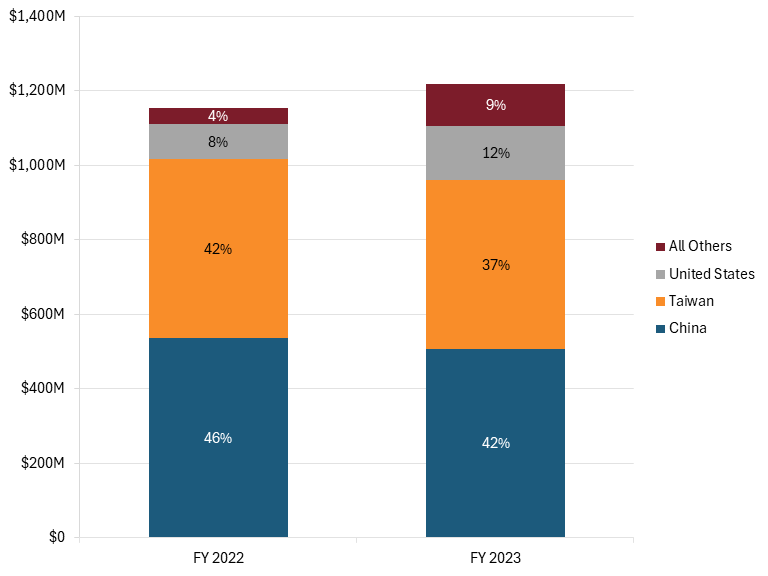
Inventec’s manufacturing base is deeply anchored in China. As of 2023, approximately 60 percent of its production capacity was based there.[79] At Inventec’s 2023 shareholders’ meeting, executives said that the future proportion of production capacity outside China would increase close to 50 percent.[80] Inventec’s geographic shares of long-term assets such as property, equipment, and other long-lived investments appear to show that the company is indeed diversifying its global footprint, with a shrinking plurality of assets remaining in China and a growing majority of long-term assets outside the country, as seen in figure 8.[81]
Figure 8: Inventec’s long-term assets by geographic region, FY 2022–2023[82]
Inventec additionally has strong localization of IP in China through collaborations and partnerships. These initiatives likely provide the firm with a strong pipeline of IP, innovation, and talent. However, it is fair to question how much they help Inventec relative to its Chinese competitors and China’s contract manufacturing sector. In 2019, Inventec’s Tianjin-based subsidiary helped jointly establish the Industry 4.0 Center of the Nanjing Tsingyan Institute of Green Manufacturing.[83] The co-establisher of the Industry 4.0 Center was e-Works Manufacturing Information Technology, a Chinese contract manufacturer.[84] According to WireScreen, 16.1 percent of e-Works’s ownership can be traced back indirectly to PRC state entities.[85] Moreover, the Industry 4.0 Center’s stated goal is to “promote the transformation and upgrading of China’s manufacturing industry.”[86]
Similarly, in 2023, Inventec co-launched the Shunwei Technology Server R&D Center within the state-owned Chongqing Xiyong Microelectronics Industrial Park, along with Chinese contract manufacturer Guangzhou Trusme Electronic Technology.[87] Shunwei’s goal is to develop high-performance servers for cloud computing, edge computing, and AI use cases.[88] Yet, according to WireScreen, Trusme owns 80 percent of Shunwei, leaving just 20 percent to Inventec.[89] Additionally, Shunwei’s general manager was previously a Trusme executive.[90]
In terms of revenue, Inventec performs well in China’s market, especially in its AI server product line.[91] In June 2025, an Inventec executive stated that the company’s China market share had reached 25 to 30 percent for servers.[92] Inventec attempts to showcase its most “cutting-edge technologies” at expositions in China, which increasingly include AI servers and liquid cooling equipment that target China’s rapidly developing AI industry.[93] Inventec is well-placed to grow its market share moving forward, having entered into AI server supply chains for China’s biggest hyperscalers—Baidu, Alibaba, Tencent, and ByteDance—by early 2025, and in particular becoming Alibaba’s main server supplier.[94]
While these developments mean Inventec’s performance in China’s market is strong in the near term, they could lock Inventec more into China’s market in the long run. As TrendForce has reported, U.S. export controls on advanced chips have pushed Chinese hyperscalers to build proprietary AI stacks using domestic chips, interconnects, and system architectures.[95] These companies could in turn request Inventec to develop increasingly China-specific server designs and manufacturing processes that are not exportable.
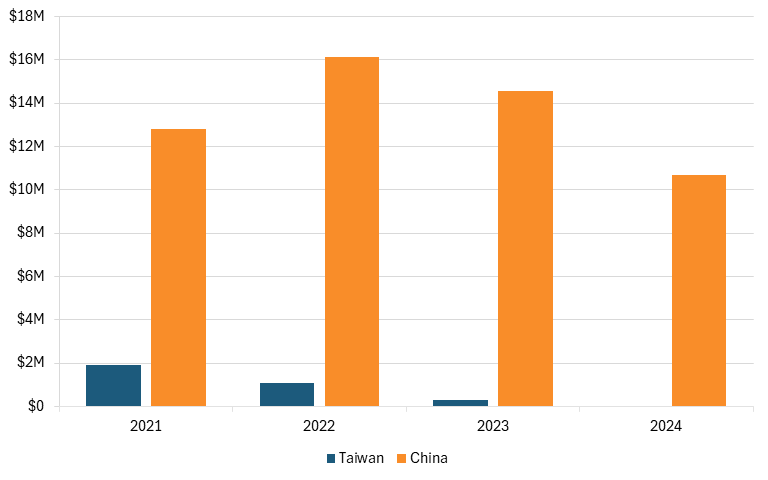
Through 2024, Inventec also received large and sustained subsidies from China’s government, as seen in figure 9.[96]
Figure 9: Inventec’s government subsidies from Taiwan and China, 2021–2024[97]
That support is helping Inventec automate and power its factories in China. In 2023, a Chongqing Daily journalist visited Inventec’s Chongqing-based subsidiary, located in the state-owned Western (Chongqing) Science City and as seen in figure 10.[98] According to the journalist, Western (Chongqing) Science City supported Inventec in “initiating an intelligent transformation and upgrade, advancing innovative development through non-hazardous raw materials, cleaner production processes, waste resource utilization, and low-carbon energy systems.”[99]
Figure 10: Inventec’s Chongqing-based subsidiary, 2023[100]
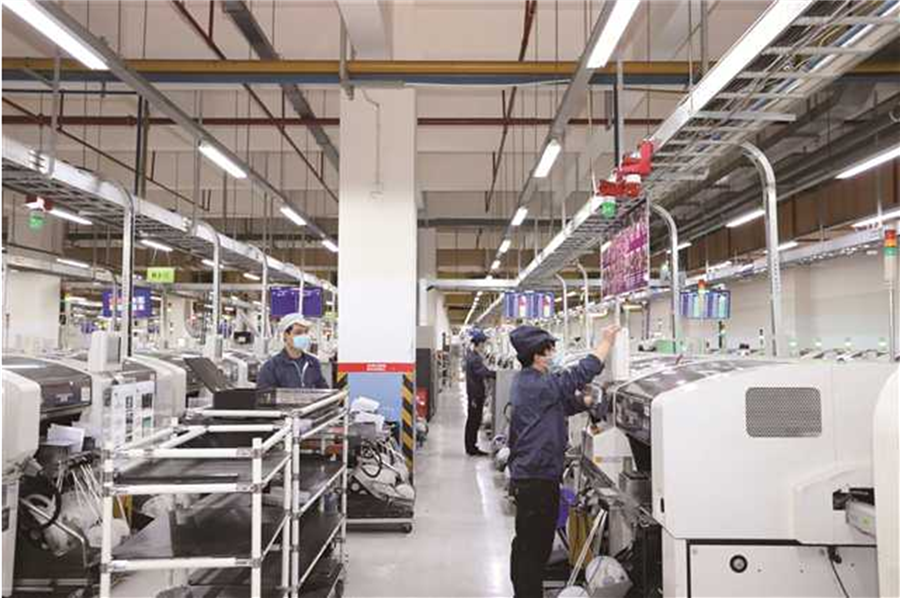
Inventec’s presence in China shows that the “China” component in China-Plus-One is not a passive legacy manufacturing base that can easily be shifted away, but rather an active, state-supported ecosystem that increasingly shapes firms’ capital allocation, technology development, and future market-orientation decisions.
Inventec: United States as a Plus-One Node
Inventec has had a long-standing supply chain diversification strategy that has gone hand in hand with the firm’s global expansion. In 2006, the firm opened a subsidiary in the Czech Republic to sell into the European market, and in 2007, it began operations in Mexico.[101] More recently, Inventec has diversified its supply chains more due to geopolitical factors. In the company’s 2024 annual report, Inventec’s highest-ranked risk was rising global trade protectionism and geopolitical risks.[102]
In interviews between President Trump’s election victory and inauguration, Inventec’s CEO, Jack Tsai, explained that Inventec would take a wait-and-see approach before deciding whether to build out production capacity in the United States or instead use one of Inventec’s many global locations to avoid high tariff costs.[103] In its 2024 annual report and based on other comments from Tsai, Inventec had stated that “[in order] to counter U.S. trade protectionism, [Inventec] is actively evaluating plans to establish production lines in the United States,” specifically mentioning Texas.[104]
Based on this evidence, Inventec’s SCM strategy can therefore be interpreted as more of a risk mitigation and global expansion sales strategy than a dedicated China-Plus-One strategy. But even if that is how Inventec has approached its SCM strategy, it is still operating within a China-Plus-One reality. This is seen most evidently in terms of China’s human capital hold on Inventec’s global talent flows.
Job postings indicate that Inventec relies heavily on Chinese nationals and China-based engineers to stand up and support Inventec’s global operations. For example, Inventec’s Shanghai and Chongqing subsidiaries have posted multiple hiring notices for intermediate and senior engineer roles to be based out of Shanghai or Chongqing but spend up to half the year in Mexico, with Chinese as the working language on-site.[105] The job responsibilities for these roles include directly assisting the head of Inventec’s Mexico subsidiary’s materials department and “standards creation and improvement,” which is important, as fixture and functional testing are crucial to manufacturing’s internal processes.[106] In 2025, Inventec’s Shanghai subsidiary posted hiring notices for an information and communication technology fixture maintenance engineer to “train new employees” at “overseas factories,” and a process engineer to “lead the introduction of new models into production” in Inventec’s Thailand or Mexico operations.[107]
In 2015, Tsai “insisted on sending a group of Taiwanese managers to Mexico,” which helped smooth out issues that Inventec was facing on the ground.[108] While Inventec’s Taiwan’s operations occasionally hire engineers to support overseas subsidiaries—such as a recent job posting from Inventec’s Taoyuan facility to support production line testing and training in Mexico, Thailand, and Shanghai—Inventec’s recent hiring trends show a distinct preference to send Chinese engineers to assist with processes in Mexico and Inventec’s other overseas businesses.[109] One exception was an international business-focused job posting for an engineer who could help with technical localization tasks in “North America, Europe, Japan, South Korea, Southeast Asia, and the Middle East.”[110] While the role explicitly called for a Taiwanese national with a U.S. visa, the role was to be based out of Inventec’s Shanghai subsidiary, once again showing human capital dependence on China.[111]
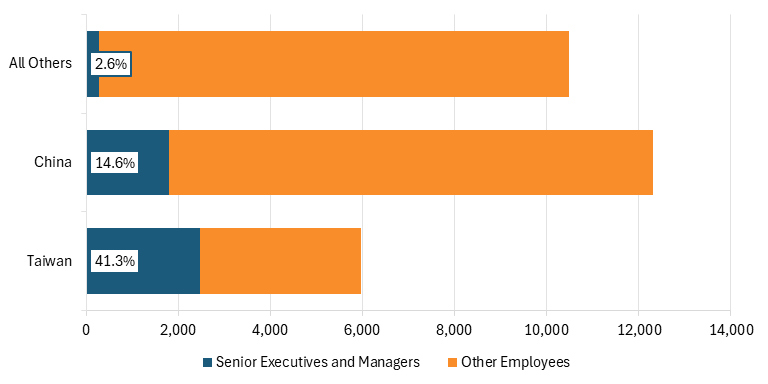
These hiring trends show that Inventec, whether due to lower costs of labor or other business-related decisions, is keeping critical know-how concentrated in China and, as a result, has partially designed its overseas operations—especially Mexico’s—to depend on China-origin engineering and technical support. While this is logical, considering Inventec’s manufacturing base is in China, it also shows that China’s model of creating stickiness in supply chains extends to talent chains as well. Data shows that Chinese nationals constituted a large share of executive positions within Inventec as of 2024, as seen in figure 11.[112]
Figure 11: Inventec employees by nationality and level of seniority, 2024[113]

More precisely, while Taiwanese nationals account for the strongest share of seniority in Inventec, at 41.3 percent, Chinese nationals are far and away in second place. As seen in figure 12, 14.6 percent of Chinese Inventec employees were senior executives or managers in 2024, compared with approximately 2.5 percent for all other nationalities.
There are three likely explanations for this. First is influence resulting from PRC strategic supply chain stickiness. The second is path dependency, as a result of Inventec having outsourced to China longer than to other countries. As scholar Yaping Gong noted, an overseas subsidiary’s “longer operation reduces agency costs, deepens local isomorphism, and therefore decreases reliance on expatriate parent country nationals.”[114] Gong also touched on the third explanation, which is cultural and linguistic overlap between Taiwan and China, stating that “[as] cultural distance increases, complete and accurate information about subsidiary actions and performance becomes more difficult and expensive to obtain.”[115]
Figure 12: Inventec senior executives and managers as share of total workforce by nationality, 2024[116]
Whether Inventec will continue such management and human capital trends for its U.S.-based operations remains to be seen. In April 2025, Inventec’s board approved a plan for an $85 million expansion of its operations in the United States, which until that point were largely limited to a service and distribution center in California with 16 employees.[117] Other reporting has suggested that Inventec’s U.S. expansion could be as high as $251 million and create as many as 2,353 new jobs.[118] So far, the expansion has completed phase one and is currently in phase two.
Based on early evidence, Inventec’s U.S. expansion looks much like its other overseas nodes, including Mexico, Malaysia, and beyond: a “China-plus-many” model in which critical engineering and process knowledge remains anchored in China.
Phase one of the investment occurred between September and October 2025, and retrofitted 39,390 square feet in an “interior remodel of open warehouse to electronic component assembly” of a 540,000 square foot prior bulk distribution center and factory that Inventec is leasing.[119] From that description, phase one looks to have built out final assembly capacity to serve the U.S. market and mitigate tariffs; in May 2025, Inventec stated that its new plant in Texas would assemble its B300 server “in order to comply with the ‘Made in America’ policy and in accordance with commitments to investment and procurement amounts” and be ready to ship to U.S. customers by Q1 of 2026.[120] It is unclear how this will intersect with Inventec’s Mexican subsidiary, which according to Taiwanese reporting, produces complete machine assembly and system testing of its back-end L10 servers and already sells tariff-free into the U.S. market.[121]
Phase two, which began in October 2025, is expected to cost $50 million and is projected to be completed in June 2026.[122] Phase two plans to renovate and alter 216,950 square feet of the Houston-area facility, and coupled with its nine-month timeline, is likely to be more advanced and build out more upstream processes than phase one.[123] Phase two’s description vaguely describes the project as focused on “computer assembly,” so it is an open question what products Inventec will ultimately manufacture in its new Texas facility.
Based on this early evidence, Inventec’s U.S. expansion looks much like its other overseas nodes, including Mexico, Malaysia, and beyond: a China-Plus-Many model in which critical engineering and process knowledge remains anchored in China. With higher labor costs and relatively higher techno-economic objectives in the United States, it remains to be seen how far up the value chain Inventec’s Texas facility will go, and whether the investment will rely on China-origin talent for standards setting and other manufacturing inputs. From a U.S. geopolitical and policy standpoint, Inventec’s inbound investment is a success, but when evaluated within the China-Plus-One paradigm, the investment currently looks like another node in Inventec’s China-dependent value chain.
Inventec: Firm and Taiwan’s Stakes
Inventec faces significant risk from its deep exposure to China, especially in terms of human capital. From the perspective of Taiwan’s government, this risk is less than ideal for the health of Taiwan’s contract manufacturing sector. China is increasingly innovative in global display and other industries within which Inventec and other Taiwanese contract manufacturers compete.[124] China’s growing strength in contract manufacturing and Taiwanese firms’ China dependence risk test the long-term resilience of Taiwan’s contract manufacturing industry.
Resonac
Resonac is a Japanese chemical company whose legacy traces back to the founding of Showa Denko in 1939.[125] In 2023, Showa Denko and its subsidiary Showa Denko Materials merged to create Resonac.[126] The company’s market capitalization as of January 2026 was approximately $8 billion.[127]
Resonac: China as the Manufacturing Base
In a December 2025 interview, Resonac’s CEO, Hidehito Takahashi, stated that the company is “ring-fencing China” by on one hand increasing production capacity in China to meet the PRC’s push for a domestic semiconductor supply chain and simultaneously attempting to lower reliance on Chinese rare earths.[128] Despite this dual-track approach, Resonac remains strongly dependent on China.
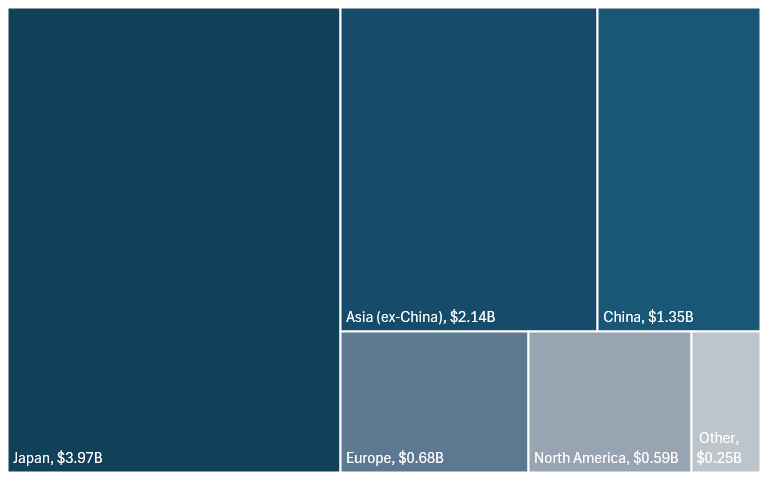
In terms of revenue, Resonac’s sales revenue from the Chinese market was approximately $1.35 billion in 2024, which accounted for approximately 15.1 percent of Resonac’s total 2024 sales revenue, as seen in figure 13.[129] That figure was up from 13.5 percent total 2023 sales to China’s market, which maps to Takahashi’s comments on recent opportunities in China.[130]
Figure 13: Resonac’s sales revenue by region, 2024 ($9 billion, total)[131]
Resonac maintains a dense manufacturing footprint across China, with 20 of its 59 global subsidiaries based in China and Hong Kong as of 2026.[132] Some of these subsidiaries are deeply embedded local suppliers that have only limited exports to the rest of Resonac’s global markets. For example, the subsidiary Resonac Materials (Dongguan), which specializes in the manufacturing of dry film photoresist, was selling more than 90 percent of its output domestically into China’s market as of 2024.[133]
Other Resonac China-based subsidiaries, such as Resonac Materials (Suzhou), both supply China’s market and are key cogs for Resonac’s global supply chain. The state-operated industrial park that hosts Resonac Materials (Suzhou) referred to the subsidiary in February 2025 as the “globally most important manufacturing base for semiconductor packaging materials and photosensitive dry film products.”[134]
In terms of human capital, in 2024, Resonac employed 2,747 employees in China, approximately 11.5 percent of its global labor share. That figure is in line with a multiyear relative downsizing of labor share to Resonac’s China-based businesses, in contrast to a growing share of Japan-based employees, as seen in figure 14.[135]
Figure 14: Resonac labor share by region, 2022–2024[136]
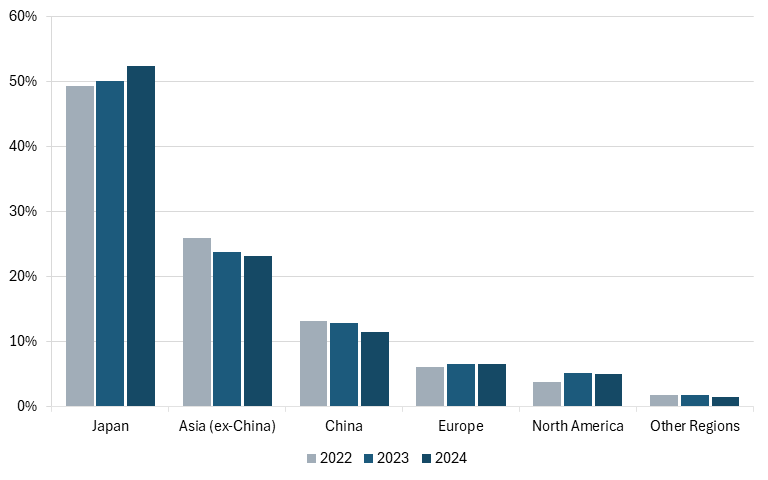
This data paints a picture that Resonac’s operations in China are important for the company’s global production but only offer a solid market foothold amid a slowly shrinking relative share of global employee headcount. But Resonac is strongly dependent on China for producing and maintaining its IP. As seen in figure 15, Resonac filed approximately 1,072 patents to the World Intellectual Property Organization between 2023 and 2026, of which approximately 30 percent—319 patents—were filed in China, only surpassed by 37 percent, or 393 patents, filed in Japan.[137]
Figure 15: Resonac published patents by region, 2023–2026 (1,072 filings, total)[138]

Quantity of patents does not always translate to quality or necessarily represent innovation.[139] But in Resonac’s case, qualitative data points to the company holding significant sectoral IP competitiveness through its patent base in China. For example, in 2024, the PRC government entity Shanwei Municipal Administration for Market Regulation published an “Early Warning Briefing” of patents within what the PRC calls the “new materials” industry and highlighted Resonac’s China-filed patent “Photosensitive resin composition and manufacturing method thereof” as a “top 10 most valuable patent” within the new materials sector.[140] Furthermore, Resonac has a strong track record of weaponizing its patents defensively, and places strong importance on the Chinese patent ecosystem, with the company’s Intellectual Property Department internally having a “high demand for translating Chinese patents.”[141]
While Resonac has comparatively less human capital tied up in China than Inventec does, it remains highly dependent on China for key IP and know-how. This is unlikely to change moving forward. As a senior executive at one of Resonac’s China subsidiaries wrote in September 2025, “[Resonac is] optimizing its local production and consumption system in China and deepening its presence in the high-value-added markets for mobility materials and innovative materials.”[142]
Resonac: United States as a Plus-One Node
Resonac’s presence in the U.S. economy is limited and deliberately cautious. With a few small exceptions, Resonac’s U.S. activities are concentrated in research collaboration, sales, and customer interface rather than standalone manufacturing.[143] The company has no large-scale U.S. production facilities for its core semiconductor materials, including photoresists, epoxy molding compounds, or other materials used in the semiconductor back-end process.[144]
Resonac’s main footprint in the U.S. economy in recent years has come in the form of creating or joining numerous consortia, rather than significant capital expenditure. In July 2024, the company launched US-JOINT, a consortium of five Japanese and five U.S. companies working together with the shared goal “to collaborate on next-generation semiconductor packaging in Silicon Valley.”[145] As Resonac CEO Takahashi wrote in 2025, US-JOINT will lead to “building interfaces with businesses we have had limited interaction with,” acknowledging that Resonac has not historically focused significantly on the U.S. market.[146] The consortium also plans to establish an R&D center in Union City, California, to be fully operational in 2025, but as of 2026, US-JOINT has yet to announce whether the R&D center was built, despite the consortium having grown to include 12 companies.[147]
In September 2025, Resonac announced the establishment of JOINT3, “a co-creation evaluation framework formed by a consortium comprising Resonac and 26 other companies from Japan, the United States, Singapore, etc.”[148] This followed Resonac’s pre-merger predecessor company, Showa Denko Materials, having created a Japan-based consortium, JOINT2, in 2021.[149] In 2025, Resonac CEO Takahashi wrote that the reason why Resonac is well-placed to form and lead consortia such as US-JOINT, JOINT2, and JOINT3 is the company’s vertical integration: “We offer a lineup that covers approximately 80%, presumably, of the key semiconductor back-end process materials.”[150]
In November 2023, Resonac joined a consortium of semiconductor-related manufacturers hosted by The University of Texas at Austin and named Texas Institute for Electronics (TIE), which has the goal “to advance the roadmap of cutting-edge semiconductor systems by five years, and to develop them in the United States.”[151] In 2024, the Defense Advanced Research Project Agency (DARPA) selected TIE “to develop the next generation of high-performing semiconductor microsystems for the Department of Defense,” with the Department of War (DOW) and State of Texas funding TIE with a combined investment of $1.45 billion.[152] Resonac is one of seven strategic partners in TIE, with it and Canon being the only Japanese firms.[153]
Ventures such as US-JOINT, JOINT3, and TIE are safe and beneficial choices for Resonac from a China-Plus-One perspective. They promise to help the company access U.S. talent, IP, and government funding, and also are low cost since they are in collaboration with other firms, are mostly focused on R&D, and allow Resonac to test the waters before making any more capital-intensive investments. At the moment, Resonac is employing a tentative China-Plus-One strategy: The same vertical integration that Resonac claims helps it lead consortia rests on a significant share of tightly coupled manufacturing, testing, and human-capital capabilities that remain concentrated in China.
CEO Takahashi said in February 2025 that the company “is not currently considering manufacturing materials in the United States,” something he said would only change with a notable increase in U.S. demand.[154] Taken together, Resonac’s intent is clear: It is willing to invest time, expertise, and limited capital in U.S.-based R&D ecosystems but remains unwilling to commit to high-value manufacturing in the United States—in the process, likely shifting more production out of China—absent stronger demand and clearer policy signals.
Resonac: Firm and Japan’s Stakes
Resonac’s 2025 annual report provides insight into how the company evaluates China risk. Resonac revealed that the company views the “disruption of global markets due to the acceleration of U.S.-China economic security policies” as one of its highest-tier risks.[155] Specifically toward China, Resonac listed “[e]xport restrictions on China are expanded to include not only semiconductors and their manufacturing equipment and technology, but also semiconductor materials” as its primary China-related risk.[156] Resonac additionally launched a team dedicated to U.S.-China decoupling in 2023.[157] While Resonac surely evaluates other China-related risk internally, it is notable that the only publicly-listed China country-level risk is vis-à-vis U.S. policy, and does not mention China-policy-related risks, outside a formulated Taiwan contingency evacuation plan that does not mention China.[158]
However, Resonac’s IP strength in its China operations has created significant risk for the company. Two lawsuits show how Resonac faces intense IP theft and regulatory risk in China’s market that threaten its long-term market share prospects.
In December 2023, Resonac and its subsidiary Resonac Materials (Dongguan) filed a patent infringement lawsuit in the Shenzhen Intermediate People’s Court.[159] The lawsuit sought “an injunction against the sale in China of photosensitive films manufactured and sold by” four Chinese photosensitive film firms that Resonac claimed infringed upon “a Chinese patent held by the company relating to photosensitive films.”[160]
Three months before Resonac filed the patent infringement lawsuit, one of the four named co-defendants changed its name from Hunan Wujo High-Tech Materials to Hunan Initial New Materials (Initial NM).[161] In 2021, a local PRC government profiled Initial NM, lauding the company for having helped China “overcome a critical ‘bottleneck’ technology, contributing to the security of the national electronic information industry chain” after the company successfully produced a photosensitive dry film for integrated circuit (IC) packaging substrates. The article went on to note that, before Initial NM’s breakthrough, “dedicated photosensitive dry films [had only been] produced in countries such as the United States and Japan.”[162] The bottleneck mention was in reference to a PRC Ministry of Education summary of 35 different bottleneck technologies that a Chinese government-run newspaper published in 2018.[163]
Around the time of Resonac’s patent lawsuit, Initial NM had what one journalist described as “a concentrated burst of 15 patent grants that was obtained [by Initial NM] between 2024 and September 2025.[164] As of 2024, Initial NM’s global market share for photosensitive dry film was 13.2 percent, making it the lead Chinese firm in the sector, and third globally behind Taiwanese firm Eternal Materials and the global leader Resonac.[165] According to WireScreen, 18.1 percent of Initial NM’s ownership can be traced back to state entities, with the PRC State Council itself indirectly holding a 3.7 percent share of the company.[166]
Of the other three Chinese firms that Resonac named as codefendants, one is closely related to Initial NM, with executives from the same Chinese family, the Xiaos, and shared supply chains, patents, and financing.[167] Another company, Shenzhen Technology Trust Precision Industry (TTST), is 9.4 percent PRC state-owned and also is 3.3 percent indirectly owned by China’s leading domestic chipmaker, Semiconductor Manufacturing International Corporation, according to WireScreen.[168] In 2024, TTST began exporting its products—which include equipment and machinery used for IC substrate and related dry film processes—to Taiwan, Japan, and South Korea.[169]
As of 2026, Resonac’s patent lawsuit remains unresolved. However, the precedent for enforcing IP in China as a foreign multinational firm is not in Resonac’s favor. Nor does Resonac’s own historical precedent provide much optimism. Showa Denko Materials, one of the two firms that merged to create Resonac in 2023, filed a patent infringement lawsuit in China against Beijing Kehua New Materials (Scienchem) for its white epoxy molding compounds in 2021.[170] Showa Denko Materials requested Scienchem cease infringement and provide compensation for economic losses, but Scienchem challenged the patent with the PRC National Intellectual Property Administration (CNIPA).[171] In January 2022, CNIPA invalidated Showa Denko Materials’ patent entirely.[172] Five years later, the legal case has now moved to the PRC’s Supreme People’s Court, with no resolution in sight, leaving Resonac, as the post-merger successor company to Showa Denko Materials, responsible for pursuing two unresolved patent infringement lawsuits.[173]
Like Initial NM and TTST, Scienchem is PRC state owned: the Institute of Chemistry, Chinese Academy of Sciences (ICCAS) founded the company with the goal to develop the PRC’s domestic epoxy molding compounds capabilities, and according to WireScreen, ICCAS owns 41.9 percent of Scienchem.[174] As of 2026, Scienchem has grown continuously, and its subsidiary, Zhongke Kehua, is applying for an initial public offering (IPO) on China’s Shanghai Stock Exchange STAR Market.[175]
Resonac’s two ongoing IP disputes underscore the persistent risk faced by foreign multinational firms operating in China, and particularly those—like Resonac—with technology that China still cannot manufacture domestically.
In Zhongke Kehua’s IPO prospectus, the company identifies Resonac as a key competitor in the epoxy molding compounds sector, writing that “the global mid-to-high-end epoxy molding compound market remains dominated by two Japanese manufacturers” (Resonac, as well as Japanese company Sumitomo Bakelite).[176] Zhongke Kehua went on to write:
The company’s mid-range products have successfully replaced Japanese competitors, and its supply volume to multiple customers has surpassed that of Sumitomo Bakelite and Resonac. While the company’s high-end products can now replace Japanese competitors, the product introduction cycle remains lengthy due to factors such as customer Product Change Notification procedures. It is anticipated that large-scale replacement will gradually be achieved in the future, driving business growth.[177]
Resonac’s two ongoing IP disputes underscore the persistent risk faced by foreign multinational firms operating in China, and particularly those—like Resonac—with technology that China still cannot manufacture domestically. These disputes and the state-backed competitive environment illustrate why the China component of China-Plus-One is both strategically essential and operationally risky for Resonac. On one hand, Resonac is competing to stay ahead of Chinese, state-backed competitors such as Zhongke Kehua. From Resonac’s perspective, its incremental approach to offshoring from China is rational. Relocating more production from its established Asian facilities, especially those such as Resonac Materials (Dongguan) that are already tightly integrated into customer supply chains, would impose significant risks.
On the other hand, Resonac is bleeding valuable IP that is likely ending up precisely with competitors such as Zhongke Kehua. As a long-term threat that is unlikely to show up on quarterly balance sheets, that risk is most concerning not for Resonac, but for Japan’s government, which needs to ensure the long-term health of its domestic but globally connected semiconductor packaging and chemistry sectors.
LS C&S
LS C&S is a subsidiary of the South Korean conglomerate LS Corp and primarily manufactures energy, industrial cable, and telecommunications products.[178] LS Corp was listed at 1,830 in the 2025 Forbes Global 2000 ranking with a $2.41 billion market value.[179]
LS C&S: China as the Manufacturing Base
At a high level, LS C&S’s footprint in China appears no larger than other countries in which LS C&S has operations. The company operates two large manufacturing subsidiaries in China, LSHQ in Hubei province and LSCW in Jiangsu province, as well as four sales offices.[180] LS C&S has two manufacturing plants in Indonesia and Vietnam, so rather than a China manufacturing hub with global spokes, it would appear that China is just one of many diversified supply chain nodes LS C&S has globally. While LS C&S relies on Chinese suppliers of specialty materials at the process level, it is not particularly reliant on China as an overall source of upstream suppliers.[181] In 2024, LS C&S purchased approximately $37 million of goods and services—including commodities, raw materials, construction services, manufacturing, and equipment—from China, amounting to a mere 1.6 percent of its total global purchase amount.[182]
Yet, this assessment understates the strategic importance of LS C&S’s China operations to the company’s bottom line for two reasons: LS C&S’s two manufacturing plants in China are without a doubt the heart of its global production capabilities, and China is a huge and important market to LS C&S.
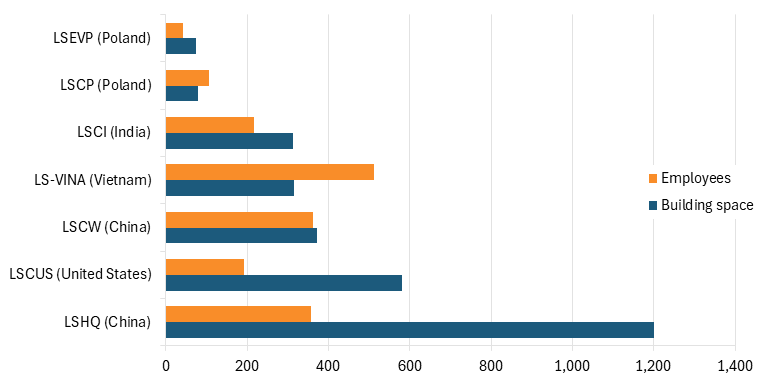
As of 2019—the last year LS C&S published data on its subsidiaries’ employee count and building area—the company’s China-based subsidiary LSHQ was far and away the largest manufacturing facility out of any LS C&S global subsidiary.[183] As seen in figure 16, LSHQ is a massive plant at 1,200,713 square feet of building area, despite having fewer employees than other, smaller manufacturing subsidiaries.[184]
Figure 16: LS C&S global subsidiaries by numbers of employees and thousands of square feet, 2019[185]
LSHQ is one of LS C&S’s most technologically sophisticated global subsidiaries. Established in 2009 as a Chinese-foreign joint venture through LS C&S’s acquisition of a controlling stake in the former state-affiliated Hubei Red Flag Cable Factory, LSHQ combines legacy PRC industrial capabilities with LS C&S’s proprietary cable technologies.[186] LS C&S framed the deal as “glocalization,” and indeed, over the years, the acquisition allowed LS C&S to increase its institutional roots, workforce continuity, and access to national infrastructure projects in China.[187] As of 2026, according to WireScreen, LS C&S holds a 92.7 percent direct share of LSHQ in 2026, with the PRC state-affiliated China Citic Financial Asset Management Company Limited owning the remainder.[188]
LSHQ, as of 2019, operated advanced production lines for ultra-high-voltage (220kV–500kV) cables, submarine power and fiber-optic composite cables, and DC transmission systems. LSHQ is one of only a handful of manufacturers in China capable of producing ultra-high-voltage and submarine cable systems at scale, making it central not only to LS C&S’s China strategy but also to its global high-end cable portfolio.[189] LSHQ additionally “attaches great importance to the development of overseas markets,” seen most clearly in its successful bid in 2019 for a substantial project in Ecuador.[190]
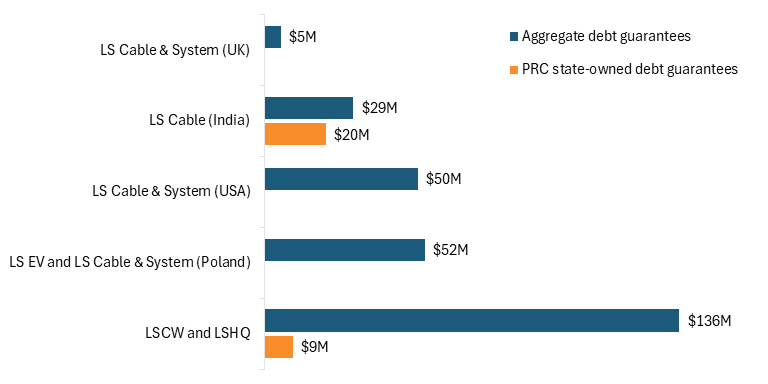
Debt guarantee data also shows how LS C&S’s global scale of operations tilts toward its China subsidiaries. In 2020, LS C&S financed LSCW and LSHQ with an aggregate total of approximately $135.8 million in debt guarantee, with coverage extending through 2021.[191] As figure 17 illustrates, this amount disproportionately exceeded the capital that LS C&S directed toward other global branches between late 2019 and late 2020. While the COVID-19 pandemic likely influenced these figures, they overall correlate to a strong operational dependency on China. LS C&S channeled much of this funding through South Korean policy and commercial banks, with PRC state-owned banks holding approximately 11 percent of LS C&S’s total debt guarantees during this stretch, with much of that exposure directed to LS C&S’s India-based subsidiary.[192]
Figure 17: Debt guarantee financing, LS C&S global subsidiaries, 2019–2020[193]
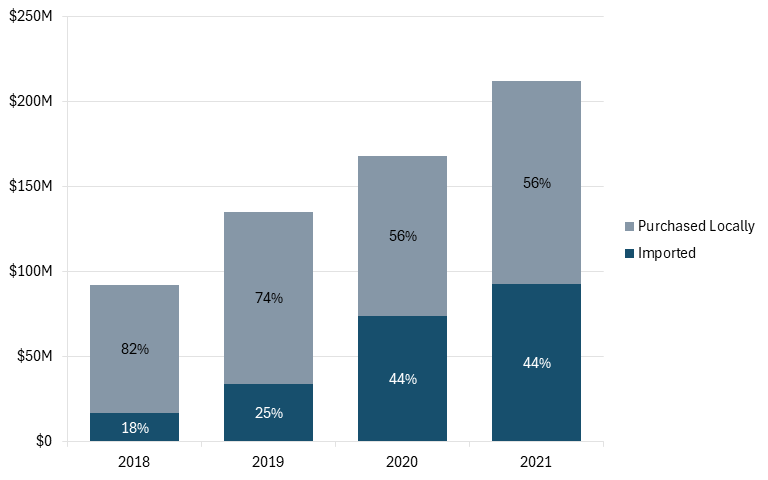
Between 2018 and 2021, LS C&S’s China subsidiaries appeared to grow in scale. As seen in figure 18, LSCW and LSHQ steadily increased their procurement of raw materials.[194] Additionally, the share of raw materials imported into China versus sourced locally rose from 18 percent in 2018 to 44 percent in 2020 and 2021.[195] Although LS C&S has not released comparable granular data since 2021, the upward trajectory of material imports indicates an aggressive expansion of either manufacturing scale, technical complexity, or both.
Figure 18: LS C&S raw materials procurement in China-based subsidiaries, 2018–2021[196]
Second, LS C&S has long viewed China’s market opportunity as important to the company’s future fortunes. In 2010, the company predicted that “China will be a key market to realize our vision of becoming the global No. 1 cable manufacturer.”[197] While LS C&S does not publish region-specific revenue data, it appears to have been successful in the Chinese market for two reasons. The first is it understands how to compete in China’s market. For example, in 2016, LS C&S partnered with the state-owned Chinese electric vehicle (EV) company BAIC Group to supply it with EV harnesses.[198] An LS C&S executive, Jae In Yoon, said at the time, “[W]e were able to be selected as a partner, beating out major Chinese electrical equipment companies, by quickly providing products that reflect customer requirements.”[199]
LS C&S has also likely beaten out Chinese competitors at the highest levels in China. In 2015, the National People’s Congress (NPC) Procurement Center—the centralized procurement body serving China’s national legislature—awarded LSHQ a contract for approximately $475,000 to supply power cables for the Great Hall of the People.[200] Although the tender did not disclose competing bidders, a contemporaneous government-backed cable procurement in 2015 shows LSHQ as the only foreign multinational among 14 bidding cable companies, suggesting that LSHQ prevailed over domestic suppliers.[201] Given that the Great Hall of the People is the seat of the NPC and one of the PRC’s most politically sensitive government facilities, LS C&S’s selection indicates a high degree of technical credibility and institutional trust.[202]
LS C&S is also embedded within China’s technical standards ecosystem. LSHQ has served as a drafting organization for multiple PRC national cable standards for insulation types, voltage classes, testing protocols, and tolerances.[203] The PRC often modifies these standards to adopt international norm bodies’ standards—such as the International Electrotechnical Commission’s 60502-1—but localizes them under national PRC standards committees.[204] Acting as a drafting unit goes well beyond passive compliance and puts LSHQ in a position to be involved in, and also influenced by, the technical rulebook governing China’s cable market.[205]
While LS C&S’s overall manufacturing footprint and global supplier network appear more diversified than Inventec’s and Resonac’s, its China-based subsidiaries remain central to the company’s global production capabilities, technical know-how, and standards ecosystem, making the firm still substantially dependent on China.
LS C&S: United States as a Plus-One Node
LS C&S’s U.S. investments are sizable, ambitious, and illustrative of what successful China-Plus-One investment can look like when the United States is the plus-one recipient nation.
Over 2024 and 2025, LS C&S announced three major new investments in the U.S. economy. First was a 750,000-square-foot submarine power cable manufacturing factory to be operated by the U.S. subsidiary LS GreenLink, which the company announced in July 2024 and broke ground on in April 2025.[206] The factory, a rendering of which is shown in figure 19, will be located in Chesapeake, Virginia, will cost approximately $681 million, and is expected to create 330 new jobs.[207] The project stands to benefit from substantial public support, including $99 million in IRA tax credits, $48 million in Virginia state-level subsidies and tax relief, and $13.2 million for Chesapeake to assist the project.”[208]
Figure 19: LS GreenLink Chesapeake, Virginia, facility, rendering[209]

LS C&S announced its second major new investment in November 2025, stating that it had secured a $345.3 million, three-year contract with an unnamed U.S. tech company “to supply high-capacity power distribution systems to artificial intelligence data centers.”[210] This announcement is light on details, but dovetails with LS C&S’s multi-year effort to embed itself within the U.S. data-center power ecosystem. In November 2025, LS C&S separately appointed Empire Electric Sales as its representative in northern California, explicitly citing the region’s “explosive data center growth due to AI and cloud computing.”[211]
The third investment is an additional factory in Chesapeake that is expected to cost $689 million, create 430 new jobs, and produce copper rods, magnet wires, and rare earth magnets.[212] Both Chesapeake and LS C&S will have access to relatively modest public subsidies to assist the project.[213] However, LS C&S and the state of Virginia had slightly different messages during the announcements of the project. On December 12, 2025, Virginia governor Glenn Youngkin announced “plans for a significant additional investment,” while on December 15, 2025, LS C&S announced that it “is reviewing the feasibility of the project, and has formally begun cooperation discussions with the State of Virginia,” with a representative adding the qualifier, “if the business becomes a reality.”[214] LS C&S has started marketing employment at its new Virginia investments to potential South Korean national employees.[215]
From a U.S. perspective, these three investments are unequivocally positive. LS C&S appears to be taking as many precautions as possible to make sure its localization into the U.S. economy goes smoothly. For its submarine cable factory, LS GreenLink is hiring a bilingual “Organizational Development Specialist (Cross-Cultural Integration)” who can “serve as a bridge between [South] Korean headquarters and U.S. operations” and “support [South] Korean expatriates in adapting to the U.S. business environment and help local employees understand [South] Korean business culture.”[216]
U.S. policy, however, threatens the investment’s potential. LS C&S’s initial plan to build the submarine cable factory occurred under the Biden administration and IRA framework.[217] The state of Virginia and LS C&S framed the investment purely in terms of clean energy potential, with the facility’s future subsea cables planned to transmit electricity generated from offshore wind farms to onshore grids.[218] President Trump has consistently expressed skepticism toward offshore wind projects and, in 2025, reversed policy aimed at increasing U.S. wind capacity.[219]
In contrast, in 2025, Virginia governor Youngkin said that LS C&S’s more recent, rare earths factory investment “will create a new and growing domestic supply chain … that bypasses the monopoly of Chinese suppliers,” and directly mentioned rare earth dual-use functionality.[220] LS C&S has also adapted its language toward how it discusses its U.S. investment, for instance, noting in March 2025 that its subsidiaries do not use Chinese aluminum or copper in its supply chain.[221] Speaking about U.S. tariff risk, LS C&S president Koo Bon-kyu said in April 2025, “Can we de-risk everything? No, but I think we can de-risk quite a lot of it.”[222]
LS C&S appears ready to adapt its U.S. investments to evolving policy conditions, and it is positive that, with the new administration’s direction in the United States, its three investments have increasingly considered China-related supply chain risks. In this, LS C&S sees opportunity, stating in March 2025 that the U.S. government’s “China phase-out” policies are helping LS C&S and other LS Corp subsidiaries in “their conquest of the U.S. market.”[223]
Still, continued policy volatility could prompt the company to reassess the scale and timing of future projects. While LS C&S’s U.S. investments are massive, it is still reserving some capacity. LS GreenLink is developing approximately half of the 96-acre site it purchased to build a submarine cable factory, but the company is “reserving the remainder for future phases of development,” which the company has said will allow it “to expand its production capacity and technological capabilities in response to evolving global infrastructure requirements.”[224] Those “global infrastructure requirements” will likely depend, in part, on U.S. policy direction.
If fully realized, LS C&S’s Chesapeake investments would localize manufacturing processes and supply chain capabilities that China has recently dominated, while embedding the company within U.S. energy and AI ecosystems.
Taken together, LS C&S’s U.S. investments largely align with the conditions under which the United States can “win” China-Plus-One in this context. The company’s projects target advanced, high-fixed-cost infrastructure sectors where scale, reliability, and industrial know-how matter more than low-cost assembly. If fully realized, LS C&S’s Chesapeake investments would localize manufacturing processes and supply chain capabilities that China has recently dominated, while embedding the company within U.S. energy and AI ecosystems.[225]
LS C&S: Firm and South Korea’s Stakes
LS C&S is attempting to hedge between market opportunities and other benefits to its presence in China while simultaneously diversifying and expanding its international business ambitions. It is a narrow line to walk.
More so than Inventec or Resonac, open source documentation points to LS C&S gaining benefit after benefit within the Chinese market, perhaps due to the institutional trust that allowed it to win a sensitive PRC contract in 2015. LS C&S gets preferential access to financing from banks and state-backed programs.[226] LS C&S appears to be involved in the PRC’s Belt and Road Initiative.[227] The company enjoys hundreds of millions of renminbi in government subsidies on a consistent basis, from reward subsidies to disaster relief to insurance facilitation.[228] China’s government rewards LS C&S China subsidiary executives for “maintain[ing] a firm and long-standing friendly stance towards China.”[229] The Yichang Municipal Bureau of Economy and Information Technology has “provid[ed] cable demand information to facilitate production and sales connections” to LS C&S.[230]
At the same time, LS C&S is pivoting strongly toward the United States. Its investments far outsize Resonac’s various consortia and even Inventec’s sizeable Texas-based factory. LS C&S has sizeable investments in many other regions, but they do not compare in scope to its U.S. investments, making the company’s approach truly China-Plus-One. These investments go beyond business decisions, showing a geopolitical tilt; while there is no evidence that it has taken place on U.S. soil, LS C&S participated in the U.S. defense-industrial base in 2023, with the U.S. Navy awarding LS C&S $41,175 to repair a ship in South Korea.[231]
There are signs that LS C&S’s hedging could be untenable. The most unpredictable part of the equation is how the PRC will react to LS C&S’s substantial investment plans in the United States. Early signs show that LS C&S’s moves are causing alarm in China. One example is the Ningbo Magnetic Materials Association, which is a trade association representing over 200 Chinese rare earth member companies with a mandate “to reflect the industry’s wishes and demands to relevant government departments, and to investigate and study major issues within the industry.”[232] The association regularly publishes “warning notices” concerning U.S., Japanese, Australian, and other U.S. allied nations’ developments on building independent rare earth supply chains.[233] In August 2024, the association posted a warning notice in the form of a reposted article that LS C&S had signed a commercial agreement with the Republic of Korea’s (ROK’s) Export-Import Bank of Korea to contribute to ROK’s “economic security.”[234] In December 2025, the association posted another warning notice concerning LS C&S’s rare earth investment in Virginia.[235]
There are other signs of cracks. The city of Wuxi’s government selected LSCW for random inspections at a sustained and repeated rate between 2020 and 2025 at least nine times.[236] In 2011, LS C&S established an R&D center in Wuhan, Hubei Province, with the company stating that the center’s “greatest strength” was access to Wuhan’s “highly skilled professional workforce.”[237] In 2022, the Hubei Provincial Development and Reform Commission posted a list of “Hubei Provincial Enterprise Technology Centers that have been revoked.”[238] LS C&S’s R&D center was listed as one of those revoked centers, with the only explanation given being that they were “unqualified.”[239]
For LS C&S’s part, the company seems unfazed, at least publicly. It frames China risk mostly through market competition, writing in 2021 that “competition for general products is fierce among small and medium-sized wire and cable companies, and this competition is intensifying due to the growth of these SMEs and the expansion of overseas companies, particularly from China.”[240]
In 2022, LS Corp representatives “stated that while the escalating U.S.-China trade dispute has led to difficulties such as increased tariffs on U.S. exports and restrictions on raw material imports, LS Corp will continue to collaborate with local businesses and further strengthen its business in China, including new renewable energy and EV components, through government policy cooperation.”[241]
Taken together, LS C&S is walking an increasingly fine line between market opportunity and strategic exposure in China. As the firm pivots toward large, geopolitically salient investments in the United States, this hedging strategy may not remain cost free. There is currently little open source evidence that LS C&S has experienced patent infringement attacks such as Resonac has experienced in China. The scale, sensitivity, and policy alignment of LS C&S’s U.S. investments raise broader questions for South Korean policymakers. From an economic security perspective, LS C&S’s exposure to potential PRC retaliation, regulatory pressure, and informal discipline warrants closer attention from Seoul as LS C&S’s China-Plus-One strategy begins to collide with China’s own red lines.
An Example of the Right Company to Target
Fortune Electric is a Taiwanese manufacturer of power distribution equipment, including high-voltage transformers important for AI data centers.[242] In 2025, the company secured a Project Stargate contract worth approximately $63 million, becoming the first Taiwanese firm to participate in the initiative.[243] The company subsequently obtained a second Project Stargate order in October 2025, which it is currently negotiating.[244] These deals are opportune for the company, with 80 percent of its exports targeting the U.S. market and transformer orders tied to the broader Project Stargate buildout and other demand exceeding approximately $3.8 billion as of late 2025.[245]
Like Inventec and other Taiwanese multinationals, Fortune Electric entered China decades ago, first opening a branch in Wuhan in 2002.[246] Fortune Electric initially struggled to enter the Chinese market, but by 2006, PRC provincial and local Taiwan Affairs Offices had assisted the firm in identifying sales targets, including to the Hubei Electric Power Company, a fully state-owned enterprise according to WireScreen.[247]
As its China subsidiary became profitable, Fortune Electric grew increasingly embedded in China’s industrial ecosystem.[248] Fortune Electric’s former chairman, Sun Shiming, chose to gradually replace the subsidiary’s Taiwanese managers with Chinese employees due to lower wage costs, offsetting lower pay for Chinese nationals with exchange programs at Fortune Electric’s Taiwan headquarters.[249] This trend continued until only Sun and one vice president remained the only Taiwanese nationals in senior oversight roles at the Wuhan subsidiary.[250] By 2015, the subsidiary had established recruitment and training programs with nearby educational institutions, and by 2019, a local Taiwan Affairs Office was helping Fortune Electric market its products through China’s Belt and Road Initiative.[251]
At its peak operations in China, Fortune Electric had effectively made Wuhan its manufacturing base. The Wuhan subsidiary employed approximately 200 workers, operated two downstream subsidiaries of its own, had received full technology transfer from its Taiwan-based parent company, and produced approximately 3 million kilovolt-amperes (kVA) of transformer capacity annually.[252]
This trajectory reversed in the early 2020s. The Wuhan Municipal Government designated the subsidiary’s land as commercial property and required Fortune Electric to relocate its factory.[253] The local government reclaimed the subsidiary’s 443,264 square foot site “to revitalize land resources” and Fortune Electric sold its entire stake in its Wuhan-based subsidiary to a Chinese real estate company.[254] In January 2023, Fortune Electric repatriated $6.06 million to Taiwan, barely recovering its original $6 million investment, and by the end of 2024 maintained only a single, small subsidiary in China’s market.[255]
The PRC government provided relocation compensation and initially approved Fortune Electric to reclaim land use rights following the redistricting, and Taiwanese coverage of the event stated that Fortune Electric “will not withdraw from the mainland market.”[256] In 2024 and 2025, Fortune Electric obtained construction and planning permits for a replacement facility.[257] Yet, China’s government stalled these efforts with a series of administrative and regulatory setbacks, for example, canceling Fortune Electric’s original licenses due to personnel noncompliance during the relocation.[258] There are indications that the acquiring real estate firm has ties to Fortune Electric, as the companies share a partial beneficial owner, according to WireScreen.[259] This leaves open the theoretical possibility of a future reentry, but taken together, it appears likely that Fortune Electric’s near-total exit from China’s market was not a voluntary business decision, but rather the result of a PRC market pushout.
From a U.S. policymaker’s perspective, the precise motivations behind the land seizure or the identity of potential domestic Chinese competitors to Fortune Electric ultimately matter less than the outcome. Fortune Electric is a strategically important manufacturer that was deeply embedded in China, transferred technology locally, and still found itself out of the Chinese market, likely through regulatory and administrative pressure. The company has since pivoted decisively toward the U.S. market and U.S.-aligned industrial initiatives. This evidence makes Fortune Electric exactly the kind of firm U.S. federal and state policymakers should be targeting for reshored investment.
Resonac also deserves more targeted U.S. policymaker attention, given that it occupies critical chokepoints in the advanced semiconductor supply chain. The company is facing sustained IP erosion, regulatory leverage, and state-backed competition in China, all of which threaten its long-term competitive position. This combination creates a strategic opening. Resonac would likely enjoy materially stronger IP security in the U.S. economy than in China’s if it replicated selected high-value processes. To improve Resonac’s China-Plus-One standing within the paradigm relative to China, U.S. policymakers would need to better align incentives so that the company’s existing “test-the-waters” posture evolves into deeper process localization over time.
Policy Recommendations
To move toward a more strategic, resilient, and U.S.-aligned inbound FDI strategy, policymakers should view the China-Plus-One framework as more than a corporate risk-management tool. A policy-relevant China-Plus-One strategy requires aligning inbound investment, domestic industrial policy, and international engagement with the goal of sustaining critical capabilities on U.S. and allied soil. At the heart of this approach should be the recognition that not all supply chains, technologies, R&D, talent pools, and employment opportunities are equally substitutable.
U.S. policymakers should think about U.S.-China competition toward China dependency in multinationals’ internal value chains both defensively and offensively. Both sides have strengths and weaknesses. A defensive approach would take the position that multinationals are locked into China and unlikely to change. The focus instead would be on matching China’s position at the most strategic upstream points in multinationals’ value chains. Responding offensively would lead to the difficult goal of attempting to persuade more multinationals to decouple from China and relocate at least some of their assets to the United States. Such an approach would require more substantive government intervention. Yet, the United States increasingly needs to implement risk-taking policy to effectively compete with China.[260]
To respond defensively, the Trump administration and Congress should do the following:
1. Direct the Commerce Department’s International Trade Administration (ITA) to incorporate China dependency monitoring into its existing supply-chain resilience and competitiveness work. Congress should require ITA’s existing Supply Chain Center (SCC) in the Industry and Analysis (I&A) unit to focus on China supply-chain dependency in U.S. inward FDI.[261] This effort should focus on already-announced inbound investment within power industries and collect both sectoral and firm-level data looking at China dependency across manufacturing inputs, R&D locations, IP ownership, talent, and standards participation.[262]
Project 2025 stated that I&A should “be permanently restructured to perform supply-chain analysis on an ongoing basis for the U.S. government, identifying potential vulnerabilities like those exposed by the pandemic and resulting shortages in everything from semiconductors to baby formula.”[263] While those vulnerabilities are real and deserving of focus, I&A should, in addition to this proposed restructuring, explicitly incorporate China dependence in inbound FDI as a standing analytical priority. In this framework, SCC should serve as the primary collector of firm- and project-level data, while I&A should be responsible for synthesizing, analyzing, and scoring China-dependency risk across sectors and firms. The Commerce Department’s Bureau of Industry and Security should play a consultative role.
Identifying these firms requires not only robust business intelligence but also analysis capable of tracing ownership links, regulatory actions, and industrial policy pressure across jurisdictions. ITA already has existing capabilities in analyzing business opportunities, with Global Markets’ longstanding mission to assist U.S. businesses in international markets.[264] Working with Global Markets, SCC should switch to focus on this same type of business opportunity research, but look at inbound rather than outbound investment. DOC should also integrate SelectUSA into this effort with a mandate to flag inbound investment prospects such as Fortune Electric that are already reducing or involuntarily losing China exposure, and coordinate engagement with state and local partners.[265]
While SCC focuses on already-announced inbound investment projects’ China dependency, I&A should additionally look ahead to future inbound investment. Working with the National Institute of Standards and Technology (NIST), I&A should create a Strategic Dependency Index for industrial policy use. This index would identify firm-level exposure to PRC operations, personnel, capital, revenue, and standards ecosystems, and identify both multinationals that are heavily dependent on China as well as firms that have removed or forcibly lost their China dependency. These changes would likely require improved Commerce hiring and training to build a more robust economic security regime, for which recent commentary has supplied numerous strong ideas.[266]
Firms such as Fortune Electric that are being pushed out of China or facing regulatory, IP, or other attacks on their business in China are ideal prospects for U.S. reshoring. Fortune Electric is unlikely to be an isolated case, but Commerce and other agencies do not task any existing government function with identifying and targeting such firms for inbound FDI.
2. Tie current and future industrial policy incentives to reduced PRC supply-chain dependency or, at minimum, aim to match or exceed PRC capabilities at critical upstream value chain inputs. Congress should mandate that federal, state, and local agencies administering industrial policy funding require applicants to demonstrate how funded projects reduce reliance on China for critical inputs, process IP, and skilled labor. These agencies should cross-reference applicants’ submissions with NIST’s Strategic Dependency Index, used as a relative risk-ranking tool. Wherever possible, agencies should prioritize industrial policy toward applicants with lower China dependency scores. Similarly, agencies should decrease priority or reduce support for projects that preserve or do not at least match China-based process control or IP in their U.S. investment plans.
3. Instruct the departments of Commerce and Treasury and advise state and local governments to prioritize high-value process localization rather than final assembly. Through report language and program guidance, Congress should require the departments of Commerce and Treasury to design incentive programs that favor localization of design, materials formulation, pilot-scale production, testing, and systems integration. Final-assembly-only projects should be eligible only if paired with meaningful process or IP localization. Programs should offer clear tiers of incentives, allowing firms to participate even if full localization is initially infeasible, and should require periodic certification that participants are meeting milestones.
4. Expand supply-chain stress testing to better consider China dependency in multinationals’ internal value chains as a potential chokepoint the PRC can leverage. As China expert Dewardric McNeal has commented, “China has slowly built out [its] export control toolkit, really mimicking and copying U.S. export controls to hit back at U.S. and other countries for actions that China believes are unfair.”[267] As this report argues, the PRC could increasingly use its leverage over China dependence in multinationals’ internal value chains as part of an expanded export control toolkit designed for deterrence, for what Schelling has called “compellence,” or, in crisis scenarios, for brinkmanship.[268]
In response, the National Security Council (NSC) should direct Commerce, War, the intelligence community, and State’s Office of Policy Planning to expand supply-chain risk assessments to cover second-degree dependence through allied nations’ multinationals. NSC should ensure that these assessments go beyond traditional dual-use goods to include all national power industries.[269] These assessments should include tabletop and other predictive exercises looking at both near-term risks, such as PRC chokepoint leverage to force the United States or allies to change policy behavior, or longer-term risks, such as a Taiwan, South China Sea, or East China Sea contingency or other rapid-decoupling scenarios. Relevant U.S. agencies should integrate lessons from these assessments into procurement, industrial base planning, and Committee on Foreign Investment in the United States risk assessments.
To respond offensively, the Trump administration and Congress should do the following:
1. Direct I&A to perform cost-benefit analysis evaluating whether the benefits of targeted, large-scale investment in highly China-dependent foreign multinationals, contingent on substantial relocation from China to the United States and allied nations, would outweigh the costs. Under this approach, the U.S. government would identify the small number of China-dependent multinationals that fit those constraints and whose China exposure poses outsized risk to U.S. future objectives. The core policy question would be whether it is economically and strategically rational for the United States to intervene directly to attempt to pull such a firm out of China rather than continue to absorb the risk created by that dependency.
Support could take the form of time-limited subsidies to offset the costs of relocating production, rebuilding process capacity, reconstituting supply chains, and retraining talent in the United States. In return, the U.S. government could receive a minority equity stake, governance rights, or other forms of contingent upside. I&A’s role would be to rigorously model whether such an intervention would be worth the extraordinary cost. This analysis should assess firm-level impacts, sectoral spillovers, and broader systemic benefits, including the value of eliminating China-based chokepoints, reducing coercive leverage over critical industries, strengthening allied supply-chain ecosystems, and advancing U.S. industrial and technological leadership. The resulting analysis would inform subsequent policy decisions by NSC and the National Economic Council.
This approach should be understood as one potential tool within a broader financial and industrial policy toolkit, rather than a standalone solution. As Fishman wrote in Chokepoints, “Imagine how much more effective U.S. policy could be if Washington had a big sovereign wealth fund, a strategic stockpile of critical minerals and other commodities extending beyond crude oil, or the leeway to direct capital abroad at the scale of China’s Belt and Road Initiative.”[270]
Fishman’s argument highlights the broader reality that countering China’s industrial strategy may require the United States to deploy capital at scale and accept calculated risk.[271]
2. Align China dependency outcomes with East Asian allies and embed this coordination into a broader allied economic security framework.The Trump administration should direct the U.S. Trade Representative (USTR) and the departments of Treasury and State to factor China dependency into trade negotiations, economic security dialogues, and allied industrial partnerships with Taiwan, Japan, and South Korea. Treasury should focus on financial and subsidy alignment, USTR on trade and standards frameworks, and State on diplomatic coordination. More than a series of bilateral or sector-specific efforts, this coordination should be treated as a core pillar of an eventual general agreement among allied economies to counter China’s industrial and standards-setting ambitions. The goal should be to steer high-value activities toward the U.S. and allied economies rather than allowing China to retain significant upstream chokepoints.
3. Direct the State Department to operationalize China-Plus-One within its Pax Silica framework by linking allied economic security commitments to concrete diversification outcomes. The State Department should use Pax Silica, its flagship effort on AI and supply chain security, not only as a principles-based declaration but also as a vehicle to steer China-Plus-One diversification toward the United States and U.S. partners and allies rather than allowing diversification to remain dependent on PRC-based inputs, processes, talent, and standards-setting institutions.[272] As Pax Silica expands, the State Department should work with participating governments to incorporate explicit expectations that new investments, industrial partnerships, and AI-related supply-chain initiatives reduce reliance on China in upstream and high-value activities.
4. Make it easier for East Asian allies’ multinationals to staff and operate their U.S. subsidiaries, and modernize federal talent and exchange programs to reduce China-based human-capital lock-in. As the Inventec human capital study shows, China is not just winning at tangible parts of the supply chain but also creating stickiness in labor and talent chains by climbing up the ladder of seniority within multinationals’ organizational charts and creating further dependence on Chinese subsidiaries talent pools to educate and install processes globally. In recent waves of inbound investment to the United States, East Asian high-tech multinationals have faced challenges transplanting their manufacturing processes to the U.S. context. That is not to fault these companies, but rather to highlight the difficulty of exporting business practices to the United States during a time when the U.S. economy has atrophied its advanced industry manufacturing capabilities.
The open market and path dependency will likely help cross this bridge over time, but it will likely be too gradual for U.S. interests.[273] Companies such as LS C&S that have longstanding operations in the United States have set up programs such as an “Intensive - Chinese / English / China Biz. Academy” and “In-house/external foreign language programs.”[274] But ideally, the U.S. government can help by establishing and sponsoring more people-to-people exchanges for U.S. nationals—especially those with STEM (science, technology, engineering, and math) backgrounds—to travel to, learn languages in, and experience corporate cultures firsthand in allied nations such as Taiwan, Japan, and South Korea. Congress should update and expand programs such as Fulbright and Boren or create new STEM and industrial exchanges, working with the departments of State, Education, and Commerce, to embed U.S. engineers and managers within allied firms’ production and R&D environments. Policymakers should view talent localization as a core supply-chain resilience and de-risking objective, not as an auxiliary workforce program.
Conclusion
China-Plus-One is a durable feature of the global manufacturing landscape, but its strategic value depends on how stakeholders within the framework define success. Geographic diversification alone will not neutralize the PRC’s leverage if control over upstream inputs, process know-how, technical talent, and standards ecosystems remain anchored inside China. For the United States, the central challenge is whether it will use its growing role as a Plus-One recipient to relocate control, resilience, and long-term competitiveness, or merely host China-dependent production under a different flag. By redefining success, measuring China dependency with more precision, pairing defensive risk reduction with offensive investment incentives, conditioning support on the relocation or meaningful matching of strategic capabilities, and coordinating more deliberately with allies, U.S. policymakers can ensure that China-Plus-One recipient investment strengthens U.S. standing in competition with China.
Acknowledgments
The author would like to thank Robert D. Atkinson, Rodrigo Balbontin, Stephen Ezell, Sejin Kim, and Meghan Ostertag for their reviews. Any errors are the author’s own.
About the Author
Eli Clemens is a senior policy analyst focusing on e-commerce and retail technology policy at the Center for Data Innovation as well as U.S.-China competition at ITIF. Previously, he worked as an open source intelligence analyst and served as a Peace Corps volunteer in China. He holds a Master of International Affairs degree from Columbia University’s School of International and Public Affairs and a B.A. from New York University.
About ITIF
The Information Technology and Innovation Foundation (ITIF) is an independent 501(c)(3) nonprofit, nonpartisan research and educational institute that has been recognized repeatedly as the world’s leading think tank for science and technology policy. Its mission is to formulate, evaluate, and promote policy solutions that accelerate innovation and boost productivity to spur growth, opportunity, and progress. For more information, visit itif.org/about.
Errata
Endnotes
[1]. Robert D. Atkinson, Marshaling National Power Industries to Preserve America’s Strength and Thwart China’s Bid for Global Dominance (ITIF, November 2025), https://itif.org/publications/2025/11/17/marshaling-national-power-industries-to-preserve-us-strength-and-thwart-china/; Audrey Kurth Cronin, “How Private Tech Companies Are Reshaping Great Power Competition” (Henry A. Kissinger Center for Global Affairs, August 2023), https://kissinger.sais.jhu.edu/programs-and-projects/kissinger-center-papers/how-private-tech-companies-are-reshaping-great-power-competition/; Glenn Chafetz, “The Economy as Battlefield: The 21st Century Sino-American Cold War” (Irregular War Center, May 2025), https://irregularwarfarecenter.org/publications/perspectives/the-economy-as-battlefield-the-21st-century-sino-american-cold-war/.
[2]. Robert D. Atkinson, “The Case for Policy Transformation to Avoid Losing the Techno-Economic-Trade War With China” (ITIF, February 2026), https://itif.org/publications/2026/02/02/case-for-policy-transformation-avoid-losing-techno-economic-trade-war-with-china/; Mila Larionova, “Conceptualizing Soft Balancing Beyond Cold War. What’s Changed, What Remains the Same?” Central European Journal of International and Security Studies, 14, issue 3 (September 2020): 65–91, https://cejiss.org/images/issue_articles/2020-volume-14-issue-3/03-larionova.pdf; Edward Fishman, Chokepoints: American Power in the Age of Economic Warfare (New York: Portfolio, 2025).
[3]. Darren E. Tromblay, “From Outside Assaults to Insider Threats: Chinese Economic Espionage” (ITIF, November 2025), https://itif.org/publications/2025/11/03/from-outside-assaults-to-insider-threats-chinese-economic-espionage/; Hal Brands, “Multinationals Aren’t Ready for the US-China Clash,” Bloomberg, November 13, 2025, https://www.bloomberg.com/opinion/articles/2025-11-13/multinationals-aren-t-ready-for-the-us-china-clash.
[4]. Larionova, “Conceptualizing Soft Balancing Beyond Cold War. What’s Changed, What Remains the Same?”; Fishman, Chokepoints; Alex Rubin, “China Plans to Dominate a Key Semiconductor Material” (ITIF, September 2025), https://itif.org/publications/2025/09/08/china-plans-to-dominate-a-key-semiconductor-material/.
[5]. Fishman, Chokepoints, 8.
[6]. Spencer Feingold, “US companies cut investments in China to record lows. Here’s why,” World Economic Forum, July 30, 2025, https://www.weforum.org/stories/2025/07/tariff-impacts-us-companies-cut-investments-china-record-lows/; Hugo Britt, “Exit the Dragon: Shifting Manufacturing Out of China,” Una, November 9, 2023, https://una.com/resources/article/shifting-manufacturing-out-of-china/; Evelyn Cheng, “Share of U.S. companies in China looking to relocate hits a record high, survey finds,” CNBC, https://www.cnbc.com/2025/01/23/us-companies-in-china-looking-to-relocate-at-a-record-high-survey-finds.html.
[7]. “Welcome to the Arena: Who’s Ahead, Who’s Behind, and Where We Are Headed Next in the U.S.-China Technology Competition” (SCSP, January 2025), https://www.scsp.ai/wp-content/uploads/2025/01/Gaps-Analysis-2025-Report.pdf; U.S. Coast Guard Cyber Command, “Ship-to-Shore Cranes Manufactured in China” (Washington DC: U.S. Coast Guard, 2025), https://www.uscg.mil/Portals/0/Images/cyber/2025CTIME_Chinese_Cranes_Special_Edition.pdf.
[8]. Luo Shanshan and Wang Pei, “Multinationals continue to invest in China,” People’s Daily, July 2, 2025, https://en.people.cn/n3/2025/0702/c90000-20334970.html; Thomas Zhang, “Despite the ‘De-risking’ Buzz, Some Multinationals Are Doubling Down in China,” The Diplomat, May 3, 2024, https://thediplomat.com/2024/05/despite-the-de-risking-buzz-some-multinationals-are-doubling-down-in-china/; “2025 MNC China Outlook Report” (KPMG, November 2025), https://assets.kpmg.com/content/dam/kpmgsites/cn/pdf/en/2025/11/2025-kpmg-mnc-china-outlook-report.pdf.coredownload.inline.pdf.
[9]. Trinh Nguyen, “Book Review | Chokepoints,” LSE Blogs, June 29, 2025, https://blogs.lse.ac.uk/usappblog/2025/06/29/book-review-chokepoints/.
[10]. Christopher A. McNally, “The Rare Earth Bottleneck,” China-US Focus, May 23, 2025, https://www.chinausfocus.com/finance-economy/the-rare-earth-bottleneck; Michael Froman, “China, the United States, and a Critical Chokepoint on Minerals,” Council on Foreign Relations, October 17, 2025, https://www.cfr.org/articles/china-united-states-and-critical-chokepoint-minerals.
[11]. Department of Commerce, “Fact Sheet: Restoring American Semiconductor Manufacturing Leadership Through an Agreement on Trade & Investment with Taiwan” (Washington DC: DOC, January 2026), https://www.commerce.gov/news/fact-sheets/2026/01/fact-sheet-restoring-american-semiconductor-manufacturing-leadership.
[12]. Atkinson, Marshaling National Power Industries to Preserve America’s Strength and Thwart China’s Bid for Global Dominance.
[13]. Stuart Witchell and Philippa Symington, “China Plus One” (FTI Consulting, February 2013), https://www.fticonsulting.com/~/media/files/us-files/insights/journal-articles/china-plus-one.pdf.
[14]. Evan S. Medeiros et al., Pacific Currents: The Responses of U.S. Allies and Security Partners in East Asia to China’s Rise (RAND, October 2008), https://www.rand.org/pubs/monographs/MG736.html.
[15]. Witchell and Symington, “China Plus One”; John F. Fei, Beyond Rivalry and Camaraderie: Explaining Varying Asian Responses to China (RAND, 2011), https://www.rand.org/content/dam/rand/pubs/rgs_dissertations/2011/RAND_RGSD279.pdf.
[16]. Glen Hilton, “Is it time for ‘China plus two’ or ‘China plus many?’” Nikkei Asia, February 27, 2025, https://asia.nikkei.com/opinion/is-it-time-for-china-plus-two-or-china-plus-many; “Future-proof your supply chain: A guide to China Plus N,” FedEx, https://www.fedex.com/en-cn/small-business/adapt-innovate/future-proof-supply-chain-china-plus-one.html; Michael Mariani, “Why ‘China Plus One’ Has Become ‘Anywhere but China’,” Z2Data, March 13, 2025, https://www.z2data.com/insights/why-china-plus-one-has-become-anywhere-but-china.
[17]. Peter Enderwick, “A ‘China-Plus-One’ strategy: The best of both worlds?” Human Systems Management 30, no. 1 (January 2011): 85-96, https://www.researchgate.net/publication/286697072_A_’China-Plus-One’_strategy_The_best_of_both_worlds.
[18]. Ibid.
[19]. Atkinson, Marshaling National Power Industries to Preserve America’s Strength and Thwart China’s Bid for Global Dominance; Atkinson, “The Case for Policy Transformation to Avoid Losing the Techno-Economic-Trade War With China”; Robert D. Atkinson, China Is Rapidly Becoming a Leading Innovator in Advanced Industries (ITIF, September 2024) https://itif.org/publications/2024/09/16/china-is-rapidly-becoming-a-leading-innovator-in-advanced-industries/.
[20]. Paul Clifford and Christopher Logan, China’s Logistics: From Laggard to Innovator (London: Routledge, 2024); Ken Wilcox, “SVB’s First Failure,” The Wire China, March 19, 2023, https://www.thewirechina.com/2023/03/19/silicon-valley-bank-first-failure/; Tromblay, “From Outside Assaults to Insider Threats: Chinese Economic Espionage.”
[21]. Clifford and Logan, China’s Logistics.
[22]. Nick Ackert and Hannah Feldshuh, “U.S. Tariffs and the Future of ‘China Plus One’” (The Asia Group, June 2025), https://theasiagroup.com/wp-content/uploads/2025/06/WEB-06.05.25-Geotrends-U.S.-Tariffs-and-China-Plus-One.pdf.
[23]. Atkinson, Marshaling National Power Industries to Preserve America’s Strength and Thwart China’s Bid for Global Dominance.
[24]. “About JMC,” Japan Machinery Center for Trade and Investment (JMC), accessed February 2026, https://www.jmcti.org/jmchomepage/shoukai/index.htm; “Japan Machinery Center for Trade and Investment,” LobbyFacts, accessed February 2026, https://www.lobbyfacts.eu/datacard/japan-machinery-center-for-trade-and-investment?rid=601005945866-35; “Proposal on dealing with China’s transfer pricing tax system and the challenges of profit recovery for Japanese companies” (JMC, June 2002), https://www.jmcti.org/jmchomepage/naigai_seisaku/zeimu/pdf/0206-2.pdf.
[25]. Ibid.
[26]. “Proposal on dealing with China’s transfer pricing tax system and the challenges of profit recovery for Japanese companies.”
[27]. Ibid.
[28]. Ibid.
[29]. “Kayoko Kitamura,” research map, accessed February 2026, https://researchmap.jp/read0062498/committee_memberships/1915161; Kayoko Kitamura, “China-Plus-One: Which Country will be Chosen?” International Business Information Magazine 53, no. 637 (December 2003): 7, https://ndlsearch.ndl.go.jp/books/R000000004-I6855838.
[30]. “Kayoko Kitamura,” research map; Kitamura, “China-Plus-One: Which Country will be Chosen?”; “What is JETRO?” Japan External Trade Organization, accessed February 2026, https://www.jetro.go.jp/en/jetro/.
[31]. “Global Economic Strategy” (Tokyo: Ministry of Economy, Trade and Industry, April 2006), https://www.meti.go.jp/shingikai/sankoshin/sokai/pdf/006_05_02.pdf; “Asia Quarterly Report” (The Bank of Fukuoka, April 2007), https://www.fukuokabank.co.jp/fuku/kaigai/asia/asia200704/hongkong.pdf; “Indonesia’s Investment Environment: Issues that Emerge Through Comparison with Vietnam, and What is Needed for Indonesia to be Chosen” (Mizuho Research & Technologies, February 2007), https://www.mizuho-rt.co.jp/publication/mhri/research/pdf/report/report07-0227.pdf.
[32]. Medeiros et al., Pacific Currents.
[33]. Automotive Industry: Powering India’s participation in Global Value Chains (NITI Aayog, April 2025), https://www.niti.gov.in/sites/default/files/2025-06/Automotive%20Industry%20Powering%20India%E2%80%99s%20participation%20in%20GVC_Non%20Confidential.pdf; Liu Bo, “Singapore Prime Minister Lee Hsien Loong plays the role of a salesman promoting the ‘China Plus One’ model,” 21st Century Business Herald, October 26, 2005, https://m.cj.sina.cn/page/aHR0cDovL2ZpbmFuY2Uuc2luYS5jb20uY24vai8yMDA1MTAyNi8xNTM2MjA2NzE4NS5zaHRtbA.
[34]. Enforcement Decree of the Framework Act on Supply Chain Stabilization for Economic Security (Supply Chain Stabilization Act), Presidential Decree No. 35947 (South Korea), https://www.law.go.kr/LSW/lsInfoP.do?lsiSeq=280785#0000.
[35]. Emily Benson and Gloria Sicilia, “A Closer Look at De-risking,” Center for Strategic & International Studies, December 20, 2023, https://www.csis.org/analysis/closer-look-de-risking.
[36]. Atkinson, Marshaling National Power Industries to Preserve America’s Strength and Thwart China’s Bid for Global Dominance.
[37]. White House, “FACT SHEET: CHIPS and Science Act Will Lower Costs, Create Jobs, Strengthen Supply Chains, and Counter China” (Washington DC: White House, August 2022), https://www.whitehouse.gov/briefing-room/statements-releases/2022/08/09/fact-sheet-chips-and-science-act-will-lower-costs-create-jobs-strengthen-supply-chains-and-counter-china/ (site discontinued); DOC, “Commerce Department Outlines Proposed National Security Guardrails for CHIPS for America Incentives Program” news release, March 21, 2023, https://www.commerce.gov/news/press-releases/2023/03/commerce-department-outlines-proposed-national-security-guardrails; DOC, “Biden-Harris Administration Announces Final National Security Guardrails for CHIPS for America Incentives Program,” news release, September 22, 2023, https://www.commerce.gov/news/press-releases/2023/09/biden-harris-administration-announces-final-national-security.
[38]. CHIPS and Science Act, H.R. 4346, 117th Cong. (2022).
[39]. OpenAI, “Announcing The Stargate Project,” news release, January 21, 2025, https://openai.com/index/announcing-the-stargate-project/; White House, “SoftBank CEO Masayoshi Son speaks about the ‘Stargate’ project at the White House,” news release, April 30, 2025, https://www.whitehouse.gov/videos/softbank-ceo-masayoshi-son-speaks-about-the-stargate-project-at-the-white-house/.
[40]. “Request for Proposals (RFP) for Large AI Data Center Projects” (OpenAI, January 2025), https://cdn.openai.com/sg/stargate-request-for-proposal-rfp.pdf; “Request for Qualification (RFQ) for Architecture/Engineering Firms for Site Design Services” (OpenAI, January 2025), https://cdn.openai.com/sg/stargate-request-for-qualification-rfq.pdf.
[41]. Laura Alfaro and Davin Chor, “Global Supply Chains: The Looming ‘Great Reallocation’” (working paper, National Bureau of Economic Research, September 2023), https://www.nber.org/system/files/working_papers/w31661/w31661.pdf.
[42]. Meghan Ostertag, “Big Announcements, Small Results: FDI Falls Yet Again” (ITIF, August 19, 2025), https://itif.org/publications/2025/08/19/big-announcements-small-results-fdi-falls-yet-again/.
[43]. Ibid.
[44]. Harry Moser and Millar Kelley, “Reshoring Initiative 2024 Annual Report, Plus 1Q2025” (Reshoring Initiative, June 2025), https://reshorenow.org/content/pdf/2024-1Q2025_RI_DATA_Report.pdf; Reshoring Initiative reinforces ITIF’s point about FDI announcements overstating actual capital investment, stating, “While we expect these measures to ultimately boost reshoring and FDI, ongoing uncertainty and mixed messaging have slowed many announcements and delayed action.”
[45]. Moser and Kelley, “Reshoring Initiative 2024 Annual Report, Plus 1Q2025”; Harry Moser and Millar Kelley, “Reshoring Initiative 2023 Annual Report” (Reshoring Initiative, July 2024), Exhibit 1c, https://reshorenow.org/content/pdf/Reshoring_Initiative_2023_Annual_Report.pdf.
[46]. Alfaro and Chor, “Global Supply Chains.”
[47]. Ostertag, “Big Announcements, Small Results.”
[48]. Bureau of Economic Analysis (BEA), International Data (Direct Investment and MNE, Investment Expenditures, By Country of Ultimate Beneficial Owner (UBO) Only (All Countries)), accessed February 2026, https://www.bea.gov/itable/direct-investment-multinational-enterprises; some annual observations are unavailable for select years, so totals are approximate. BEA notes that “first-year expenditures include expenditures in the year in which the transaction occurred.”
[49]. BEA, International Data (Direct Investment and MNE, Employment of New Affiliates, Country of UBO by Type of Investment), accessed February 2026, https://www.bea.gov/itable/direct-investment-multinational-enterprises; some annual observations are unavailable for select years, so totals are approximate.
[50]. Caroline Freund et al., “Is US Trade Policy Reshaping Global Supply Chains?” (working paper, World Bank Group, October 2023), https://documents1.worldbank.org/curated/en/099812010312311610/pdf/IDU0938e50fe0608704ef70b7d005cda58b5af0d.pdf.
[51]. Ibid.
[52]. Enderwick, “A ‘China-Plus-One’ strategy.”
[53]. Robert D. Atkinson and Stephen Ezell, “Toward Globalization 2.0: A New Trade Policy Framework for Advanced-Industry Leadership and National Power” (ITIF, March 2025), https://itif.org/publications/2025/03/24/globalization2-a-new-trade-policy-framework/.
[54]. Enderwick, “A ‘China-Plus-One’ strategy”; Atkinson, Marshaling National Power Industries to Preserve America’s Strength and Thwart China’s Bid for Global Dominance.
[55]. Enderwick, “A ‘China-Plus-One’ strategy.”
[56]. Atkinson and Ezell, “Toward Globalization 2.0.”
[57]. Ibid.
[58]. Ibid.
[59]. Ibid.
[60]. Robert D. Atkinson, Enough is Enough: Confronting Chinese Innovation Mercantilism (ITIF, February 2012), http://www2.itif.org/2012-enough-enough-chinese-mercantilism.pdf.
[61]. BEA, International Data (Direct Investment and MNE, Investment Expenditures, Country of UBO and Industry), accessed February 2026, https://www.bea.gov/itable/direct-investment-multinational-enterprises.
[62]. State Council of the People’s Republic of China (PRC), “Made in China 2025” (Beijing: State Council of the PRC, May 2015), http://www.gov.cn/zhengce/content/2015-05/19/content_9784.htm; Philip Heijmans et al., “Two Cables and the Hidden Subsea Battle Between US and China,” Bloomberg, October 2, 2025, https://www.bloomberg.com/graphics/2025-us-vs-china-undersea-internet-cables/.
[63]. Meghan Ostertag, “The Hamilton Index, 2025” (ITIF, forthcoming report); Organization for Economic Cooperation and Development, Trade in Value Added (TiVA) 2025 ed. Principal Indicators, https://data-explorer.oecd.org/?pg=0&bp=true&tm=%22%28TIVA%29%202025%20edition%22&snb=5.
[64]. Ibid.
[65]. Ibid.; calculated as China’s share of global value added minus the U.S. share.
[66]. Zhang Qizai, “Accelerate the construction of a modern industrial system supported by the real economy,” QSTHEORY, May 15, 2023, https://www.qstheory.cn/dukan/hqwg/2023-05/15/c_1129614652.htm.
[67]. Ibid.
[68]. Xi Jinping, “Implementing the new development philosophy in the new development stage inevitably requires building a new development pattern,” Qiushi, August 31, 2022, https://www.qstheory.cn/dukan/qs/2022-08/31/c_1128960034.htm.
[69]. Xi Jinping, “Speech at the Symposium on Cybersecurity and Informatization,” Xinhua, April 19, 2016, http://www.xinhuanet.com/politics/2016-04/25/c_1118731175.htm.
[70]. Liu Senjun, “Wang Lizong: Strengthen risk prevention and compliance guidance for enterprises going global,” People’s Daily, March 10, 2025, http://sz.people.com.cn/n2/2025/0310/c202846-41159117.html.
[71]. Zheng Yali, “Strengthening Confidence and Stabilizing Expectations: Committee Members Discuss Continuously Expanding High-Level Opening-up,” People’s Political Consultative Conference Daily, February 5, 2022, http://www.cppcc.gov.cn/zxww/2025/02/05/ARTI1738718659719110.shtml.
[72]. Yan Lanfei, “The ‘stickiness’ of imports and exports; the ‘resilience’ of the industrial chain,” International Business Daily, July 2, 2025, https://www.workercn.cn/c/2025-07-02/8554634.shtml; “Company Profile,” International Business Daily, accessed February 2026, http://www.gjsbgg.com/Intro.asp.
[73]. “Academic Lecture by Professor Zhou Xiaoyang of Xi’an Jiaotong University,” Chongqing University, accessed February 2026, https://www.cqu.edu.cn/info/5101/55681.htm; Zhou Xiaoyang, “Enhancing the resilience and security of industrial and supply chains,” Economic Daily, January 8, 2024, https://www.qstheory.cn/qshyjx/2024-01/08/c_1130055030.htm.
[74]. Trelysa Long, “America’s Innovation Future Is at Risk Without STEM Growth” (ITIF, September 10, 2025), https://itif.org/publications/2025/09/10/americas-innovation-future-at-risk-without-stem-growth/.
[75]. U.S.-China Economic and Security Review Commission (USCC), “Made in China 2025: Evaluating China’s Performance” (Washington DC: USCC, November 2025), https://www.uscc.gov/research/made-china-2025-evaluating-chinas-performance; Trelysa Long, “China Is Catching Up in R&D—and May Have Already Pulled Ahead” (ITIF, April 9, 2025), https://itif.org/publications/2025/04/09/china-catching-up-rd-may-have-already-pulled-ahead/; Justin Riggi, “Government Funding: The Unsung Hero of Innovation and Progress” (ITIF, October 29, 2025), https://itif.org/publications/2025/10/29/government-funding-the-unsung-hero-of-innovation-and-progress/.
[76]. Shane Tews and Luke Hogg, “If the U.S. Doesn’t Set Global Tech Standards, China Will,” The Wall Street Journal, August 12, 2025, https://www.wsj.com/opinion/if-the-u-s-doesnt-set-global-tech-standards-china-will-035cdb97; Eli Clemens, “Comments to the Cyberspace Administration of China Regarding Certification of Personal Information Transferred Abroad” (ITIF, January 2025), https://itif.org/publications/2025/01/23/comments-cyberspace-administration-china-certification-personal-information-transferred-abroad/.
[77]. Atkinson, Marshaling National Power Industries to Preserve America’s Strength and Thwart China’s Bid for Global Dominance.
[78]. Andrea Murphy and Matt Schifrin, “The Global 2000,” Forbes, June 12, 2025, https://www.forbes.com/lists/global2000/; “Company Profile,” Inventec, accessed February 2026, https://www.inventec.com/en/about.htm.
[79]. “Inventec, a major OEM manufacturer, has stated that 60% of its production capacity is in mainland China and it is not currently considering setting up a factory in India,” Sohu, June 14, 2023, https://www.sohu.com/a/685333206_166680.
[80]. Ibid.
[81]. 2023 Annual Report (Inventec, November 2024), https://www.inventec.com/Upload/202411/investor_2024112200120203.pdf; original figures converted from TWD to USD. Long-term assets defined here via Inventec’s definition of “non-current assets” including “property, plant, and equipment; right-of-use assets; investment property; intangible assets; and other assets,” but excluding “non-current assets such as financial instruments, deferred income tax assets, and assets related to retirement benefits.”
[82]. Ibid.
[83]. “The Industry 4.0 Center of Nanjing Tsinghua Green Manufacturing Research Institute, co-built by Inventec, was officially unveiled,” Inventec, accessed February 2026, https://www.inventectj.com/archives/1232.
[84]. “The Industry 4.0 Center of Nanjing Tsinghua Green Manufacturing Research Institute, co-built by Inventec, was officially unveiled,” Inventec.
[85]. WireScreen dataset, accessed February 2026.
[86]. “The Industry 4.0 Center of Nanjing Tsinghua Green Manufacturing Research Institute, co-built by Inventec, was officially unveiled,” Inventec.
[87]. “The newly established server R&D center in Chongqing fills a gap in the city’s computer industry chain for server R&D,” Chongqing Daily, July 9, 2023, https://www.cq.gov.cn/ywdt/jrcq/202307/t20230709_12134132.html; “Recruitment Announcement of Chongqing Xiyong Microelectronics Industrial Park Development Co., Ltd.,” Chongqing Xiyong Microelectronics Industrial Park, last modified December 4, 2023, https://gzw.cq.gov.cn/gqzp/202312/t20231204_12645181.html.
[88]. Ibid.
[89]. WireScreen dataset, accessed February 2026.
[90]. “Filling a gap! Chongqing adds a new server R&D center, aiming to become a top domestic player within 5 years,” CQNEWS, July 7, 2023, https://news.cqnews.net/1/detail/1126904193018368000/web/content_1126904193018368000.html; “Empowering and Winning Together: The 2021 Sunway Web3.0 Distributed Storage Industry Summit was a Complete Success,” Shilian Caijing, September 19, 2021, https://i.ifeng.com/c/89dhDRCOOQt.
[91]. “Enterprise & Cloud Data Center,” Inventec, accessed February 2026, https://www.inventec.com/en/products12.htm.
[92]. “Inventec showcases its next-generation servers and liquid cooling solutions at IDCE 2025, keeping pace with the evolving AI computing era,” DTDATA, June 17, 2025, https://www.dtdata.cn/news/show/3411.html.
[93]. “The Taiwan Expo witnesses a new pulse of cross-strait integrated development,” Dongguan Plus, September 14, 2025, https://content.foshanplus.com/newsDetails.html?newsId=969473.
[94]. Lin Yi-ru, “How did Inventec manage to secure a leading position in the AI field in China ahead of the other four cloud computing giants?” Economic Daily News, February 24, 2025, https://money.udn.com/money/story/11162/8568473; Quan Zhidao, “Inventec secures a large order from Alibaba Cloud; AI server shipments are expected to grow significantly,” CMoney, September 3, 2025, https://cmnews.com.tw/article/newsyoudeservetoknow-47712aaa-8853-11f0-9566-9e9f02e2b18d.
[95]. TrendForce, “Geopolitical Tensions Fuel a Wave of AI Chip Independence as US and Chinese CSPs Race to Develop In-House ASICs, Redefining the Market Landscape, Says TrendForce,” news release, May 15, 2025, https://www.prnewswire.com/news-releases/geopolitical-tensions-fuel-a-wave-of-ai-chip-independence-as-us-and-chinese-csps-race-to-develop-in-house-asics-redefining-the-market-landscape-says-trendforce-302456405.html.
[96]. Sustainability Report 2024 (Inventec, July 2025), https://esg.inventec.com/uploads/files/shares/esg-report/en/2024%20Inventec%20Sustainability%20Report.pdf; The Czech Republic additionally subsidized Inventec with $.3 million in 2023, but this data point was omitted as statistically too small to render on the figure.
[97]. Ibid; original figures converted from TWD to USD.
[98]. “Green and Low-Carbon Development: Western (Chongqing) Science City Takes the Lead in ‘Dual Carbon’ Management,” Chongqing Daily, January 17, 2023, https://gxq.cq.gov.cn/zwxx_202/gxdt/mtgz/202301/t20230128_11535137.html; “Introduction to Western (Chongqing) Science City,” Administration of Chongqing High-tech Industrial Development Zone, last modified March 2024, https://gxq.cq.gov.cn/mlgx/gxqgk/gxqjj/t_6969826_wap.html.
[99]. “Green and Low-Carbon Development.”
[100]. Ibid.
[101]. “About Us,” Inventec, accessed February 2026, https://inventec.cz/en/about-us/; Alan Gutiérrez, “Inventec lays the foundation stone for a $ 300 million complex in Ciudad Juárez,” ProMexico Industry, September 28, 2021, https://www.promexicoindustry.com/en/article/inventec-lays-the-foundation-stone-for-a-300-million-complex-in-ciudad-jurez.
[102]. 2024 Annual Report (Inventec, September 2025), https://www.inventec.com/Upload/202509/investor_2025091613401303.pdf.
[103]. Hou Liangru, “Inventec General Manager Tsai Chih-an: Pursuing supply chain resilience means breaking the cycle of economies of scale,” Business Weekly, October 31, 2024, https://www.businessweekly.com.tw/Archive/Article?StrId=7011238.
[104]. 2024 Annual Report (Inventec); “Inventec Group’s GB300 business has seen a surge in market share, successfully securing a major CSP liquid cooling order,” Hansen Fluid, accessed February 2026, http://www.hansenfluid.com/dc/inventec.htm.
[105]. “FBT Fixture Engineer (Mexico assignment),” Zhipin, accessed February 2026, https://m.zhipin.com/job_detail/e539f85be69460b403R829-9FlFX.html; “FBT Fixture Engineer (Mexico assignment),” Zhipin, accessed February 2026, https://www.zhipin.com/job_detail/412808b0e76f155d03V409S0F1dZ.html; “Materials Supervisor (Mexico assignment),” Jinri Zhaopai, accessed February 2026, https://www.jrzp.com/job3928485.shtml (site discontinued); “Materials Supervisor (Mexico assignment),” 51job, accessed February 2026, https://msearch.51job.com/jobs/chongqing-spbq/167732589.html?refer__1567=eqUxcDuQDQD%3DB40vjDjEx0E4mOjLKzrq4D (site discontinued).
[106]. “FBT Fixture Engineer (Mexico assignment),” Zhipin, https://m.zhipin.com/job_detail/e539f85be69460b403R829-9FlFX.html; “FBT Fixture Engineer (Mexico assignment),” Zhipin, https://www.zhipin.com/job_detail/412808b0e76f155d03V409S0F1dZ.html; “The Importance of Functional Testing (FCT) in Electronics Manufacturing,” Dynamic Source Manufacturing, https://dynamicsourcemfg.com/functional-testing-fct-in-electronics-manufacturing.
[107]. “Automation maintenance engineer (overseas assignment),” LinkedIn, accessed February 2026, https://cn.linkedin.com/jobs/view/%E8%87%AA%E5%8A%A8%E5%8C%96%E7%BB%B4%E6%8A%A4%E5%B7%A5%E7%A8%8B%E5%B8%88%EF%BC%88%E5%87%BA%E5%B7%AE%E5%9B%BD%E5%A4%96%EF%BC%89-at-%E8%8B%B1%E4%B8%9A%E8%BE%BE-4179961411; “Process Engineer (overseas factory assignment),” LinkedIn, accessed February 2026, https://cn.linkedin.com/jobs/view/%E5%B7%A5%E8%89%BA%E5%B7%A5%E7%A8%8B%E5%B8%88%EF%BC%88%E5%87%BA%E5%B7%AE%E5%9B%BD%E5%A4%96%E5%B7%A5%E5%8E%82%EF%BC%89-at-inventec-4350618552; “ICT Fixture Maintenance Engineer (overseas factory posting),” LinkedIn, accessed February 2026, https://cn.linkedin.com/jobs/view/ict%E6%B2%BB%E5%85%B7%E7%BB%B4%E6%8A%A4%E5%B7%A5%E7%A8%8B%E5%B8%88%EF%BC%88%E5%A4%96%E6%B4%BE%E5%9B%BD%E5%A4%96%E5%B7%A5%E5%8E%82%EF%BC%89-at-%E8%8B%B1%E6%A5%AD%E9%81%94-4156504879.
[108]. Hou Liangru, “Inventec’s secret to retaining talent is dancing! While others have a 12% turnover rate, Inventec’s is only 3%,” Business Today, June 7, 2023, https://www.businesstoday.com.tw/article/category/183015/post/202306070025/.
[109]. “Overseas Business Trip -- ICT Production Line Testing and Maintenance Support Engineer,” 104 Job Bank, accessed February 2026, https://www.104.com.tw/job/8ggnn; “Inventec Automotive Electronics,” Inventec, accessed February 2026, https://ame.inventec.com/en.
[110]. “FAE (Taiwanese national; overseas assignment) (United States assignment), Zhipin, accessed February 2026, https://www.zhipin.com/job_detail/ce42087d74f6997f03R-29y9GVJY.html.
[111]. Ibid.
[112]. Sustainability Report 2024 (Inventec).
[113]. Ibid.
[114]. Yaping Gong, “Subsidiary Staffing in Multinational Enterprises: Agency, Resources, and Performance,” Academy of Management Journal 46, No. 6 (November 2017): 728–739, https://journals.aom.org/doi/abs/10.5465/30040664.
[115]. Ibid.
[116]. Sustainability Report 2024 (Inventec).
[117]. “Taiwan, Texas sign economic cooperation agreement,” Overseas Community Affairs Council, May 12, 2025, https://www.ocac.gov.tw/OCAC/Eng/Pages/Detail.aspx?nodeid=329&pid=75384610; “Inventec U.S. Agent Designation for Service of Process,” FCC report, accessed February 2026, https://fcc.report/FCC-ID/DGIAX210NG/7297983.pdf; Sustainability Report 2024 (Inventec).
[118]. Margaret Barrientos, “New Business Announcements: Q2/25,” Greater Houston Partnership, August 13, 2025, https://www.houston.org/houston-data/new-business-announcements-q2-25/.
[119]. “Project #: TABS2025027042,” Texas Department of Licensing and Regulation (TDLR), accessed February 2026, https://www.tdlr.texas.gov/TABS/Search/Project/TABS2025027042; “Park 1099,” LoopNet, accessed February 2026, https://www.loopnet.com/Listing/Park-1099-Katy-TX/25881767/; “Park 10 Ninety-Nine Leasing Brochure,” LoopNet, accessed February 2026, https://www.loopnet.com/viewer/pdf?file=https%3a%2f%2fimages1.loopnet.com%2fd2%2fm2hVhJlAVjl567zIsssAkSVNzI9kyGjUmVirrjC66T4%2fPark%252010%2520Ninety%2520Nine%2520Leasing%2520Brochure12924.pdf.
[120]. “Inventec’s main shipments in Q2 and Q3 are B200 models; its new Texas plant is responsible for shipping B300 complete units,” anue, May 21, 2025, https://today.line.me/tw/v3/article/5ylQPMV.
[121]. Ibid.
[122]. “Project #: TABS2026000845,” TDLR, accessed February 2026, https://www.tdlr.texas.gov/TABS/Search/Print/TABS2026000845.
[123]. Ibid.
[124]. Stephen Ezell, “How Innovative Is China in the Display Industry?” (ITIF, September 2024), https://itif.org/publications/2024/09/16/how-innovative-is-china-in-the-display-industry/; “M215T,” Inventec, accessed February 2026, https://nabd.inventec.com/en/product/18/36.
[125]. “Showa Denko was reborn as Resonac on Jan.1, 2023,” Resonac, accessed February 2026, https://www.resonac.com/corporate/name-change.html; “Profile,” Resonac, accessed February 2026, https://www.resonac.com/corporate/outline.html.
[126]. Ibid.
[127]. “Resonac Holdings Market Cap 2017-2025,” Macrotrends, accessed February 2026, https://www.macrotrends.net/stocks/charts/SHWDY/resonac-holdings/market-cap.
[128]. Annabelle Droulers and Avril Hong, “Chip-Sector Linchpin Resonac Seeks to Tap China’s AI Ambitions,” Bloomberg, December 16, 2025, https://www.bloomberg.com/news/articles/2025-12-17/chip-sector-linchpin-resonac-seeks-to-tap-china-s-ai-ambitions.
[129]. Resonac Report 2025 (Resonac, July 2025), https://www.resonac.com/sites/default/files/2025-09/pdf-sustainability-report-integratedreport-RESONAC25E.pdf; original figures converted from JPY to USD.
[130]. Resonac Report 2024 (Resonac, July 2024), https://www.resonac.com/sites/default/files/2024-09/en-pdf-sustainability-report-01.pdf.
[131]. Resonac Report 2025; original figures converted from JPY to USD; Resonac appears to categorize Taiwan-based businesses as part of China, so the numbers here reflect that nuance.
[132]. “Subsidiaries(Global),” Resonac, accessed February 2026, https://www.resonac.com/corporate/network/oversea.html.
[133]. “Introduction to Resonac Materials (Dongguan) Co., Ltd.,” Dongguan Municipal People’s Government Office, accessed February 2026, https://www.dg.gov.cn/chashan/2019xb/zjcs/tzcs/zmqy/qtmpqy/content/post_4296428.html.
[134]. Suzhou Industrial Park Media Convergence Center, “Resonac Suzhou 20th Anniversary Event Held,” news release, February 27, 2025, http://www.sipac.gov.cn/szgyyjapan/yqdt/202502/52ef775ebc984bc79833d5b024caf6f6.shtml; “Subsidiaries(Global).”
[135]. Resonac Report 2025; Resonac Report 2024; Resonac Report 2023 (Resonac, July 2023), https://www.resonac.com/sites/default/files/2023-09/pdf-sustainability-report-integratedreport-RESONAC23_English.pdf.
[136]. Ibid.; Resonac appears to categorize Taiwan-based businesses as part of China, so the numbers here reflect that nuance.
[137]. Patent data retrieved using Google Patents, with priority date from January 1, 2023, to January 2026. To prioritize core innovation over legal volume, data was reduplicated by patent family. Figures are approximate due to the industry-standard patent publication lag and other factors. WIPO total reached after quality assurance filtering but inconsistent totals on Google Patents. Totals specifically reflect filings under the “Resonac Corporation” entity name; earlier filings under legacy names such as Showa Denko Materials were excluded.
[138]. Ibid.
[139]. Robert D. Atkinson, “Innovation Doesn’t Equal Productivity, and Patents Don’t Always Represent Innovation” (ITIF, December 4, 2025), https://itif.org/publications/2025/12/04/innovation-doesnt-equal-productivity-and-patents-dont-always-represent-innovation/.
[140]. “Patent Analysis Early Warning Briefing” (Shanwei Municipal Market Supervision Administration, 2024), https://www.shanwei.gov.cn/attachment/0/64/64948/1091680.pdf; Showa Denko KK, “Photosensitive Resin Composition and Its Production Method,” CN110998443A, filed July 6, 2018, https://patents.google.com/patent/CN110998443A/zh.
[141]. Resonac, “Patent for magnetic sealing material for inductors to be maintained,” news release, February 8, 2024, https://www.resonac.com/jp/news/2024/02/08/2892.html; “JAICI AutoTrans contributes to the efficiency of foreign patent searches with its extensive menu and translation accuracy,” Japan Association for International Chemical Information, February 2023, https://www.jaici.or.jp/solutions/interview/translation/autotrans-case2/.
[142]. Hiroyuki Suzuki, “China Special Feature: Resonac, Co-creation with Stakeholders,” The Chemical Daily, September 22, 2025, https://chemicaldaily.com/archives/707383.
[143]. “Resonac America, Inc.,” ImportInfo, accessed February 2026, https://www.importinfo.com/resonac-america-inc; “Resonac Graphite Business Unit,” Resonac, accessed February 2026, https://www.graphite.resonac.com/; “About Us,” Resonac America, accessed February 2026, https://am.resonac.com/about/; “Packaging material solution,” HD MicroSystems, accessed February 2026, https://www.hdmicrosystems.com/.
[144]. “Semiconductor Related Materials,” Resonac, accessed February 2026, https://www.resonac.com/products/semi-backend-process/76.
[145]. Resonac, “Resonac Announces New US-JOINT Consortium; Ten Partners to Collaborate on Next-Generation Semiconductor Packaging in Silicon Valley,” news release, July 8, 2024, https://www.resonac.com/news/2024/07/08/3116.html.
[146]. Resonac Report 2025.
[147]. “Resonac Announces New US-JOINT Consortium; Ten Partners to Collaborate on Next-Generation Semiconductor Packaging in Silicon Valley”; 3M, “3M joins consortium to accelerate semiconductor technology in the US,” news release, https://news.3m.com/2025-02-03-3M-joins-consortium-to-accelerate-semiconductor-technology-in-the-US.
[148]. Resonac, “Resonac Launches 27-Member “JOINT3” Consortium to Develop Next-Generation Semiconductor Packaging,” news release, September 3, 2025, https://www.resonac.com/news/2025/09/03/3599.html.
[149]. Resonac, “Showa Denko Materials Establishes the “JOINT2” Consortium for the Development of Next-Generation Semiconductor Packaging Technologies,” news release, October 29, 2021, https://www.resonac.com/news/2021/10/29/2077.html.
[150]. Resonac Report 2025.
[151]. Resonac, “Resonac Participates in a US-based Leading-edge Semiconductor Consortium as The First Japanese Strategic Material Manufacturing Partner,” news release, November 22, 2023, https://am.resonac.com/wp-content/uploads/2023/11/20231122_TIE_ResonacNews_E.pdf.
[152]. The University of Texas at Austin, “UT’s Texas Institute for Electronics Awarded $840M To Build a DOD Microelectronics Manufacturing Center, Advance U.S. Semiconductor Industry,” news release, July 18, 2024, https://news.utexas.edu/2024/07/18/uts-texas-institute-for-electronics-awarded-840m-to-build-a-dod-microelectronics-manufacturing-center-advance-u-s-semiconductor-industry/.
[153]. Texas Institute for Electronics, “UT’s Texas Institute for Electronics Awarded $840M to Build a DOD Microelectronics Manufacturing Center, Advance U.S. Semiconductor Industry,” news release, July 18, 2024, https://www.txie.org/tifea/.
[154]. Sam Nussey and Ritsuko Shimizu, “Japan chip materials maker Resonac looks to chase deals after restructuring,” Reuters, February 18, 2025, https://tech.yahoo.com/business/articles/japan-chip-materials-maker-resonac-024140606.html.
[155]. Resonac Report 2025.
[156]. Ibid.
[157]. Takumi Wakai, “Semiconductor materials giant Resonac launches risk analysis team for US-China power struggle,” The Asahi Shinbun, February 17, 2023, https://www.asahi.com/articles/ASR2J455GR2HUTFK01V.html.
[158]. Resonac Report 2025.
[159]. Resonac, “Resonac files patent infringement lawsuit against four Chinese manufacturers regarding photosensitive films for semiconductor package substrates and high-density electronic circuit boards,” news release, January 24, 2024, https://www.nikkei.com/article/DGXZRSP667458_U4A120C2000000/.
[160]. Ibid.
[161]. “Dry film manufacturing expert,” Initial NM, accessed February 2026, http://en.initialnm.com/; “Resonac has filed a patent infringement lawsuit against Hunan Chuyuan and Ruitai regarding photosensitive dry film materials,” Semi Union, April 7, 2024, https://www.semiunion.com/news/17124715623399.html; “Dry film photoresist process introduction” (Shenzhen Printed Circuit Association), http://www.spca.org.cn/down_load/01/6.%E4%BA%94%E6%B1%9F%E9%AB%98%E7%A7%91.pdf (site discontinued).
[162]. “Wujo High-Tech breaks foreign monopoly and makes another breakthrough in key core technologies that are ‘bottleneck,’” Hunan Provincial People’s Government, September 6, 2021, https://www.hunan.gov.cn/hnyw/szdt/202109/t20210906_20530872.html.
[163]. “35 Key ‘Stranglehold’ Technologies,” Science and Technology Daily, September 24, 2020, https://www.edu.cn/rd/zui_jin_geng_xin/202009/t20200924_2016138.shtml (site discontinued).
[164]. “Unsung heroes, rags-to-riches board secretary: The story behind Initial NM’s IPO,” Shangchi Caiguan, October 10, 2025, http://news.cnfol.com/chanyejingji/20251010/31695868.shtml.
[165]. Sun Subo, “The second generation of Wujiang Group takes over the IPO of Initial NM, and the Xiao Zhiyi family cashes out 736 million yuan,” Rui Caijing, August 7, 2025, https://m.sohu.com/a/921525775_100032554; “Eternal,” Eternal Group, accessed February 2026, https://www.eternal-group.com/EN/Home (site discontinued); Liao Ziwen, “The unit price of Initial NM’s main products declined,” Gangwan Shangye Guancha, August 12, 2025, https://xueqiu.com/1652258883/346535533.
[166]. WireScreen dataset, accessed February 2026.
[167]. Wang Lin, “Initial NM attempts to list on ChiNext,” National Business Daily, August 13, 2025, https://finance.sina.com.cn/roll/2025-08-13/doc-infkwfyu2993355.shtml; Sun Subo, “The second generation of Wujiang Group takes over the IPO of Initial NM, and the Xiao Zhiyi family cashes out 736 million yuan”; “Dry film manufacturing expert”; “Resonac has filed a patent infringement lawsuit against Hunan Chuyuan and Ruitai regarding photosensitive dry film materials.”
[168]. WireScreen dataset, accessed February 2026; “Resonac has filed a patent infringement lawsuit against Hunan Chuyuan and Ruitai regarding photosensitive dry film materials”; “TTST,” TTST, accessed February 2026, http://www.chinattst.com/en/.
[169]. “Product Center,” TTST, accessed February 2026, http://www.chinattst.com/en/product.html; “Development history,” TTST, accessed February 2026, http://www.chinattst.com/about#ny1-section5.
[170]. Resonac, “Showa Denko Materials Files a Patent Lawsuit against a Chinese Company for Infringement on Its White Epoxy Molding Compounds for LED Packages,” news release, March 31, 2021, https://www.resonac.com/news/2021/03/31/2111.html; “Profile,” Resonac.
[171]. “Legal Opinion issued by Beijing Hairun Tianrui Law Firm regarding the initial public offering and listing on the Science and Technology Innovation Board of Jiangsu Zhongke Kehua New Materials Co., Ltd.” (Beijing Hairun Tianrui Law Firm, November 2025), https://static.sse.com.cn/stock/disclosure/announcement/c/202512/002130_20251205_56I4.pdf.
[172]. Ibid.
[173]. “Zhongke Kehua’s IPO: A Triple ‘Suffocating Trap’ Under a 6 Billion Yuan Market Ceiling,” Qingyi Touyan, December 31, 2025, https://cj.sina.com.cn/articles/view/6098652856/16b820eb800101fpku.
[174]. WireScreen dataset, accessed February 2026; “About Us,” Scienchem, accessed February 2026, http://www.scienchem.com.cn/en/col.jsp?id=136.
[175]. “About Us,” Scienchem; “Zhongke Kehua’s IPO application on the Science and Technology Innovation Board has been accepted, but it faces multiple challenges,” Yinhang Lianhe Xinxi, December 8, 2025, http://www.unbank.info/static/pages/2064/380140.html.
[176]. “Initial Public Offering of Shares and Listing on the Science and Technology Innovation Board Prospectus (Draft for Submission)” (Zhongke Kehua, November 2025), https://static.sse.com.cn/stock/disclosure/announcement/c/202512/002130_20251205_OXS2.pdf.
[177]. Ibid.
[178]. “Overview,” LS Cable & System (LS C&S), accessed February 2026, https://www.lscns.co.kr/en/intro/overview.asp; “ABOUT LS,” LS Corp, accessed February 2026, https://www.lsholdings.com/en/about/business.
[179]. Murphy and Schifrin, “The Global 2000.”
[180]. “Overseas Business Sites,” LS C&S, accessed February 2026, https://www.lscns.co.kr/en/intro/global_offices.asp.
[181]. “Yangzhou Tengfei Cable & Electric Appliance Materials,” Wire & Cable Weekly, December 31, 2021, https://www.cwc.net.cn/upload/202112/31/202112311730458082.pdf.
[182]. 2024-2025 Sustainability Report + Annual Report (LS C&S, June 2025), https://www.lscns.co.kr/upload/download/LS_2024_reports_english.pdf; original figures converted from KRW to USD.
[183]. 2019 - 2020 Sustainability Report & Annual Report (LS C&S, May 2020), https://www.lscns.co.kr/upload/download/LS_2019_reports_english.pdf.
[184]. Ibid.; building area data converted from square meters to square feet.
[185]. Ibid.; building area data converted from square meters to thousands of square feet.
[186]. “General Status,” LSHQ, accessed February 2026, http://lshqcable.com/company/company01_01.asp (site discontinued).
[187]. LS Corp, “LS Cable acquires China’s cable maker, Hongqi Electricity,” news release, September 1, 2009, https://www.lsholdings.co.kr/en/media/news/71375371694e6d5064655a42505072354d7345647365374d77584d5955566475.
[188]. WireScreen dataset, accessed February 2026.
[189]. “General Status,” LSHQ.
[190]. “LS Red Flag Cable Enters Central and South American Market,” Electrical Win, September 30, 2019, https://www.electricalwin.com/article-499.html.
[191]. Business Report for Fiscal Year 2020 (LS Corp, March 2021), http://www.lsholdings.com/scrap/LS%EC%A0%9C52%EA%B8%B0%EC%82%AC%EC%97%85%EB%B3%B4%EA%B3%A0%EC%84%9C.pdf.
[192]. Ibid.
[193]. Ibid.; Debt guarantees defined here as financing provided by the parent company (LS C&S) to its global subsidiaries; all local currencies (CNY, EUR, GBP) were converted into USD according to exchange rates from period during which the majority of the guarantees remained active. Aggregate debt guarantees include PRC state-owned debt guarantees.
[194]. 2018-2019 Sustainability Report + Annual Report (LS C&S, May 2019) http://lscns.co.kr/upload/download/LS_2018_reports_english.pdf; 2019 - 2020 Sustainability Report & Annual Report; “2020 - 2021 Sustainability Report + Annual Report” (LS C&S, July 2021), http://lscns.co.kr/upload/download/LS_2020_reports_english.pdf; 2021 - 2022 Sustainability Report + Annual Report (LS C&S, August 2022), https://www.lscns.co.kr/upload/download/LS_2021_reports_english.pdf.
[195]. Ibid.
[196]. Ibid.; Total amounts do not include nonferrous metals linked to international market prices.
[197]. LS Cable & System 2010 Sustainability Report (LS C&S, June 2011), https://www.lscns.co.kr/upload/download/LS_2010_reports_english.pdf.
[198]. LS C&S, “LS Cable & System to Supply Electric Vehicle Parts to China’s Beijing Automotive Industry Corporation,” news release, February 5, 2016, http://lscns.co.kr/kr/pr/news_view.asp?idx=100184.
[199]. Ibid.
[200]. “Public Bidding Announcement for the Procurement of Cables for the Great Hall of the People,” 88cha, accessed February 2026, https://www.1688.com/pingjia/88cha/shangji/7b73bbfa4d58a3251ac6b15e6ca4bac5.html; National People’s Congress Procurement Center, “Notice on the Activation of the Framework Agreement Procurement System for the National People’s Congress,” news release, September 29, 2025, https://zc.npc.gov.cn/cgzx/dbzfcg/mh/newsDetail?dtId=507885fd73668a0436d5cb84d2b9ff10; original figure converted from RMB to USD.
[201]. “Fourteen cable companies bid for the high-voltage cable project of Phase I of Shijiazhuang Metro Line 1,” cableabc.com, September 6, 2015, https://ceeia.com/DLGNZX/d/201509/60771.html.
[202]. “State Structure of the People’s Republic of China,” National People’s Congress of the People’s Republic of China, accessed February 2026, http://www.npc.gov.cn/zgrdw/englishnpc/stateStructure/node_3826.htm.
[203]. “LSHQ,” National public service platform for standards information, accessed February 2026, https://std.samr.gov.cn/search/orgOthers?q=%E4%B9%90%E6%98%9F%E7%BA%A2%E6%97%97%E7%94%B5%E7%BC%86%EF%BC%88%E6%B9%96%E5%8C%97%EF%BC%89%E6%9C%89%E9%99%90%E5%85%AC%E5%8F%B8.
[204]. “Power cables with extruded insulation and their accessories for rated voltages from 1 kV (Um=1.2 kV) up to 35 kV (Um=40.5 kV)—Part 1: Cables for rated voltage of 1 kV(Um=1.2 kV)and 3 kV(Um=3.6 kV),” National public service platform for standards information, accessed February 2026, https://std.samr.gov.cn/gb/search/gbDetailed?id=A24AF19F413B5C2EE05397BE0A0A5E0D.
[205]. Ibid.
[206]. Hampton Roads Alliance, “LS GreenLink Commences Development of Advanced Manufacturing and Port Facility in Chesapeake, Virginia,” news release, April 29, 2025, https://hamptonroadsalliance.com/news/ls-greenlink-commences-development-of-advanced-manufacturing-and-port-facility-in-chesapeake-virginia/; Governor of Virginia, “Governor Glenn Youngkin Announces LS Cable & System Ltd.’s $689 Million Investment in Chesapeake,” news release, December 12, 2025 https://www.governor.virginia.gov/newsroom/news-releases/2025/december/name-1072314-en.html (site discontinued); Ryan Murphy, “$700M subsea cable factory breaks ground in Chesapeake amid concerns about tariffs, energy policy,” WHRO, April 28, 2025, https://www.whro.org/business-growth/2025-04-28/700m-subsea-cable-factory-breaks-ground-in-chesapeake-amid-concerns-about-tariffs-energy-policy.
[207]. White House, “Fact Sheet: President Donald J. Trump Brings Home More Billion Dollar Deals During State Visit to the Republic of Korea” (Washington DC: White House, October 2025), https://www.whitehouse.gov/fact-sheets/2025/10/fact-sheet-president-donald-j-trump-brings-home-more-billion-dollar-deals-during-state-visit-to-the-republic-of-korea/; “Governor Glenn Youngkin Announces LS Cable & System Ltd.’s $689 Million Investment in Chesapeake”; Murphy, “$700M subsea cable factory breaks ground in Chesapeake amid concerns about tariffs, energy policy”; Governor of Virginia, “Submarine Cable Manufacturer to Locate in Virginia,” news release, July 9, 2024, https://www.governor.virginia.gov/newsroom/news-releases/2024/july/name-1030531-en.html (site discontinued).
[208]. Kim Hyong-gu, “LS GreenLink breaks ground in Virginia for largest subsea cable plant in U.S.,” Korea JoongAng Daily, April 29, 2025, https://koreajoongangdaily.joins.com/news/2025-04-29/business/industry/LS-GreenLink-breaks-ground-in-Virginia-for-largest-subsea-cable-plant-in-US/2296421; Governor of Virginia, “Submarine Cable Manufacturer to Locate in Virginia.”
[209]. “Generating Jobs in Chesapeake ...” LS GreenLink, accessed February 2026, https://www.lsgreenlinkcareersvirginia.com/.
[210]. Byun Hye-jin, “LS Cable to supply W500b power distribution systems to US big tech,” The Korea Herald, November 5, 2025, https://www.koreaherald.com/article/10609527; LS C&S, “LS Cable & System Secures Busduct Supply Agreement for US Big Tech Data Centers, Estimated at More than KRW 500 Billion Over 3 Years,” news release, November 5, 2025, https://www.lscns.co.kr/en/pr/news_view.asp?brd_id=news1&mode=MOD&idx=119411&lang_cd=en.
[211]. LS C&S USA, “LS Cable & System USA Busway Partners with Empire Electric Sales to Continue Westward Expansion,” news release, November 3, 2025, https://lscsusa.com/blog/ls-cable-system-usa-busway-partners-with-empire-electric-sales-to-continue-westward-expansion.
[212]. “Generating Jobs in Chesapeake ...”; Governor of Virginia, “Governor Glenn Youngkin Announces LS Cable & System Ltd.’s $689 Million Investment in Chesapeake”; LS C&S, “LS Cable advances rare earth magnet factory in the US… securing strategic assets in the Korea-US supply chain,” news release, December 15, 2025, https://www.lscns.co.kr/cn/pr/news_view.asp?brd_id=news1&mode=MOD&idx=119518&lang_cd=cn.
[213]. Governor of Virginia, “Governor Glenn Youngkin Announces LS Cable & System Ltd.’s $689 Million Investment in Chesapeake.”
[214]. LS C&S, “LS Cable advances rare earth magnet factory in the US… securing strategic assets in the Korea-US supply chain.”
[215]. “[LS GreenLink in Virginia] LS GreenLink Resident Life – A to Z of Life, Culture, and Housing in Virginia, USA,” YouTube, accessed February 2026, https://www.youtube.com/watch?v=FDwwTNkr-3o.
[216]. “Organizational Development Specialist,” LS GreenLink, accessed February 2026, https://www.lsgreenlinkcareersvirginia.com/organizational-development-specialist.
[217]. Governor of Virginia, “Submarine Cable Manufacturer to Locate in Virginia.”
[218]. LS GreenLink, “LS GreenLink Acquires Strategic 96.6-Acre Site in Chesapeake, Virginia, for a State-of-the-Art Manufacturing Hub,” news release, March 31, 2025, https://www.businesswire.com/news/home/20250331995360/en/LS-GreenLink-Acquires-Strategic-96.6-Acre-Site-in-Chesapeake-Virginia-for-a-State-of-the-Art-Manufacturing-Hub; Kim, “LS GreenLink breaks ground in Virginia for largest subsea cable plant in U.S.”; Governor of Virginia, “Submarine Cable Manufacturer to Locate in Virginia.”
[219]. “Offshore wind developer prevails in U.S. court as Trump calls wind farms ‘losers,’” Associated Press, January 12, 2026, https://www.npr.org/2026/01/12/g-s1-105808/offshore-orsted-revolution-wind-trump-court-clean-energy.
[220]. Governor of Virginia, “Governor Glenn Youngkin Announces LS Cable & System Ltd.’s $689 Million Investment in Chesapeake.”
[221]. LS C&S, “LS Cable & System and LS Eco Energy Target US Solar Power Market, Supplying First Aluminum Power Cables,” news release, March 6, 2025, https://www.lscns.co.kr/kr/pr/news_view.asp?brd_id=news1&mode=MOD&idx=118638&lang_cd=kr.
[222]. Murphy, “$700M subsea cable factory breaks ground in Chesapeake amid concerns about tariffs, energy policy.”
[223]. LS C&S, “LS Cable & System and LS Eco Energy Target US Solar Power Market, Supplying First Aluminum Power Cables.”
[224]. LS GreenLink, “LS GreenLink Acquires Strategic 96.6-Acre Site in Chesapeake, Virginia, for a State-of-the-Art Manufacturing Hub”; LS GreenLink, “LS GreenLink Commences Development of Advanced Manufacturing and Port Facility in Chesapeake, Virginia,” news release, April 29, 2025, https://www.businesswire.com/news/home/20250428422244/en/LS-GreenLink-Commences-Development-of-Advanced-Manufacturing-and-Port-Facility-in-Chesapeake-Virginia.
[225]. Ryan McMorrow and Demetri Sevastopulo, “China unveils sweeping rare-earth export controls to protect ‘national security,’” Financial Times, October 9, 2025, https://www.ft.com/content/c4b2c5d9-c82f-401e-b763-bc9581019cb7; “China leads in offshore wind energy – Germany and the EU fall behind,” German Aerospace Center, December 16, 2025, https://www.dlr.de/en/latest/news/2025/china-leads-in-offshore-wind-energy-germany-and-the-eu-fall-behind.
[226]. “Notice on Issuing the ‘Fourth Batch of Hubei Province Intellectual Property Pledge Financing Credit Enterprise White List’” (Hubei Provincial Intellectual Property Office, June 2025), https://zscqj.hubei.gov.cn/fbjd/zc/qtzdgkwj/202508/P020250804543781304163.pdf.
[227]. “The First Belt and Road Business Association Roundtable Conference (Yancheng) Summit on Optimizing the Business Environment and Achieving Mutual Benefit and Win-Win Results was successfully held,” China.org.cn, April 19, 2019, http://edu.china.com.cn/2019-04/19/content_74700054.htm.
[228]. “Shifting Mindsets to Stimulate Market Vitality: Behind the Accelerated Development of Enterprise Projects in Dianjun District,” Sanxia Ribao, June 18, 2021, https://www.cn3x.com.cn/article/202106/18/c280070.html; “[Optimizing the Business Environment] The government, banks, and government jointly provide financial assistance, enabling Lexing Hongqi to secure a loan of 125 million yuan in just 5 days,” March 23, 2021, Sanxia Ribao, https://www.thepaper.cn/newsDetail_forward_11846735; Huang Lu, Zhou Yanqiong, and Ding Hansong, “Yichang deepens the ‘1,000 cadres visiting 1,000 enterprises’ service campaign,” Hubei Daily, January 12, 2021, https://www.hb.chinanews.com.cn/news/2021/0112/350865.html; National Development and Reform Commission, “Representatives at the Two Sessions hotly debated Hubei’s business environment,” news release, April 2, 2021, https://www.ndrc.gov.cn/fggz/fgfg/dfxx/202104/t20210402_1271718_ext.html.
[229]. Hubei Provincial People’s Government, “Decision of the Hubei Provincial People’s Government on Awarding the 2013 ‘Chime Bell Award’ to 11 Foreign Experts Including Bi Ge,” news release, September 25, 2013, https://www.hubei.gov.cn/zfwj/ezf/201310/t20131012_1711777.shtml; Hubei Provincial Department of Human Resources and Social Security and Hubei Provincial Department of Science and Technology, “Notice from the Hubei Provincial Department of Human Resources and Social Security and the Hubei Provincial Department of Science and Technology on Conducting the 2020-2022 Hubei Provincial Government ‘Chime Bell Award’ Selection and Commendation Work,” news release, February 10, 2023, https://kjt.hubei.gov.cn/kjdt/tzgg/202302/t20230210_4518023.shtml.
[230]. “A shopkeeper in Yichang received a foreign banner,” Yichang Municipal Bureau of Economy and Information Technology, September 2, 2020, https://jxt.hubei.gov.cn/bmdt/szgz/202009/t20200904_2886587.shtml.
[231]. “PIID N4033923PF017,” USAspending, accessed February 2026, https://www.usaspending.gov/award/CONT_AWD_N4033923PF017_9700_-NONE-_-NONE-.
[232]. “Chamber of Commerce Introduction and Main Services,” Ningbo Magnetic Materials Association, accessed February 2026, http://www.nbscxcl.com/html/aboutus/.
[233]. “Warning information,” Ningbo Magnetic Materials Association, accessed February 2026, http://nbscxcl.com/list-13-1.html.
[234]. “Eximbank, LS Cable to bolster supply chain for rare-earth magnets,” The Korea Herald, August 25, 2024, https://www.koreaherald.com/article/3461380; “Foreign media: South Korean companies Eximbank and LS Cable strengthen rare earth magnet supply chain,” Ningbo Magnetic Materials Association, accessed February 2026, http://nbscxcl.com/show-13-3020-1.html.
[235]. “LS C&S will produce rare earth magnets in the United States,” Ningbo Magnetic Materials Association, accessed February 2026, http://nbscxcl.com/show-13-3503-1.html.
[236]. Wuxi Municipal Bureau of Ecology and Environment, “List of enterprises subject to random inspections in the second quarter of 2020,” news release, July 7, 2020, https://bee.wuxi.gov.cn/doc/2020/07/07/2967441.shtml; Wuxi Municipal Bureau of Ecology and Environment, “List of candidates for random inspections in the third quarter of 2021,” news release, October 9, 2021, https://bee.wuxi.gov.cn/doc/2021/10/09/3447632.shtml; Wuxi Xinwu Ecological Environment Bureau, “The list of enterprises randomly inspected by the Xinwu Ecological Environment Bureau of Wuxi City in the fourth quarter of 2021 has been released,” news release, January 5, 2022, http://www.wnd.gov.cn/doc/2022/01/05/3567427.shtml; Xinwu District Civil Affairs and Health Bureau, “Summary Table of the Results of the 2022 Random Inspection of Employers Involved in Occupational Hazards in Xinwu District,” news release, November 8, 2022, https://www.wnd.gov.cn/doc/2022/11/08/3793034.shtml; Wuxi Municipal Bureau of Ecology and Environment, “List of Enterprises Subject to Random Inspection in the Second Quarter of 2023,” news release, July 4, 2023, https://bee.wuxi.gov.cn/doc/2023/07/07/4102340.shtml; Wuxi Xinwu Ecological Environment Bureau, “The list of enterprises randomly inspected by the Xinwu Ecological Environment Bureau of Wuxi City in the third quarter of 2023 has been released,” news release, October 8, 2023, https://www.wnd.gov.cn/doc/2023/10/08/4076926.shtml; Wuxi Xinwu Ecological Environment Bureau, “Notification Regarding the Technical Verification of Environmental Impact Reports for Construction Projects in Xinwu District, Wuxi City, from October 2024 to July 2025,” news release, November 7, 2025, http://www.wnd.gov.cn/doc/2025/11/07/4678826.shtml; Wuxi Xinwu Ecological Environment Bureau, “Wuxi Xinwu Ecological Environment ‘Two Randoms, One Disclosure’ Enforcement Plan (May-December 2025),” news release, May 15, 2025, https://www.wnd.gov.cn/doc/2025/05/15/4563693.shtml; Wuxi Xinwu Ecological Environment Bureau, “2025 Wuxi High-tech Zone (Xinwu District) Ecological and Environmental Law Enforcement Work Plan,” news release, May 29, 2025, https://www.wnd.gov.cn/doc/2025/05/29/4583106.shtml.
[237]. LS C&S, “LS Cable & System Establishes Korea’s First R&D Center in China,” news release, November 28, 2011, https://www.lscns.co.kr/kr/pr/news_view.asp?idx=2784.
[238]. Hubei Provincial Development and Reform Commission, “List of Hubei Provincial Enterprise Technology Centers that have been revoked,” news release, January 2022, https://fgw.hubei.gov.cn/fbjd/zc/zcwj/tz/202201/P020220107699107224509.wps.
[239]. Ibid.
[240]. Business Report for Fiscal Year 2020.
[241]. “LS Group: Using the Chinese Market as a ‘Springboard’ to Go Global,” AJUNEWS, November 14, 2022, https://www.ajudaily.com/view/20221113091300653.
[242]. “What is the Stargate Project? What are the challenges? Which Taiwanese concept stocks might be involved?” fiisual, August 21, 2025, https://fiisual.com/blog/post/2025/stargate-project-introduction; “About Fortune,” Fortune Electric, accessed February 2026, https://www.fortune.com.tw/en/about_concept_01.html.
[243]. “What is the Stargate Project? What are the challenges? Which Taiwanese concept stocks might be involved?”; Original figures converted from TWD to USD.
[244]. Angel Liu and Charlene Chen, “Fortune Electric secures second phase of Stargate orders, US market share expected to rise,” DIGITIMES Asia, October 16, 2025, https://www.digitimes.com/news/a20251016PD212/fortune-electric-data-infrastructure-growth-2025.html.
[245]. Liu and Chen, “Fortune Electric secures second phase of Stargate orders, US market share expected to rise”; Angel Liu and Emily Kuo, “Stargate Project initiates AI buildout, Fortune Electric transformer orders exceed NT$120 billion,” DIGITIMES Asia, December 15, 2025, https://www.digitimes.com/news/a20251215PD209/fortune-electric-equipment-demand-expansion-launch.html; Original figures converted from TWD to USD.
[246]. Yang Qian, “Sun Shiming, Chairman of Huacheng Electric Wuhan Co., Ltd.: I received the warmest care from the Economic Development Zone during the most difficult time,” Changjiang Daily, September 22, 2015, http://zt.cjn.cn/zt2015/twz/rwzf/201509/t2713304.htm.
[247]. Qian, “Sun Shiming, Chairman of Huacheng Electric Wuhan Co., Ltd.”; WireScreen dataset, accessed February 2026.
[248]. Qian, “Sun Shiming, Chairman of Huacheng Electric Wuhan Co., Ltd.”
[249]. Qian, “Sun Shiming, Chairman of Huacheng Electric Wuhan Co., Ltd.”; 2021 ESG Sustainability Report (Fortune Electric, September 2022), https://www.fortune.com.tw/tw/attached/sustainable/%E8%8F%AF%E5%9F%8E%E9%9B%BB%E6%A9%9F2021%E6%B0%B8%E7%BA%8C%E5%A0%B1%E5%91%8A%E6%9B%B8.pdf;
“En-Liang Enterprise Co., Ltd. – ELEC,” Facebook, accessed February 2026, https://www.facebook.com/TAIWANENLIANG/photos/%E6%AD%A1%E8%BF%8E%E8%8F%AF%E5%9F%8E%E9%9B%BB%E6%A9%9F%E6%8E%A1%E8%B3%BC%E8%99%95%E5%AD%AB%E5%A3%AB%E6%98%8E%E8%99%95%E9%95%B7%E4%B8%80%E8%A1%8C%E4%BA%BA%E8%92%9E%E8%87%A8%E6%81%A9%E8%89%AF%E4%BC%81%E6%A5%AD%E7%AB%B9%E5%8C%97%E5%BB%A0%E5%8F%83%E8%A7%80%E6%8C%87%E6%95%99/1306506487937664/; Ting-feng Wu, “Managing Those Difficult Young Workers,” CommonWealth Magazine, December 20, 2012, https://english.cw.com.tw/article/article.action?id=606.
[250]. Qian, “Sun Shiming, Chairman of Huacheng Electric Wuhan Co., Ltd.”
[251]. Ibid.; People’s Government of Dongxihu District, “District vocational schools ‘join hands’ with multiple enterprises to form a school-enterprise alliance for win-win cooperation,” news release, January 1, 2015, https://www.dxh.gov.cn/XWZX/SHMS/202001/t20200108_685414.shtml; People’s Government of Dongxihu District, “A delegation led by Chen Fang, Vice Chairman of the Sichuan Provincial Committee of the Chinese People’s Political Consultative Conference, visited our district for inspection,” news release, September 29, 2019, https://www.dxh.gov.cn/zxdxhq/gzdt/202006/t20200608_1372474.shtml.
[252]. “Huacheng Electric (Wuhan) Co., Ltd.,” Wuhan Taiwan Enterprises Association, accessed February 2026, http://www.whtaixie.org/zzjxxjss/1040.jhtml.
[253]. Shen Meixing, “Huacheng sold 100% equity of Wuhan Huacheng for RMB 120 million,” China Times Group, July 24, 2020, https://www.ctee.com.tw/news/20200724700648-439803.
[254]. Dongxihu District Natural Resources and Planning Bureau, “Public Notice on the Recovery of State-owned Construction Land Use Rights by the Natural Resources and Planning Bureau of Dongxihu District, Wuhan City,” news release, May 16, 2022, http://dxh.gtghj.wuhan.gov.cn/info/4758; Shen, “Huacheng sold 100% equity of Wuhan Huacheng for RMB 120 million”; “Consolidated Financial Statements for the Years Ended December 31, 2023 and 2022 and Independent Auditors’ Report” (Fortune Electric, March 2024), https://www.fortune.com.tw/WEB_Manage/attached/file/financial/en/20240524/20234_112Q4-IFRS%E5%90%88%E4%BD%B5%20%E5%85%A8%E5%B9%B4%E5%BA%A6%20%E8%8B%B1%E6%96%87%E7%89%88.pdf.
[255]. “Consolidated Financial Statements for the Years Ended December 31, 2023 and 2022 and Independent Auditors’ Report”; 2024 ESG Sustainability Report (Fortune Electric, August 2025), https://www.fortune.com.tw/tw/attached/sustainable/%E8%8F%AF%E5%9F%8E%E9%9B%BB%E6%A9%9F2024%E6%B0%B8%E7%BA%8C%E5%A0%B1%E5%91%8A%E6%9B%B8.pdf.
[256]. Dongxihu District Natural Resources and Planning Bureau, “Public Notice on the Recovery of State-owned Construction Land Use Rights by the Natural Resources and Planning Bureau of Dongxihu District, Wuhan City”; Shen, “Huacheng sold 100% equity of Wuhan Huacheng for RMB 120 million.”
[257]. Wuhan Municipal Bureau of Natural Resources and Urban Rural Development, “Huacheng Electric (Wuhan) Co., Ltd. Industrial Project,” news release, September 10, 2024, https://spxx.zrzyhgh.wuhan.gov.cn/showSgsJyh.asp?type=1&cid=2255&instanceID=SX20240910005354; Wuhan Municipal Bureau of Natural Resources and Urban Rural Development, “Huacheng Electric (Wuhan) Co., Ltd. Industrial Project,” news release, November 17, 2005, https://spxx.zrzyhgh.wuhan.gov.cn/showSgsJyh.asp?type=1&cid=2255&instanceID=SX20251117007027.
[258]. Central China Regulatory Bureau of the National Energy Administration, “Decision of the Central China Regulatory Bureau of the National Energy Administration on Re-approving the Permits for Some Enterprises to Install (Repair, Test) Power Facilities,” news release, November 8, 2024, https://hzj.nea.gov.cn/dtyw/xzxk/202411/P020241111626948125155.pdf; Central China Regulatory Bureau of the National Energy Administration, “Decision of the Central China Regulatory Bureau of the National Energy Administration on Canceling the Power Facility Installation (Repair, Testing) Licenses of Chongqing Jinhang Power Installation Engineering Co., Ltd. and Other Enterprises,” news release, April 8, 2025, https://hzj.nea.gov.cn/dtyw/xzxk/202504/P020250410607214217358.pdf; Central China Regulatory Bureau of the National Energy Administration, “Regulatory Rectification Notice,” news release, October 16, 2024, https://hzj.nea.gov.cn/dtyw/tzgg/202410/P020241021494955243851.pdf.
[259]. WireScreen dataset, accessed February 2026.
[260]. Atkinson, “The Case for Policy Transformation to Avoid Losing the Techno-Economic-Trade War With China.”
[261]. “Supply Chain Center,” DOC, accessed February 2026, https://www.trade.gov/about-us/supply-chain-center.
[262]. Meghan Ostertag, “US National Power Industries Are at Risk” (ITIF, November 2025) https://itif.org/publications/2025/11/17/us-national-power-industries-are-at-risk/; Atkinson, Marshaling National Power Industries to Preserve America’s Strength and Thwart China’s Bid for Global Dominance.
[263]. Paul Dans and Steven Groves, Mandate for Leadership: The Conservative Promise (The Heritage Foundation, 2023), https://static.heritage.org/project2025/2025_MandateForLeadership_FULL.pdf.
[264]. “Global Markets,” DOC, accessed February 2026, https://www.trade.gov/global-markets.
[265]. “SelectUSA,” DOC, accessed February 2026, https://www.trade.gov/selectusa.
[266]. Emily Benson, Catharine Mouradian, and Andrea Leonard Palazzi, “Toward a U.S. Economic Security Strategy: Twenty-First-Century Guidance for Domestic and International Policymaking” (CSIS, July 2024), https://www.csis.org/analysis/toward-us-economic-security-strategy; Navin Girishankar, “America Needs Economic Warriors: A New Era of Statecraft Demands a New Kind of Strategist,” Foreign Affairs, December 30, 2025, https://www.foreignaffairs.com/united-states/america-needs-economic-warriors.
[267]. Magdalena Petrova, Jeniece Pettitt, and Jason Reginato, “Rare earths are China’s bargaining chip in the trade war — the U.S. is trying to fix that,” CNBC, July 29, 2025, https://www.cnbc.com/2025/07/29/rare-earths-china-bargaining-chip-trade-war-us.html.
[268]. Thomas C. Schelling, Arms and Influence (New Haven: Yale University Press, 1966).
[269]. Ostertag, “US National Power Industries Are at Risk”; Atkinson, Marshaling National Power Industries to Preserve America’s Strength and Thwart China’s Bid for Global Dominance.
[270]. Fishman, Chokepoints, 422.
[271]. Atkinson, “The Case for Policy Transformation to Avoid Losing the Techno-Economic-Trade War With China.”
[272]. Pax Silica, Department of State, accessed February 2026, https://www.state.gov/pax-silica.
[273]. Atkinson, “The Case for Policy Transformation to Avoid Losing the Techno-Economic-Trade War With China.”
[274]. 2021 - 2022 Sustainability Report + Annual Report.
Editors’ Recommendations
November 17, 2025
Marshaling National Power Industries to Preserve America’s Strength and Thwart China’s Bid for Global Dominance
February 2, 2026
The Case for Policy Transformation to Avoid Losing the Techno-Economic-Trade War With China
September 8, 2025
China Plans to Dominate a Key Semiconductor Material
September 16, 2024
China Is Rapidly Becoming a Leading Innovator in Advanced Industries
August 19, 2025
Big Announcements, Small Results: FDI Falls Yet Again
Related
April 14, 2022
Testimony to the US-China Economic and Security Review Commission on Innovation, Technology, and Intellectual Property
November 26, 2025
The Bottom-Up Roots of China’s Hi-Tech Manufacturing Power
February 28, 2023
