


Data Centers and Electricity Costs: Bad Assessment Leads to Bad Policy
Following recent success in the U.S. midterm elections, multiple Democrats have renewed calls for federal legislation to halt construction of new data centers, driven in part by concerns about AI raising electricity costs for consumers. Critics argue that energy prices will explode as electricity demand from data centers grows in response to AI adoption. But the evidence to date does not support this view, and there are very good reasons to believe it won’t be true in the future either.
Electricity prices are up since 2010, but only in line with general inflation, as shown in Figure 1. In real terms, national electricity prices now are 6 percent lower (although that varies a lot by state – see discussion of Maine below).
Figure 1: National Average Retail Electricity Prices
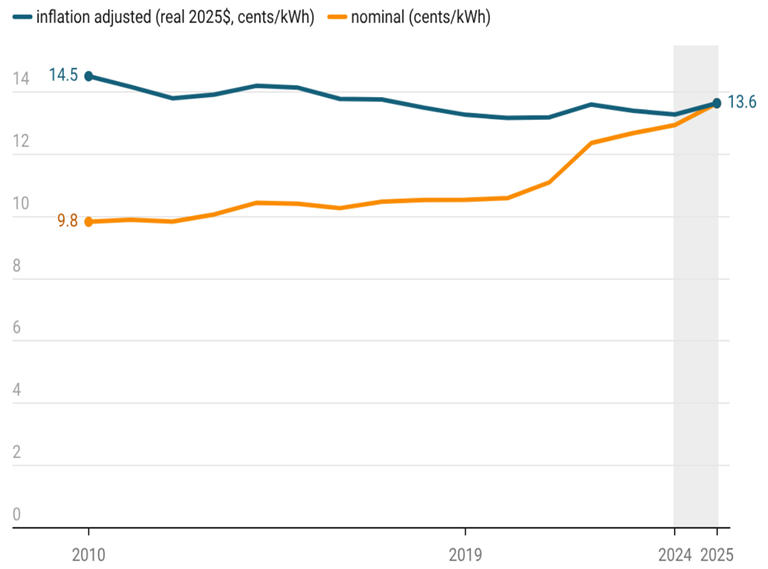
Source: LBNL Retail Electricity Price Trends and Drivers: Data Update−2026 Edition
Data centers are also not primary drivers of nominal price increases. Electricity prices closely follow fuel prices, especially natural gas (as shown in Figure 2) which now powers 45 percent of U.S. electricity generation.
Figure 2: Wholesale Electricity Price and Natural Gas Prices
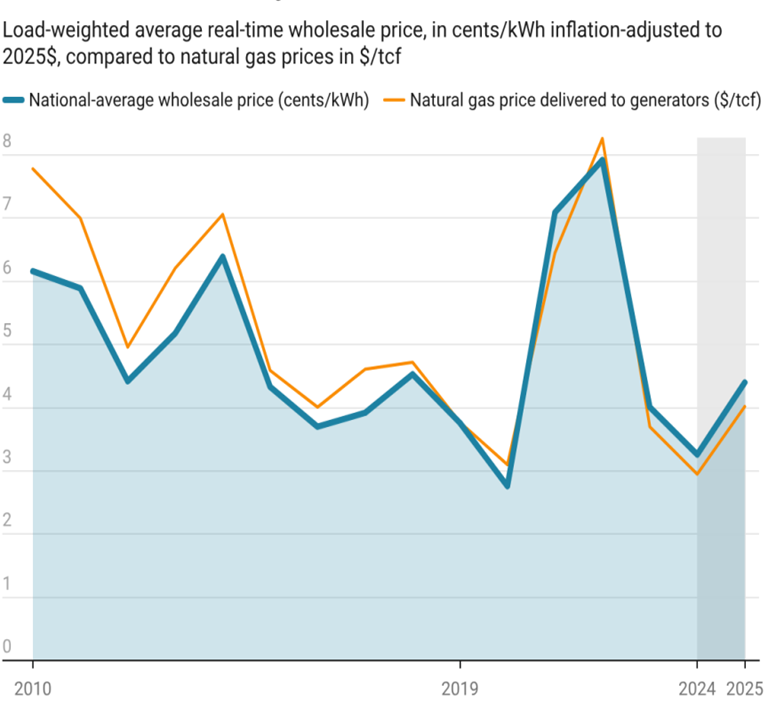
Source: LBNL Retail Electricity Price Trends and Drivers: Data Update−2026 Edition
Beyond fuel costs, utilities in many areas buy reliability through “capacity auctions,” where providers bid to supply grid systems with backup power. In the PJM Interconnection, the largest regional grid that covers 13 states, costs in the most recent auction aimed at ensuring sufficient future capacity to guarantee a reliable grid were up from approximately $60 per kWh in 2024 to over $300 per kWh in 2025. This spike did not come from planned new data centers. Prices reflect uncertainty: variable energy sources require more backup capacity, electricity demand has become less predictable, and volatile natural gas prices increase the cost of relying on gas peaker plants as the primary grid backup.
Utilities are also spending more on capital expenditures, up 13 percent each in 2023 and 2024, and by 23 percent in 2025. Some of that expense is driven by data centers, but costs have increased too: gas turbine prices are up almost 200 percent since 2019. And capex for transmission is also up, as utilities replace old equipment at current prices, harden infrastructure against natural disasters (e.g. wildfires), and respond to more damaging storms. New data centers account for only a small share of new transmission costs.
Costs also vary by region, and that helps to show the limited impact of data centers on prices. For example, electricity costs in Maine have risen very sharply, up 50-70 percent from 2021, among the biggest increases in the United States. But there are no significant data centers in Maine, and it seems unlikely that any will be built in the face of intense local opposition. Those increases have been driven by the cost of substantial storm damage in 2024-2025 and the need for subsequent infrastructure hardening, increased gas prices partly driven by growing competition for resources from export-oriented LNG development, and the cost of greening the grid, including attractive net metering rates for distributed solar power.
In short, data centers are a long way down the list of factors that caused recent nominal electricity price increases in the United States.
But what about the future? Will massive new data center overwhelm the grid?
Large cloud service providers (“hyperscalers”) and data center companies have announced more than 240 GW of new data centers to power the AI revolution, much planned for deployment by 2030. That’s approximately 20 percent of current U.S. electricity demand; without matching new supply, that suggests we could expect shortages and potentially dramatic price spikes.
But that conclusion is quite wrong. Electricity price hikes can be avoided without a moratorium or even a pause in data center construction, for four reasons.
First, the pace of data center construction will be slower than anticipated, and actual deployment will likely be smaller than announced.
▪ Capital crunch. Anthropic alone needs $900 billion to meet its needs; that’s challenging on the basis of ~$33 billion in revenues for the first nine months of 2026. . Even Google and Meta are taking on debt to pay for their commitments.
▪ Permits take time. Average time to acquire the necessary land use permits has been 6-18 months. Larger projects take longer.
▪ Design and construction takes 20-54 months, more for large projects especially given shortages of both people and materials).
▪ Grid connections take a long time. In the PMJ region, projects approved in 2025 had been in the queue for8 years. More time equals more cost, raising the capital burden.
Projected new data center deals fell about 50 percent between the 3rd and 4th quarters of 2025. Actual construction fell 6 percent year on year in 2025 to about 6GW.
As a result, the amount of energy built to power new data centers will be considerably lower than headline announcements suggest, and that new demand will take a lot longer to hit the grid.
Second, data centers can manage their demand. Electricity grids are designed to meet peak power demand, not average power demand, because they must ensure that customer needs will always be met. More peak demand equals more generation and more energy infrastructure, and massive new data centers appear to add to peak demand, as they seek to serve their own customers 24/7. Figure 1 shows that the California grid hits maximum utilization for only a few hours a year; most of the time there is plenty of spare capacity.
Figure 3: Used and Unused Capacity, CAISO California 2022
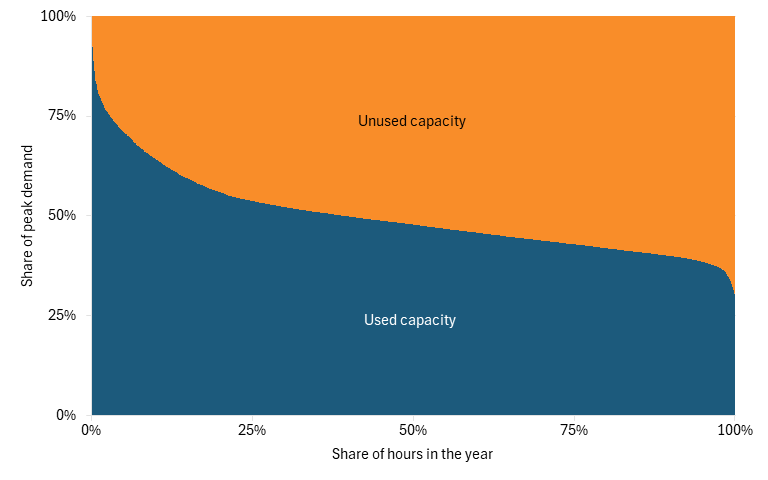
Source: CAISO Historical EMS Load
But in reality, demand peaks for only a few hours per year. The rest of the time, there is plenty of capacity available. So if data centers can manage their demands on the grid to avoid peaks, they can access plenty of power without increasing peak demand at all. In fact, they may even improve overall capacity utilization, which could reduce rates for existing ratepayers. Hyperscalers are taking steps to do exactly that.
Third, hyperscalers know they must bring their own power, often by placing those generating assets off the grid right where data centers are built (“behind the meter” or “BTM”). Most facilities will still need a grid connection for backup, but that’s not the same as depending on the grid for power 24/7. Grid-connected data centers can help with reliability, and BTM also helps avoid expensive transmission upgrades.
Fourth, utility contracts with data centers can be structured to protect existing ratepayers via “large load tariffs” (for new projects seeking 50MW of electricity or more). Options include:
▪ Data center funding for upfront costs such as engineering studies or power delivery infrastructure.
▪ Minimum contract periods (often 15 years).
▪ Minimum load guarantees (typically 85 percent of anticipated load), which apply even if the data center changes course and does not need that electricity.
▪ Defined ramp-up schedules so there are no sudden and unexpected hits on the grid.
▪ Exit fees in case a data center wants to exit the contract.
▪ Incentives such as faster interconnection to encourage demand management and BYOP.
▪ Hold harmless guarantees – some hyperscalers (e.g. Microsoft) have directly committed to ensuring that ratepayers will not pay the price for data center expansion.
▪ Higher rates for large loads.
These elements have to be implemented properly, and badly designed models like PJM’s capacity auctions have to be fixed, but these four key points mean that big new data centers can become a collaborative partner for electric grids, protecting existing ratepayers and managing the addition of new loads without adding to peak demand. None of this is theoretical – new contracts in Viginia, Ohio, and other states all include these elements. Over time, it seems likely that data centers will add a great deal of new generation, but that it won’t be paid for by other customers.
“Emergency” legislation to impose a moratorium on data center construction is therefore simply not necessary to protect Americans from rate increases from data centers. Concerns that data centers must drive up energy costs and potentially reduce reliability are misplaced; there are plenty of options to ensure a smooth path to growth. A national moratorium is also risky: it could bottleneck U.S. AI development, creating an opportunity for Chinese companies in particular to close the gap with American AI companies. And it could devastate the economics of the industry, frightening off the capital necessary to reach scale. Blocking the growth of a key industry on the basis of imaginary energy concerns is simply unnecessary.
