

A US Agenda for World Radiocommunication Conference 27
WRC-27 is an opportunity for the United States to advance global space and spectrum policies that promote productivity and innovation, build support for American priorities, and counter foreign efforts to undermine U.S. leadership in space and terrestrial wireless communications.
KEY TAKEAWAYS
Key Takeaways
Contents
Introduction
The World Radiocommunication Conference (WRC) is a meeting of the United Nations (UN) International Telecommunication Union (ITU). It convenes every three to four years to craft international guidelines for radio communication, including frameworks for satellite operations and terrestrial spectrum allocations. The seamless communications networks people around the world rely on today are the product of these long-term coordination plans that update rules to incorporate innovative technologies and plan for the wireless ecosystem years ahead.
The next WRC will be held in Shanghai, China, in October and November 2027. But the results agreed to there will themselves be the result of years of planning by the participant countries. And though the conference is meant to seek consensus, opposing visions of space and terrestrial spectrum rules will arise, with China likely to use its position as host to shift outcomes in a way that’s adversarial to American interests. For other issues, especially the space economy, European countries could seek to slow innovation at the expense of U.S. leadership. As these competing positions develop, the United States must establish its proposals on major agenda items and build international support. Cooperation with regional allies and like-minded countries around the world is essential to steering WRC-27 in a way that benefits free and innovative communications in general—and American interests in particular.
This report highlights some of the most pressing agenda items for WRC-27, suggests what positions the United States should take, and identifies ways of building international support for those positions.
Space Spectrum Issues
WRC-27 presents an important opportunity to align global rules for satellite communications technologies. Satellite services operate across national borders, so they need globally harmonized rules. The space economy cannot develop if it must abide by drastically different rules on either side of borders, especially between geographically small countries. As satellite technology advances and as more countries establish domestic space capabilities, the United States should use its economic, technological, and diplomatic weight in the global space economy to shape those standards and support productive spectrum use, innovative radio technologies, and continued U.S. leadership in the sector.
Advances in low-earth orbit (LEO) satellite technology, a subset of non-geostationary satellite orbit (NGSO) satellites, are driving innovation in communications services, so it is notable that several WRC-27 agenda items could modernize global satellite spectrum regulations to account for these developments. NGSO satellites enable direct-to-device (D2D) connectivity, allowing mobile phones to connect to more nodes and maintain connectivity where terrestrial infrastructure cannot reach. This capability has already produced partnerships between satellite and mobile companies in the United States in bands in which the Federal Communications Commission (FCC) has modernized regulations to allow for the development of advanced satellite connectivity.[1]
Because U.S. companies are among the leading NGSO operators, overly restrictive rules could disproportionately constrain U.S. innovation.
But as much as some WRC-27 agenda items present opportunities to advance space innovation, positive outcomes are far from certain. Other countries could work to restrict U.S. space companies and limit the growth of the global space economy. For example, some proposed restrictions on the rapidly growing NGSO ecosystem rely on interference metrics that no longer reflect current technologies or deployment models. Because U.S. companies are among the leading NGSO operators, overly restrictive rules could disproportionately constrain U.S. innovation. Though ITU rules do not directly bind domestic policy in each member country, many countries copy ITU rules directly into their domestic frameworks, so overly restrictive international rules could limit the availability and benefits of satellite connectivity worldwide.
To ensure that WRC-27 results in rules that benefit consumers and spur growth in the American and global space economies, the United States should garner support from international partners for the following priorities.
Reform GSO-NGSO Spectrum Sharing
The ITU set the current rules for satellite spectrum sharing in 2000, and those rules impose restrictions on NGSO operations that exceed what is necessary to protect geostationary satellite orbit (GSO) operations.[2] Good spectrum policy should maximize the productivity of scarce spectrum—and effective interference management is essential to that goal. But the optimal level of interference is not zero; spectrum rules should protect against harmful interference while allowing users to operate as productively as possible. The ITU should therefore update its spectrum-sharing regime to capture the productivity gains from next-generation NGSO satellite services without compromising GSO service.
The growth of the NGSO sector provides a strong reason to reassess the ITU’s EPFD rules.
The balance of GSO and NGSO systems has changed substantially since the ITU set the current spectrum sharing rules. From 2000 until the last WRC in 2023, NGSO satellite launches vastly outpaced GSO launches, as shown in figure 1.[3] This shift was driven by the growth of large LEO broadband constellations, including those operated by U.S. companies such as SpaceX and Amazon, as well as China’s Shanghai Spacecom Satellite Technology. The disparity has continued to grow since WRC-23, further underscoring the need to reassess rules written for a world of dominant GSO players with NGSO only an afterthought.
Figure 1: Annual global launches to NGSO and GSO, 2000–2022
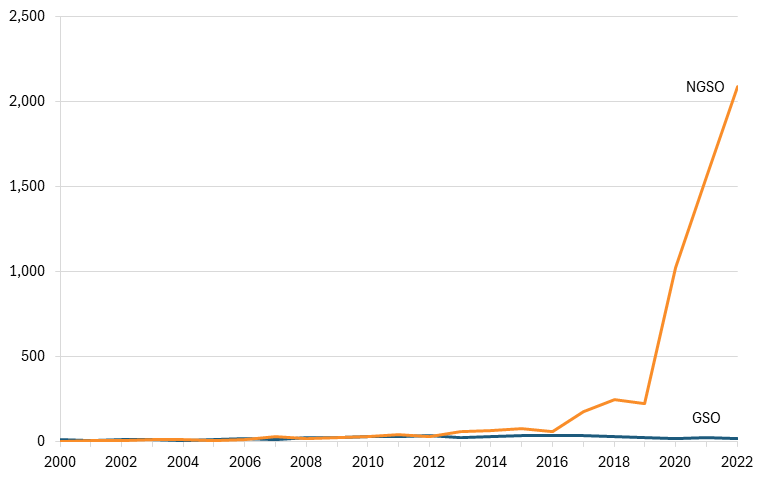
The growth of the NGSO sector provides a strong reason to reassess the ITU’s equivalent power flux-density (EPFD) rules, which govern interference between NGSO and GSO satellite systems.[4] The current EPFD framework places hard limits on NGSO transmissions regardless of whether higher-power transmissions would cause harmful interference to GSO systems. That imbalance leaves productive capacity on the table.[5] Indeed, EPFD limits that govern NGSO–GSO sharing are also more restrictive than are the protections applied to GSO systems sharing with one another.[6] These limitations suggest that the current framework can unnecessarily reduce the productivity of shared NGSO–GSO spectrum.
In the United States, the FCC has already provided a model for sensible, modernized NGSO–GSO spectrum sharing.[7] The FCC adopted these rules in 2026 after developing a robust public record supporting the changes, including technical studies submitted to the ITU Radiocommunication Sector (ITU-R) Working Party 4A (WP4A).[8] The new rules replace existing EPFD limits with a degraded throughput methodology.
Taken together, the updated protection criteria and the degraded throughput methodology allow NGSO satellites to expand operations and enable new operators to enter the market without causing harmful interference to GSO systems. The U.S. delegation should use the FCC’s technical record and the protection criteria in its WRC proposals to develop an internationally harmonized approach that expands NGSO capacity without undue interference to GSO services.
The U.S. delegation should seek procedural avenues to update EPFD rules during WRC-27.
While no official agenda item at WRC-27 addresses these outdated EPFD rules, the need to update is more urgent than ever. Despite efforts by the U.S. delegation at WRC-23 to add EPFD to the WRC-27 agenda, countries with investments in legacy GSO systems successfully opposed adding the item.[9] WRC-23 did, however, call for technical studies examining whether EPFD rules could change to improve NGSO performance without harming GSO operations.[10] The ITU-R WP4A is conducting those studies.[11] The U.S. delegation should seek procedural avenues to update EPFD rules during WRC-27. At a minimum, it should seek to add it as an agenda item for WRC-31.
Enable Direct-to-Device Service Through Expanded Allocations
D2D connectivity allows satellites to connect directly to devices such as phones, vehicles, and Internet of Things (IoT) devices. D2D services could provide connectivity to rural communities, maritime and aviation users, disaster-affected areas, and other remote locations where terrestrial deployment is unavailable or economically impractical.[12] NGSO operators such as Starlink and Amazon are building the first large-scale D2D networks, and two agenda items would open additional spectrum to increase flexibility and extend Internet connectivity to the most remote and isolated areas of the planet.[13]
Agenda Item 1.13
Agenda item 1.13 would enable Supplemental Coverage from Space (SCS) via secondary Mobile Satellite Service (MSS) allocation in IMT bands.[14] SCS functions by allowing terrestrial mobile licensees to use their spectrum for satellite service as well, under criteria to ensure the same protections guaranteed to other terrestrial licensees.[15] Enabling SCS would have the effect of using satellites to extend and enhance terrestrial mobile networks.
The United States has led the development and implementation of SCS and has facilitated partnerships between satellite operators and mobile carriers that expand coverage, to the benefit of broadband consumers.[16] The U.S. delegation should use the FCC’s domestic SCS framework to inform its position on Agenda Item 1.13. Specifically, the delegation should support a secondary SCS allocation in IMT bands while advocating technical rules that preserve appropriate interference protections while accounting for cross-border coordination challenges to protect the legal rights of mobile licensees on both sides of borders.[17]
Agenda Item 1.14
Agenda item 1.14 would expand the amount of spectrum allocated for MSS as a primary service to support D2D capabilities.[18] MSS differs from SCS because MSS licensees hold primary rights to the spectrum rather than using spectrum assigned to terrestrial mobile licensees. Expanding MSS allocations could increase the spectrum available for D2D networks and support the growth of global satellite connectivity.
The United States should draw on its domestic regulatory experience and market developments when developing proposals for Agenda Items 1.13 and 1.14.
There is a similar trend toward satellite operators acquiring MSS spectrum to build D2D networks in the United States. In 2025, SpaceX agreed to purchase around 65 megahertz (MHz) of spectrum from EchoStar for around $19.6 billion.[19] In 2026, Amazon agreed to acquire satellite company Globalstar, which provides D2D connectivity to Apple devices, for $11.57 billion.[20] These transactions demonstrate the value that market participants place on D2D connectivity and illustrate how market transactions can move spectrum resources toward more productive uses. The U.S. delegation should consider these market developments when evaluating proposals to expand primary MSS allocations internationally.[21]
The United States should draw on its domestic regulatory experience and market developments when developing proposals for both D2D agenda items.
Create Global Spectrum Abundance for Satellite Gateway Earth Stations
Agenda items 1.3, 1.10, and 1.18 would collectively open 11,000 megahertz of spectrum for NGSO services across multiple millimeter wave bands. The FCC has previously examined sharing rules in several of the bands relevant to these agenda items, including 51.4–52.4 GHz, along with the 71–76 GHz, 81–86 GHz, and 92–94 GHz (collectively referred to as the 70/80/90 GHz bands).[22] Although the FCC pursued new regulations for the 70/80/90 GHz bands (but not for 51.4–52.4 GHz), its proceedings provide technical and regulatory analysis that can inform the U.S. delegation’s positions on these WRC-27 agenda items.
Gateway earth stations are important because they help expand network capacity, much like “middle mile” fiber in wireline broadband networks.
Agenda Item 1.3
This agenda item would enable NGSO gateway earth stations to use the 51.4–52.4 GHz band on a primary basis.[23] This band is already allocated for fixed-satellite service (FSS) and is used by GSO earth stations with antennas of at least 2.4 meters in diameter. WRC-23 invited technical studies on compatibility for NGSO gateway earth stations. Gateway earth stations are important because they help expand network capacity, much like “middle mile” fiber in wireline broadband networks. Enabling NGSO gateway earth stations in the 51.4–52.4 GHz band would help satellite networks expand capacity and serve additional customers worldwide.
Agenda Item 1.10
Agenda Item 1.10 would introduce power flux-density (PFD) and equivalent isotropic radiated power (EIRP) limits in the 70 and 80 GHz bands to protect terrestrial broadband services.[24] The United States should ensure that any PFD and EIRP rules use a productive methodology informed by robust technical data rather than layering on hard-coded limits without regard to their necessity to protect the legal rights of terrestrial services. The FCC has already established a sharing regime for these bands in the United States, and the U.S. delegation should draw on that experience when developing its proposal for Agenda Item 1.10.[25]
Agenda Item 1.18
Agenda Item 1.18 would establish new interference restrictions on FSS operations to protect radio astronomy.[26] The existing ITU Radio Regulations already provide protections for radio astronomy, and different telescopes may require different levels of protection. This agenda item risks creating inflexible rules calibrated for the most interference-vulnerable facilities. Such an approach could create an unnecessarily restrictive sharing regime that severely limits NGSO operations without corresponding benefits to radio astronomy. The United States should instead support interference protections that protect radio astronomy’s actual facilities and reflect the technical characteristics needed to do that.
Prevent Authoritarian Governments From Disrupting Satellite Service
Agenda item 1.5, if approved, would prohibit NGSOs from transmitting over countries that have not authorized service domestically.[27] This agenda item raises two concerns.
The United States should oppose rules that would allow national restrictions on authorized satellite operations to prevent satellite operators from maintaining connectivity or performing necessary network functions.
First, it is being advanced by Russia and Iran, both of which want to block NGSO connectivity for their own insidious reasons. Iran has restricted Internet access during periods of civil unrest. Russia, which already tries to jam Starlink terminals used by Ukrainian forces, could potentially use agenda item 1.5 to demand that operators cease service in occupied Ukrainian territory.[28] The United States should oppose rules that would allow national restrictions on authorized satellite operations to prevent satellite operators from maintaining connectivity or performing necessary network functions. The concern is not limited to any one country: international spectrum rules should not create a mechanism that governments can use to impose broader restrictions on satellite communications beyond their existing domestic licensing authority.
Second, the proposed restrictions could prohibit transmissions necessary for space safety and threaten the ability of people in countries adjacent to those where service is not authorized to access the benefits of satellite connectivity. As more satellites enter orbit, operators increasingly need to coordinate satellite movements in order to avoid collisions.[29] Space-traffic coordination relies on continuous telemetry, tracking, and command communications to monitor satellite positions and, when necessary, maneuver satellites.[30] Because electromagnetic radiation does not recognize national borders, a requirement to prevent its entering one country would practically require operators to stop transmitting signals needed to perform functions in space, potentially increasing the risk of collisions.
Blocking transmissions could also hinder satellite operators serving regions where many countries are located within a small geographic area. In Europe, the Caribbean, and West Africa, for example, requiring satellites to repeatedly stop and resume transmissions could degrade service in neighboring countries that have authorized satellite operations; if a satellite must turn off to avoid transmitting into one small country, it will be unable to provide full connectivity to a neighboring small country. Moreover, Article 18 of the Radio Regulations already restricts radio transmissions where the operator lacks authorization.[31] The United States should therefore oppose Agenda Item 1.5, as it is unnecessary and could create additional operational and space-safety risks without providing a clear benefit.[32]
Terrestrial Spectrum Issues
Spectrum policy at WRC is about harmonization. Phones work in different countries because they all use roughly the same frequencies for their mobile and Wi-Fi networks. That same harmonization means the antennas and other hardware that make up the network can be mass produced and sold around the world, which results in lower prices for consumers. If the United States is alone in its spectrum allocations, device manufacturers will find it more profitable to sell to the rest of the world rather than retool their factories to meet bespoke U.S. requirements.
But the United States is not a passive victim of global standards setting. It can and should drive international harmonization by making the case to other countries for why spectrum allocations that work for the United States also work for them. In the build-up to and at WRC-27, the United States should lead both by promoting domestic spectrum allocations that enable productive use of the airwaves and cultivating a coordinated global ecosystem.
An unharmonized spectrum ecosystem would add up to more limited, slower, and more expensive communications services for consumers.
The guiding star of spectrum productivity is maximum flexibility, and flexible allocation means there should not be a strict distinction between terrestrial-only or satellite-only spectrum. There is overlap—for example, the D2D services using terrestrial spectrum described previously. But three bands are especially important for terrestrial use. The relevant WRC-27 agenda item is 1.7, which seeks to identify spectrum bands for International Mobile Telecommunications (IMT). An IMT identification indicates that countries will create spectrum rules that enable the sorts of power levels and usage rights sufficient for modern 4G, 5G, and 6G networks. By harmonizing the world around these bands, ITU members would signal to standards bodies, device manufacturers, network operators, and domestic regulators that there will be a market for advanced communications networks using these bands. Then those bodies can start their work to make those markets a reality.
Without harmonization, device manufacturing will be haphazard, deployment efforts will be disjointed, and regulatory frameworks will be incompatible. An unharmonized spectrum ecosystem would add up to more limited, slower, and more expensive communications services for consumers. There is also a risk that China will be more successful than the United States at rallying countries around its preferred spectrum ecosystem, which would be harmful to U.S. interests. Therefore, the United States should build international support for its domestic spectrum frameworks, including the following identifications of key bands for the future of wireless technology.
Maintain 5.925–7.125 GHz Band for Unlicensed Use
Unlicensed spectrum is a key component of wireless communications ecosystems because it facilitates efficient access and productive use for times, places, and technologies that are unlikely to cause harmful interference.
As economist Ronald Coase demonstrated, spectrum usage rights are like any other scarce resource: they can generally be allocated efficiently by market prices when the rights are well defined and able to be traded freely.[33] These kinds of tradeable rights are the way to rationally reconcile different people’s competing, mutually exclusive plans for how to use a given range of frequencies at a given place and time. Without defined rights and market prices, competing uses of spectrum will experience harmful interference or congestion—a manifestation of the classic “tragedy of the commons.” Markets in tradeable rights generate the knowledge necessary to coordinate disparate priorities toward the most productive ends. Without the market process, this knowledge does not exist. In short, markets solve knowledge problems.
The policy choice between licensed and unlicensed use is whether, given the circumstances and characteristics of a band, transaction costs exceed the costs of not solving knowledge problems.
As Coase also argued, however, there are costs inherent in the creation and operation of markets.[34] These “transaction costs” are just as real as the costs of unsolved knowledge problems. Common-pool resources avoid many transaction costs since there are no transactions to be had; people just use the resources at hand without regard to exclusive rights or markets. And not all common-pool resources are subject to a tragedy of the commons. Depending on the type of resource and the circumstances of its use, productive management can exist in a commons.[35] In short, common-pool resources solve transaction cost problems.
For spectrum, licensed use such as IMT is the equivalent of a market in defined rights. Unlicensed use is akin to a common-pool resource. Therefore, the policy choice between licensed and unlicensed use is whether, given the circumstances and characteristics of a band, transaction costs exceed the costs of not solving knowledge problems. The central determinant of this question is the likelihood that the band is the object of many mutually exclusive uses.
For example, bands now used for 5G need to connect to many independent devices in wide areas and be able to reliably reach phones through walls with enough power to support high-bandwidth services, such as video streaming, for all devices in a given area. Multiple signals in the same area are likely to be in the same receiver at the same time, so, absent some coordination, devices will not know whether a communications channel will be clear to send or receive upon. With many consumer mobile devices and three major mobile carriers in most areas of the United States, this lack of coordination is very likely to cause harmful interference. That’s why the United States uses market mechanisms to assign exclusive rights in order to separate potentially conflicting uses by frequency and location. It is worthwhile to run the market process because the cost of not solving the knowledge problems is having nonfunctioning mobile networks.
But take another example, the Wi-Fi connection between a laptop and home router. Unlike a wide-area mobile network, a home Wi-Fi network only needs to support a few devices in a small area and doesn’t need high power to propagate beyond the walls of a house or apartment. Thus, conflicting uses of spectrum used for Wi-Fi are less likely; there aren’t a lot of users all trying to use the unlicensed spectrum in a house, so the transaction costs of running a market to assign households that spectrum likely exceed the benefits of solved knowledge problems.
A unique aspect of spectrum usage rights is that not all frequencies are the same. Most notably, lower frequencies propagate farther and penetrate buildings better. That’s one reason why radio and TV broadcasts use low frequencies. The higher the frequency, the less penetration. Engineers and policymakers can exploit this property of radio waves to match use cases and allocations with appropriate bands. As a general rule, the likelihood of interference at a given power level and environment decreases as the frequency increases; since the signal doesn’t go as far, the number of transmissions getting into a single receiver to cause interference is lower.
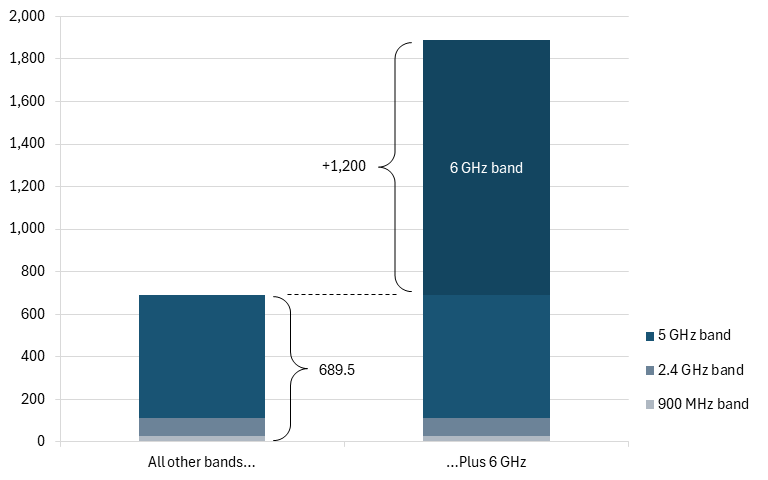
The 5.925–7.125 GHz (6 GHz) band, however, sits in the middle of the most usable communications frequencies for contemporary wireless use cases. In the mid-band, technical rules play a large role in determining the trade-off between transaction costs and knowledge problems. The power level at which transmitters may operate, for example, is a major factor in whether a signal stays indoors or propagates into adjacent buildings. The United States has adopted rules for the 6 GHz band that make it productive for indoor use while coordinating via a database for outdoor use, and it should not undo these rules to incur the transaction costs of repurposing the band.
The United States must, therefore, be vigilant: continue to make the case for unlicensed use of 6 GHz and build international equipment ecosystems around it.
The American usage rules for 6 GHz make it a viable option for relatively wide indoor connectivity without the need to deploy huge numbers of antennas. And the propagation characteristics of the band under those rules solve the tragedy of the commons by essentially fencing the transmissions within a building. A factory or hospital can deploy a 6 GHz network for internal communications without much worry of causing or receiving interference from nearby networks doing the same thing. That’s another way of saying that the transaction costs associated with auctioning the rights to operate in the building aren’t worth the knowledge the market transaction would generate. A market isn’t necessary to reveal the more productive use between competing uses if there are no competing uses.
Given an unlicensed allocation in 6 GHz, the United States should double down on its productivity, and protect that allocation on the international stage, not backtrack or divide the band between unlicensed and licensed use. The full band is the largest ever unlicensed mid-band allocation, wide enough for three 320-megahertz channels. Multiple, wide channels create the potential for high-bandwidth devices operating at low latency while the usage rules keep the signal at short range. That combination sets up well for augmented reality and virtual reality devices or potential robotic manufacturing applications. Latency is especially important for many emerging technologies, and wide channels mitigate latency because they allow more data to be sent all at once rather than serially over a few transmissions.
As always, the most valuable uses of a spectrum band may be ones nobody has yet conceived of—and a high-capacity, mid-band unlicensed allocation is well positioned to support such future developments for decades to come.
Officially, revisiting the 6 GHz band is not on the agenda for WRC-27, but China has not stopped trying to get countries to undo their decision to use 6 GHz for unlicensed use and is pressuring countries to join a Radio Regulations footnote that would call unlicensed use of the full 6 GHz band into question.[36] The United States must, therefore, be vigilant: continue to make the case for unlicensed use of 6 GHz and build international equipment ecosystems around it.
Figure 2: Megahertz of unlicensed mid-band spectrum before and after the 6 GHz decision (2020)
Identify Substantial New Spectrum for IMT
The decision to create a large, productive unlicensed band in 6 GHz makes it all the more urgent that the United States lead the creation of a licensed ecosystem in other bands. A globally harmonized equipment ecosystem that supports U.S. interests will not only support Wi-Fi and other unlicensed equipment in 6 GHz but also support corresponding mobile-network equipment in highly productive licensed spectrum bands. Since other countries, including China, are sacrificing unlicensed use of 6 GHz and situating licensed mobile use in part of that band instead, the United States needs to be proactive in identifying its own mobile bands and rallying enough other countries to create a global market in them. Two bands are especially good candidates for the United States to support at WRC-27.
4.4–4.8 GHz
The United States should domestically enable and internationally build support for usage rules suitable for a full-power, wide area mobile network in the upper 4 GHz band. The lower portion of the band, from 3.7 to 4.14 GHz, is already a major workhorse for 5G networks.[37] Though radio altimeters occupy a slice of the band from 4.2 to 4.4 GHz, the propagation characteristics of the band above 4.4 still make it an ideal candidate for high-bandwidth services that need reliable connectivity on the move, not just within the kind of controlled environment in which unlicensed use is feasible.
Proximity to altimeters also presents an opportunity. The mobile and aviation industries have been involved in a long process of technical learning and policy compromise to expand mobile services in the frequencies below the altimeter band. Part of the outcome of this process has been installation of higher-performing altimeters in aircraft with receivers that focus more narrowly on their assigned frequencies. That same experience and performance increase should enable more rapid understanding and coexistence between altimeters and full-power mobile devices just above the altimeter band.
The United States and other countries need reliable access to wide, high-power channels that enable an increase in volume and types of traffic necessary to effectively deploy AI.
A wide swath of mobile spectrum in 4 GHz will provide similar benefits to the wide unlicensed channels in 6 GHz: lower latency and a larger range of potential new uses, including those no one has thought of yet. The U.S. alternative to the licensing of 6 GHz undertaken by countries such as China should be 4.4 GHz. Making 4.4 GHz attractive for licensed mobile use is a key part of winning the international argument for unlicensed use of 6 GHz. The United States and other countries need reliable access to wide, high-power channels that enable an increase in the volume and types of traffic necessary to effectively deploy AI. While Wi-Fi may be sufficient for some AI applications, legal interference protection will be necessary to realize the full benefits of AI for more-sensitive or safety-critical use cases.
7.125–8.4 GHz
The 7 GHz band is the other half of the 6 GHz compromise. In the United States, unlicensed advocates have fought to expand the 6 GHz unlicensed framework further in the 7 GHz band while licensed advocates have sought to claw back some unlicensed portion of 6 GHz for licensed mobile use.[38] The United States should stick by the compromise: 6 GHz stays unlicensed while 7 GHz becomes suitable for full-power, wide area mobile networks.
Though by statute, near-term U.S. domestic auctions can only extend up to 7.4 GHz, other countries have no such limitations.[39] Global harmonization must account for this fact and embrace a big tent that supports broad identification of 7 GHz for IMT even though U.S. domestic allocation will remain in the lower portion of the band. A device ecosystem that works with all of 7 GHz will also work for the United States, while a U.S. position that insists on a smaller portion will place the United States at a disadvantage in bringing along other countries to a harmonized ecosystem that serves American interests.
Conclusion
Productive and innovative communications networks are the product of decades of investment in research and development, infrastructure, and entrepreneurship. But they are also dependent on rules that both enable new generations of technologies to flourish and harmonize them across the globe. WRC is both an opportunity for the United States to lead that next generation and a challenge from foes of freedom and innovation that oppose productive, future-focused space and spectrum rules. By staking out the right positions clearly and early, the United States and its allies can seize the opportunity and surmount the challenge.
About the Authors
Joe Kane is director of broadband and spectrum policy at ITIF. Previously, he was a technology policy fellow at the R Street Institute, where he covered spectrum policy, broadband deployment and regulation, competition, and consumer protection. Earlier, Kane was a graduate research fellow at the Mercatus Center, where he worked on Internet policy issues, telecom regulation, and the role of the FCC and interned in the office of Chairman Ajit Pai. He holds a J.D. from The Catholic University of America, a master’s in economics from George Mason University, and a bachelor’s in political science from Grove City College.
Ellis Scherer is a former policy analyst at ITIF covering broadband, spectrum, and space policy. He previously interned with the National Telecommunications and Information Administration (NTIA) and worked as a cybersecurity consultant. He holds a master’s degree in terrorism and homeland security policy from American University and a bachelor’s degree in politics and history from the University of California, Santa Cruz.
About ITIF
The Information Technology and Innovation Foundation (ITIF) is an independent 501(c)(3) nonprofit, nonpartisan research and educational institute that has been recognized repeatedly as the world’s leading think tank for science and technology policy. Its mission is to formulate, evaluate, and promote policy solutions that accelerate innovation and boost productivity to spur growth, opportunity, and progress. For more information, visit itif.org/about.
Endnotes
[1]. “Satellite Phone Service,” T-Mobile, accessed September 30, 2026, https://www.t-mobile.com/coverage/satellite-phone-service; “AT&T Business Expands Enterprise and Public Sector Connectivity Architecture with Amazon Leo Satellite,” AT&T, September 8, 2026, https://about.att.com/story/2026/amazon-leo-satellite.html.
[2]. International Telecommunications Union, “Radio Regulations,” Chapter V, Article 22, Section 22.5D, 2000, https://www.itu.int/pub/R-REG-RR-2024.
[3]. “UCS Satellite Database,” Union of Concerned Scientists, updated May 1, 2023, https://www.ucs.org/resources/satellite-database.
[4]. ITU, “Radio Regulations,” Chapter V, Article 22.
[5]. Ibid.
[6]. “Report and Order In the Matter of Modernizing Spectrum Sharing for Satellite Broadband, SB Docket No. 25-157,” FCC, April 30, 2026, https://docs.fcc.gov/public/attachments/FCC-26-26A1.pdf, at paragraph 33.
[7]. “Report and Order In the Matter of Modernizing Spectrum Sharing for Satellite Broadband,” FCC, SB Docket No. 25-157, adopted April 30, 2026, https://docs.fcc.gov/public/attachments/FCC-26-26A1.pdf.
[8]. “Working Party 4A (WP 4A) – Efficient orbit/spectrum utilization for FSS and BSS,” ITU, accessed September 30, 2026, https://www.itu.int/en/ITU-R/study-groups/rsg4/rwp4a/Pages/default.aspx.
[9]. Delegation of the United States of America, “Proposals for the Work of the Conference Agenda Item 10 – Article 22 EPFD Limits,” Inter-American Telecommunication Commission Consultative Committee II, August 13, 2023, https://www.fcc.gov/sites/default/files/CCPII-2023-42-5941_i.docx; Michael Calabrese et al., “Leading on LEO Satellite Policy: U.S. Priorities for the 2027 World Radiocommunication Conference,” New America and ICLE, June 25, 2026, https://www.newamerica.org/wp-content/uploads/2026/04/Leading-on-LEO-Satellite-Policy-PDF.pdf.
[10]. “ITU-R WRC23 Minutes,” ITU, accessed September 30, 2026, https://www.itu.int/md/meetingdoc.asp?lang=en&parent=R23-WRC23-C&class=MINS.
[11]. “Working Party 4A (WP 4A) – Efficient orbit/spectrum utilization for FSS and BSS,” ITU.
[12]. Ellis Scherer and Elizabeth Sanchez, “Comments to the FCC Regarding Assignment and Transfer of Control of Licenses and Authorizations Held by Globalstar to Amazon” (ITIF, July 2026), https://itif.org/publications/2026/07/21/comments-fcc-regarding-assignment-transfer-licenses-authorizations-globalstar-amazon/.
[13]. “ITU-R Preparatory Studies for WRC-27,” ITU, accessed September 30, 2026, https://www.itu.int/en/ITU-R/study-groups/rcpm/Pages/wrc-27-studies.aspx.
[14]. “WRC-23 Resolution 253: Studies on possible new allocation to the mobile-satellite service for direct to device connectivity between space stations and International Mobile Telecommunications (IMT) user equipment to complement IMT network coverage,” ITU, 2023, https://www.itu.int/dms_pub/itu-r/oth/0c/0a/R0C0A0000110013PDFE.pdf.
[15]. “Report and Order and Further Notice of Proposed Rulemaking In the Matter of Single Network Future: Supplemental Coverage from Space and Space Innovation,” FCC, GN Docket No. 23-65 and IB Docket No. 22-271, adopted March 14, 2024, https://docs.fcc.gov/public/attachments/FCC-24-28A1.pdf.
[16]. Joe Kane and Jessica Dine, “Good and Bad Reasons for Allocating Spectrum to Licensed, Unlicensed, Shared, and Satellite Uses” (ITIF, October 2023), https://itif.org/publications/2023/10/23/good-bad-reasons-for-allocating-spectrum-to-licensed-unlicensed-shared-satellite-uses/.
[17]. Calabrese et al., “Leading on LEO Satellite Policy: U.S. Priorities for the 2027 World Radiocommunication Conference.”
[18]. “WRC-23 Resolution 254: Studies on possible new frequency allocations to the mobile-satellite service in the frequency bands 2010-2024 MHz (Earth-to-space) and 2160-2170 MHz (space-to-Earth) in Regions 1 and 3 and 2120-2160 MHz (space-to-Earth) in all Regions,” ITU, 2023, https://www.itu.int/dms_pub/itu-r/oth/0c/0a/R0C0A0000110014PDFE.pdf.
[19]. Jason Rainbow, “EchoStar sells more spectrum in $2.6 billion deal for bigger SpaceX stake,” Space News, November 6, 2025, https://spacenews.com/echostar-sells-more-direct-to-device-spectrum-for-bigger-spacex-stake/.
[20]. Deborah Mary Sophia and Akash Sriram, “Amazon to buy satellite firm Globalstar in $11.57 billion deal to take on Musk’s Starlink,” Reuters, April 14, 2026, https://www.reuters.com/business/media-telecom/amazon-signs-1157-billion-deal-satellite-firm-globalstar-challenge-starlink-2026-04-14/.
[21]. Joe Kane, “Comments to the FCC Regarding Transfer and Control of Spectrum Licenses Held by EchoStar to AT&T and SpaceX” (ITIF, December 2025), https://itif.org/publications/2025/12/03/comments-fcc-regarding-transfer-spectrum-licenses-echostar-to-att-spacex/; Scherer and Sanchez, “Comments to the FCC Regarding Assignment and Transfer of Control of Licenses and Authorizations Held by Globalstar to Amazon.”
[22]. “Report and Order and Further Notice of Proposed Rulemaking In the Matter of Modernizing and Expanding Access to the 70/80/90 GHz Bands,” FCC, WT Docket No. 20-133, adopted January 24, 2024, https://docs.fcc.gov/public/attachments/FCC-24-16A1.pdf; “Report and Order and Order of Proposed Modification and Two Further Notices of Proposed Rulemakings In the Matters of Satellite Spectrum Abundance, Spectrum Abundance for Weird Space Stuff, Expanding the Use of the 12.7-13.25 GHz Band for Mobile Broadband or Other Expanded Use, Shared Use of the 42-42.5 GHz Band, and Use of Spectrum Bands Above 24 GHz for Mobile Radio Services,” FCC, SB Docket Nos. 25-180 and 26-54, GN Docket Nos. 22-352 and 14-177, and WT Docket No. 23-158, adopted September 30, 2026, https://docs.fcc.gov/public/attachments/DOC-424841A1.pdf.
[23]. “WRC-23 Resolution 130: Studies relating to the use of the frequency band 51.4-52.4 GHz to enable its use by gateway earth stations transmitting to non-geostationary-satellite orbit systems in the fixed satellite service (Earth-to-space),” ITU, 2023, https://www.itu.int/dms_pub/itu-r/oth/0c/0a/R0C0A0000110003PDFE.pdf.
[24]. “WRC-23 Resolution 775: Power-flux density and equivalent isotropically radiated power limits for inclusion in Article 21 for the fixed-satellite, mobile-satellite and broadcasting-satellite services to protect the fixed and mobile services in frequency bands 71-76 GHz and 81-86 GHz,” ITU, 2023, https://www.itu.int/dms_pub/itu-r/oth/0c/0a/R0C0A0000110010PDFE.pdf.
[25]. “Report and Order and Further Notice of Proposed Rulemaking In the Matter of Modernizing and Expanding Access to the 70/80/90 GHz Bands,” FCC.
[26]. “WRC-23 Resolution 712: Studies on compatibility between the Earth exploration-satellite service (passive), the radio astronomy service in certain bands above 76 GHz, and active services in adjacent and nearby frequency bands,” ITU, 2023, https://www.itu.int/dms_pub/itu-r/oth/0c/0a/R0C0A0000110018PDFE.pdf.
[27]. “WRC-23 Resolution 14: Studies on development of regulatory measures, and implementability thereof, to limit the unauthorized operations of non-geostationary-satellite orbit (non-GSO) earth stations in the fixed-satellite service (FSS) and mobile-satellite service (MSS) and associated issues related to the service area of non-GSO FSS and MSS satellite systems,” ITU, 2023, https://www.itu.int/dms_pub/itu-r/oth/0c/0a/R0C0A0000110005PDFE.pdf.
[28]. Max Hunter, “Russia tries to jam Musk’s Starlink systems to counter Ukrainian drones,” Reuters, July 8, 2026, https://www.reuters.com/business/aerospace-defense/russia-tries-jam-musks-starlink-systems-counter-ukrainian-drones-2026-07-08/; Alexander Ward and Robbie Gramer, “U.S. Smuggled Thousands of Starlink Terminals Into Iran After Protest Crackdown,” Wall Street Journal, February 12, 2026, https://www.wsj.com/world/middle-east/u-s-smuggled-thousands-of-starlink-terminals-into-iran-after-protest-crackdown-69a8c74f.
[29]. “ESA Space Environment Report 2026,” European Space Agency, September 14, 2026, https://www.esa.int/Space_Safety/Space_Debris/ESA_Space_Environment_Report_2026.
[30]. “TT&C and PDT Systems and Techniques section,” European Space Agency, accessed September 29, 2026, https://www.esa.int/Enabling_Support/Space_Engineering_Technology/Radio_Frequency_Systems/TT_C_and_PDT_Systems_and_Techniques_section
[31]. ITU, “Radio Regulations,” Chapter V, Article 18, Section 18.1 2000, https://www.itu.int/pub/R-REG-RR-2024.
[32]. Ibid.
[33]. Ronald Coase, “The Federal Communications Commission,” The J. of L. and Econ., Oct. 1959. https://web.stanford.edu/~dntse/papers/coase.pdf.
[34]. Ronald Coase, “The Nature of the Firm,” Economica (1937) http://rochelleterman.com/ir/sites/default/files/Coase%201937.pdf
[35]. Jerry Brito, “The Spectrum Commons in Theory and Practice,” Stanford Technology Law Review 1 (2007): 1, https://jerrybrito.com/pdf/2007StanTechLRev1.pdf; Elinor Ostrom, Governing the Commons: The Evolution of Institutions for Collective Action (Canto Classics. Cambridge: Cambridge University Press, 2015), doi:10.1017/CBO9781316423936.
[36]. Michael Calabrese, testimony before the Senate Committee on Commerce, Science, and Transportation, Subcommittee on Telecommunications and Media, U.S. Leadership at the World Radiocommunication Conference 2027: Strategy and Challenges Ahead of Shanghai, 119th Cong. (March 17, 2026), 7–8, https://www.commerce.senate.gov/wp-content/uploads/meetings/1746dbd8-0ad3-8cef-0d6e-4b9c745ce341/SenateCommerce_MichaelCalabreseWrittenTestimony_WRC-27.pdf.
[37]. Federal Communications Commission, “Expanding Flexible Use of the 3.7 to 4.2 GHz Band,” Report and Order and Order of Proposed Modification, GN Docket No. 18-122, FCC 20-22 (March 3, 2020), https://docs.fcc.gov/public/attachments/FCC-20-22A1.pdf; Federal Communications Commission, “Upper C-band (3.98–4.2 GHz); Expanding Flexible Use of the 3.7 to 4.2 GHz Band,” Report and Order, Order of Proposed Modification, and Order on Reconsideration, GN Docket Nos. 25-59 and 18-122, FCC 26-46 (July 24, 2026), https://docs.fcc.gov/public/attachments/FCC-26-46A1.pdf.
[38]. Jake Neenan, “White House Wants Portions of 7 GHz Band for Licensed Use,” Broadband Breakfast, December 22, 2025, https://broadbandbreakfast.com/white-house-wants-portions-of-7-ghz-band-for-licensed-use/.
[39]. Communications Act of 1934 § 309(j)(11)(B) (as amended by Pub. L. No. 119-21, § 40002(b)(1), 139 Stat. 129 (2025)) (47 U.S.C. § 309(j)(11)(B)).
