


The False Panic Over Workers’ Declining Share of Income
In recent weeks, pundits and policymakers have had a field day with new federal data showing that American workers are receiving a low share of national income. They argue this “proves” the economy is rigged against the people and in favor of the powerful.
Democratic voices have predictably embraced this interpretation, which reinforces a familiar claim that economic gains increasingly accrue to capital rather than labor. Rep. Ro Khanna (D-CA) argues on X that the “sharp decline in national income is the central economic issue of our time.” He continues, “In an age of AI, we must ensure that the productivity gains do not simply go to the existing capital class but also to workers.” Steve Rattner, a Wall Street financier who led the Obama administration’s Auto Industry Task Force, agrees.
But the alarm has spread beyond progressive political circles. The Kobeissi Letter, a financial publication on global capital markets, highlights the “problem.” John Dearie, president of the Center for American Entrepreneurship, implies that such divides will lead to societal revolt. And a CBS article asserts that “American workers’ share of the economic pie has fallen to its lowest level since at least 1947” and that more economic gains are therefore “flowing to shareholders and business owners.”
This all makes for compelling headlines and plenty of political hay, but it’s vastly misleading. The fundamental problem is that a decline in wages and salaries as a share of national income does not automatically mean an increase in the share going to corporate profits. There are many other categories of national income. Indeed, recent data on the categories of national income from the Bureau of Economic Analysis (BEA) show a quite different story.
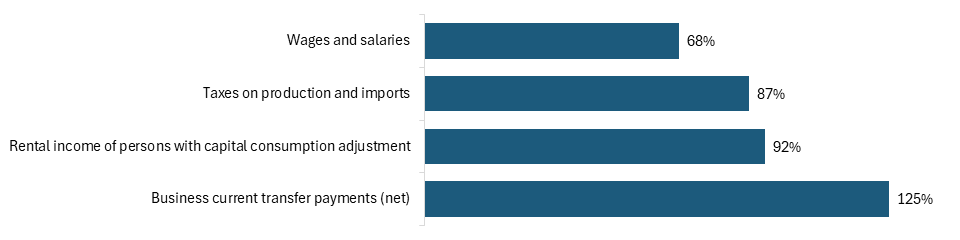
First, workers and their households receive income through channels other than wages and salaries. For example, national accounts attribute imputed rental income to homeowners, reflecting the net income they would receive if they rented out their homes. From the first quarter of 2015 through the first quarter of 2026, wages and salaries increased 68 percent, but rental income increased 92 percent. (See figure 1.) If there is a problem here, it’s not weak wage growth; it’s insufficient housing construction.
Income also flows to groups other than capitalists and workers. One category is business current transfer payments, which are transfers from businesses that are not payments for current goods or services. For example, these include deposit insurance premiums paid by banks, donations and corporate gifts, and unpaid consumer debts. These increased by 125 percent during the same period.
Another component of gross domestic income is government taxes on production and imports, which include taxes associated with the production, sale, or use of goods and services, including tariffs. These receipts accrue to the government rather than to corporate shareholders. From the first quarter of 2015 to the first quarter of 2026, taxes on production and imports increased 87 percent, compared with a 68 percent increase in wages and salaries. In other words, part of the increase in income outside wages and salaries went to the government, not to corporations. Given that the U.S. government runs a massive and unsustainable budget deficit, caused by low taxes and high mandatory spending, this is not a bad thing.
Figure 1: Growth of wages and salaries, rental income, business current transfer payment, and taxes on production and imports from Q1 2015 to Q1 2026
Second, even if corporate profits are growing faster than workers’ incomes, that does not necessarily indicate corporate greed or power. Thankfully, not all corporate profits are distributed to shareholders. Companies distribute some profits through dividends, but they also retain earnings to finance capital investment, research and development, and other activities that bolster competitiveness and boost productivity. Given the problems with shareholder capitalism, which prioritizes quarterly results over long-term investment, increased retained earnings are exactly what the nation needs.
From the first quarter of 2015 to the first quarter of 2026, total corporate profits after taxes increased by 113 percent, a rate higher than the 68 percent growth in wages and salaries. Some point to this as evidence of shareholders benefiting more than workers. For instance, Rattner points to a chart showing that corporate profits’ share of GDP has risen to a “near record high” of 12.4 percent while wages’ share has fallen to a “record low” of 41.2 percent, arguing that this dynamic may exacerbate further. However, a closer look at the chart shows that the measure of corporate profits includes net dividends and retained corporate earnings.
When total corporate profits are disaggregated to include only dividends, net dividends paid by private enterprises and interest income paid to individuals collectively increased by only 52 percent, 16 percentage points lower than the 68 percent growth in wages and salaries. In other words, most of the growth in corporate profits came from undistributed earnings used for reinvestment, which increased 168 percent.
Figure 2: Growth of net dividends and interest payments compared to wages and salaries from Q1 2015 to Q1 2026

Moreover, corporate net dividends and interest payments are definitely not growing faster when compared to total income accrued to households and government. From the first quarter of 2015 to the first quarter of 2026, net dividends and net interest paid by private enterprises increased 52 percent, compared with 72 percent for the broader measure of household and government income. This further undermines the claim that the decline in the labor share means a growing share of economic gains is flowing to corporate shareholders.
The labor share is a useful statistic, but it should not be treated as a comprehensive measure of whether workers are benefiting. Wages and salaries are only one component of national income. Other household income, government receipts, and the ultimate disposition of corporate profits all matter when evaluating who benefits from economic growth.
As with so many techno-economic issues, we, as a nation, seem unable to move beyond headline-driven, single-variable thinking: Workers’ share of income is down, so, ipso facto, capitalism is failing. Is it too much to ask pundits, journalists, and elected officials to exercise nuance and discernment? Alas, it appears that it is.
