

Comments to FCC Regarding Reforming the High-Cost Program For an All-IP Future
Introduction and Summary
The Information Technology and Innovation Foundation (ITIF) appreciates the opportunity to comment on Reforming the High-Cost Program for an All-IP Future.[1] The Commission should eliminate legacy high-cost support mechanisms and allow A-CAM support to expire without extension. These programs have achieved their original objectives, while changes in the broadband marketplace have substantially reduced the policy rationale for continuing them. Accordingly, the Commission should phase out support consistent with existing program timelines, terminate mechanisms that no longer advance the Commission’s statutory objectives, and refocus a smaller Universal Service Fund (USF) on broadband affordability and adoption. The Commission should also consider that these same market developments support broader reform of the High-Cost Fund.
The Commission Should Eliminate Legacy High-Cost Support Mechanisms
The Connect America Fund Broadband Loop Support (CAF BLS) and High-Cost Loop Support (HCLS) continue to provide cost-based operating-expense (op-ex) support to rate-of-return carriers rather than tying support to forward-looking deployment obligations.[2] These mechanisms warrant reconsideration because they provide continuing operational support to carriers whose economic viability may depend on federal subsidies rather than sustainable market demand.[3] This support structure reflects the communications marketplace that existed during the transition from legacy telephone networks to broadband-capable infrastructure. Since then, broadband deployment, competition, and next-generation technologies have evolved substantially.
Technological convergence has increased competition and expanded consumer choice in today’s broadband marketplace, making continued support for less competitive carriers increasingly difficult to justify.[4] As demand for high-bandwidth applications has grown, so too have the technologies available to deliver them. New wireline broadband networks are largely made up of fiber optic infrastructure; cable operators have upgraded their networks; fixed wireless access has made 5G an in-home as well as a mobile option; and low-Earth-orbit (LEO) satellite systems now provide high-speed, low-latency broadband, including in many previously unserved locations. [5] Although these technologies can complement one another within the broader connectivity ecosystem, they also provide substitutable broadband options for many common consumer uses.
The result of the proliferation of substitutable services is greater competition in the broadband marketplace, as shown by declining consumer prices and extensive promotions, including service bundles.[6] Nevertheless, one industry survey estimated that recipients of legacy High-Cost support would need to charge nearly $165 per month on average absent support, compared with a median monthly price of $63 across a sample of 250 service plans.[7] This disparity suggests that legacy support mechanisms subsidize carriers that cannot compete on merit, rather than filling a genuine service gap.
Legacy High-Cost support also slows progress toward the Commission’s goal of an all-IP communications environment. Recipients of these subsidies often continue to provide voice service over legacy infrastructure, including copper networks, that can be costly to maintain and may provide lower-quality service than modern broadband platforms.[8] Continuing to subsidize such infrastructure can therefore undermine the Commission’s network-modernization objectives.[9] The Commission should end legacy High-Cost support mechanisms that are no longer necessary to advance the statutory objective of universal access to modern communications services.
The Commission Should Allow A-CAM Programs to Sunset as Scheduled
The Commission established A-CAM I, Revised A-CAM, and A-CAM II to replace rate-of-return support with model-based support tied to defined deployment and speed obligations over fixed 10-year support terms. A-CAM I is scheduled to sunset in 2026, and A-CAM II is scheduled to sunset in 2028. Since these programs were adopted, private investment, technological innovation, and complementary federal deployment initiatives have substantially narrowed the broadband deployment gap. The Commission should allow the programs to expire according to their existing terms, which would be consistent with their original design and would avoid converting time-limited support into an open-ended commitment.
In the years since the Commission created the A-CAM programs, providers have expanded coverage in many high-cost areas. With the expansion of fixed and mobile 5G services and the emergence of LEO satellite broadband, over 96 percent of broadband serviceable locations (BSLs) in the United States have at least two providers offering 100/20 Mbps service, reducing the need for continued A-CAM support in many areas.[10]
In addition to private investment, other federal deployment initiatives also reduce the need for continued A-CAM support. NTIA’s $42.45 billion Broadband Equity, Access, and Deployment (BEAD) program will fund last-mile connectivity in remaining unserved and underserved areas.[11] If the Commission extends or redesigns A-CAM without accounting for BEAD commitments and private deployment, it could subsidize overbuilding in locations already served or subject to enforceable deployment obligations. The Commission should therefore discontinue A-CAM support where unsubsidized broadband competition already exists or where enforceable federal or state deployment commitments are sufficient to achieve the relevant broadband service objectives.
Shifting USF Toward Affordability Would Address Tech-Neutrality Concerns
The NPRM observes that a technology-neutral approach to modernizing high-cost support could complicate how the Commission determines eligible locations when unsubsidized competitors use different network technologies.[12] Under the current carrier-focused framework, the Commission must make difficult policy judgments about which services qualify as “unsubsidized competition.” Satellite broadband illustrates the challenge: the NPRM states that satellite Internet is available to 99 percent of BSLs that currently lack terrestrial broadband service.[13] Treating that availability as dispositive could substantially narrow the locations eligible for high-cost support, while excluding satellite service could undermine the objective of technology neutrality.[14]
Rather than disqualifying satellite broadband from eligibility determinations, the Commission should transition from direct carrier support toward a targeted affordability program. Under such an approach, providers using any qualifying technology could charge sustainable market rates while assistance would flow to eligible consumers, allowing them to select the service that best meets their needs. A consumer-directed affordability subsidy would dissolve the eligibility problem entirely because support goes directly to consumers without requiring the Commission to classify locations as eligible based on technology. This change also strengthens the policy basis for sunsetting legacy high-cost programs, because support would prioritize consumers rather than incumbent providers.
If the Commission focuses USF support on affordability rather than carrier-specific deployment subsidies, it could also improve competitive incentives in areas with limited provider choice. New entrants and lower-cost providers would have an opportunity to compete for customers who control their affordability benefits. By contrast, the current framework directs support to designated carriers, which may confer an advantage over unsubsidized competitors that could provide comparable or superior service at lower cost.
USF Needs Additional Reforms Outside the Scope of the NPRM
The same market developments, technological innovations, and federal deployment initiatives that weaken the rationale for the programs addressed in the NPRM also support a reassessment of the entire High-Cost Fund. In 2025, the High-Cost Fund disbursed more than $4.5 billion, including approximately $1.6 billion through the programs addressed in the NPRM. ITIF has a broader reform proposal and estimates that it would reduce High-Cost Fund spending by $22.7 billion through 2031 by ending certain legacy subsidies and allowing other programs to sunset at the conclusion of their existing support periods.
Figure 1: USF Spending 2025 through 2031, ITIF Plan vs. Status Quo
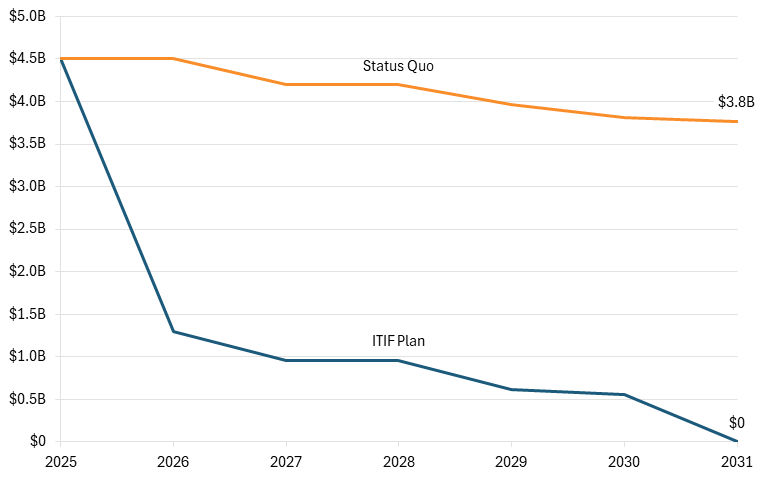
Table 1: Annual reduction in High-Cost Fund spending in ITIF's plan vs. status quo[15]
|
Status Quo |
ITIF’s Plan |
|||||||
|
Program |
2025 |
2026 |
2027 |
2028 |
2029 |
2030 |
2031 |
Total Reduction |
|
PR/USVI |
$42M |
$42M |
$42M |
$42M |
$42M |
$0 |
$0 |
$83M |
|
CAF II Auction |
$144M |
$144M |
$144M |
$144M |
$0 |
$0 |
$0 |
$433M |
|
RDOF |
$564M |
$564M |
$564M |
$564M |
$564M |
$564M |
$0 |
$564M |
|
RBE |
$1M |
$0 |
$0 |
$0 |
$0 |
$0 |
$0 |
$7M |
|
AK Plan |
$166M |
$166M |
$0 |
$0 |
$0 |
$0 |
$0 |
$828M |
|
ACAM I & II |
$390M |
$390M |
$216M |
$216M |
$0 |
$0 |
$0 |
$2.3B |
|
Enhanced ACAM |
$1.3B |
$0 |
$0 |
$0 |
$0 |
$0 |
$0 |
$7.5B |
|
FHCS |
$324M |
$0 |
$0 |
$0 |
$0 |
$0 |
$0 |
$1.9B |
|
HCL |
$200M |
$0 |
$0 |
$0 |
$0 |
$0 |
$0 |
$1.2B |
|
CAF BLS |
$1.1B |
$0 |
$0 |
$0 |
$0 |
$0 |
$0 |
$6.6B |
|
ICC |
$330M |
$0 |
$0 |
$0 |
$0 |
$0 |
$0 |
$2.0B |
|
Annual Spending |
$4.5B |
$1.3B |
$966M |
$966M |
$605M |
$564M |
$0 |
$23.5B |
|
Total Reduction |
$0 |
$3.2B |
$3.5B |
$3.5B |
$3.9B |
$4.0B |
$4.5B |
$22.7B |
As discussed above, CAF BLS and HCLS are op-ex subsidies that no longer represent the most efficient approach to federal broadband support and should be eliminated. Two additional High-Cost Fund mechanisms likewise provide continuing op-ex support and should be eliminated as well:
▪ Intercarrier Compensation Recovery (ICC Recovery) ($330 million disbursed in 2025): ICC Recovery is a component of CAF that supports changes to the intercarrier compensation system, which governs payments among carriers for traffic exchanged across their networks.[16] Like the other High-Cost op-ex programs, continuing to provide support without a clear, forward-looking deployment objective can distort normal market incentives. USF support should be narrowly targeted to demonstrable consumer needs rather than maintained primarily because the mechanism remains part of the existing framework.
▪ Frozen High-Cost Support ($324 million disbursed in 2025): Established in 2012, this mechanism supported the transition from legacy telecommunications infrastructure toward broadband deployment in sparsely populated areas with limited expected returns on investment.[17] Federal programs such as BEAD and private investment in network expansion make subsidies such as this program obsolete, as next-generation networks are already being deployed.
Several additional programs should be permitted to conclude and sunset once their existing obligations are complete, consistent with the recommended treatment of A-CAM I and A-CAM II:
▪ Connect USVI Fund and Uniendo a Puerto Rico Fund ($950 million total; $42 million disbursed in 2025): These programs were established to restore, expand, and upgrade fixed and mobile communications infrastructure following Hurricanes Irma and Maria in 2017.[18] The FCC authorized approximately $950 million over a 10-year support period to strengthen connectivity in Puerto Rico and the U.S. Virgin Islands. Although the programs include operating support, they are time-limited disaster recovery and broadband deployment initiatives. The Commission should allow them to fulfill their existing obligations and sunset at the conclusion of their support periods.
▪ Connect America Fund Phase II Auction (CAF II Auction) ($1.5 billion total, $144 million disbursed in 2025): The CAF II Auction is a blend of cap-ex and op-ex.[19] Because the program’s deployment obligations are nearing completion and support has already been committed, the Commission should allow the program to run its course and sunset when its existing funding obligations conclude at the end of 2028.
▪ Rural Digital Opportunity Fund (RDOF) ($20.4 billion authorized; $564 million disbursed in 2025): RDOF supports infrastructure deployment and the provision of broadband and voice services to eligible rural homes and businesses.[20] The program began in 2020 with a 10-year support term. Given that substantial funding is already allocated and deployment obligations are underway, the Commission should complete the existing program, enforce its performance requirements, and allow it to sunset at the end of the current support period.
▪ Rural Broadband Experiments (RBE) ($100 million total, $1 million spent in 2025): The RBE program provided support from 2015 through 2025 to test approaches for deploying next-generation networks in rural areas. Because the funding period has concluded, the program appears in the 2025 disbursement data but will not generate material expenditures going forward.
▪ Alaska Plan ($1.5 billion total, $166 million spent in 2025): Established in 2016, the Alaska Plan provides support to 23 carriers over a 10-year term. The Commission should enforce the program’s existing obligations and allow the support mechanism to sunset when its current term concludes in 2026.
Finally, Enhanced A-CAM requires separate treatment because of its scale and duration. The program provides long-term support to carriers that accepted higher performance requirements and other obligations in exchange for continued model-based funding. With approximately $18 billion authorized through 2038 and $1.3 billion disbursed in 2025, Enhanced A-CAM may provide support in some locations that subsequently become served through private investment, BEAD, or other public programs. The program’s objective is to ensure service to eligible locations, not to provide duplicative support where deployment goals have already been achieved. As such, the Commission should periodically reassess service availability in Enhanced A-CAM areas and adjust support, where legally permissible, to address only remaining gaps in a cost-effective and fiscally bounded manner.
The Commission should evaluate whether existing Enhanced A-CAM commitments remain necessary to achieve the program’s deployment objectives and identify legally sustainable options for modifying unnecessary or duplicative support rather than lock up over $18 billion until 2038. Any recalibration should account for reliance interests, contractual obligations, and litigation risk. Where support can be reduced without undermining enforceable deployment commitments, the Commission should redirect available resources toward closing the broadband affordability gap.
Conclusion
High-Cost reform, and USF reform more broadly, should be an urgent Commission priority. The fund continues to allocate substantial resources to mechanisms whose marginal effectiveness has diminished as broadband markets, technologies, and deployment programs have evolved. Phasing out legacy High-Cost mechanisms, allowing time-limited deployment programs to sunset as scheduled, and establishing a leaner USF focused on broadband affordability and adoption would better serve consumers, strengthen competition, and improve stewardship of USF resources.
Thank you for your consideration.
Endnotes
[1]. Founded in 2006, ITIF is an independent 501(c)(3) nonprofit, nonpartisan research and educational institute—a think tank. Its mission is to formulate, evaluate, and promote policy solutions that accelerate innovation and boost productivity to spur growth, opportunity, and progress. ITIF’s goal is to provide policymakers around the world with high-quality information, analysis, and recommendations they can trust. To that end, ITIF adheres to a high standard of research integrity with an internal code of ethics grounded in analytical rigor, policy pragmatism, and independence from external direction or bias. For more, see: “About ITIF: A Champion for Innovation,” https://itif.org/about; Notice of Proposed Rulemaking, Reforming the High-Cost Program for an All-IP Future and Connect America Fund: A National Broadband Plan for our Future High-Cost Universal Support, WC Docket Nos. 26-96 and 10-90, FCC, May 20, 2026, https://docs.fcc.gov/public/attachments/FCC-26-35A1.pdf, (NPRM).
[2]. See Notice, para. 7.
[3]. Ellis Scherer and Joe Kane, “How the Universal Service Fund Can Better Serve Consumers While Spending Less,” ITIF, September 15, 2025, https://www2.itif.org/2025-usf-reform.pdf, at 5-6.
[4]. Ellis Scherer and Joe Kane, “Broadband Convergence Is Creating More Competition,” ITIF, July 7, 2025, https://www2.itif.org/2025-broadband-convergence.pdf.
[5]. Ibid at 3.
[6]. Ibid at 9.
[7]. “NTCA Survey Highlights Significant Risks of Skyrocketing Consumer Bills, Plummeting Broadband Investment & Loans in Peril if USF Support were Eliminated,” NTCA, September 4, 2024, https://www.ntca.org/newsroom/press-releases/2024/4/ntca-survey-highlights-significant-risks-skyrocketing-consumer-bills; See Scherer and Kane at 9.
[8]. Ellis Scherer, “Reply Comments of ITIF on Reducing Barriers to Network Improvements and Service Changes and Accelerating Network Modernization, WC Docket Nos. 25-208 and 25-209,” ITIF, November 5, 2025, https://www2.itif.org/2025-comments-network-modernization.pdf.
[9]. Report and Order, Reducing Barriers to Network Improvements and Service Changes and Accelerating Network Modernization, WC Docket Nos. 25-208 and 25-209, March 26, 2026, https://docs.fcc.gov/public/attachments/FCC-26-19A1.pdf.
[10]. Office of Economics and Analytics, Industry Analysis Division, “Internet Access Services: Status as of June 30, 2025,” FCC, May 2026, https://docs.fcc.gov/public/attachments/DOC-421557A1.pdf, at 9.
[11]. “Broadband, Equity, Access, and Deployment Program,” NTIA, accessed July 8, 2026, https://broadbandusa.ntia.gov/funding-programs/broadband-equity-access-and-deployment-bead-program.
[12]. NPRM at 37.
[13]. Ibid.
[14]. NPRM at 18.
[15]. USAC, High-Cost Fund disbursement data (amount disbursed in 2025, fund type; accessed 7/16/2026), https://opendata.usac.org/d/w6qn-gx72/visualization.
[16]. “ICC Recovery,” USAC, accessed July 16, 2026, https://www.usac.org/high-cost/funds/legacy-funds/icc-recovery/.
[17]. “Frozen High-Cost Support,” USAC, accessed July 16, 2026, https://www.usac.org/high-cost/funds/legacy-funds/frozen-high-cost-support/.
[18]. “Bringing Puerto Rico (Uniendo a Puerto Rico) Fund and the Connect USVI Fund,” USAC, accessed July 16, 2026, https://www.usac.org/high-cost/funds/bringing-puerto-rico-together-uniendo-a-puerto-rico-fund-and-the-connect-usvi-fund/.
[19]. “CAF Phase II Auction,” USAC, accessed July 16, 2026, https://www.usac.org/high-cost/funds/caf-phase-ii-auction/.
[20]. “Rural Digital Opportunity Fund,” USAC, accessed July 16, 2026, https://www.usac.org/high-cost/funds/rural-digital-opportunity-fund/.
Editors’ Recommendations
Related
November 5, 2025
