


America Needs Both Small and Large Firms
Innovation is central to the United States’ long-term economic growth and technological competitiveness against foreign rivals, particularly China. Yet in debates over competition policy and industrial strategy, a common narrative has emerged: Small firms are inherently more innovative than large firms. For example, a report from the Biden administration’s National Economic Council argued that the “evidence is clear that new small and medium-sized businesses are drivers of innovation.” However, the reality is that both small and large firms contribute to innovation, albeit in different but complementary ways. Smaller firms generally concentrate on product innovation, while larger firms tend to focus more on process innovation. National Science Foundation (NSF) data also shows the distinct R&D spending patterns of different-sized firms. Small firms have higher R&D intensity, while large firms perform most of the nation’s business R&D.
As such, policymakers should encourage both small and large firms to continue investing in R&D at high rates to promote innovation. One step Congress can take is to double the R&D tax credit from 20 to 40 percent and reduce the administrative red tape associated with claiming it, making the credit easier for firms of all sizes to use and encouraging greater R&D investment.
Both small and large firms are essential to America’s innovation system because they specialize in different forms of innovation. Indeed, research has long shown that firm size shapes the type of innovation firms pursue. Larger firms generally emphasize process innovation (e.g., improvements in manufacturing, logistics, production efficiency, and organizational systems), while smaller firms focus more heavily on product innovation that could generate rapid revenue growth. A 2009 study found that as firms grow, managing increasingly complex operations requires greater expenditures, coordination, and attention to efficiency. Because of this complexity, large firms gain more from innovations that lower costs, improve productivity, and streamline operations. A 1996 study illustrated that the potential payoff from process innovation rises with firm size, giving large firms a stronger incentive to invest in technologies and systems that improve efficiency at scale.
In contrast, small firms tend to benefit more from product innovation. Studies have shown that smaller firms are generally more aggressive in pursuing growth opportunities, and new products provide a direct path to expanding revenue and market share. Unlike large firms, smaller businesses are often more flexible, less bureaucratic, and more willing to experiment with disruptive ideas or niche technologies. This agility allows startups and smaller companies to pioneer entirely new products and services. For example, smaller firms helped launch the personal computer industry by recognizing an emerging market while larger incumbents remained focused primarily on mainframe computers. Before introducing its first PC in 1981, IBM, for instance, made only mini and mainframe computers because it was unsure whether personal computers would be profitable.
Because they contribute different types of innovation to the U.S. economy, small and large firms also contribute to R&D spending in different ways. Small firms often invest a larger share of their revenue in R&D as they aggressively pursue growth through product innovation, resulting in higher R&D intensity. For example, firms with 10 to 19 employees have the highest R&D intensity, spending roughly 21.8 percent of revenue on R&D. Medium-sized firms with 50 to 99 employees spend about 11.7 percent. By comparison, firms with more than 25,000 employees spend approximately 4.6 percent of revenue on R&D. (See figure 1.)
Figure 1: R&D intensity for companies that performed or funded business R&D in the United States in 2023, by firm size
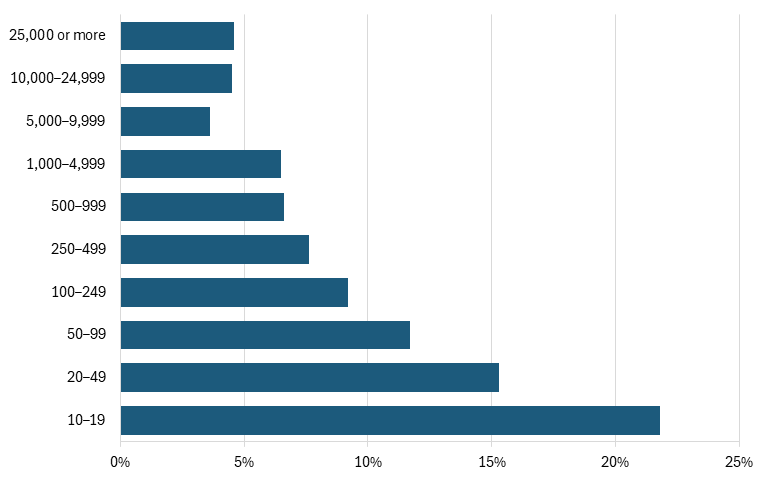
Critics of large firms often point to these figures as evidence that large companies are less innovative. But R&D intensity alone does not tell the full story. Large firms may devote a smaller share of their revenue to R&D partly because they face enormous operating, labor, infrastructure, and capital costs. Yet in absolute terms, they account for the overwhelming majority of business R&D spending in the United States.
Indeed, NSF data shows that small firms with 10 to 49 employees collectively invested about $20 billion in R&D, while medium-sized firms with 50 to 249 employees invested roughly $46 billion. By comparison, large firms with 250 or more employees invested over $655 billion. The very largest firms, those with 25,000 or more employees, invested approximately $281 billion in R&D, far exceeding the combined investment of small- and medium-sized firms with 10 to 249 employees. (See figure 2.) In other words, small firms may be more R&D-intensive, but large firms provide the scale of investment necessary to sustain America’s technological leadership.
Figure 2: Total R&D investments for companies that performed or funded business R&D in the United States in 2023, by firm size
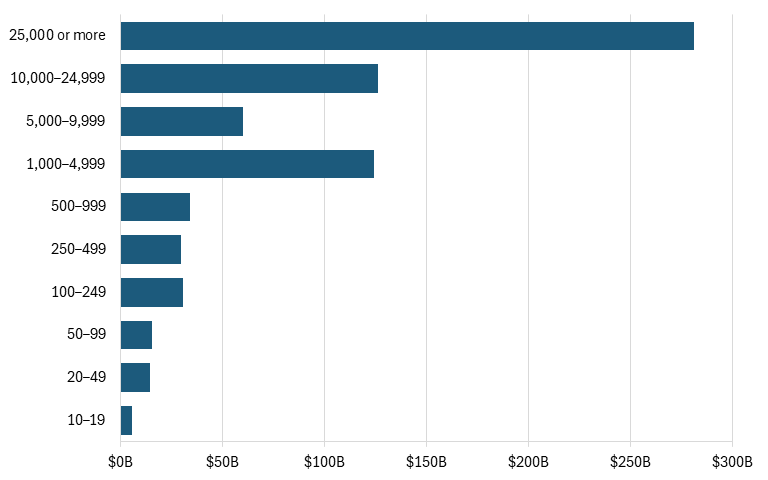
This distinction matters because innovation policy should not confuse intensity with overall contribution. A startup spending 20 percent of its revenue on R&D makes an important contribution, but so does a multinational company investing tens of billions of dollars in semiconductor fabrication, advanced AI systems, aerospace technologies, or pharmaceutical research. America’s innovation advantage depends on both: small firms advancing disruptive ideas and large firms scaling technologies, improving production processes, and funding massive research programs.
Policymakers should therefore avoid simplistic narratives that portray either small or large firms as the sole drivers of innovation. Instead, policy should focus on creating an environment in which firms of all sizes can invest, experiment, scale, and compete. One important step would be to expand and simplify the federal R&D tax credit. Doubling the regular credit from 20 to 40 percent and reducing the administrative burdens associated with claiming it would help startups and established firms alike increase their investment in R&D. Smaller firms would gain additional resources to pursue high-risk product innovation, while larger firms would have stronger incentives to undertake large-scale process innovation in the United States.
At a time of intensifying global technological competition with China, the United States cannot afford to undermine any part of its innovation ecosystem. Small firms and large firms are not substitutes in the innovation economy; they are complements. America’s competitive strength depends on maintaining both the entrepreneurial dynamism of startups and the immense research capacity of large enterprises. Policies that recognize and support the distinct contributions of both will do far more to strengthen U.S. innovation and competitiveness than attempts to pit one against the other.
Related
May 24, 2016
