

Testimony to the Special Committee on Aging Regarding Foreign Ownership and Control in America’s Drug Supply Chain
Contents
U.S. Drug Supply Chain Vulnerabilities 2
China’s Biopharmaceutical Competitiveness 4
Chinese Obfuscation of Companies and Activities in the Biopharma Supply Chain. 6
Introduction and Summary
The Information Technology and Innovation Foundation (ITIF) is an independent 501(c)(3) nonprofit, nonpartisan research and educational institute that has been recognized repeatedly as the world’s leading think tank for science and technology policy. ITIF is honored to testify before the Senate Special Committee on Aging on the topic of “Foreign Ownership and Control in America’s Drug Supply Chain.”
This testimony will first examine how key elements of biopharmaceutical supply chains—notably for key starting materials (KSMs) and active pharmaceutical ingredients (APIs)—have been increasingly offshored, principally to China (but also to India). The testimony will then briefly summarize how China has become an increasingly successful competitor in the global biopharmaceutical industry. It will then examine how one component of China’s strategy is to obfuscate ownership or control over actors in the biopharmaceutical supply chain and thereby to downplay the extent of its influence in the sector. Another aspect of this is how China leverages grey markets and obfuscates its exports unregulated or poorly regulated products, such as peptides, and how China engages in extensive biopharmaceutical intellectual property (IP) theft. The testimony concludes with policy recommendations, grouped into three broad themes: 1) addressing the challenge of Chinese “false flagging” and obfuscation; 2) addressing America’s increasing drug supply chain vulnerabilities; 3) broader policies to advance U.S. biopharmaceutical competitiveness.
U.S. Drug Supply Chain Vulnerabilities
As the Council on Foreign Relations recently wrote, “For decades the United States has allowed its pharmaceutical supply chain to migrate offshore in pursuit of lower business costs, a process accelerated by regulatory inertia and inadequate public investment.”[1] Indeed, America is increasingly reliant on China for active pharmaceutical ingredients (APIs)—the biologically active components in medicines that produce their intended therapeutic effects, and which are a foundational element of drug security and pharmaceutical innovation.[2]
It wasn’t always that way, however. In the early 1980s, most API production took place in Europe and the United States. Data compiled by the U.S. Pharmacopeia from the U.S. Food and Drug Administration’s (FDA’s) active API Drug Master Files (DMFs) show that, in 1981, Europe held 63 percent of the overall share of DMFs, while the United States held 25 percent. India and China held virtually none.[3] By 2024, that picture had reversed. Europe’s share had dropped to 6 percent, while the U.S. share had fallen to just 3 percent. Meanwhile, China and India accounted for 45 and 43 percent of active API DMFs, respectively.[4] Today, China thus plays a key role in the production of basic chemical precursors and key starting materials, while India primarily specializes in later-stage API synthesis and generic drug manufacturing, with much of India’s raw material for APIs originating in China.[5]
This geographic concentration reflects several factors that have developed over decades. A key driver is cost. An IQVIA report notes that API manufacturing costs are about 30 to 35 percent lower in India and 35 to 40 percent lower in China compared to the United States, creating incentives for offshore API production.[6] Lower labor and operational costs, cheaper raw materials, and historically weaker environmental standards are several of the factors that have enabled these cost differentials, creating strong offshore economies of scale.[7]
As it has in many other advanced-technology industries (such as solar panels or legacy semiconductors), China has used an aggressive underpricing strategy in APIs to knock out foreign competitors and come to dominate global market share (positioning China to either raise prices later—or to weaponize control over supply chains it’s come to dominate for geopolitical leverage). Indeed, some Chinese producers have in recent years cut prices on key API starting materials by 40 to 50 percent, an aggressive pricing strategy that can squeeze other competitors out of the market.[8]
This is not simply a reflection of efficiency gains—it is enabled by direct Chinese state support. Chinese API producers benefit from a combination of direct production subsidies, below-market land and energy costs, preferential financing from state-owned banks, and more permissive environmental regulations.[9] State support extends to infrastructure and industrial clustering: government policy has subsidized the creation of dedicated pharmaceutical manufacturing zones, including API “super factories” and explicitly included biomedical technology on the list of high-tech fields supported by key financial subsidies.[10] This support allows Chinese producers to sustain prices that would be commercially unviable without government backing. The strategic objective appears to be consistent with market consolidation: By pricing competitors out, Chinese API producers can secure dominant positions in key upstream segments, reducing other producers’ ability to compete and increasing global dependence on Chinese supply.
KSMs constitute the upstream building blocks used to manufacture APIs.[11] China is trying to corner production of these KSMs just as it is APIs. Across all medications, nearly 41 percent of KSMs used in U.S.-approved active pharmaceutical ingredients are produced only in China, and 16 percent from India.[12] China controls the raw or key starting materials for 94 percent of amoxicillin, 74 percent of heparin, and 70 percent of acetaminophen.[13] China also enjoys significant global concentrations for the following KSMs: angiotensin II receptor blockers (100 percent of APIs use China sole-sourced KSMs); blood glucose-lowering drugs (excluding insulins), 94 percent; direct acting antivirals, 83 percent; antineoplastics, 71 percent; antibacterials, 66 percent; statins, 62 percent. For its part, India dominates global production of several key KSMs, including high-ceiling diuretics (100 percent of APIs use India sole-sourced KSMs); X-ray contrast media, iodinated, 86 percent; and anti-dementia drugs, 80 percent.[14]
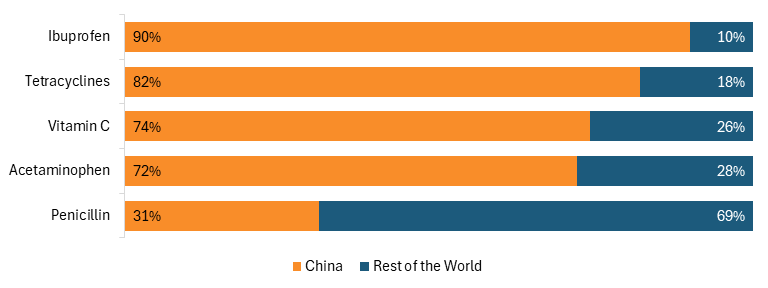
With China dominating so much of the KSMs that represent the key inputs to APIs, it’s no wonder that China is also coming to dominate global API production, making the United States increasingly dependent on China for API imports. Indeed, as figure 1 shows, the United States imports 90 percent of its ibuprofen from China, 82 percent of tetracyclines (a broad-spectrum class of antibiotics primarily used to treat bacterial infections, including acne and Lyme disease), 74 percent of Vitamin C, and 72 percent of acetaminophen.[15]
These figures showcase significant U.S. exposure and vulnerability to China for critical elements of the biopharmaceutical supply chain. For instance, more than 600 medications—including over-the-counter and prescription medications—contain acetaminophen.[16] In 2022 alone analysts estimated that the United States administered 49.8 million amoxicillin prescriptions.[17] Heparin is a critical medication in modern medicine, with an estimated 265 million doses provided to Americans annually and administered to more than 12 million hospitalized Americans each year.
Figure 1: U.S. imports of APIs, 2024[18]
Overall, the Brookings Institution estimates that Chinese-produced APIs are involved in at least one-quarter of the drug volume sold within the United States, however estimates of U.S. reliance on Chinese-made APIs reach to as high as 47 percent, when factoring indirect impacts from India’s reliance on China for inputs such as KSMs to the APIs India produces.[19] India’s exact reliance on Chinese APIs, intermediates, solvents, and reagents to produce their own API’s isn’t easily quantifiable, but Indian producers are heavily reliant on Chinese components for antibiotics, fluorine-rich drugs such as statins, and blood pressure medications.[20]
China’s Biopharmaceutical Competitiveness
It’s critically important that policymakers understand it’s not just that China is cornering markets for KSMs and APIs, but that China represents an increasingly viable competitor throughout the entirety of the biopharmaceutical supply and innovation chain, as ITIF detailed in a recent report on China’s burgeoning biopharmaceutical competitiveness.[21] It starts with increasingly competitive Chinese science and research and development (R&D). For instance, over the decade from 2015 to 2024, the number of biotechnology publications in China increased by 162 percent, from about 2.1 million to 5.4 million.[22] China now stands second behind only the United States in Patent Cooperation Treaty (PCT) patent publications in biotechnology and pharmaceuticals.[23]
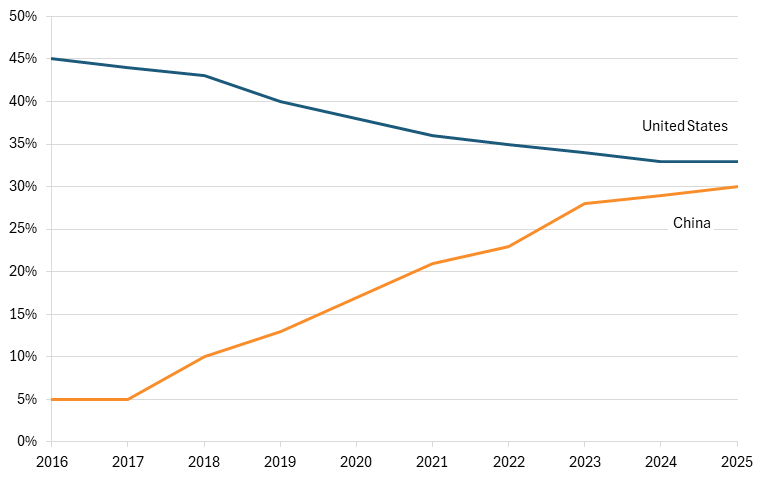
China has become an increasingly attractive location for the conduct of clinical trials. In fact, China is catching up to the United States in trials of the most-innovative drugs, including those with new mechanisms of action or that use advanced technologies to treat diseases. In 2016, just 5 percent of global clinical trials for innovative drugs were conducted in China, compared with 45 percent in the United States. This gap has now shrunk substantially, with 30 percent of all innovative drug trials taking place in China—a 500 percent increase—compared with 33 percent in the United States. (See figure 2.)
One reason why China is now a more-attractive location for clinical trials is that improvements to China’s regulatory processes have sped up the timeline from early discovery to new drug application in China by 50 to 70 percent.[24] In total, Chinese firms can now take a drug from discovery to the start of human trials in about half the global industry’s average time.[25] Research from PhRMA finds that the average duration of a phase I clinical trial conducted in China in 2025 is now over 50 percent shorter than phase I trials conducted in the United States. Similarly, the average cost of a phase I clinical trial in China was 43 percent less expensive than a phase I trial in the United States.
Figure 2: China and U.S. companies’ share of worldwide clinical trials for innovative drugs, 2016–2025[26]
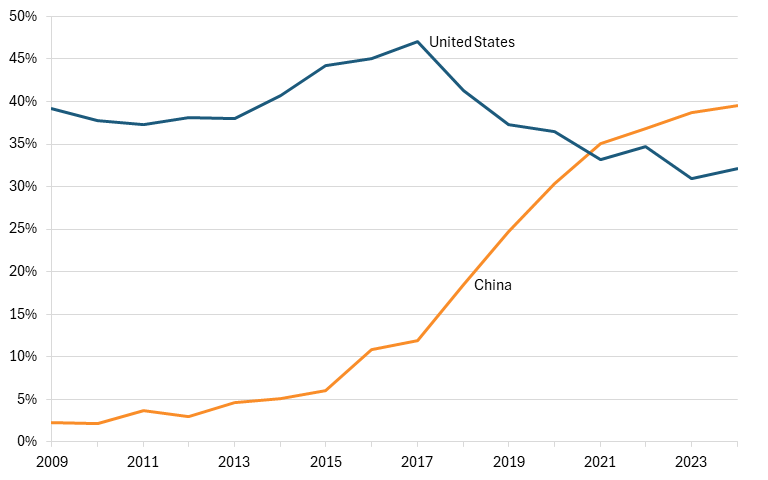
China is even now beating the United States in oncology R&D. In 2024, China overtook the United States in research output in oncology for the first time, with over 2,600 research publications compared with 2,481 from the United States.[27] Additionally, according to a report from IQVIA, China-based companies accounted for 39 percent of global oncology clinical trial starts in 2024, up from only 5 percent in 2014. (See figure 3.) China surpassed the United States in share of global oncology clinical trial starts in 2021, and now accounts for a 7 percentage-point higher share than the United States. Between 2020 and 2024, China launched 84 new active substances in oncology, more than double the 37 it had launched from 2015 to 2019.[28]
China today accounts for 31 percent of the global drug pipeline after its share of global pharmaceutical output mushroomed from 2.7 percent in 1995 to 17.3 percent in 2022.[29] Demonstrating how the quality of biopharmaceutical innovation has dramatically increased in China, the number of out-licensing deals from China increased by a factor of 31, from 5 deals in 2015 to 157 in 2025, while the value of those deals increased by a factor of 54 over that timeframe, from $2.5 billion to $135.7 billion.[30]
In summary, China is becoming an increasingly fearsome biopharmaceutical competitor. In the future, it may not be the United States depending on China for KSMs and APIs, but also for cutting-edge medicines such as cancer drugs. It should be noted that China has achieved this position through legitimate policies such as infrastructure, incentives, capital accumulation, R&D investments, and workforce development, among others. Other practices, however, raise significant concerns. Indeed, China has deployed a panoply of “innovation mercantilist” practices such as IP theft, industrial subsidization, the sale of unregulated products, and obfuscating the role of Chinese firms in the drug supply chain, policies that enable Chinese firms to operate outside the constraints faced by competitors in market-based economies.
Figure 3: Share of oncology trial starts by company headquarters location, 2009–2024[31]
Chinese Obfuscation of Companies and Activities in the Biopharma Supply Chain
As ITIF wrote in “How Some Chinese Companies Obscure Ties to China and What Policymakers Should Do About It,” some Chinese companies obscure their ownership and strategic intent in the U.S. economy, gaining access to markets, talent, IP, and even U.S. government subsidies.[32] Indeed, China regularly directs its companies to “downplay the company’s home-country identity” when operating abroad. In some cases, this has led to branding imitation and ownership obfuscation that blur the line between adaptation and deception. Overall, these practices advance China’s economic, industrial, and event military interests.
Chinese False Flagging
Outside the biopharmaceutical industry, a clear example of Chinese “false flagging” from ITIF’s aforementioned report is Continental Aerospace Technologies (CAT), a company that presents itself as American, with patriotic branding, while ultimately operating within a Chinese state-owned defense-industrial structure. CAT traces its roots to Continental’s historic role in U.S. aviation, including supplying engines for U.S. aircraft and military vehicles during World War II. Yet, the company’s ownership changed materially after Teledyne Technologies sold Teledyne Continental Motors in 2010 to Technify Motor (USA), which, despite the “USA” name, was a vehicle tied to the Aviation Industry Corporation of China (AVIC), a Chinese state-owned aerospace and defense conglomerate.[33] The Committee on Foreign Investment in the United States (CFIUS) approved the transaction, and the company continues to operate in Alabama as a U.S.-based employer and manufacturer. Today, China’s state-owned Assets Supervision and Administration Commission owns 100 percent of AVIC and, through it, a significant share of CAT.
It can be challenging to identify false flagging in the global biopharmaceutical supply chain because it is highly fragmented and often involves multiple layers of manufacturers, contract research organizations (CROs), contract development and manufacturing organization (CDMOs), suppliers, distributors, investors, and licensing partners. The challenge is particularly relevant when Chinese-linked entities participate through minority equity stakes, venture capital investments, offshore holding companies, joint ventures, subsidiaries, etc. In such cases, a company may appear to be independent while maintaining relationships with Chinese parent companies or state-backed investors. The concern is that U.S. policymakers may lack sufficient visibility into ownership, governance arrangements, and strategic affiliations to accurately assess supply-chain dependencies and potential risks.
Nevertheless, ITIF endeavored to find examples where Chinese companies operating in the drug supply chain are making an effort to hide their ownership, affiliation, or ties to the Chinese Communist Party (CCP). It offers three case studies: Beijing Genomics Institute, GenScript Biotech, and WuXi AppTec.
Case Study 1: Beijing Genomics Institute’s Acquisition of Complete Genomics
Beijing Genomics Institute (BGI) acquired Complete Genomics, a California-based company in 2012.[34] This acquisition was cleared by CFIUS in 2012 when the national security significance of genomic data and sequencing was less understood.[35] In 2023, the Bureau of Industry and Security (BIS) added BGI Research and BGI Tech Solutions based out of Hong Kong to the Entity List, indicating that their collection and analysis of genetic data poses a significant risk of contributing to Chinese government monitoring and surveillance and also poses a significant risk of diversion of sensitive data to China’s military programs.[36] Following this, the House Select Committee on the CCP wrote a letter to the Department of Defense (DOD) in 2024 stating that MGI (an entity founded as a subsidiary of BGI Group) and Complete Genomics are subsidiaries of BGI, describing how the Complete Genomics brand is used in the U.S. market, concealing ties to MGI, BGI, and ultimately the CCP and the People’s Liberation Army (PLA). Both BGI and MGI are included in the DOD’s 1260H list (a DOD inventory of Chinese military companies operating in the United States).[37] Innomics and STOmics were also identified as subsidiaries of BGI, operating in the United States under the name BGI Americas Corporation.[38]
Numerous subsidiaries operating in the United States under BGI without clear affiliations constitutes an intentional strategy, making it difficult for American companies and businesses to understand who they are truly working with. In June 2026, BGI announced it will pursue the company’s long-term goal of extending life sciences technologies into daily-life scenarios by aiming to develop handheld rapid genetic testing kits for consumers, consumer cosmetics, and wellness products, and expanding into personalized microbiome products.[39] With BGI Americas still headquartered in the United States, it’s unclear how accessible personalized medical products developed by BGI will be to Americans in the future.
Case Study 2: GenScript Biotech
GenScript Biotech was founded in New Jersey in 2002 and has since grown into a multinational biotechnology conglomerate, becoming the majority shareholder in several subsidiary firms and maintaining operations in over 100 countries. Today, the firm is headquartered and operates largely out of Nanjiang County, China.[40] As a CDMO, GenScript Biotech provides U.S. firms and government entities with custom gene synthesis services.[41] The current CEO of the firm, Shao Weijui, previously served as the chief operating officer and CCP committee secretary for GenScript.[42] GenScript operates three main subsidiaries in the United States: Legend Biotech, ProBio Technology, and Bestzyme. Legend Biotech, a smaller, lesser-known firm, is headquartered in New Jersey and incorporated in the Cayman Islands, but has an intermediate holding company in Hong Kong, and its largest shareholder was once GenScript.[43] In 2024, GenScript relinquished its majority-shareholder status, but the firm still exerts “significant influence” over Legend.[44] Legend previously partnered with Johnson & Johnson in 2017 to develop a cancer cell therapy, CARVYKTI, indicating close ties with leading American biotech firms.[45]
In 2024 and again in 2025, the House Select Committee on Strategic Competition Between the United States and the CCP sent letters to the director of National Intelligence and the director of the Federal Bureau of Investigation (FBI) requesting intelligence and law-enforcement information on GenScript and its ties to the PRC.[46] The letters note that GenScript’s role as a CDMO which has partnered with U.S. companies and government entities poses potential risks to U.S. biotech IP and advances the PRC’s technological capabilities. The letter also urges the agencies to investigate GenScript’s subsidiaries, such as Legend Biotechnology, which present themselves as American firms but have clear ties to the PRC.[47]
Case Study 3: WuXi AppTec
WuXi AppTec is a contract research, development, and manufacturing organization (CRDMO) that provides laboratory testing, drug discovery, and manufacturing services to the pharmaceutical and life sciences industries. Chinese biotech firm WuXi PharmaTech acquired Minnesota-based biologics and medical device testing firm AppTec Laboratory Services in 2008, transforming the company into WuXi AppTec, maintaining part of the American firm’s name. WuXi AppTec has claimed that it does not, and will not, pose a national security risk to any country (in a response to the U.S. BIOSECURE Act).[48] Yet WuXi AppTec maintains an extensive network of relationships with the CCP, is involved in the Military-Civil Fusion Development Strategy, and has alignment with the People’s Republic of China’s (PRC) national development plans. Indeed, according to WuXi AppTec’s CCP party group vice secretary Lin Wenbun, the company’s culture promotes the notion that “Party members are the technical backbone” of the organization.[49]
Indicative of WuXi AppTec’s deep connections to the Chinese government, the company operates the PRC’s “state key laboratory of Drug Lead Compound Research,” which carries out research to promote the Chinese economy and military development. Moreover, lawmakers have found that investments into Wuxi came from multiple PLA affiliated investment funds.[50] In addition to this, concerns were raised in 2024 that a U.S. client’s data was transferred to Beijing without consent.[51] These concerns led to WuXi AppTec being listed on the DOD’s 1260H list of companies. (In response, Wuxi has rejected accusations of Chinese military affiliation and filed a lawsuit contesting this.)[52]
WuXi historically has had a major impact on the global pharmaceutical industry, involved in one-quarter of drugs commercialized in the United States, with 65 percent of its reported revenue in 2023 (valued at over $5 billion) due to U.S. contracts.[53] The firm has become a pillar of the Western pharmaceutical supply chain, developing long-standing relationships with U.S. leaders in pharmaceutical development, including Pfizer.[54] The commissioner of the U.S. China Economic and Security Review Commission has called WuXi an “integral part of most American pharmaceutical companies.”[55] While WuXi AppTec may not be so much a case of “false flagging,” it’s certainly a case of the company making an effort to conceal its incredibly deep ties to the CCP and PLA.
Gray Market Companies and Counterfeit Products
A related issue—though technically separate from issues of obfuscation of corporate ownership or control—pertains to entities operating in grey markets or peddling counterfeit products. Chinese firms have engaged in selling unregulated products in U.S. markets, and often at price points (often one-fifth retail prices) that undermine legitimate competitors. This is particularly evident in the peptide industry, which has seen the emergence of a large, ill-regulated Chinese export market.[56]
Sometimes looking for cheaper drugs, Americans and patients around the globe are purchasing untested, unregulated “drugs” from e-commerce platforms such as TikTok Shop through gray markets.[57] When these products are ordered online, often shipping from China, one-third of such products tested by Finnrick in the United Kingdom failed to pass basic quality checks. This means the substance sold to consumers did not contain what the label claimed, it had substandard purity of less than 98 percent, or the dosing amount was more or less than stated.[58] The labeling of gray market products sold online is causing Americans to obtain unsafe products. Products are labeled in fine print and sold as being for laboratory use only or not for use in humans while being directly marketed to members of the American public. Counterfeiting legitimate household name products such as Wegovy may appear to be legitimate to American consumers, while in reality consumers are receiving an entirely different product.
Indeed, the GLP-1 industry has been hit particularly hard by counterfeit products. Chinese and Turkish companies and pharmaceutical middlemen have become increasingly prevalent with the rising popularity of drugs such as Wegovy and Ozempic.[59] Many counterfeit products may contain some semaglutide but are not formulated in the same way as reputable companies’ approved products. Often being produced by disreputable suppliers, these products are also at risk of containing dirty needles, being improperly stored, or containing an entirely different compound.[60] Patients worldwide suspected of ingesting counterfeit GLP-1s have suffered loss of consciousness, swelling of the face and throat, and even death.[61]
Different regulatory approaches worldwide also make it challenging to ensure quality medications are being delivered to patients, and that counterfeit products aren’t circulating.[62] The sheer volume of counterfeit medications also poses a challenge, making it difficult to intercept them all. In February 2024, illegal pharmacies in the United States filled more than 734,000 GLP-1 prescriptions, and a cybersecurity firm took down over 250 websites selling fake versions of GLP-1drugs.[63] Given the complexity and sophistication of counterfeit production companies, it’s becoming increasingly difficult to identify when drugs are counterfeited. Novo Nordisk and Eli Lilly have sued several entities seeking to stop them from selling products claiming to contain the active ingredients used in their products, but more robust policies should exist to protect American consumers and businesses from fraudulent products.[64]
The profits from online peptide sales in the United States also pose another unanticipated problem: Chinese-based manufacturers that traditionally produce synthetic opioids like fentanyl and their precursors have been profiting from the popularity of peptides.[65] Cryptocurrency payments to gray-market peptide suppliers reportedly totaled $27 million in the first quarter of 2026, a 150 percent increase from the fourth quarter of 2025.[66] Companies are utilizing cryptocurrency to evade capital controls, maintain cross-border efficiency, and achieve perceived anonymity.[67] The growth in payments to Chinese-based synthetic opioid producers from the gray market for peptides serves as another challenge for the United States to overcome in fighting the opioid crisis and protecting the health and safety of all Americans.
IP Theft and Non-Disclosure of Adversarial Affiliations
There have been many reports of Chinese biomedical researchers working at U.S. universities, often on National Institutes of Health (NIH) grants, and taking the IP developed in their labs back to China.[68] For example, in 2020, the U.S. Department of Justice charged the chair of Harvard University’s Chemistry and Chemical Biology Department, Charles Lieber, with aiding China with “one count of making a materially false, fictitious and fraudulent statement” regarding his work with organizations tied to the Chinese government, while on NIH funding.[69] In 2020, Ohio citizen Yu Zhou was sentenced to prison for conspiring to steal trade secrets concerning the research and treatment of different medical conditions, including cancer, from Nationwide Children’s Hospital’s Research Institute to sell to China.
In July 2025 Li Yunhai was detained by U.S. Customs and Border Protection and later charged with the theft of trade secrets.[70] Li had accepted a position as a postdoctoral fellow at the University of Texas MD Anderson Cancer Center in 2022 to work on breast cancer treatments while simultaneously receiving grant money from China’s National Natural Science Foundation and conducting research for a Chinese university hospital.[71] His research in the United States was funded by an NIH grant.[72] Li uploaded information to his Baidu account with the intention of preventing U.S. government officials from discovering that he possessed the data when he made a return trip to China.[73]
Moreover, Chinese state-sponsored actors have targeted biopharma firms for IP theft, including through cybertheft and rogue employees.[74] That theft is sometimes through direct means whereby scientists working at U.S. biopharma companies steal IP and then transfer it to China. For instance, in 2018, Yu Xue, a leading biochemist working at a GlaxoSmithKline research facility in Philadelphia, admitted to stealing company secrets and funneling them to Renopharma, a Chinese biotech company funded in part by the Chinese government.[75] In October 2023, intelligence chiefs from the Five Eyes countries—Australia, Canada, Great Britain, New Zealand, and the United States—accused China of IP theft in sectors including biotechnology.[76]
Policy Recommendations
As noted, this testimony offers policy recommendations, grouped into three themes: 1) addressing the challenge of Chinese “false flagging” and obfuscation; 2) addressing America’s increasing biopharmaceutical supply chain vulnerabilities; and 3) broader policies to advance U.S. biopharmaceutical competitiveness.
Addressing the Challenge of Chinese “False Flagging” and Obfuscation
The U.S. government needs to more comprehensively approach transparency, ownership disclosure, and risk management of Chinese investment in the U.S. economy, especially within defense, dual-use, and enabling industries. The following recommendations explain how the U.S. government can strengthen its systems to reduce vulnerabilities to Chinese techno-industrial predation.
Strengthen CFIUS Screening and Oversight
As of 2020, CFIUS is implementing the Foreign Investment Risk Review Modernization Act of 2018 (FIRRMA) in its screens.[77] FIRRMA states that CFIUS should also factor into its reviews “whether a covered transaction involves a country of special concern that has a demonstrated or declared strategic goal of acquiring a type of critical technology or critical infrastructure that would affect United States leadership in areas related to national security.”[78]
Congress should expand FIRRMA to widen the definition of what would affect U.S. leadership. CFIUS’s mandate should encompass not only threats to U.S. leadership “in areas related to national security” but also industries critical to economic and strategic competitiveness, such as civilian aerospace engines, aerial work platforms (AWPs), and advanced batteries.[79]
CFIUS should also create a comprehensive registry of all Chinese-origin companies operating in the United States, including subsidiaries, joint ventures, firms with Chinese financing, and entities with partial Chinese government ownership. To ensure that the list is accurate and up to date, CFIUS should leverage private sector open-source intelligence providers to both identify Chinese-controlled entities that may otherwise evade detection and ensure that the registry remains accurate and up to date.
Expand Ownership Disclosure
Congress should expand the Corporate Transparency Act to require Chinese-origin companies operating in U.S. “national power” industries—industries that enable a strong military or give the United States leverage over other nations, especially China—to report beneficial ownership and operational control, including minority stakes, joint ventures, offshore subsidiaries, and IP transfer rights.[80] Using CFIUS’s registry, the Securities and Exchange Commission should collect detailed information on ownership and decision-making structures, while the Department of Commerce should verify compliance and monitor access to dual-use technology and strategic assets. Companies that fail to provide full transparency should be barred from doing business in America, and CFIUS and Commerce should have authority to enforce restrictions or divestment where necessary to protect U.S. national security.
Proactively Use NDAA and CFIUS Authority
Congress should direct National Defense Authorization Act (NDAA) authorities that the NDAA for FY26 mandate that agencies expand Section 1260H and related authorities to ensure that Chinese-origin companies in defense, dual-use, and enabling industries cannot indirectly advance military capabilities.[81] This should include explicit prohibitions on contracting, technology sharing, and participation in federally funded programs. The NDAA should also direct agencies to require ongoing reporting for Chinese companies, covering IP transfers, supplier relationships, and workforce development activities.
Block Subsidies to PRC-Financed Companies
Federal agencies, led by the Office of Management and Budget, should bar companies with PRC financing from receiving U.S. government funding, tax incentives, or other financial support. The same should apply to companies with involvement in China’s military or dual-use programs. These checks should span both national and subnational levels, with CFIUS coordinating with state-level economic development offices. U.S. state policy has sped ahead on foreign adversary defensive regulation, but in many cases, these laws are flawed and could be better harmonized to national-level security priorities.[82]
Federal agencies such as the Department of Energy (DOE), DOD, National Science Foundation (NSF), and the Department of Transportation, as well as federal agency-linked consortiums such as USCAR (the United States Council for Automotive Research), should also implement pre-award due diligence to screen for Chinese ownership, operational control, or dual-use access before awarding grants or cooperative agreements. This would ensure that U.S. taxpayer funds support domestic innovation rather than foreign industrial strategies.
In addition, the Department of the Treasury, through CFIUS, working with funding agencies, should require companies that receive U.S. federal funding to obtain explicit U.S. government approval before relocating operations or substantial portions of their workforce or IP to China. This requirement would ideally be designed to not prevent legitimate global business activity but rather ensure that taxpayer-funded investments are not diverted to foreign jurisdictions in ways that could undermine U.S. strategic industrial capabilities.
Clarify Brand Obscuration Practices
Companies such as CAT and BGI maintain U.S. branding to obscure foreign ownership, misleading stakeholders and regulators. The Federal Trade Commission (FTC), with congressional authority as needed, should issue guidance on truth-in-branding and ownership disclosure by requiring companies in defense, dual-use, or enabling industries, including biopharmaceuticals, to clearly disclose foreign state ownership or control in marketing, websites, and communications.
In addition, for Chinese companies operating in defense, dual-use, or enabling industries, Congress should consider legislation or FTC rulemaking to mandate disclosure of foreign state ownership or control in a standardized and visible manner.[83] This requirement would not apply to benign consumer sectors, where branding obfuscation poses minimal national security or economic risk, but would prevent companies in critical sectors from misleading U.S. consumers, investors, or regulators about their foreign affiliations.
Centralize Interagency Due Diligence
The Treasury Department, along with the departments of Commerce, War, and other relevant agencies, and with oversight from the House and Senate intelligence committees, should establish a single, interagency due-diligence database that integrates CFIUS, Commerce, and federal grant-funding data to screen all potential recipients of federal awards, contracts, and research grants. As the Select Committee on the CCP’s Fox in the Henhouse 2025 report and a recent article, “Why Is the U.S. Defense Department Funding China’s Military Research?” underscore, a lack of data interoperability has enabled Chinese defense-linked institutions to receive U.S. funding through loopholes in agency coordination.[84] A unified system bringing together in-house capabilities and outsourced procured capabilities would automatically flag any entity on federal restriction lists (e.g., the Entity List, Section 1260H list, or the NS-CMIC list) before awards are approved.
Another area of improved intelligence sharing would be for CFIUS to integrate trade intelligence into its screens. The Commerce Department’s trade enforcement arm routinely collects detailed information on foreign corporate ownership, subsidy networks, and state involvement, producing rich data that overlaps with the national security risks CFIUS evaluates. There are no clear formal mechanisms for synthesizing such information, and the Government Accountability Office has documented interagency coordination gaps across U.S. efforts to mitigate national security risks from foreign investment in the U.S. economy.[85] CFIUS should establish a formal analytic mechanism—led by Treasury in coordination with the Commerce Department’s International Trade Administration and BIS—to integrate dumping, subsidy, and export-control data into investment reviews.
Addressing U.S. Biopharmaceutical Supply Chain Vulnerabilities
There are a number of steps the United States should take to reduce its biopharmaceutical supply chain vulnerabilities.
Facilitate Domestic Reshoring Through Manufacturing Innovation
Whether it comes to APIs, KSMs, critical minerals, or rare earth elements (REEs), the only way the United States (and allied nations) are going to compete with China is through technological innovation, notably ones that develop superior refining and processing techniques in a cost-competitive and ideally environmentally friendly manner. Advanced manufacturing technologies—including continuous manufacturing and advanced chemistry—will be central to this effort. This is why ITIF has called for the creation of a Manufacturing USA Institute (a network of currently 17 institutes focused on developing advanced manufacturing product and process technologies) for critical minerals and REEs.[86] (An alternative approach would be to create a new NSF Industry/University Cooperative Research Center (I/UCRC) focused on this.)[87] Given the significant similarities between chemistry- or chemical-based KSMs/APIs and critical minerals/REEs, the remit of such an institute could extend to also innovating new processes for KSM/API development.
Recent advances in biomanufacturing illustrate the significant potential. As Drew Endy, a member of the bioengineering faculty at Stanford University, has explained, novel bio-based and bio-fermentation processes now “make possible the biosynthesis of active pharmaceutical ingredients through bio-brewing-based processes…we can actually leverage yeast to create a set of medicinal alkaloids” including for many key APIs.[88] By leveraging engineered organisms such as yeast to produce many key APIs, these methods can significantly reduce both environmental impacts and reliance on traditional chemical synthesis.
At the same time, continuous manufacturing offers a pathway to disrupt the batch-based production model that has dominated API manufacturing. Rather than scaling production through large, capital-intensive batch facilities, continuous manufacturing based on flow chemistry enables smaller, more flexible systems that operate continuously and efficiently.
The United States is already making significant efforts to accelerate domestic API production. Phlow Corp. is a public-private partnership (PPP) which develops and domestically manufactures APIs and finished drug products that are essential for the United States. Phlow seeks to secure essential medicine manufacturing by building domestic API manufacturing capacity and maintaining a reserve of critical APIs to mitigate supply disruptions in times of disruption or emergency.
In addition to Phlow’s work, other early efforts demonstrate the promise of this approach. CONTINUUS Pharmaceuticals, for example, is developing an integrated continuous manufacturing platform that takes raw materials, synthesizes and purifies APIs, and produces final dosage forms all in a single system that can operate 24/7. Whether advanced manufacturing technologies can help close the cost gap with Chinese production remains an open question. CONTINUUS’s prototype results show that it reduced costs by 30–50 percent, solvent use by more than 60 percent, energy costs by 50–60 percent, facility footprint by roughly 90 percent, and lead time from months to less than 48 hours.[89] These cost reductions could help reduce the gap if replicated at commercial scale. However, achieving those results outside of controlled pilot conditions requires solving challenges in process scale-up, workforce training, regulatory approval, and supply chain integration. The federal government should support independent techno-economic assessments of what cost parity between U.S. advanced manufacturing and Chinese conventional production would require, and at what production scale it becomes commercially viable.
Strengthen Strategic Stockpiling
Aside from developing new manufacturing and refining processes for APIs, the United States should strengthen strategic stockpiling of them. One initiative the United States has undertaken to begin addressing near-term supply vulnerabilities is SAPIR, the Strategic Active Pharmaceutical Ingredient Reserve, a federally supported effort led by the U.S. Department of Health and Human Services (HHS), including the Administration for Strategic Preparedness and Response (ASPR) and the Biomedical Advanced Research and Development Authority (BARDA), in partnership with companies such as Phlow Corp.
SAPIR is not designed as a passive stockpile. Rather, it constitutes an integrated system for pharmaceutical resilience. Its core components include domestic manufacturing capacity for critical APIs and inputs, a distributed storage network for rapid response in times of crisis, analytical testing infrastructure to ensure ingredient quality, and conversion capabilities to rapidly turn stored ingredients into finished medicines. These activities are coordinated through a centralized platform for inventory, forecasting, and deployment, leading SAPIR to be a “living” reserve that combines stockpiling with production and logistics.[90]
Phlow’s work is a critical part of SAPIR. Through its BARDA-supported contract, the company is working to build an innovative end-to-end domestic supply chain for essential medicines, including the production of chemical precursors, APIs, and finished drugs in partnership with other organizations.[91] This effort combines manufacturing scale-up with upstream R&D and process innovation. In particular, Phlow is advancing continuous-flow and green chemistry manufacturing techniques to produce APIs more efficiently, at a higher quality and a lower cost than traditional batch production.[92] Such technologies are intended to make domestic production economically viable while reducing reliance on foreign suppliers.
Strategic stockpiling, as a complement to supply chain diversification through friendshoring and domestic manufacturing growth, can serve as an important buffer against disruptions while long-term production and innovation ecosystems are developed. Yet it’s important to acknowledge that stockpiling and near-term domestic capacity building are not self-sustaining solutions if the underlying cost differences between American and Chinese producers remain large. The viability of domestic reshoring at scale depends on either closing that gap through manufacturing innovation, offsetting it through policy tools such as advance purchase commitments and tax incentives, or accepting that strategic resilience for a defined set of essential medicines warrants ongoing public investment, much as the United States accepts the cost of maintaining other strategic reserves. Policymakers should be transparent about which of these mechanisms they are relying on for different types of API. As noted, much of the effort depends on advancing new biomanufacturing processes for APIs—including continuous manufacturing and novel synthesis methods—which in turn requires sustained investments in R&D, specialized workforce training, and scale-up capabilities. Therefore, initiatives such as Phlow’s work on SAPIR are critical not only for safeguarding near-term resilience, but also for catalyzing the technological and industrial base needed for increased domestic production.
Support Domestic Reshoring in Puerto Rico
Congress should leverage the tax code to encourage greater levels of medicines manufacturing in Puerto Rico. For example, Congress should reinstitute Section 936 of the Internal Revenue Code, which, when originally enacted in 1976, released pharmaceutical manufacturers from taxes on profits made in Puerto Rico and other U.S. territories. Section 936 contributed to making Puerto Rico a pharmaceutical manufacturing powerhouse, and while the biopharmaceutical sector does still contribute 30 percent of Puerto Rico’s gross state product, the phase-out of the provision from 2006 to 2016 contributed to a shrinking of the sector and a 40 percent reduction in the territory’s manufacturing job base. In 2024, the territory produced $48.3 billion in pharmaceutical exports, representing 74 percent of its total exports, with 60 facilities and 13,917 employees in the sector.[93] Yet this capacity exists despite, not because of, the federal tax environment. Congress should restore the tax credit in Section 936 for biopharmaceutical production in Puerto Rico and other U.S. territories.[94]This would signal a federal commitment to expanding this domestic production base, generating additional API and finished drugs within the United States at a scale that no other domestic location could match in the near term.[95]
Expand Nearshoring and Friendshoring to Diversify Supply Chains
Preceding sections have outlined domestic reshoring strategies—including manufacturing innovation, the SAPIR initiative, and Puerto Rico’s underutilized capacity—that could expand API production in the United States. These efforts are necessary but not sufficient, as even such a fully executed domestic reshoring agenda would leave the United States short of the supply chain independence needed to withstand a major disruption or a deliberate Chinese supply cutoff. Nearshoring, friendshoring, and allied coordination could complement U.S. production by diversifying supply chains without requiring every stage of manufacturing to occur domestically, while reducing concentration risk through expanded production across trusted jurisdictions.
A U.S.-Mexico collaboration for API and precursor material manufacturing, for instance, could build on Mexico’s growing chemical and manufacturing sector while maintaining proximity to U.S. markets, leveraging existing industrial capabilities and strengthening regional resilience.[96] Such a partnership could involve several factors: (1) a bilateral working group to identify priority APIs for joint production; (2) financing through the U.S. Development Finance Corporation for Mexican pharmaceutical manufacturing facilities; (3) harmonized FDA-COFEPRIS (Mexico’s health regulatory authority) inspection protocols to streamline market access for Mexican-produced APIs, and (4) joint infrastructure investments in dedicated pharmaceutical manufacturing zones near the U.S.-Mexico border, reducing logistics costs and enabling just-in-time supply chains.
Similarly, friendshoring with allies—such as India and South Korea—could support diversification in both production and innovation.[97] South Korea represents a compelling friendshoring partner not primarily because of cost, but also due to its advanced manufacturing capabilities, strong IP protections, and proven capacity in pharmaceutical production. While Korean wages tend to be higher, meaning that Korean API production would not be as price-competitive with Chinese production, South Korea’s value proposition lies in higher-value, technically complex APIs and advanced manufacturing partnerships—areas where quality, reliability, and innovation matter more than unit cost. Bilateral cooperation should focus on APIs where technical complexity or quality requirements make Korean producers competitive, and on mutually supporting R&D to develop next-generation manufacturing platforms. South Korea possesses established capabilities in pharmaceuticals and advanced manufacturing, and bilateral cooperation between the two countries could include joint R&D initiatives, co-investment in emerging manufacturing technologies, and improved data-sharing to map and understand shared supply chain vulnerabilities. These partnerships would help reduce reliance on concentrated sources—especially China—while preserving efficiency and scale through coordinated production across trusted allies.
The United States should also increase its reliance on India through a coordinated combination of procurement, financing, and regulatory tools. Indeed, drugs and APIs have been identified as a key opportunity for U.S.-India collaboration as part of the U.S.-India “TRUST” initiative.[98] On the demand side, federal purchasing authorities, including BARDA, the War Department, and the Centers for Medicare & Medicaid Services (CMS), could deploy advance market commitments to provide Indian API producers with the revenue predictability needed to justify capacity investments. A White House determination under the Defense Production Act in December 2023 expanded BARDA’s authority to issue such commitments for essential medicines and medical countermeasures, providing a legal avenue for this approach.[99] In parallel, CMS reimbursement policy could prioritize medications for preferred Medicare formulary placement for drugs that source APIs from trusted Indian suppliers.[100]
On the supply side, U.S. development and industrial finance tools could support India’s API capacity expansion. The U.S. International Development Finance Corporation (DFC), which has approximately $3.8 billion already deployed in India—making it the agency’s largest single-country market—could provide loan guarantees and political risk insurance for API facilities and chemical intermediate plants in India, particularly those aligned with U.S. essential-medicines priorities.[101]
Regulatory cooperation is also critical: Expanded FDA technical assistance, faster inspection scheduling, and early scientific engagement can lower compliance costs and shorten time-to-market for Indian producers scaling advanced or continuous manufacturing. Finally, joint U.S.–India initiatives to localize key starting material production—supported by tax credits, export-import financing, or allied co-investment—could reduce India’s starting material dependence on China. India currently imports most of its API key starting materials from China, with roughly 87 percent of India’s imported antibiotic ingredients by value coming from China, meaning that a simple shift in final API assembly without addressing upstream inputs would leave the supply chain exposed.[102] Diversification that includes these materials, not just finished APIs, would be key to turning procurement reorientation into durable supply chain resilience.
Strengthen Oversight of Foreign API Manufacturing
Another enduring challenge in global pharmaceutical supply chains consists of asymmetries in inspection and enforcement across jurisdictions. While the FDA applies Current Good Manufacturing Practice (CGMP) requirements to all facilities supplying the U.S. market, oversight of foreign facilities—particularly in China—has historically been more limited and has been subject to greater operational constraints than for domestic manufacturers.[103]
Prior to the COVID-19 pandemic, FDA inspections abroad were often pre-announced and conducted less frequently than domestic inspections. The pandemic further disrupted these processes, reducing foreign inspections and increasing reliance on host-country regulatory oversight, resulting in a backlog that constrained U.S. visibility into foreign manufacturing conditions and practices. Although inspections have since resumed, structural factors, including limited staffing, logistical barriers, and broader geopolitical frictions, continue to affect the FDA’s ability to maintain consistent, on-the-ground oversight of facilities in China.[104]
The inspection regime’s limitations in China are not merely logistical; they reflect a structural information asymmetry that Beijing is difficult to remedy under current conditions. Unlike domestic U.S. facilities, which can be inspected with no warning, FDA inspectors in China must obtain a business visa and schedule inspections in advance, providing facilities with effective forewarning of oversight visits. This advance notice creates opportunities for facilities to stage compliance by concealing deficiencies, updating incomplete records, and coaching workers before inspectors arrive.[105]
As Rosemary Gibson, author of China RX and a witness before the U.S.-China Economic and Security Review Commission, has commented, the FDA faces a regulator’s dilemma: It must choose between allowing potentially defective medicines from non-compliant suppliers to remain on the market or exacerbating drug shortages by banning these suppliers. The dilemma was created because the United States has allowed itself to become dependent on a single adversarial source.[106] This cannot be solved through better inspection protocols alone. Congress should require that all inspections of foreign facilities be unannounced, and that no APIs or finished drugs may be imported from any facility that hasn’t passed an FDA inspection within the preceding three years.
In May 2025, the FDA announced the expanded use of unannounced inspections at foreign manufacturing facilities that produce essential medicines intended for American patients. This followed a pilot program in China and India, which aimed to ensure that foreign plants are subject to the same level of regulatory oversight and rigor as domestic companies. The FDA also announced it would evaluate the agency’s policies and practices for improvements to its foreign inspection program to ensure that the FDA is the gold standard for regulatory oversight.[107]
These inspection asymmetries have important implications. They may affect competitive dynamics, as differences in inspection frequency and enforcement intensity can translate into variation in effective compliance costs across jurisdictions. At the same time, they can contribute to reduced supply chain transparency, limiting regulators’ ability to carefully assess quality risks, production vulnerabilities, and dependencies in upstream inputs such as key starting materials.
Addressing these challenges requires greater consistency in how regulatory standards are applied globally. The FDA’s data show that prior to the pandemic, many foreign facilities had never received in-person FDA inspections.[108] Congress should authorize and fund a substantial increase in FDA foreign inspection capacity and set a statutory inspection frequency floor for foreign facilities, at minimum, once every three years for any facility actively supplying the U.S. market, and appropriate funding sufficient to achieve that target. The FDA should also leverage inspection-sharing agreements with trusted regulators such as the European Medicines Agency (EMA) through its Mutual Recognition Agreement (MRA) and Japan’s Pharmaceuticals and Medical Devices Agency to extend oversight reach.[109]
Complementing physical inspections with remote monitoring tools and improved access to manufacturing data could further enhance visibility into Chinese production facilities specifically.[110] In parallel, greater transparency around inspection outcomes, along with incorporating compliance track records into federal procurement decisions, could help align market incentives with quality and supply chain resilience goals.[111] More importantly, inspection enforcement is itself a supply chain diversification tool. When the FDA bans imports from non-compliant suppliers, buyers must source elsewhere, prompting a shift toward domestic and allied producers that the supply-side policies discussed throughout are designed to support. Incorporating compliance track records into federal procurement decisions would reinforce this dynamic. Therefore, a more rigorous and consistently enforced inspection regime does not merely protect patients from potentially defective drugs—it actively supports the broader goal of reducing U.S. structural dependence on Chinese pharmaceutical production.
Push Back on China’s Promulgation of Decrees 834 and 835
In response to the BIOSECURE Act, and other foreign export controls and investigations, China created Decree 834, which entered into effect on March 31, 2026, and Decree 835, which entered into effect on April 7, 2026.[112] Decree 834 establishes that China’s industrial supply-chain security is an independent regulatory concern.[113] Within Decree 834, supply-chain-related investigations and data collection is prohibited if it violates PRC laws or regulations which can include origin tracing, export-control compliance checks, and internal investigations.[114] China’s State Council Department is also authorized to investigate discriminatory measures thought to impact the security of China’s supply chains.[115] Following an investigation, Chinese authorities can implement countermeasures against foreign organizations or individuals that could harm China’s supply-chain security, which can include trade restrictions, visa, and entry restrictions.
Decree 835 establishes a framework for identifying and responding to foreign acts that China views as an improper use of extraterritorial jurisdiction. China’s Ministry of Justice and related authorities can investigate and determine if a foreign effort is of improper extraterritorial jurisdiction. If a foreign act is found improper, the Ministry of Justice can issue a public announcement of its findings and can place foreign organizations or individuals on a Malicious Entity List. Entities placed on the malicious entity list can face visa denial, deportation, seizure or freezing of assents in China, transaction restrictions, limitations on import-export activities and investments, fines, product entry bans, and other measures deemed necessary. Chinese citizens or organizations harmed by an improper foreign act can seek civil compensation. Organizations and individuals cannot engage in activities with individuals on the malicious entities list. A relief mechanism is in place for organizations or individuals subject to countermeasures, with corrective action of countermeasures can be suspended, modified, or removed.
The combination of these decrees means that Chinese counterparts can refuse, limit, or delay information requests, impacting commercial disputes involving China.[116] Companies can anticipate increased foreign regulatory investigations, proceedings, and hurdles. Routine investigations that the United States conducts could trigger countermeasures requiring information disclosure.[117] Any business that modifies its relationship with Chinese counterparties can be at risk, and many critical terms under these decrees remain undefined.[118]
Enforcement of Decree 835 has begun with Nuctech.[119] The European Commission is investigating if government support has provided Chinese companies an unfair advantage and opened an investigation into Nuctech (a security inspection product manufacturer and security solutions supplier). China’s Ministry of Justice publicly ordered Nuctech to not cooperate with Europe’s investigation. In short, Decrees 834 and 835 raise new questions about the extent to which the United States will be able to capture information about Chinese entities operating in biopharmaceutical supply chains.
Require Products Made by Chinese Companies to Be Labeled as Such
In a 2020 survey, 40 percent of Americans said they would not purchase goods made in China.[120] But while the law requires labeling to show where products are made, consumers often cannot easily discern if a product is made by a Chinese company.[121] For example, many American consumers are likely unaware that their Blue Bottle coffee, their GE Appliances microwave, their Smithfield Foods deli meats, or their Wilson Sporting Goods tennis racket are all products sold by Chinese-owned companies.[122] The same is true of longstanding, distinctly American brands, such as Milwaukee Tool, that are owned by companies located in China or Hong Kong.[123]
Congress needs to take steps to allow consumers to easily identify if they are buying a product owned by a Chinese company. Three difficulties would exist for a manufacturer ownership policy: defining ownership, thinking through liability, and choosing scope.
For ownership, defining what “Chinese-owned” or “Chinese-controlled” means in an era of complex global corporate structures is difficult. ByteDance is incorporated in the Cayman Islands.[124] Shein is headquartered in Singapore.[125] A binary yes-or-no label cannot capture these distinctions without misleading consumers in the process. A better approach would be to differentiate between shades of gray, such as a subsidiary of a Chinese parent versus a company where Chinese mutual funds hold a minority stake in publicly traded shares. In the subsidiary case, the Chinese parent company could fire the board and direct the company’s decisions. In the investment case, shareholders benefit from returns but do not govern operations. For the most complicated cases, where elaborate financial arrangements obscure effective control, the Treasury Department could investigate. Milwaukee Tool is an example of a company that might not qualify as Chinese-controlled.
A threshold of 25 percent beneficial ownership is a reasonable starting point, consistent with standards used in anti-financial crime law.[126] But rather than embedding a rigid threshold in statute, Congress should direct the Department of Commerce, working with industry, to develop a tiered classification framework that distinguishes between majority Chinese-owned, Chinese-controlled-with-minority-stake, Chinese-invested-but-not-controlled, and no material Chinese ownership. Milwaukee Tool is precisely the kind of complicated case a tiered framework should be designed to consider.
With the conceptual piece of control in place, the U.S. government would then need to implement a China control regime. Importers of record—the entities that interact with customs at the border—should bear the disclosure obligation, consistent with how existing country-of-manufacture labeling works.[127] A safe harbor should accompany that obligation. Importers should not need to independently verify ownership structures across layers of holding companies but should have to verify where they got that information, such as from a commercial database, government database, or the manufacturer. Importers who conduct due diligence, use approved data sources, disclose in good faith, and update filings when material information changes should not face liability for inadvertent errors. Importers that do not meet that bar should face civil fines, as they already do for inaccurate or misleading country-of-origin markings.[128]
Sellers who make false ownership claims should bear a higher legal risk than importers. They should face a ban on importing goods into the United States, a power that Customs and Border Protection already holds.[129] Finally, regulators should identify country-of-control at the time of import, accounting for the possibility of post-import changes to corporate structure, which would likely only apply to a minimal amount of goods.
The Consumer Labeling for Enhanced API Reporting and Legitimate Accountability for Base Entity Listings (CLEAR LABELS) Act would require all prescription medications dispensed in the United States to include clear labeling that identifies the country, or countries, of origin of both the finished drug product and its individual active pharmaceutical ingredients.[130] The legislation includes: 1) a labeling requirement, under which drug manufacturers would have to clearly display, for each included API in a finished drug product, the name and location of the API’s original manufacturer, packer, and distributor; 2) reporting and accountability requirements, under which the FDA would have to maintain and update a publicly accessible electronic database of country of origin information for all APIs used in prescription drugs approved for use in the United States; and 3) enhanced oversight, which would support existing FDA oversight efforts to strengthen monitoring, inspections, and enforcement against manufacturing practices that could impact drug quality or safety.[131]
The legislation sensibly seeks to provide consumers with more visibility into the origins of their medications, and it would provide pharmacists and providers with more data for inventory decisions, recall management, and patient education. The legislation may not need to be so prescriptive as to require unique facility identifiers that enable tracking down to the exact address of the facility. (It’s perfectly fine for the FDA and inspectors to have that information, of course, but requiring disclosure of this information to the public may not add significant new value.)
Strengthening U.S. Biopharmaceutical Competitiveness
As ITIF wrote in “China’s Burgeoning Biopharmaceutical Competitiveness Demands a US Response,” it’s time for policymakers to stop “making own goals” that harm the U.S. biopharmaceutical industry and to “set ambitious goals” to bolster U.S. biopharmaceutical competitiveness. This testimony will highlight three of the most significant issues in particular.
Do Not Cut Federal Funding for Basic Research in Life Sciences
Multiple actors, including the federal government, academia, and industry (including both small biotech start-ups and large multinational corporations) play complementary roles at various phases in the U.S. life-sciences innovation process. While “drug populists” on the left argue that government should primarily take over drug development from the private sector, and “drug libertarians” on the right want to remove the government’s role entirely and have the private sector play the predominant role in drug development, the reality is that the contributions of both are essential.[132]
Particularly crucial is NIH funding for basic scientific research that aims to extend the frontiers of medical understanding, although it’s estimated that approximately one-third of NIH funding supports clinical research (including patient-oriented research, clinical trials, and epidemiological and behavioral studies, as well as outcomes and health services research) that is more applied in nature.[133] NIH-funded research has supported discoveries that have contributed to reduced deaths from cancer and lower rates of disability due to stroke, heart disease, hepatitis B, and osteoporotic fractures.[134] NIH-supported research has also led to the development of anti-AIDS drugs; the discovery of neurotransmitters, which led to the development of anti-depression treatments leveraging selective serotonin reuptake inhibitors (SSRIs); and treatments reducing scar tissue formation.[135]
The American public enjoys a tremendous return from the federal government’s investments in basic biomedical scientific research. In fact, each NIH dollar invested yields roughly $2.50 in short-term economic returns and stimulates an additional $8.30 in long-term private-sector R&D investment, underscoring the strong multiplier effect of public science funding.[136] Economists find that, in general, an additional dollar of public contact research added to the stock of government R&D has the effect of inducing an additional twenty-something cents of private R&D investment.[137] However, for the life sciences industry, a dollar of NIH support for research leads to an even greater increase in private medical research, roughly 32 cents.[138]
Unfortunately, the Trump administration’s proposed FY 2026 budget proposal sought to reduce NIH funding by a potentially staggering 40 percent, from roughly $48 billion in 2025 to about $27 billion in 2026.[139] Fortunately, Congress rejected these proposals, providing NIH with a total program funding level of $47.49 billion in FY 2026.[140] Nevertheless, the Trump administration has persisted in calling for cuts to NIH funding, with the administration’s proposed FY 2027 budget calling for 12 percent NIH cuts in FY 2027.[141] The administration’s FY 2027 NIH funding request would also zero out three important NIH institutes: the National Institute on Minority Health and Disparities, the Fogarty International Center, and the National Center for Complementary and Integrative Health. Congressional policymakers should reject the administration’s calls for NIH cuts. Moreover, Congress should fund NIH in excess of $50 billion in FY 2027 and further ensure that NIH funding in future years will increase, at the very least, at the rate of inflation.[142]
Repeal Drug Price Controls
If policymakers are concerned about U.S. drug supply chain vulnerabilities, the number one thing they should do is repeal or refrain from introducing drug price controls. Not only do drug price controls inhibit drug innovation, they also preclude companies from earning the revenues needed to reinvest in domestic supply chains and exacerbate the need to favor low-cost options for needed services in the drug supply chain, such as the services CRDMOs provide.
America’s life sciences companies are devoted to developing innovative drugs that tackle some of the most difficult problems in biomedical science, including solutions to heretofore intractable challenges such as Alzheimer’s, Parkinson’s, pancreatic cancer, and rare diseases (which affect small patient populations of less than 10,000). But the work is difficult. That’s why developing a new medicine can take 10 to 15 years and cost upwards of $2.6 billion, on average.[143] Life sciences companies need to earn revenues from their successful medicines in order to recoup the R&D costs of both their successful and failed efforts, and so they can garner revenues to invest in future generations of biomedical innovation. That’s why research finds a statistically significant positive relationship between a biopharma firm’s profits from the previous year and its R&D expenditures in the current year.[144] Other research makes this linkage direct, finding that every $2.5 billion of additional biopharmaceutical revenue leads to one new drug approval.
But recent drug price controls introduced by both the Biden and Trump administrations have disrupted market economics and are already having a significant deleterious impact on innovation. Drug price controls in the Biden administration’s Inflation Reduction Act (IRA) had an immediate deleterious impact on drug innovation, especially for small molecule drugs.[145] Research firm Vital Transformations found that, from September 2021 to 2024, small-molecule investment funding dropped by 70 percent (in the wake of the promulgation of the IRA legislation).[146] That coincided with a 2023 PhRMA study in which 78 percent of PhRMA member respondents reported that they expected to cancel early-stage small-molecule pipeline projects.[147] The IRA has already forced companies to halt more than 55 drug R&D programs since it became law.[148]
Most-Favored Nation (MFN) drug pricing policies proposed by the Trump administration could be even more damaging to U.S. biopharmaceutical innovation than the IRA drug price controls have been because they would apply to all drugs, not just the specific ones selected for price controls in the IRA. Tomas Philipson and his colleagues at the University of Chicago have found that applying MFN pricing policy to existing drugs in Medicare and Medicaid would reduce U.S. pharmaceutical revenues by 49 percent. They further found that if the drug price controls persisted over a 10-year horizon, the revenue shortfall would result in the loss of 210 new drug approvals, together with 290 post-approval indications, resulting in a combined loss of 500 drugs, or 50 per year. The authors associate this large cut in innovation with a loss of 516 million life-years, corresponding to approximately 6.6 million lives lost worldwide.[149] Especially in the face of burgeoning Chinese biopharmaceutical competitiveness, Congressional policymakers should repeal the IRA drug price controls and reject the Trump administration’s various MFN drug pricing proposals.[150]
Press Allied Nations to Pay Their Fair Share for Innovative Medicines
The United States has borne a disproportionate share of the cost of pharmaceutical innovation. American patients and taxpayers fund the majority of R&D in the life sciences, bearing the financial risks of drug discovery and clinical trials that benefit nations globally. At the same time, many countries in the Organization for Economic Cooperation and Development (OECD) have implemented price controls on pharmaceuticals, often paying less than is needed to sustain the innovation pipeline they benefit from, creating free riding on American innovation investment. Individually, each nation benefits from suppressing drug prices while assuming others, particularly the United States, will continue funding breakthroughs. But when every country around the world other than the United States follows this strategy, the global system becomes unsustainable, innovation slows, and patients worldwide lose access to future therapies.[151]
The innovation costs of this free riding are measurable and substantial. If the 32 OECD countries had lifted pharmaceutical price regulations in 2018, the world would have benefited from approximately 25 additional new drugs per year.[152] These are cures that patients never received, treatments that were never developed because the expected return on investment could not justify the risk and expense. China has recognized this weakness in allied cost-sharing and exploited it strategically. By offering lower-cost generics and biosimilars through state-subsidized manufacturing, China has positioned itself as an attractive alternative to sometimes more expensive Western pharmaceuticals. Allied nations facing budgetary pressures driven by price controls have increasingly turned to Chinese suppliers, weakening both private pharmaceutical innovation in the West and allied governments’ independence from Chinese supply chains.
The United States should use trade negotiations to correct this misalignment. A prime example for this—indeed, a template—was established in December 2025 when the United States Trade Representative’s Office secured a commitment from the United Kingdom that it would pay 25 percent more for new medicines by 2035 as part of a U.S.-U.K. drug pricing deal.[153] Making drug pricing a central issue in bilateral and multilateral trade agreements establishes clear expectations: Nations that implement reasonable pharmaceutical pricing that reflects innovation value receive preferential trade treatment, such as reduced tariffs, faster regulatory approval, and priority access to U.S. research partnerships. Conversely, nations that maintain stringent price controls should face trade consequences. This approach requires the United States to credibly signal a willingness to defect from cooperative trade relationships unless allies contribute their fair share to innovation financing. The goal is not punishment but rebalancing, encouraging OECD nations to raise drug prices to more reasonable levels that sustain the innovation ecosystem.[154]
By raising reimbursement for Western-developed drugs through trade-linked pricing mechanisms, allied nations would simultaneously reduce their economic incentive to source Chinese generics and biosimilars. When German health systems can afford recently developed targeted therapies at fair prices negotiated as part of trade agreements, their need for cheaper Chinese alternatives lacking transparency or quality oversight decreases. Trade-linked pricing thus accomplishes multiple strategic objectives at once: It distributes innovation financing more equitably across wealthy nations, preserves incentives for private pharmaceutical R&D, and reduces allied dependence on Chinese supply chains.
Conclusion
ITIF commends the U.S. Senate Special Committee on Aging for taking up the vitally important topic of U.S. drug supply chain security. The hearing comes at a time when China is becoming an increasingly capable competitor in the global pharmaceutical industry, with growing strengths at every level of the biopharmaceutical supply chain, from KSMs and APIs to high-quality science to a compelling clinical trial environment to impressive drug innovations. Responding to this challenge will require the United States to develop a comprehensive, whole-of-government strategy, with strong cross-agency collaboration, to advance U.S. biopharmaceutical competitiveness.[155]
Endnotes
[1]. Thomas J. Bollyky, “The Pharma Choke Point: How to Reduce U.S. Dependence on Chinese Pharmaceutical and Biotechnology Supply Chains” (Council on Foreign Relations, June 2026), 2, https://www.cfr.org/reports/the-pharma-choke-point.
[2]. National Cancer Institute, “Active pharmaceutical ingredient,” https://www.cancer.gov/publications/dictionaries/cancer-terms/def/active-pharmaceutical-ingredient.
[3]. US Pharmacopeia, “Global manufacturing capacity for active pharmaceutical ingredients remains concentrated,” https://qualitymatters.usp.org/global-manufacturing-capacity-active-pharmaceutical-ingredients-remains-concentrated.
[4]. Ibid.
[5]. Christine Ardal et al., “Supply chain transparency and the availability of essential medicines,” Bulletin of the World Health Organization Vol. 99 No. 4 (2021): 319–320; Andrew Rudman, “A Bilateral Approach to Address Vulnerability in the Pharmaceutical Supply Chain” (CSIS, November 2024), https://www.csis.org/analysis/bilateral-approach-address-vulnerability-pharmaceutical-supply-chain.
[6]. IQVIA Chemical Intelligence, “Overview of the Active Pharmaceutical Ingredient Market,” (IQVIA, February 2024), https://www.iqvia.com/-/media/iqvia/pdfs/library/white-papers/iqvia-innsight-api-market-article-02-24-forweb.pdf.
[7]. ChemExpert Database, “API Sourcing in India, Europe and China: Strengths and Challenges,” September 2025, https://chemxpert.com/blog/api-sourcing-in-india-europe-and-china-strengths-and-challenges.
[8]. Ambika Sharma, “China’s price war hits Indian Active Pharmaceutical Ingredients industry,” The Tribune, September 12, 2025, https://www.tribuneindia.com/news/himachal/chinas-price-war-hits-indian-active-pharmaceutical-ingredients-industry/.
[9]. Qing Li, Jie Di, and Qingqing Liu, “Impact of government subsidies on innovation of Chinese biopharmaceutical firms: Based on kink threshold model,” Frontiers in Public Health (2023), https://doi.org/10.3389/fpubh.2023.1087830.
[10]. Ibid.
[11]. USP, “Different medicines, same chokepoints: Key starting materials concentrate supply chain risk for widely used therapeutic classes,” December 11, 2025, https://qualitymatters.usp.org/different-medicines-same-chokepoints-key-starting-materials-concentrate-supply-chain-risk-widely.
[12]. Bollyky et al., “The Pharma Choke Point,” 24.
[13]. Ibid., 2.
[14]. USP, “Different medicines, same chokepoints.”
[15]. Yobo Kubota, “How China’s Chokehold on Drugs, Chips and More Threatens the U.S.” The Wall Street Journal, November 4, 2025, https://www.wsj.com/world/china/how-chinas-chokehold-on-drugs-chips-and-more-threatens-the-u-s-8b3f6b2e.
[16]. U.S. Food and Drug Administration (FDA), “Don’t Overuse Acetaminophen” (FDA, February 2024), https://www.fda.gov/consumers/consumer-updates/dont-overuse-acetaminophen.
[17]. Center for Disease Control and Prevention (CDC), “Outpatient Antibiotic Prescriptions-United States, 2022” (CDC, November 2023), https://archive.cdc.gov/#/details?url=https://www.cdc.gov/antibiotic-use/data/report-2022.html.
[18]. Ibid.
[19]. Marta E. Wosińska and Yihan Shi, “US drug supply chain exposure to China” (Brookings, July 28, 2025), https://www.brookings.edu/articles/us-drug-supply-chain-exposure-to-china/.
[20]. Ibid.
[21]. Stephen Ezell, Meghan Ostertag and Sandra Barbosu, “China’s Burgeoning Biopharmaceutical Competitiveness Demands a US Response” (ITIF, June 2026), https://itif.org/publications/2026/06/29/chinas-burgeoning-biopharmaceutical-competitiveness-demands-us-response/.
[22]. OECD (Bibliometric indicators, by field, biotechnology scientific publications), accessed June 4, 2026, https://data-explorer.oecd.org/vis?fs[0]=Topic%2C1%7CScience%252C%20technology%20and%20innovation%23INT%23%7CBibliometric%20indicators%23INT_BIB%23&pg=0&fc=Topic&bp=true&snb=4&vw=tb&df[ds]=dsDisseminateFinalDMZ&df[id]=DSD_BIBLIO%40DF_BIBLIO&df[ag]=OECD.STI.STP&df[vs]=1.1&dq=CHN%2BUSA%2BEU27_2020%2BCHE%2BDEU%2BJPN.TOP10FPUBS_NBFRAC%2BFPUBS_NBFRAC.PBL_SC.1305.&pd=2010%2C2024&to[TIME_PERIOD]=false.
[23]. World Intellectual Property Organization (WIPO) (PCT publications by technology).; accessed June 5, 2026, https://www3.wipo.int/ipstats/pmh-search/search-result?type=PMH&selectedTab=pct&indicator=1011&reportType=4001&fromYear=1995&toYear=2026&pmhOffSelValues=&pmhOriSelValues=CN,DE,JP,CH,GB,US&pmhClassSelValues=15.
[24]. Anirudh Roy Popli et al., “The Emerging Epicenter: Asia’s Role in Biopharma’s Future” (McKinsey and Company, January 7, 2026), https://www.mckinsey.com/industries/life sciences/our-insights/the-emerging-epicenter-asias-role-in-biopharmas-future.
[25]. “Chinese pharma is on the cusp of going global,” The Economist, November 23, 2025, https://www.economist.com/china/2025/11/23/chinese-pharma-is-on-the-cusp-of-going-global.
[26]. 2026 analysis performed by GlobalData for PhRMA. Courtesy PhRMA.
[27]. “China Overtakes the United States in Cancer Research Output,” Nature, April 23, 2025, https://www.nature.com/articles/d41586-025-01154-4.
[28]. IQVIA, “Global Oncology Trends 2025,” May 22, 2025, https://www.iqvia.com/insights/the-iqvia-institute/reports-and-publications/reports/global-oncology-trends-2025.
[29]. Ian Lloyd, “Pharma R&D Annual Review 2026,” Citeline Clinical, January 2026, https://www.citeline.com/en/rd26.
[30]. Yeon Woo Lee, “The next tech war? Why biotech may become a new US-China battleground,” South China Morning Post, June 2, 2026, https://www.scmp.com/economy/global-economy/article/3355700/next-tech-war-why-biotech-may-become-new-us-china-battleground.
[31]. IQVIA, “Global Oncology Trends 2025.”
[32]. Eli Clemens, “How Some Chinese Companies Obscure Ties to China and What Policymakers Should Do About It,” (ITIF, November 2025), https://itif.org/publications/2025/11/03/some-chinese-companies-obscure-ties-to-china-what-policymakers-should-do-about-it/.
[33]. Teledyne Technologies Incorporated and AVIC International Holding Corporation, “Teledyne Technologies Agrees to Sell Teledyne Continental Motors to AVIC International,” news release, December 14, 2010, https://www.sec.gov/Archives/edgar/data/1094285/000095012310113274/v58132exv99w1.htm.
[34]. Andrew Pollack, “U.S. Clears DNA Firm’s Acquisition by Chinese,” The New York Times, December 30, 2012, https://www.nytimes.com/2012/12/31/health/chinese-firm-is-cleared-to-buy-american-dna-sequencing-company.html.
[35]. Ibid.
[36]. Federal Register, “Additions and Revisions of Entities to the Entity List,” Bureau of Industry and Security Vol. 88, No. 43 (2023), https://www.govinfo.gov/content/pkg/FR-2023-03-06/pdf/2023-04558.pdf.
[37]. Federal Register, “Notice of Availability of Designation of Chinese Miliary Companies,” Department of the Defense, Vol. 90, No. 4 (2025) https://www.govinfo.gov/content/pkg/FR-2025-01-07/pdf/2025-00070.pdf.
[38]. House China Select Committee, “Letter to DoD on Hidden BIG Subsidiary, Innomics, Operating in the US, Call on Pentagon to List Chinese Biotech Firms as ‘Chinese Military Companies’,” April 1, 2025, https://chinaselectcommittee.house.gov/media/letters/letter-dod-hidden-bgi-subsidiary-innomics-operating-us-call-pentagon-list-chinese.
[39]. Wang Zhuoquio, “BGI plans foray into consumer products,” China Daily, June 26, 2026, https://www.chinadaily.com.cn/a/202606/25/WS6a3c958da310986e2b461d76.html.
[40]. Karen Freifeld, “US Lawmakers Renew Concerns About GenScript’s Ties to China,” Reuters, July 9, 2025, https://www.reuters.com/legal/government/us-lawmakers-renew-concerns-about-genscripts-ties-china-2025-07-08/.
[41]. Ibid.
[42]. Hu Xiafei, “Our College’s Party Committee and the Party Committee of Genscript Group Held a Signing Ceremony For Joint Party Building and School-Enterprise Cooperation,” Nanjing University School of Life Sciences Centennial Celebration, January 23, 2022, https://life.nju.edu.cn/life100/8e/ca/c42817a560842/page.htm.
[43]. “Legend Biotech Corporation,” United States Securities and Exchange Commission, 2025, https://www.sec.gov/Archives/edgar/data/1801198/000180119826000008/legn-20251231.htm.
[44]. Angus Liu, “Amid Geopolitical Tensions, Legend Sheds GenScript As Its Majority Shareholder,” Fierce Pharma, October 23, 2024, https://www.fiercepharma.com/pharma/amid-geopolitical-risk-legend-sheds-genscript-majority-shareholder.
[45]. Freifeld, “US Lawmakers Renew Concerns About GenScript’s Ties to China.”
[46]. Select Committee on the CCP Democrats, “Select Committee Leaders Request Update From Intelligence Community on GenScript and Affiliated Entities,” news release, July 8, 2025, https://democrats-selectcommitteeontheccp.house.gov/media/press-releases/select-committee-leaders-request-update-intelligence-community-genscript-and.
[47]. Freifeld, “US Lawmakers Renew Concerns About GenScript’s Ties to China.”
[48]. Sunny Cheung, Arran Hope, and Peter Mattis, “Red Genes: Assessing WuXi AppTec’s Ties to the Party-Army-State in China” Jamestown Vol. 4, Issue 5 (February 9, 2024), https://jamestown.org/red-genes-assessing-wuxi-apptecs-ties-to-the-party-army-state/.
[49]. Ibid.
[50]. The Select Committee on China, “ Letter to Admin to Investigate Chinese Biotech Company, WuXi AppTec,” February 12, 2024, https://chinaselectcommittee.house.gov/media/letters/letter-admin-investigate-chinese-biotech-company-wuxi-apptec.
[51]. “Chinese Biotech Giant QuXi ‘Sent US Clinet’s Data to Beijing,” Asia Financial, March 28, 2024, https://www.asiafinancial.com/chinese-biotech-giant-wuxi-sent-us-clients-data-to-beijing.
[52]. Nikita Maria Jino, Kumar Tanisk, and Jonathan Stempel, “China’s WuXi sues US over allegations in supports Beijing’s military,” Reuters, June 11, 2026 https://www.reuters.com/legal/litigation/wuxi-apptec-files-complaint-against-us-dod-linking-it-chinese-military-2026-06-11/.
[53]. Jules Adam, “Biotech under surveillance: The global impact of the WuXi AppTec controversy,” Labiotech, April 18, 2024, https://www.labiotech.eu/trends-news/wuxi-apptec-controversy/.
[54]. Kenneth Rapoza, “Sen. Gillibrand Raises Concerns About China’s Ability To Attract U.S. Biotech Investment, Partners,” (Prosperous America, June 23, 2026), https://prosperousamerica.org/sen-gillibrand-raises-concerns-about-chinas-ability-to-attract-u-s-biotech-investment-partners/.
[55]. Ibid.
[56]. Jasmine Sun, “Chinese Peptides’ Are the Latest Biohacking Trend in the Tech World,” The New York Times, January 3, 2026, https://www.nytimes.com/2026/01/03/business/chinese-peptides-silicon-valley.html.
[57]. Ezell, Ostertag, and Barbosu, “China’s Burgeoning Biopharmaceutical Competitiveness Demands a US Response.”
[58]. Sarah Marsh and Nicola Davis, “‘Traceability is vital’: labs test thousands of unregulated substances amid peptide craze,” The Guardian, April 6, 2026, https://www.theguardian.com/science/2026/apr/06/labs-testing-thousands-of-unregulated-substances-amid-peptide-craze.
[59]. Katherine Eban, “Why Counterfeit Ozempic Is a Global-Growth Industry,” Vanity Fair, June 4, 2024, https://www.reuters.com/business/healthcare-pharmaceuticals/us-fda-warns-website-over-unlawful-sale-weight-loss-drugs-2024-07-02/.
[60]. Ibid.
[61]. Ibid.
[62]. Ibid.
[63]. Ibid.
[64]. Christy Santhosh and Maju Samuel, “US FDA warns website over unlawful sale of weight-loss drugs,” Reuters, July 2, 2024, https://www.reuters.com/business/healthcare-pharmaceuticals/us-fda-warns-website-over-unlawful-sale-weight-loss-drugs-2024-07-02/.
[65]. Tina Reed, “Chinese fentanyl makers find new U.S. market in peptides,” Axios, July 7, 2026, https://www.axios.com/2026/07/07/chinese-fentanyl-makers-pivot-peptides.
[66]. Ibid.
[67]. “Cryptocurrency’s Role in the Global Fentanyl Trade Offers Opportunities for Disruption,” Chainalysis, March 19 2025, https://www.chainalysis.com/blog/cryptocurrency-fentanyl-disruption/.
[68]. Robert D. Atkinson, “The Impact of China’s Policies on Global Biopharmaceutical Industry Innovation” (ITIF, September 2020), https://itif.org/publications/2020/09/08/impact-chinas-policies-global-biopharmaceutical-industry-innovation/; Lawrence Tabak and Roy Wilson, “Foreign Influences on Research Integrity” (presented at the 117th meeting of the advisory committee to the director, NIH, December 13, 2005), https://acd.od.nih.gov/documents/presentations/12132018ForeignInfluences.pdf.
[69]. Alex Keown, “Harvard Professor Arrested as Government Continues to Crack Down on Researchers’ Financial Ties to China,” BioSpace, January 29, 2020, https://www.biospace.com/article/harvard-professor-two-chinese-national-charged-with-lying-about-ties-to-government-of-china/.
[70]. Kyle McClenagen, “Former MD Anderson Researcher found guilty of attempting to share research with China,” Houston Public Media, March 17,2026, https://www.houstonpublicmedia.org/articles/news/crime/2026/03/17/546318/former-md-anderson-researcher-found-guilty-of-attempting-to-share-research-with-china/.
[71]. Ibid.
[72]. Kendall Meachum, “Former MD Anderson researcher charged with stealing cancer research to China,” The Daily Texan, September 8, 2025, https://thedailytexan.com/2025/09/08/former-md-anderson-researcher-charged-with-stealing-cancer-research-to-china/.
[73]. Ibid.
[74]. Office of the United States Trade Representative Executive Office of the President, Update Concerning China’s Acts, Policies, and Practices Related to Technology Transfer, Intellectual Property, and Innovation (Washington, D.C.: USTR, November 2018), 11, https://ustr.gov/sites/default/files/enforcement/301Investigations/301%20Report%20Update.pdf.
[75]. Jeremy Roebuck, “Chinese American scientist admits plot to steal GlaxoSmithKline’s secrets for firm in China,” The Philadelphia Inquirer, August 31, 2018, http://www.philly.com/philly/news/pennsylvania/philadelphia/chinese-american-scientist-admits-plot-to-steal-glaxosmithklines-trade-secrets-for-firm-in-china-20180831.html.
[76]. Zeba Siddiqui, “Five Eyes intelligence chiefs warn on China’s ‘theft’ of intellectual property,” Reuters, October 18, 2023, accessed July 10, 2024, https://www.reuters.com/world/five-eyes-intelligence-chiefs-warn-chinas-theft-intellectual-property-2023-10-18/.
[77]. Office of Investment Security, USDT, 31 C.F.R. Parts 800-802 (published January 17, 2020).
[78]. Foreign Investment Risk Review Modernization Act of 2018, H.R. 4311, 115th Cong. (2018).
[79]. Robert D. Atkinson, “How to Implement CFIUS to Support U.S. Competitiveness” (ITIF, January 2, 2020), https://itif.org/publications/2020/01/02/how-implement-cfius-support-us-competitiveness/.
[80]. Corporate Transparency Act of 2020, Pub. L. No. 116-283, 134 Stat. 3388 (2021); Meghan Ostertag, “US National Power Industries Are at Risk” (ITIF, November 2025), https://itif.org/publications/2025/11/17/us-national-power-industries-are-at-risk/; Robert D. Atkinson, “Is It Too Much to Ask for a Third Way Beyond Free Trade and Constrained Trade?” In the Arena, September 10, 2025, https://www.policyarena.org/p/is-it-too-much-to-ask-for-a-third.
[81]. Atkinson, “Is It Too Much to Ask for a Third Way Beyond Free Trade and Constrained Trade?”
[82]. Eli Clemens, “Make Foreign Adversary Bills Smarter” (ITIF, April 7, 2025), https://itif.org/publications/2025/04/07/make-foreign-adversary-bills-smarter/.
[83]. Atkinson, “Is It Too Much to Ask for a Third Way Beyond Free Trade and Constrained Trade?”
[84]. Select Committee on the CCP, “New Investigative Report Uncovers Billions in Taxpayer Money Used to Fund Chinese Military Apparatus”; Caroline Nowak and Ryan Fedasiuk, “Why Is the US Defense Department Funding China’s Military Research?” The Diplomat, October 15, 2025, https://thediplomat.com/2025/10/why-is-the-us-defense-department-funding-chinas-military-research/.
[85]. Kimberly Gianopoulos, “Foreign Investment in the U.S: Efforts to Mitigate National Security Risks Can Be Strengthened,” U.S. Government Accountability Office, April 2024, https://www.gao.gov/assets/gao-24-107358.pdf.
[86]. Manufacturing USA, “About,” https://www.manufacturingusa.com/.
[87]. The U.S. National Science Foundation Industry-University Cooperative Research Centers (IUCRC) Program, “Accelerating Impact Through Partnerships,” https://iucrc.nsf.gov/.
[88]. Stephen Ezell, “Faulty Prescription: Why a ‘Buy American’ Approach for Drugs and Medical Products Is the Wrong Solution” (ITIF, June 2020), https://itif.org/publications/2020/06/15/faulty-prescription-why-buy-american-approach-drugs-and-medical-products/.
[89]. Chapter: “Innovations in Pharmaceutical Manufacturing: Proceedings of a Workshop-in Brief,” (National Academies Press, 2020), https://www.nationalacademies.org/projects/DELS-BCST-19-04/publication/25814.
[90]. Phlow SAPIR, “A strategic inventory of critical and essential ingredients that can be converted rapidly to finished drug products in case of emergency,” https://www.phlow-usa.com/sapir/.
[91]. “New pharma company lands $354 million government contract to produce coronavirus drugs in the U.S.,” PR Newswire, May 2020, https://www.phlow-usa.com/new-pharma-company-lands-354-million-government-contract-to-produce-coronavirus-drugs-in-the-u-s-2/.
[92]. “Phlow included in BARDA contract development and manufacturing organization network to provide domestic API capability for essential medicines and medical countermeasures,” press release, October 20, 2021, https://www.phlow-usa.com/phlow-included-in-barda-contract-development-and-manufacturing-organization-network-to-provide-domestic-api-capability-for-essential-medicines-and-medical-countermeasures/.
[93]. Puerto Rico Department of Economic Development and Commerce, “Puerto Rico’s Pharmaceutical and Medicine Manufacturing Profile,” 2025, https://docs.pr.gov/files/DDEC/DEDC%20PUERTO%20RICO%20DATA%20CENTER/Puerto%20Rico%20Industry%20Profiles/Puerto%20Rico%27s%20Pharmaceutical%20Profile%202025.pdf.
[94]. Stephen Ezell, “Faulty Prescription: Why a “Buy American” Approach for Drugs and Medical Products Is the Wrong Solution” (ITIF, June 2020), https://itif.org/publications/2020/06/15/faulty-prescription-why-buy-american-approach-drugs-and-medical-products/.
[95]. Puerto Rico Department of Economic Development and Commerce, “Puerto Rico’s Pharmaceutical and Medicine Manufacturing Profile.”
[96]. “Strengthening US-Mexico Quality Pharmaceutical Supply Chains,” Wilson Center, June 11, 2024, https://www.wilsoncenter.org/article/strengthening-us-mexico-quality-pharmaceutical-supply-chains.
[97]. Indian Pharmaceutical Alliance, “Indo-US pharma alliance: Time to step up,” January 27, 2025, https://www.ipa-india.org/article/indo-us-pharma-alliance-time-step.
[98]. The White House, “United States-India Joint Leaders’ Statement,” February 13, 2025, https://www.whitehouse.gov/briefings-statements/2025/02/united-states-india-joint-leaders-statement/.
[99]. “New Legal Authorities for BARDA Industry Day Initiatives,” BDO, https://www.bdo.com/insights/industries/life-sciences/new-legal-authorities-for-barda-industry-day-initiatives; “Pharmaceutical Countermeasures Infrastructure,” BARDA, DHS, https://medicalcountermeasures.gov/barda/pci.
[100]. API Innovation Center, “Building a resilient domestic drug supply chain: The path to national health security,” https://apicenter.org/wp-content/uploads/2025/03/APIIC-White-Paper-2025-Building-a-Resilient-Domestic-Drug-Supply-Chain.pdf.
[101]. “DFC announces $70 million in new investments in India to advance shared priorities in health systems, affordable housing, and small business support,” U.S. International Development Finance Corporation (DFC), September 12, 2024, https://www.dfc.gov/media/press-releases/dfc-announces-70-million-new-investments-india-advance-shared-priorities; “U.S. International Development Finance Corporation Annual Management Report,” 2024, DFC, https://www.dfc.gov/sites/default/files/media/documents/USIDFC%20FY2024%20AMR.pdf.
[102]. USP, “Concentrated origins, widespread risk: New USP insights on key starting materials,” October 14, 2025, https://qualitymatters.usp.org/concentrated-origins-widespread-risk-new-usp-insights-key-starting-materials; “China’s shadow over India’s medical supply chains,” Observer Research Foundation, https://www.orfonline.org/expert-speak/china-s-shadow-over-india-s-medical-supply-chains.
[103]. “FDA has Improved its Foreign Drug Inspection Program, but Needs to Assess the Effectiveness and Staffing of Its Foreign Offices,” GAO, December 2016, https://www.gao.gov/assets/gao-17-143.pdf.
[104]. Ibid; “FDA Has Faced Persistent Challenges Overseeing Foreign Drug Manufacturing,” GAO, February 6, 2024, https://www.gao.gov/assets/d24107359.pdf.
[105]. “Oversight and Investigations Subcommittee Hearing: Protecting American Health Security,” February 6, 2024, https://energycommerce.house.gov/events/oversight-and-investigations-subcommittee-hearing-protecting-american-health-security-oversight-of-shortcomings-in-the-fda-s-foreign-drug-inspection-program. “FDA Expands Use of Unannounced Foreign Inspections – A new Compliance era for Global Manufacturers,” PDA Letter, September 2025, Parenteral Drug Association, https://www.pda.org/pda-letter-portal/home/full-article/fda-expands-use-of-unannounced-foreign-inspections; Irena Hwang, “After Pandemic Delays, FDA still Struggling to Inspect Foreign Drug Manufacturers,” April 19, 2023, ProPublica, https://www.propublica.org/article/fda-drugs-medication-inspections-china-india-manufacturers.
[106]. Rosemary Gibson, “Testimony before the U.S.-China Economic and Security Review Commission,” July 15, 2019.
[107]. FDA, “FDA Announces Expanded Use of Unannounced Inspections at Foreign Manufacturing Facilities,” May 2025, https://www.fda.gov/news-events/press-announcements/fda-announces-expanded-use-unannounced-inspections-foreign-manufacturing-facilities.
[108]. “COVID-19 and Beyond: Oversight of the FDA’s Foreign Drug Manufacturing Inspection Process,” Mark Abdoo testimony before Senate Committee on Finance, June 2, 2020, https://www.fda.gov/news-events/congressional-testimony/covid-19-and-beyond-oversight-fdas-foreign-drug-manufacturing-inspection-process-06022020.
[109]. FDA, “European Union Mutual Recognition Agreement,” https://www.fda.gov/international-programs/international-arrangements/european-union-eu-mutual-recognition-agreement.
[110]. FDA, “Resiliency Roadmap for FDA Inspectional Oversight,” May 2021, https://www.fda.gov/files/about%20fda/published/Resiliency%20Roadmap_FINAL_5_4_21_508ed.pdf.
[111]. National Academies of Sciences, “Building Resilience into the Nation’s Medical Product Supply Chains,” March 2022, https://pubmed.ncbi.nlm.nih.gov/36070409/.
[112]. Simon Hui et al., “China Expands Legal Toolkit to Counter Foreign Extraterritorial Jurisdiction,” Paul Hastings, June 23, 2026, https://www.paulhastings.com/insights/client-alerts/china-expands-legal-toolkit-to-counter-foreign-extraterritorial-jurisdiction.
[113]. Ibid.
[114]. Ibid.
[115]. Ibid.
[116]. Alex Roberts, Ellen (Qidi) Zhang, and Tiantian Ke, “ China-New rules on Supply Chain Security and measures to counter extraterritorial jurisdiction,” Linklaters, May 21, 2026, https://www.linklaters.com/insights/blogs/digilinks/2026/may/china-new-rules-on-supply-chain-security-and-measures-to-counter-extraterritorial-jurisdiction.
[117]. Ibid.
[118]. Ibid.
[119]. Alexandra Stevenson and Murphy Zhao, “The Chinese Company That Could Start a Trade War With Europe,” The New York Times, July 6, 2026, https://www.nytimes.com/2026/07/06/business/china-europe-nuctech.html.
[120]. FTI Consulting, “Shifting Expectations Survey: Wave 2,” Question 35, May 15, 2020, https://fticommunications.com/covid-19/wp-content/uploads/2020/05/FTI-Shifting-Expectations-II-Topline-Results.pdf.
[121]. U.S. Customs and Border Protection, “Marking of Country of Origin on U.S. Imports,” last modified July 2005, https://www.cbp.gov/trade/rulings/informed-compliance-publications/marking-country-origin-us-imports; Alliance for American Manufacturing, “Chinese Companies Saturate U.S. Holiday Gift Market; Consumers Hunting for American‑Made Goods,” news release, November 20, 2024, https://www.americanmanufacturing.org/press-release/chinese-companies-saturate-u-s-holiday-gift-market-consumers-hunting-for-american-made-goods/.
[122]. Brendan Ruberry, “China’s Luckin Coffee Acquires Blue Bottle,” Semafor, March 4, 2026, https://finance.yahoo.com/news/chinas-luckin-coffee-acquires-blue-223139564.html; Wendy Leigh, “The Beloved American Kitchen Appliance Brand That’s Been Owned By a Chinese Company Since 2016,” Tasting Table, August 11, 2025, https://www.tastingtable.com/1930425/american-appliance-brand-china-owned-ge/; Holly Riddle, “These Iconic Food Brands Are Owned By Chinese Companies,” The Takeout, July 26, 2025, https://www.yahoo.com/news/articles/iconic-food-brands-owned-chinese-114000768.html; Andrew Cohen, “IPO Could Reportedly Value Wilson Parent at $10 Billion,” Front Office Sports, September 7, 2023, https://frontofficesports.com/ipo-could-reportedly-value-wilson-parent-at-10-billion/.
[123]. Pztrick Phillips, “5 Tool Brands You Might Not Realize Are Owned by Chinese Companies,” SlashGear, June 28, 2025, https://www.slashgear.com/1896136/tools-brands-owned-chinese-companies/.
[124]. “BYTEDANCE LTD.,” Bloomberg LEI, accessed March 2026, https://lei.bloomberg.com/leis/view/54930057HU24VGK3CO92.
[125]. Angelica Ang, “The ‘Singapore-washing’ strategy starts to unwind as both China and the U.S. closely scrutinize corporate roots,” Fortune, March 9, 2026, https://fortune.com/2026/03/09/singapore-washing-us-china-shein-manus/.
[126]. Financial Crimes Enforcement Network, “Beneficial Ownership Information Reporting Rule Fact Sheet,” September 29, 2022, https://www.fincen.gov/beneficial-ownership-information-reporting-rule-fact-sheet.
[127]. Jeff Newman Law, “For Products Imported to the U.S. the Importer Has the Responsibility to Make Sure the Marked Country of Origin Is Accurate,” April 17, 2025, https://jeffnewmanlaw.com/for-products-imported-to-the-u-s-the-importer-has-the-responsibility-to-make-sure-the-marked-country-of-origin-is-accurate/.
[128]. Ibid.
[129]. Customs and Border Protection, “Uyghur Forced Labor Prevention Act (UFLPA),” last modified February 4, 2025, https://www.cbp.gov/trade/forced-labor/UFLPA.
[130]. Dominick P. DiSabatino and Justine F. Lei, “The CLEAR LABELS Act Proposes Changes to the U.S. Prescription Drug Supply Chain,” February 4, 2026, https://www.sheppard.com/insights/blogs/the-clear-labels-act-proposes-changes-to-the-us-prescription-drug-supply-chain.
[131]. Ibid.
[132]. Robert D. Atkinson, “Why Life-Sciences Innovation Is Politically “Purple”— and How Partisans Get It Wrong” (ITIF, February 2016), https://itif.org/publications/2016/02/22/why-life-sciences-innovation-politically-purple/.
[133]. Pierre Azoulay et al., “Public R&D Investments and Private-sector Patenting: Evidence from NIH Funding Rules,” NBER Working Paper 16–056 (January 2017), https://www.nber.org/papers/w20889.
[134]. Federation of American Societies for Experimental Biology (FASEB), “Federal Funding for Biomedical and Related Lifesciences Research” (FASEB, 2017), https://www.faseb.org/Portals/2/PDFs/opa/2016/Federal_Funding_Report_FY2017_FullReport.pdf.
[135]. Ruchika Nijhara et al, “Bypassing Bypass Surgery an. Other Success Stories from the National Institutes of Health,” Journal of the Association of University Technology Managers Vol. 17, Issue 2 (2005): 1-16, https://pubmed.ncbi.nlm.nih.gov/23730679/.
[136]. United for Medical Research, “UMR Releases Annual NIH Economic Impact Report: 2025 Update.”
[137]. David M. Levy and Nestor E. Terleckyj, 1983, “Effects of Government R&D on Private R&D Investment and Productivity: A Macroeconomic Analysis,” Bell Journal of Economics (14) 2: 551–561.
[138]. Everett Ehrlich, “An Economic Engine: NIH Research, Employment, and the Future of the Medical Innovation Sector,” United for Medical Research, 5, http://www.eyeresearch.org/pdf/UMR_Economic%20Engine_042711a.pdf.
[139]. Richard G. Frank, “The 2026 health and health care budget” (Brookings Institution, June 2025), https://www.brookings.edu/articles/the-2026-health-and-health-care-budget/.
[140]. Congressional Research Service (CRS), “National Institutes of Health (NIH) Funding: FY1996-FY2026” (CRS, May 18, 2026), https://www.congress.gov/crs-product/R43341.
[141]. Kritika Agarwal, “White House Once Again Proposes Massive Cuts to Scientific Research and Education,” Association of American Universities, April 3, 2026, https://www.aau.edu/newsroom/leading-research-universities-report/white-house-once-again-proposes-massive-cuts.
[142]. Ezell, “China’s Burgeoning Biopharmaceutical Competitiveness Demands a US Response.”
[143]. Tufts Center for the Study of Drug Development, “Cost to Develop and Win Marketing Approval for a New Drug is $2.6 Billion,” news release, November 18, 2014, http://csdd.tufts.edu/news/complete_story/pr_tufts_csdd_2014_cost_study.
[144]. Destrina Grace Simanjuntak and Raymond R. Tjandrawinata, “Impact of Profitability, R&D Intensity, and Cash Flow on R&D Expenditure in Pharmaceutical Companies” (Working paper, Social Science Research Network, April 29, 2011), http://papers.ssrn.com/sol3/papers.cfm?abstract_id=1824267.
[145]. Stephen Ezell, Leah Kann, and Sandra Barbosu, “The Inflation Reduction Act Is Negotiating the United States Out of Drug Innovation” (ITIF, February 2025), https://itif.org/publications/2025/02/25/the-inflation-reduction-act-is-negotiating-the-united-states-out-of-drug-innovation/.
[146]. Duane G. Schulthess et al., “ The Inflation Reduction Act’s Impact upon Early-stage Venture Capital Investments” (preprint, MedRxiv, January 7, 2025), https://doi.org/10.1101/2025.01.07.25320113.
[147]. PhRMA, “Inflation Reduction Act Already Impacting R&D,” https://cdn.aglty.io/phrma/global/resources/import/pdfs/Infographic%20%20Inflation%20Reduction%20Act%20Already%20Impacting%20RD%20%20010923%20FINAL.pdf.
[148]. Tomas J. Philipson, “Commentary: Price controls on medicines are stymieing innovation. Trump’s plan will make it worse,” The Chicago Tribune, https://www.chicagotribune.com/2026/05/20/opinion-drug-innovation-mfn-most-favored-nation-congress/.
[149]. Tomas J. Philipson, “Policy Brief: The Impact on Patient Health of Most-Favored-Nation Pricing of Already Marketed Drugs” (The University of Chicago, September 27, 2025), https://bpb-us-w2.wpmucdn.com/voices.uchicago.edu/dist/d/3128/files/2025/09/MFN-Impact-on-Patient-Health-Final-Sep-29.pdf.
[150]. See for instance: Stephen Ezell, “Comments to Department of Health and Human Services Regarding the Proposed GUARD Model” (ITIF, February 23, 2026), https://itif.org/publications/2026/02/23/comments-department-health-human-services-regarding-proposed-guard-model/; Stephen Ezell, “Comments to Department of Health and Human Services Regarding the Proposed GLOBE Model” (ITIF, February 23, 2026), https://itif.org/publications/2026/02/23/comments-department-health-human-services-regarding-proposed-globe-model/.
[151]. Sandra Barbosu, “America Funds Cures – The World Must Share the Burden,” Innovation Files, April 2025, https://itif.org/publications/2025/04/21/america-funds-cures-the-world-must-share-the-burden/.
[152]. Trelysa Long and Stephen Ezell, “The Hidden Toll of Drug Price Controls: Fewer New Treatments and Higher Medical Costs for the World” (ITIF, July 2023), https://itif.org/publications/2023/07/17/hidden-toll-of-drug-price-controls-fewer-new-treatments-higher-medical-costs-for-world/.
[153]. Lisa O’Carroll and Denis Campbell, “NHS to pay 25% more for innovative drugs after UK–US zero-tariff deal,” The Guardian, December 1, 2025, https://www.theguardian.com/business/2025/dec/01/uk-us-agree-zero-tariff-pharmaceuticals-deal.
[154]. Barbosu, “America Funds Cures – The World Must Share the Burden.”
[155]. Ezell, “China’s Burgeoning Biopharmaceutical Competitiveness Demands a US Response.”
Editors’ Recommendations
Related
September 30, 2026
