


New Evidence Contradicts Myth that AI Is Destroying Jobs
Artificial intelligence (AI) has become the latest target of dire predictions about mass technological unemployment. In recent years, critics have warned that AI will replace millions of workers and permanently reduce employment opportunities. For example, Anthropic CEO Dario Amodei recently argued that AI could eliminate half of all entry-level white-collar jobs within five years and push unemployment as high as 20 percent. Similarly, Senator Bernie Sanders has claimed that AI and automation could lead to the loss of nearly 100 million American jobs over the next decade, including 40 percent of registered nurses, 47 percent of truck drivers, 64 percent of accountants, 65 percent of teaching assistants, and 89 percent of fast-food workers.
These predictions have fueled calls to slow AI deployment and impose new restrictions on its use. But the evidence increasingly counters such assertions. A recent study by Kharazian et al. concluded that firms with high-intensity AI adoption hire more workers than firms that do not adopt AI intensively. The implication is clear: policymakers should accelerate AI adoption across the economy by encouraging firms and workers to integrate AI into everyday tasks while actively rebutting exaggerated claims about AI-driven job loss and societal harm.
The study provides some of the strongest evidence yet that AI complements workers rather than substitutes for them. The authors examined firms during the first two years after AI adoption and found that companies making intensive use of AI increase total employment by 10.2 percent. In contrast, firms that adopt AI only sparingly show no statistically significant increase in headcount.
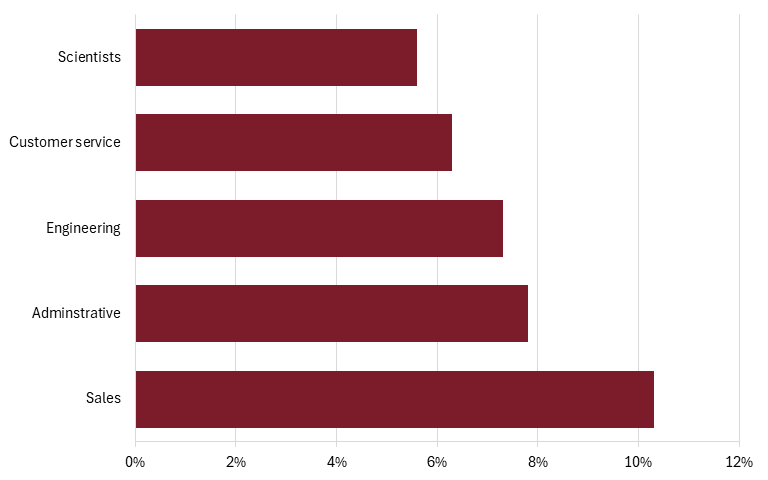
When disaggregated, AI adoption drives employment growth across a broad range of occupations. Sales employment increases by 10.3 percent, administrative positions by 7.8 percent, engineering by 7.3 percent, customer service by 6.3 percent, and scientists by 5.6 percent. (See Figure 1.) Operations is the only occupational category that does not experience employment growth. Together, these findings show that intensive AI adoption enables firms to expand rather than shrink their workforce.
Figure 1: Percentage increase in headcount of firms with high-intensity AI adoption over 24 months after sustained AI adoption, by occupation
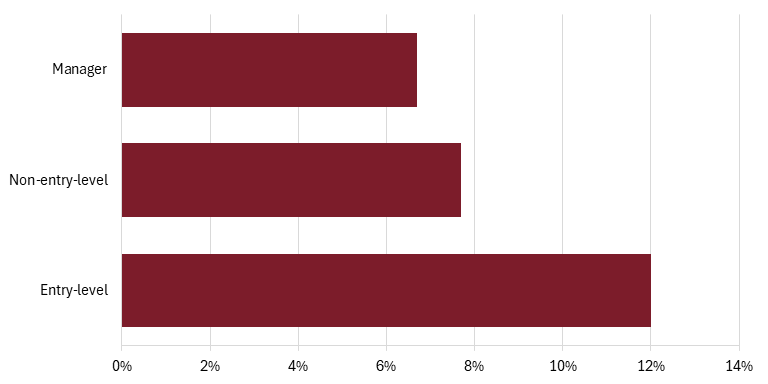
Moreover, the study also directly contradicts one of the most common criticisms of AI: it disproportionately replaces junior workers. According to the study, "The high-intensity coefficient for entry-level headcount is 0.113, or a 12.0 percent increase after adoption, and statistically significant at the 1 percent level.” In other words, if AI replaced entry-level workers as many critics suggest, firms adopting AI most aggressively would hire fewer of them. Instead, they hire substantially more. High-intensity AI adopters also expanded employment among experienced workers and managers. Non-entry-level employment increases by 7.7 percent, while manager-level employment rises by 6.7 percent. (See Figure 2.) As such, AI is not destroying entry-level or non-entry-level employment.
Figure 2: Percentage increase in headcount of firms with high-intensity AI adoption over 24 months after sustained AI adoption, by job level
The benefits of AI also extend well beyond the firms that adopt it. At the broader economic level, AI raises productivity, and higher productivity has long driven employment growth and rising living standards. As ITIF has explained, automation increases productivity, allowing firms to lower prices, raise wages, or both. Lower prices leave consumers with more disposable income, while higher wages increase purchasing power. In either case, consumers and businesses spend and invest more, creating demand for workers throughout the broader economy.
Consider the legal profession. If AI automates many routine legal tasks, legal services become less expensive. Consumers then have more money to spend elsewhere, whether on restaurant meals, home renovations, health care, or recreation. Businesses in those sectors hire additional workers to meet rising demand, creating new employment opportunities that offset job displacement in legal services. This dynamic explains why studies have found little evidence that technology-driven automation leads to net negative employment over the long run. In fact, some studies find the opposite. Productivity growth expands economic output, increases incomes, and ultimately supports higher employment.
Recent evidence reinforces these conclusions. An ITIF analysis found that AI created approximately 119,900 jobs in 2024 while contributing to only 12,700 layoffs, which accounted for just 0.1 percent of all layoffs that year. The available evidence therefore contradicts claims that AI is causing widespread unemployment.
Rather than slowing AI deployment because of speculative fears, policymakers should make AI adoption a national priority. The United States faces intense global competition with China, and the country that diffuses AI most rapidly throughout its traded sectors will enjoy faster productivity growth and greater competitiveness. Congress should work with the administration to pursue a national AI adoption plan that leverages all available tools— tax policy, trade policy, R&D spending, workforce training, regulatory streamlining, and digital infrastructure investment—to encourage more firms to integrate AI into their operations.
Policymakers should also actively push back against the narrative that AI inevitably destroys jobs. Unfounded public concern about AI is becoming a barrier to adoption and the policies that support it. When workers believe AI will eliminate employment opportunities, they will naturally become more resistant to the technology, opposing everything from data centers to workplace adoption. In sum, if policymakers want stronger economic growth and greater U.S. competitiveness, they should focus less on slowing AI and more on ensuring that every American business has the tools and resources to adopt it.
Related
December 18, 2025
AI’s Job Impact: Gains Outpace Losses
June 5, 2025
