

China Now Produces Nearly One-Quarter of Global Output in Advanced Industries, New ITIF Report Finds
WASHINGTON—China now produces nearly one-quarter of global output across the world’s most advanced industries, extending its lead over the United States and other major economies, according to a new report from the Information Technology and Innovation Foundation (ITIF).
The Hamilton Index, 2026 finds that China is steadily gaining ground across high-value, innovation-driven sectors—raising concerns about the erosion of Western industrial leadership and the long-term implications for economic strength, supply chains, and national security.
“China is increasingly dominating the world’s advanced industries, and its gains are coming at the expense of the United States and its traditional allies in the West,” said Robert D. Atkinson, a senior fellow and founder of ITIF. “If current trends continue, this erosion of the West’s industrial leadership will define future economic and military power.”
To assess U.S. and other nations’ performance and global competitiveness, ITIF uses the latest OECD data on trade in value added to analyze countries’ relative levels of industrial concentration and global market shares in 10 advanced industries, which it aggregates into the Hamilton Index of Advanced-Technology Performance. The 10 industries include information technology (IT) and information services; computers, electronics, and optical products; chemicals (not including pharmaceuticals); machinery and equipment; basic metals; motor vehicles; fabricated metals; pharmaceuticals; electrical equipment; and other transportation equipment.
The new report is the latest update of ITIF’s Hamilton Index, following the first edition in 2022 and the second in 2023. It is accompanied by three data visualization tools covering the entire dataset.
“Since 1995, China’s share of global output in advanced industries has surged from 3.5 percent to nearly 25 percent,” said Meghan Ostertag, who led the study. “Across all 10 industries, China’s output has grown by at least 1,750 percent—and more than 2,200 percent on average—compared to roughly 200 percent growth in the United States.”
China’s gains have been broad and sustained. It is now the world’s leading producer in 7 of the 10 advanced industries ITIF tracked and has increased its market share at least threefold in every sector. In several core industries, including chemicals, machinery, and electrical equipment, China accounts for nearly a quarter of global output.
China’s dominance reflects not just the rapid growth of its overall economy but also the relative concentration of advanced industries as a share of its economy—a standard analytical measure known as a “location quotient” (LQ). ITIF’s analysis shows China’s economy performs 36 percent above the global average level of concentration in advanced industries (an LQ of 1.36), whereas the U.S. economy falls 12 percent below the global average (an LQ of 0.88).
Among the report’s other key country-level findings:
- Fifteen countries overperformed in the composite Hamilton Index in 2022, led by Taiwan with an LQ of 2.63, driven largely by its semiconductor strength in computers and electronics.
- South Korea ranked second overall with an LQ of 2.17, reflecting strong specialization across multiple advanced industries, including electronics, vehicles, and machinery.
- Vietnam ranked third with an LQ of 1.82, standing out among developing nations due to rapid growth in computers and electronics manufacturing.
- Vietnam saw the largest increase in LQ from 2013 to 2022, rising 44 percentage points, followed by Taiwan and Israel.
- Several emerging economies—including Poland, Mexico, and Turkey—posted moderate gains, while the United States, Canada, and Japan experienced declines in relative performance.
- To reach an LQ of 1, U.S. advanced industry output would have needed to be $370 billion higher in 2022—a 14 percent increase.
- Although China’s LQ declined over the past decade, its output continued to grow rapidly, outpacing the United States, OECD, and global average.
- China now accounts for 24.9 percent of global advanced industry output, compared to 22.3 percent for the United States.
China’s growth reflects a long-term industrial strategy. Since 2018, its advanced industry output has grown more than 26 percent, compared to 15.6 percent globally. Excluding IT services—where the United States remains strongest—the rest of the world grew just 11.4 percent, underscoring China’s dominance in manufacturing-intensive sectors.
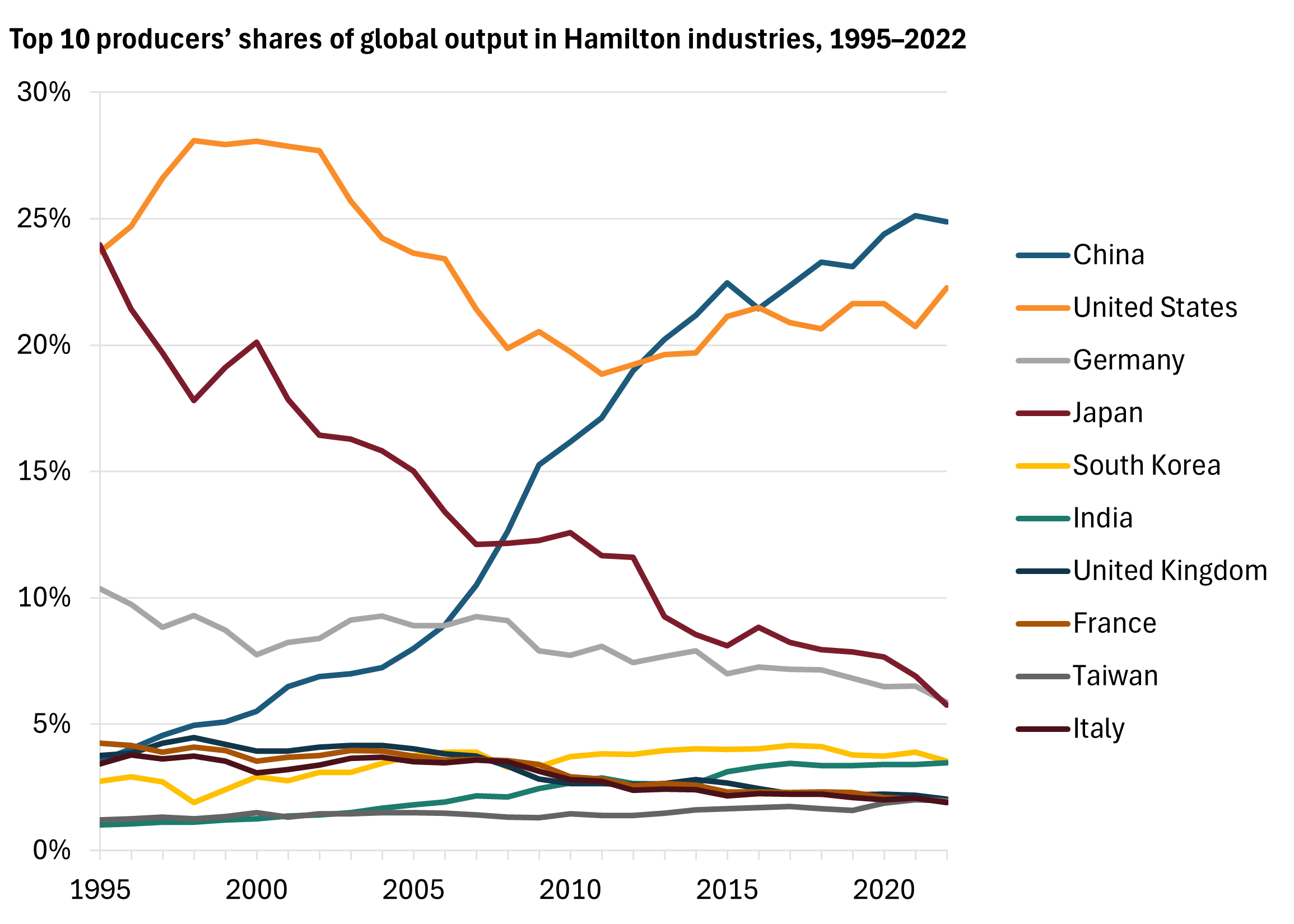
The gap with the United States is widening. Outside of IT and information services, other transportation, and pharmaceuticals, China holds a larger global market share in every advanced industry. In sectors such as basic metals and machinery, China’s output has grown several times faster than America’s.
The scale of the gap is substantial. To match China’s level of industrial intensity, the United States would have needed to increase advanced industry output by nearly $1.5 trillion in 2022 alone—a 56 percent increase. That would require nearly doubling IT services output, quadrupling computers and electronics production, or increasing pharmaceutical output sixfold.
China’s rise has coincided with a sharp decline in the OECD’s industrial position. The bloc’s share of global advanced industry output fell from 86 percent in 1995 to 58 percent in 2022—a 28 percentage-point drop. Losses were especially pronounced in basic metals and electrical equipment, where market share fell by more than 40 percentage points.
At the same time, advanced industry production is shifting toward the developing world. Non-OECD countries increased their global market share by more than 28 percentage points since 1995, although most of that growth came from China. Excluding China, their share still rose nearly 7 percentage points, driven by gains in heavy manufacturing and electronics.
Industry-level highlights:
- China leads in 7 of the 10 advanced industries and dominates global production in manufacturing-intensive sectors.
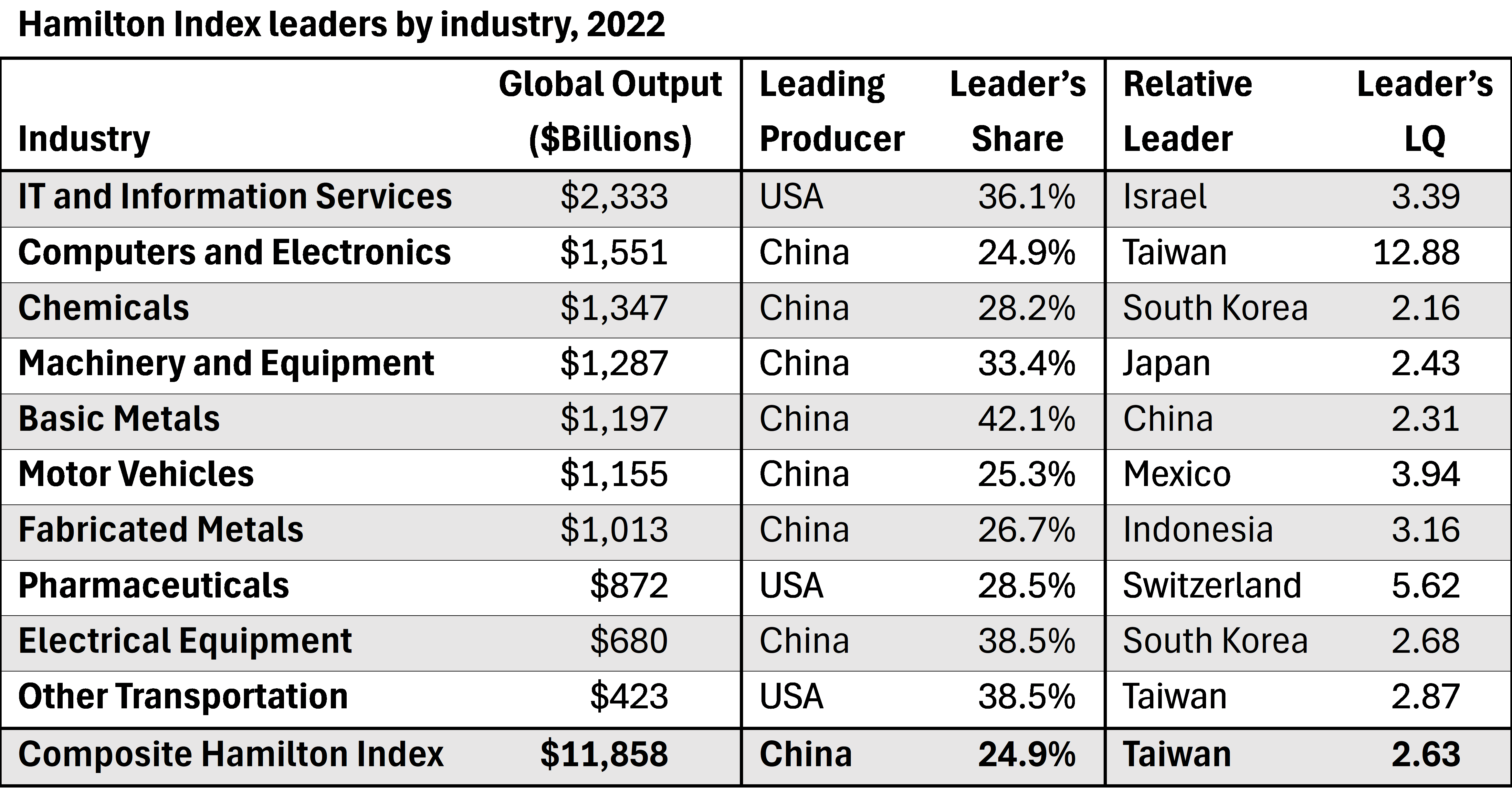
- The United States leads in IT and information services with 36.1 percent of global output, while Israel is the top relative performer with an LQ above 3.
- In computers and electronics, China holds 24.9 percent of global output, while Taiwan is the top relative performer with an LQ of 12.88.
- In chemicals, China leads in absolute output, accounting for more than 28 percent of global market share, while South Korea is the top relative performer.
- In machinery and equipment, China holds over one-third of global output, while Japan and Germany lead in relative specialization.
- In basic metals, China controls more than 40 percent of global output, making it the dominant global producer by a wide margin.
- In motor vehicles, China leads globally, driven in part by rapid growth in electric vehicles, while Mexico is the top relative performer.
- In fabricated metals, China leads in output, while countries such as Indonesia show strong relative specialization.
- In pharmaceuticals, the United States remains the global leader, while Switzerland is the top relative performer by a wide margin.
- In electrical equipment, China accounts for nearly 40 percent of global output, far ahead of other nations, while South Korea leads in relative performance.
- In other transportation, the United States leads by a wide margin, controlling 37.6 percent of global market share, while Taiwan leads in relative performance with an LQ of 2.87.
For the United States and its allies, the implications are clear: This is not just about trade. It is about losing ground in the industries that underpin innovation, economic strength, and national security. Without a coordinated strategy to scale advanced industry production, the gap with China will continue to grow.
- Read the report.
- Browse the data visualization tool for industries.
- Browse the data visualization tool for countries.
- Browse the data visualization tool showing momentum.
Contact: Sydney Mack, [email protected]
###
The Information Technology and Innovation Foundation (ITIF) is an independent, nonprofit, nonpartisan research and educational institute focusing on the intersection of technological innovation and public policy. Recognized by its peers in the think tank community as the global center of excellence for science and technology policy, ITIF’s mission is to formulate and promote policy solutions that accelerate innovation and boost productivity to spur growth, opportunity, and progress.
