


E-Commerce Is Fighting Retail Crime—Governments Should Do More
Organized retail crime (ORC) refers to coordinated theft and fraud schemes in which groups systematically steal goods—often in bulk—and resell them through secondary channels, including online marketplaces. Unlike opportunistic shoplifting, ORC involves organized networks that manage sourcing, logistics, and resale, and may intersect with other illicit activities such as money laundering. As retail commerce has shifted online, these networks have increasingly used e-commerce platforms to scale distribution.
Several large platforms have invested in enforcement capabilities and, in some cases, publish data on their efforts. These disclosures provide useful insights into the scale and persistence of ORC activity.
Amazon provides the most detailed public reporting. In its 2025 brand protection report, the company states that its Counterfeit Crimes Unit (CCU)—a team that investigates and refers counterfeiters for civil litigation or criminal enforcement—seized more than 15 million counterfeit products in 2025. Since 2020, the CCU has pursued more than 32,000 bad actors across 14 countries through lawsuits and referrals to law enforcement. Year-to-year increases in seizures and enforcement actions, shown in Figure 1, likely reflect multiple factors, including expanded internal enforcement capacity and continued growth in e-commerce.
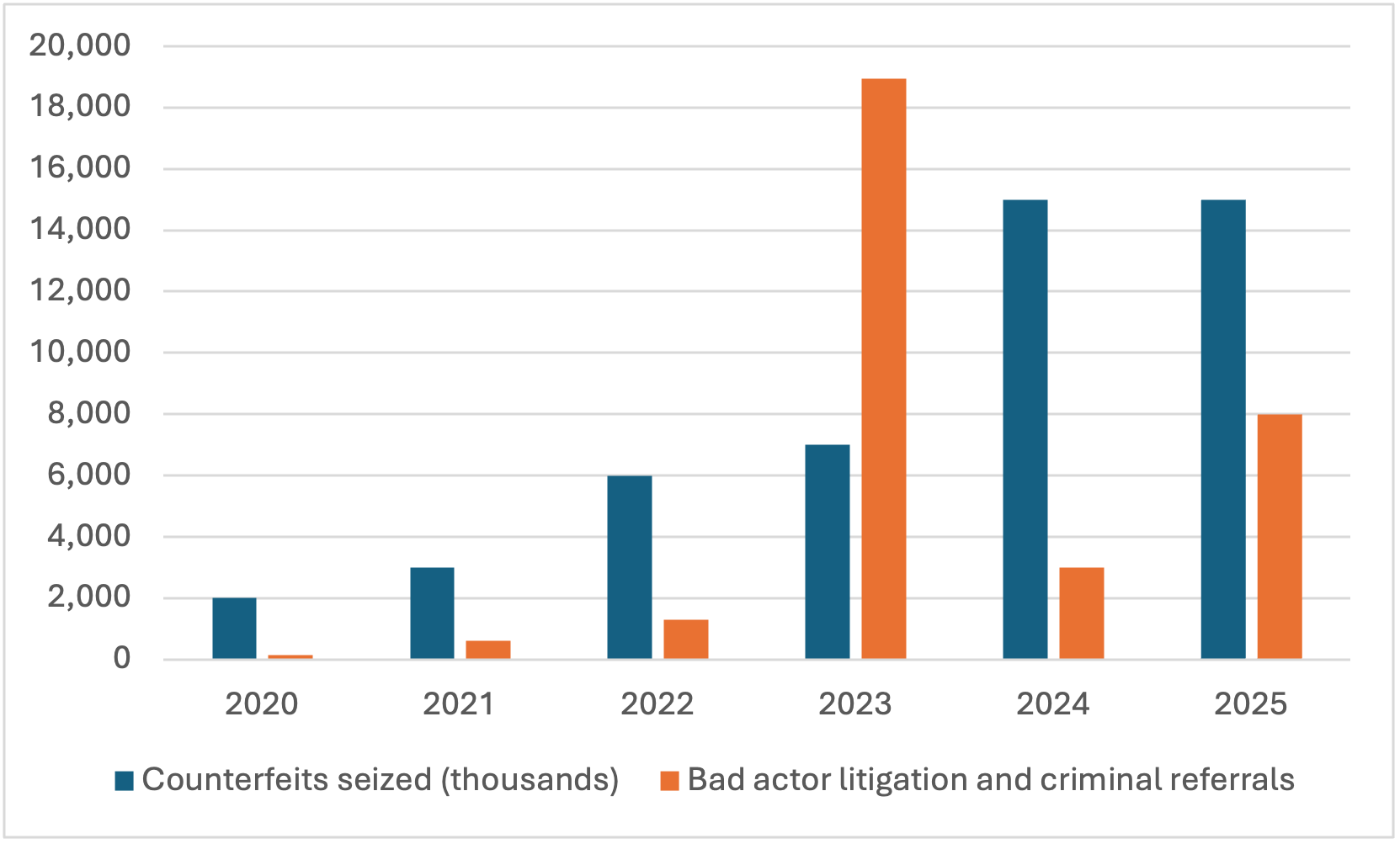
External data points reinforce that the problem remains significant. The Organisation for Economic Co-operation and Development (OECD) estimates that counterfeit goods account for roughly 2 to 2.5 percent of global trade, with total volumes rising alongside trade growth. The National Retail Federation reports that most retailers observed increases in online ORC-related theft in the past year.
eBay, Mercado Libre, and Alibaba Group have published more limited disclosures about ORC. For example, eBay has disclosed receiving tens of thousands of subpoenas, warrants, and data requests from law enforcement annually, suggesting substantial investigative activity tied to marketplace misuse. Mercado Libre and Alibaba report seizures and enforcement collaborations with authorities, though typically without standardized or longitudinal detail. Platforms also rely on automated systems to detect suspicious listings and seller behavior. Reported “proactive detection” rates indicate internal enforcement capacity but do not measure the full scope of undetected activity.
Some firms have expanded disclosure in response to regulatory scrutiny in specific markets. For example, AliExpress has released localized intellectual property (IP) protection reports following scrutiny from regulators in South Korea. However, such disclosures are not consistently available across jurisdictions or languages, which limits their value for comparative analysis. Where platforms publish detailed, recurring data—covering seizures, enforcement actions, and cooperation with law enforcement—they provide a meaningful public resource. These reports improve visibility into how ORC operates online. However, voluntary transparency by the private sector does not replace law enforcement capacity.
ORC is a law enforcement problem that increasingly operates across jurisdictions and through digital channels. Platforms can detect, disrupt, and refer cases, but they cannot investigate or prosecute criminal networks. U.S. policy should therefore focus on strengthening enforcement and coordination. Congress should expand funding for multi-agency efforts targeting organized theft and resale networks, including those operating online. Policymakers should also improve public-private information sharing by establishing structured mechanisms for platforms to share relevant data with law enforcement, subject to appropriate legal safeguards. In addition, policymakers should convene joint workshops with major platforms, researchers, and law enforcement agencies to develop voluntary, standardized reporting frameworks. Consistent metrics would make existing disclosures more comparable and more useful for policy analysis.
Some e-commerce platforms have made significant investments in combating ORC and have begun to publish data on those efforts. These initiatives are valuable, but they do not alter the underlying division of responsibility. Addressing organized criminal networks requires sustained public-sector enforcement. Governments should treat platform transparency as a complement to, not a substitute for, building that capacity.
