


CPSC Is Tough on Chinese Factories, but Should Get Tough on Chinese Platforms Too
The Consumer Product Safety Commission (CPSC) exists to protect American consumers from dangerous products. Its main tools to accomplish this mission are warnings and recalls, and by design, those actions are supposed to follow risk wherever it appears. Yet CPSC increasingly focuses on Chinese manufacturers while its attention to Chinese platforms remains limited. This is a mistake. Chinese online marketplaces are popular with American consumers and have repeatedly demonstrated poor product safety track records. The CPSC should subject foreign platforms distributing unsafe goods to the same scrutiny as the overseas factories that produce them.
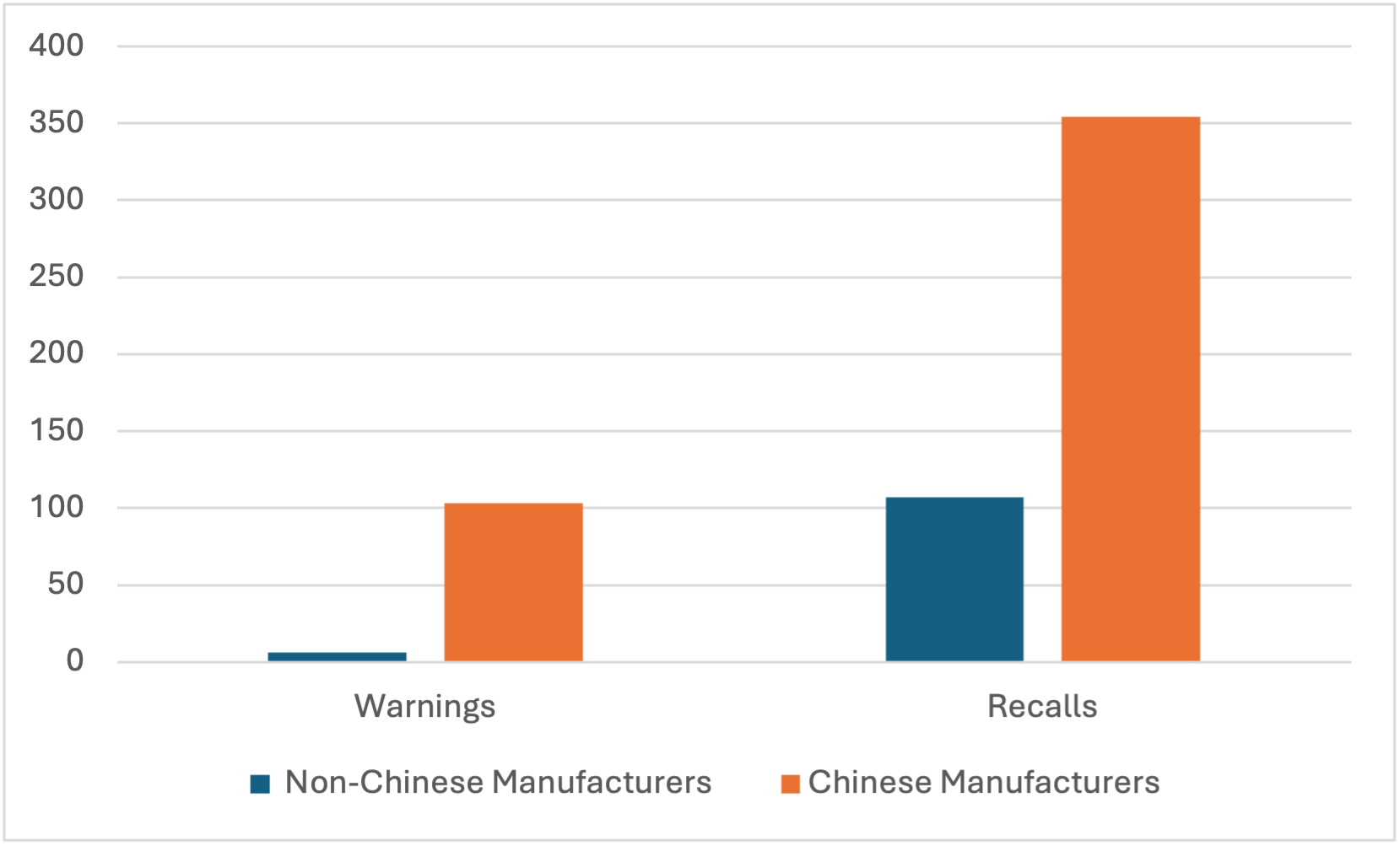
Between April 2025 and April 2026, the overwhelming majority of CPSC-recalled or warned products were manufactured in China or in China alongside another country, as seen in Figure 1. This trend is not new. According to CPSC’s own estimates, between 2017 and 2026, Chinese imports accounted for 33 percent of all imported consumer products under CPSC jurisdiction, but more than 75 percent of violations.
However, over the same period, only a small fraction of CPSC warnings or recalls were tied to listings on Chinese platforms, as seen in Figure 2.
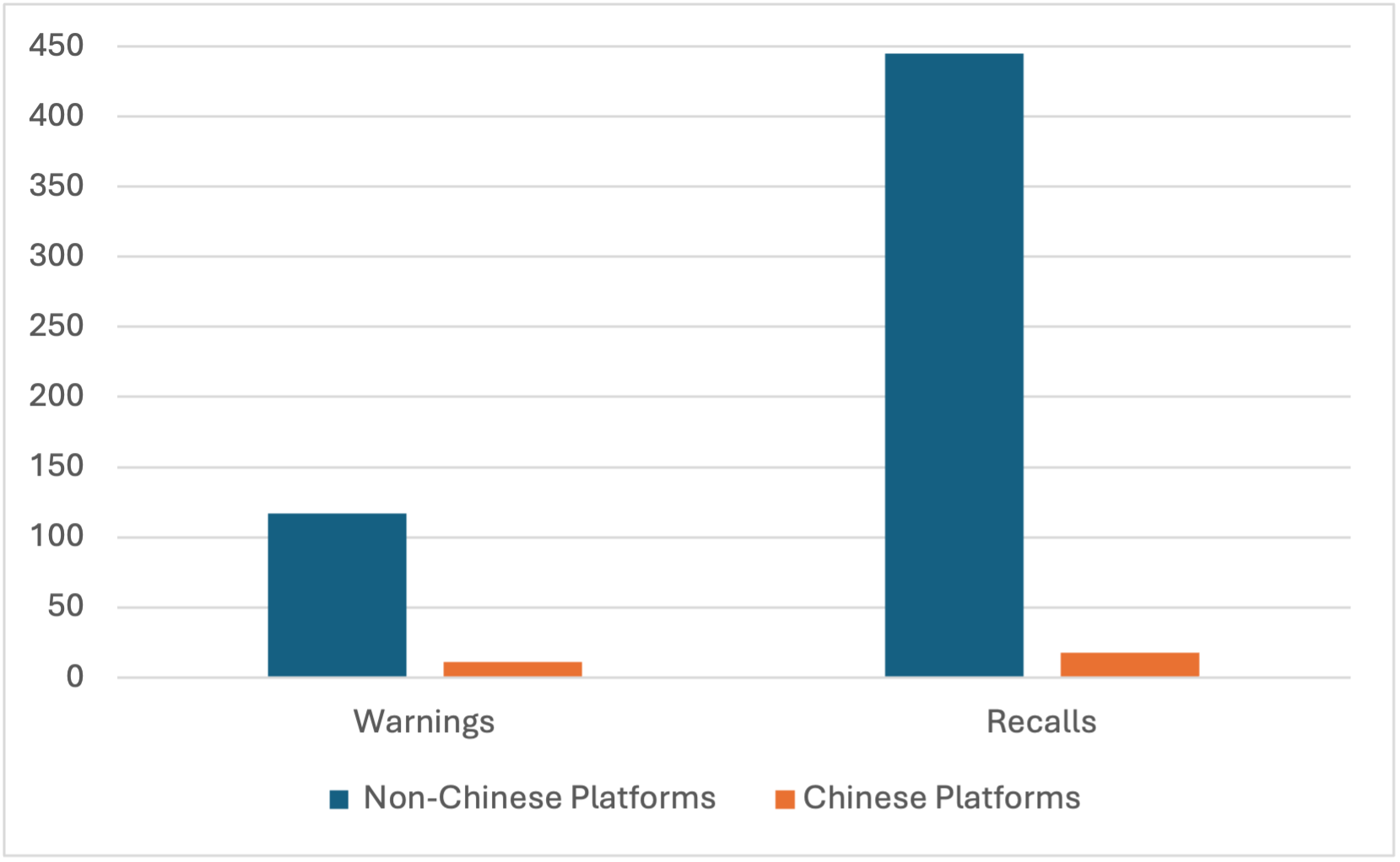
Since CPSC aims to “retrieve as many hazardous products from the distribution chain and from consumers as is possible,” the commission should warn about or recall more products from where consumer exposure is greatest. In 2025, four Chinese online marketplaces—Temu, Shein, AliExpress, and Alibaba.com—were among the top 10 shopping apps by downloads in the United States, with Temu and SHEIN taking the top two spots. By the end of the year, Temu’s U.S. install base was 91.9 million, and SHEIN’s was 63.3 million.
The mismatch between Chinese online marketplaces’ scale and CPSC’s lack of enforcement would be less concerning if these platforms had strong product safety records, but they do not.
A recent Toy Association study of products purchased from SHEIN and Temu found that 89 percent of the toys tested presented significant safety concerns, and over 70 percent of toys failed at least one laboratory safety test. One SHEIN-listed musical toy set marketed to children between the ages of 0 and 3 years old included contradictory age warnings and failed multiple mandatory safety tests, including choking, strangulation, and impact hazard standards.
There is also evidence that Chinese online marketplaces are aware of these problems. Reporting by The Information in 2024 indicated that U.S.-based SHEIN employees raised internal concerns about product safety and noted that “executives based in China don’t always heed their concerns.” This is likely not because Chinese firms are indifferent to product safety. China’s domestic product safety enforcement laws are, in some places, more stringent than the United States’ laws.
A more plausible explanation is that China’s e-commerce industrial policy encourages Chinese international-facing online marketplaces like SHEIN to prioritize rapid growth and global market share. Building an ample product safety system across complex global supply chains requires platforms to substantially invest in compliance, testing, traceability, and enforcement. Platforms prioritizing rapid growth face incentives to underinvest in these systems, particularly in export markets.
CPSC appears to recognize the issue. In 2024, CPSC commissioners stated that the commission would evaluate how SHEIN, Temu, and other foreign e-commerce platforms comply with the Consumer Product Safety Act (CPSA), the statute that defines CPSC’s authority. More recently, CPSC announced plans in its Fiscal Year 2026 Operating Plan to “deepen its oversight of e-commerce platforms,” including “foreign-owned platforms that sell directly to U.S. consumers.”
This additional oversight is necessary. While both SHEIN and Temu have, in the past, shown a willingness to collaborate with CPSC, that does not mean they have robust product safety enforcement, nor that they are in perfect compliance with the CPSA. For example, Temu failed to delist a drill six months after CPSC warned the product could fatally explode. Chinese online marketplace product safety risks extend beyond child safety, as seen through Temu’s listing of counterfeit dog food linked to severe vomiting.
Recently, CPSC has taken steps toward an artificial intelligence-driven enforcement model. That is a welcome development, and ideally, CPSC will one day detect unsafe products before they ever reach a consumer’s home. But in the meantime, the commission needs to focus on where unsafe goods are being sold.
Closing this gap does not require new legislation. In 2024, CPSC established that e-commerce platforms can qualify as “distributors” under the CPSA, which means they bear responsibility for the safety of products they help place into the market. With that remit, the commission should take two steps in 2026.
First, CPSC should publish platform-level safety performance data. In July 2026, the commission plans to implement its eFiling system, which will require importers of regulated consumer products to file certain data elements with Customs and Border Protection. This system will theoretically give CPSC access to real-time data on product compliance and import flows.
To the extent that CPSC can cross-reference eFiling data with marketplace listings, CPSC should use that data to identify which platforms are repeatedly connected to noncompliant or hazardous products. It should then publish platform-level performance metrics, including recalls, violations, and risks tied to children’s products, tracked over time on a rolling multi-year basis for statistical reliability. Transparency will give consumers better information and create incentives for platforms to improve.
Second, CPSC should integrate platform-level risk into its Risk Assessment Methodology (RAM), which determines which shipments and products the commission inspects, and which CPSC has identified as a priority for improvement. While CPSC has begun to acknowledge e-commerce risks, its RAM targeting still largely traces risk back to manufacturers. That approach ignores how products reach consumers.
CPSC should treat platforms as core nodes in the distribution chain and use platform track records to guide its RAM to better concentrate its limited shipment and product surveillance resources. Products sold on a popular platform with a history of safety violations warrant more scrutiny than products sold on a niche platform with a strong track record. Platforms such as Chinese online marketplaces that combine massive scale with weak safety controls should face the highest level of scrutiny.
To protect American consumers, CPSC should treat Chinese online marketplaces as high-risk distribution nodes and target them accordingly.
Related
August 20, 2025
How Chinese Online Marketplaces Fuel Counterfeits
April 4, 2025
