


USTR Should Count Search Indexing Evasion as Notorious Market Conduct
In today’s online apparel market, Chinese marketplaces often allow sellers to rip off independent designers and sell cheaper versions of their products, harming many American businesses. Concerningly, some of these platforms make it harder for businesses to detect counterfeits by limiting search engines’ ability to index their sites.
Take SpiritHoods, for example. Founded in 2009, the American small business gained fame after appearing on Shark Tank in 2013 for its faux fur products, which carry “the spirit of the wild” without using real animal fur. SpiritHoods also donates 10 percent of its profits to conservation efforts supporting endangered species.
The company sells the “Grey Wolf” version of its “Hooded Women’s Faux Fur Coat” for $449 (shown in Figure 1).
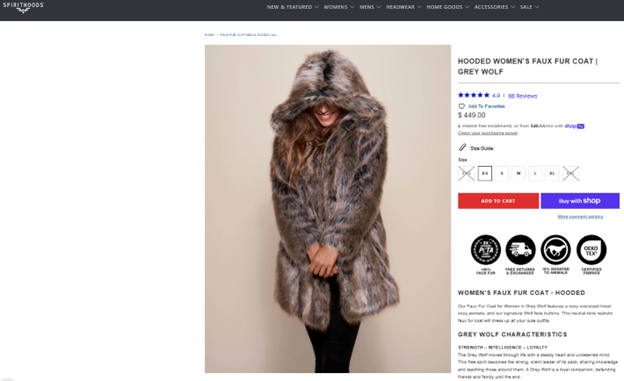
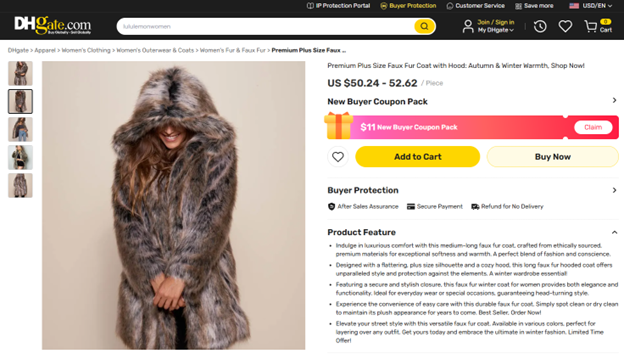
A reverse image search of this product’s official image on Google produces links to SpiritHoods’ official website and its official Amazon storefront. It also reveals links for the same product sold by likely counterfeiters at a fraction of SpiritHoods’ listed price. On eBay, the China-based seller “kiader” lists a product using SpiritHoods’ official photo for $67.47. Among the reverse image search results, the Chinese platform DHgate has the most listings, with their China-based seller “girl_legend” listing a similar product for $52.62 (shown in Figure 2).
However, two of the most popular international-facing Chinese e-commerce platforms—Temu and AliExpress—do not appear in the results.
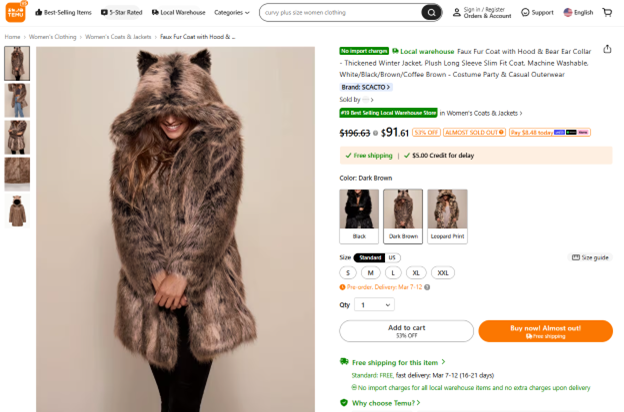
Their absence is not because these platforms do not fuel the counterfeit economy—they do. Instead, it is likely that these online marketplaces limit search engines from indexing their websites. For example, on Temu, the China-based seller “Global Preference Mall” lists a product using an altered version of SpiritHoods' photo for $91.61 (shown in Figure 3). AliExpress also has listings that appear to use SpiritHoods product images.
Platforms can use various technical measures to restrict crawling. One method is to explicitly disallow search engines from crawling product images in the site’s robots.txt file, a publicly posted instruction file that tells crawlers which parts of a website they are permitted to index. Another is to embed “noindex” tags in the HTML headers of product listing pages, which similarly instructs crawlers to skip that content. Sites can also block crawlers using technical measures such as IP filtering or CAPTCHAs, which requires humans to solve a puzzle, preventing automated access.
The evidence is clear. For example, an AliExpress listing appears to use a photo taken from an official SpiritHoods product listing. However, the product page itself does not appear to be indexed by Google, as demonstrated through a site-specific search query. AliExpress hosts that image on a separate domain that returns only two Google-indexed results in the past year and none on Bing. Similarly, Google and Bing return only a few results for the domain Temu uses to host its images. By comparison, many major U.S. marketplace image-hosting domains return thousands of indexed results at the time of review.
In contrast to AliExpress and Temu, U.S. retailers with online marketplaces do not appear to restrict search engine indexing of their product images. For example, a Google reverse image search of a photo of Scott toilet paper reveals results from Walgreens, The Home Depot, Amazon’s official Scott storefront, and many other retailers. Scott is owned by Kimberly-Clark, a U.S. company that manufactures domestically. Temu and AliExpress appear to offer the same product, but those listings do not surface in reverse image search results. Neither Chinese platform listing is sold through an official Scott storefront, and AliExpress’s China-based seller lists its product at $2.16—less than half of the product’s typical $5.00 price.
One of the most powerful tools that companies have to detect intellectual property (IP) violations is reverse image search. When a rights holder discovers a listing using its product photos without permission, it can report directly to the platform or file a takedown request under the Digital Millennium Copyright Act (DMCA). The DMCA allows copyright owners to submit formal notices to online platforms demanding the removal of infringing content. But to take either action, a rights holder first must find the infringing listing, and reverse image search is one of the most effective ways to do so.
While it is possible to find listings with infringing images on Temu and AliExpress, doing so without reverse image search is much more difficult because counterfeit sellers tend to remove the legitimate brand’s name from listings. Moreover, regularly searching manually for infringing images is not feasible for most companies, especially those monitoring hundreds of products. This practice also further undermines product safety by preventing consumer safety regulators from efficiently monitoring these platforms for products identified as having safety defects.
Temu and AliExpress surely have many reasons for limiting the reverse image searchability of their listings, and nothing about their indexing practices is necessarily illegal. Online marketplaces design their underlying code to achieve various goals, such as improving search engine optimization for customer visibility, conserving server resources, and setting permissions that control how bots, like large language models, access listings.
AliExpress and Temu would likely argue that they already provide robust brand-protection tools. AliExpress claims that 99 percent of notice-and-takedown requests are processed within 24 hours through Alibaba’s International Intellectual Property Protection Platform. Temu operates an IP Portal and Brand Registry Portal, allowing rights holders to submit takedown requests, track complaints, and streamline repeat filings. Yet these tools depend on rights holders first detecting infringing listings—which in part relies on the ability to reverse image search.
While both platforms have effectively limited external usage of reverse image search, they use similar tools internally. AliExpress deploys image recognition technology that “combines confirmed cases of image infringement with factors such as SKUs (stock keeping units) and keywords to proactively remove counterfeit listings.” Temu states that its anti-counterfeiting image recognition technology “allows detection of subtle or modified brand marks, supported by high-precision data annotation.” However, these capabilities emphasize the detection of trademarked identifiers, such as brand logos, rather than copyrighted images protected under U.S. law even if they do not contain visible trademarks. This renders AliExpress and Temu’s anti-counterfeiting tools narrower in scope than their descriptions suggest.
Ultimately, when design and enforcement choices systematically reduce transparency and make it materially harder for rights holders, journalists, and regulators to detect counterfeiting, those choices become relevant to policy. Without identification, aided through reverse image searches, platform takedown requests or DMCA notices cannot occur. And without such notice, infringing listings remain live, undermining the effectiveness of the DMCA.
For SpiritHoods, the result is lost sales. For conservation groups, the result is reduced donations; Temu’s China-based “Global Preference Mall” is unlikely to donate any profits from its product using SpiritHoods’ photo. But the biggest impact, whether intentional or not, is that blocking reverse image searches shields infringing sellers from scrutiny.
The Office of the United States Trade Representative (USTR) is set to release its 2025 Notorious Markets List (NML). The list will identify online and physical marketplaces that “engage in, facilitate, turn a blind eye to, or benefit from substantial piracy or counterfeiting.” While the list does not create legal penalties, it serves as a formal signal that a platform poses systemic IP risks.
USTR should list both AliExpress and Temu in its forthcoming NML for turning a blind eye to and benefiting from substantial counterfeiting. Regardless of this year’s outcome, USTR should also consider search engine indexing transparency as an additional criterion of notoriety in future NMLs. This would help ensure that platforms benefiting from access to U.S. consumers operate under principles of transparency that allow IP enforcement to function effectively.
Editor's note: This article was updated on March 4, 2026, to clarify the distinction between image hosting domains and page-level search indexing.
Editors’ Recommendations
August 20, 2025
How Chinese Online Marketplaces Fuel Counterfeits
June 11, 2025
