


AI Is a Productivity Engine for the U.S. Economy
In recent months, critics of artificial intelligence (AI) have increasingly argued that the technology threatens the economy by destroying jobs, exacerbating income inequality, and even catastrophically collapsing consumer demand. These misguided fears underpin calls to pause AI development and deployment, enact a moratorium on data center construction, and impose sweeping regulatory constraints that would undermine innovation, investment, and U.S. technological competitiveness. Yet the reality is that AI offers enormous economic benefits.
AI could bolster U.S. productivity and, in turn, strengthen the country’s global competitiveness. Like other nations that are aggressively investing in and deploying these technologies, the United States should do the same. AI should be viewed as a strategic capability that can enhance productivity, expand innovation capacity, and support long-term economic growth. To realize these benefits, policymakers should accelerate AI adoption across the economy by encouraging firms and workers to integrate AI into everyday tasks while actively rebutting exaggerated claims about AI-driven job loss and societal harm.
The empirical evidence supporting AI’s productivity benefits is substantial and growing. For instance, the Organization for Economic Co-operation and Development (OECD) has reviewed a wide range of experimental studies on generative AI and finds consistent evidence that these tools improve productivity, support innovation, and enable new entrepreneurial activity. Similarly, a study by Song et al. using GitHub Copilot data finds that AI-assisted software development increases project-level code contributions by 5.9 percent, driven by both higher individual output and greater developer participation. Another study by Cui et al. finds that developers using generative AI complete roughly 26 percent more tasks. Likewise, a study highlighted by the Massachusetts Institute of Technology shows that, when used within its capabilities, generative AI can increase the performance of highly skilled workers by nearly 40 percent.
These gains extend across sectors. Indeed, a recent National Bureau of Economic Research study concluded that “labor productivity gains [from AI] are positive, vary across sectors, and are expected to strengthen in 2026, with the largest effects concentrated in high-skill services and finance.” As a result, at the macroeconomic level, economists at Goldman Sachs estimate that widespread AI adoption could increase annual productivity growth by between 0.3 and 3.0 percentage points over the following decade, with a midpoint estimate of 1.5 percentage points. Such an increase would represent a meaningful acceleration relative to recent productivity trends.
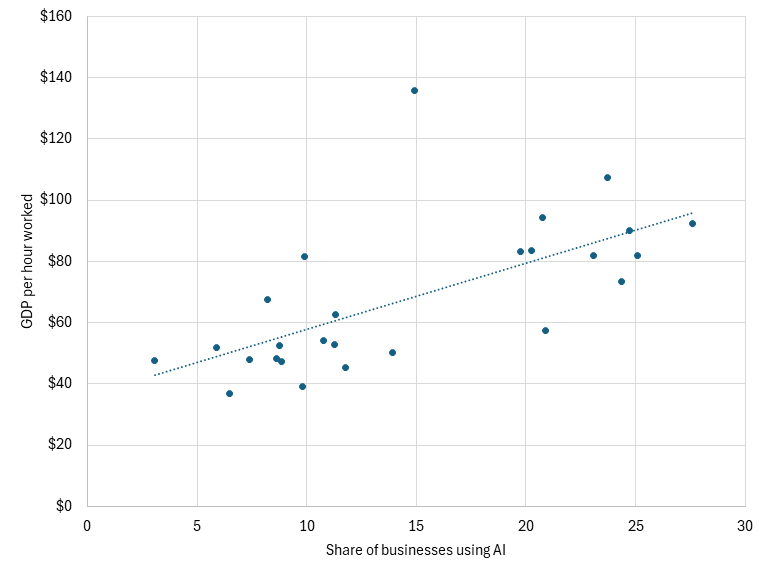
Cross-country evidence further supports the link between AI adoption and economic performance. Using OECD data on business AI usage and productivity, ITIF finds a consistently positive relationship between the share of firms using AI and a country’s GDP per hour worked. Between 2020 and 2024—excluding 2022 due to data limitations—the correlation ranged from 0.32 to 0.66. For example, in 2024, the correlation coefficient between business AI usage and productivity was 0.66. (See figure 1.) Put simply, countries with higher levels of AI adoption tend to exhibit higher productivity.
Figure 1: Correlation between the share of all businesses using AI and GDP per hour worked in 26 OECD nations, 2024 (2020 U.S. dollars, PPP converted)
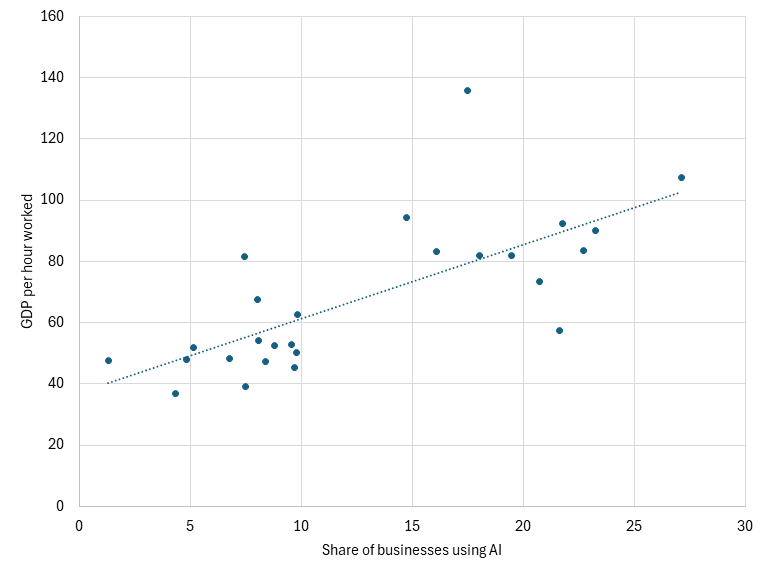
This relationship is also evident in manufacturing. From 2020 to 2024 (excluding 2022), the correlation between AI adoption among manufacturing firms and national productivity ranged from 0.36 to 0.72. In 2024, the correlation coefficient was 0.72. (See figure 2.) These findings underscore that AI is not confined to digital industries but is increasingly central to productivity growth in traditional sectors as well.
Figure 2: Correlation between the share of manufacturing firms using AI and GDP per hour worked, 2024 in 26 OECD nations, 2024 (2020 U.S. dollars, PPP)
The policy implications are straightforward. Policymakers should accelerate AI adoption across the economy by encouraging firms and workers to integrate AI into everyday tasks. They should also encourage experimentation with new use cases, promote the diffusion of best practices, and invest in workforce training that enables workers to use AI effectively on the job. The largest gains from general-purpose technologies such as AI come from widespread adoption alongside complementary innovations. At the same time, policymakers should actively rebut exaggerated claims about AI-driven job loss and societal harm by emphasizing the growing body of empirical evidence showing that AI boosts productivity and drives job transformation, not wholesale displacement.
In an era of intensifying technological competition, particularly with China, the greatest risk is not that AI advances too quickly, but that the United States underutilizes it. Indeed, while the United States leads in AI infrastructure and frontier model development, it ranks surprisingly low in AI adoption among the working-age population. According to a report by Microsoft, in 2025, the United States fell from 23rd to 24th place globally in AI usage, with only 28.3 percent of working-age Americans regularly using AI tools. In contrast, South Korea, despite having a much smaller economy, rapidly increased its AI adoption rate from 25.9 percent to 30.7 percent in just half a year, surpassing the United States and illustrating how quickly other nations are integrating AI into everyday economic activity. These trends underscore the urgency for policymakers to promote broader AI adoption and acceptance across the economy for policymakers, particularly given AI’s benefits for productivity and competitiveness.
Related
April 8, 2025
AI Can Improve US Small Business Productivity
December 15, 2025
