

How to Align Incentives to Accelerate Spectrum Productivity
Timing mismatches hamper otherwise mutually beneficial spectrum reallocation processes. Dominant assurance contracts can resolve these mismatches and enhance the overall productivity of spectrum resources.
KEY TAKEAWAYS
Key Takeaways
Contents
Newcomers are Willing to Pay 3
Dominant Assurance Contracts: Aligning Incentives, Time, and Money 4
Introduction
Productive use of the airwaves is essential to not only everyday wireless services but also national leadership in wireless technologies. Therefore, technological and policy mechanisms that enhance the productivity of spectrum are important pieces of the national economy. Often, however, decades of accreted allocation decisions coupled with technological changes have left bands in arrangements less productive than they could be, and changed allocations could enable greater commercial spectrum access and thus more productive wireless applications that benefit consumers and innovation.
But policies don’t achieve their effects by fiat. Regardless of the merits of old policies, unwinding them presents real complications. Without upgrades or replacement, devices deployed under the old rules might suffer when faced with modern realities.
Technology can help bridge this mismatch between the old and new worlds. For example, it can enable an incumbent to achieve its productive mission with a smaller range of frequencies or make its receivers more resilient to adjacent band transmissions. As a result, the incumbent can have an overall higher performing system that also enables other productive uses (by the incumbent itself or newcomers). In short, technological enhancements to spectrum-using devices are a win-win.
While technology is the domain of engineers and scientists, policymakers can set the conditions for faster funding for more spectrum more quickly through mechanisms that provide money up front to accelerate spectrum reallocation.
But this positive sum outcome has a major caveat: it must balance the timing and costs associated with the transition to the improved outcome. And while better technology enables more productive use of spectrum, that technology doesn’t burst into existence and deployment on its own. It takes time and funding to develop new performance standards, research of new types of devices, manufacture of those devices, and deploy them in the field. Time, money, and technology form a three-legged stool of spectrum productivity enhancement. While technology is the domain of engineers and scientists, policymakers can set the conditions for faster funding to make more spectrum more available more quickly through mechanisms that provide money up front to accelerate spectrum reallocation. We propose, for the first time, that DACs be implemented to align incentives and, thereby, accelerate movement toward productive spectrum uses.
Money Up front
This report proposes a mechanism to dedicate money before a reallocation that will accelerate that reallocation. Both parts of that phrase are important.
Money
It’s easier, and sometimes fairer, to pay incumbent spectrum users to move out of or alter their deployments in existing bands. The benefit of productive spectrum allocation is the productivity it enables, so it’s worthwhile to pay the amount that maximizes the net present value of the spectrum, regardless of how the money is used or whether it creates a “windfall.”[1] For example, through a Federal Communications Commission (FCC) auction mechanism, mobile carriers formerly paid TV broadcasters to access the latter’s spectrum.[2] This aptly named “incentive auction” didn’t just wrench away rights belonging to broadcasters, but also paid for them to go off the air or repack into different frequencies. That’s a mutually beneficial outcome that enhanced spectrum productivity.
Up Front
The timing of the rollout of new, more productive services after reallocation depends on the timing of incumbents’ repacking, relocating, or retrofitting. This process routinely takes years and runs consecutive to FCC auctions. First the FCC sells licenses, and then it uses those proceeds to fund the relocation costs of incumbents. But faster retrofits would achieve productive outcomes more quickly. If money were available to incumbents up front, the two sides of the reallocation process could proceed in parallel, with incumbents getting out of the way while the FCC assigns rights to newcomers, rather than waiting for the funding from an auction of new rights before funding the relocation.
Moreover, the contours of the eventual new, more productive uses often depend on what solutions incumbents are able and willing to deploy—and that’s a decision that must be made up front. The solutions on the table for incumbents, in turn, depend on what funding they expect to be available for such retrofits or relocations.
In other cases, upfront funding may be necessary for more generalized research and development to see what reallocations are technically feasible to begin with. This problem is important, but outside the scope of the solution proposed here.
Newcomers are Willing to Pay
Economic theory and actual experience demonstrate that would-be productive spectrum users are willing to pay to get access to spectrum. As a matter of theory, a firm that expects to make a profit if it gets access to spectrum will be willing to pay any amount under the net present value of that profit to get it. And this dynamic has played out time and again.[3]
The 2020 lower C band auction highlights an additional wrinkle to carriers’ willingness to pay for access. For that band, carriers not only bid enough for access to the band to successfully compensate incumbent satellite operators, but also paid an additional $9.7 billion for the incumbents to vacate the band more quickly.[4] And one carrier paid an additional $170 million to further accelerate its access to spectrum won at auction.[5]
Evidently, then, productive users of spectrum are willing to pay not just to get access to spectrum in general, but also to do so sooner rather than later. This willingness makes sense, since, given a carrier’s expectation that it can profit from use of a given band, every day that it lacks access to that band is a day it does not reap that profit. In other words, there is a price at which carriers would rather pay cash than pay the opportunity cost of delay.
Productive users of spectrum are willing to pay not just to get access to spectrum in general, but also to do so in a timely manner.
Misaligned Timelines
Other factors can also militate for more rapid repurposing of spectrum. Today, for example, the FCC is laboring on a statutory deadline to auction licenses for the upper C band by July of 2027, but, according to the FAA, radio altimeter retrofits that would resolve potential interference in the adjacent 4.2 gigahertz band could stretch until 2032.[6] Moreover, the federal government more broadly is obligated to transition at least 800 megahertz of spectrum to commercial use by 2034.[7] The imperative to follow the law may, therefore, necessitate finding mechanisms to accelerate the relocation, retrofit, and other procedures necessary to meet statutory deadlines.
Upfront Payment Is Helpful but Risky
Upfront payments would be markedly different from prior examples of acceleration payments, which all came after the fact. Payments came from auction proceeds, which necessarily did not exist prior to the auction, or came from a carrier that had already won licenses and therefore knew exactly what it would get from the accelerated access.
There is a good reason why after-the-fact payments are the norm: paying up front is risky. In theory, everyone could benefit if carriers dedicated enough money up front so that whatever licenses any of them win at auction could transition to productive service more quickly. But what if only some carriers contribute? Then we have a free-rider problem: one carrier might hope the other two pay the acceleration costs such that the first carrier can reap the benefits without paying. The incentive to free ride in this way thus undermines the likelihood that the acceleration will happen at all. And there’s the possibility that, even if carriers do contribute enough toward acceleration, the incumbents might spend the money unwisely or simply run behind schedule, in which case carriers will have paid acceleration costs without getting benefits.
Since the benefits of accelerated reallocation are likely to be large, it would be beneficial to find a mechanism that can deal with the two risks that hamper carrier-funded, upfront relocation acceleration.
Other mechanisms, such as federal funding through the spectrum relocation fund, could provide upfront money to accelerate productive spectrum outcomes, but these have proven to be politically and legally fraught. Reform is necessary, but not forthcoming.[8]
But since the benefits of accelerated reallocation are likely to be large, it would be beneficial to find a mechanism that can deal with the two risks that hamper carrier-funded, upfront relocation acceleration.
Dominant Assurance Contracts: Aligning Incentives, Time, and Money
What follows is a proposed mechanism that addresses each potential risk: lack of reliable coordination from carriers to pay up front and lack of assurance that incumbents accelerate.
The heart of the mechanism is DACs, and follow-through is guaranteed by bonds secured by payment recipients.
How Dominant Assurance Contracts Work
Dominant assurance contracts (DACs) were first proposed by economist Alex Tabarrok in the context of public goods provision.[9] One of Tabarrok’s examples is a bridge to an island town (admittedly a bridge is not technically a public good, since it is excludable, but it works to illustrate the mechanism).
Each of the 100 townspeople would like a bridge so they can access the mainland, and the total benefit to all the people in the town exceeds the cost of the bridge. For the sake of simplicity, say the bridge costs $500, and each person values the bridge at $10; thus, the benefit of the bridge is 100 × $10 = $1,000, which exceeds the cost of the bridge. So, we might expect the town to pass the hat and have everyone evenly contribute: each could give 1/100 of the total cost of the bridge, or $5 each.
But there are challenges that might prevent that from happening:
1. Coordination problems. It’s hard to get everyone on the same page, decide who will pass the hat, and work out how much to collect.
2. Assurance problems. Even if there’s a coordinated way to contribute, some might worry that their money will be wasted since there’s no assurance that enough others will contribute to attain the public good. If only one or a few virtuous souls decide to pay their fair share, that’s not nearly enough to build the bridge, so they’d each lose their $5.
3. Free-rider problems. Some people may seek to get the benefit of the public good without themselves paying for it. In the bridge example, someone might say, “Sure I value the bridge at $10, but so does everyone else. So let them pay 1/99 of the cost ($5.06), I’ll pay nothing, and I’ll get the benefit of the bridge without paying.” And while this free-rider’s calculation might be right for himself, every other townsperson could make that same calculation and therefore refuse to pay. No money is raised, the bridge is not built, and everyone is worse off. This scenario is particularly difficult to get out of since no individual can fix the incentive problem on their own.
Tabarrok’s solution to this problem is to change the incentives by creating an upside for those who contribute even if their contributions turn out not to be enough. In our bridge example, an entrepreneur would solve the coordination problem by inviting all 100 people to pay their $5 and, if he can’t raise the full $500, he would return all the money plus a $1 bonus (taking on the risk himself). Thus, everyone would have an incentive to contribute even if others did not; indeed, contributors would make a $1 profit if the bridge plan failed. But precisely because contributions are profitable even when others don’t contribute, we should expect everyone to contribute. And when everyone contributes, we get the bridge and everyone gets the benefits.
We can arrange the choices faced by each townsperson in a matrix with the payoff that results from each combination of his own choices and others’ choices (figure 1).
Figure 1: Payoff matrix for a townsperson
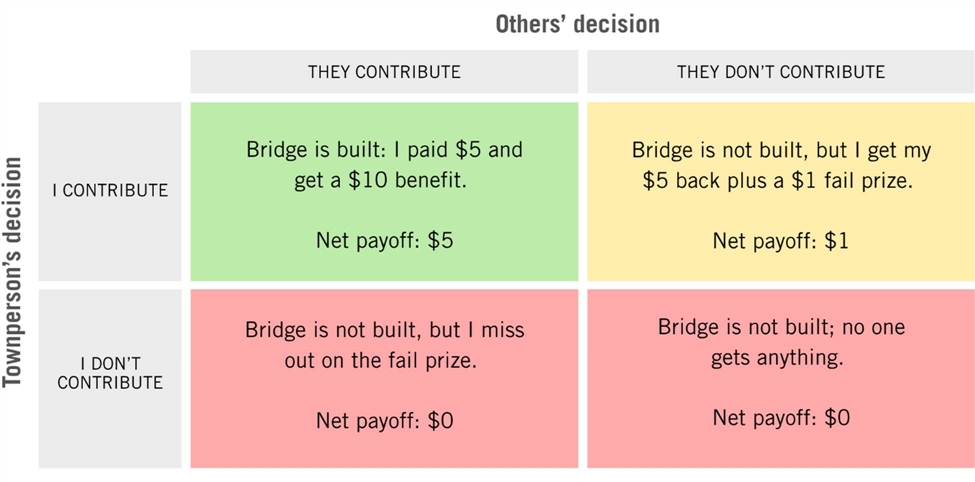
The townsperson, faced with these potential trade-offs, wants the highest payoff he can get dependent on what others do. That is, he has a choice of which row to be in, while his fellow townsfolk have the choice of which column to put him in. But notice: Regardless of which column he’s in, the higher payoff comes from contributing. If others contribute, he can contribute (and gain $5) or not contribute (and lose out on $1). Or if others don’t contribute, he can gain $1 or get nothing at all. Since contributing is the better strategy regardless of what others do, it can be called a “dominant” strategy.
Notice how this mechanism addresses each of the three challenges to providing the bridge in the abstract:
1. The entrepreneur is a point around which to coordinate. He can pass the hat and clearly define the terms of the contract with each townsperson.
2. The DAC provides assurance. It builds in the return of the money if the bridge is not built, so no one is left without both their contribution and their bridge.
3. The DAC is structured to prevent free riders from scuttling the project. In Tabarrok’s telling, the DAC should be structured so that the amount requested from each person is such that the bridge is only built if everyone contributes. That is, the number of contributions necessary to hit the success threshold equals the number of possible participants. Tabarrok also noted, however, that while this mechanism prevents free riders, it is not necessary to incentivize the construction of the bridge, since, under a DAC, the only situation in which someone can free ride is one in which the bridge is already being built. Self-interested would-be free riders cannot scuttle the outcome since, if they could, their self-interest would drive them to contribute and reap the fail prize.
DACs have seen some small-scale applications, for example, successfully funding donations to a nonprofit and a platform for running DACs themselves.[10] Widespread, large-scale DACs have been slow to catch on, however. This limitation is likely due to a lack of a central coordinator to play the entrepreneur role of defining and facilitating contributions while also credibly pledging the ability and willingness to pay the fail prize.
In the context of spectrum policy, however, the FCC could play that role. It could identify and coordinate necessary activities to accelerate spectrum reallocation and the costs to achieve that acceleration. It could also credibly fund the failure of contributions to those efforts by paying contributors via bidding credits in an unaccelerated auction.
Dominant Assurance Contracts for Spectrum Reallocation: Example of the Upper C Band
We can apply the simplified example of using a DAC to build a bridge to the more complex world of spectrum policy. Rapid access to spectrum has some features of the bridge. Often, DACs are difficult to implement because there is no one forthcoming with a sum of money to coordinate the participants and credibly pay the fail prize to contributors. But for spectrum auctions, the FCC can coordinate and use the auction proceeds themselves as the method of paying contributors in the form of bidding credits.
Let’s use the example of altimeter retrofits necessary to enable commercial communications access to the upper C band.
In that proceeding, fast retrofits take the place of the bridge from the prior example. The aviation industry would benefit from having higher-performing altimeters paid for, developed, and installed rapidly. The mobile industry would benefit from being able to deploy services in the C band rather than being blocked by aviation concerns about interference to altimeters. And funding could conceivably enable fast retrofits if the necessary activities (design, manufacture, installation, etc.) were funded up front rather than having to wait until after the auction. We should expect the aviation industry to get started on its own, but it’s also true that the complex and granular nature of each step in the retrofit process could go faster if funds were available before the auction. Indeed, the FAA found “the availability of incentive or reimbursement payments could affect the rate at which RAs are replaced in response to the requirements of this proposed rule.”[11] And the aviation community proffers that it “is working to develop a more aggressive timeline assuming financial incentives are available.”[12]
For any such incentives to materialize, however, it is necessary for the aviation industry to identify with specificity where the money could go to speed up retrofits and how much such money would accelerate access to the C band.
With that assumed threshold in place, however, the process could work as follows:
1. The FCC invites participants to contribute up front to direct, particularized relocation costs with performance guarantees from potential recipients (to include development, manufacturing, and retrofit of altimeters). Call this the “Fast Retrofit Plan (FRP)” and the dollar amount associated with it the “Threshold.”
2. Mobile carriers may contribute up to 34 percent of the total Threshold. NOTE: This example uses “mobile carriers” as the actors who seek access to the upper C band for simplicity, but the model does not depend on that. If additional parties, satellite providers or others, were likely to participate, the model would proceed in the same way but with a lower allowed contribution from each party.
3. If the Threshold is met, the money is paid according to the FRP, and we proceed to step 5.
4. If the Threshold is not met, no money is paid; the money goes into escrow and is credited toward bids at the slow-retrofit auction; bids made with those dollars count as $1.15.
5. The altimeter/aviation industry secures bonds for the amount of money it gets plus potential nonperformance penalties and undertakes the FRP activities.
6. If the FRP is successful, fast retrofit takes place; aviation/altimeters are released from their bonds and keep the Threshold money; carriers get quicker access to spectrum and pay the full price at the auction.
7. If the FRP is not successful such that fast retrofits don’t take place, the bond of entities that failed to meet the deadline are forfeited to the FCC and the recipients of that money pay a penalty. Carriers get a retroactive 15 percent discount on their bids and slower access to that spectrum.
Consider Carrier 1’s matrix (figure 2); it looks just like the townsperson’s matrix from the bridge example.
Figure 2: Payoff matrix for a carrier
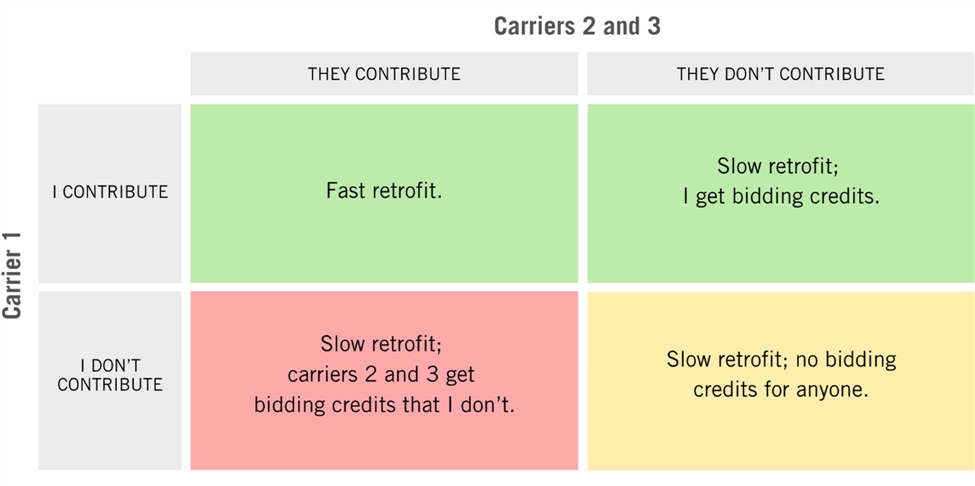
Carrier 1 acts to maximize profits and, therefore, wants to get the biggest payoff given the other carriers’ choices. Consider Carrier 1’s options given each possible choice by the other carriers.
Scenario 1: The other carriers contribute. In this case, Carrier 1’s choices are to:
1. contribute and receive the fast retrofit, or
2. not contribute and suffer a slow retrofit after an auction in which its competitors get bidding credits, but it does not.
It is self-evident that “contribute” is the better choice here.
“Contribute” is the dominant strategy for all carriers. Therefore, we should expect all carriers to contribute and the fast retrofit plan to be funded.
Scenario 2: The other carriers do not contribute. In this case, Carrier 1’s choices are to:
1. contribute and suffer a slow retrofit but with bidding credits in the auction, or
2. not contribute and suffer a slow retrofit without bidding credits.
In this case as well, the better choice is “contribute.”
Thus, since “contribute” is the better choice regardless of what the other carriers do, it is a dominant strategy. And each carrier faces the same payoff matrix; “contribute” is the dominant strategy for all of them. Therefore, we should expect all carriers to contribute and the fast retrofit plan to be funded.
Admittedly, the mechanism is less elegant for the aviation side: they must perform the FRP to keep the money and avoid penalties. But it’s already a benefit to the altimeter manufacturers to get that money up front, and they will likely end up profiting. Plus, the aviation industry gets the benefits of new, higher-performing altimeters more quickly, which can enhance safety.[13]
Assumptions of This Model
This model relies on several assumptions, some of which were previously noted, but they are listed here for clarity along with the reasons they are likely to hold true in this case.
1. There is a well-defined set of actions incumbents or related parties could take to accelerate the repurposing, if they had funding to do so. This assumed fact is likely true. Indeed, the aviation industry told the Federal Aviation Administration (FAA), “The aviation community recognizes the importance of accelerating the retrofit/replacement process and is working to develop a more aggressive timeline assuming financial incentives are available.”[14] This affirmation makes sense. Altimeter manufacturing is a mature business that can use funds to pre-invest in production line capacity, tooling, and supply chains while the design and certification process proceeds. Airlines retrofitting their aircraft could also use funds for overtime shifts to complete retrofits around the clock or move specialized installation teams rapidly around the country. There are obviously details to be worked out about which entities get what money for what work. But potential participants can profit by hashing out a cohesive plan.
2. The value of the acceleration to each carrier exceeds each carrier’s share of the total acceleration cost, i.e., carriers would find successful relocation/acceleration worth their contribution. A corollary to this assumption is that there is actual acceleration; the value to carriers comes from faster access above and beyond the status quo without additional payments.[15] The public good here is a faster retrofit than would have happened otherwise. This assumed fact is likely true. The lower C band reallocation demonstrates that carriers place a high value on rapid access to spectrum. Carriers themselves have indicated that acceleration payments may be worth it to them to get access to the spectrum by 2029, and the necessary payments should be substantially smaller this time since they are not premised on clearing an incumbent out of a band, but rather only ensuring that adjacent band receivers perform more highly.[16]
3. The allowable contribution per carrier is such that the DAC will only succeed if all 3 contribute (the 34-percent rule). This fact can be made true by the FCC in setting the terms of the DAC. The FCC can also adjust this rule to match 1/(number of expected major auction participants) if it expects more major auction participants.
4. Incumbent occupants of the band, or in this case an adjacent band, can obtain the necessary bonds; or put another way, they can be relied on to carry out the FRP. Since the aviation industry will necessarily have to take on these retrofits anyway, given assumptions 1 and 2, that actual acceleration is possible at the Threshold price, the credit markets should agree and provide the bonds. Successful completion of each part of the FRP must be judged separately for enforcement purposes; that is, an entity that receives money and successfully completes its part of the FRP should not forfeit a bond simply because others’ failures caused the FRP to miss the overall deadline. This dynamic does create a risk, borne by the FCC, that carriers would deserve bidding credits even though not all the money has been returned.
5. Carriers trust the FCC to use the funds as promised and provide the bidding credits if the Threshold is not met. The FCC should bind itself through its rules to carry out the terms of the DAC and not get cold feet about granting the bidding credits if the Threshold or timelines are not met. Success or failure of the FRP from the carriers’ perspective must be all or nothing: if the fast retrofit occurs, they pay the full price; if it does not, they get the retroactive bidding credits.
Cost Estimate
To put some rough numbers on this process, the following is an estimate of the costs of acceleration that carriers would need to contribute via a DAC. These focus solely on the Part 121/129 aircraft fleets, which include domestic and international passenger airlines. The smaller regional and private aircraft have different regulatory challenges, which could also be part of this or another regulatory process. Notably, however, as the proportion of aircraft affected by mobile transmissions in the C band diminishes, so does the case for restricting mobile deployment as compared with restricting the smaller number of aircraft. It may be reasonable to tolerate some delay to consumer mobile service to avoid grounding all passenger aircraft, but the cost-benefit flips if the ask is to degrade consumers’ mobile service to give private jets more time to bring their hardware up to date.
The Threshold for the DAC would be $129.7 million. Each carrier would be asked to contribute 34 percent of that, or $43.2 million.
Note that not all acceleration payments need to be the subject of a DAC. The function of the DAC is to get funding up front when auction proceeds are not yet available. For example, accelerating the design process, priming supply chains, and ensuring sufficient manufacturing capacity are good candidates for DAC funding. The costs of altimeter installation or aircraft downtime associated with retrofits will likely be incurred after the auction and, therefore, can likely be covered by auction proceeds rather than upfront payments. In short, there may be a case for more payments to reimburse and accelerate allocation in addition to those suggested ahead.
All these numbers are subject to challenge and revision, but the goal should be to arrive at an aggressive yet reliable goal that will enable the retrofit process for major airlines to be completed and mobile service in the upper C band to turn on at full power before the end of 2029.
Equipment design and development: The Threshold should include $20.2 million to incrementally increase parallelization and rate of design. Extra engineers and tests would be the main cost here. For altimeter manufacturers, we posit 3 additional parallel workstreams each with 10 full-time employees working on this project for 1.5 years—a total of 45 engineer-years. Certification and testing support teams can be shared, so we posit 15 additional engineer-years to accelerate capabilities on that level. In total, the DAC Threshold would include funding for 60 additional engineer-years. Based on BLS 2024 median wage of $134,830, a 2.5x fully loaded multiplier (which covers the overhead to support the specialized full-time employees), the cost of those 60 additional engineer-years would be $20.2 million.[17]
Early prep of manufacturing, testing, and supply chain capacity: The Threshold should contain $109.5 million to prep the manufacturing and supply chains necessary to produce larger numbers of updated altimeters rapidly. This figure depends on factors such as the current state of procurement relationship and expandability of existing manufacturing and testing infrastructure. Upfront acceleration payments could pay for nonrecurring setup costs for staging components and preparing or expanding facilities to meet accelerated timelines. We estimate that such costs represent 5 percent of the FAA’s total retrofit cost for part 121 and 129 fleets ($2.19 billion).[18] Since the same facilities and components can be used to build altimeters across all tranches of aircraft, taking 5 percent of the cost to manufacture for all aircraft would overestimate cost.
In sum, then, the Threshold for the DAC would be $129.7 million. Each carrier would be asked to contribute 34 percent of that, or $43.2 million. While comparisons with other auctions are fraught with their own peculiarities, it is worth noting that, in the lower C-band auction, Verizon paid about four times this sum outside the auction-embedded acceleration payments to gain access to a similar amount of spectrum two years earlier.[19] Here, the acceleration is likely to be less than two years, but the sum of money would also be substantially smaller. It is thus reasonable to expect there to be a sum of money that can produce acceleration that carriers find to be worth paying for.
Conclusion
Accelerating spectrum reallocation from a suboptimal use to a more productive one has long been a policy challenge. The proposed mechanism of DACs can make one part of that challenge more tractable. So far, upfront costs have posed a barrier to even getting to an auction that could then reimburse actual relocation costs. As policymakers face statutory requirements to open more spectrum to commercial use, DACs can be a tool to get the ball rolling to fund more efficient allocations of spectrum usage rights. Breaking through spectrum stalemates will then enable all Americans to benefit from safer and more productive uses of spectrum resources.
About the Author
Joe Kane is director of broadband and spectrum policy at ITIF. Previously, he was a technology policy fellow at the R Street Institute, where he covered spectrum policy, broadband deployment and regulation, competition, and consumer protection. Earlier, Kane was a graduate research fellow at the Mercatus Center, where he worked on Internet policy issues, telecom regulation, and the role of the FCC, where he interned in the office of Chairman Ajit Pai. He holds a J.D. from The Catholic University of America, a master’s in economics from George Mason University, and a bachelor’s in political science from Grove City College.
About ITIF
The Information Technology and Innovation Foundation (ITIF) is an independent 501(c)(3) nonprofit, nonpartisan research and educational institute that has been recognized repeatedly as the world’s leading think tank for science and technology policy. Its mission is to formulate, evaluate, and promote policy solutions that accelerate innovation and boost productivity to spur growth, opportunity, and progress. For more information, visit itif.org/about.
Endnotes
[1]. Joe Kane, “Why We Should Stop Worrying and Learn to Love Spectrum Windfalls” (ITIF, September 26, 2022), https://itif.org/publications/2022/09/26/why-we-should-stop-worrying-and-learn-to-love-spectrum-windfalls/.
[2]. “Broadcast Incentive Auction and Post-Auction Transition,” Federal Communications Commission, accessed March 31, 2026, https://www.fcc.gov/about-fcc/fcc-initiatives/incentive-auctions.
[3]. “Part III: 1755–1780 MHz Band (AWS-3),” National Telecommunications and Information Administration, October 16, 2024, https://www.ntia.gov/report/2024/2023-commercial-spectrum-enhancement-act-csea-report/part-iii-1755-1780-mhz-band-aws-3; “Auction 107: 3.7 GHz Service,” Federal Communications Commission, accessed March 31, 2026, https://www.fcc.gov/auction/107.
[4]. Federal Communications Commission, “Expanding Flexible Use of the 3.7 to 4.2 GHz Band,” Report and Order and Order of Proposed Modification, GN Docket No. 18-122, FCC 20-22, released March 3, 2020, https://docs.fcc.gov/public/attachments/FCC-20-22A1.pdf.
[5]. Mary Lennighan, “Verizon spends more for early C-band access,” Telecoms.com, March 23, 2022, https://www.telecoms.com/5g-6g/verizon-spends-more-for-early-c-band-access.
[6]. H.R. 1, An act to provide for reconciliation pursuant to title II of H. Con. Res. 14, 119th Cong., Public Law No. 119-21 (July 4, 2025), https://www.congress.gov/bill/119th-congress/house-bill/1/text; Federal Aviation Administration, “Requirements for Interference-Tolerant Radio Altimeter Systems,” 91 Fed. Reg. 459 (January 7, 2026), https://www.federalregister.gov/documents/2026/01/07/2026-00051/requirements-for-interference-tolerant-radio-altimeter-systems.
[7]. H.R. 1, 119th Cong., Public Law No. 119-21 (July 4, 2025).
[8]. Joe Kane and Jessica Dine, “Building on Uncle Sam’s ‘Beachfront’ Spectrum: Six Ways to Align Incentives to Make Better Use of the Airwaves” (ITIF, January 30, 2023), https://itif.org/publications/2023/01/30/six-ways-to-align-incentives-to-make-better-use-of-the-airwaves/.
[9]. Alexander Tabarrok, “The Private Provision of Public Goods via Dominant Assurance Contracts,” Public Choice 96 (1998): 345–62, https://mason.gmu.edu/~atabarro/PrivateProvision.pdf.
[10]. Alex Tabarrok, “A Test of Dominant Assurance Contracts,” Marginal Revolution, August 29, 2013, https://marginalrevolution.com/marginalrevolution/2013/08/a-test-of-dominant-assurance-contracts.html; Yaseen Mowzer, “The Economics of the Asteroid Deflection Problem (Dominant Assurance Contracts),” LessWrong, August 29, 2023, https://www.lesswrong.com/posts/CwgHX9tbfASqxjpsc/the-economics-of-the-asteroid-deflection-problem.
[11]. “Requirements for Interference-Tolerant Radio Altimeter Systems,” 91 Fed. Reg. 459 (January 7, 2026), https://www.federalregister.gov/documents/2026/01/07/2026-00051/requirements-for-interference-tolerant-radio-altimeter-systems.
[12]. Joint Aviation Community, “Joint Aviation Community Response to Federal Aviation Administration Notice of Proposed Rulemaking on Requirements for Interference-Tolerant Radio Altimeter Systems in Docket No. FAA-2025-5666” (comment, March 9, 2026), ii, available via Regulations.gov, https://www.regulations.gov/comment/FAA-2025-5666-0040.
[13]. Joseph Cramer, “Wireless Avionics Intra-Communications (WAIC)” (presentation for Working Parties 5A, 5B, 5C Workshop on Preparations for WRC-15, ITU, May 23, 2012), https://www.itu.int/net/ITU-R/study-groups/docs/workshop-wp5abc-wrc15/WP5ABC-WRC15-P2-5.pdf.
[14]. Joint Aviation Community, “Joint Aviation Community Response.”
[15]. “Requirements for Interference-Tolerant Radio Altimeter Systems,” 91 Fed. Reg. 459 (January 7, 2026).
[16]. CTIA, “260309 CTIA Comments on FAA RA NPRM and Coexistence Modeling Paper” (comment, March 10, 2026), https://www.regulations.gov/comment/FAA-2025-5666-0051.
[17]. U.S. Bureau of Labor Statistics, “Aerospace Engineers,” Occupational Outlook Handbook, last modified August 28, 2025, https://www.bls.gov/ooh/architecture-and-engineering/aerospace-engineers.htm.
[18]. “Requirements for Interference-Tolerant Radio Altimeter Systems,” 91 Fed. Reg. 459 (January 7, 2026).
[19]. Lennighan, “Verizon spends more for early C-band access.”
