


Four Reasons New AI Data Centers Won’t Overwhelm the Electricity Grid
The AI Data Center Moratorium Act recently introduced in Congress by Sen. Bernie Sanders (I-VT) and Rep. Alexandria Ocasio-Cortez (D-NY) to block construction of new data centers, partly to allay concerns about AI raising electricity costs for consumers, aligns with similar action in many states. But federal and state proposals both misunderstand the dynamics of electricity costs and use a sledgehammer to address problems that could be solved cheaply and effectively by other means.
Critics argue that data centers require electricity, AI will require much more electricity, and energy prices will explode as new and existing customers compete for scarce electrons. The evidence does not support this view—either based on past trends or on likely future dynamics.
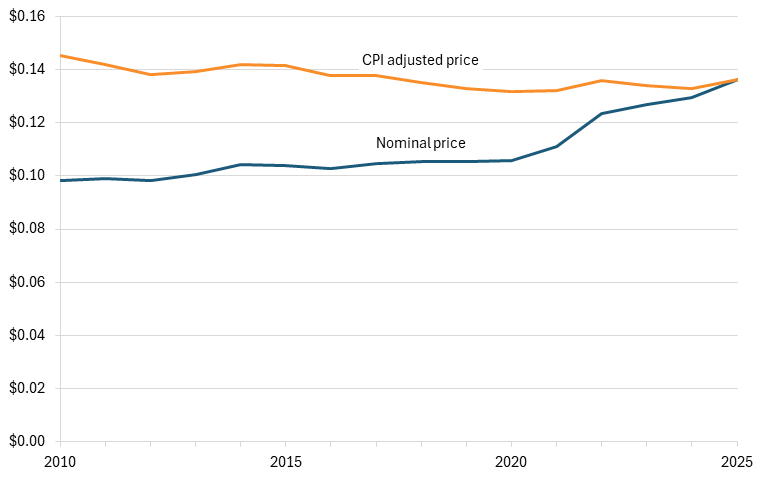
Looking backwards, energy prices have risen since 2010, but only in line with general inflation. In real terms, prices now are 6 percent lower than they were then, as shown in figure 1.
Figure 1: National average retail electricity prices (per kilowatt hour)
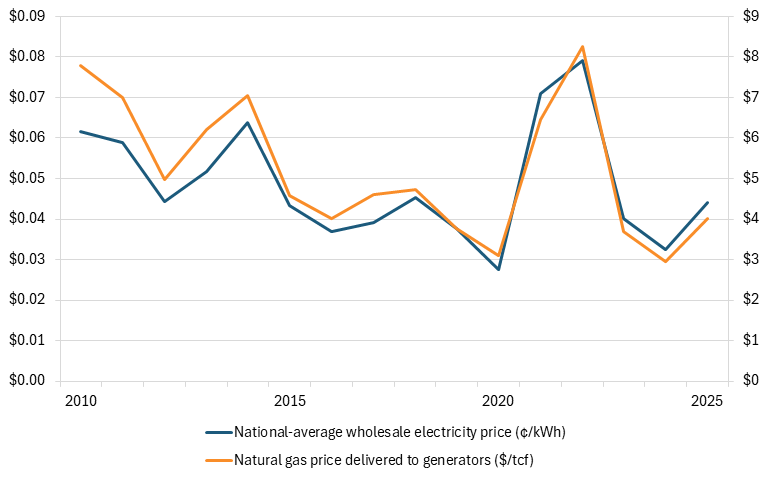
Deconstructing the drivers of price increases, data centers are near the bottom of the list. Electricity prices closely follow fuel prices, especially natural gas, which now powers 40 percent of U.S. electricity generation, as shown in figure 2.
Figure 2: Wholesale electricity prices (per kilowatt hour) and natural gas prices (per trillion cubic feet)
Beyond fuel costs, utilities in many areas buy reliability through “capacity auctions,” where providers bid to supply grid systems with backup power. Costs in one large region in the mid-Atlantic and Midwest, which is supplied by the regional transmission organization PJM Interconnection, rose from ~$60/kWh in 2024 to more than $300/kWh in 2025. A data center spike? Not really. Prices reflect uncertainty in the market, because variable energy sources require more backup, backup “peaker plants” use gas, and gas prices are volatile.
Utilities are also spending more on capital expenditures, with year-over-year increases going from 13 percent in 2023 and 2024, to 23 percent in 2025. Some of that expense includes data centers, but other costs have increased, too. For example, gas turbine prices are up almost 200 percent since 2019. And capex for transmission is also up, as utilities replace old equipment at current prices, harden infrastructure against natural disasters such as wildfires, and respond to more damaging storms. New data centers account for only a small share of new transmission costs.
Costs also vary by region. Maine, for example, suffered substantial storm damage in 2024 and 2025, and also paid attractive net metering rates for distributed solar power, which raised rates. Even so, Maine’s price increases in 2025 were mostly still driven by increased gas prices.
In short, data centers are a long way down the list of factors that caused recent nominal electricity price increases in the United States.
But what about the future? Will massive new data centers overwhelm the grid? In short, no, they don’t have to.
Yes, large cloud service providers (“hyperscalers”) and data center companies have announced more than 240 GW of new data centers to power the AI revolution, much of it planned for deployment by 2030. That’s an increase of approximately 20 percent over current U.S. electricity demand. So, on paper, that suggests that without new supply to match the new demand, we’re in for potentially dramatic price spikes. But electricity price hikes can be avoided without a moratorium or even a pause in data center construction, for four reasons.
First, the pace of data center construction will likely be slower than anticipated, and actual deployment will likely be smaller than announced. Consider this:
▪ There’s a looming capital crunch. OpenAI plans to invest $600 billion in data centers by 2030; that’s challenging on the basis of ~$20 billion in revenues and growing annual losses. Even Google and Meta are taking on debt to pay for their commitments.
▪ Permits take time. Average time to acquire the necessary permits has been 6–18 months. Larger projects take longer.
▪ Design and construction also takes time—generally 20–54 months (more for large projects, especially given shortages of both people and materials).
▪ Grid connections take even longer. In the mid-Atlantic and Midwest region that PJM Interconnection serves, projects approved in 2025 had been in the queue for 8 years. More time equals more cost, raising the capital burden.
New data center deals underway fell more than 40 percent between the third and fourth quarters of 2025. Of that 240GW of planned construction, only one-third are actually being built, and capex from the hyperscalers could fall by half in 2026. The $500 billion Stargate project—OpenAI’s flagship in Texas—appears to have stalled, after disputes between partners.
As a result, the demand for energy to power new data centers will be considerably lower than headline announcements suggest, and new demand will take a lot longer to hit the grid.
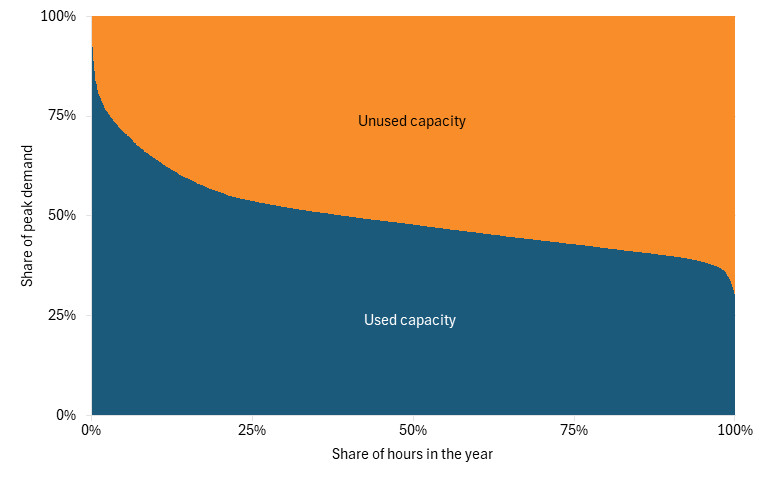
Second, data centers can manage their demand. Electricity grids are designed to meet peak power demand, not average power demand, because they must ensure that customer needs will always be met. More peak demand necessitates more generation and more energy infrastructure, and massive new data centers seem to add inevitably to peak demand, as they seek to serve their own customers 24/7.
But in reality, as figure 3 illustrates, demand peaks for only a few hours per year. The rest of the time, there is plenty of capacity available. So if data centers can manage their demands on the grid to avoid peaks, they can access plenty of power without increasing peak demand at all. In fact, they may even improve overall capacity utilization, which could reduce rates for existing ratepayers. Hyperscalers are taking steps to do exactly that.
Figure 3: Used and unused capacity, California 2022
Third, hyperscalers know they must bring their own power (BYOP), often by placing those generating assets off the grid right where data centers are built (“behind the meter” or “BTM”). Most facilities will still need a grid connection for backup, but that’s not the same as depending on the grid for power 24/7. BTM also helps avoid expensive transmission upgrades.
Fourth, utility contracts with data centers can be structured to protect existing ratepayers via “large load tariffs” (for new projects seeking 50MW of electricity or more). Options include:
▪ Data center funding for upfront costs for such as engineering studies or power delivery infrastructure
▪ Minimum contract periods (often 15 years)
▪ Minimum load guarantees (typically 85 percent of anticipated load), which apply even if the data center changes course and does not need that electricity
▪ Defined ramp-up schedules so there are no sudden and unexpected hits on the grid
▪ Exit fees in case a data center wants to get out of its contract
▪ Incentives such as faster interconnection to encourage demand management and BYOP
▪ “Hold harmless” guarantees, wherein some hyperscalers (e.g., Microsoft) have directly committed to ensuring that ratepayers will not pay the price for data center expansion
▪ Higher rates for large loads
Together, these four pathways mean that big new data centers can become collaborative partners for electric grids, protecting existing ratepayers and managing the addition of new loads without adding to peak demand. None of this is theoretical—new contracts in Viginia, Ohio, and other states all include these elements. So, over time, it seems very likely that data centers will add a great deal of new generation, but that won’t be paid for by other customers.
“Emergency” legislation like the Sanders-Ocasio-Cortez bill is therefore simply not necessary to protect Americans from rate increases from data centers. Concerns about energy and data centers are misplaced, and there are plenty of options to ensure a smooth path to growth.
A moratorium would also be incredibly risky, because it would open the door for other countries like China to race ahead, which would collapse American companies’ lead in AI. Moreover, it could devastate the economics of the industry, frightening off the capital that is absolutely necessary to reach the requisite scale. Blocking the growth of a key industry on the basis of imaginary energy concerns is panic, not policymaking.
Editors’ Recommendations
Related
February 19, 2026
