

The Digital Marriage Divide: Ranking States’ Online Services for Tying the Knot
States have moved many public services online, but the legal steps to get married remain largely paper-based. Modernizing marriage licensing, recording, and certificates would reduce costs, save time, and make the major life event easier for American families.
KEY TAKEAWAYS
Key Takeaways
Contents
Obtaining a Marriage License. 4
Obtaining a Marriage Certificate. 6
Appendix: Evaluation Criteria. 9
Introduction
Getting married is a major milestone in many people’s lives. People view marriage in many ways—an act of love, a sacred bond, a civil contract, or a social institution that anchors family life—but in every case, a marriage in the United States becomes legal only after the government properly records it. In practice, this process typically requires a couple to obtain a marriage license, an officiant to complete and submit the required documentation, and a government agency to officially record the marriage.
Today, many people meet online, and governments increasingly deliver core services digitally. In most states, individuals can register to vote, renew a driver’s license, and pay taxes online. Yet, the process of getting married remains largely offline. In many jurisdictions, couples still must appear in person, complete paper forms, and mail documents to multiple offices. As a result, a major life event that should be straightforward often becomes unnecessarily time consuming, complicated, and expensive. Modernizing these processes would help governments deliver more effective and accessible services to American families.
Dating has gone digital. Getting legally married, in most states, has not.
This report evaluates how digitally accessible the marriage process is across the United States, focusing on three steps: applying for a marriage license, recording a marriage, and obtaining a certified copy of a marriage certificate. The analysis finds significant variation across states. A small group of states and local jurisdictions has implemented fully or mostly digital workflows, while many others still rely heavily on paper forms and in-person requirements, particularly for identity verification and document submission.
To close these gaps, state and local governments should prioritize the following actions:
▪ Create secure, end-to-end online options for applying for marriage licenses and requesting certified marriage certificates.
▪ Allow video conferencing to replace routine in-person appearances when identity verification is required.
▪ Invest in enabling digital infrastructure, including digitized records, secure online payments, and electronic identity verification.
▪ Partner with established vendors when building in-house systems is not feasible.
▪ Update laws and administrative policies to permit electronic signatures and support digital vital records.
Methodology
In the United States, each state can set its own marriage laws, and cities and counties often establish additional policies and procedures for issuing marriage licenses and certificates. For each state, this analysis assesses how digitally friendly three key processes are for individuals getting married: (1) applying for a marriage license; (2) recording a marriage with the appropriate authorities; and (3) obtaining a copy of a marriage certificate. Because practices vary within states, the analysis examines a specific city, or county when necessary, and selects the jurisdiction with the largest population. See the appendix for more details.
The analysis focuses on the largest jurisdictions because those governments can more easily invest in digital processes, spread fixed costs across a larger population, and capture greater efficiency gains from digitalization. The research also identifies notable examples of digitally friendly marriage policies and practices in smaller jurisdictions, when relevant. The findings therefore reflect what individuals are most likely to encounter in the largest city or county in each state, although policies and procedures may differ across jurisdictions within the same state. Overall, the results provide an indication of what current law and administrative practice allow within each state.
Findings
Dating has gone digital. Getting legally married, in most states, has not. Every state could do more to create a more seamless online process for obtaining a marriage license, recording a marriage, and obtaining a marriage certificate. However, there are clear differences between states.
Overall Rankings
In this report, we group states into one of three categories—E-Lopers (highest), Paper Trailers (mid-tier), and In-Personals (lowest)—based on a composite assessment of how digitally accessible the marriage process is in the largest jurisdiction in each state.
Figure 1: State rankings of digital marriage processes
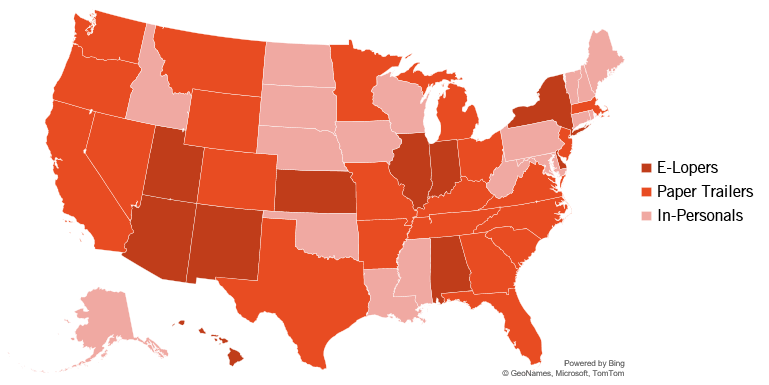
As shown in figure 1, 10 states are leading in implementing digital marriage processes: Alabama, Arizona, Delaware, Hawaii, Illinois, Indiana, Kansas, New Mexico, New York, and Utah. These states generally make it easy both to obtain, complete, and submit a marriage license application online, as well as to go online to request a certified copy of a marriage certificate. These states have also modernized other parts of the process, such as not requiring applicants to appear in person to obtain a license, allowing officiants to sign marriage certificates electronically, and delivering marriage certificates electronically.
Other states are less advanced. Almost half—22 states—only provide basic online services. These states generally allow individuals to obtain, complete, and submit a marriage license application online and request a certified copy of a marriage certificate online, but they typically still require in-person appearances or paper documents.
The remaining 18 states have few processes online. In some, the entire process may still be manual—such as requiring individuals to travel to a government agency to submit marriage license paperwork in person or payments to be made by mail using a money order.
Obtaining a Marriage License
The first step to getting married is obtaining a marriage license. Marriage licenses are legal documents issued by a government authority that permit two people to marry during a certain period. To obtain a license, a couple must demonstrate that they meet the legal requirements to marry in that state, such as age and marital status (i.e., they are unmarried). Couples must submit a marriage license application to the appropriate authorities, such as a county clerk, and pay the associated fees. If approved, they then receive the license, which the officiant uses to record the marriage.
In total, 32 states offer the option to complete and submit a marriage license application online. The remainder only have basic forms online, or sometimes no forms, and require couples to appear in person to apply for a marriage license. Among the jurisdictions examined, fees for marriage licenses range from a low of $24 for any county in Rhode Island to $169 in King County, Washington.[1]
Only two states—New York and Utah—have a fully online process for obtaining a marriage license in at least one major jurisdiction. Until 2020, in New York, a couple had to apply in person for a marriage license at a town’s or city clerk’s office. However, in response to the COVID pandemic, Governor Andrew Cuomo issued an executive order in March 2020 allowing local governments to permit couples to use video conferencing instead of appearing in person.[2] After this change, New York City created “Project Cupid,” a new initiative to make obtaining a marriage licensing fully online.[3] Using this new website, couples can complete a marriage certificate application online, upload all required documents, schedule a virtual video appointment with the city clerk’s office, and pay all fees.[4] During the video appointment with the clerk, both applicants must be together physically and in New York State. The clerk can issue a license immediately, although the license cannot be used during the first 24 hours. The license is then valid for 60 calendar days.[5] After the marriage ceremony, the applicants must mail in a completed copy of the marriage license to obtain the marriage certificate.
Utah also has a major jurisdiction with a fully online process for marriage licenses. In its largest county, Salt Lake County, individuals can fill out and submit a marriage license application online and schedule an appointment with the county clerk’s office; however, couples must appear in person to pay the fee and obtain the license.[6] By contrast, Utah County—the second largest county in the state—offers a fully online process. Couples can apply for a marriage license completely online, including using a phone to scan their government IDs and complete a facial verification check, and they can pay the fee online. Successful applicants immediately receive a digital marriage license that they can send to their officiant. The license is valid for 32 days.[7]
Utah also does not impose a residency or citizenship requirement for marriage licenses, which allows nonresidents to apply for a marriage license through Utah County. In addition, couples may participate in a “remote appearance wedding.” As long as the officiant is physically located in Utah, the state recognizes the ceremony as having taken place within the state.
Alabama provides an interesting example of a state that has streamlined the process through both digital and legal reforms. Prior to 2019, couples had to apply for a marriage license with a county probate court. However, the Alabama Legislature changed the law so that marriage licenses were no longer needed. Instead, couples must complete, sign, and notarize a Marriage Certificate form and then mail it to the probate court within 30 days to register a marriage.[8] The state has an online form that applicants can use to generate and print the Marriage Certificate themselves. These reforms eliminate the need for couples to appear in person.[9]
A handful of additional states, including Kansas, Illinois, and Arizona, also have at least one major jurisdiction where couples can obtain a marriage license without an in-person appearance. For example, in Kansas, couples can apply for a license online, but they must wait up to two weeks to receive a license by mail from a county clerk.[10] Maricopa County, Arizona, provides the option to request a marriage license without an in-person appearance; however, the steps are complicated. Couples must complete an online application; upload copies of their government IDs; receive a confirmation email with an affidavit; print, sign, and upload the affidavit; wait 7 to 10 business days for the county clerk’s office to review the application; and then confirm their personal information and provide their payment information by phone.[11] Cook County, Illinois, also provides an online option whereby couples can pre-register for a marriage license, submit an online marriage license application, and then complete the marriage license process via a virtual video call.[12]
Recording a Marriage
In most states, a couple signs a marriage license at their wedding ceremony. In addition, an officiant, as well as witnesses, may sign the document. This document must then be submitted to local officials within a set period of time. It is only once the local government agency has received and processed the completed document that the marriage is recorded.
Only Utah and New York provide online options for signing marriage licenses electronically or submitting completed marriage licenses online. For all other states, the process is an entirely paper-based one. Some states also require a marriage license to be notarized, whereby a third party—a notary public—ensures that the signature on a document is authentic, the signer knows what they are signing, and they are doing so voluntarily.
In Hawaii, the State Department of Health issues licenses to perform marriage and civil unions. These officiants have access to an online system on which they can certify electronically that a wedding ceremony occurred.[13]
In Utah County, Utah, the process is entirely digital. Couples receive a link and QR code that they share with their officiant. The officiant uses that link to go to an online system on which they can submit the information about the marriage electronically, including their digital signature and the names of the witnesses.[14]
Americans can find a match online, but turning that match into a legal marriage still requires an offline process.
Obtaining a Marriage Certificate
A marriage certificate is the official, government-issued document showing that a couple is legally married. This document may be required for several reasons, such as applying for a name change, adding a spouse to bank accounts or health insurance, or obtaining government benefits. Jurisdictions may provide both certified copies, which are often necessary for official purposes, and noncertified ones, which may be used for personal reasons, such as for commemorative copies or genealogy research. Certified copies have traditionally been paper documents that have included elements such as a raised seal from the issuing authority and wet-ink signatures.
Only one state—Utah—offers a major jurisdiction with a completely online option for both requesting and receiving a certified marriage certificate. Utah County provides certified copies as PDFs with a digital signature that use a cryptographic hash recorded on a blockchain.[15] The hash functions as a unique code generated from the certified marriage certificate. The clerk’s office records this number on the blockchain—a cryptographically secured public digital ledger—to establish verifiable credentials for the document’s authenticity. Anyone who receives such a PDF can generate a hash from the file and compare it to the value on the blockchain to confirm that no one has altered the document. The PDF also includes instructions for completing this verification.
Some states offer online copies of marriage certificates, but only noncertified copies. For example, individuals married in Delaware can order a noncertified copy of a marriage certificate for $2 that is delivered by email as a PDF within 7 business days or a certified paper copy for $25 that is delivered by mail within 14 business days.[16]
Only four states that we reviewed do not provide an online option to request a copy of marriage certificate: Georgia (where our analysis is based on Fulton County), Montana (Yellowstone County), Pennsylvania (City of Philadelphia), and Oklahoma (Oklahoma County). In these states, the process of obtaining a certified marriage certificate is almost entirely paper-based and cumbersome. For example, in Georgia, for marriages that occurred in 2014 or later, individuals must complete and mail a marriage verification request form, along with a copy of a government ID and a check or money order, to the Georgia Department of Public Health. For marriages that already occurred earlier, they must complete a similar process with the relevant county. In Fulton County, for example, this entails completing and mailing a marriage certificate request form, along with a self-address stamped envelope and a money order, to the Fulton County Probate Court.
Many states directly partner with a third-party service, such as VitalChek, to allow individuals to order certified copies of marriage certificates online. These services collect the necessary information to locate the records, handle payments, and, if required, verify the identity of the individuals placing the orders. They typically charge an additional processing fee, in addition to the fees charged by the vital records agency.
Recommendations
Americans can find a match online, but turning that match into a legal marriage still requires an offline process. State and local governments could make the marriage process much easier for couples by adopting a customer-first mindset and shifting from paper-based workflows to fully digital, online services. Specifically, states should take the following steps:
Create an Online Option for All Marriage Licenses and Certificates
Most states and local governments provide information about marriage licenses and certificates online, but many stop at the informational stage. States should instead offer a secure, end-to-end online option that allows couples to apply for a marriage license without appearing in person. They should also allow officiants to submit signed documents electronically and enable individuals to request and pay for certified copies of marriage certificates online. Because mobile devices are now ubiquitous, governments should design these services as mobile-first offerings optimized for users on smartphones while still ensuring full functionality for those using computers.
Allow Video Conferencing to Replace In-Person Appearances
Many states require couples to appear in person to obtain a marriage license. That requirement once helped confirm applicants’ identities, but current technology provides reliable alternatives. Government officials could use common video conferencing platforms such as Zoom or Microsoft Teams to verify identity and complete required interactions. State and local governments should recognize video conferencing as a valid substitute for in-person appearances.
Invest in Enabling Digital Infrastructure
State and local governments deliver stronger digital services when the underlying infrastructure for online service delivery already exists, including technology, policies, and workforce skills. For example, agencies that have digitized their records can automate related processes more easily. Agencies with secure online payment systems can launch new fee-based services faster. When states issue electronic IDs, they can use those credentials to support identity verification for additional online services. Some leading jurisdictions also experiment with blockchain-based methods to secure public records. Governments that understand both the capabilities and limits of these technologies, and that establish clear organizational policies for their use, position agencies to adopt new digital services more quickly.
Partner With Vendors if Building a Solution Is Not Feasible
Some jurisdictions, such as New York City, have built their own online systems for people to request marriage licenses and marriage certificates, but many others rely on established vendors. Smaller jurisdictions may not find it practical to develop and maintain their own platforms and could instead purchase off-the-shelf systems designed for this purpose. Even Utah County’s innovative digital marriage certificate depends on a third-party service provider. States could also develop single, statewide solutions and make them available to local jurisdictions, tailored to state-specific legal and administrative requirements.
Update Relevant Laws and Policies to Facilitate Electronic Signatures and Digital Vital Records
States should update laws and policies governing family legal documents and vital records, including marriage licenses and marriage certificates, to permit the use of electronic signatures.
The Uniform Electronic Transactions Act (UETA) governs electronic signatures and records at the state level but excludes many documents related to family law. As a result, state law often requires traditional wet-ink signatures for these records. Congress has expanded the use of electronic signatures through the federal E-SIGN Act, but that statute primarily addresses commercial contracts and does not override many state requirements that apply to family matters such as marriage and adoption.[17]
After the COVID-19 pandemic, almost all states enacted laws that allow remote online notarization, which enables a notary public to witness document signing through video conferencing technology.[18] Federal legislation, specifically the SECURE Notarization Act, would establish national security standards for remote online notarization and provide interstate recognition of these notarial services.[19]
Conclusion
State and local governments have made steady progress in digitizing many public services, but the process of getting married still reflects outdated, paper-based workflows in much of the country. Modernizing marriage licensing, recording, and certificate issuance represents a practical and achievable opportunity to improve government service delivery, reduce administrative costs, and make an important life event easier for millions of Americans.
Advances in digital identity, secure online payments, electronic signatures, blockchain, and remote notarization already provide the tools needed to support fully online workflows. By updating laws, investing in enabling infrastructure, and expanding proven digital practices across jurisdictions, governments can move toward a future in which getting legally married is as accessible and efficient as other core public services.
Appendix: Evaluation Criteria
To assess how digitally accessible the marriage process is in each state, we focused on states’ largest jurisdictions by population and evaluated three stages of the process: applying for a marriage license, recording a marriage, and obtaining a certified copy of a marriage certificate. For each jurisdiction, the analysis answered a set of standardized yes-or-no questions about whether key steps could be completed online or without an in-person visit.
Applying for a Marriage License
For the marriage license application process, the analysis asked:
▪ Is the marriage license application available online?
▪ Can applicants complete the marriage license application electronically?
▪ Can applicants submit the marriage license application online?
▪ Can applicants obtain a marriage license without an in-person appearance?
▪ Is the required license or related filing document available for digital download?
Recording a Marriage
For the process of recording a marriage, the analysis asked:
▪ Are electronic signatures permitted on the completed marriage license or related documents?
▪ Can the completed marriage license be submitted to the appropriate government office online?
Obtaining a Certified Marriage Certificate
For obtaining proof of marriage, the analysis asked:
▪ Can individuals request a certified copy of a marriage certificate online?
▪ Can the jurisdiction provide the certified marriage certificate electronically?
Acknowledgments
The author would like to thank Justin Riggi for collecting the data for this project. Any errors or omissions are the author’s own.
About the Author
Daniel Castro is vice president of ITIF and director of ITIF’s Center for Data Innovation. He has a B.S. in foreign service from Georgetown University and an M.S. in information security technology and management from Carnegie Mellon University.
About ITIF
The Information Technology and Innovation Foundation (ITIF) is an independent 501(c)(3) nonprofit, nonpartisan research and educational institute that has been recognized repeatedly as the world’s leading think tank for science and technology policy. Its mission is to formulate, evaluate, and promote policy solutions that accelerate innovation and boost productivity to spur growth, opportunity, and progress. For more information, visit itif.org/about.
Endnotes
[1]. Rhode Island Department of Health, “General Marriage Requirements in the State of Rhode Island,” January 2025, https://health.ri.gov/sites/g/files/xkgbur1006/files/publications/requirements/GeneralMarriageRequirements.pdf.
[2]. Adriel Colón-Casiano, “Summary of Executive Order 202.20 and Executive Order 202.21,” New York State Bar Association, April 20, 2020, https://nysba.org/summary-of-executive-order-202-20-and-executive-order-202-21/.
[3]. New York City Council, “Speaker Corey Johnson and Mayor Bill de Blasio Announce ‘Project Cupid,’” press release, April 29, 2020, https://council.nyc.gov/press/2020/04/29/1944/.
[4]. City of New York, “Project Cupid,” accessed February 8, 2026, https://projectcupid.cityofnewyork.us/.
[5]. New York State Department of Health, “Information on Getting Married in New York State,” May 2022, https://www.health.ny.gov/publications/4210/index.
[6]. Salt Lake County Clerk, “Apply for a Marriage License,” accessed February 8, 2026, https://www.saltlakecounty.gov/clerk/marriage/apply/.
[7]. Utah County Clerk, “Marriage Licenses,” accessed February 8, 2026, https://www.utahcounty.gov/dept/clerk/marriage/marriagelicense.html.
[8]. Alabama Department of Public Health, “Frequently Asked Questions Regarding the Alabama Marriage Certificate,” accessed February 8, 2026, https://www.alabamapublichealth.gov/vitalrecords/assets/marriage_faq.pdf.
[9]. Alabama Department of Public Health, “Marriage Certificates,” accessed February 8, 2026, https://www.alabamapublichealth.gov/vitalrecords/marriage-certificates.html.
[10]. Kansas Judicial Branch, “Kansas Marriage License Application,” accessed February 8, 2026, https://ks.accessgov.com/marriage-license/Forms/Page/marriage-license/4265c67e-e25f-4214-ae61-51c215ad3f6f/2bfb7949-c8db-4bcb-9fab-d7e941f99b75/1.
[11]. Clerk of the Superior Court, Maricopa County, “Online Marriage License,” accessed February 8, 2026, https://www.clerkofcourt.maricopa.gov/services/marriage-licenses-passports/marriage-licenses/online-marriage-license.
[12]. Cook County Clerk, “Virtual Marriage License Issuance (Online Video Call),” accessed February 8, 2026, https://www.cookcountyclerkil.gov/vital-records/virtual-marriage-license-issuance-online-video-call.
[13]. Hawaii State Department of Health, “About Marriage and Civil Union Licenses,” accessed February 8, 2026, https://health.hawaii.gov/vitalrecords/marriage-licenses/.
[14]. Utah County Clerk, “Marriage License Frequently Asked Questions,” accessed February 8, 2026, https://www.utahcounty.gov/dept/clerk/marriage/faq.html.
[15]. Utah County Clerk, “Digital vs Paper Certified Copies,” accessed February 8, 2026, https://www.utahcounty.gov/dept/clerk/marriage/digitalvspapercertcopy.html.
[16]. Delaware County, Pennsylvania, “Marriage Records,” accessed February 8, 2026, https://www.delcopa.gov/row/marriage-records.
[17]. Electronic Signatures in Global and National Commerce Act, Pub. L. No. 106-229, 114 Stat. 464 (2000), https://www.govinfo.gov/content/pkg/PLAW-106publ229/pdf/PLAW-106publ229.pdf.
[18]. NotaryCam, “What States Allow Remote Notary?” October 31, 2024, accessed February 8, 2026, https://www.notarycam.com/what-states-allow-remote-notary.
[19]. SECURE Notarization Act of 2025, S. 1561, 119th Cong. (2025–2026), https://www.congress.gov/bill/119th-congress/senate-bill/1561.
Editors’ Recommendations
August 27, 2018
Benchmarking State Government Websites
Related
February 13, 2026
Dating Is Digital. Why Is Getting Married Still So Offline?
April 20, 2023
