WASHINGTON—Over 70 percent of public servants now use AI, but only 18 percent say governments are using it effectively, according to the Public Sector AI Adoption Index 2026, released today by Public First for the Center for Data Innovation, with sponsorship from Google.
The Public Sector AI Experience Index is based on a survey of 3,335 public servants across 10 countries—including the United States, UK, Germany, France, Japan, Brazil, South Africa, India, Singapore, and Saudi Arabia (KSA). It evaluates how effectively governments use AI in public services across five dimensions: Enthusiasm, measuring public servants’ enthusiasm for AI; Empowerment, confidence and support to use AI in daily work; Enablement, availability of approved tools and clarity of leadership guidance; Embedding, the integration of AI into everyday work; and Education, their access to training. These measures highlight both areas of progress and persistent barriers to impact.
Figure 1: Index Scores Across Dimensions by Country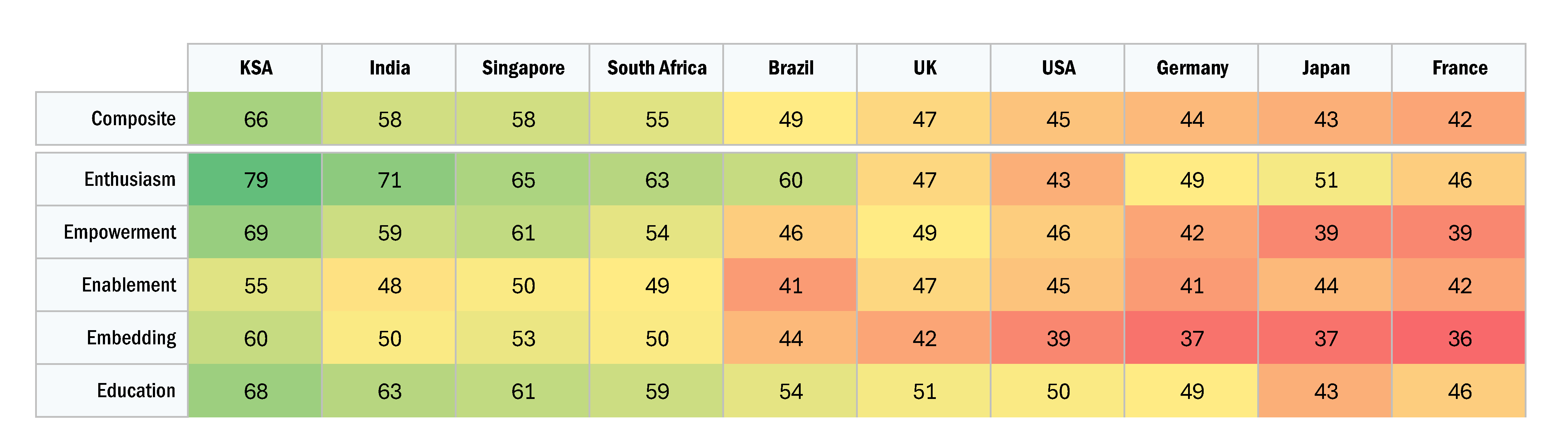
Scores for each dimension and the overall index are calculated on a 0–100 scale, with higher scores indicating more mature, supportive conditions for AI adoption.
Overall, the index finds that AI adoption in the public sector is accelerating. Eighty percent say it feels empowering in their daily roles. Yet confidence and impact vary sharply depending on the clarity of rules, leadership support, and availability of practical resources. In countries with clear guidance and backing for AI use, 91 percent of public servants feel confident using AI, 82 percent are optimistic, and 79 percent say AI feels empowering—compared with far lower confidence where rules and support are unclear.
The index also reveals clear differences in adoption across countries. Advanced Adopters such as Singapore, Saudi Arabia (KSA), and India combine strong leadership with widespread, everyday AI use. Uneven Adopters—including the United States, UK, South Africa, and Brazil—show progress but face gaps in infrastructure or guidance. Cautious Adopters such as Germany, France, and Japan remain more risk-averse, with AI largely confined to limited or specialist use.
“Many governments have ambitious plans for AI in the public sector, but some are creating better conditions for real‑world use than others,” said Rachel Wolf, CEO of Public First. “Our research shows who is succeeding and where improvement is needed. This matters because effective AI enables better public services, stronger outcomes for citizens, and more resilient public institutions.”
Despite rising use, public servants remain skeptical about how effectively governments are deploying AI overall, highlighting a significant gap between aspiration and execution.
“Turning AI ambition into results depends on translating strategy into day-to-day practice,” said Daniel Castro, director of the Center for Data Innovation. “Policymakers can learn from advanced adopters and focus on removing barriers, so AI delivers real improvements for citizens.”
View the Public Sector AI Adoption Index 2026.
Contact: Nicole Hinojosa, [email protected]


