Higher education is an essential performer of research and development (R&D) in the United States. Yet between 2013 and 2023, higher education R&D intensity, measured as R&D expenditures by higher education as a share of GDP, declined by nearly 2 percent overall. This measure includes all R&D conducted by higher education institutions, regardless of funding source, including the federal government and the private sector. More concerning, a large share of this decline occurred in key science and engineering fields, including the physical sciences and chemical and mechanical engineering, which are foundational to economic growth, industrial competitiveness, and national power.
This decline reflects two distinct policy failures: a broad erosion in overall investment in higher education R&D, and a misallocation of funding away from strategically critical science and engineering fields. At a time when China is rapidly expanding public investment in strategic technologies, the continued erosion of U.S. science and engineering R&D represents a dangerous trend that policymakers must correct.
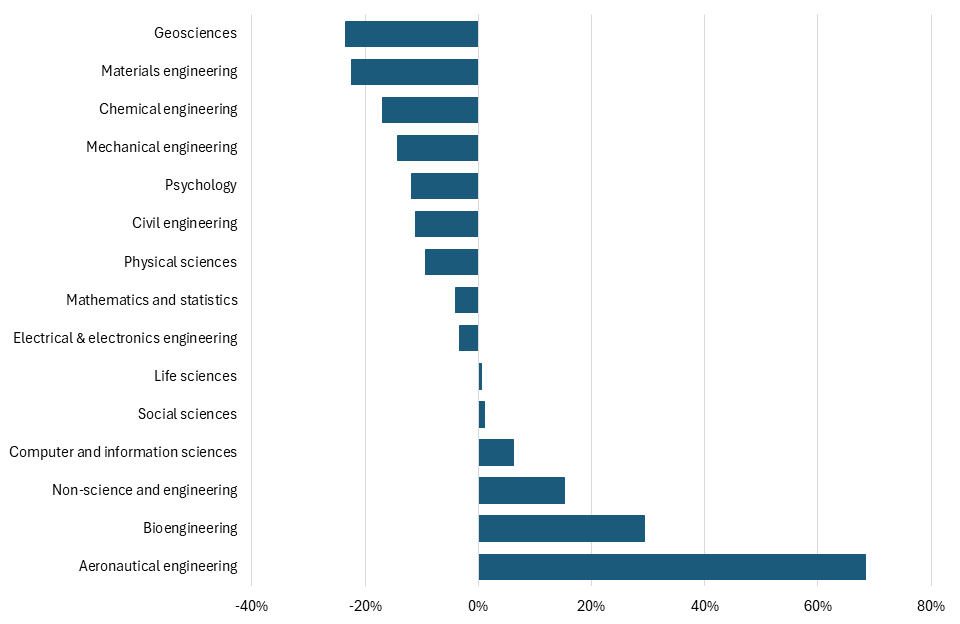
Of the 14 scientific fields classified by the National Center for Science and Engineering Statistics, only 5 experienced increased investment over the decade, while 6 saw declines of 10 percent or more (see Figure 1). Electronics engineering, a field critical to semiconductor design and manufacturing, saw R&D investment fall by more than 3 percent, while materials engineering declined by over 20 percent. These declines coincide with rising R&D intensity in non-science and engineering fields, which increased by roughly 15 percent. This shift underscores the need to reallocate R&D expenditures toward fields most central to technological leadership and industrial competitiveness.
Figure 1: Change in higher education R&D intensity from 2013 to 2023
Declining science and engineering research in higher education slows the pipeline of foundational knowledge that underpins innovation in national power industries. To avoid further loss of industrial competitiveness vis-à-vis China, the United States must boost government R&D investment in higher education and devote those funds toward science and engineering research.
The National Science Foundation (NSF), one of the largest funders of higher education research in the United States, must prioritize funding research in technology focus areas most critical to national competitiveness, building on efforts such as its Directorate for Technology, Innovation, and Partnerships. NSF funding should be tightly concentrated in engineering (with the exception of civil engineering), the physical sciences, computer science, and the life sciences, rather than spread across disciplines with weaker links to technological and industrial competitiveness, as has been the case for the past several decades.
Policymakers and federal agencies should aim both to increase overall support and to reallocate existing funding toward these strategically important science and engineering fields, with the goal of raising higher education R&D intensity in these disciplines by at least 5 percent by 2036.



