


The United States Should Retain International Graduates to Meet Demand for STEM Talent
The United States faces a growing shortage of U.S. citizens and permanent residents pursuing careers in science, technology, engineering, and math (STEM), a gap that threatens the nation’s economic strength, technological leadership, and innovation capacity. Despite world-class universities, the domestic pipeline of scientists, engineers, and computer scientists remains insufficient to meet the demands of advanced industries, including strategically critical sectors such as semiconductors.
As a result, the United States increasingly relies on foreign talent, specifically temporary visa holders who earn advanced STEM degrees at American universities, to fill critical roles. Indeed, recent National Science Foundation (NSF) data show that a substantial share of graduate STEM degrees in the United States are awarded to these temporary visa holders. To ensure the country’s competitiveness and retain this highly skilled workforce, policymakers should implement an expedited green card process for these individuals, particularly those in computer science and engineering.
International students make up a strikingly high share of advanced STEM degree recipients. Between 2012 and 2021, temporary visa holders earned between 25 and 40 percent of all science (including social sciences) and engineering master’s degrees, as well as between 33 and 35 percent of all science and engineering doctorates (see Figure 1).
Figure 1: Share of science and engineering degrees (including social sciences) awarded to temporary visa holders, by degree level, from 2012 to 2021
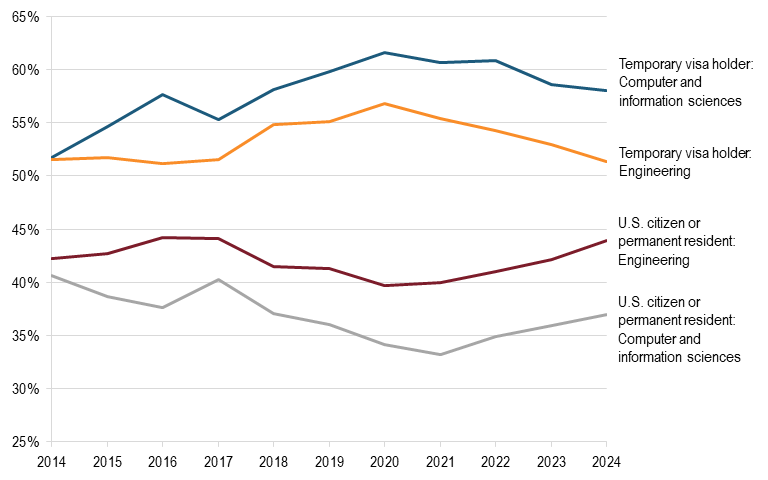
When more recent NSF data is disaggregated, their presence is even more pronounced in strategically important fields. In computer and information sciences, temporary visa holders earned 58 percent of all doctorates in 2024, compared with 37 percent awarded to U.S. citizens or permanent residents. The pattern is similar in engineering, where 51 percent of doctorates went to temporary visa holders, compared with 44 percent awarded to domestic students. Moreover, temporary visa holders have historically earned a larger share of these critical degrees than U.S. citizens or permanent residents (see Figure 2).
Figure 2: Share of STEM doctorate recipients by citizenship status in computer and information science and engineering from 2014 to 2024
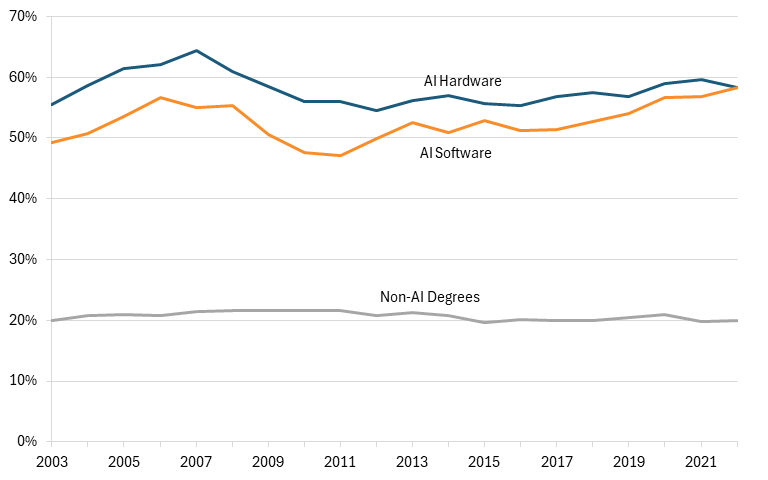
AI-related disciplines show a similar trend. A report from the Council of Economic Advisers (CEA), an agency within the White House charged with advising the president on economic policy, found that over the past five years, between 40 and 60 percent of AI-relevant master’s degrees were awarded to non-U.S. citizens, and that since 2003, more than 50 percent of relevant doctoral degrees have gone to non-U.S. citizens. In 2022, 59 percent of AI-relevant doctorate degrees went to non-U.S. citizens (see Figures 3 and 4).
Figure 3: Share of AI-relevant master's degrees awarded to non-U.S. citizens since 2003 (from CEA report)
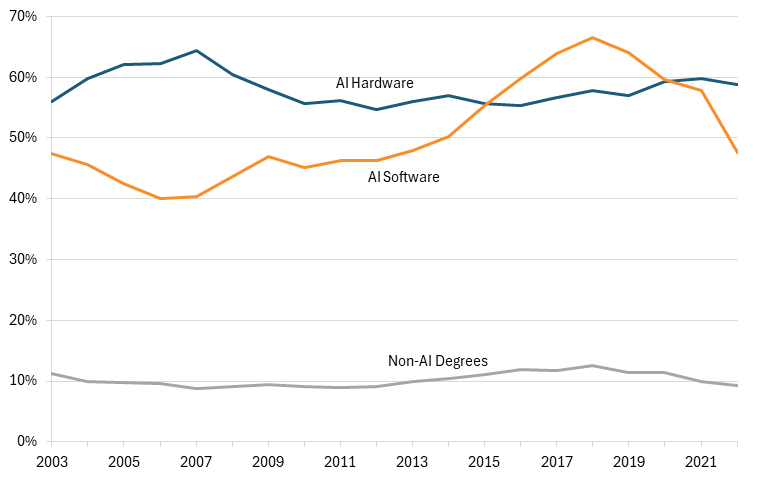
Figure 4: Share of AI-relevant doctorate degrees awarded to non-U.S. citizens since 2003 (from CEA report)
Policymakers should establish an expedited green card pathway for temporary visa holders, particularly those graduating in computer science and engineering, as doing so would directly strengthen the U.S. workforce at a time of acute demand. Such a policy would allow the United States to retain individuals who are already here, already trained, and already contributing to domestic research labs, university programs, and industrial innovation. At the same time, it would incentivize individuals pursuing graduate degrees in these fields to remain in the United States after graduation. As a result, this would boost economic growth and reinforce America’s position at the forefront of global technological competition.
Related
November 13, 2025
