

Data Innovation
Navigate forward to interact with the calendar and select a date. Press the question mark key to get the keyboard shortcuts for changing dates.
Navigate backward to interact with the calendar and select a date. Press the question mark key to get the keyboard shortcuts for changing dates.
As every sector of the global economy and nearly every facet of modern society undergo digital transformation, ITIF advocates for policies that spur not just the development of IT innovations, but more importantly their adoption and use throughout the economy. ITIF’s Center for Data Innovation formulates and promotes pragmatic public policies designed to maximize the benefits of data-driven innovation in the public and private sectors.


Featured
Picking the Right Policy Solutions for AI Concerns
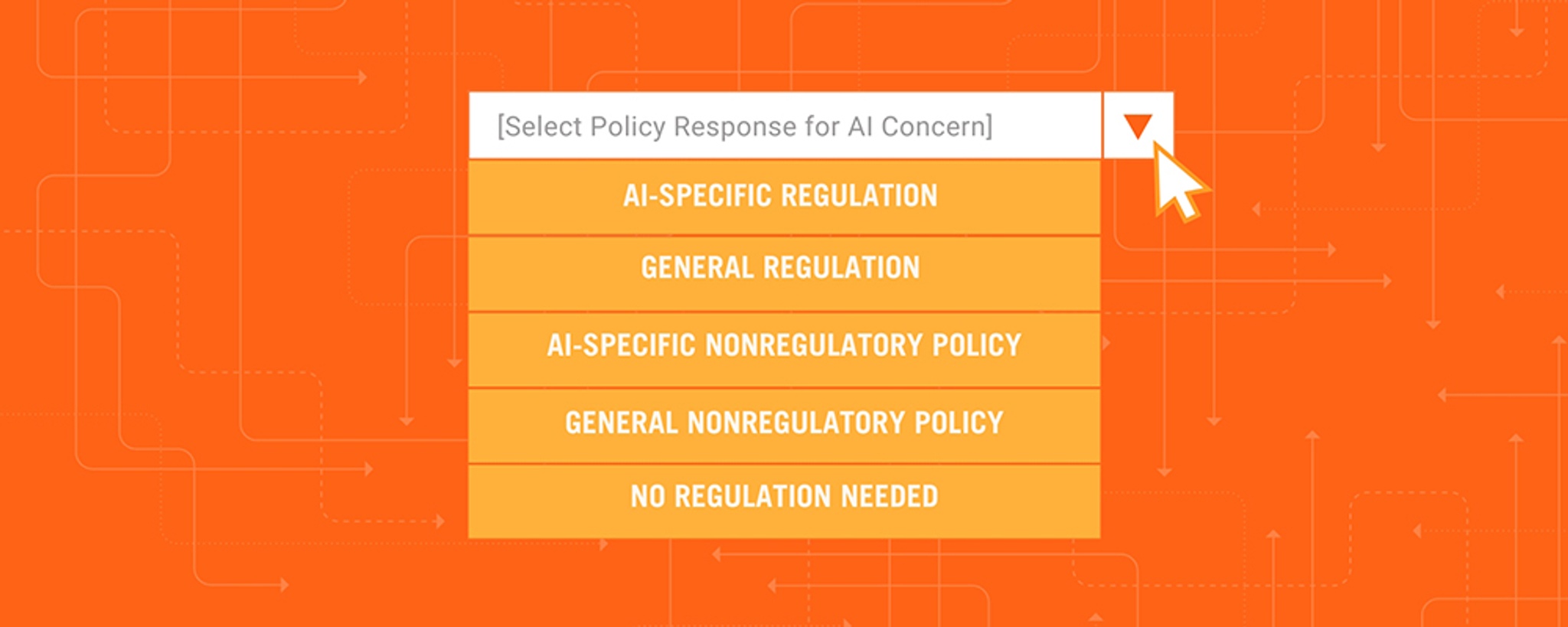
Some concerns are legitimate, but others are not. Some require immediate regulatory responses, but many do not. And a few require regulations addressing AI specifically, but most do not.
Exploring Data-Sharing Models to Maximize Benefits From Data

Data-driven innovation has the potential to be a massive force for progress. Data sharing enables organizations to increase the utility and value of the data they control and gain access to additional data controlled by others.
Overcoming Barriers to Data Sharing in the United States

Without policy change, the United States will continue trending toward data siloes—an inefficient world in which data is isolated, and its benefits are restricted.
Digital Equity 2.0: How to Close the Data Divide
Unlike the digital divide, many ignore the data divide or argue that the way to close it is to collect vastly less data. But without substantial efforts to increase data representation and access, certain individuals and communities will be left behind in an increasingly data-driven world.
More Publications and Events
September 30, 2026|Blogs
Europe Should Double Down on Its Open-Source AI Bet
Europe cannot match the United States and China in closed AI models, but it has an opportunity to lead in open models. The EU should remove regulatory and procurement barriers and foster a global open-model ecosystem.
September 29, 2026|Blogs
Democrats Should Treat Data Centers Like Clean Energy
Democrats should approach data centers as they have clean-energy infrastructure: take legitimate local concerns seriously and mitigate their impacts without allowing opposition to become a blanket rejection of development. As AI drives growing demand for data centers, policymakers should balance community protections with the economic, technological, and clean-energy benefits these investments can provide.
September 18, 2026|Blogs
AI Kill Switches Won’t Solve the Rogue AI Problem
As AI systems gain greater autonomy, policymakers should prioritize research and safeguards that make dangerous behavior harder to initiate, easier to detect, and faster to contain. Emergency shutdown capabilities can be one useful tool in that effort, but a government‑mandated kill switch is neither universally feasible nor sufficient to address the broader challenges posed by autonomous AI.
September 17, 2026|Op-Eds & Contributed Articles
Don’t Sacrifice American Capitalism to AI Anxiety
In an op-ed for National Review, President Daniel Castro argues that the United States should address specific AI risks without sacrificing the economic freedom, competition, and market-driven innovation that give America an edge over China in the global AI race.
September 16, 2026|Blogs
The Case for Safer AI Without Slowing Progress
AI presents real risks that warrant serious investment in security, testing, monitoring, and accountability, but claims that it poses an imminent existential threat lack a clear empirical basis. Rather than slowing AI development, policymakers should focus on evidence-based safeguards that make increasingly capable AI systems safer and more reliable.
September 9, 2026|Presentations
Internet Governance Forum USA: AI & Data Centers in the USA
Daniel Castro moderates a panel on how the United States can responsibly govern the rapid development of data centers at the 2026 Internet Governance Forum USA hosted by the Internet Society Washington DC Chapter.
August 3, 2026|Blogs
Congress Can Bring Clarity to AI Shutdown Authority
The temporary shutdown of Anthropic's Fable 5 and Mythos 5 highlighted the uncertainty surrounding the government's authority to restrict access to frontier AI models and the costs that uncertainty can impose on innovation and trust. To provide greater clarity for developers, customers, and allies, Congress should establish a transparent statutory framework for AI shutdown authority with clear standards and proportionate safeguards.
July 28, 2026|Blogs
How to Fix the AI Model Theft Bill Before It Becomes Law
Adversarial AI distillation poses a growing threat to U.S. AI leadership and national security, and Congress is right to address it through the Deterring American AI Model Theft Act (DAAMTA). But before passing the bill, lawmakers should narrow its scope, strengthen evidentiary standards, protect legitimate research, and pair it with technical safeguards and international cooperation to better combat large-scale AI model theft without hindering innovation.
July 13, 2026|Blogs
Universities Must Rethink AI Education for the AI Economy
As employers increasingly seek workers who can apply AI alongside domain expertise, universities should integrate AI across disciplines—not just standalone AI or computer science programs—to prepare graduates for the modern workforce.
June 18, 2026|Blogs
The Cities Getting AI Right Are Investing in Workforce Upskilling
Cities that are successfully scaling AI are investing in workforce upskilling alongside governance and technology deployment. Case studies from Washington, DC, San Jose, Seattle, and Cleveland show that employee training and AI literacy are critical to turning pilot projects into lasting improvements in public service delivery.
